Tag: COP28

  • Challenge for India to align policies with COP28 outcomes

    Challenge for India to align policies with COP28 outcomes

    • The key existential need is to move away from coal to renewables. To be able to do so, developing nations will need finance that must not add to their debt burden.

    “The final outcome, thrashed out during the conference which went into overtime, does, however, represent a small step forward that needs to be noted. The unanimous decision at the conference was to begin reducing the global consumption of fossil fuels and achieve net-zero by 2050, the first such binding decision ever taken. This signals the eventual demise of the age of fossil fuels — coal, oil and gas. It, thereby, sends a key signal to policymakers, including those in India, who have been somewhat brazenly continuing with policies to support investment in coal, to change tack. It also sends signals to coal investors to get out as quickly as they can and make no further commitments, irrespective of any contrary signals from policymakers.”

    By Subir Roy

    How useful has COP28, the Conference of the Parties held in Dubai, been in taking forward the initiative which began with the 2015 Paris Agreement to address climate change, its mitigation and adaptation and securing the finance needed for the whole process? Typically, a lot of the right kind of noises have been made, as also promises to deliver, while seeking to leave commitments as open-ended as possible so that short-term national imperatives can be addressed even while working on and swearing allegiance to the overall goals.

    The final outcome, thrashed out during the conference which went into overtime, does, however, represent a small step forward that needs to be noted. The unanimous decision at the conference was to begin reducing the global consumption of fossil fuels and achieve net-zero by 2050, the first such binding decision ever taken. This signals the eventual demise of the age of fossil fuels — coal, oil and gas. It, thereby, sends a key signal to policymakers, including those in India, who have been somewhat brazenly continuing with policies to support investment in coal, to change tack. It also sends signals to coal investors to get out as quickly as they can and make no further commitments, irrespective of any contrary signals from policymakers.

    The member countries also reached a historic agreement to triple renewable energy capacity globally by 2030, again a decision which has run counter to the Indian position. The timeline, barely seven years away, is important as India and China, the two large economies with rapidly rising emission levels, had decided early during the conference to stay out of such an agreement to mitigate present climate trends by tripling the world’s renewable energy output and doubling energy efficiency by that date. This is despite 118 countries agreeing to join the pact.

    The International Energy Agency says the tripling is needed to keep in sight the goal of driving down the demand for fossil fuels and keeping global warming to 1.5°C above pre-industrial levels by the end of the century. The focus of action will be on phasing out coal-fired power plants and curbing the use of oil and gas.

    Should Indian policymakers see these outcomes as somewhat excessively binding, they have reason to be happy about one key decision which emerged early during the two weeks over which the conference lasted. A ‘loss and damage’ fund to help vulnerable countries cope with the impact of climate change will be created. This is the right thing to do, but the giveaway is the size, albeit initial, of the fund — a mere $475 million, with the US commitment being just $17.5 million. This needs to be set against the $525 billion combined loss that the 55 most vulnerable countries have suffered from climate change in the last 20 years. The loss will reach $580 billion by 2030.

    Of course, further contributions will come as the work of the fund, to be initially overseen by the World Bank, progresses. It will help poor countries cope with the cascading effects of climate change, such as rising sea levels, floods, droughts and cyclones. The moral justification for asking for such a fund is that the rich countries, whose industrial growth since 1850 resulted in greenhouse gas accumulation, global warming and the climate crisis, should now help the poor countries, who are the most vulnerable victims, combat it.

    India’s approach so far has been that without making any fresh commitment, it wishes to abide by the nationally determined targets it has already announced. In journeying towards that, a sea change will come in sectors like steelmaking, vehicles design and manufacturing, building design and construction processes, not to speak of cookstoves used by households. The drive towards using more clean energy will affect businesses of all sizes, ranging from micro, small and medium enterprises to large corporates.

    What is critical is that the investment to enable this energy transition needs to be forthcoming. At present, investment in the fossil fuel sector continues to outstrip that directed towards promoting a clean economy. An advisory panel for COP28 has recommended that a two-pronged strategy be adopted — tax polluting activities and cut fossil fuel subsidies. One area where carbon taxes can be introduced relatively smoothly is transportation — maritime and aviation. But overall, cutting subsidies where they are deeply entrenched will be politically challenging. Farmers will not like fertilizer subsidy to be cut and it will need a brave state government to go back on supplying free a minimum load of electricity to every household.

    A particular culprit, a term the panel did not explicitly use, is large oil and gas companies which have made windfall profits from the quick rise in energy prices as a result of the Ukraine war. But it will be difficult to put a punitive tax on them as many of them are either state-owned (like Coal India, NTPC and West Asian giants) or have political clout, like those in the US.

    Overall, the key global existential need is to move away from coal to renewables. Rich countries that have moved away from coal to natural gas are balking at helping the rest of the world do so. Hence, coal is the whipping boy, but it is also the fuel used by countries which have not moved to gas, which is somewhat cleaner. To be able to do so, developing countries will need finance that must not add to their debt burden.

    What are the corrective measures that Indian policymakers will have to take in view of the conference’s outcomes? They will have to speed up the creation of greater capacity of renewable energy like solar and wind power. There is much talk about producing hydrogen of various hues, but it is worth remembering that the only hydrogen which passes muster is green hydrogen that is made from renewable energy itself. Besides, huge battery banks will have to be set up and transmission lines strengthened so that wind and solar power can be transmitted from areas where they can be produced to those which are deficient in the necessary climatic and geographical requirements.

    COP28 has forged a global consensus on the path the planet must take to save itself. This has posed a double challenge for a country like India, which has to both grow rapidly to overcome poverty as also do away with an abundant natural source of energy like coal. If India’s politicians do not rise to this challenge, they risk pulling both themselves and the country down.
    (The author is a Senior economic analyst)

  • COP28 president denies using climate talks to push oil deals

    COP28 president denies using climate talks to push oil deals

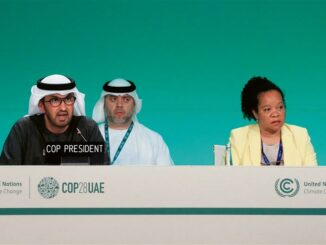
    DUBAI (TIP): The Emirati host of the UN climate conference in Dubai denied November 29 reports that he used his presidency of the crucial talks on global warming to pursue fossil fuels deals.
    The allegations against Sultan Al Jaber, who is also CEO of his country’s oil giant ADNOC, have fanned long-running suspicions over the wisdom of a petrostate hosting the COP28 talks.
    But Jaber, who also chairs a UAE-owned clean energy company, strongly denied reports that he used his position as COP president to pitch new oil and gas investments to governments.
    “These allegations are false, not true, incorrect and not accurate,” Jaber told reporters on the eve of the talks, which will draw world leaders and tens of thousands of delegates to Dubai over the next two weeks.
    “It’s an attempt to undermine the work of the COP28 presidency. Let me ask you a question: do you think the UAE or myself will need the COP or the COP presidency to go and establish business deals or commercial relationships?”
    Leaked documents obtained by the BBC and the Centre for Climate Reporting alleged that talking points prepared for Jaber for COP meetings with foreign governments pushed joint business opportunities in fossil fuels.
    The briefing notes, detailed in reports published on Monday, signalled ADNOC’s willingness to work with countries including China, Germany and Egypt to develop oil and gas projects.
    “I promise you, never ever did I see these talking points that they refer (to), or that I ever even used such talking points in my discussions,” said Jaber.
    He said every meeting he conducted with governments or stakeholders as president of the climate talks “has always been centred around one thing and one thing only: and that is my COP28 agenda.”
    ‘Worst fears’
    But the allegations fuelled persistent scepticism over the suitability of an oil executive leading the world’s climate negotiations as governments are pushed to commit to phasing out fossil fuels, something no COP has ever achieved.
    Former US vice president Al Gore said the allegations “have confirmed some of the worst fears” around Jaber while former UN climate chief Christiana Figueres said the COP28 host had been caught “red handed”.
    “The global community’s gaze is fixed upon these leaders, expecting them to embody the very essence of integrity, untainted by bias and national or personal gain,” said Tasneem Essop, executive director of the Climate Action Network International.
    “Any deviation from this path represents a betrayal of the trust placed in them by the world and a failure in their duty to future generations,” he wrote on X.
    But Jaber has weathered other controversies over his alleged conflict of interest since being appointed COP president earlier this year, including calls from US and European lawmakers for his replacement.
    Supporters, including US climate envoy John Kerry, say Jaber is uniquely positioned to broker compromise at the COP talks, where world leaders will be confronted by their lack of progress in curbing global warming in a record-breaking hot year.
    The 50-year-old bristled at accusations that he has a conflict of interest, touting his years of work in climate and sustainability, and success in drawing out commitments from big oil and gas players. (AFP)