Tag: CRS

  • India’s top health experts question WHO report on excess Covid deaths

    India’s top health experts question WHO report on excess Covid deaths

    New Delhi (TIP)- Questioning the modelling methodology used by WHO to estimate 4.7 million deaths in India due to Covid or its impact, top health experts have expressed disappointment over the global health body’s “one-size-fits-all” approach to arrive at the figure. ICMR Director General Balram Bhargava, NITI Aayog Member (Health) V K Paul, AIIMS Director Randeep Guleria and NTAGI’s Covid-19 Working Group Chairman Dr N K Arora on Thursday rejected the WHO report as “untenable and unfortunate”.

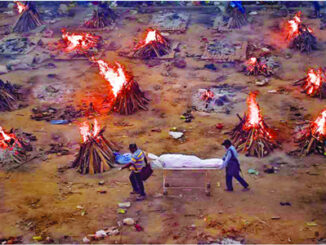
    In its report released on Thursday, WHO estimated that nearly 15 million people were killed either by the coronavirus or by its impact on the overwhelmed health systems in the past two years, more than double the official death toll of six million. Most of the fatalities were in Southeast Asia, Europe and the Americas.

    According to the report, there were 4.7 million Covid deaths in India — 10 times the official figures and almost a third of Covid deaths globally.

    Rejecting it, Dr V K Paul said India has been telling WHO with all humility through diplomatic channels along with data and rational reasoning that it does not agree with the methodology that has been followed for the country.

    They have used a methodology for several nations which is based on a systematic collection of data on deaths.

    “We have a similar system, a robust Civil Registration System (CRS). We released that report yesterday (Wednesday) and we have an actual count of deaths for 2020… the 2021 numbers will also come up,” he said.

    The Civil Registration System of India provides accurate estimates emanating from the ground, certified and validated by the district and the state administration.

    “We want them to have used these numbers. Unfortunately, despite our emphatic writing and communication at the ministerial level, they have chosen to use the numbers that are based on modelling and assumptions,” Paul said.

    “Modelling is a one-size-fits-all kind of assumption and you may apply it where the systems are poor. But to apply assumptions based on a subset of states and on reports that come from websites and media, and then you come out with an exorbitant number is not tenable. We are disappointed with what WHO has done,” he stated.

    These kinds of assumptions used for a nation of India’s size “to put us in poor light is not desirable,” Paul added.

    Assuring the country that the government has nothing to hide, Paul said there is still an active process by which Covid deaths are being reconciled. “Our numbers are there and we have a robust system from the ground. We, therefore, do not accept these numbers, we reject them,” he said.

    On what would be India’s next step, Paul said, “We will communicate our stance systematically. We have a rebuttal by way of educating people and the public at large through our press release. “We will go back to WHO to explain this and at the same time we would like to make sure that our stand is put forth around the world.”           Source: PTI

  • No change in policy on Jammu and Kashmir, says U.S.

    No change in policy on Jammu and Kashmir, says U.S.

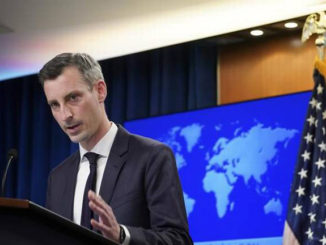
    WASHINGTON (TIP): The United States on Wednesday, Feb 10, said that there is no change in its policy on Jammu and Kashmir. “I want to be very clear there has been no change in U.S. policy in the region,” State Department Spokesperson Ned Price told reporters in view of a tweet from the South and Central Asia Bureau of the State Department which welcomed the resumption of 4G mobile internet in Jammu and Kashmir.

    “We welcome the resumption of 4G mobile internet in India’s Jammu & Kashmir. This marks an important step for local residents, and we look forward to continued political & economic progress to restore normalcy in J&K,” tweeted the South and Central Asia Bureau of the State Department. High-speed mobile internet was restored on February 5 in the entire union territory of Jammu and Kashmir, exactly one and a half years after it was snapped in August 2019 when the Centre had abrogated the special status of the erstwhile State. According to a 2019 Congressional Research Service report of August 2019, a longstanding goal of U.S. policy in South Asia has been to prevent India-Pakistan conflict from escalating to inter-state war. This meant the United States has sought to avoid actions that overtly favored either party. Over the past decade, however, Washington has grown closer to India while relations with Pakistan continue to be viewed as clouded by mistrust, CRS report said.

    On a question related to Twitter shutting down some accounts in India, Mr. Price said, “Well, I think what I would say generally is that around the world — and this goes back to what I was saying before — we are committed to supporting democratic values, including freedom of expression. I think when it comes to Twitter’s policies, we’d have to refer you to Twitter itself.”

    Responding to a similar question, White House Press Secretary Jen Psaki told reporters at her daily news conference: “of course, we always have concerns about crackdowns on freedom of speech, freedom of expression happening around the world and when it doesn’t allow people to communicate and peacefully protest.”

    (Source: PTI)