Tag: Cyber Attacks
-

News, sports sites vulnerable to cyber attacks
LONDON (TIP): News and sports websites have some of the lowest levels of security adoption, making them vulnerable to cyber attacks, a new study has found.
Researchers looked at the security protocols used by the top 500 sites in various industries and online sectors. They found that fewer than 10 per cent of news and sports websites used basic security protocols such as Transport Layer Security (TLS).
Even those that do are not always using the “latest or strongest protocols”, researchers said. “It is like news and sport content providers do not value the security of their content,” said Professor Alan Woodward, a cyber-security expert at the University of Surrey in the UK.
“They are leaving themselves vulnerable to attacks like cross-site scripting, where an attacker can pretend something has come from a website when it has not,” said Woodward. The study shows that some sectors seem much more security conscious than others, ‘BBC News’ reported. The websites of computer and technology companies and financial organisations showed a much higher level of adoption than shopping and gaming sites, for example.
A quarter of the shopping sites studied were using TLS, which offers tools including digital certificates, remote passwords, and a choice of ciphers to encrypt traffic between a website and its visitors.
The study was published in the Journal of Cyber Security Technology.
Source: PTI
-

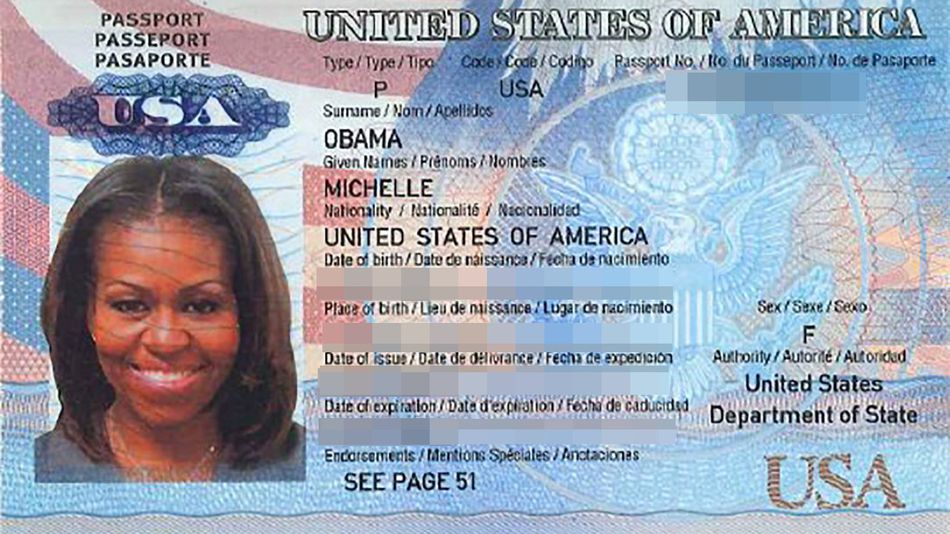
Hackers publish apparent scan of Michelle Obama’s passport
The White House says it is investigating a “cyber breach” after what appeared to be a scan of Michelle Obama’s passport was published online.
The scan appeared to have been taken from a Gmail account belonging to a White House employee, a spokesman said.
Other confidential information was published online, including travel details, names, social security numbers and birth dates of members of staff.
The White House said it had not yet verified the documents.
DCLeaks.com, a hacker group which last week published personal emails from an account belonging to former US Secretary of State Colin Powell’s emails, claimed responsibility for the hack.
The US attorney general, Loretta Lynch, said the incident was “something that we are looking into”. White House press secretary Josh Earnest said the breach “should be a wake-up call for all of us”.
Mr Earnest said that the employee targeted by the hackers was a contract worker and not a permanent member of staff.
He said: “At this point I cannot announce any sort of conclusion that’s been reached about the individual or individuals that may have been responsible for the cyber breach that resulted in this information being leaked.”
“The Secret Service is concerned any time unauthorised information that might pertain to one of the individuals we protect, or our operations, is allegedly disclosed,” said communications director Cathy Milhoan.
In July, hackers released a string of emails from the Democratic National Committee (DNC), prompting the resignation of chairwoman Debbie Wasserman Schultz. State-sponsored Russian hackers have been accused of behind the DNC leaks.
And on Friday, internet giant Yahoo confirmed that hackers stole information from about 500 million users in 2014, in what appears to be the largest publicly disclosed cyber-breach in history.
he Secret Service, which is responsible for protecting the President and First Lady, said it was “concerned” about the apparent hacking.
-

US targets overseas cyber attackers with new sanctions program
WASHINGTON (TIP): The Obama administration on April 1 launched the first-ever sanctions program to financially punish individuals and groups outside the United States that are engaged in malicious cyber attacks.
US President Barack, in an executive order, declared such activities a “national emergency” and allowed the US Treasury to freeze the assets and bar other financial transactions of entities engaged in cyber attacks.
Under the program, first reported by the Washington Post, cyber attackers or those who conduct commercial espionage in cyberspace can be listed on the official sanctions list of specially designated nationals, a deterrent long-sought by the cyber community.
The move, which the paper said has been in development for two years, comes after a string of high-profile cyber attacks ranging from corporate hacks targeting Target, Home Depot and other retailers, to an attack on Sony and other data breaches.
Subjecting cyber criminals, companies that benefit from commercial espionage and even foreign intelligence operatives, to tough financial sanctions could have a “momentous” effect in deterring the growing number of cyber attacks seen daily on US networks, said Dmitri Alperovitch, chief technology officer of Crowdstrike, a cybersecurity firm.
“Today, the White House is making yet another huge leap forward in the effort to raise the cost to our cyber adversaries and establish a more effective deterrent framework to punish actors engaged in serious intentional destructive or disruptive attacks,” Alperovitch wrote in a blog posted on the company’s website.
The executive order gives the administration the same sanctions tools it now deploys to address other threats -including crises in the Middle East and Russia’s aggression in Ukraine – and makes them available for less visible cyber threats. The program could prompt a strong reaction from China. Cybersecurity has been a significant irritant in US-China ties, with US investigators saying hackers backed by the Chinese government have been behind attacks on US companies, and China rejecting the charges.
Obama has moved cybersecurity toward the top of his 2015 agenda after recent breaches, and last month, the Central Intelligence Agency announced a major overhaul aimed in part at sharpening its focus on cyber operations.
-

FBI INVESTIGATES CYBER ATTACK ON US BANKS
WASHINGTON (TIP)The FBI is investigating a suspected Russian cyber attack on a number of American banks. Hackers are believed to have targeted JP Morgan and at least four other banks in the US, amid increasing concern over cyber security from watchdogs on both sides of the Atlantic. The attack on JP Morgan reportedly resulted in the loss of “gigabytes of sensitive data” that could have involved customer and employee information. It is said to have been of a level of sophistication beyond ordinary criminals, leading to speculation of a state link.
The FBI is thought to be investigating whether there is a connection to Russia. American-Russian relations continue to be fraught amid the crisis in Ukraine, with sanctions ramped up. The bank is understood to have been in touch with executives in London to see if there is any link to its UK operations, but so far the attack, which happened earlier this month, is thought to have affected only the US. But watchdogs are increasingly worried about the city’s potential vulnerability to an aggressive state-backed hack.
A spokesman for JP Morgan said: “Companies of our size unfortunately experience cyber attacks nearly every day. We have multiple layers of defence to counteract any threats and constantly monitor fraud levels.” JP faced criticism in April when it blocked a payment from a Russian embassy to the affiliate of an American-sanctioned bank. Russia’s foreign ministry described the move as “absolutely unacceptable, illegal and absurd”. -

US attorney probes Mt. Gox, bitcoin businesses
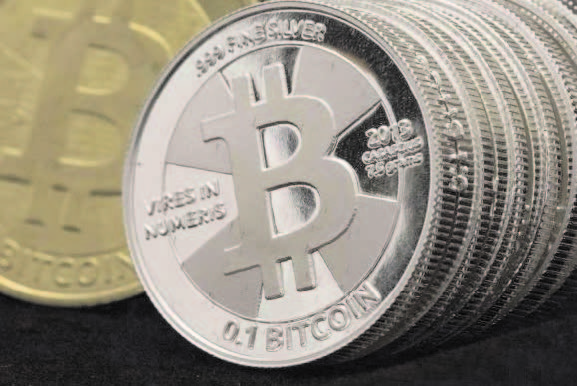
NEW YORK (TIP): Manhattan attorney Preet Bharara has sent subpoenas to Mt. Gox, other bitcoin exchanges, and businesses that deal in bitcoin to seek information on how they handled recent cyber attacks, a source familiar with the probe said on Wednesday.
In the attacks — known as distributed denial of service attacks — hackers overwhelmed bitcoin exchanges by sending thousands of phantom transactions. At least three exchanges were forced to halt withdrawals of bitcoins on February 7, including Mt. Gox, which was the largest at the time. Mt. Gox never resumed service before going dormant on Tuesday, leaving customers unable to recover their funds.
The Tokyobased company’s chief executive, Mark Karpeles, said earlier on Wednesday that he is working with others to solve the problems. “As there is a lot of speculation regarding Mt Gox and its future, I would like to use this opportunity to reassure everyone that I am still in Japan, and working very hard with the support of different parties to find a solution to our recent issues,” Karpeles said in a statement posted on the Mt. Gox website.
A spokesman for Bharara declined to comment. Bitcoin, a form of electronic money independent of traditional banking, relies on a network of computers that solve complex mathematical problems as part of a process that verifies and permanently records the details of every bitcoin transaction that is made. At current prices, the bitcoin market is worth about $7 billion. Investors deposit their bitcoins in digital wallets at specific exchanges, so the Mt. Gox shutdown is similar to a bank closing its doors — people cannot retrieve their funds.
While proponents of bitcoin hail its anonymity and lack of ties to traditional banking, regulators have become increasingly interested in the digital currency due to its usage by criminal elements and its volatile nature. It has been a rough month for bitcoin investors, with cyber attacks on several exchanges, a sharp fall in bitcoin’s value, and rising pressure from regulators. Bitcoin’s price varies by exchange, but the losses were most dramatic on Mt. Gox, where it fell to about $135 from $828.99 before February 7. “Mt Gox has been broken and it was obvious there was something really bad going on there for nearly a year.
They were processing withdrawals very slowly and generally being very opaque about what was going on there,” said Mike Hearn, a bitcoin developer in Zurich, Switzerland. A second source familiar with the case said US federal law enforcement is investigating Mt. Gox. A third source said the US Federal Bureau of Investigation was monitoring the situation. Japan’s finance ministry and police are also looking into the abrupt closure of Mt. Gox, according to the Japanese government’s top spokesman.
MALLEABILITY
Bitcoin has gained increasing acceptance as a method of payment and has attracted a number of prominent venture capital investors, including Andreessen Horowitz and Union Square Ventures. The digital currency has also caught the eye of hackers. The recent cyber attacks exploited a process used by some bitcoin exchanges that introduced “malleability” into the code governing transactions, experts said. Simply put, this allowed hackers to slightly alter the details of codes to create thousands of copies of transactions.These copies slowed the exchanges to a crawl, forcing them to independently verify each transaction to determine what was real and what was fake. A document circulating on the Internet purporting to be a crisis plan for Mt. Gox, said more than 744,000 bitcoins were “missing due to malleability-related theft,” and noted Mt. Gox had $174 million in liabilities against $32.75 million in assets. It was not possible to verify the document. If accurate, that would mean approximately 6 percent of the 12.4 million bitcoins minted would be considered missing.
Developers are working on fixes to bitcoin’s software to guard against cyber attacks, though many larger service providers have already implemented such changes, according to Gregory Maxwell, one of the bitcoin software’s core developers. He said some malleability in the software protocol was necessary — for example, in transactions where multiple people can put in money, but the transaction is not valid until enough funds are contributed. “None of these fixes are especially complicated, but because the correctness of the software is important we use a conservative release process that avoids rushing anything out,” Maxwell said, adding that the bulk of the recent work on the software is being done by four people.
BITSTAMP
Jacob Dienelt, who trades bitcoins and sells paper bitcoin wallets, said people he knows in the bitcoin community in New York stopped using Mt. Gox when the exchange halted dollar withdrawals several months ago and said all withdrawals had to be in bitcoin. Dienelt said has not been subpoenaed. With Mt. Gox’s shutdown, Bitstamp has handled the most volume in the last two days, with more than 165,000 US dollar transactions, according to Bitcoincharts. Bitstamp had temporarily halted customer withdrawals earlier this month, citing “inconsistent results” and blaming a denial-ofservice attack.The price of bitcoin was lately at $588 on Bitstamp, up about 7% on the day. “Right now is a sweet buying opportunity. I don’t think you’re going to see bitcoin go this low for awhile — if ever again,” said Jordan Kelley, chief executive of Robocoin, which launched the world’s first Bitcoin ATM in Vancouver, Canada, in the fall. “The more that bitcoin is on the front pages, the more that people are discussing it and educating one another, the better for the currency.” Kelley said Robocoin has not been subpoenaed in the US regulatory probe; nor has New York-based exchange Coinsetter, according to a spokesperson. Bitstamp did not respond to requests for comment.
-

The Geopolitics of Nuclear Proliferation
AS I SEE IT
It is not easy for Iran and the US to end mutual hostility
The author sees no end to three decades of mutual hostility and suspicion between Iran and the US.
Just after the foreign ministers of the self-styled “international community” (comprising the EU members and the US) together with their Russian and Chinese counterparts met the Iranian Foreign Minister in Geneva, the Foreign Ministers of India, China and Russia issued a statement which recognized “the right of Iran to peaceful uses of nuclear energy, including for uranium enrichment, under strict IAEA safeguards and consistent with its international obligations”.
This was an important declaration as the Republican right wing in the US, egged on by a predictable alliance of Israel and Saudi Arabia, would like to scuttle any possibility of an agreement that ends sanctions against Iran in return for Iran accepting safeguards mandated by the IAEA on all its nuclear facilities. Israel wants a termination of uranium enrichment and plutonium production in Iran, together with an end to Iran’s implacable hostility to its very existence. American policies on clandestine nuclear enrichment have been remarkably inconsistent. The country responsible for triggering the proliferation of centrifugebased uranium enrichment technology was the Netherlands.
It was the Dutch who carelessly granted A.Q. Khan access to sensitive design documents on centrifuge enrichment technology when he worked at the Holland-based Physical Dynamic Research Laboratory, a sub-contractor of the “Ultra Centrifuge Nederland”. Former Dutch Prime Minister Ruud Lubbers has revealed that after Khan’s activities came to light, he was prepared to arrest Khan in Holland, but was prevented from doing so in 1975 and 1986 by the CIA. It is well known that the Reagan Administration had tacitly assured Pakistan that it would look the other way at Pakistani efforts to build the bomb.
If President Reagan looked the other way at Pakistani proliferation, President Clinton winked at Chinese proliferation involving the transfer of more modern centrifuges, nuclear weapon designs and ring magnets apart from unsafeguarded plutonium facilities to Pakistan. The A.Q. Khan-Iranian nexus goes back to the days of Gen Zia-ul-Haq when the Iranians received the knowhow for uranium enrichment from Khan. Iran is now known to possess an estimated 19,000 centrifuges, predominantly at its enrichment facilities in Natanz.
It has an old plutonium reactor used for medical isotopes which, it says, is to be replaced by a larger reactor together with reprocessing facilities being built at Arak. Given the clandestine nature of its nuclear program, its activist role in the Islamic world and its virulent anti-Semitism, Iran’s nuclear program has invited international attention. This has resulted in seven UN Security Council Resolutions since 2006, which called on Iran to halt enrichment and even led to the freezing of assets of persons linked to its nuclear and missile programs.
There have also been cyber attacks (Stuxnet) by the Americans and the killing of some of Iran’s key scientists, believed by the Iranians to have been engineered by the Israelis. While Iran’s nuclear program enjoys widespread domestic support,what have really hurt the Iranians are the crippling economic sanctions by the US and its European allies. These sanctions have led to the shrinking of its oil exports and spiraling of inflation. They have been crucial factors compelling Iran to seek a negotiated end to sanctions, without giving up its inherent right to enrich uranium that it enjoys under the NPT.
Crucially, the US can now afford to review its policies in the Middle East. Its dependence on oil imports from the Persian Gulf has ended, its oil production will exceed that of Saudi Arabia in the next five years and it is set to become a significant exporter of natural gas. The emergence of Saudi backing for al Qaeda-linked Salafi extremists in Iraq and Syria is not exactly comforting as the Americans prepare to pull out of Afghanistan. While the Obama Administration may make soothing noises to placate the ruffled feathers in Riyadh and Jerusalem, rapprochement with Iran does widen its options in the Muslim world at a time when Iranian Foreign Minister Mohammad Javad Sharif proclaims that Shia-Sunni tensions are “the most serious threat not only to the region but to the world at large”.
But it would be unrealistic to expect that negotiations between the P 5 and Germany on the one hand and the Iranians on the other will produce any immediate end to the Iranian nuclear impasse. The Israelis and the Saudis, who wield immense clout in the Republican right wing, the US Congress and in many European capitals will spare no effort to secure support for conditions that the Iranians would not agree to. Iran already has one nuclear power plant built by the Russians at Bushehr, with another 360 MW plant under construction at Darkhovin. It currently has stockpiles of uranium enriched to either 3.5%, which can be used in power reactors, or to 20%, which can be relatively easily further enriched and made weapons grade.
The Iranians are reported to have agreed that the highly enriched uranium will be converted into fuel rods or plates. Iran has an old plutonium reactor for medical isotopes, which it requires to shut down. It is constructing a larger plutonium research reactor at the city of Arak. The Iranians claim that the reactor at Arak is set to replace the existing plutonium reactor, which is being shut down. This is not an explanation that skeptics readily buy. In the negotiations at Geneva, France reportedly took a hard-line position, demanding that the construction of the Arak plutonium reactor should stop and that there should be no reference to Iran’s “right” to enrich uranium.
This is not surprising. France has recently concluded a $1.8 billion arms deal with Saudi Arabia and is the recipient of large Saudi investments in its sagging agricultural sector. The Iranians are hard bargainers and will not unilaterally give any concessions unless these are matched by a corresponding and simultaneous lifting of economic sanctions. Having already concluded an agreement with the IAEA, granting the IAEA access to its uranium mine and heavy water plant, Iran is unlikely to agree to yield to demands to stop the construction of its new plutonium reactor.
More importantly, given the continuing gridlock in Washington between the Obama Administration and the Republican-dominated Senate, the Obama Administration will not find it easy to secure Congressional approval for easing sanctions against Iran, especially in the face of Israeli and Saudi opposition. It is not going to be easy for Iran and the US to end over three decades of mutual hostility and suspicion.
-

The Geopolitics of Nuclear Proliferation It is not easy for Iran and the US to end mutual hostility
The author sees no end to three decades of mutual hostility and suspicion between Iran and the US.
Just after the foreign ministers of the self-styled “international community” (comprising the EU members and the US) together with their Russian and Chinese counterparts met the Iranian Foreign Minister in Geneva, the Foreign Ministers of India, China and Russia issued a statement which recognized “the right of Iran to peaceful uses of nuclear energy, including for uranium enrichment, under strict IAEA safeguards and consistent with its international obligations”.
This was an important declaration as the Republican right wing in the US, egged on by a predictable alliance of Israel and Saudi Arabia, would like to scuttle any possibility of an agreement that ends sanctions against Iran in return for Iran accepting safeguards mandated by the IAEA on all its nuclear facilities. Israel wants a termination of uranium enrichment and plutonium production in Iran, together with an end to Iran’s implacable hostility to its very existence. American policies on clandestine nuclear enrichment have been remarkably inconsistent. The country responsible for triggering the proliferation of centrifugebased uranium enrichment technology was the Netherlands.
It was the Dutch who carelessly granted A.Q. Khan access to sensitive design documents on centrifuge enrichment technology when he worked at the Holland-based Physical Dynamic Research Laboratory, a sub-contractor of the “Ultra Centrifuge Nederland”. Former Dutch Prime Minister Ruud Lubbers has revealed that after Khan’s activities came to light, he was prepared to arrest Khan in Holland, but was prevented from doing so in 1975 and 1986 by the CIA. It is well known that the Reagan Administration had tacitly assured Pakistan that it would look the other way at Pakistani efforts to build the bomb.
If President Reagan looked the other way at Pakistani proliferation, President Clinton winked at Chinese proliferation involving the transfer of more modern centrifuges, nuclear weapon designs and ring magnets apart from unsafeguarded plutonium facilities to Pakistan. The A.Q. Khan-Iranian nexus goes back to the days of Gen Zia-ul-Haq when the Iranians received the knowhow for uranium enrichment from Khan. Iran is now known to possess an estimated 19,000 centrifuges, predominantly at its enrichment facilities in Natanz. It has an old plutonium reactor used for medical isotopes which, it says, is to be replaced by a larger reactor together with reprocessing facilities being built at Arak.
Given the clandestine nature of its nuclear program, its activist role in the Islamic world and its virulent anti-Semitism, Iran’s nuclear program has invited international attention. This has resulted in seven UN Security Council Resolutions since 2006, which called on Iran to halt enrichment and even led to the freezing of assets of persons linked to its nuclear and missile programs. There have also been cyber attacks (Stuxnet) by the Americans and the killing of some of Iran’s key scientists, believed by the Iranians to have been engineered by the Israelis.
While Iran’s nuclear program enjoys widespread domestic support,what have really hurt the Iranians are the crippling economic sanctions by the US and its European allies. These sanctions have led to the shrinking of its oil exports and spiraling of inflation. They have been crucial factors compelling Iran to seek a negotiated end to sanctions, without giving up its inherent right to enrich uranium that it enjoys under the NPT. Crucially, the US can now afford to review its policies in the Middle East.
Its dependence on oil imports from the Persian Gulf has ended, its oil production will exceed that of Saudi Arabia in the next five years and it is set to become a significant exporter of natural gas. The emergence of Saudi backing for al Qaeda-linked Salafi extremists in Iraq and Syria is not exactly comforting as the Americans prepare to pull out of Afghanistan. While the Obama Administration may make soothing noises to placate the ruffled feathers in Riyadh and Jerusalem, rapprochement with Iran does widen its options in the Muslim world at a time when Iranian Foreign Minister Mohammad Javad Sharif proclaims that Shia-Sunni tensions are “the most serious threat not only to the region but to the world at large”.
But it would be unrealistic to expect that negotiations between the P 5 and Germany on the one hand and the Iranians on the other will produce any immediate end to the Iranian nuclear impasse. The Israelis and the Saudis, who wield immense clout in the Republican right wing, the US Congress and in many European capitals will spare no effort to secure support for conditions that the Iranians would not agree to.
Iran already has one nuclear power plant built by the Russians at Bushehr, with another 360 MW plant under construction at Darkhovin. It currently has stockpiles of uranium enriched to either 3.5%, which can be used in power reactors, or to 20%, which can be relatively easily further enriched and made weapons grade. The Iranians are reported to have agreed that the highly enriched uranium will be converted into fuel rods or plates. Iran has an old plutonium reactor for medical isotopes, which it requires to shut down.
It is constructing a larger plutonium research reactor at the city of Arak. The Iranians claim that the reactor at Arak is set to replace the existing plutonium reactor, which is being shut down. This is not an explanation that skeptics readily buy. In the negotiations at Geneva, France reportedly took a hard-line position, demanding that the construction of the Arak plutonium reactor should stop and that there should be no reference to Iran’s “right” to enrich uranium. This is not surprising.
France has recently concluded a $1.8 billion arms deal with Saudi Arabia and is the recipient of large Saudi investments in its sagging agricultural sector. The Iranians are hard bargainers and will not unilaterally give any concessions unless these are matched by a corresponding and simultaneous lifting of economic sanctions. Having already concluded an agreement with the IAEA, granting the IAEA access to its uranium mine and heavy water plant, Iran is unlikely to agree to yield to demands to stop the construction of its new plutonium reactor.
More importantly, given the continuing gridlock in Washington between the Obama Administration and the Republican-dominated Senate, the Obama Administration will not find it easy to secure Congressional approval for easing sanctions against Iran, especially in the face of Israeli and Saudi opposition. It is not going to be easy for Iran and the US to end over three decades of mutual hostility and suspicion.
-

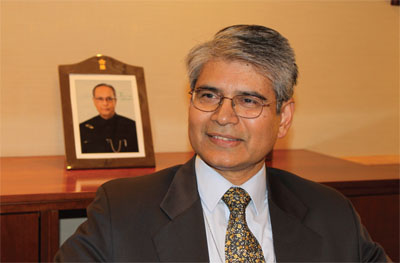
India’s Ability To Articulate Has Always Been Very High ASOKE K. MUKERJI
Q. Can you tell us a few high and low points of your career in Foreign Service so far?
I joined the Indian Foreign Service 35 years ago. We were young then. We didn’t realize how the would changed right after the Cold War. Whatever we have achieved after that was a collective effort. The Indian Foreign Service was a small team during those years. For me personally dealing with a part of the consequences of the Cold War was when I was posted in Russia. This was right after Russia broke into 15 independent countries. Five of those countries were directly in my charge. I was the only English-speaking diplomat in Central Asia. I had to establish the foundations of political and economic relations with each of these countries. This meant we had to pave way to negotiating treaties from the scratch. This was rather unusual for us because India inherited most of the treaties during 1947. But doing that part of my job was one of the most satisfying phases of my career. It was a real learning experience. Another moment of satisfaction was when I got the opportunity to work with the World Trade Organization (WTO). This was a body that not only negotiated our trade relations legally but also protected the economic and commercial interest of each participating region. WTO had a body within which was called the Dispute Settlement body. I represented India in 11 disputes that were heard by the court. This was an equally satisfying experience. We won some cases, we did lose my cases but that is how it goes in the court of law. When I was working in UAE as the Consul General, we pioneered the set up of a mechanism, which involved the community, the public sector and the government. This was called the Indian Community Welfare. I chaired the committee. We were able to reach out to 1 million Indian passport holders who live and work in those parts of UAE. Today, our government has taken that model and established it many missions across the world. Also in 2005, I was sent to Kazakhstan as Ambassador. Our main purpose was to get oil for ONGC. Even recently the President of Kazakhstan reiterated that to be able to draw a negotiation without any hassles of tenders or disputes is surely an achievement. This was possible only due to a transparent government-to-government dialogue. Each assignment has rewards. Of course, there are shortcomings too. But it is the reward that stays with you and you remember when you look back.
Q. Can you also tell us a bit about the challenges that you faced during your service?
Well, there have been many weak points but the one sole challenge for any diplomat is the way the world is changing. It is not only changing to something entirely new but it is also fast paced. So you need to keep up with it. You can never say that I know everything. You have to keep educating yourself. Yet, this kind of education does not come through books and periodicals. You get educated these days by meeting people, participating in events and attending informative seminars. I do all of them and I am very fond of learning in this manner. One of the challenges for us in the Foreign Service is how the world is adept at technology. The technological advancement is ever changing and cannot be contained. Everything is pursued through technology, be it communicating with your elected representatives, banking on mobiles or communication in general. For any Foreign Service or a diplomat technological advancement plays an important role. This can also affect diplomacy. Before coming here, I was involved in India’s cyber dialogue with many other countries. Each of these dialogues was about education as it is a completely new sector.
Q. Do you see such similar challenges in your time as the Permanent Representative of India to the UN?
Certainly. We have always felt that the changes that take place in the world must be reflected in the United Nations. Whether it was disarmament in 1950s or terrorism right now, we need to as a mission in the UN participate in a way that the international community responds to these challenges. All of us know about our views on the Security Council reforms. We are hopeful that the process that has been initiated and has faced 9 rounds of discussion, it will lead to reforms in Security Council. It is very difficult to implement reforms, if you do not have the tools to implement them. Tools are as important as the objective that is put forward. Implementation requires carrying the consensus of all member states towards a common objective. So if you have a common consensus among all participating countries, the chances are that implementing the objective will be easy. If you have objectives that are set outside the international community and are forced to be carried through UN, then chances of implementing these objectives are lower.
Q. Where are we as far as Security Council reforms are concerned?
I think we are significantly further down the road to reforming the SC. Initially even the idea of reforming the SC was not accepted. We have moved from that to a process of discussing groups. Within the groups and participating countries that have discussed this matter, there is now a larger consensus about reforms in SC. The next stage is how we put all these reforms into a document. Then we need to discuss this document and then how to execute the suggested reforms. We are currently at that stage. It has taken us 9 rounds of discussions to reach here. Of course, there are still several groups that have not consented to reforms maybe because they have not analyzed the benefits of these reforms in their own regions.
Q. Can you hypothesize a time frame within which these reforms could be executed?
Apart from the political will for reforms, we have to also keep in mind of the procedures of the UN through which the reforms are implemented. We have to focus on the reforms of the UN procedures as well. These were created at the end of World War Two. They have evolved in their own way. The time frame cannot be set in only one process.
Q. Can you shed some light on how diplomacy can work in today’s age of spiraling conflicts around the world?
Diplomacy is one side of the coin. The other side has traditionally been war. In the last 20 to 30 years there has not been wars but instabilities. Instability may not have been caused by states, but even non-state influencers like viruses, pandemics, etc. The way we achieve diplomacy cannot be conventional methods of stopping war anymore, but also in understanding that our issues of instabilities are not conventional and thereby our methods can’t be the same either. Today we are dealing with issues like poverty, terrorism, gender, cyber attacks and such issues. These are newer issues for diplomacy. That is why we must take a wider approach on how to do our job. Our biggest strength in Indian Foreign Service today is that we have large number of technically proficient members. This is certainly an advantage that we did not have during our time of Foreign Service. So we need to adopt newer means to combat today’s instabilities.
Q. Diplomacy is straightjacket post. How would you like to win more admiration for India? How would you be able to take other nations along and meet the agenda that India has manifested and make it successful?
I start from a very strong foundation. When we were elected to Security Council elections we had 187 votes out of 190. That itself is a manifestation of the regard in which India is held in the International community. How do we carry forward this momentum? I think the answer is in conveying the message and in emphasizing in the substance of your message. If we show that the challenges to the international community are challenges to everybody and that there is no one who is immune from it, then you make sure that there are more friends than foes. India’s ability to articulate has always been very high. We are a knowledge-based society. If we maintain this tradition, I don’t see why we cannot carry everyone along with us.
-

Narasimha Rao had asked Kalam to be ready for nuclear test
NEW DELHI (TIP): Just two days before announcement of results of the 1996 general election, then prime minister P V Narasimha Rao had directed A P J Abdul Kalam, scientific adviser to the defence minister at the time, to keep his team ready for a nuclear test. However, with the poll outcome throwing up a change in government, Rao ensured his impending successor Atal Behari Vajpaee was briefed in his presence on the nuke test plans and so enabled a smooth takeover of the nuclear programme. This was revealed by Kalam himself while delivering the 7th R N Kao Memorial Lecture, organized by the Research and Analyses wing of the Cabinet Secretariat, here on Thursday. “I still remember a scene during May 1996. It was 9 ‘o’ clock. I got a call ….that I should meet Prime Minister P V Narasimha Rao immediately,” Kalam said. According to the father of India’s missile programme, who later went on to become the President of India, Rao told him, “Kalam, be ready with the department of atomic energy and your team for the N-test and I am going to Tirupati. You wait for my authorization to go ahead with the test. DRDO-DAE teams must be ready for action”. Recounting Rao’s plans were not meant to be as “the election result was quite different from what he anticipated”, Kalam said he received yet another call from the then PM asking him to meet him along with Prime Minister-designate Vajpayee.
This was “so that the smooth takeover of such a very important programme can take place,” he elaborated. However, the nuke test plans could not be carried out as the Vajpayee government lasted barely 13 days. Noting that Rao’s act of ensuring continuity of the nuclear programme “reveals the maturity and professional excellence of a patriotic statesman who believed that the nation is bigger than the political system,” Kalam revealed that the first task he was assigned after Vajpayee embarked on his second stint as the PM in 1998 was to conduct the nuclear test at the earliest.
The Pokhran tests were finally carried out in May, 1998. Placing the focus of his lecture on cyber terrorism and counter measures, Kalam on Thursday suggested an empowered coordinating agency be set up to receive information about all cyber attacks. Apart from calling for continuous upgrade of technical capabilities by the intelligence agencies, the former President insisted that hacking skills be imparted by scientists, computer software and hardware experts, on the lines of China where virus writing is taught in its military schools. Kalam suggested human intelligence and electronic intelligence be used as a tool to penetrate terrorist groups, besides building offensive and defensive cyber capabilities on the lines of nuclear capabilities. “Technology-driven covert operations are becoming the order of the day and inflicting collateral damages through critical information infrastructure is threatening to change the conventional wisdom in warfare,” he said and sought crippling of the ability of terrorists to use technology for communication.
Kalam also recommended creation of an intelligence cadre, like the Indian Intelligence Service, by recruiting specifically for intelligence agencies. All these recruits, he said, must be made to pass a strict personality test based on evolved and dynamic physiological and psychological aptitude tests.