Tag: D. Gukesh

  • At 18, Gukesh conquers chess world: Dethrones China’s Ding to become youngest world champion

    At 18, Gukesh conquers chess world: Dethrones China’s Ding to become youngest world champion

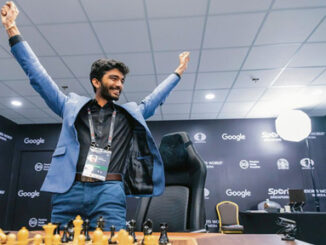
    SINGAPORE (TIP): At 18 years, six months and two weeks, Indian grandmaster Gukesh Dammaraju became the youngest world chess champion defeating reigning champion Ding Liren of China in game 14 of the world title match in Singapore on Thursday, December 12.

    He will be crowned the chess champion at a ceremony on Friday.

    For Gukesh, dethroning Ding in the last game of the hard-fought 14-round classical format matchup by 7.5 points against his rival’s 6.5, was the culmination of a childhood dream of bringing back the coveted title to India. As a seven-year-old chess enthusiast in 2013, Gukesh had seen first Indian world chess champion Viswanathan Anand lose his title to Norwegian Magnus Carlsen in the match played in the customary sound-proof glass box room at Chennai.

    Advertisement

    Ever since, the son of an ENT doctor and a microbiologist mother nurtured the dream of competing in that glass box — also called the fishtank by the chess grandmasters where outsiders can see you but you can’t see them. He finally did so and came up trumps. “In 2013… I watched Vishy sir lose. I was young but that vision has stayed in my memory. The title was taken away from India. I wanted to be in the same glass box and bring back the title. That has been my dream for the past 10 years or so to be in the glass box. And my best moment, before this, was when I entered the glass box for the first game,” he shared after winning the title.

    It was a befitting birthday gift for Anand, who turned 55 yesterday.

    Gukesh replaces Russian grandmaster Garry Kasparov as the youngest world champion. Kasparov was 22 when he won the title. Gukesh is also the 18th world champion — Wilhelm Steinitz was the first to win the crown in 1886.

    This is Gukesh’s record third world tournament victory in a calendar year. He won the Candidates tournaments, making him eligible to challenge Ding, and later was part of the Indian team that won the gold at the Chess Olympiad. This is also perhaps India’s biggest win against China at the world stage where both countries compete on an equal footing — unlike athletics that is dominated by China and hockey that is balanced towards India.

    Gukesh showed a remarkable display of aggression and novelty throughout the championship. He kept pressing for a win in a rook-bishop pawn endgame theoretically drawn at the grandmaster level.

    Playing with white, Ding had opened with reverse Grunfeld opening — where his light-coloured bishop is fianchettoed to control the h1-a8 diagonal. This control had proved decisive in game 12 when he beat Gukesh. But not today. Gukesh produced a surprise sixth move by placing his kingside knight on e7 to support the queenside which was left weak in game 12.

    Caught off guard, Ding began exchanging pieces in an attempt to force a draw and go for the rapid and blitz tiebreaks. However, Gukesh continued putting pressure, avoiding the draw moves and exchange of pieces wherever he saw the advantage. In the endgame, Ding blinked under pressure and committed a blunder on move 55 when he went for a rook trade. Gukesh had three pawns against two of his opponents with both having a rook and a bishop each.

    Gukesh could not believe what he saw on the board. His eyes widened in surprise, but he didn’t play his move immediately. He took his time, reflecting on the position, had a sip of water, and then took Ding’s rook. Ding held his head in disbelief and resigned after three moves.

    Gukesh, whose meditative pose on the chair next to the board has become as famous as his rival’s ‘Dingchilling’ smile, could not hold back any longer. He had not shown any emotion in the last 13 games. Today, the floodgates opened. He sobbed and cried as he set up the board again, settling the black pieces back on the board — a gentleman chess tradition — as has been his habit. He accepted congratulations on the chair and then got up, throwing his hands up in the air to finally exalt in the moment.

    At the post-match conference, Ding was asked about losing the theoretical endgame. “It was a blunder…. a shock. So, there will be no games tomorrow,” he said, referring to the redundancy of tiebreak games now. He remained desolate and heartbroken but wore his famous smile again and said: “I played my best tournament. It could be better. It seems a fair result to lose in the end. No regrets. I will continue to play. I will…”

    “It seemed like a draw, but the position was tricky. We had rook and bishop but I had three pawns against his two. So, there were a lot of possibilities,” said Gukesh, whose accuracy was 99 per cent against Ding’s 95.2. Gukesh saluted his formidable opponent, saying: “We all know who Ding is. How much pressure he has to face to be the world champion and try to defend it. And how much fight he gave in this match. He is a true champion. He is a real world champion. In such matches, the champions step up the momentum. He came here. He was struggling with form and health for the past two years. For me, he is a true champion. I would like to thank him. This couldn’t have been the same for me if he weren’t my opponent.”

    On his chat over the phone with his mother after the game, he said: “We didn’t say anything. We were crying. I think I said congratulations.” Gukesh’s father was seen at the venue crying with joy when he hugged his world champion son. Gukesh earned a rich applause when he remarked on what it means to be the world champion. “My career has just started. I want to have a very long career and to stay at the top. Winning a world champion does not mean I am the best. There is Magnus Carlsen. I want to achieve the greatness which he had,” the champion signed off.
    (Source: PTI)

  • A legend, made: On D. Gukesh, the world’s youngest chess champion

    Gukesh is first among a cohort of young Indian chess geniuses to reach the pinnacle

    Eighteen-year-old D. Gukesh has made history by becoming the 18th world chess champion, which will make him the youngest to do so and emulating the doyen of Indian chess, Viswanathan Anand, the only other Indian to achieve the honor. Gukesh managed his feat after a blunder made by the reigning world champion, Ding Liren of China, on the 55th move, Rf2, in the 14th and final classical game of the match. The game was headed towards a draw, but with Gukesh pressing for any advantage in a rook-bishop-pawn endgame and having an extra pawn, it took just one misstep for Ding to lose his crown. Ding was in poor form prior to the match but the Chinese GM proved his mettle by winning the first game, setting up a strong contest. Gukesh won Game 4 to tie the match and after a series of draws, Gukesh played an enterprising Game 11 to take the lead; Ding fought back brilliantly to tie the match again with a strong win in Game 12. The strategies of both players were evident. Gukesh played strong openings and exhibited tenacity in trying to gain advantages in near equal positions as the games progressed. Ding’s plan seemed to be to secure a stalemate in the classical games and to drag the match into the shorter rapid and if need be, blitz formats, and to use his strength in terms of experience. Sticking to his strategy of pushing through equal positions, Gukesh had the last laugh.

    The Chennai-born Grandmaster’s mental toughness and wisdom beyond his age have been his calling card. His steady rise was due to his dedication and his accelerated path to glory was helped by the work done by his seconds — Gukesh revealed their names only after the match — besides the mentoring by GM Anand’s WestBridge Anand Chess Academy. His versatile game, built on an innate ability to calculate moves deeply on the board, kept him in good stead against his more experienced opponent. The surge of young Indian talent to the top echelons of world chess in recent years — compatriot GMs Arjun Erigaisi and R. Praggnanandhaa are in the top 15 along with Gukesh — raised expectations of another Indian world champion in chess. The youngsters have pushed each other to do their best. Gukesh won a strong Candidates tournament to emerge as Ding’s challenger and his prowess was evident following his individual gold winning performances in the Chennai and Budapest Chess Olympiads, the latter being India’s first gold in the team event. His next frontier would be to reach the heights scaled by the world’s strongest chess player, Magnus Carlsen. Gukesh becoming the world champion would also motivate his Indian compatriots and will add a fillip to the growth of modern chess as a sport and vocation in the country of its birth.
    (The Hindu)
