Tag: DACA (Deferred Action for Childhood Arrivals Program)

  • Trump is targeting illegal immigrant children — US citizen kids could be next

    Trump is targeting illegal immigrant children — US citizen kids could be next

    By Cori Alonso-Yoder

    After holding Dreamers and immigrant families hostage, Trump now seems determined to escalate the strategy. Documents from within the administration indicate that he now has his sights on U.S. citizen children living in poverty. In leaked drafts, the administration proposes increasing the penalties on immigrant families whose U.S. citizen children receive means-tested public benefits such as Women Infants and Children (WIC), Medicaid, and Supplemental Nutritional (SNAP).

    This summer, the country has focused its attention on the forced separation of immigrant families at the U.S. southern border. Initially touted by the Trump administration as a policy to deter illegal immigration, the decision drew rare bipartisan condemnation.

    Under intense pressure, President Trump eventually signed an executive order in June to reverse the practice of family separation. By that point the damage had been done. Now, weeks later, hundreds of families are still not reunited, and doubts are growing that they ever will be.

    This hasty “zero tolerance” policy is the administration’s latest in a series that use children to advance a regressive immigration agenda. These policies demonstrate the White House’s dwindling hesitation to increase penalties on the most vulnerable in order to advance its nativist objectives. All signs indicate that U.S. citizen children are its next targets.

    Surrounding the president’s campaign against immigrants, policymakers will recognize a familiar theory to explain migration: “push” and “pull” factors. Push factors are circumstances in the country of origin that force migrants away, while pull factors are those that attract them to a destination country. The push factors driving the current surge of refugees from Central America include gang and societal violence, poverty, and a culture of impunity.

    Attorney General Jeff Sessions recently suggested, with little evidence, that the U.S. asylum system is also a pull factor because it is ripe for fraud and abuse. But the administration has not yet articulated the pull factor animating its cynical stance on family separation — the desire of parents to provide safety and protection for their children.

    For the majority of Central Americans I have represented, faith in American rule of law and commitment to human rights are the major draws to the U.S. Trumpian policies pervert these pull factors and use them to punish immigrant parents and children seeking protection.

    Trump’s willingness to bargain with the welfare of children and families began last year, with his attempt to terminate of the Deferred Action for Childhood Arrivals (DACA) program. DACA offered protection to undocumented immigrants brought to the U.S. as children by their parents. Ensuing debates about the status of DACA recipients failed to yield a legislative fix — in part, because of the President’s shifting stance on DACA legislation.

    Trump opportunistically used the uncertain future of DACA to call for construction of his pet border wall project. He also blamed DACA for encouraging crossings into the U.S., despite the fact that new arrivals would not qualify for the program’s protections. This view of DACA as a “magnet” for migration falls into line with his administration’s efforts to subvert family integrity as a factor attracting immigrants to the U.S.

    The Trump administration is not the first to try to neutralize pull factors to deter migration. In the 1980s, policymakers created penalties for employers who knowingly hire undocumented laborers, relying on the theory that job opportunities in the U.S. were the primary pull. Ten years later, the Illegal Immigration and Immigrant Responsibility Act of 1996 theorized that the availability of government welfare attracted newcomers. That law penalized immigrants — documented and undocumented — by conditioning their immigration status (or the opportunity for future status) on the avoidance of welfare benefits.

    Neither one of those laws succeeded in meaningfully reducing irregular border crossings (in fact, unauthorized immigration surged in their wake). Nevertheless, the Trump administration is preparing to dust off this old theory — this time, with an unconscionable new variation on the theme. While the desire to secure a better future for one’s family has pulled several generations to the U.S., never before now has the U.S. government sought to cut off that magnet by brazenly targeting children for punishment.

    After holding Dreamers and immigrant families hostage, Trump now seems determined to escalate the strategy. Documents from within the administration indicate that he now has his sights on U.S. citizen children living in poverty. In leaked drafts, the administration proposes increasing the penalties on immigrant families whose U.S. citizen children receive means-tested public benefits such as Women Infants and Children (WIC), Medicaid, and Supplemental Nutritional (SNAP).

    The administration is calling for immigrants whose families use these benefits to face denial of immigration status and deportation. According to a recent report by the Migration Policy Institute, these changes could affect an estimated 9.2 million U.S. citizen children’s access to vital services to which they are legally entitled.

    These leaked policies demonstrate the administration’s continued commitment to policies that most deeply punish those with no choice in creation of their circumstances — the children of immigrants. Any justification about the deterrent effect of these policies is wholly illogical in view of the steep toll paid by children.

    Even if these policies could effectively deter desperate families, we as a country must still reject them outright. The pull to opportunity, protection, and family unity are at the core of what we have come to understand as the American dream. While the need for immigration reform is real, any changes in law and policy must reflect these ideals.

    Despite the administration’s contrary view, enforcing the law also includes upholding the current system’s emphasis on family unity and humanitarian protection. Instead, these new policies exploit desperate families in order to punish, scapegoat, and traumatize — all under the banner of law and order.

    (The authorteaches law at American University Washington College of Law where she supervises an immigrant rights clinic)

  • Congress Fails to Pass Immigration Bill, Leaving Dreamers in the Lurch

    Congress Fails to Pass Immigration Bill, Leaving Dreamers in the Lurch

    Schumer accuses President of “torpedoing bipartisan efforts”

    WASHINGTON (TIP): The rejection of four proposals in the Senate, coupled with a lack of consensus in the House, underscored the immense political pressures on Republicans and Democrats alike.

    Weeks of intense negotiations for a bipartisan deal on immigration collapsed in Congress on Thursday, February 15, leaving thousands of young undocumented immigrants facing possible deportation after March 5 when DACA is set to end.

    Immigration has proved intractable for years, vexing lawmakers and presidents of both parties. Breaking the stalemate in an election year seemed even more unlikely.

    In a sharp rebuke, the Republican-led Senate blocked an immigration plan backed by President Trump, with the bill mustering just 39 votes. It highlighted the divisions even within GOP ranks, with some wary that granting legal status to undocumented immigrants would amount to amnesty.

    The House offered no answers, with conservatives threatening Speaker Paul D. Ryan (R-Wis.) unless he pushes a bill that provides only temporary work permits for dreamers, while also imposing ­border-security measures and restrictions on legal immigration that go beyond what Trump has proposed.

    “I don’t think the president helped very much, but the bottom line is the demagogues won again on the left and the right,” said Sen. Lindsey O. Graham (R-S.C.).

    How the Trump administration and Congress will resolve the fate of dreamers — undocumented immigrants who were brought into the country as children — remained unclear Thursday, but several senators said they hoped a solution could be included in a sweeping spending plan that must be passed by March 23.

    Proposals have been floated by senators in both parties to temporarily extend the Deferred Action for Childhood Arrivals (DACA) program — which is set to end on March 5 — and provide some ­funding to begin border-security construction projects. Courts in California and New York have issued temporary injunctions requiring the administration to extend DACA.

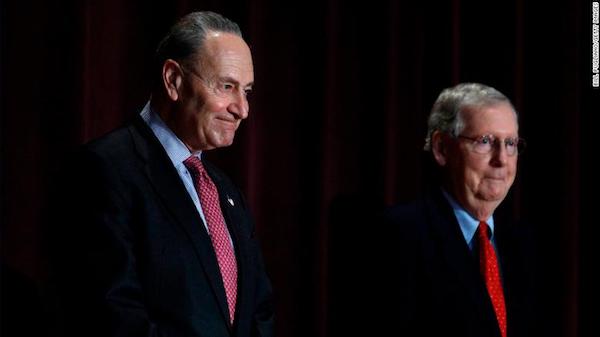
    Senate Minority Leader Charles E. Schumer (D-N.Y.) blamed Trump, who had tweeted moments before the votes that the bipartisan plan was a “total catastrophe” that faced the threat of a veto.

    “If he would stop torpedoing bipartisan efforts, a good bill would pass,” Schumer said.

    McConnell has told others that any bill he could pass in the Senate would be unlikely to earn Trump’s support.

    Senators rejected a watered-down bipartisan plan by Sens. John McCain (R-Ariz.) and Christopher A. Coons (D-Del.) to grant legal status to dreamers and provide billions of dollars to boost border security — but not immediately as Trump requested. The plan failed 52 to 47, short of the 60 votes needed.

    Senators also rejected a bill by Sen. Patrick J. Toomey (R-Pa.) to punish “sanctuary” municipalities that refuse to help enforce immigration laws. That bill failed 54 to 45.

    Much of the Senate’s attention was on the third option, a bipartisan plan to legalize the same ­number of undocumented immigrants and appropriate $25 billion for southern-border-security construction projects over the next decade — not immediately as Trump wants. That bill also would curb family-based immigration programs but not to the extent Trump is seeking, and it said nothing about the diversity visa lottery program.

    The bipartisan proposal laid bare how difficult it can be for members of both parties to try striking a deal. United We Dream — a dreamer advocacy group that works closely with Democrats — and the White House had aggressively lobbied against the measure.

    The frustration of bipartisan negotiators was evident. Before the vote, Sen. Susan Collins (R-Maine), who had helped broker the deal, was heard in the well of the chamber chastising Laura Dove, the top Republican parliamentary expert, over the names of senators listed as being involved in the legislation.

    The Democratic leader had not been part of writing the bill, but his name was included in official notices because of the complex rules regarding how amendments are considered.

    As the two clashed, Collins brandished her cellphone to show Dove the messages proving that copies of the legislation did not include Schumer’s name.

    “You’re supposed to be a fair broker,” Collins said as she walked away from Dove. “It was wrong. It was really wrong.”

    The bipartisan plan failed 54 to 45.

    Finally, senators rejected the Trump plan, which would have granted legal status to 1.8 million young immigrants, spent at least $25 billion to bolster security along the U.S.-Mexico border, revamped family-based legal migration programs and ended a diversity lottery system used by immigrants from countries with low rates of immigration to the United States.

    The vote was 39 to 60, well short of the 60 yes votes needed to move ahead. Three moderate Democrats voted for the proposal, but 14 GOP senators voted against it, including Sen. Ted Cruz (Tex.), who had blasted the proposal as being “to the left from President Obama’s position.”

    Ahead of the votes, the White House mobilized a full-fledged effort to scuttle the bipartisan immigration plan that was emerging as the best hope for a legislative deal.

    On Capitol Hill, attention is likely to shift to the House, which could take up the issue after next week’s Presidents’ Day recess.

    A bill sponsored by Judiciary Committee Chairman Bob Goodlatte (R-Va.) and Homeland Security Committee Chairman Michael McCaul (R-Tex.) has the backing of the hard-right House Freedom Caucus and other conservatives who want to stake out a position further to the right of the White House proposal to guard against future concessions.

    The bill includes new resources for immigration enforcement away from the border; a crackdown on “sanctuary cities” — ­jurisdictions that do not cooperate with federal immigration enforcement authorities; and a requirement that employers use ­ “E-Verify,” a federal database, to check whether their employees are authorized to work in the United States.

    “We have the bill that’s consistent with what the American people elected us to do,” said Rep. Jim Jordan (R-Ohio), a co-founder of the Freedom Caucus.

    But it is not at all clear that the bill, which has no Democratic support, can win enough Republican votes to pass the House.

    (Source: Reports)