Tag: Defense News

  • Details of offset partners will be known when procurement begins: Defense Minister Sitharaman

    Details of offset partners will be known when procurement begins: Defense Minister Sitharaman

    MUMBAI(TIP): Denying any cronyism in the Rafale fighter aircraft deal, Defense Minister Nirmala Sitharaman said here on Thursday, October 25,  that details about offset partners will be known only when the procurement begins.

    “…Dassault and two or three companies are participating in the supply of Rafale. So each one of them will have an offset obligation to be fulfilled,” she said at the ‘India Summit: Status of the nation’, organized by the Economist magazine.

    Asked about the controversy surrounding Dassault Aviation’s choice of Anil Ambani’s Reliance Defense as an offset partner, Sitharaman said each company involved in the supply will have its offset partners in India.

    “Now for Dassault alone to come back to me to say that their offset is getting fulfilled completely, through one, two, three or any number of companies with whom they either go with investments or go for a buying of a product or buying of a service, (it) is left to Dassault to come to me to claim it.

    “Till such time they claim each and every one of them, I will not know whether they are with one, or ten or with hundred (Indian offset partners),” the minister said.

    “The offset partners’ details will be known when they approach me with bills detailing what kind of service is being received, whether it is in the form of equipment or investment,” she said.

    While the Congress has alleged irregularities in the Rafale deal and accused the government of favoring Ambani’s firm, the government as well as Anil Ambani have vehemently denied the opposition party’s allegations.

    Sitharaman noted that the commencement of the delivery of Rafale jets has not begun.

    “They still have time to come back to me to say look, my offset is getting fulfilled through these routes. They will have to submit transaction details of who got the money, for what purpose. Till all that is done, I cannot even claim how many people they (Dassault) are going with,” the minister added.

    She said the previous UPA government had floated a global tender for procurement of Medium Multi-Role Combat Aircraft (MMRCA).

    “They never bought it (the aircraft) but always claim that they bought it at one particular amount,” she said, rebutting the Congress allegation that the price of the aircraft shot up in the deal signed by the NDA government.

    “The emergency number (of planes) which UPA required was 18 but with more time passing, the emergency number what we wanted was 36, which is equal to two squadrons,” the defense minister said.

    She said the UPA government went for an open tender, but the present government opted for an inter-governmental tender.

    “For the 18 and for the rest they (UPA government) went for a tender. What we have done is that we have gone for inter-governmental tender for first 36 emergency number, while rest of the procurement will be through strategic partnership,” Sitharaman said.

    She added that there will be an overseas manufacturer along with an Indian partner for manufacturing of rest of the planes.

    “So, the processes have been simplified, (made) much transparent now. That is why there is so much information available in the public domain. There is no scandal or crony (capitalism) any way,” the defense minister insisted.

    (Source: PTI)

  • US army photographer captured fatal blast that took her life

    US army photographer captured fatal blast that took her life

    WASHINGTON (TIP): The US Army has released two photographs that show the moment an accidental mortar tube explosion killed five people in Afghanistan, including an American combat photographer who took one of the images just before her death.

    Army Specialist Hilda I. Clayton was photographing a live-fire training exercise on July 2, 2013, in Laghman Province, east of Kabul, when a mortar tube exploded, killing her and four Afghan army soldiers, according to the US army magazine Military Review.

    \One of the Afghan soldiers killed in the blast was a photojournalist who was training with Clayton, the magazine said in an article posted on its website.

    It said there has been discussion about the decision to publish the images taken by Clayton and her Afghan counterpart.

    “This edition of the Military Review is focused on promoting the concepts of gender equality and these photographs illustrate the dangers our military men and women face both in training and in combat,” the magazine said. (Reuters)

  • Israel shows off F-35 stealth fighters for first time

    Israel shows off F-35 stealth fighters for first time

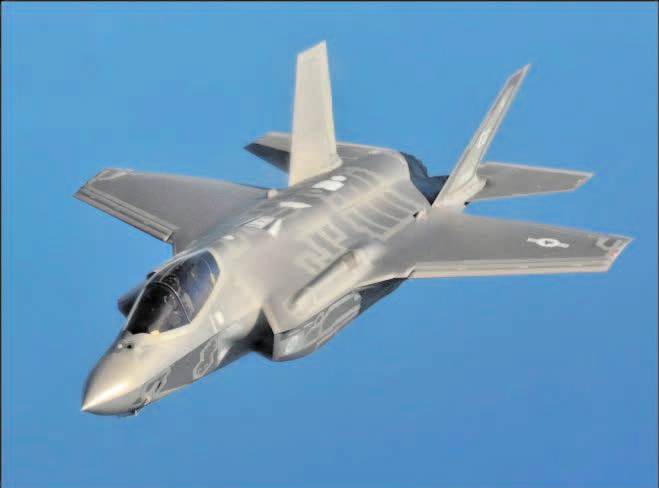
    TEL AVIV (TIP): Israel on May 1 showed off its new F-35 stealth fighter jets recently delivered from the United States as part of an air show marking its annual Independence Day celebrations.

    Three of Israel’s five stealth fighters took to the skies along the Mediterranean coast off Tel Aviv as thousands of people gathered at the waterfront to watch.

    The F-35s, made by US-based Lockheed Martin, were the highlight of the show, which marked 69 years of Israeli independence.

    Israel has received the initial five jets since December with the aim of allowing it to maintain its military superiority in the turbulent Middle East, particularly regarding its arch-foe Iran.

    It plans to purchase a total of 50 F-35s. Its first jets are to be operational this year.

    While other countries have ordered the planes, Israel – which receives more than USD 3 billion a year in US defence aid – says it will be the first outside the United States with an operational F-35 squadron. Among its main features are advanced stealth capabilities to help pilots evade sophisticated missile systems. The pilot’s ultra-high-tech helmet, at a cost of about $400,000 each, includes its own operating system, with data that appears on the visor and is also shared elsewhere.

    Thermal and night vision as well as 360-degree views are possible with cameras mounted on the plane. (AFP)

  • Donald Trump: ‘Major, major’ conflict with North Korea possible

    Donald Trump: ‘Major, major’ conflict with North Korea possible

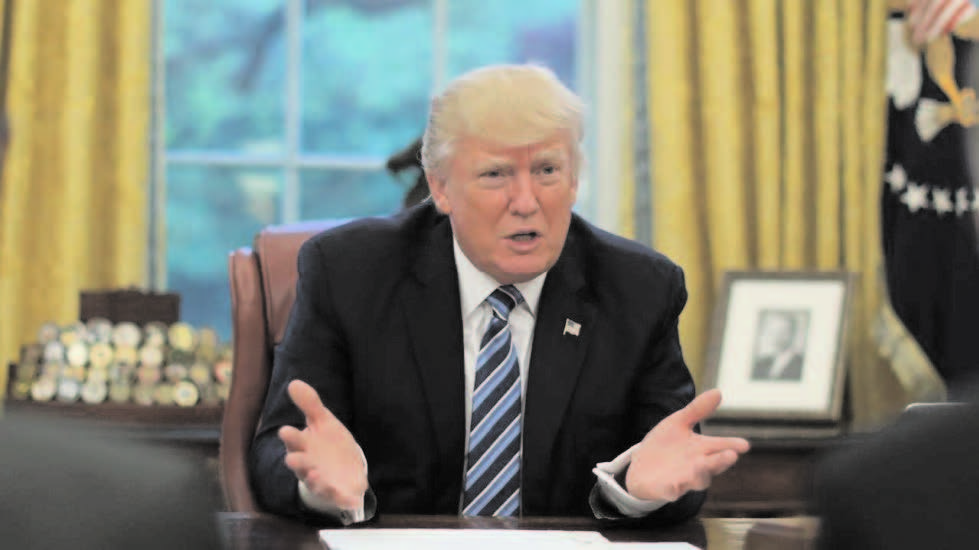
    WASHINGTON (TIP): US President Donald Trump said on April 27 a major conflict with North Korea is possible in the standoff over its nuclear and missile programs, but he would prefer a diplomatic outcome to the dispute.

    “There is a chance that we could end up having a major, major conflict with North Korea. Absolutely,” Trump told Reuters in an Oval Office interview ahead of his 100th day in office on Saturday.

    Nonetheless, Trump said he wanted to peacefully resolve a crisis that has bedeviled multiple US presidents, a path that he and his administration are emphasizing by preparing a variety of new economic sanctions while not taking the military option off the table.

    “We’d love to solve things diplomatically but it’s very difficult,” he said.

    In other highlights of the 42-minute interview, Trump was cool to speaking again with Taiwan’s president after an earlier telephone call with her angered China. He also said he wanted South Korea to pay the cost of the US THAAD anti-missile defense system, which he estimated at $1 billion. He said he intended to renegotiate or terminate a US free trade pact with South Korea because of a deep trade deficit with Seoul.Trump said he was considering adding stops to Israel and Saudi Arabia to a Europe trip next month, emphasizing he wanted to see an Israeli-Palestinian peace. Trump said North Korea was his biggest global challenge. He lavished praise on Chinese President Xi Jinping for Chinese assistance in trying to rein in Pyongyang. The two leaders met in Florida earlier this month. “I believe he is trying very hard. He certainly doesn’t want to see turmoil and death. He doesn’t want to see it. He is a good man. He is a very good man and I got to know him very well.

    “With that being said, he loves China and he loves the people of China. I know he would like to be able to do something, perhaps it’s possible that he can’t,” Trump said.

    ‘I hope he’s rational’ : Trump spoke just a day after he and his top national security advisers briefed US lawmakers on the North Korean threat and one day before Secretary of State Rex Tillerson will press the United Nations Security Council on sanctions to further isolate Pyongyang over its nuclear and missile programs.

    The Trump administration on Wednesday declared North Korea “an urgent national security threat and top foreign policy priority.” It said it was focusing on economic and diplomatic pressure, including Chinese cooperation in containing its defiant neighbor and ally, and remained open to negotiations.

    US officials said military strikes remained an option but played down the prospect, though the administration has sent an aircraft carrier and a nuclear-powered submarine to the region in a show of force. Any direct US military action would run the risk of massive North Korean retaliation and huge casualties in Japan and South Korea and among US forces in both countries.

    Trump, asked if he considered North Korean leader Kim Jong Un to be rational, said he was operating from the assumption that he is rational. He noted that Kim had taken over his country at an early age.

  • #SUKMAATTACK  – Maoists claim responsibility in audio message, warn security forces not to crush ‘revolution’

    #SUKMAATTACK – Maoists claim responsibility in audio message, warn security forces not to crush ‘revolution’

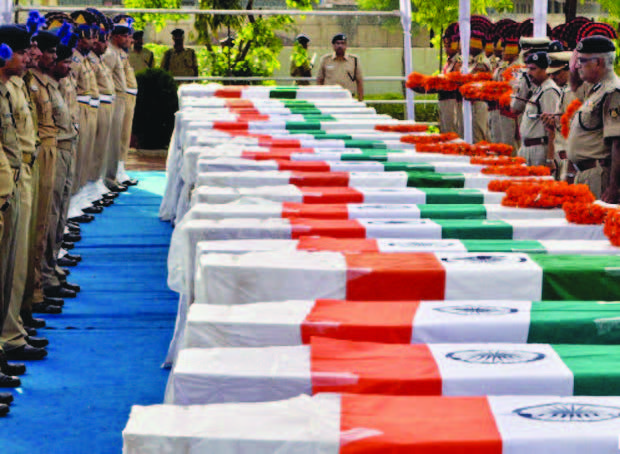
    NEW DELHI (TIP): Maoists based in the Bastar region of Chhattisgarh have claimed responsibility for the recent attack on CRPF jawans – the worst in few years – and warned the security forces not to come in way of their ‘revolution’.

    A News18.com report claimed on April 28 (Friday) that the home-grown rebels have released an audio message in which they have claimed responsibility for the gruesome attack.

    Their attack on the CRPF jawan was in retaliation to Operation Green Hunt launched by the government against Naxals, they claimed.

    In the 16-minute long audio message clip, a spokesperson of the banned Communist Party of India (Maoist) also hailed the attack by the outfit’s military arm People’s Liberation Guerrilla Army (PLGA) on the CRPF personnel.

    The Maoists’ spokesperson, who spoke in Hindi, said that their “fight” was not with the paramilitary personnel, but warned central forces against standing in the way of “revolution”.

    He also appealed to them and to the police personnel to leave the forces, which he said were targeting activists and journalists.

    “In 2016, the government killed nine of our people in Chhattisgarh and 21 in Odisha. The ambush is a reaction to these killings and sexual violence against our women,” Vikalp, the Maoists spokesperson reportedly said.

    He also alleged that the state police had gang-raped tribal women and killed villagers in “fake” encounters.

    However, the veracity of the purported audio clip, which has become viral on the social media, and the claims made by the Maoists could not be confirmed.

  • US reaffirms India’s designation as major defence partner as Modi meets US NSA

    US reaffirms India’s designation as major defence partner as Modi meets US NSA

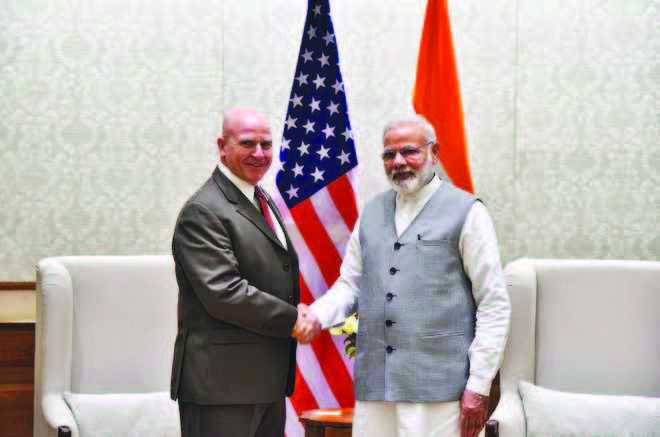
    NEW DELHI (TIP): US National Security Adviser HR McMaster and Indian NSA held a two-hour long meeting in New Delhi today.

    According to sources from the government – the issue of terrorism and Indo-US Cooperation was prominently discussed. India and US agreed to increase military cooperation and more active information exchange on counter terror operations.

    McMaster also discussed regional security issues with his Indian counterpart Ajit Doval.

    Indian side emphasized that the terrorism emanating from Pakistan is posing serious threat to regional stability and security. India and US have very good cooperation.

    McMaster  also to met Prime Minister Narendra Modi at Lok Kalyan Marg. He may also meet External Affairs Minister Sushma Swaraj. McMaster arrived in Islamabad, Pakistan on Monday, barely a day after the United States reinstated its tough stance on Pakistan.

    Incidentally, this was the first visit by a top member from the Donald Trump administration. McMaster arrived in Pakistan after a brief stop in Afghanistan.

    Following the meet in Pakistan, Prime Minister Nawaz Sharif’s office issued a statement saying that McMaster had assured the PM that the Trump administration was dedicated to strengthening bilateral relations and working with Pakistan.

    New Delhi hopes discussions with Herbert Raymond McMaster will provide clarity on US President Donald Trump’s policy for South Asia.

  • India, Israel ink defence deals worth over $2 bn

    India, Israel ink defence deals worth over $2 bn

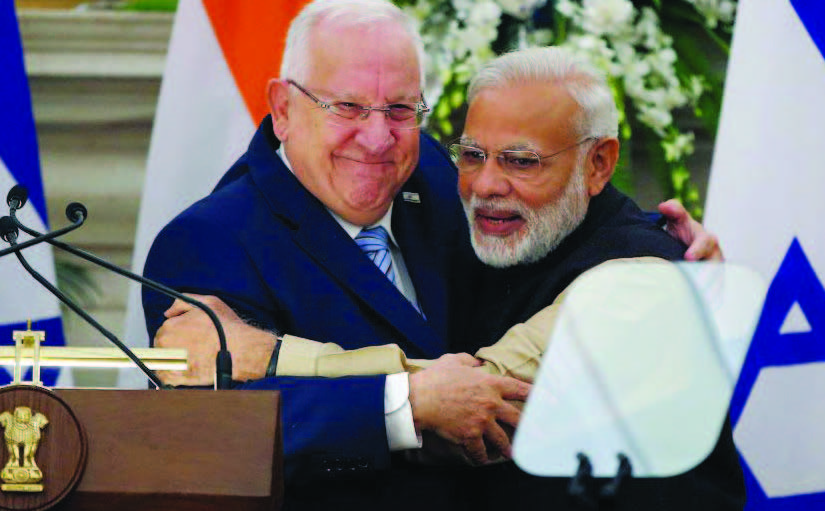
    NEW DELHI (TIP): India and Israel on Thursday inked mega defence deals worth over $2 billion for advanced surface-to-air missile (SAM) systems, which are designed to destroy hostile aircraft, missiles and drones at a range of 70-km, to further tighten the bilateral strategic partnership ahead of PM Narendra Modi’s impending visit to Tel Aviv in July.

    Defence sources said the major deal was for the joint project between the Defence Research and Development Organization (DRDO) and Israel Aerospace Industries (IAI) for the Barak-8 medium-range SAM systems to initially include one regiment of 16 launchers and 560 missiles for the Indian Army.

    The second deal to be inked was for a similar SAM system to be fitted on board the 40,000-tonne indigenous aircraft carrier INS Vikrant being built at the Cochin Shipyard.

    The Modi-led Cabinet Committee on Security (CCS) in February had cleared the MR-SAM project for the Army at an overall cost of Rs 16,830 crore, which will now include a first instalment of Rs 1,500 crore.

    This project follows the two similar DRDO-IAI programmes already underway for the next-generation SAMs for Indian warships at an initial cost of Rs 2,606 crore and nine air defence squadrons for the IAF for Rs 10,076 crore.

    These Barak-8 systems, with their MF-STARs (multi-function surveillance and threat alert radars) as well as weapon control systems with data links, can detect and track hostile aerial threats at a range of 100-km and destroy them at 70-km. Consequently, they will help in plugging the existing holes in India’s air defence coverage.

    But questions have been raised about these SAM systems, which are to be produced in bulk by defence PSU Bharat Dynamics, both in terms of their exorbitant costs as well as long delays in their delivery schedules.

    The naval SAM project, for instance, was sanctioned by the CCS in December 2005, while the IAF one for nine squadrons was cleared in February 2009. As per the latest revised timeline, the naval project’s completion date is now slated for December 2017 instead of the original May 2011 deadline.

    The naval SAM system, tested for the first time in November 2014, meanwhile, has been fitted on the three new Kolkata-class destroyers. Each new SAM system is projected to cost around Rs 1,200 crore for the 12 under-construction warships in Indian shipyards, including NS Vikrant, four guided-missile destroyers and seven stealth frigates.

    Though the expansive bilateral defence ties are kept largely under wraps due to international and domestic political sensitivities, Israel is among the top three defence suppliers to India.

    Having already inked deals and projects worth around $10 billion over the last 15 years, Israel has bagged seven Indian arms contracts in the last two years.

    There are also several more big-ticket deals in the pipeline. These include two more Israeli Phalcon AWACS (airborne warning and control systems), which are to be mounted on Russian IL-76 military aircraft, and four more Aerostat radars at a cost upwards of $1.5 billion.

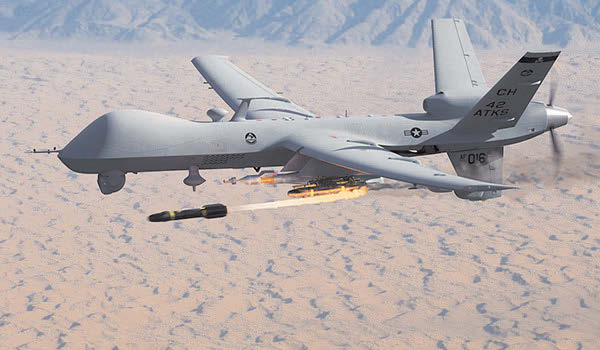
    Moreover, India is set to soon acquire 10 Heron-TP armed drones for around$400 million. While the Indian armed forces have inducted over 100 Israeli unmanned aerial vehicles, which include the surveillance Searcher and Heron as well as the kamikaze Harop drones, this will be the first time it will acquire missile-armed drones capable of undertaking bombing missions like fighter jets.

  • China developing stealth drones to evade anti-aircraft missiles

    China developing stealth drones to evade anti-aircraft missiles

    BEIJING (TIP): China’s largest missile maker is developing military drones with stealth abilities that can evade anti-aircraft weapons, the official China Daily said on Thursday, in another advance for the country’s ambitious military modernisation programme.

    “Drones have become an indispensable weapon in modern warfare because they can play an important role in high-resolution reconnaissance, long-distance precision strikes, anti-submarine operations and aerial combat,” Wei Yiyin, deputy general manager of China Aerospace Science and Industry Corp, told the English language newspaper.

    Insisting it has no hostile intent, China is investing billions of dollars to update ageing equipment and develop new weapons, including stealth fighters and aircraft carriers.

    Its heavy defence spending, however, has unnerved a region already on guard over Beijing’s more assertive approach to disputes in the South and East China Seas and over self-ruled Taiwan, claimed by China as a wayward province. Wei told the newspaper his company was also developing near-space and long-range endurance drones.

    The paper described China Aerospace Science and Industry Corp as the country’s sole producer of cruise missiles, and said the drones also resembled cruise missiles.

    China has stepped up research into military drones, hoping to take market share from the United States and Israel with its cheaper technology and willingness to sell to countries that Western states are reluctant to deal with.(Reuters)

  • The Pivot under Pressure

    The Pivot under Pressure

    It’s not just the canceled trip. Other factors are limiting the ability of the U.S. to focus on the Asia-Pacific.

    Senior U.S. administration officials have been at pains in recent weeks to demonstrate how Washington’s strategic focus is shifting from the military quagmires of the greater Middle East to the dynamism of Asia. It’s a tough sell, and there is reason to doubt that America’s allies and friends in the region are buying it. Even before the cancellation of President Barack Obama’s Asia trip, which would have included the APEC and East Asia summits, doubts about U.S. focus were rising. Take Obama’s address before the UN General Assembly earlier this month. Its core takeaway is that the manifold problems of the Middle East have once more re-asserted their claim on Washington’s attention. Unveiled with much fanfare (here and here) two years ago, the so-called Asia pivot is all about shoring up the U.S. presence in a vital region that is increasingly under the sway of an ascendant China.

    Obama dubbed himself “America’s first Pacific president” and declared that Asia is where “the action’s going to be.” Vowing that the future would be “America’s Pacific Century,” his lieutenants rolled out two specific initiatives: 1.) A buildup of military forces that is plainly directed against China; and 2.) An ambitious set of trade and investment negotiations known as the “Trans-Pacific Partnership” (TPP) that would contest Beijing’s economic hegemony in East Asia. But the pivot – or the “strategic rebalance,” as administration officials now prefer to call it – was birthed with two congenital defects: It was unveiled just as the convulsions of the Arab Spring began tearing apart the decades-old political order in the Middle East, and just as an era of severe austerity in U.S. defense budgeting was taking shape. Until a few weeks ago, Obama gave every appearance of a man wishing the problems of the Middle East would just go away. But much like the Glenn Close character in Fatal Attraction, the region refuses to be ignored. For all the talk about turning the page on years of military and diplomatic activism in the region, Obama keeps having to take notice.

    Indeed, he was forcefully reminded of its combustibility when the outbreak of fighting in Gaza between Israel and Palestinian militants intruded on his last trip to Asia a year ago. And despite his stubborn determination to steer clear of it, he now finds himself sucked into Syria’s maelstrom. The president’s General Assembly address underscores the power of this gravitational pull. In it, Mr. Obama affirmed: “We will be engaged in the region for the long haul,” and outlined the security interests that he is prepared to use military action to protect. He reiterated his intention to see through the uncertain prospect of Syria’s chemical disarmament and then staked his prestige on two longshot projects: stopping Iran’s nuclear weapons program and brokering an Israeli-Palestinian peace accord. He also pledged renewed focus on sectarian conflicts and humanitarian tragedies like the Syrian civil war. This marks quite an evolution in Obama’s thinking from earlier in the year when he justified his Hamlet-like ambivalence on Syria by pondering: “And how do I weigh tens of thousands who’ve been killed in Syria versus the tens of thousands who are currently being killed in the Congo?” In all, Obama’s remarks last month mark a noticeable change in his foreign policy agenda.

    As the New York Times noted: “For a president who has sought to refocus American foreign policy on Asia, it was a significant concession that the Middle East is likely to remain a major preoccupation for the rest of his term, if not that of his successor. Mr. Obama mentioned Asia only once, as an exemplar of the kind of economic development that has eluded the Arab world.” This shift will only renew the multiplying doubts in the region about his commitment to the pivot. So too will the fiscal policy drama currently being played out in Washington, which regardless of its precise outcome, looks certain to end up codifying the sequestration’s deep budget cuts that have disproportionally affected defense spending. Already the drama in Washington has prompted him to cancel his Asia visit. Meanwhile, many in Asia are questioning whether the administration has the fiscal wherewithal to undertake its promised Asia pivot, including the military aspect. The budget squeeze is already cutting into military readiness. The U.S. Navy is slated to play a central part in the buildup, but two thirds of its non-deployed ships and aviation units reportedly don’t meet readiness goals, and the frequency of naval deployments has been noticeably pared back. The Air Force has grounded a third of its fighter squadrons and “Red Flag,” its premier combat training exercise, was canceled for the fiscal year that just ended. Deep reductions in Army and Marine Corps ground forces are in the offing, and joint exercises involving U.S. forces and their Asian counterparts have been scaled back.

    Moreover, a senior officer working on strategic planning for the Pentagon’s Joint Staff recently acknowledged the difficulty of militarily disengaging from the Middle East and re-directing forces to Asia. As Defense News reported: “‘We’ve been consumed by that arc of instability from Morocco to Pakistan for the last 10 years,’ Rear Adm. Robert Thomas said. And while the senior staffs at the Pentagon are dutifully discussing how they are rebalancing to the Pacific, ‘I suspect, though, for the next five years, just as the last 10 years, we will have this constant pull into the’ Middle East.” “Over the next several years, he continued, ‘I think that you’re going to continue to talk about a rebalance to Asia, and you’re going to do some preparatory work in the environment, but the lion’s share of the emphasis will still be in that arc of instability.’” Thomas also predicted a constant tug for resources between the U.S. military commands responsible for Asia and the Middle East. This strain may explain why the Pentagon has yet to develop a comprehensive game plan for the military buildup in Asia. Likewise in doubt is U.S. resolve on the TTP, which involves 12 Pacific Rim countries that together account for a third of the world’s trade.

    The Obama administration, having already missed the initial November 2011 deadline it set for completion, was hoping to have a basic agreement in place in time for the Asia Pacific Economic Cooperation (APEC) summit that convened in Indonesia on the weekend. But there has been slow progress in the negotiations (see here, here and here for background), and even the revised deadline looks likely to slip. Moreover, the White House has not even moved to formally request socalled “trade promotion authority,” a traditional indicator of serious intent because it puts trade deals on a quick path to Congressional approval. The administration announced more than a year ago that it would request this authority from Congress but Michael Froman, the new U.S. Trade Representative, recently stated there is “no particular deadline in mind.” Nor has the White House used its political capital to address rising domestic opposition (here and here) to the trade deal. Washington will continue to proclaim the Obama administration’s steadfastness to the Asia pivot. But U.S. allies and friends now have even more reason to think otherwise.