Tag: Delhi

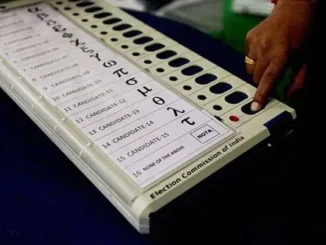
  • Modi’s claim of 400 plus seats entails 100% EVM-VVPAT

    Modi’s claim of 400 plus seats entails 100% EVM-VVPAT

    “Free and fair elections are fundamental to a thriving democracy. One of the foremost indications of that effect is citizenship participation in the democratic process. It is every citizen’s right and duty to vote in the electoral process. Through that participation, they help to build a better democratic system that could effectively serve the public. However, intimidation, corruption, and threats to citizens during or before an election are against the principles of democracy, and the same also holds true for manipulating the voter lists or the voting mechanisms. There ought to be transparency in the public square where those in power are genuinely accountable to the people, and the voters should be fully appraised of what decisions are made, by whom, and why.”

    By George Abraham

    Prime Minister Modi claims that their NDA coalition will win 400 plus seats in the upcoming Parliamentary elections that will take place in India starting April 19 of this year. Is it a panacea or a realistic assessment considering nationwide political dynamics? What is the purpose of making such exaggerated claims if they are not based on accurate data? Their history is replete with fraudulent claims and unscrupulous behavior. Why then should the public believe it now? Anyway, this whole public relations campaign may also be aimed at enthusing the cadres.

    Responding to their claim, Mr. Sam Pitroda, who is also known as the father of the Telecommunication revolution in India, retorted, “BJP can win more than 400 seats in the 2024 elections if issues associated with EVMs are not fixed “. In further expressing his concerns, Mr. Pitroda cited a report by “The Citizens’ Commission on Elections,” chaired by former Supreme Court judge Madan B Lokur and said that the main recommendations of the report were to modify the current design of the VVPAT System to make it truly “voter-verified.”

    It appears that the BJP leaders are engaged in a psychological warfare where people are being conditioned to believe that Modi’s victory is inevitable. It has dual purposes: one is to demoralize the opposition and dispirit their grassroots, and the other is to set up the stage for any illicit operations that would benefit the party before a desensitized electorate. Their strategy is apparently working.

    The public generally assumes that Modi’s third term is inevitable, and to them, it is just a numbers game as far as how big a majority his party could achieve. Is the Indian electorate so naïve as to believe a narrative created by the BJP without supporting facts? However, the BJP is confident that a public that believes in the ‘Gujarat Model’ can be swayed time after time and will fall prey to their deception once again.

    An entirely different picture might emerge if one looks at the electoral map. Their carefully crafted plans may have little impact in South India. With Karnataka going back to the Congress fold, BJP’s expectations of a repeat performance are quite unlikely. The victory in Telangana by the Congress and the BJP’s lack of an alliance with TRS may also spell trouble for the BJP there. In short, the BJP’s plan of building on the 2019 election results is indeed further complicated by the setbacks in these two southern states. With 130 seats distributed among the five states and the union territory in the south, the BJP’s chances of making any substantial gains in South India will remain as elusive as ever before.

    If we look at the poll results in the Northern States, the BJP almost swept them out, creating the current brute majority in the Loka Sabha. They have won all the seats in states like Gujarat, Rajasthan, Haryana, Himachal Pradesh, Uttarakhand, Delhi, and Tripura. In addition, Madhya Pradesh, Bihar, Maharashtra, U.P., Odisha, and Chhattisgarh combined for a whopping 92% of all seats gained by the NDA coalition. It was an incredible win that even the Political pundits have had a hard time explaining since that came at the heel of a disastrous mismanagement of the COVID-19 pandemic that killed more people in India than anywhere else.

    For any sane mind, that history will be hard to replicate. At present, the Modi regime is in the throes of a mushrooming corruption scandal involving Electoral bonds. If the current allegations of pay-to-play are proven, this BJP government may be one of the most corrupt administrations in the history of an Independent India. This is the party that came to power, putting the Manmohan Singh government on the defensive as regards a number of alleged scams. Yet, they have far exceeded in excelling in corrupt ways while covering up their misdeeds from the public’s view. Thanks to the Supreme Court, the public is learning much more about the crimes and the exploitation the country has been subjected to.

    For the BJP leaders, it is imperative that they stay in power not only to perpetuate their ideology and remake India in its medieval ways but also to be in the unenviable position of power where they will never be held accountable for their misdeeds and misgovernance. It is common knowledge that the economy for the man on the main street is not working that well. Rampant inflation, increasing unemployment among the youth, and persistent poverty at the lower end of the strata have all clouded the high GDP numbers India boasts about. The economy is working for the elites and the super-rich, who already own 40% of India’s wealth. It is crony capitalism at its best, joined at the hip by the governing establishment.

    There is a limit to one who can exploit religious sentiment to win votes. The euphoria over the Ram Janmabhoomi Kshetra may be just about dissipated. Patriot games using CAA and NRC may also have found their boundaries. Therefore, despite all the bravado about winning 400 or more seats, the BJP team must be worried, and their internal polls must have indicated the same. Therefore, they dwell on propagating this narrative about the upcoming massive victory, intending to inject inertia into the minds of the opposition while adding fuel to energize their cadre.

    Considering these circumstances, one should be overly concerned about whether the country will have free and fair elections. It doesn’t matter whether the electorate is dissatisfied or opposition parties run a well-rounded campaign if the will of the people is not truly reflected in the outcome. Some countries in the world would conduct pre-determined elections, whereas India stood as a champion of democracy, transferring power when people finally spoke through the ballot boxes. The question being raised by Sam Pitroda and others touches on this susceptible issue.

    Free and fair elections are fundamental to a thriving democracy. One of the foremost indications of that effect is citizenship participation in the democratic process. It is every citizen’s right and duty to vote in the electoral process. Through that participation, they help to build a better democratic system that could effectively serve the public. However, intimidation, corruption, and threats to citizens during or before an election are against the principles of democracy, and the same also holds true for manipulating the voter lists or the voting mechanisms. There ought to be transparency in the public square where those in power are genuinely accountable to the people, and the voters should be fully appraised of what decisions are made, by whom, and why.

    Therefore, the Supreme Court’s query to the Election Commission on adding VVPAT to every EVM is sensible. Voter Verified Paper Audit Trail is a machine that prints a paper slip of a candidate’s name, serial number, and party’s symbol after a voter has cast their vote. It displays a paper slip for seven seconds for the voters to check if their vote is cast for the chosen candidate. The paper slip then drops down to a locked compartment, and it can be used to audit voting data in the EVMs. Whether the handpicked election commissioners by Modi Sarkar would comply with the public sentiment on this issue will be critical in saving democracy for India and its future generations.

    (The author is a former Chief Technology Officer at the United Nations. He is Vice Chair of Indian Overseas Congress. He can be reached at gta777@gmail.com)

  • The CBI’s fishing expedition

    The CBI’s fishing expedition

    • It is not clear what offences punishable by law Sisodia is being charged with

    “Even if kickbacks are accepted and then credited to the party’s coffers, an offence would be made out under the Prevention of Corruption Act. It may not be easy to garner the evidence to prove the receipt of monies but adequate evidence to pin moral culpability must be disclosed to the public before tarring Sisodia with the accusing brush. People in our country forgive even those who have fattened themselves on corrupt practices. They will forgive Sisodia also even if the money has not gone to his personal account but to the party. His reputation, however, will then be tainted with a small stain on a white shirt.”

    By Julio Ribeiro

    Manish Sisodia, Delhi’s former Deputy CM, is presently in judicial custody after being arrested by the CBI. Narendra Modi and Amit Shah will breathe a little easy now! Sisodia’s popularity with the poorer population of Delhi surpassed Modi’s popularity with the affluent. With Sisodia out of commission, the AAP machine in Delhi will slow down or that, it appears, is the intent!

    To a neutral observer, it appears that the intent of the government is to rob the man and his party of any halo of respectability he or the party may be sporting.

    The Kejriwal government had concentrated on education and healthcare, the two subjects any government, either at the Centre or in the states, should pay particular heed to. It had done very well in both spheres, especially in education. That subject was handled by Sisodia. But the Rhodes scholar now in the AAP think tank, Atishi Marlena, will take care of that now.

    Instead of neutralizing those whose extraordinary talents and good work keep the AAP ahead of its political competitors, Modi and Shah should advise the double-engine governments in BJP-ruled states to emulate AAP’s achievements. Future generations of voters will surely discard such divisive politics. Revolutions in education and healthcare will appeal to all generations.

    I have always suspected that successive governments, starting with the Congress which was in power for decades after Independence, may not have wanted the masses to be fully literate. The uneducated blindly follow what is told to them by those with the ‘gift of the gab’. Literate individuals may not be really educated but they listen to news on the television and many of them decide to form her or his own opinion on important issues. Politicians cannot take their support for granted. Religion and caste will remain factors to contend with but votes cast without considering the pros and cons will reduce when people can read and write.

    It is not clear, to me at least, what offences punishable by law Sisodia is being charged with. An accused not cooperating with the police is certainly not an offence under any law. The police and the courts can draw an inference from the accused’s silence or refusal to answer questions but cannot force him to admit something that could later implicate him in an offence.

    Another complaint against Sisodia is that he was in the habit of using multiple phones at any one time and that he had obliterated call data. Again, inferences can be drawn from such practices but where is it laid down in law that one cannot use more than one phone at one time and that a record of calls needs to be kept?

    To a neutral observer, it appears that the sole intent of the government is to rob the man and his party of any halo of respectability he or the party may presently be sporting. To that end, the investigative agencies have been sent on a ‘fishing’ expedition that is not going to end till some fish, even a tiny one, is finally and firmly in the net.

    Investigative journalists are adept at ferreting out the truth. They manage to get hold of the remand applications that usually disclose the grounds for asking the court to give a few days of remand to force the truth out of the arrested individual. An insight into the remand application has not been established in Sisodia’s case. The public has not yet learnt of the grounds for his arrest!

    What the people have been told is that Sisodia, the man they admire and even love, is involved in a massive scam involving a hundred crores! As Excise Minister, he took decisions on his own without involving the Council of Ministers and the Lt Governor in the decision-making process. He allegedly tweaked the policy to benefit a group of licensees known to the investigators as the ‘South Group’ in which the daughter of Telangana CM K Chandrashekar Rao and an MP representing that state were members.

    The profit allowed to be earned by the group had been increased from 5% to 12%. This was sanctioned by Sisodia, who was asked to explain this decision but was unable to give a satisfactory explanation, according to the media.

    Lobbying for relaxations or workable policies is a common feature of working life in the Mantralayas, the seats of state governments. It was even more prevalent in the ministries of the Central government till the Modi administration discouraged the lobbyists. It is also true that a group like the Adanis could not have achieved success (now notoriety) without approaches to the ultimate power.

    Even if Sisodia had met someone from the South Group, that in itself would not inculpate him in a crime unless it is proved that he benefited personally from the interaction. The raids on his office, his home, his bank and the bank locker have drawn a blank.

    The party may have received kickbacks. It is a given that all political parties need money to run their business. The BJP at the Centre has electoral bonds, but in Karnataka, for instance, some ministers in the BJP government have been accused by contractors of demanding 40% cuts from contracts instead of the standard 15% (the figure quoted in the Mumbai MC is less, only 10%, and since the money is paid to the corporators, all parties benefit. Parties with a greater number of corporators benefit more!). The allegations by contractors against BJP leaders in Karnataka have been reinforced lately with the arrest of one of its prominent legislators and the recovery of crores of rupees from the home of his son.

    Even if kickbacks are accepted and then credited to the party’s coffers, an offence would be made out under the Prevention of Corruption Act. It may not be easy to garner the evidence to prove the receipt of monies but adequate evidence to pin moral culpability must be disclosed to the public before tarring Sisodia with the accusing brush. People in our country forgive even those who have fattened themselves on corrupt practices. They will forgive Sisodia also even if the money has not gone to his personal account but to the party. His reputation, however, will then be tainted with a small stain on a white shirt.

    (The author is a former governor and a highly decorated retired Indian Police officer)

  • India to import 50,000 MT medical oxygen amid COVID surge

    New Delhi (TIP): The government on Thursday, April 15,  said it would import 50,000 metric tonnes of medical oxygen to assure supplies to states even as it added that oxygen availability in the country was adequate. As hospitals reeled under oxygen shortages, the empowered group of officers addressing the issue met today and started mapping of oxygen sources for 12 high burden states of Maharashtra, Madhya Pradesh, Gujarat, Uttar Pradesh, Delhi, Chhattisgarh, Karnataka, Kerala, Tamil Nadu, Punjab, Haryana and Rajasthan.

    Medical oxygen is a critical component in the treatment of COVID affected patients and demands have been rising unusually in the high burden states.

    “There has been increasing demand for medical oxygen, especially from the 12 states with high burden of active COVID cases. While the demand in Maharashtra is expected to be beyond available production capacity of the state, Madhya Pradesh does not have any production capacity to meet their demand for medical oxygen. There is also a trend of increasing demand in other oxygen producing states such as Gujarat, Karnataka and Rajasthan,” the government said.

    After the meeting with manufacturers today, the government said 4880 MT, 5619 MT and 6593 MT have been assured and factored for 12 high burden states to meet their projected demand as on April 20, 25 and 30.

    The assured supply will be notified through a government order, sources said. The meeting also decided to import 50,000 MT of medical oxygen to be ready for the increasing demand.

    Health Ministry has been asked to finalise the tender and explore possible sources for import identified by the missions of MEA.

    Meanwhile 162 Pressure Swing Adsorption plants (plants manufacture oxygen and help hospitals become self-sufficient in their requirement for medical oxygen while also reducing the burden on the national grid for supply of medical oxygen) sanctioned under PM-Cares are being closely reviewed for early completion of 100 percent of the plants to enhance self-generation of oxygen in hospitals especially in remote areas.

    The empowered group asked the Health Ministry to identify another 100 hospitals in far flung locations for consideration of sanction for installation of PSA plants.

    The government said it was monitoring the situation to ensure uninterrupted supply of medical oxygen. India’s daily medical oxygen production capacity is 7127 MT. Current national oxygen stocks are 50,000 MT – more than daily consumption of 3842 MT but the government is readying for what it calls unusual surge in demand.

              Source: The Tribune

  • Polarization of societies

    Polarization of societies

    By Shyam Saran

    “The Right has been able to exploit the existing social, communal and sectarian fault lines to deflect attention from its complicity in the disempowerment and the immiseration of the majority. In the US, it is by deliberately sharpening the racial divide, stoking the fear of immigrants and loss of cultural identity that a figure like Trump was able to continue rewarding the corporate class with large tax cuts at the cost of the very services that could ameliorate the worsening economic status of the less-educated white minority. Recently, historian Rana Dasgupta has drawn attention to a very cynical insight offered by Lyndon Johnson, a former President: ‘If you can convince the lowest white man he’s better than the best-colored man, he won’t notice you’re picking his pocket. Hell, give him somebody to look down upon and he’ll empty his pockets for you.’


    Stop the Steal. Trump supporters stormed the capitol on January 6

    We see echoes of what Johnson was alluding to in our own country. Those most affected by demonetization were the already poor and those eking out a constantly threatened existence as small and medium enterprises and their unorganized workers. But millions were ready to stand in unending queues to get their paltry sums exchanged, their pain dulled by the belief that fat cats and money bags had been deprived of their ill-gotten gains. Except that they had not and many profited by turning their black money into white. Or if the lowliest Hindu is made to feel superior to the best among the Muslims in the country, perhaps he is ready to accept his dire economic situation and forget who may be really responsible for his deprivation.

    There has been a sigh of relief manifest across the world as Joe Biden has succeeded to the US presidency, presaging a more predictable and more ‘normal’ conduct of domestic and external affairs under an experienced and professional administration. Biden has promised to heal a deeply divided country, to promote reconciliation and unity and to restore the democratic and liberal credentials of the US as the world’s oldest democracy. This promises to be a long haul and unlikely to be achieved during one four-year administration. He would be deemed a success if he at least manages to, as he said, ‘lower the temperature.’

    The social and political polarization on display in the US is increasingly manifest in other democracies, including our own. A key causal factor is the rising inequalities of wealth and income that undermine the most powerful appeal of democracy which is egalitarianism, the equality of opportunity it promises and the fairness with which the state will treat all its citizens. As economies develop, as technology advances, there will inevitably be winners and losers. A democratic state will have to continually ensure that it is able to redistribute rising incomes and wealth in a manner that helps those left behind to retain hope in a better future, if not for themselves, then at least for their children. It is not that globalizationin itself has spawned huge inequalities, nor that inequality is inherent in increasingly arcane and specialized technological advancement. The fault lies with public policy which has failed to distribute the benefits of globalization more evenly. When the number of losers far outstrips the winners, and this state of affairs persists and even worsens, democracy will be challenged. This is what we witness in the US and in democracies across the world, India included.

    There is an intriguing question, however. It is the political Left (in which I broadly include the liberal constituency) which has historically mobilized support among those who are at the lower end of the economic and social scale. In the present case, the Right and nativist forces have captured the imagination of the exploited and deprived. The Left targets the rich and the corporate sector; the Right does not pay a price for associating with this privileged minority and profiting from its generous funding. What explains this oddity? That there is an alliance between the populist and the powerful elements within the corporate sector is more than apparent. But the liberal and the Left have been unable to leverage this to mobilize support among those who are, in fact, at the receiving end of this powerful nexus. The Right has been remarkably successful in co-opting the ranks of the dejected and deprived to buttress its own power. How is this possible?

    The Right has been able to exploit the existing social, communal and sectarian fault lines to deflect attention from its complicity in the disempowerment and the immiseration of the majority. In the US, it is by deliberately sharpening the racial divide, stoking the fear of immigrants and loss of cultural identity that a figure like Trump was able to continue rewarding the corporate class with large tax cuts at the cost of the very services that could ameliorate the worsening economic status of the less-educated white minority. Recently, historian Rana Dasgupta has drawn attention to a very cynical insight offered by Lyndon Johnson, a former President: ‘If you can convince the lowest white man he’s better than the best-colored man, he won’t notice you’re picking his pocket. Hell, give him somebody to look down upon and he’ll empty his pockets for you.’ Dasgupta points to an ugly truth: Sometimes people can be persuaded to ‘prize the removal of others’ rights above the preservation of their own.’

    And this is what is happening in the US. Can Biden change this?

    Why is the Left unable to build its constituency in the ranks of the deprived? Precisely because ideologically, it sees its role as transcending the societal fault lines and uniting around a more inclusive concept of egalitarianism.

    We see echoes of what Johnson was alluding to in our own country. Those most affected by demonetization were the already poor and those eking out a constantly threatened existence as small and medium enterprises and their unorganized workers. But millions were ready to stand in unending queues to get their paltry sums exchanged, their pain dulled by the belief that fat cats and money bags had been deprived of their ill-gotten gains. Except that they had not, and many profited by turning their black money into white.

    Or if the lowliest Hindu is made to feel superior to the best among the Muslims in the country, perhaps he is ready to accept his dire economic situation and forget who may be really responsible for his deprivation.

    There was only one brief occasion when the current political dispensation was threatened and that was when the label of ‘suit-boot kisarkar’ struck home but then it was never built up into an alternative political narrative. The Left in our country has failed precisely because it has become defensive about its core beliefs and started flirting with the narrow inclinations of the Right, for example, by doing its own religious rituals and spouting nationalist slogans. Nor is there stomach to shine the spotlight on the nexus among the politician-bureaucracy and big business that has come to dominate governments in democracies across the world.

    There are parallels between the oldest and the largest democracies in the world. Both are at critical junctures in their evolution as enlightened democracies envisaged by their respective constitutions. But I believe that the future of democracy as a political ideal may likely be determined by the trajectory that India takes in the coming years rather than the US, especially when the Chinese model of authoritarian capitalism seems to bewinning admirers across the world.

    (The author is Former Foreign Secretary and senior fellow, Centre for Policy Research)


  • Eminent Ophthalmologist VK Raju honored by Egyptian Ophthalmology Society

    Eminent Ophthalmologist VK Raju honored by Egyptian Ophthalmology Society

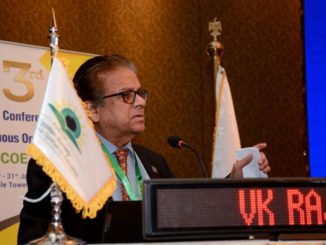
    CAIRO (TIP): Dr. VK Raju, an eminent ophthalmologist based in Morgan Town, West Virginia, USA was invited to Cairo by the Egyptian Ophthalmology Society to speak on childhood blindness. He lectured on difficult cataract surgery, prevention of blindness in premature children. The condition is called ROP (retinopathy of prematurity). If premature babies are given too much oxygen, it can be harmful. It leads to bleeding in the eye and causes permanent blindness. The good news is it can be prevented by laser treatment. Early recognition is the key.

    Dr. Raju who is Founder and President of the Eye Foundation of America is a passionate crusader for prevention of avoidable childhood blindness. His passion takes him to many parts of the world, particularly to his country of origin India where he has set up a hospital and eye institute in Rajahmundry, Andhra Pradesh. At the Goutami Eye Institute, Rajahmundry, a dedicated staff serves a large community, particularly rural.

    Dr. VK Raju is internationally recognized and has been honored by many organizations. Only this January, Rotary Club of Calcutta, the oldest Rotary club, at their centenary celebrations, honored Dr. Raju for his tremendous contribution.

  • No More 1947; no more 1984; no more 2002; no more 2020

    13000 SOS calls made over 4 days of communal violence raging in some parts of Delhi, and no response from 85000 strong Delhi Police force to come to the aid of the victims. The result: 42 lives snuffed out. Over 350 injured. Property worth thousands of crores destroyed. And relationships ruptured, may be, beyond repair.

    Reminds one of 1984 when thousands of Sikhs made frantic calls without any response from police. The result, over 10,000 lost their lives. Hundreds of women were raped. Thousands were injured.

    Had the police done their duty in 1984, the barbaric and tragic incident could have been avoided, and precious lives saved.

    The pattern was repeated in 2002 when in Gujarat, communal violence erupted taking a heavy toll of life and property. Police even there preferred to look the other way while the arsonists and perpetrators of violence continued to loot and kill without a finger being raised by the police.

    It has happened again, in Delhi where over three to four days, goons went around, beating and killing, damaging property right under the nose of the police. Reports say, at places, police actively connived with the goons.

    So, the 1984 and 2002 pattern were repeated in 2020. Is it a coincidence that the police in Delhi in 1984 and in 2020 conducted itself in a similar fashion as police did in Gujarat in 2002? Are the police all across the country trained that way? Or, is it the dharma of the police to obey, not the law, but those who control political power?

    Is it a coincidence that 2002 Gujarat communal violence took place under the duo of Narendra Modi and Amit Shah when they  were Chief Minister and Home Minister respectively of the State, and the 2020 Delhi communal violence took  place under the same team with one being the Prime Minister and the other being the Home Minister?  It is an interesting coincidence.

    However, getting back to the conduct of police in Delhi, it is quite strange that the High Court had to pull up police to move forward in cases of hate speech which surely provoked people into violence. Those who make provocative statements and instigate people to communal violence are guilty of creating conditions of civil war and destabilizing the nation, and as such, should be treated as traitors.

    India has suffered enough. Indians have suffered enough from 1947 through 1984 and 2002. Already, another wound has been inflicted in the body of the nation in the form of recent Delhi Communal clashes. Every time there is a communal clash it is a stab in the heart of Mother India. Let those who love Mother India desist from any further crimes against their mother.

    Let us pledge today: “No more 1947; no more 1984; no more 2002 and no more 2020.”


  • Arvind Kejriwal on apology spree: 3 down, 30 more to go?

    Arvind Kejriwal on apology spree: 3 down, 30 more to go?

    NEW DELHI (TIP): Aam Aadmi Party (AAP) national convener and Delhi CM Arvind Kejriwal has been humble pie.

    Kejriwal’s spree of apologies has generated mixed reactions, with some amused, some piqued and others downright infuriated.

    The AAP chief, with 33 defamation cases against him in 22 states, has crossed three cases off his list by saying sorry to the complainants.

    Kejriwal has tendered a series of apologies, starting with Akali Dal leader Bikram Singh Majithia, followed by Union minister Nitin Gadkari, and subsequently Congress leader Kapil Sibal and his son.

    Deputy chief minister of Delhi and senior AAP leader Manish Sisodia justified the apologies. “We are here to work for public. If someone is hurt by our remarks, we will apologise. We do not have time for courts. We do not want to indulge in battle of ego,” he said.

    In contrast to the moral high ground by AAP leaders in Delhi, cracks appeared in party’s Punjab unit after Kejriwal apologised to Majithia with AAP’s Punjab chief Bhagwant Mann quitting from the post in protest. Lok Insaaf Party, AAP’s alliance partner in Punjab, said it will snap ties with Kejriwal-led party.

    Kejriwal’s apologies have provided readymade ammunition to the Opposition to target AAP. Congress, taking a dig at the Delhi Chief Minister, said that Kejriwal should change his name to “Arvind Sorry Kejriwal”. Delhi BJP president Manoj Tiwari slammed Kejriwal for being a “regular and habitual offender”. Punjab Chief Minister Amarinder Singh dismissed Kejriwal’s apology as an “antic”.

    Kejriwal’s apology episode is the latest in a series of recent events that have earned the party criticism from several corners and could hurt its public image in the long run.

    However, things will be difficult for Kejriwal in the case involving Finance Minister Arun Jaitley.

    According to the sources, Kejriwal sent one of his newly inducted Rajya Sabha MPs as an emissary to Jaitley to discuss the possibility of an apology.

    “The finance minister hasn’t agreed with the apology proposal,” a source said.

    It’s also learnt that Jaitley wanted to know whether Kejriwal could ensure apologies from other AAP leaders Sanjay Singh, Kumar Vishwas, Ashutosh, Raghav Chadha and Deepak Bajpai against whom defamation case has been filed.

    The finance minister had filed a Rs 10 crore defamation suit against Kejriwal and five other AAP leaders. A civil defamation case was filed in Delhi High Court and a criminal defamation suit was filed in lower court in Delhi.Besides, a separate defamation case was filed against Kejriwal after certain remarks were made by his lawyer Ram Jethmalani during the trial. Kejriwal wanted to take the apology route with Jaitley as the next hearings in the high court and lower court are respectively on 3 April and 8 April.