Tag: Delhi Police

  • Delhi Police lodge FIR under UAPA over violence at Indian Mission in UK

    Delhi Police lodge FIR under UAPA over violence at Indian Mission in UK

    New Delhi (TIP)- The special cell of the Delhi Police has registered a case in connection with the protest in front of the Indian High Commission in the UK on March 19, officials said on March 24.
    Among the protesters were persons holding Indian passports. The FIR has been registered under the IPC, Unlawful Activities (Prevention) Act and the Prevention of Damage to Public Property Act as it involves unlawful activities carried out by certain people holding Indian passports abroad, they said.
    The move has come following the direction issued by the Ministry of Home Affairs (MHA) to take appropriate legal action after it received a report from the Ministry of External Affairs (MEA) over the incident at the Indian High Commission in London on March 19.
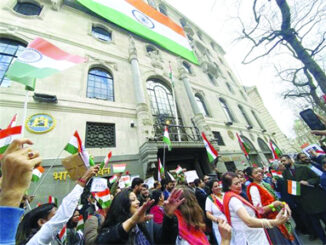
    Last Sunday, the Tricolor flying atop the Indian High Commission in London was grabbed by a group of protesters waving Khalistan flags and raising pro-Khalistan slogans, leading to an arrest. Officials from the mission said the “attempted but failed” attack had been foiled and that the Tricolor was now flying “grander”.
    The Metropolitan Police said that two members of security staff sustained minor injuries, which did not require hospital treatment.
    Want action: MEA to US, UK over vandalism at Missions
    “We are not interested in assurances. We would like to see action,” said MEA spokesperson Arindam Bagchi on statements from the US, the UK, Canada and Australia on their promise to prosecute the pro-Khalistan activists involved in attacks on Indian Missions in these countries.
    India expected the host governments to take action to identify and prosecute all those involved, he said at a media briefing. “We also want them to take necessary measures to prevent the recurrence of such incidents as well as provide adequate protection to Indian Missions and the personnel working there,” said Bagchi. Source: TNS

  • Farm unions mark 4-month anniversary of protest against agri. laws

    Farm unions mark 4-month anniversary of protest against agri. laws

    The nation-wide bandh call urged that shops, malls, markets and institutions remain closed

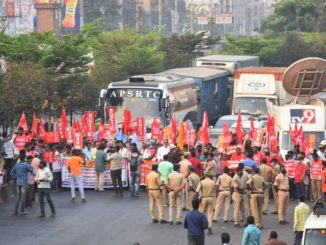
    BENGALURU (TIP): Protesting farm unions under the banner of the Samyukt Kisan Morcha have called for a day long Bharat Bandh on Friday, March 26 to mark the four-month anniversary of their agitation on the borders of Delhi, and to reiterate their demand to repeal three contentious farm laws. The strike is in effect from 6 a.m. to 6 p.m. The nation-wide bandh call urged that shops, malls, markets and institutions remain closed. Protestors intend to block road and rail transport and suspend services, except for ambulances and other emergency services.

    Here are the live updates:

    9.40 AM

    Traffic movement suspended on Ghazipur border

    The Delhi Police has closed both carriageways of National Highway-24 passing through the Ghazipur border in view of the ‘Bharat Bandh’. In a tweet, the Delhi Traffic Police said, “Traffic movement is closed on Ghazipur Border NH-24 (Both carriageways).” The one side of the carriageway was earlier opened on March 15 for traffic. However, the other side from Ghaziabad towards Delhi is closed since the farmers’ protest started. – PTI

    9.30 AM

    ‘Satyagraha’ ends atrocities, arrogance: Rahul Gandhi on Bharat Bandh

    India’s history shows that ‘satyagraha’ ends atrocities, injustice and arrogance, Congress leader Rahul Gandhi said, expressing support for the ‘Bharat Bandh’.

    In a tweet in Hindi, Mr. Gandhi said India’s history shows that ‘satyagraha’ ends atrocities, injustice and arrogance.  The movement should be in national interest and peaceful, the former Congress chief added. – PTI

    9.20 AM

    Vehicular movement hit in Punjab, Haryana, Delhi

    In Punjab and Haryana, groups of farmers started sit-in protests, or dharnas, on key roads, including national and State highways, as well as besides railway tracks at a few locations.

    Vehicular movement was disrupted in parts of the two States, which have been at the forefront of the protests. Public transport, including buses and taxis, stayed off the roads. SKM members will hold dharnas at 120 places in Punjab alone, said Jagmohan Singh, general secretary, Bhartiya Kisan Union-Ekta (Dakonda).

    At least five agitation points have also been identified within Delhi city, with protests to begin by 11 a.m. This will also be the first major agitation within the capital since the Republic Day tractor parade.

    8.40 AM

    Farmers occupy key roads in Punjab, Haryana

    Several groups of farmers on Friday went on dharna on key roads, including national and State highways, besides railway tracks at a few places, in Punjab and Haryana amid the call for ‘Bharat bandh’.

    Vehicular movement was disrupted in parts of Punjab and Haryana. Public transport, including buses and taxis, stayed off the roads.

    “A complete shutdown has been called from 6 a.m. to 6 p.m,” said Jagmohan Singh, general secretary, Bhartiya Kisan Union-Ekta (Dakonda).

    DELHI

    Adequate security arrangements in place, says Delhi Police

    The Delhi Police said adequate security arrangements have been put in place in view of the ‘Bharat Bandh’.

    Delhi Police PRO Chinmoy Biswal said there will be intense patrolling to maintain peace in the national capital.

    “There will be adequate security arrangements in all police districts during the ‘Bharat Bandh’,” he said.

    “The patrolling staff will roam in their area throughout the day and their focus will be to maintain peace in busy marketplaces,” Mr. Biswal said.

    ODISHA

    Odisha declares closure of educational institutes

    The Odisha government declared the closure of all educational institutions across the state on March 26 in view of the nationwide Bharat Bandh call.

    The Congress and Left parties have announced their support to the 12-hour bandh to be observed from 6 a.m.

    The State’s BJD government has asked its employees to reach offices by 9.30 a.m. on Friday in view of the bandh.

    The front gates of state secretariat Lok Seva Bhawan will be closed at 10.15 a.m. and all the passage will be regulated through rear gates. Security check of identity cards and passes of the employees and visitors will be intensified, the home department said.

    In a notification, the government said that schools, colleges, universities and technical institutions will be closed on Friday in view of the bandh.

    (Source: PTI)


  • Why Modi And Shah Fear young Activists

    By Ramachandra Guha

    “Unlike MPs and MLAs of other parties, these young activists cannot be made to join the BJP through bribery or coercion. Nor are they burdened by charges of corruption, nepotism, or dynastic entitlement. Nikhil Wagle is absolutely right – at a psychological and ideological level, the Sangh Parivar fears the likes of Umar Khalid and Natasha Narwal far more than they fear Rahul Gandhi or Mamata Banerjee.”

    Why would the Indian state arrest a 21-year-old woman activist who seeks a cleaner and safer planet? Should not the country want young people to look beyond their narrow personal interests to the interests of society at large? Why did our government lock up a young citizen seeking to build a better future for herself and her compatriots? And why in such a draconian manner, with a police party flown down from Delhi to whisk her away from her home in Bengaluru to the capital? How could a non-violent campaign to spread awareness about global warming, and tweets in support for farmers’ protests, constitute a seditious threat to the mighty, professedly self-reliant, Indian state?

    Environmentalist Disha Ravi was whisked away by Delhi Police from her Bengaluru home on February 13, in utter violation of lawful procedure of arrest, and charged under various sections of the Indian Criminal Procedure code, including sedition.

    These questions were asked of me by a friend when the news of Disha Ravi’s arrest came in. They were surely asked in many other homes across India as well. At first glance, the arbitrary arrest and sentencing to police custody of this young lady from Bengaluru flew in the face of logic, reason, and common sense. No state governed by the rule of law and a democratic constitution should act like this. But the Indian state did. Why?

    Based on what we know of the Modi-Shah regime, of how it functioned in Gujarat between 2001 and 2014, and how it has functioned at the Centre thereafter, I’d like to outline six possible reasons why this young, idealistic, female resident of Bengaluru was picked up without notice by the police from the house where she lived with her mother, put on a plane, and taken away for five days of intense interrogation in Delhi.

    The first reason is that the Modi-Shah regime fears independent thinking in general. Indians must be obedient, conformist, loyal to the state and the ruling regime, and worshipful towards the Great and Visionary Leader. Ideally, the Indian state would like no critical, objective, detailed, scrutiny of its policies and actions to be permitted at all. However, while democratic freedoms have been greatly attenuated since May 2014, they have not been fully extinguished. There still exists (bare) elements of a free press, some (rapidly shrinking spaces) in civil society, and a few major states which are not ruled by the BJP.

    The Modi-Shah regime is dominant across India, in politics as well as in civil society. But it is not content with dominance – it wants total hegemony. In pursuit of this ambition, it curtails discussions in parliament, erodes the rights of states, and suppresses media freedoms. By not having a single press conference in six-and-a-half years, and by assiduously cultivating and promoting a ‘Godi Media’, the Prime Minister has succeeded in reducing journalistic scrutiny of his government’s work. But he has not completely eliminated it – as yet. Hence the attacks on independent sites like Newsclick, and on independent-minded journalists as well (for more details, see this.)

    The second reason that Disha Ravi was arrested is that while the Modi-Shah regime fears independent thinking in general, they particularly fear it when expressed by young people. Indians in their 20s and 30s, who are animated by ideals of religious pluralism, caste and gender justice, democratic transparency, and environmental sustainability – that is, by ideals different from and often opposed to those of the Sangh Parivar – have more energy and more time on this earth to fulfil their own hopes for our land. Therefore, they must be sent off to prison, through the abuse of state power and of the legal process if necessary. The arrest of Disha Ravi is in keeping with the arrest of an ever-growing list of young, idealistic, selfless young Indians seeking a better future for our country. These young idealists constitute a far greater threat to the Sangh Parivar’s agenda than older Indians who may also think of themselves as independent-minded. Indeed, they constitute a greater threat to the Sangh Parivar than the Opposition parties themselves. As the experienced journalist Nikhil Wagle wrote when Disha Ravi was jailed: “Indira Gandhi arrested opposition leaders in her emergency. Modi won’t arrest them as he knows most of them have little credibility or influence. He arrests genuine, young activists who fight to protect democracy. This is Modi’s emergency with a difference!”

    Unlike MPs and MLAs of other parties, these young activists cannot be made to join the BJP through bribery or coercion. Nor are they burdened by charges of corruption, nepotism, or dynastic entitlement. Nikhil Wagle is absolutely right – at a psychological and ideological level, the Sangh Parivar fears the likes of Umar Khalid and Natasha Narwal far more than they fear Rahul Gandhi or Mamata Banerjee.

    The third reason the Modi-Shah regime has arrested Disha Ravi is their compelling desire to manage the headlines. The bad press generated by the government’s handling of the farmers’ protests, and by their maniacal over-reaction to a few tweets by foreign celebrities, is now sought to be diverted through jingoistic over-drive, by claiming that there was a deeper international conspiracy being forged by a trinity of malign actors – these being some out-of-work Khalistanis in Canada, a teenager in Sweden, and a girl barely out of her teens in Bengaluru. The Delhi Police will now selectively leak some alternative facts, the ‘Godi Media’ and the BJP IT Cell will go to town with them, and the saga of the suffering farmers on the borders of our capital will – so the government hopes – go unnoticed (at least for a while).

    The fourth reason that the Modi-Shah regime has arrested my fellow Bengaluru resident is that they are xenophobic at heart. That a Bharatiya Nari, and with such a swadeshi-sounding name too, was in regular touch with climate change activists with white skins and a Christian heritage outrages their own, perverted, insular form of nationalism, which mandates that a girl called Disha Ravi must, if she indeed crosses the kala pani, only be in conversation with the New York or Washington Cell of the Overseas Friends of the BJP.

    The fifth reason that the Modi-Shah regime has arrested this 21-year-old Bengaluruan is to send a chilling message to the young in general. And to their parents too. If tweeting in support of a farmers’ protest against the government can lead to such savage retribution from the state, many students inclined to venture beyond careers and exams towards (even part-time) activism will now be inhibited from doing so. Their parents, as well as their uncles, aunts, and older cousins, will urge them to stay away from social media, not participate in public meetings, etc. And so, will the principals and teachers of their schools and colleges. The atmosphere of obedience and conformity that Modi and Shah so desperately desire will now (so Modi and Shah hope) permeate more deeply among the young.

    The five reasons outlined above apply to the Modi-Shah regime’s persecution of younger activists in general. The sixth reason is specific to this particular activist. The central government fears Disha Ravi because her group, Fridays for the Future (FFF), has focused attention on environmental violations by the Indian state. As the excellent website The NewsMinute reports, “What seems to have irked the Union government is that FFF had taken a strong stand against the draft EIA 2020 (Draft Environmental Impact Assessment notification 2020) that reduced public consultation on projects and allowed post-facto environmental clearance.”

    The weakening of the EIA is consistent with the Modi Government’s broader policy of always putting corporate interests above social justice andenvironmental sustainability. In central India, Sudha Bharadwaj and Stan Swamy opposed handing over tribal lands and forests to mining companies whose promoters are close to the regime and are paying a horrific cost for their opposition. Now it is the turn of Disha Ravi of Bengaluru.

    Knowing the Indian state, it is entirely possible that it picked on Disha Ravi because (unlike the other activists mentioned earlier in the column) she has no tradition of student political activism to prepare her for withstanding brutal interrogation. One fears for what she is going through at the hands of the Delhi Police right now.

    As I said earlier, no state governed by the rule of law would act in this manner. But the Modi-Shah regime has contempt for democratic procedure. This is a government with no humanity, no civility, no decency, no transparency. It is committed only to the pursuit of total power. It seeks absolute political, ideological, and personal supremacy. The noble sentiments expressed in the Preamble to the Indian Constitution are being violated everyday by those who took their oaths of office on that document. That is why, when challenged by young minds to honor and uphold those Constitutional values, the response of the state is to put these young minds in jail.

    (Originally published in NDTV)

    (The author is a historian based in Bengaluru. His books include ‘Environmentalism: A Global History’ and ‘Gandhi: The Years that Changed the World’.)

  • Eminent Ophthalmologist VK Raju honored by Egyptian Ophthalmology Society

    Eminent Ophthalmologist VK Raju honored by Egyptian Ophthalmology Society

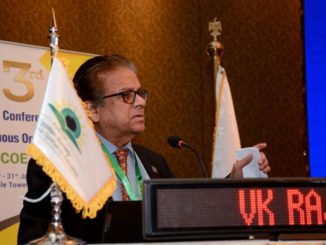
    CAIRO (TIP): Dr. VK Raju, an eminent ophthalmologist based in Morgan Town, West Virginia, USA was invited to Cairo by the Egyptian Ophthalmology Society to speak on childhood blindness. He lectured on difficult cataract surgery, prevention of blindness in premature children. The condition is called ROP (retinopathy of prematurity). If premature babies are given too much oxygen, it can be harmful. It leads to bleeding in the eye and causes permanent blindness. The good news is it can be prevented by laser treatment. Early recognition is the key.

    Dr. Raju who is Founder and President of the Eye Foundation of America is a passionate crusader for prevention of avoidable childhood blindness. His passion takes him to many parts of the world, particularly to his country of origin India where he has set up a hospital and eye institute in Rajahmundry, Andhra Pradesh. At the Goutami Eye Institute, Rajahmundry, a dedicated staff serves a large community, particularly rural.

    Dr. VK Raju is internationally recognized and has been honored by many organizations. Only this January, Rotary Club of Calcutta, the oldest Rotary club, at their centenary celebrations, honored Dr. Raju for his tremendous contribution.