Tag: Democracy

  • IUDF opposes dividing the Indian American community by Hindutva groups

    NEW YORK (TIP): The Indo-US Democracy Foundation (IUDF), a newly formed think tank, deplores the attack on elected representatives in the U.S. by a cadre of people belonging to the Hindutva group, who support ideologies opposed by America.

     They are virtually threatening U.S. Representatives like Ro Khanna (California) and Pramila Jayapal (Washington) for not towing their line of Hindutva politics, which want to reshape India as a Theocracy or Hindu Rashtra. They even threatened Rep. Tom Suozzi of New York, a good friend of the Indian community, for demanding the restoration of democracy in Kashmir.

    The Hindutva forces in the U.S. follow the ideology of RSS, a militant organization in India, who want to make India a Hindu Rashtra and keep the Muslims, Christians, Sikhs, Dalits, and others as second class citizens, denying them equality in their ancestral land. It is not acceptable. It is un-American to profess such a fascist ideology in this land of the free.

     Rep. Khanna’s grandfather was a freedom fighter for India’s independence struggle and suffered greatly in jail for many years. Rep. Khanna rightly says that his grandfather fought for all Indians, and he cannot support divisive ideologies now. Rep.  Jayapal, too, demanded democratic rights for Kashmiris, who are citizens of India.

     The Hindutva forces in the U.S. may have money, power, and numbers; however, they forget that they have reached this level of success because of the democratic, secular, and tolerant fabric of this great country. While they enjoy the freedom and great opportunities in this nation, they are working hard on the sideline to deny these same rights and liberties to minorities and lower castes in India.

    These wolves in many garbs are busy trying to influence policies in Washington, often masquerading as champions for the Indian community in America.  Moreover, many Asian Indians in this country remained quiet for too long, under the false impression that India needed lobbying by these Hindutva groups for a better bilateral relationship. However, upon careful examination, these folks are exposed as more militant and strident in their voices than their so-called mentors in India, which is sad. It appears that they have brought their whole baggage of racism and bigotry to these shores and are working hard to convert others into the same.  In internet forums and discussion groups, they attack and denigrate anyone who is opposed to their ideology, often calling them traitors. Traitors to whom? These people seem to forget that their behavior is inconsistent with the values and traditions of this great country and is un-American.

     It is quite astonishing that some of these folks who are highly educated and better positioned in the social strata, denigrate Christianity and attack Islam in heinous terms. To intimidate others, they often use the legal system and also threaten actions from the Government of India, such as visa denial or cancellation of OCI Card.

    The Indian Diaspora is diverse and comprises many religions, regions, and languages. According to a Pew Research poll, 50% of the Indian Diaspora consists of Non-Hindus. And the majority of the Hindus in this country may also want to live in peace with one another. However, it is unfortunate that a small band of radical Hindutva supporters in this country is in the process of ruining the peace and harmony for everyone else.

    Here is a quote from the editorial of the Indian Panorama newspaper that captured the essence of the sentiment of the majority of the Indians who live here: “There is no harm in exercising one’s democratic rights in a democratic country. For long, Khalistanis have been demanding a Khalistan in India. It does not make a difference that there are people here who want a Hindu Rashtra. If the Khalistanis demanding Khalistan are anti-India and enemies of the nation, the same yardstick could be applied to those demanding a Hindu Rashtra. What is the difference? The demands of both the Khalistanis and the Hindutva supporters are divisive and against the interests of India and its 1.3 billion people.

     It is unfortunate that Indians who now are citizens of America should attempt to create hatred among people of Indian origin and divide them here in the U.S., where hundreds of ethnicities have learned to live in brotherhood and peace. Aren’t they committing a crime against America and American people? Nobody should be allowed to take advantage of the freedoms offered by the greatest nation on the earth. Nobody should be allowed to practice any form of terrorism in the greatest democracy in the world, which prides itself on the values of freedom and fraternity. President Trump, who has been bold enough to deal with the terrorism of all shades, should find a way to lock up people of foreign origin who promote hatred and create divisions and are a threat to the American National Security.

     Nobody should be allowed to take advantage of the freedoms offered by the greatest nation on the earth. Nobody should be allowed to practice any form of terrorism in the greatest democracy in the world, which prides itself on the values of freedom and fraternity. President Trump, who has been bold enough to deal with the terrorism of all shades, should find a way to lock up people of foreign origin who promote hatred and create divisions and are a threat to the American National Security.”

    Ref: https://www.theindianpanorama.news/other-stories/from-defending-a-diplomats-statement-to-advocating-hindutva-and-demanding-a-hindu-rashtra/

    https://indicanews.com/2019/09/07/ro-khannas-statement-against-hindutva-riles-bjp-supporters-but-is-hailed-by-others/


  • An abrogation of democratic principles

    An abrogation of democratic principles

    By Navnita Chadha Behera

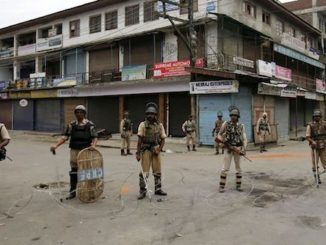
    The BJP government’s move has, however, not only completely swung the pendulum but is also antithetical to the very idea of inclusivity. By turning J&K, especially the Valley, into a virtually open air prison, with a full clampdown and information blackout, the message is clear: that New Delhi alone will decide the political future of the people of J&K with no room for any consultative process and no space for dissent.

    The Kashmir move affects the robust nature of Indian democracy in addressing internal conflicts and alienation

    The recent abrogation of Article 370 ending the special status of Jammu & Kashmir (J&K) in the Indian Constitution along with the Jammu and Kashmir Reorganisation Bill, 2019, bifurcating the State into two Union Territories (J&K and Ladakh), have delivered a knock-out blow to the long-drawn-out peace process in Kashmir.

    These moves also herald a paradigm shift in the fundamental premises and parameters of India’s approach towards the Kashmir issue, with long-term implications for its political strategy of tackling such internal conflicts. There are three cardinal principles which successive political regimes have hitherto followed in addressing internal conflicts and seeking political reconciliation with alienated segments of the populace. These in turn have bolstered the robust and resilient nature of Indian democracy. The future, however, appears much more uncertain. Here is why.

    Accommodative parameters

    The first principle entails adhering to the letter and spirit of the Indian Constitution. Its far-sighted and malleable nature has stood the test of time. Since 1947, India has faced a wide-ranging nature of political demands ranging from secession, to the creation of a separate State for Jammu, Union Territory status for Ladakh and others seeking affirmative discrimination for the Dogri language, Scheduled Tribe status for Gujjars and Paharis and so on.

    In response, the central leadership has tried finding ways and means within the overarching parameters of the Indian Constitution and have rarely been disappointed. In view of the difficult circumstances under which the Dogra Maharaja Hari Singh had acceded to India, Article 370 itself offered an excellent example as to how the special needs and political aspirations of the people of J&K could be politically and constitutionally accommodated by India’s Constitution makers.

    Decades later, when Ladakhi Buddhists launched an agitation in 1989, demanding Union Territory status, the Indian Constitution once again made space for political experimentation by introducing intermediate state structures — the creation of two autonomous hill councils for Leh and Kargil.

    Weakening federalism

    Against this backdrop, it is for the first time in independent India’s history that the Bharatiya Janata Party government has used constitutional provisions for opposite ends: to undermine and weaken India’s federal character by downgrading a State and territorially dividing it into two Union Territories without the consent of the people of J&K.

    The method adopted to execute this decision is of special concern because by equating or replacing the Constituent Assembly of J&K (which was dissolved in 1957) with the Legislative Assembly of J&K, and Parliament appropriating the latter’s powers since the State is under President’s rule, the Central government has acted unilaterally to reorganize the State of J&K.

    This rests not only on legally shaky ground but also flies in the face of constitutional norms and propriety. If this passes judicial scrutiny, it can then be done to any State in India, with drastic implications for its federal character.

    The second principle pertains to the maxim of ‘inclusivity’, that is, a political demand being made must be inclusive in terms of representing the interests of all those in whose name it is made. This supported bridge building and coalition-making among different communities certainly helped in shaping the peace process, in turn bolstering India’s deeply diverse and plural character.

    In J&K’s context too, it has also proven to be a critical common factor helping to explain the failures and successes of various political demands. The Kashmiri idea of self-determination in a multi-ethnic, multi-religious and multi-lingual society, for instance, was to call for a plebiscite as mandated by the UN resolutions of 1949 or seek an independent and sovereign State of J&K, but this was not the approach taken by other communities such as the Dogras, Kashmiri Pandits, Gujjars, Bakkarwals, and Ladakhi Buddhists. In the 1950s, as indeed in the 1990s, the demand by Kashmiri Muslims for a right to self-determination or azadi was politically checkmated by these communities as their political choices were very different; time and again, an exclusively Valley-focused approach has doomed the prospects of the peace process.

    Demographic impact

    The BJP government’s move has, however, not only completely swung the pendulum but is also antithetical to the very idea of inclusivity. By turning J&K, especially the Valley, into a virtually open air prison, with a full clampdown and information blackout, the message is clear: that New Delhi alone will decide the political future of the people of J&K with no room for any consultative process and no space for dissent.

    The decision to divide the State is particularly fraught with the risk of deepening regional and communal fault lines. While Ladakhi Buddhists, for instance, are now celebrating the fulfilment of their long pending demand for Union Territory’s status, the voices of Kargilis who are still under a strict curfew are yet to be heard. They may not support this decision because ‘a Union Territory without a legislature’ not only negates the idea of decentralization of power to the grassroots (the undergirding principle of the autonomous hill council) but could well lead to a shifting of the loci of power to Leh, resulting in losing whatever gains they have assiduously made over the years.

    The celebrations by Kashmiri Pandits are anticipated because of the gross injustice and displacement they have suffered since their forced exodus from the Valley in the early 1990s. It remains to be seen whether the abrogation of Article 370 by itself, would facilitate their return to the Valley without the support of local Kashmiri Muslims and rising violence.

    Instead of making all communities equal stakeholders in the peace process, the BJP government’s decision may well end up pitching one community against the other. A deepening of societal fissures and communal fault lines do not go hand in hand with the agenda of peace-making.

    The third principle refers to a promise and the practices of holding a dialogue process and sharing political power with opponents of all hues. In Kashmir, successive Central governments have until now never shut the door of dialogue in the face of political opponents who have ranged from the Sheikh Abdullah-led Plebiscite Front in the 1960s to the Muslim United Front in the 1980s to the Hurriyat leadership since the 1990s. This also holds true for militant groups.

    While the bottom line of Congress governments has been a commitment by their opponents to abjure the path of violence and abide by the Indian Constitution, the erstwhile Vajpayee-led National Democratic Alliance (NDA) regime was even more generous in offering the broad framework of ‘insaniyat, jamhooriyat and Kashmiriyat’.

    The Modi government faces an uphill task in identifying credible local partners in ushering in peace to the Valley, which may well end up in facing yet another impasse.

    Political fallout

    In a significant point of departure, the present government is pursuing a hard, top-down approach. The Home Minister has categorically ruled out any dialogue with militants and the Hurriyat and has even castigated the mainstream regional political leadership of the National Conference and Jammu and Kashmir Peoples Democratic Party for being corrupt, promoting family rule and fomenting separatism and violence. This move has nullified the very idea of a process of dialogue and runs the risk of discrediting the mainstream politicians and obliterating the middle ground between the militants and mainstream politicians.

    The Prime Minister in his recent address to the nation, expressed hope that new leadership in Kashmir would emerge from grass-roots politics. It is important to note that in 1,407 out of 2,135 halqas or village clusters, there was no voting at all in the panchayat elections that were held in 2018. This does not lend credence to youth being optimistic about joining mainstream politics especially after the abrogation of Article 370, a move which is only likely to deepen the alienation. The Modi government faces an uphill task in identifying credible local partners in ushering in peace to the Valley, which may well end up in facing yet another impasse.

    (Navnita Chadha Behera is the author of ‘Demystifying Kashmir’ and ‘State, Identity and Violence: Jammu, Kashmir and Ladakh’)