Tag: Dot

  • City Planning Congratulates this Year’s Class of Youth Engagement Curriculum Graduates

    City Planning Congratulates this Year’s Class of Youth Engagement Curriculum Graduates

    Taking place at The Laboratory School of Finance and Technology, the curriculum helps give seniors the planning tools to advocate for their communities.

    NEW YORK (TIP): Department of City Planning Director Dan Garodnick, on April 4, announced that 45 high school seniors from The Laboratory School of Finance and Technology (MSHS223) in Mott Haven, the Bronx graduated from DCP’s youth engagement curriculum course, which teaches young people about planning concepts to help them become civic leaders and advocates in their communities. Click here for a gallery of photos from today’s ceremony.

    “The great work that these students have produced through this course demonstrates that the next generation of planners is ready to craft a better future for New York City. Congratulations to them, the teachers, City Planning staff, and everyone who helped make this important curriculum possible,” said Dan Garodnick, Director of the Department of City Planning.

    “Our students know their neighborhoods better than anyone, and I commend all the young people honored today for not only showing promise as future leaders of our city, but demonstrating their capacity as current leaders in their communities,” said New York City Schools (DOE) Chancellor David C. Banks. “I urge my fellow city leaders to really listen to what our students have to say and celebrate their voice.”

    “By providing students with an opportunity to engage with city agencies and visit sites located within their communities, the Department of City Planning is providing the next generation of urban planners and advocates a ‘hands-on’ experience that will better equip them to make an impact on the future of their neighborhoods,” said New York City Economic Development Corporation (NYCEDC) President & CEO Andrew Kimball. “NYCEDC was thrilled to host this year’s students at the historic Kingsbridge Armory, where we had the opportunity to discuss what a redeveloped armory would mean for the community, and we look forward to hosting next year’s students.”

    “Congratulations to the graduates of DCP’s youth engagement curriculum! This program equips our youth with leadership and city planning skills, and a deeper understanding of community engagement. By evaluating street improvement projects near their school, the students learned firsthand how to enhance their neighborhood’s livability and design safer streets. As future leaders, we are preparing them to address the challenges facing our city, how to become effective advocates, and how to actively contribute to our city’s improvement,” said New York City Department of Transportation (DOT) Commissioner Ydanis Rodriguez.

    “I am proud of the work of each of the high school seniors of The Laboratory School of Finance and Technology MSHS 223 who successfully completed the Department of City Planning’s youth engagement curriculum course,” said Bronx Borough President Vanessa L. Gibson. “When you involve our youth at an early age in real-world projects and developments that address sustainability, transportation, and affordable housing, they are not only becoming informed citizens but are also more equipped to support their communities. I want to thank Department of City Planning Director Dan Garodnick and his team of planners, human resource experts, and urban designers along with staff from The Laboratory School for their collective work in creating this amazing opportunity for our teens.”

    At today’s student fair, seniors presented their final projects to City government leaders, including representatives from DCP, DOE, DOT, EDC, the Department of Housing Preservation and Development, and the Department of Small Business Services, as well as community groups such as the Architectural League, Living City Project, and South Bronx Unite. The 45 seniors who participated in the youth engagement curriculum were divided into three classes, each of whom did a mock neighborhood study of Bronx Community District 1. Each study was exhibited through five displays – one that showed a plan overview and four that covered key topics studied during their course: housing, economic development, sustainability/resiliency, and transportation.

    The curriculum was crafted by DCP’s Community Planning and Engagement division and Civic Engagement Studio, and included lessons on urban planning concepts, planning history, urban design, and advocacy and decision-making, including how the public review process works. DCP is dedicated to putting communities at the forefront of planning conversations about the future of their neighborhoods.

    “Over the past eight weeks, DCP’s Community Planning and Engagement division has empowered F&T seniors to articulate and advocate for their visions of a more equitable and sustainable city. Students transitioned from observers to active participants in the city planning process, proposing insightful plans based on their lived experiences and aspirations for the South Bronx. I would like to thank DCP for equipping students with both the platform and audience to shape the future of economic development, housing, sustainability, and transportation in our city,” said Hope Grossman Devore, government teacher at The Laboratory School of Finance and Technology.

    “Developing a project about affordable housing was a really enjoyable experience. It allowed me and others to contribute to the future and help our community. I learned about the importance of communication during this unit because that way we can create a strong relationship between people, leaders, and communities when it comes to city planning,” said Edwin Lucas, senior at The Laboratory School of Finance and Technology.

    “I really enjoyed brainstorming ideas and finding solutions for creating better living spaces in the city planning project. I learned about economic development and discovered how vital it is to invest in young people through proper training and support because we are the future generation. It’s exciting to think about how empowering young people in the workforce can lead to a stronger economy and brighter future for all of us,” said Gideon Owusu, senior at The Laboratory School of Finance and Technology.

    Now in its third year, the eight-week curriculum began on February 5, 2024, and was structured to build students’ advocacy skills and elevate their voices and ideas on neighborhood needs. The course featured planners and urban designers as well as teachers from The Laboratory School; and included input from City agencies with deep expertise in housing, economic development, planning, and much more.

    All three classes went on site visits that covered the four main planning topics. For housing and sustainability, the students visited Via Verde, an income-restricted, energy-efficient building in the South Bronx. To learn more about economic development, the students went on a guided tour of the Kingsbridge Armory with the New York City Economic Development Corporation. For transportation, they joined the New York City Department of Transportation at street improvement projects near their school, measuring street widths and analyzing vehicle speeds.

    DCP’s Community Planning and Engagement division continues to explore opportunities to expand the program to other schools and get more students involved in planning and civic advocacy.

    Department of City Planning
    The Department of City Planning (DCP) plans for the strategic growth and development of the City through ground-up planning with communities, the development of land use policies and zoning regulations applicable citywide, and its contribution to the preparation of the City’s 10-year Capital Strategy. DCP promotes housing production and affordability, fosters economic development and coordinated investments in infrastructure and services, and supports resilient, sustainable communities across the five boroughs for a more equitable New York City.

    In addition, DCP supports the City Planning Commission in its annual review of approximately 450 land use applications for a variety of discretionary approvals. The Department also assists both government agencies and the public by advising on strategic and capital planning and providing policy analysis, technical assistance and data relating to housing, transportation, community facilities, demography, zoning, urban design, waterfront areas and public open space.

    .

  • MAYOR ADAMS ANNOUNCES SIGNIFICANT QUALITY-OF-LIFE IMPROVEMENTS, NEW AFFORDABLE HOMEOWNERSHIP OPPORTUNITIES IN SOUTHEAST QUEENS

    MAYOR ADAMS ANNOUNCES SIGNIFICANT QUALITY-OF-LIFE IMPROVEMENTS, NEW AFFORDABLE HOMEOWNERSHIP OPPORTUNITIES IN SOUTHEAST QUEENS

    Mayor Adams and Speaker Adams Return to Area Where They Grew up, Highlighting Major Investments in Infrastructure and Affordable Housing

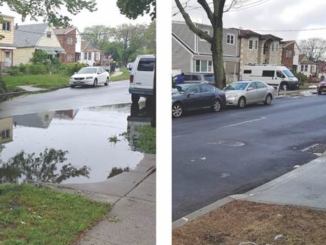
    City Has Completed $50 Million Water Infrastructure Project Under Budget to Address Regular Flooding of Homes and Streets

    Mayor Kicks off “Habitat Net Zero” Project, Creating 16 Green Homes for Affordable Homeownership Through Innovative Community Land Trust Model

    SOUTH JAMAICA, NY ­– New York City Mayor Eric Adams today announced milestones in two major projects that will improve infrastructure and quality of life, while tackling the affordable housing crisis in Southeast Queens. Mayor Adams and New York City Council Speaker Adrienne Adams — both of whom grew up in the area — celebrated the completion of a $50 million project delivering more than six miles of new sewers and water mains to alleviate flooding of homes and streets in Rochdale under budget. They also kicked off construction of “Habitat Net Zero,” a project that will turn 13 dilapidated homes previously owned by the New York City Housing Authority (NYCHA) into 16 green homes for affordable homeownership.

    “This community represented the promise of a better life for my family, and I am going to keep that promise for generations of New Yorkers,” said Mayor Adams. “Government has ignored this community for too long, denying them their fair share of investments and services — that ends in my administration. These projects will make life better for the residents of Southeast Queens today and those who will be able to move here in the future, and I’m proud to say that this is just the beginning.”

    “For too long, Southeast Queens has endured systemic disinvestment and neglect, resulting in widening disparities that persist today,” said Council Speaker Adams. “With the completion of the $49.3 million water infrastructure project in Rochdale and the start of construction for Habitat Net Zero — a project to deliver new affordable homeownership opportunities — our communities are seeing the investments and improvements that we have always deserved. I thank Mayor Adams, Habitat NYC, Interboro CLT, and all of the city agencies involved in making these projects possible.”

    “Ever since the residential development of Southeast Queens more than 50 years ago, neighbors have worried about any threat of rain in the forecast, because there were no catch basins or sewers built to drain the roadways, resulting in chronic flooding and property damage,” said Deputy Mayor for Operations Meera Joshi. “With a commitment of $2.5 billion for a comprehensive drainage system, we are now correcting that past failure block by block, and I thank our teams at DEP, DDC, and DOT for completing this particular project under-budget.”

    “Today, we are strengthening our promise to provide families not just homes they can afford but homes they can be proud of,” said Chief Housing Officer Jessica Katz. “By using every tool available and leaning on great partners – including Habitat for Humanity, which will change the lives of 16 families through their work here — once again, Queens and New York City will be a place where you can raise your family, regardless of income.”

    SEWER AND WATER INFRASTRUCTURE

    The New York City Department of Environmental Protection (DEP), New York City Department of Transportation (DOT), and New York City Department of Design and Construction (DDC) have reached substantial completion on a $49.3 million project, bringing more than six miles of new sewers and water mains to Rochdale — improving street conditions, alleviating flooding, and upgrading infrastructure, while staying $5.7 million under budget. Work began in March 2018 and took place on 78 individual blocks.

    More than one mile (5,535 feet) of new storm sewers was added to the neighborhood, and an additional 2,265 feet of existing storm sewers were replaced. To better capture stormwater and direct it to the new storm sewers, 55 new catch basins were installed, and 53 old ones were replaced. The holding capacity of the local sewers was increased with the installation of three new underground chambers and replacement of an old one. During construction, 9,235 feet of sanitary sewers were replaced, and 595 feet of new sewers was installed. More than three miles (16,160 feet) of water mains were replaced to improve water infrastructure reliability.

    As part of the final street restoration, 490,240 square feet of asphalt were laid down over a new concrete base. Throughout the project area, 65,840 square feet of sidewalk and 19,370 feet of curbs were reconstructed, and 890 square feet of new sidewalk and 995 feet of new curbs were added. The new curbs and sidewalks were graded to help guide stormwater to the area’s new catch basins and ensure adequate street drainage during storms. Fire protection was enhanced with the installation of six new fire hydrants and the replacement of 33 existing ones. Compliance with the Americans with Disabilities Act was improved with the installation of four new pedestrian ramps and the replacement of 158 existing ones.

    The project is part of the ongoing $2.5 billion Southeast Queens Initiative, in which the city will build a comprehensive drainage system, improve street conditions, and alleviate flooding in neighborhoods throughout Southeast Queens. The program — the largest of its kind — consists of 44 projects overall, including 18 substantially completed, 14 in design, and three in active construction.

    AFFORDABLE HOUSING

    The New York City Department of Housing Preservation (HPD), NYCHA, and Habitat for Humanity New York City and Westchester County have closed and started construction on “Habitat Net Zero,” bringing long-term affordable homeownership opportunities to Southeast Queens. Through HPD’s Open Door program, this project will see the demolition or rehabilitation of 13 vacant, dilapidated, previously NYCHA-owned houses to create 16 new and rehabilitated homes built to Passive House standards for affordable homeownership. This project represents the first new construction of affordable homes where the land will be transferred to the Interboro Community Land Trust (CLT) to ensure long-term affordability. Developed by Habitat, the homes will be equipped with rooftop solar panels and highly efficient heat-pump technology for heating and cooling, reducing costs, and keeping homes at or near net zero energy use. Thirteen of the new homes will be new construction and built using modular construction; three will be gut rehabilitations of the existing structures.

    Agreements with HPD, Interboro CLT, and the homeowners are structured to ensure that the homeowners have the support they need to maintain their homes and that the homes remain affordable in the long term. Initial sale prices and resale prices will be affordable to low- and moderate-income households. HPD will enter a 40-year regulatory agreement with Interboro CLT, and the CLT will enter into 99-year, renewable ground leases with each homeowner.

    These sites were awarded to Habitat through a 2018 request for proposals from NYCHA. In addition to funding from HPD’s Open Door program — which funds the new construction of homeownership opportunities for low-, moderate-, and middle-income households — funding for this project will be financed by the New York State Affordable Housing Corporation and with Reso A funds provided by Queens Borough President Donovan Richards, City Council Speaker Adams, and former New York City Councilmember I. Daneek Miller. HPD also facilitated an Article XI tax exemption, which will help keep ongoing housing costs affordable for lower-income households. The Local Initiatives Support Corporation (LISC) and Nonprofit Finance Fund are also providing construction financing.

    “We have committed $2.5 billion for building a comprehensive drainage system to ensure public safety and protect the homes and property of the residents and businesses of Southeast Queens,” said DEP Commissioner Rit Aggarwala. “We also hope this massive financial investment will improve the quality of life for residents who worked hard to buy a home and maybe raise a family in these neighborhoods. These residents deserve the same infrastructure as the rest of the city, and we’re making tangible progress on that promise.” “The city’s investment in Southeast Queens infrastructure is growing and making a tangible difference in the lives of the half a million people who live in these historically underserved areas,” said DDC Commissioner Thomas Foley. “Street conditions are greatly improved, curbs and sidewalks have been installed in some areas where there were none, and miles of new storm sewers now keep stormwater off the streets and out of people’s homes. We are delighted to share that this project was delivered $5.7 million under budget, and we look forward to working with DEP and DOT to complete this program of more than 40 individual projects.”

    “Everyone in New York City deserves the assurance that their streets or homes will not be inundated every time it rains, but for thousands of Southeast Queens residents, flooding has been a frustrating perennial issue,” said DOT Commissioner Ydanis Rodriguez. “DOT has been proud to work with our partners at DEP and DDC on investments that are transforming the streets and sidewalks of these neighborhoods — improving quality-of-life while at the same time providing better access for pedestrians and the disability community.”

    “Soon, these old, vacant homes will become high-quality, energy-efficient, new affordable homeownership opportunities — a testament to our team at HPD, who looks at every opportunity to expand the supply and quality of affordable housing,” said HPD Commissioner Adolfo Carrión, Jr. “And by transferring land ownership to the Interboro CLT, we are advancing equity in ownership, long-term affordability, and wealth building for families and communities alike. Thank you to our local partners at Interboro Community Land Trust, Habitat NYC and Westchester, and NYCHA for making this exciting project possible.”

    “NYCHA, in partnership with HPD and local non-profit organizations like Habitat for Humanity New York City and Westchester, has made great progress in connecting low- and moderate-income residents to housing opportunities across New York City,” said NYCHA Chair and CEO Greg Russ. “By leveraging underutilized assets in our portfolio, we can facilitate the construction of homes that enrich our local neighborhoods, while making the dream of homeownership possible for a new generation of New Yorkers.”

    “This community has long suffered from flooding issues and deteriorating infrastructure, so we heartily welcome the new sewer system and repairs that the city is implementing,” said New York State Senator James Sanders Jr. “We have waited for a long time, and we are looking forward to an improved quality of life.”

    “Through HCR’s Affordable Housing Corporation, New York State makes safe and affordable homeownership a reality for thousands of New Yorkers each year,” said New York State Homes and Community Renewal Commissioner RuthAnne Visnauskas. “Our $560,000 award to support ‘Habitat Net Zero’ in Southeast Queens will expand economic opportunity and access to generational wealth building for low- and moderate-income households. Under Governor Hochul’s sweeping plan to make housing more equitable and climate-friendly, we will continue to work alongside our city and nonprofit partners to create and protect the healthy, secure, and affordable homes that New Yorkers deserve.”

    “‘Habitat Net Zero’ creates more opportunities for more families in Southeast Queens to build equity and stability through homeownership,” said Karen Haycox, CEO, Habitat for Humanity New York City and Westchester County. “The positive impact of these healthy, energy-efficient, and affordable homes will benefit hard-working families now and for generations to come. Our city and our state are stronger when we make room for more of us to own a piece of our communities.” “The ownership of the land by the community land trust, coupled with the net-zero features of the homes and the Article XI property tax exemption, constitute a potent trifecta that not only strengthens the permanent affordability of the homes but also reinforces the opportunity for homeowners to build personal as well as generational wealth,” said John Edward Dallas, coordinator, Interboro Community Land Trust. “Interboro thanks Habitat, HPD, NYCHA, LISC, and everyone else who made this trailblazing and much-needed permanently affordable homeownership project possible.”

    “New Yorkers need more options to affordably stay in their neighborhoods, despite increasing land speculation and threats of displacement,” said Olivia Pipitone, financing director, Nonprofit Finance Fund. “As a community land trust, this project will give Queens homeowners greater control over assets in their neighborhoods — control that is needed to help close racial health and wealth gaps.”

    “We’re thrilled to support this exceptional public-private partnership that will transform dilapidated and vacant buildings into new, highly-efficient, and affordable homes in Southeast Queens,” said Valerie White, executive director, LISC NYC. “This project is centered around equity and opportunity, providing safe, secure, and affordable housing for New Yorkers who need it most, while creating pathways for first-time homebuyers to help jumpstart the process of building generational wealth. We’re proud to partner with Interboro Community Land Trust, Habitat for Humanity New York City and Westchester, HPD, and NYCHA to advance this innovative and equitable project.”

  • Hinduism symbols and their meaning

    Hinduism symbols and their meaning

    Hinduism is full of symbolism—arguably no other religion employs the art of symbolism as effectively as the Hindus. Most of these symbols are representative of the philosophies, teachings, omen, and even the gods and goddesses.

    In Hinduism, symbols play a major ritual in social life, culture, and rituals. Hinduism is full of powerful theories and philosophies which find similarity with the modern science. Over time many concepts of Hinduism are gaining credibility among modern scientists.

    Let us look at major symbols of Hinduism and their deep meaning they convey.

    Aum

    The Aum (Om)) is the most important spiritual Hindu symbol and its sound is used in meditation. In Hinduism, the word “Om” is the first syllable in any prayer.

    More specifically, Om is used to signifying the universe and the ultimate reality. Some people say that this symbol represents the three aspects of God: the Brahma (A), the Vishny (U), and the Shiva (M).

    Om is a foundation of Hinduism, where it is considered the very first sound of the universe. “Before the sound Om, there was nothing.” It is sometimes wrongly pronounced as ‘Om.’ The correct pronunciation however is ‘Aum’. The ‘A’ here represents creation, ‘U’ is manifestation, and ‘M’ is destruction.

    Lotus

    The lotus is a very important symbol of Indian cultural heritage. Hindu scriptures are full of praises of the lotus because it is very sacred to all the Gods.

    God Brahma and  Buddha are both shown sitting on a lotus. The Sun is also like a red lotus rising from the blue ocean/sky. Lord Vishnu holds a lotus in one of His left hands. Goddess Lakshmi also holds a lotus, presumably because both were obtained from the ocean churning.

    It is a water-borne flower, yet not even a drop of water stays on the lotus or its leaf, so it is regarded as the most appropriate symbol of detachment from surroundings.

    Tilak, Dot, Bindu

    Our ancient human ancestors saw the shape and form of their own body on earth and he also saw the burning ball-like shape of the Sun in the sky.

    This was his first acquaintance with shape. Then,  they also saw the clouds assuming random shapes and dimensions so they start to give shapes and forms to their own ideas and thoughts and realized that the starting point of all shapes and forms is a point. Geometry recognizes the point as a shape without dimensions which, though it cannot be described, still exists. Every drawn line is a string of points so he conceived a starting point to describe his thoughts, visions, and emotions and to express them with the help of his own sound.

    Thus, sound and point became intertwined. A dot or point is the seed of language expressed by sound so it was the finale of the highest attainment.

    A dot or point is the abode of Shiva-Shakti, Vishnu- Lakshmi-Shakti. Every person belonging to any society or civilization had an indomitable will and urge to communicate his thoughts, emotions, and experiences to indicate their distinct identity, so symbols were developed.

    Swastik

    For success in every undertaking human beings pray to God by invoking hymns, singing praise, recitations, etc. The Rishis had determined a shape as a symbol to propitiate cherished desire. The root of Swastik is su + us su means benefic and us means existence; whosoever desires to have glory, prosperity, progress, success, etc. is advised to invoke the Swastik Yantra.

    The swastika is also one the most recognized Hindu Symbol outside India. This however has to do with its infamous association with Nazi Germany symbol.

    Shree Chakra or Shree Yantra

    Sri Yantra – symbol of formed by nine interlocking triangles that radiate out from the central point.

    The Garbh-Grah — sanctum sanctorum, of Lord Venkateshwara’s temple in India, has a highly powerful Shreeyantra beneath the foundation, so this temple has become a wish-fulfilling holy place for real devotees. It is the richest temple in India.

    It is claimed that a Shree Yantra made with five precious metal alloys in the prescribed composition as laid down by the Rishis and sanctified by a Siddha saint, acquires undisputable potency of bestowing riches on the devotee for several years as per the potency infused in it.

    Sir John Woodruff and Dr. N.J. Button of U.K., and Dr. Zejerta of Germany have undertaken a deep study and research on the scientific construction and celestial effects of Shree Yantra. In Russia, Dr. Alexi Kulaicheva has attempted to analyse and study the formation of Shree Chakra or Shree Yantra on a computer to establish its precision and accuracy.

    Rudraksha

    Rudraksha is the seed (stone) of a fruit of a rare species of a tree found in Nepal, Java, Sumatra and Malaya. In India, it has been found in Haridwar and spotted at some centers in Konkan and Karnataka. It is roundish with a cellular demarcation and has a central bore. Small or unripe, unmatured seeds are of no value.

    Rarely, a seed with no bore is also seen but then it becomes a piece of great sanctity value if it has only 1 cell mark. The cellular mark/division varies from 1 to 21 per seed. The Rishis observed these peculiarities and made detailed investigations because they noticed that every seed is a ball of energy but the efficacy quantum differed from piece to piece with different cellular markings but there was no difference in any two identical seeds.

    Rudraksha holds a place of pride in the Rigveda, Atharvaveda, Skand Puran, and other scriptures because of their beneficial properties of attracting healthy vibrations. Saints wear it as a necklace; the Rishis had deified it as an ornament of Lord Shiva.

    Sacred Thread

    To encourage cooperation and establish order in society, Hindus had divided the life span of every person into four distinct divisions — Brahmacharya — the celebate life of a student; Grihasta — family life; Vanprastha — the third portion of life when a person should detach himself from family bonds and endeavour to serve the society; and Sanyasa — when a person should finally renounce the world. In this final stage, the person ceases to belong to his family, caste, or creed. Instead, he devotes himself to spread the message of the scriptures of love and benevolence and simultaneously practices Yogic Sadhna to illuminate his own self to attain salvation.

    There is no sanction for leading an idle life and becoming a burden on society or to look to pass life in an old-age-home run with the help of others. To make life simpler and enjoyable, Lord Shree Krishna preached secularism, saying, “I have divided mankind in four stages (Ashrams) as per their competence/capability and deeds (calling) or professions so, there is no need for any class conflict, or haves and have-nots in society.”