Tag: Dr APJ Abdul Kalam

  • Red tape blocking NRI partnership in Punjab’s growth: Indo-Canadian leader Dhaliwal

    Red tape blocking NRI partnership in Punjab’s growth: Indo-Canadian leader Dhaliwal

    CHANDIGARH /  VANCOUVER (TIP): Red tape and a callous bureaucratic attitude derailed ambitious development projects initiated by NRIs in collaboration with the Punjab Government, said Harbance Singh (Herb) Dhaliwal, the first Indo-Canadian Cabinet Minister, in a conversation with The Tribune in Chandigarh.

    Dhaliwal was referring to the efforts of the Indo-Canadian Friendship Society of British Columbia, which launched development projects in 20 villages across the districts of Hoshiarpur, Shaheed Bhagat Singh Nagar, Kapurthala, Jalandhar, Ludhiana, and Amritsar. Started in 1999, the projects focused on wastewater treatment, underground sewerage, street lighting, tree plantation, gender empowerment, clean drinking water, paved streets, hygiene, and computer education.

    “The initiative was led by Dr Gurdev Singh Gill, the first Indo-Canadian physician in 1958, known for his public service and grassroots activism. He stayed in Punjab to personally anchor the programme,” Dhaliwal said. “We began with Kharaudi village in Hoshiarpur district, which was later visited by former President Dr APJ Abdul Kalam,” he added.

    The programme received early support, and former Chief Minister Capt. Amarinder Singh even announced that 700 villages would be developed as model villages during a function in Bahrampur, Ludhiana.

    “Initially, the state government responded positively, but over time, things changed. Bureaucratic hurdles and delays in project clearances made it difficult to move forward. Officers offered only lip service. Eventually, we withdrew. After Dr Gill passed away in 2023, our connection with the government was lost,” Dhaliwal shared.

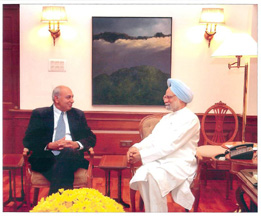
    He added, “The project had the enthusiastic support of Chief Ministers Parkash Singh Badal and Capt. Amarinder Singh. I also discussed it with former Prime Ministers Manmohan Singh, I.K. Gujral, and Atal Bihari Vajpayee. NRIs from the USA joined efforts in at least one village.”

    He remarked that despite good intentions from political leadership, the state machinery failed to offer sustained cooperation, and we were left stranded midway.

    Political Career

    A member of Jean Chrétien’s government, Dhaliwal served as Canada’s Minister of Revenue in 1997, Minister of Fisheries and Oceans in 1999, and Minister of Natural Resources in the same year.

    Personal Journey

    Dhaliwal’s grandfather had migrated to Russia in 1904, then to the USA, and eventually settled in Vancouver. Born on December 12, 1952, in Chaheru village (Kapurthala), Dhaliwal moved to Canada at the age of five.

    “My parents worked as laborers and encouraged me to focus on education. I supported myself with jobs in sawmills and other small tasks,” he recalled. He earned a B. Com from the University of British Columbia in 1972 and started a maintenance business from his basement. He later expanded into transportation and real estate. A self-made millionaire, Dhaliwal donated $1 million to his alma mater for medical cannabis research. Dhaliwal’s wife, Amrit Kaur, passed away. He is father to two daughters and a son and has five grandchildren.

    Canada Still Needs Indian Youth 

    On the recent deportation of thousands of Indian students from Canada, Dhaliwal called it a temporary phase. “Canada is facing an aging population crisis. We need young people,” he said. “The current situation is due to poor planning—lack of housing and jobs. But in the long run, Canada will need more youngsters to lead the country forward. Better planning is the need of the hour.”

  • Politics: How accountable are Advisors?

    Politics: How accountable are Advisors?

    After independence, Prime Minister Jawahar Lal Nehru, had set the concept of appointing Advisors in motion when he named JJ Anjaria as the country’s first Chief Economic Advisor in 1956. Among those who followed JJ Anjaria was Indira Gandhi’s pick Dr Manmohan Singh  who remained  country’s Chief Economic Adviser  from 1972 to 1976.

    By Prabhjot Singh

    Appointing Advisors by spending  huge sums of public money for  soliciting expert advice to facilitate the formulation and improve the quality of public policy is nothing new in liberal democracies. Ever since Independence, both the central and state governments  have been making use of experts from outside the gambit of the available political or administrative machinery  for  their advice on matters of public interest or welfare. The governments have been using consultancies, think tanks, academicians, and technocrats, to obtain expert opinion or advice while formulating plans.

    After independence, Prime Minister Jawahar Lal Nehru, had set the concept of appointing Advisors in motion when he named JJ Anjaria as the country’s first Chief Economic Advisor in 1956. Among those who followed JJ Anjaria was Indira Gandhi’s pick Dr Manmohan Singh  who remained  country’s Chief Economic Adviser  from 1972 to 1976.

    The central government has since come a long way and now it has several very “powerful” Advisors, including the National Security Advisor, a position, though outside the purview of the Constitution, that has been shared by superannuated diplomats and policemen. The Chief Economic Adviser continues to be drawn from amongst the economists.

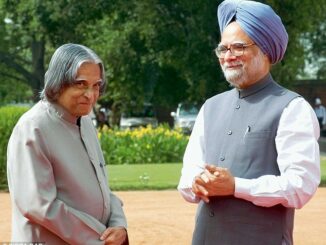
    In 1999-2000, the Union Government also appointed the country’s first Principal Scientific Advisor in Dr APJ Abdul Kalam. It is pertinent to mention that Dr Manmohan Singh (Chief Economic Advisor) and Dr APJ Abdul Kalam (Principal Scientific Advisor) rose to be the Prime Minister and President of the country, respectively. The appointments made on the basis of professional acumen and competence,  generally remain free of  any controversies. However, when the Advisors are appointed out of sheer political compulsions, they invariably  get  mired in controversies.

    There is a lot of ambiguity in the choice and classification of Advisors. There is a category of Advisors  who are  serving bureaucrats, technocrats, financial experts and are hand-picked  for  “plum” posts that generally fall in the category of ex-cadre posts.

    The second category is of political appointees  as Advisors. These appointments, if made for office for profit slots, need legislative approval.

    Chandigarh Administration is an example where serving bureaucrats hold the position of Adviser to the Administrator. The practice started in June, 1984, coinciding with the launch of Operation Bluestar in Punjab. K Banarji, who was the last Chief Commissioner of Chandigarh, became the first Adviser to the Administrator of Chandigarh. Since then, 18 Advisers have served the Administration.

    This category of “official” Advisers have their pay packets and service conditions protected by the civil service rules.

    There is another subgroup of these Advisors who  are superannuated bureaucrats, including diplomats, and financial wizards. Most of the Central Government Advisors belong to this group.

    There are no fixed norms like pay packets and service conditions for the political category of Advisers. Depending upon the status or clout of the appointee, his or her perks are fixed.

    It depends upon the State Governments or the Central Government to decide how  to make  best use  of expert advisors  in the policy process.

    The recent controversy about the appointment of Rajya Sabha member Raghav Chadha as Chairman of  an  Interim Advisory Committee has political implications. The Opposition parties are using it as a major tool to bash the Chief Minister Bhagwant Mann and the ruling Aam Aadmi Party for subjugating the interests of the State. The appointment has been challenged before the Punjab and Haryana High Court on the plea that an “outsider” has no locus standi to hold a position in a policy making body of the State.

    Punjab has a long history of being ruled by Advisors. Since the State had the longest spell of President’s Rule in 80s, it had a number of superannuated bureaucrats, defense personnel and policemen  as Advisors to the Governor or as members of the Governor-in-Council.Some of these Advisors, including JF Ribeiro, TS Baroca, Dr SS Sidhu, SL Kapur and others served  for terms from one to three years. The Governor-in-Council virtually performed the role of the State Cabinet and used to take all major policy decisions.

    Other than these Advisors, the discretion of appointing Advisors was frequently used in the post-militancy era by almost all Chief Ministers, including Parkash Singh Badal, Beant Singh, Capt Amarinder Singh and Charanjit Singh Channi. And most of these appointments were made either under political compulsions or to oblige people close to the affluent political families of the State.

    Instead of the State getting benefitted from the expert advice, these appointments  are generally  a big financial burden on deteriorating fiscal health of the State.

    Though no one disputes the rights and privileges of the elected government to appoint Advisors to seek  their expert opinion on various aspects of administration, including finances and governance, yet no provisions have been made  to hold the Advisors responsible  for advice that went against the interests of the State. Accountability clause is still not a part of terms of service conditions for the Advisors. There is no mechanism in place to judge the quality of the advice and the likelihood of it being accepted and implemented  for the welfare of the people.

    The mechanisms  to make external experts or Advisors  as active participants in the formulation of policies , and related factors or considerations influence the ability of governments to accept expert advice and incorporate it in their policy decisions are still to be worked out.

    Now when the AAP Government wants to use the expertise of Raghav Chadha to improve the fiscal health of the State, no one is talking about the role and work of the previous Financial Adviser, VK Garg, a retired bureaucrat appointed by the previous Congress Chief Minister, Capt Amarinder Singh. Intriguingly, in 2017, when Captain Amarinder Singh named six of his party legislators as  Political Advisors by according Cabinet Minister status to five of them and Minister of State status to the sixth, Bhagwant Mann was one of the frontline critics of the move saying it would put unnecessary burden on the State exchequer.There is no continuity in the expert advice or its continued implementation in the State.

    (The author  is a veteran journalist with over three decades of experience covering a wide spectrum of subjects and stories. He has covered  Punjab and Sikh affairs for more than three decades besides covering seven Olympics and several major sporting events and hosting TV shows. For more in-depth analysis please visit probingeye.com  or follow him on Twitter.com/probingeye. He can be reached at prabhjot416@gmail.com)