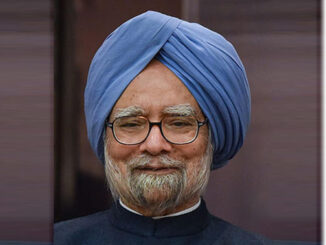
NEW DELHI (TIP): The government has shortlisted two locations for allotment of land to build a memorial to late Prime Minister Manmohan Singh. Union Urban Affairs Minister Manohar Lal Khattar on Thursday said the two sites, near the Rajghat memorial complex area, were.
The government has shortlisted two locations for allotment of land to build a memorial to late Prime Minister Manmohan Singh.
Union Urban Affairs Minister Manohar Lal Khattar on Thursday said the two sites, near the Rajghat memorial complex area, were located at the same place where other former PMs’ memorials had earlier been built. Khattar said the family of Dr Singh was being consulted and their decision would be final on the location of the memorial site.
Union Housing and Urban Affairs Secretary Katikithala Srinivas is learnt to have met the family of the former PM in the national capital today to convey the location of the shortlisted sites. The family will now get back to the government about the spot that they finalize.
Khattar said once the family takes a call, a trust would be formed and the selected land would be allotted to the trust for Re 1 and the trust would build the memorial.
“In the case of late PM AB Vajpayee, land had been similarly allotted to a trust… That trust had built Sadaiv Atal, the Atal memorial in the Rashtriya Smriti Sthal near the Raj Ghat area,” the minister said, adding that the trust that would be allotted the land would not be a government trust and would be an institution of the family’s choice.
The Tribune has learnt that the two shortlisted memorial sites are likely located at the Ekta Sthal Samadhi Complex where memorials of former Presidents Giani Zail Singh, Shankar Dayal Sharma, KR Narayanan and R Venkatraman and those of former PM Chandrashekhar, IK Gujral and PV Narasimha Rao are located.
Ekta Sthal is learnt to have space for two more memorials as of today.
(Source: TNS)
Dr. Manmohan Singh, India’s revered economist and former Prime Minister, passed away today at AIIMS, leaving an unparalleled legacy of wisdom, integrity, and transformative economic reforms. Renowned for his humility, intellect, and quiet determination, Dr. Singh was a guiding force behind India’s economic resurgence, particularly during his tenure as Finance Minister and later as Prime Minister.
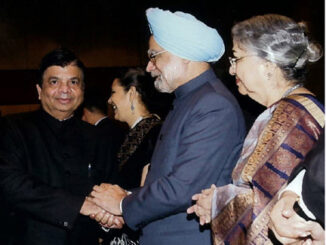
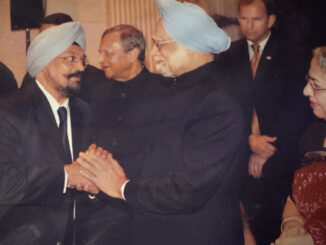
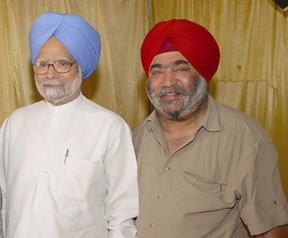
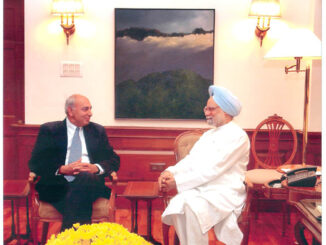
I feel deeply honored to have met this extraordinary leader during his time as Prime Minister—a memory I will always cherish. Dr. Singh’s vision and unwavering commitment to the nation will forever inspire generations to come. He will be remembered for his contributions to India’s progress and for his profound humanity.
‘India has lost a great statesman, a man of immense intellect with incredible humility,’ said George Abraham, Vice-Chair of the Indian Overseas Congress, USA, condoling the passing away of the former Prime Minister Dr. Manmohan Singh. “He will be fondly remembered for his outstanding contributions to India’s economic and social development.”
Dr. Manmohan Singh was the Chief Architect of India’s new economy. He has taken a centrally planned, inward-looking, public sector-centered economy and reversed its direction. What he has accomplished is just phenomenal. This dramatic change paints a picture of a man who is some sort of a revolutionary. If India has entered the 21st century, Dr. Manmohan Singh has much to do with it.
In addition, during his tenure as the Prime Minister of India, he was instrumental in establishing policies that lifted more than 20 crores of people above the poverty level, as per the World Bank report. IOCUSA expresses our sincere condolences to the family and the nation.
George Abraham
New York
The passing away of Dr. Manmohan Singh, India’s former Prime Minister, marks the end of an era in Indian politics and economic thought. Known for his quiet demeanor, profound intellect, and relentless commitment to public service, Dr. Singh leaves behind an indelible legacy that will continue to shape India and inspire the world for generations to come. This tribute seeks to capture the essence of his life, his achievements, and his contributions to both national and international spheres.
To me, it is a personal loss. I had the opportunity to know and meet him, and interact with him. I studied his economic thought, and it is there for the world to see how transformative were his economic ideas. He was the man who built a solid economic structure of India. The simple and unostentatious man will be remembered as a builder of a colossal India.
I am tempted to trace the life of this gem of a person for the younger generation of Indians, particularly, the ones here in America, who have been fed for too long with all kinds of lies about this great man. It will be worthwhile to know him.
Dr. Singh’s early life and education
Dr. Manmohan Singh was born on September 26, 1932 in Gah, a small village in the Punjab region of British India (now in Pakistan). His early years were marked by the tumultuous partition of India in 1947, during which his family migrated to India. Despite the hardships, Dr. Singh’s academic brilliance shone brightly.
He pursued his undergraduate degree in Economics from Panjab University and went on to earn a master’s degree from the same institution. His quest for knowledge took him to the University of Cambridge, where he completed another degree in Economics. Dr. Singh then pursued his DPhil in Economics from the University of Oxford, specifically Nuffield College, writing his doctoral thesis on “India’s Export Trends and Prospects for Self-Sustained Growth.”
Professional Career and Early Contributions
Dr. Singh began his illustrious career in academia as a professor of Economics at Panjab University and later at the prestigious Delhi School of Economics. However, his transition to policymaking and governance marked a turning point in his journey. In 1971, he was appointed as an Economic Advisor in the Ministry of Commerce and Industry, followed by a series of prominent roles:
Chief Economic Advisor (1972-1976): Dr. Singh’s insights played a key role in shaping India’s economic policies during a challenging period.
Governor of the Reserve Bank of India (1982-1985): His tenure as RBI Governor was marked by efforts to stabilize India’s financial system.
Deputy Chairman of the Planning Commission (1985-1987): Dr. Singh contributed significantly to the nation’s long-term economic planning.
Architect of Economic Reforms
Dr. Singh’s most defining role came in 1991 when he was appointed as India’s Finance Minister in the government led by Prime Minister P.V. Narasimha Rao. India was facing a severe economic crisis, with depleting foreign exchange reserves and soaring inflation. Against this backdrop, Dr. Singh unveiled a series of groundbreaking economic reforms, including:
Liberalization: Opening up India’s economy to global markets by reducing import tariffs and encouraging foreign investment.
Privatization: Reducing government control over key industries.
Globalization: Integrating India’s economy with the global market.
His visionary approach transformed India into one of the fastest-growing economies in the world. His iconic statement during the 1991 budget speech, “No power on Earth can stop an idea whose time has come,” became emblematic of India’s newfound confidence.
Tenure as Prime Minister
Dr. Manmohan Singh served as the 13th Prime Minister of India from 2004 to 2014, heading the United Progressive Alliance (UPA) government. As Prime Minister, his tenure was marked by remarkable achievements:
Economic Growth
Under his leadership, India achieved unprecedented economic growth rates, often exceeding 8% annually. Key initiatives included:
National Rural Employment Guarantee Act (NREGA): Providing a safety net for rural households.
Right to Information Act: Promoting transparency and accountability in governance.
Accelerated Infrastructure Development: Expanding roads, ports, and power projects to sustain economic growth.
Nuclear Deal with the United States
Dr. Singh’s efforts to secure the historic India-U.S. Civil Nuclear Agreement in 2008 underscored his diplomatic acumen. This agreement not only ended India’s nuclear isolation but also paved the way for strategic partnerships in science, technology, and defense.
Social Welfare
Dr. Singh’s administration introduced landmark programs in education and healthcare, such as the National Health Mission and the Right to Education Act, aiming to uplift millions from poverty and illiteracy.
Contributions to International Relations
Dr. Singh’s tenure saw India emerge as a key player on the global stage. He was instrumental in forging strong ties with major powers, including the United States, Russia, China, and Japan. His advocacy for South-South cooperation and his emphasis on combating climate change earned him international acclaim.
Under his leadership, India gained greater prominence in multilateral forums such as the G20, BRICS, and the United Nations. Dr. Singh’s measured and thoughtful diplomacy earned him respect among world leaders, many of whom sought his counsel on global economic and geopolitical issues.
Personality and Legacy
Dr. Manmohan Singh was a leader of few words but immense wisdom. Known for his integrity, humility, and steadfast dedication to the nation, he inspired admiration across party lines. Despite facing criticism during his second term as Prime Minister, particularly regarding corruption scandals, his personal reputation remained untarnished.
His ability to navigate complex economic challenges, coupled with his unwavering commitment to the welfare of India’s citizens, cemented his status as a statesman of rare caliber. His academic rigor and pragmatic approach to policymaking set him apart as a leader who prioritized the nation’s interests above all else.
Tributes from World Leaders
Dr. Singh’s demise has elicited heartfelt tributes from leaders worldwide:
Joe Biden, President of the United States: “Dr. Manmohan Singh’s vision and leadership were pivotal in strengthening U.S.-India relations. His wisdom and kindness will be deeply missed.”
Narendra Modi, Prime Minister of India: “India has lost a great leader and scholar. Dr. Singh’s contributions to our nation’s development will always be remembered.”
Rishi Sunak, former Prime Minister of the United Kingdom: “Dr. Manmohan Singh’s economic reforms and global vision elevated India on the world stage. His legacy is one of hope and progress.”
Christine Lagarde, President of the European Central Bank: “Dr. Singh was a towering figure in global economics. His insights and humility left an indelible mark on international policymaking.”
Dr. Manmohan Singh’s life was a testament to the power of knowledge, integrity, and perseverance. From his humble beginnings to becoming one of the most respected leaders in the world, he exemplified the values of hard work and selfless service.
As India mourns the loss of one of its greatest leaders, the world remembers Dr. Singh as a visionary economist, a transformative Prime Minister, and a statesman who believed in building bridges rather than walls. His legacy will continue to guide India and inspire future generations to dream big and act with courage.
Rest in peace, Dr. Manmohan Singh—a true architect of modern India.
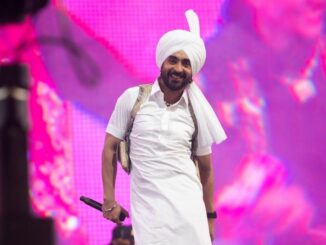
GUWAHATI (TIP): Punjabi singing sensation Diljit Dosanjh dedicated his concert to former prime minister Manmohan Singh, who died on the night of December 26. The singer-actor on Instagram shared a video from Sunday’s concert in which he spoke about the lessons he believes people should learn from Singh.
“Today’s Concert is dedicated to Dr Manmohan Singh Ji. DIL-LUMINATI TOUR Year 24,” he captioned the post.
In the clip, Dosanjh recalled how Singh would never speak ill about anyone even if someone did so towards him.
“He lived a very simple life. If I look at the journey of his life, it was so simple. Even if someone talked ill about him, he never reverted in the same manner,” he is heard saying in the video.
“Have you ever seen those Lok Sabha sessions? Our politicians fight as if they are nursery kids… But something that we should learn from Dr Manmohan Singh ji is that he never responded in the same manner,” he added.
Singh, the architect of India’s economic reforms and who served as the 13th Prime Minister of India between 2004 and 2014, died last week at the age of 92. Dosanjh, 40, further mentioned the words which Singh would speak and said everyone including him should learn from him.
“He would often say ‘Hazaaron jawabon se meri khamoshi achhi, na jaane kitne sawalon ki aabroo dhak leti hai’ (‘My silence is better than a thousand answers, it has saved the grace of many questions’) and it is something the youth needs to learn from him, even I do. We should focus on our goals even if people speak bad about us and try to distract us,” he said. “Today, I bow my head in front of a man who loved his country and spent his life serving it,” he added.
The singer will next perform in Ludhiana on December 31 as part of his ‘Dil-Luminati India Tour’.
It was in July 2009. Dr Manmohan Singh, the then Prime Minister of India, had come to Jalalabad in Ferozepur district, on an electioneering campaign. I was assigned to cover his rally.
Since I had been interacting with him for a long time, I had requested the organizers for an interview with him. The request was granted. Before he went to address the rally, I was escorted to a makeshift tent on a side of the main dais where a couple of chairs and a table were organized to facilitate the interview.
I was already seated in the tent when Dr Manmohan Singh came. “Hello Prabhjot, how are you?”
I was pleasantly surprised by the way he greeted me. I was overwhelmed to hear my name from Dr Singh as he still remembered my name as I had not met him after he became the Prime Minister in 2004. A down-to-earth man, his simplicity and his respect for others always impressed me.
“Sir, I am fine. How about you? You just had a heart procedure,” I asked him.
“It went very well. I am fine. How is Mr Dua? How is The Tribune doing?” were his next questions before the start of the interview. Mr H K Dua was at that time Editor-in-Chief of The Tribune group of newspapers.
Dr Manmohan Singh had the best of relations with all Editors of The Tribune, including Mr H.K. Dua and his predecessor, Mr Hari Jaisingh. After covering the rally when I returned to Chandigarh, the first thing Mr Dua asked me was whether I was able to talk to him.
“Yes, sir, I did. I had a brief interview with him as he had to address a couple of other election rallies also,” I told him before I got busy with my copy. I was conscious that Dr Singh would look for The Tribune and my interview with him the next morning.
Dr Manmohan Singh was often quoted saying that the first thing he wanted with his morning cup of tea was the latest edition of The Tribune. Besides The Tribune, he was in love with Chandigarh where he worked as a Professor of Economics at Panjab University and had a house close to the Panjab University campus.
Besides Panjab University, he loved to be at CRRID to participate in various programs related to rural development. He was close to the then Director of CRRID, Dr Racchpal Malhotra, who also had served Panjab University earlier.
Dr Singh visited the Sector 19 Centre for Research in Rural and Industrial Development (CRRID) in Chandigarh. Invariably, I was assigned to cover his events and interview him.
In 2004 he became the Prime Minister. But our interactions continued. Though he did not belong to the typical genre of politicians, he was an academician, a world class economist, who led the country for 10 long years or two consecutive terms. He demonstrated his political acumen by heading a coalition government and survived a no-confidence motion, thanks to a dissident Akali MP SS Libra from historic Sri Fatehgarh Sahib.
After assuming office as Prime Minister, my interactions were considerably reduced. Besides Jalalabad, I got another chance to interact with him when he came to Paonta Sahib in Himachal Pradesh. Again, he was on an electioneering campaign. Though Dr Manmohan Singh could never become a member of Lok Sabha, the lower House of Parliament, he represented the Upper House, Rajya Sabha, till he retired as a Parliamentarian in April this year after a stint that lasted more than three decades.
Herb Dhaliwal, the first MP of Indian descent to become a federal minister in Canada, was joined by some of his contemporaries in eulogizing India’s one of tallest Prime Ministers, Dr Manmohan Singh, who left for his heavenly abode early this week. Herb Dhaliwal, who lives in Vancouver, says that among various things he shared with Dr Singh was “our retirement from politics”.
“I am personally feeling very saddened by the loss of my good friend, Dr Manmohan Singh. Beginning in the late 1990s I had the distinct privilege of becoming acquainted with this wonderful gentleman. I met him several times during his terms of office, first as Finance Minister and then as Prime Minister, as well as since he and I both left politics.
“India has lost an icon, a distinguished past Prime Minister highly respected by his world leader peers. He was a humble, long-standing career official who rose to make an indelible mark as an inspirational economic visionary. His dynamic policies on deregulation changed many sectors, opening India to foreign investment and the prosperity resulting.
“Manmohan Singh was the first Sikh in history to occupy the Lok Kalyan Marg (Prime Minister’s official residence). He also was a man whose legacy includes, although with his characteristic soft voice, being outspoken on behalf of India’s less fortunate.
“May he rest in peace, remembered for having been a kind human being, one who brought India forward to becoming a modern economic marvel among the community of nations,” Dhaliwal said in his message.
Gurbaksh Malhi, who was also elected to the House of Commons along with Herb Dhaliwal in 1993, condoled the death of Dr Manmohan Singh. He was the second Indian Prime Minister after Mrs Indira Gandhi to visit Canada.
When Dr Manmohan Singh came to attend the 2010 G 20 Summit in Toronto, said Mr Gurbaksh Malhi, recalling his meeting with him. At that time, all Canadian MPs of Indian descent called on him and submitted a memorandum to him highlighting the problems members of Indian Diaspora faced back home.
“He was a thorough gentleman, soft-spoken, with an open mind. He evinced keen interest in the issues we raised with him. He promised to look into all those demands mentioned in our memorandum. “
“I also had a few other opportunities to meet him. During my visits to India, both as a part of the Canadian delegations and my personal or private visits, I would make sure to call on Dr Manmohan Singh. And he was always warm and receptive. He would enquire about the strong Indo-Canadian community in general and the Canadian Punjabis in particular.
“He was not only an upright politician but also a great human being. He lived a simple and Inspirational life. I remained a great admirer of Dr Manmohan Singh,” Gurbaksh Malhi said. “I had several opportunities to meet and interact with Dr Manmohan Singh, says Gurmant Grewal, also a former Canadian MP of Indian descent.
“I accompanied a delegation of Canadian Parliamentarians to India with Preston Manning, the then Chief of Reform Party. We wanted the sanctions Canada had Imposed on India following its nuclear explosion under the BJP regime to be lifted. We met him. And he was very open. Friendly and receptive to our suggestions. He was a giant. He was not only a world-class economist but also a wonderful human being, known for his integrity and simplicity. His connectivity to people at the grassroots level made him a most revered politician not only in India but worldwide.
“He ushered in several people welfare programs, the word appreciated. I always looked forward to meeting him for exchanging Ideas on issues facing the world. He was not only well aware but also very clear in his ideas,” says Gurmant Grewal, who frequented India mostly as part of Canadian delegations, more so when Stephen Harper was the Prime Minister.
Gurmant Grewal also says that Dr Manmohan Singh had a soft corner for Canada. “He was always ready to do anything to promote bilateral relations between India and Canada as the two nations enjoy a very strong people-to-people bonding,” he added. All MPs of Indian descent who had a chance to meet or interact with him were infatuated by his warmth, simplicity and clarity. They all have been full of praise for Dr Manmohan Singh. They have joined the global Indian community in paying rich tributes to him.
“A positive diffusion of institutionalized civic consciousness is possible because, when its energies are harnessed, it improves the delivery of public goods, increases economic productivity, and allow people to live with dignity and integrity.
By Kavitha Iyer
Today, anybody who talks about dignity and integrity is at risk of being labelled a hopeless romantic. What I hope is that we will have a time when people will admire those virtues. Rather than an existence where corruption, criminals in politics, and social violence are woven into the fabric of life, where it is rational to cheat others before they cheat you, to dig the groundwater deeper before your neighbor does, a moral restraint fosters trust and cooperation for shared economic progress.
And it is my contention in the book that the decay of social norms and public accountability prevents the delivery of public goods. I use that interplay of the lived reality with norms and accountability to assess every leader.”
Ashoka Mody wrote his new book India Is Broken: A People Betrayed, Independence To Today to challenge prevailing narratives about India’s place on the world stage and to analyze the growth and development of ‘India at 75’ through the prism of human-welfare indicators. A former World Bank and International Monetary Fund economist and now a professor at Princeton university, Mody argues the country is celebrating ‘superficial gloss’ over rosy predictions made for its future.
A provocative new account of how India moved relentlessly from its hope-filled founding in 1947 to the dramatic economic and democratic breakdowns of today. When Indian leaders first took control of their government in 1947, they proclaimed the ideals of national unity and secular democracy. …
Ashoka Mody, economic historian at Princeton University’s School of Public and International Affairs.
In his new book India Is Broken: A People Betrayed, Independence To Today, Ashoka Mody, an economic historian at Princeton University’s School of Public and International Affairs, spares no one who has ever led independent India, from Jawaharlal Nehru to Prime Minister Narendra Modi.
Before arguing against Nehru’s heavy industrialization policy to build ‘temples of modern India’, he says in a chapter titled ‘Fake Socialism’ that Mahatma Gandhi’s choice of Nehru over Vallabhbhai Patel to lead the Congress party in 1946 emerged from Gandhi’s view of Nehru as “a Harrow boy, a Cambridge graduate”, who would “represent India in international affairs more effectively than Patel”.
And yet, he says, while India came “tantalizingly close” to adopting the strategy followed by Japan, already industrialized by the 1920s, the Nehru era saw the country neglect agriculture and labor-intensive small and medium-sized manufacturing that could have generated job-rich growth.
Tracing the arc of India’s current unemployment crisis, poor quality education and public healthcare to the immediate post-Independence years, India Is Broken tells the story of how the hopes of a newly independent nation in 1947 eroded over decades; and of how uneven but measurable progress on key goals, on poverty, agriculture, industry and employment was gradually lost.
A former World Bank and International Monetary Fund economist, Mody has also written EuroTragedy: A Drama in Nine Acts (2018).
On recent rosy projections of India’s economy (see here, here, here and here), Mody told Article 14 that the country is celebrating “superficial gloss”, and that once the dust settled on the post-Covid base effect, gross domestic product (GDP) growth would be closer to 4% or 3%.
GDP growth itself is a faulty measure of human welfare, Mody said, arguing that on all the metrics of liveability and human welfare including jobs, health, education, women’s participation in the labor force, the quality of life in cities, levels of pollution, the resilience of democratic institutions, India is lagging behind nations with which it competes.
Excerpts from the interview:
Iyer: I am re-reading India Is Broken right after re-reading several expert opinions that say this is India’s time on the world stage—a Morgan Stanley report says this is India’s decade, we are going to be the world’s third largest economy and stock market; Morgan Stanley’s top Asia economist has said India will offer “a compelling opportunity for investors in a world starved of growth”; a World Bank report says India will remain one of the fastest growing major economies; and the CEO of McKinsey says this is going to be India’s century. Is yours just a glass-half-empty assessment, or are all of these guys missing something?
Mody: I know this sounds very presumptuous, but I have to say that all these guys are essentially clueless about the development process. Since about the early 1990s, an Indian elite, which lives first world lives, has set the domestic narrative in the media and politics. A corresponding group in the first world has echoed that narrative.
The Indian elite does not easily relate to the subjects I deal with in the book. The members of that elite have an abstract notion that India has an employment problem. They’ve heard about or seen videos of rioting in January 2022 by young applicants for jobs with the Railways, who were frustrated because the Railways did not honor a promise of recruitment; they’ve heard about the protests against the Agniveer scheme for recruitment to the armed forces.
Iyer: But none of the glowing assessments of India that you pointed to discusses our employment crisis. While most analysts concede that we need a better education system, they rarely focus on the enormity of the task; they are satisfied that most Indians have acquired basic literacy, not recognizing that the nations we compete with have set the bar much higher.
We say we want to receive investments moving out of China. We don’t ask why China has been so successful in becoming the world’s manufacturing hub. The answer lies in a 1983 World Bank report, its first report on China. China had just become a member of the World Bank, having recently come out of its communist phase. Despite the scars inflicted by Communism, the report said, China starts from an extraordinary base of human development. Life expectancies were high because nutrition levels were good. In a pointed comparison with India, the World Bank said China was miles ahead of India in these metrics.
China had similarly made big strides in girls’ education. You know the expression ‘women hold up half the sky’? It’s a phrase that the Chinese supreme leader Mao Zedong often used, and he lived up to it. Women were active members of the Chinese Communist Party, and they had a large presence in the labor force. I’m not saying Chinese women did not suffer from gender inequities, which they continue to do; but Chinese women have made much more progress than Indian women have.
It is not surprising that the vast bulk of the movement of production out of China is going to Vietnam, where education standards match or exceed those in Western industrialized nations and women have high labor force participation rates. We keep recycling one story about Apple investing in Chennai, but if you look at the data, much of the US investment moving from China is going to Mexico.
In Asia, Vietnam, a country of a hundred million people in comparison to our 1.4 billion, now has export levels at par with ours; Vietnam has come from behind us and is poised to go ahead. Bangladesh is also on a superior trajectory, of commitment to education and greater agency of women. Recently, Cambodia is becoming another significant international production site.
Despite the hype about the Apple project, India barely appears in the data on the production moving out of China.
Since the industrial revolution nearly 350 years ago, no country has achieved success without two fundamental achievements: good education and an increase in the participation of women in the workforce. These work as a combination.
As women come into the workforce, they have fewer children, they adopt better child-rearing practices, and they devote greater resources to educating the children. The children therefore grow up to be more productive. That cycle perpetuates itself over generations.
India has an abysmally low labor force participation rate for women.
Today, India does not have well educated kids and it has an abysmally low labor force participation rate for women. So when people say to me, oh but we’ve got this United Payments Interface, I ask if UPI is going to educate your kids? Is it going to reduce the violence against women? Is it going to prevent the sinking of Joshimath? Is it going to prevent the Hasdeo forest from being cut down? Is it going to prevent the denudation of the Aravallis? Is it going to revive all the dying rivers in this country? If not, are you telling me that none of that matters and UPI is going to be our ticket to success?
Iyer: The Indian government’s production-linked incentives have attracted some investment in pharmaceuticals and in assembly of phones, but even there, the output targets are not being met, and certainly employment levels are falling well short of the targets.
Mody: The problem with the elite commentary on India is that instead of examining the lived reality of Indians, it focuses on this animal called GDP growth, and more recently on some magical GDP targets of several trillions. This is juvenile economics. I am a former IMF economist who believes in the Marxian focus on power relations as key determinants of economic outcomes. In my IMF incarnation, I see so-called experts extrapolating from the growth rate this year to the next century, and I want to hold my head in my hand and sob uncontrollably. Because this is madness.
Even if we look at GDP growth, which as I noted is a faulty measure of human welfare, we have a problem. Recall that GDP growth had slowed to between 3% and 4% in 2019, before Covid-19. That, I would say, is the best estimate we have of India’s potential growth. All current growth rates suffer from the base effect: if a number falls from 100 to one, that’s a 99% decrease; but if it goes from one to two, that is a 100% increase. So, today’s GDP growth rates are meaningless. My best reading is that Indian GDP growth rates will fall to 4% once the dust of the base effects settles.
But we cannot allow these growth numbers to distract us from the important objectives: jobs, health, education, quality of cities, clean air and clean water, which are the right metrics of liveability, and hence in the long run are the foundation of sustainable long-term growth.
I have given you a long response to your question on the commentary by so-called experts who have fantastical visions of India’s future but have no knowledge of economic and social success achieved both historically in western nations and in our contemporary world by East Asian countries.
Human development and greater agency of women are the two fundamental ingredients why China succeeded despite having many of the pathologies we have, such as environmental degradation and over-reliance on construction as a motor of growth. China became the world’s manufacturing hub because of the foundation of strong investment in human development and women working in export-oriented factories.
In India, the demand for jobs keeps growing much faster than the supply. If all you care about is GDP growth, you can achieve that with petrochemical plants and maybe a semiconductor factory eventually. But how many jobs does such activity create?
The flip side of this highly capital-intensive growth is an economy that benefits maybe the top 5% of the people, their consumption embellished with a Louis Vuitton or a Lamborghini. The vast bulk are struggling to buy scooters and pressure cookers. And in the heat of summer, they have to wonder, can I afford a table fan?
Iyer: So is the idea of a $7 trillion economy misplaced on our wishlist or is it an empty promise?
Mody: It is both misplaced and empty.
Iyer: Your book begins with a retelling of a scene from the 1946 film Dharti Ke Lal, in which you describe an exodus from famine-struck Bengal towards Calcutta. In greater numbers, climate migrants continue to alight at railway stations in Mumbai, Delhi, Chennai, etc. Is rural India’s move to the cities, persistent over decades, a crisis or is it a solution to unequal growth?
Mody: I was struck in Dharti Ke Lal not so much by the migration to Calcutta but by the return of the migrants to their villages. That reverse trek sunk into my heart for that was the very moment I was writing about the Covid-19 reverse trek.
The reverse trek from the city to the village is heartrending. It tells me that agriculture is distressed, which makes people want to move to the city, but the cities do not have jobs and are inhospitable, which forces people to go back to the very place they want to leave.
We have made much progress since 1946, but in one fundamental sense we have failed: the lack of honorable jobs either on the farm or in the cities.
On the day after the lockdown was announced in March 2020, the factories in Surat closed down. A story of two migrants, narrated beautifully in the New York Times, was about two men who decided to stay on in Surat because going back did not hold much promise for them. Their ancestral lands had been fragmented to a degree where, if they went back, they wouldn’t have a living. However, after a few weeks out of a job in Surat, their savings ran out and they were forced to go back.
What happened during the pandemic was extreme and does not happen regularly, but it does tell you that the cities are still inhospitable because there are too few good jobs.
Additionally, we are facing a climate crisis which, as you quite rightly point out, is forcing more people out of the rural areas. Where are we going to absorb them? What are the opportunities for them? Things will become even more serious as the climate crisis causes coastal erosion, causes more frequent extreme weather events in urban areas, and reduces productivity in industry. For rural migrants to urban areas, the future is set to get harder.
Iyer: You write that the government’s promises on nutrition, health, education tend to be like Groundhog Day, a sort of a continuing winter despite promises of change, while development has tended to focus on construction of dams, riverfronts, overpasses, etc. How far back do you do trace this misplaced focus on big capital expenditures, who got it wrong first?
Mody: This process began with heavy industrialization under Jawaharlal Nehru, but as I have emphasized, Nehru was an idealist and had a vision, even if it was mistaken.
With Mrs Gandhi onwards, policy-making became a business of headline-grabbing. In her case, it was bank nationalization and Garibi Hatao. With the onset of the so-called liberalisation, the focus shifted to mining and construction.
The hard work of development, you will hear me say a million times, is human development, empowerment of women, making the judiciary fairer and responsive, cleaning the air and water.
The river Musi that runs through Hyderabad is dying because the much-celebrated pharma industry is dumping its pollutants in the Musi. Does any of the elite reporting that believes in the Indian century refer to the slow death of that river or of virtually every Indian river? This raises the question, who is development for?
In Varanasi, the river Assi, a tributary of the Ganga, gives the holy city its name along with the Varuna. The Assi has narrowed to a drain, and is extremely polluted, a fact that stays out of sight and out of mind, while the headline is that there is fancy riverfront development along the Ganga and a luxury cruise that only a handful can afford.
Everybody knows of the Sabarmati riverfront, but do people know that downstream, the Sabarmati is a highly polluted river? How many people are aware that Sabarmati riverfront is essentially a lake that’s cordoned off on both sides to collect water so that a select few people can enjoy it.
A seaplane service from the Statue of Unity (the Sardar Patel statue) to the Sabarmati riverfront is a glitzy detail embedded in the headline-grabbing pattern of development which, when extrapolated to an extreme, gives us a message that this is India’s century,
Joshimath in Uttarakhand has been sinking since 1976 when the M C Mishra committee report directed that construction activity in the Himalayas be undertaken with the utmost care because those mountains are very fragile. For years, we did exactly the opposite, building on that fragile surface without restraint or discipline. In February 2021, there was another warning that went unheeded.
Now when the town is sinking, people have suddenly woken up. But we don’t know how long this new concern will last. We also don’t know how much of the rest of the area is sinking and what we can do about it.
These examples highlight the deep erosion of social norms and public accountability. We may be in a trap. Unaccountable politicians do not impose accountability on themselves, and this becomes a Catch 22: How do you restore norms and accountability once they have eroded to such an extent?
The headline-grabbing will continue. The head of Microsoft, who was in India recently, said Indian kids are contributing to the growth of artificial intelligence. We have somehow developed a view that technology will be a substitute for long, time-honored processes of development, that the new technological tools will seamlessly take us out of the current situation into a blissful Nirvana.
Iyer: Apart from Nehru’s temples of industry, what about extractive industry? How far back do you trace the collusion between government and extractive industry, and what has been the impact of that on the people of India?
Mody: In its current form it first became manifest in the UPA period. If I had to give a precise date, I would say it was June 2005, when the Tatas signed an MoU to set up a steel plant in Bastar. Almost exactly at the same time, the vigilante group Salwa Judum was set up to protect corporate interests in the region.
Salwa Judum is a historically important marker. Its leader was a Congressman who was also the opposition leader in the Chhattisgarh assembly. The government was under the BJP. There was complete bipartisan consensus on this one thing: exploitation of natural resources is crucial for India’s model of economic development, never mind the costs of deforestation, the pollution of rivers and waterways, and damage to the livelihoods of the long-time forest dwellers.
In 2005, world trade was booming at a rate that had not been seen since the immediate post-War years. Subprime lending in the US had revved up that country’s growth. China, a recent member of the World Trade Organization, had burst on to the global scene and was importing gobs of iron and gobs of coal. Prices of coal and iron ore were rising giddily.
Suddenly, Indian and international investors became interested in these areas that were mineral-rich. These areas were also forest-rich and were occupied by a population that had suffered the worst indignities since Independence and was now being further deprived of livelihoods. And the government couched its policy approach to protesting forest-dwellers not as a matter of social justice, which it was, but as a national security issue.
We used the fig-leaf of national security to perpetuate inequities for another generation.
The entire model of development shifted at the time to a contestation for natural resources—in effect, we were privatizing the environment, including land and water. This model of development then morphed in its full-blown form into the Gujarat model of development marked by easy access to land, cheap funding, and no-fuss environmental clearances. Indian and international elites celebrated.
The examples continue to multiply. Look at the international seaport being constructed in Vizhinjam in Kerala. The fisherfolk are up in arms, as they should be for their livelihoods are at stake. To those who call this development, I ask what are you giving them in return for their displacement? Are you giving them urban jobs? Are you giving them a good education? Are you giving them good health? Will their next generation have greater opportunities?
Iyer: The most number of index entries in your book are for Indira Gandhi and Jawaharlal Nehru. Did these two leaders have the most impact on India, with outcomes both good and bad?
I don’t think that the book pays disproportionate importance to Nehru and Mrs Gandhi. Pandit Nehru gets about a quarter of the total number of pages of the book, Mrs Gandhi about the same, and the others more or less the other half of the book.
As a storyteller, I have to tell the story through the words and actions of the leaders because that is where the drama is. But as an analyst, the leaders are less important than the frame, which I call the lived reality of people. That lived reality is jobs, education, and the other public goods we discussed earlier. And the quality of the lived reality depends on social norms and public accountability.
And it is my contention in the book that the decay of social norms and public accountability prevents the delivery of public goods. I use that interplay of the lived reality with norms and accountability to assess every leader.
Iyer: You have said the early years under Dr Manmohan Singh’s prime ministership saw a ‘deceptive’ economic glow. Would you compare that situation with the present markets, the addition of all these new Indian billionaires into the world’s richest list?
Mody: I think the two are very different. The world economy grew very rapidly between approximately 2002 and 2007. For reasons we discussed a minute ago, world trade grew on a scale not seen since the immediate post-War years. All countries in the world participated in that boom, including India. But that boom was a bubble in the sense that it could not last.
In India, we also developed a homegrown finance-construction bubble.
By 2018, both these bubbles had fizzled. World trade growth had slowed down after about 2010 and, with the collapse of IL&FS in mid-2018, the finance-construction bubble deflated. That is why Indian growth slowed dramatically in 2019.
Today there is no similar bubble to prop up growth. Some individuals are thriving, but the GDP growth of 6% or thereabouts this year is purely a bounce-back from Covid-19, with the underlying growth being closer to 4% or even 3%.
Iyer: My final question is about communalism and right wing Hindutva in India, described in your book through the lens of the unrest around the time of Partition and then subsequently in 1992-1993. How do you see the current wave of Hindutva taking over India, and what do you think the impact of this is going to be, in the long term?
Savarkar recognized in the 1920s the power of Hindutva
Hindutva lay hidden in the bloodstream of the Indian polity at least since the early 1900s. Gandhi and then Nehru, by the weight of their personalities, were able to marginalize this tendency. In Nehru’s case, a national unifying force based on a newfound freedom from colonial rule helped contain Hindutva, at least in the initial post-Independence years.
But as has been the experience of other countries, national bonds forged by freedom from colonialism are apt to wear out, to be replaced by a more primitive national identification based on local origins and roots. For India, that meant that Hindu nationalism was bound to emerge as a political force.
Even during the Nehru years, a sense of Hindu nationalism prevailed not just in non-Congress parties but in the Congress party itself. Mrs Gandhi began moving towards soft Hindutva for getting votes.
And the 1983 textile strike was a precipitating moment. The many tentacles of that strike spread to this day. In terms of economics, the loss of jobs that followed the strike meant that labor’s bargaining power fell sharply. Millowners lost interest in manufacturing and instead found it more attractive to speculate in property and enter the construction and property development businesses.
So, the de-industrialization of India began with the textile strike, which kept the bargaining power of labor low. Some workers were sucked into criminal gangs that formed around property speculation and construction, a fertile area for organized crime worldwide.
And some workers were attracted to Hindutva’s silent call. They became foot soldiers of Hindutva. That is the moment in Bombay when the Shiv Sena turned away from its anti-south Indian rhetoric to an anti-Muslim stance. And nationwide, the Vishva Hindu Parishad began organizing the first of the many yatras to propagate the Hindutva narrative. The Bombay riots in 1992-1993, which followed the demolition of the Babri Masjid, imparted further strength to Hindutva.
Once unleashed, Hindutva forces had powerful momentum, a potential that Savarkar recognized in the 1920s. The political power of Hindutva stems from the friend-enemy relationship, a theme developed by the German legal theorist Carl Schmitt a few years after Savarkar emphasized that pointing an antagonistic finger at an enemy helps sustain a politically potent group identity.
Therefore, I am not able to see a clear path out of Hindutva because it has very deep historical roots and is sustained by the friend-enemy distinction. To overcome it, we need a very deep cleansing of social norms, a process that is extraordinarily difficult.
Iyer: Is there anything heartening at all? What’s your silver lining?
We need to see more experiments such as the Kerala decentralization model. That model will help generate a new civic consciousness, which is essential to repair social norms, restore accountability, and overcome development deficits.
Essentially, a decentralized governance structure places the governed and those who govern them into close proximity with each other, and for that reason it creates an institutional framework that demands a restoration of social norms and public accountability. My hope is that such institutionalized demand for restoration of norms and accountability spreads to jurisdictions beyond Kerala and percolates up to higher levels of government.
A positive diffusion of institutionalized civic consciousness is possible because, when its energies are harnessed, it improves the delivery of public goods, increases economic productivity, and allow people to live with dignity and integrity.
Today, anybody who talks about dignity and integrity is at risk of being labelled a hopeless romantic. What I hope is that we will have a time when people will admire those virtues. Rather than an existence where corruption, criminals in politics, and social violence are woven into the fabric of life, where it is rational to cheat others before they cheat you, to dig the groundwater deeper before your neighbor does, a moral restraint fosters trust and cooperation for shared economic progress.
And it is my contention in the book that the decay of social norms and public accountability prevents the delivery of public goods. I use that interplay of the lived reality with norms and accountability to assess every leader.
That is the day I am waiting for, when change comes in a fundamental form, rather than in the superficial gloss we are now celebrating.
(Kavitha Iyer is a senior editor with Article 14 and the author of ‘Landscapes of Loss’, a book on India’s farm crisis.)
After independence, Prime Minister Jawahar Lal Nehru, had set the concept of appointing Advisors in motion when he named JJ Anjaria as the country’s first Chief Economic Advisor in 1956. Among those who followed JJ Anjaria was Indira Gandhi’s pick Dr Manmohan Singh who remained country’s Chief Economic Adviser from 1972 to 1976.
By Prabhjot Singh
Appointing Advisors by spending huge sums of public money for soliciting expert advice to facilitate the formulation and improve the quality of public policy is nothing new in liberal democracies. Ever since Independence, both the central and state governments have been making use of experts from outside the gambit of the available political or administrative machinery for their advice on matters of public interest or welfare. The governments have been using consultancies, think tanks, academicians, and technocrats, to obtain expert opinion or advice while formulating plans.
After independence, Prime Minister Jawahar Lal Nehru, had set the concept of appointing Advisors in motion when he named JJ Anjaria as the country’s first Chief Economic Advisor in 1956. Among those who followed JJ Anjaria was Indira Gandhi’s pick Dr Manmohan Singh who remained country’s Chief Economic Adviser from 1972 to 1976.
The central government has since come a long way and now it has several very “powerful” Advisors, including the National Security Advisor, a position, though outside the purview of the Constitution, that has been shared by superannuated diplomats and policemen. The Chief Economic Adviser continues to be drawn from amongst the economists.
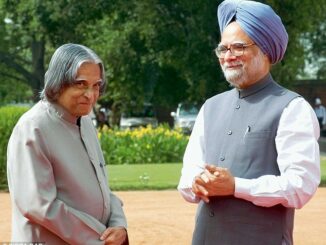
In 1999-2000, the Union Government also appointed the country’s first Principal Scientific Advisor in Dr APJ Abdul Kalam. It is pertinent to mention that Dr Manmohan Singh (Chief Economic Advisor) and Dr APJ Abdul Kalam (Principal Scientific Advisor) rose to be the Prime Minister and President of the country, respectively. The appointments made on the basis of professional acumen and competence, generally remain free of any controversies. However, when the Advisors are appointed out of sheer political compulsions, they invariably get mired in controversies.
There is a lot of ambiguity in the choice and classification of Advisors. There is a category of Advisors who are serving bureaucrats, technocrats, financial experts and are hand-picked for “plum” posts that generally fall in the category of ex-cadre posts.
The second category is of political appointees as Advisors. These appointments, if made for office for profit slots, need legislative approval.
Chandigarh Administration is an example where serving bureaucrats hold the position of Adviser to the Administrator. The practice started in June, 1984, coinciding with the launch of Operation Bluestar in Punjab. K Banarji, who was the last Chief Commissioner of Chandigarh, became the first Adviser to the Administrator of Chandigarh. Since then, 18 Advisers have served the Administration.
This category of “official” Advisers have their pay packets and service conditions protected by the civil service rules.
There is another subgroup of these Advisors who are superannuated bureaucrats, including diplomats, and financial wizards. Most of the Central Government Advisors belong to this group.
There are no fixed norms like pay packets and service conditions for the political category of Advisers. Depending upon the status or clout of the appointee, his or her perks are fixed.
It depends upon the State Governments or the Central Government to decide how to make best use of expert advisors in the policy process.
The recent controversy about the appointment of Rajya Sabha member Raghav Chadha as Chairman of an Interim Advisory Committee has political implications. The Opposition parties are using it as a major tool to bash the Chief Minister Bhagwant Mann and the ruling Aam Aadmi Party for subjugating the interests of the State. The appointment has been challenged before the Punjab and Haryana High Court on the plea that an “outsider” has no locus standi to hold a position in a policy making body of the State.
Punjab has a long history of being ruled by Advisors. Since the State had the longest spell of President’s Rule in 80s, it had a number of superannuated bureaucrats, defense personnel and policemen as Advisors to the Governor or as members of the Governor-in-Council.Some of these Advisors, including JF Ribeiro, TS Baroca, Dr SS Sidhu, SL Kapur and others served for terms from one to three years. The Governor-in-Council virtually performed the role of the State Cabinet and used to take all major policy decisions.
Other than these Advisors, the discretion of appointing Advisors was frequently used in the post-militancy era by almost all Chief Ministers, including Parkash Singh Badal, Beant Singh, Capt Amarinder Singh and Charanjit Singh Channi. And most of these appointments were made either under political compulsions or to oblige people close to the affluent political families of the State.
Instead of the State getting benefitted from the expert advice, these appointments are generally a big financial burden on deteriorating fiscal health of the State.
Though no one disputes the rights and privileges of the elected government to appoint Advisors to seek their expert opinion on various aspects of administration, including finances and governance, yet no provisions have been made to hold the Advisors responsible for advice that went against the interests of the State. Accountability clause is still not a part of terms of service conditions for the Advisors. There is no mechanism in place to judge the quality of the advice and the likelihood of it being accepted and implemented for the welfare of the people.
The mechanisms to make external experts or Advisors as active participants in the formulation of policies , and related factors or considerations influence the ability of governments to accept expert advice and incorporate it in their policy decisions are still to be worked out.
Now when the AAP Government wants to use the expertise of Raghav Chadha to improve the fiscal health of the State, no one is talking about the role and work of the previous Financial Adviser, VK Garg, a retired bureaucrat appointed by the previous Congress Chief Minister, Capt Amarinder Singh. Intriguingly, in 2017, when Captain Amarinder Singh named six of his party legislators as Political Advisors by according Cabinet Minister status to five of them and Minister of State status to the sixth, Bhagwant Mann was one of the frontline critics of the move saying it would put unnecessary burden on the State exchequer.There is no continuity in the expert advice or its continued implementation in the State.
(The author is a veteran journalist with over three decades of experience covering a wide spectrum of subjects and stories. He has covered Punjab and Sikh affairs for more than three decades besides covering seven Olympics and several major sporting events and hosting TV shows. For more in-depth analysis please visit probingeye.com or follow him on Twitter.com/probingeye. He can be reached at prabhjot416@gmail.com)
“The third regime of economic history began when Dr. Man Mohan Singh became the Prime minister in May 2004. This had been the phase of fastest economic progress as India achieved a solid compounded annual GDP growth rate of 7.74% for the decade. Finance and banking sector led the growth of the economy by growing at the rate of 11.49% per annum for the whole decade, followed by manufacturing sector’s growth rate at 9.34%. Farmers also saw prosperity as agriculture sector grew at the rate of 6.51%. Farmer’s real income almost doubled during the decade. The sector that relatively lagged was the trade, transport & communication sector which grew at the rate of 4.84%. This is absolutely not a slow annual growth rate for the decade.”
It has been now seven years of economic management by PM Modi marked by disastrous economic policies like demonetization, stifling GST, Corona lockdowns, and new Farm Act instigating farmers’ protest. All these bad economic measures showed highly negative results and India’s compounded annual GDP growth rate fell significantly from 7.74% achieved just before to 4.51% for the last seven years.
The Prime Minister, Dr. Manmohan Singh addressing the 66th Session of the United Nations General Assembly, in New York on September 24, 2011.
India has been a growing economic since its independence. The earliest systematic data available on India’s growth begins from 1950-51. We tried to analyze India’s economic progress on the lines of total and sectoral compositions under different regimes. We took the figures of GDP at factor cost which excludes indirect taxes and subsidies. This gives the real picture of economic activity. The source of data has been the Economic Survey 2021 published by Government of India. We found four distinct regimes.
The first regime has been the era of mixed economy starting from fiscal year 1950-51 and ending in fiscal year 1990-91 when Prime Minister Narsimha Rao, with the help of Finance minister Dr. Manmohan Singh started the process of liberalizing the economy. This era was characterized by planning the economy, licensing of productive activities, protecting domestic industries from foreign competition, and public sector undertakings playing the dominant economic role. Clearly this was not the era of pure competition in which there is free entry and exit of firms in the market, and public sector plays a minimal role. Entry was controlled by the Government through licensing of industries, and foreign competition was barred through high tariffs. This strategy achieved compounded annual GDP growth rate of 4.07% for the entire 40 years. As can be seen in the table below, agricultural growth had been the slowest at 2.75% while the manufacturing sector grew fastest at the rate of 5.37%.
The second era was the era of liberalization when licensing of industries was relaxed, and some foreign competition was promoted through reduced tariffs. India became the signing member of GATT, now called World Trade Organization. The membership required India to reduce tariffs. This kind of gradual liberalization brought good results and India’s GDP grew at the compounded rate of 5.74%. This was significantly higher than 4.07% achieved during the previously controlled economic management era. This phase was led by growth in trade, transport & communication sector, which grew at the rate of 8.23%, followed by finance and banking sector which grew at the rate of 7.68%. Agriculture did not benefit as its growth rate of 2.88% remained almost the same as that of the previous era.
The third regime of economic history began when Dr. Man Mohan Singh became the Prime minister in May 2004. This had been the phase of fastest economic progress as India achieved a solid compounded annual GDP growth rate of 7.74% for the decade. Finance and banking sector led the growth of the economy by growing at the rate of 11.49% per annum for the whole decade, followed by manufacturing sector’s growth rate at 9.34%. Farmers also saw prosperity as agriculture sector grew at the rate of 6.51%. Farmer’s real income almost doubled during the decade. The sector that relatively lagged was the trade, transport & communication sector which grew at the rate of 4.84%. This is absolutely not a slow annual growth rate for the decade.
The fourth regime began with the victory of BJP when Prime Minister Narendra Damodardas Modi come to power in May 2014. This phase is marked by significantly reduced growth rate of the economy. It has been now seven years of economic management by PM Modi marked by disastrous economic policies like demonetization, stifling GST, Corona lockdowns, and new Farm Act instigating farmers’ protest. All these bad economic measures showed highly negative results and India’s compounded annual GDP growth rate fell significantly from 7.74% achieved just before to 4.51% for the last seven years. Though the slowest growth rate of 2.96% has been in the trade, transport, and communication sector, the biggest downfall fall has been in the manufacturing sector as its growth rate fell from 9.34% to just 3.77%. Looks like high and faulty GST policy has been the main reason for this disaster in manufacturing sector. GST rate on most goods has been 24% which implies that the manufacturer will first pay 24% of its sales revenue as taxes which would be collected after sales have been completed. During this cash collection cycle, the manufacturer will have to pay interest also on that money which was paid as GST. Thus, the real burden of GST on the manufacturer is far more than what the government collects as tax revenue. Clearly no manufacturer can grow under such a burdensome regime. Disaster in manufacturing sector was followed by disaster in finance and banking sector whose growth rate fell from 11.49% to 6.45%. Farmers also saw their growth rate falling by more than 50% from 6.51% to 3.15%. This slower growth had been bringing discontent in them for years and the new Farm Act triggered their burst. That’s why they have been protesting against the new Farm Act for about a year, but the government has not been listening to them.
To conclude, we can say that the economy did the best under the regime of Dr Manmohan Singh. There was prosperity all around. The high GDP growth was shared more fairly amongst different sectors of the economy. The present NDA government is undoing the things that was achieved by the previous UPA government.
The callous, insensitive and prejudiced Modi government has made a mockery of governance and exposed the Indian nation and its people to the hydra of inflation, unemployment, crippling economy, a debilitating trade deficit and failing and a sinking health care system.
The Modi government’s seven-year tenure is riddled with abject failures, both short term as well as long term. The most glaring and the most recent being his catastrophic mishandling of the COVID Pandemic. A quick comparison of COVID related deaths in India versus the USA makes it clear that our leadership has entirely failed us in our collective battle against the disease.
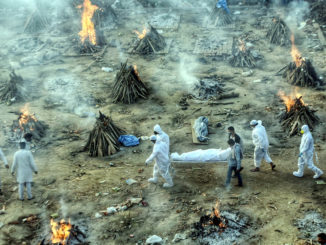
According to the latest statistics from New York Times, India’s COVID related deaths have been significantly higher when compared to other regions of the world and neighboring countries. At the peak of the pandemic, the number of weekly average deaths was 4454. On June 12, it was 3303. In the United States, the average was 370 deaths on June 12. Since the population of India is roughly 4 times of the USA, the death rate in India should have been 4×370 or around 1600. This means the death rate in India has been twice that of the USA, despite aid pouring from all over the world to save Indian lives. A quick look around the neighborhood and put Indians to shame. On June 12, the weekly average death rate in Bangladesh has been 30. India’s population is about 8.7 times larger than Bangladesh, which implies that India’s weekly average death rate should have been just 330 by this metric. At the peak death rate in Bangladesh on April 23, the average figure was just 981 which implies that the peak weekly average death rate in India should have been 850. For Pakistan, the peak weekly death rate was 140 on April 28 and on June 12 it was 61 deaths. Since the population of India is 6 times that of Pakistan it implies that as per Pakistan’s standard, the peak weekly deaths in India should have been 850 and on June 12 it should have been 360. It is clear that India, with its far larger economy, has been performing ten times worse than its immediate neighbors in handling Covid deaths.
The GDP Debacle
On the economic front too, India’s performance has been dismal. As per the latest data, the growth rate of India has been -7.3% for the fiscal year 2021 (. The US and China are much bigger economies than India and suffered the pandemic at an equal scale. However, their economies grew at the rate of 2.6% and 8.4% respectively. It is clearly the total failure of the Modi government and his regressive economic policies that this difference exists.
Another issue of major concern is the alarming Balance of Trade deficit with China as a cause of sluggish GDP growth of India. According to Chinese customs data, it is being touted that, “trade between China and India soared 70.1% in US dollar terms in the first five months of this year to $48.16 billion.” Specifically, Chinese exports to India grew 64.1% year-on-year from January to May, while imports surged 90.2%., the tabloid Global Times reported. The trade deficit during the same first five months of 2021 has been $45 billion, which is 1.5% of India’s GDP. Since GDP = Consumption + Investment + Government Expenditure + Balance of Trade, India’s GDP is down by 1.5% in just five months of trade with China. Taken annually, at this rate of trade deficit with China, 3.6% of India’s GDP would be taken away by China.
It is very surprising that the Modi Government seems oblivious to this drain on India’s economy. President Trump imposed heavy import duties on China in the year 2018 and that has been continued under the Biden administration, but the Indian Government is not even realizing this problem. Where is the competence of our finance and commerce ministries? Under Modi’s rule, with India-China trade volume being $87.6 billion in 2020, China overtook the US to become India’s largest trading partner, despite a bloody conflict along the Line of Actual Control (LAC) and the rising anti-China sentiment among Indians. All the Asian tigers, including both China and Japan have achieved miracles because of trade surpluses, but Modi’s government does not even realize that India’s wealth is being drained by the Chinese. Even the richest and the most powerful country, the United States, could not survive the economic drain on US GDP caused by trade deficit with China. This issue must be looked at urgently and discussed openly and vigorously in parliament.
Inflation and Unemployment
Not just GDP setbacks, India’s inflation for the year 2020 was 6.2% — far above the stated goal of 4%. The Government’s failure on unemployment reduction too is stark. Over 10 million (1 crore) Indians have lost their jobs because of the second wave of Covid-19, and around 97 per cent of individual household income has declined since the beginning of the pandemic last year. The total figure of unemployed workforce has risen to 3.5 crores.
Besides this, the abysmally short-sighted policies of the government have accentuated the problem of stagflation. India has experienced the worst of both the worlds because of the current regime. The relationship between inflation and unemployment has historically been inverse in many parts of the world, including in India under Dr. Manmohan Singh’s government. But India under Modi has seen higher inflation and higher unemployment. This means stagflation is a special gift of this government to us because of its disastrous economic policies.
The Inequality Monster
Inequality is on the rise. Only two business families in the country – the Adanis and Ambanis have been accumulating wealth by exploiting the rest of India. As already discussed, 97% of Indians have become poorer while the wealth of Mukesh Ambani has tripled since Modi was elected in 2014. Gautam Adani’s wealth has increased by about 30 times. As per Forbes records, Gautam Adani’s wealth was just $3.5 billion in March 2016, and jumped to $75 Billion on June 13, 2021.
The callous, insensitive and prejudiced Modi government has made a mockery of governance and exposed the Indian nation and its people to the hydra of inflation, unemployment, crippling economy, a debilitating trade deficit and failing and a sinking health care system.
The present Government still has three more years to go before it faces the people in a general election. It is time for some serious course-correction by the Modi Government, for the sake of its own survival and but more importantly, for the people of India. Let us hope that the Modi Government shakes off the ignorance and arrogance that it is becoming known for and strategizes by putting the people of India first to perform with heart, mind and muscle in the second half of their thus far catastrophic tenure.
(The author, holder of 3 masters – MBA (Marketing), MBA (Finance) and MS Computer Science, has worked extensively in the financial industry in New York. He is a veteran community leader associated with many Indian Organizations)
Signup to our Newsletter!
Don’t miss out on all the happenings around the world