Tag: DRDO

  • DRDO scientist Kurulkar was attracted to Pak agent, talked about Indian missile systems: Chargesheet

    DRDO scientist Kurulkar was attracted to Pak agent, talked about Indian missile systems: Chargesheet

    Pune (TIP)- DRDO scientist Pradeep Kurulkar was attracted to the Pakistani Intelligence Operative, who used the alias ‘Zara Dasgupta’, and chatted with her about Indian missile systems among other classified defence projects, the chargesheet has said.
    The Anti-Terrorism Squad (ATS) of the Maharashtra police filed the chargesheet against Kurulkar, who was the director of one of the labs of the Defence Research and Development Organisation (DRDO) in Pune, in a court here last week.
    He was arrested on May 3 under the Official Secrets Act and is now in judicial custody.
    Kurulkar and ‘Zara Dasgupta’ were in contact through WhatsApp as well as voice and video calls, the chargesheet said.
    ‘Dasgupta’ claimed to be a software engineer based in the UK and befriended him by sending obscene messages and videos. During the investigation, her IP address was traced to Pakistan, the ATS said in the chargesheet.
    The Pakistani agent tried to get classified and sensitive information regarding the Brahmos Launcher, Drone, UCV, Agni Missile Launcher and Military Bridging System, among other things, it said.
    “Kurulkar, who was attracted to her, stored the classified and sensitive information of DRDO on his personal phone and then allegedly shared it with Zara,” the chargesheet said.
    He chatted with her about various projects, including surface-to-air missiles (SAM), drones, Brahmos and Agni Missile Launchers and UCV, it said.
    The two were in contact from June 2022 to December 2022, as per the ATS.
    Just before the DRDO initiated an internal probe after his activities were found to be suspicious, Kurulkar blocked Zara’s number in February 2023. He soon received a WhatsApp message from another unknown Indian number, asking ‘Why you blocked my number?’ The chat records also showed that he shared his personal as well as official schedules and locations with her despite knowing that he was not supposed to share them with anyone, the chargesheet said. Source: PTI

  • DRDO constructs multi-storey building in 45 days; to house R&D facilities for aircraft project

    DRDO constructs multi-storey building in 45 days; to house R&D facilities for aircraft project

    New Delhi (TIP)-India’s premier Defence Research and Development Organisation DRDO has built a multi-storey facility for flight control system at Aeronautical Development Establishment in Bengaluru in record 45 days using in-house technology, officials said on Thursday, March 17. The seven-storey building, with a plinth area of 1.3 lakh square feet, will house research and development facilities for the development of a fifth-generation medium weight deep penetration fighter jet for the Indian Air Force. “The DRDO has completed the construction of a multi-storey infrastructure for flight control system at ADE Bengaluru with hybrid technology consisting of conventional, pre-engineered and precast methodology in record 45 days,” said one of the officials. He said the complex will have facilities for developing avionics for fighter aircraft and flight control system (FCS) for the Advanced Medium Combat Aircraft (AMCA) project.

    India has been working on the ambitious AMCA project to develop a fifth-generation medium fighter jet with advanced stealth features to significantly bolster its air power capability. The initial development cost of the project, being undertaken by the ADE, has been estimated at around Rs 15,000 crore. The defence ministry on Monday said it has initiated the process of obtaining the approval for the design and prototype development of the AMCA from the prime minister-led Cabinet Committee on Security.

    The officials said the building has been constructed using composite construction technology in the “shortest time frame” of just 45 days to provide the necessary infrastructure for the AMCA project and related activities.

    The foundation stone for the project was laid on Nov 22, 2021, and actual construction began on February 1.

    “It is a unique record of completing a permanent seven-storey building with hybrid construction technology, that too in ready-to-move condition for the first time in the country,” the official involved in the project claimed. In hybrid construction technology, the column and beam elements of the structural frame are built with steel plates; the columns are of hollow steel tubular section.

    Source: PTI

  • PRITHVI-II MISSILE SUCCESSFULLY TEST-FIRED

    PRITHVI-II MISSILE SUCCESSFULLY TEST-FIRED

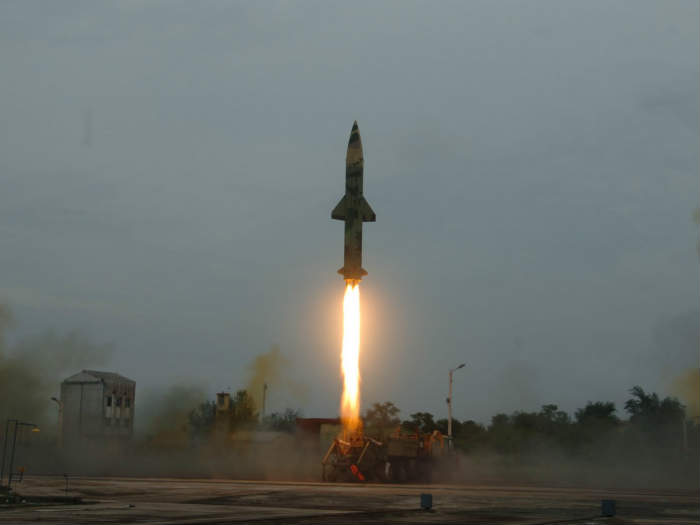
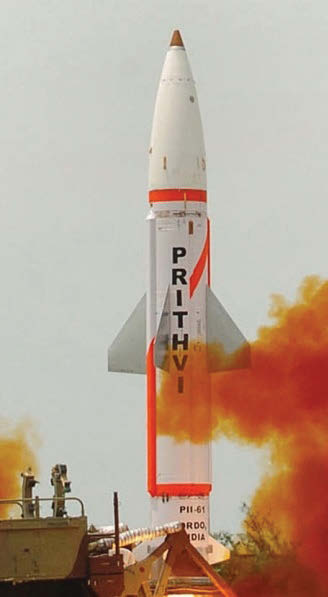
    BALASORE (TIP): India on June 2 successfully test-fired its indigenous developed nuclear-capable Prithvi-II missile from a test range in Odisha as part of a user trial by the Army.

    The trial of the surface-to-surface missile, which has a strike range of 350 km, was carried out from a mobile launcher from launch complex-3 of the Integrated Test Range (ITR) at Chandipur near here at around 9.50 am, official sources said. The trial of the sophisticated missile was successful and the mission objectives were met, they said.

    The Prithvi-II missile is capable of carrying 500 kg to 1,000 kg of warheads and is thrusted by liquid propulsion twin engines. It uses advanced inertial guidance system with manoeuvring trajectory to hit its target with precision and accuracy.

    The state-of-the-art missile was randomly chosen from the production stock and the entire launch activities were carried out by the specially formed strategic force command (SFC) and monitored by the scientists of the Defence Research and Development Organisation (DRDO) as part of training exercise, a DRDO scientist said. “The missile trajectory was tracked by the DRDO radars, electro-optical tracking systems and telemetry stations located along the coast of Odisha,” the sources said.

  • INDIA SUCCESSFULLY TEST-FIRES AGNI III MISSILE

    BHUBANESWAR (TIP): India on April 27 (Thursday) successfully test-fired its intermediate-range ballistic missile Agni-III from Abdul Kalam Island off the Odisha coast.

    The missile lifted off from launch pad No.4 of the Integrated Test Range located on the island at 9.12 am, sources in the Defence Research and Development Organisation (DRDO) said.

    This was a user test, undertaken by the Strategic Forces Command — an especially raised missile-handling unit of the Indian Army. It carried out the test with logistics support from the DRDO.

    Agni-III is the mainstay of India’s nuclear arsenal, and the missile used for the test was randomly chosen from the assembly line, according to sources.

    The missile has a strike range of 3,000 km to 5,000 km and is capable of carrying both conventional and nuclear warheads weighing up to 1.5 tonnes.

    The missile is powered by a two-stage solid propellant engine. The missile is 17 metres long, with two-metre diameter, and weighs around 2,200 kg.

    The missile was inducted into the armed forces in June 2011.

    This test comes less than a week after the Indian Navy test-fired a land attack version of BrahMos from a naval ship.

    India also recently tested BrahMos missile with an extended 450 km range, has undertaken a drop test of the air version of BrahMos, exo-atmospheric Prithvi Defence Vehicle (PDV) interceptor missile and endo-atmospheric Advanced Air Defence missile, both part of a two-tier anti-ballistic missile system, Agni IV and Agni V in the last six months. Source: IANS


  • DRDO SCIENTISTS DEVELOP SURVEILLANCE UAV FOR ARMED FORCES

    DRDO SCIENTISTS DEVELOP SURVEILLANCE UAV FOR ARMED FORCES

    HYDERABAD (TIP): Heralding a new era in the indigenous development of Unmanned Aerial Vehicle (UAV), DRDO on Wednesday successfully carried out the maiden flight of TAPAS 201 (RUSTOM – II), a Medium Altitude Long Endurance (MALE) UAV.

    The test flight took place from Aeronautical Test Range (ATR), Chitradurga, 250 km from Bangalore. Chitradurga is a newly developed flight test range for the testing of UAVs and manned aircraft.

    The flight accomplished the main objectives of proving the flying platform, such as take-off, bank, level flight and landing. TAPAS 201 has been designed and developed by Aeronautical Development Establishment (ADE), the Bangalore-based premier lab of DRDO with HAL-BEL as its production partner.

    The UAV weighing two tonnes was piloted (external and internal) by the pilots from the Armed Forces. It is also the first R&D prototype UAV which has undergone certification and qualification for the first flight from the Center for Military Airworthiness & Certification

    (CEMILAC) and Directorate General of Aeronautical Quality Assurance (DGAQA).

    TAPAS 201, a multi-mission UAV is being developed to carry out the Intelligence, Surveillance and Reconnaissance (ISR) roles for the three Armed Forces with an endurance of 24 hours. It is capable of carrying different combinations of payloads like Medium Range Electro Optic (MREO), Long Range Electro Optic (LREO), Synthetic Aperture Radar (SAR), Electronic Intelligence (ELINT), Communication Intelligence (COMINT) and Situational Awareness Payloads (SAP) to perform missions during day and night.

    According to an official release, the development of UAV immensely contributes towards the Make-in-India initiative as many critical systems such as airframe, landing gear, flight control and avionics sub-systems are being developed in India with the collaboration of private industries. Defence Electronics Application Laboratory (DEAL) of DRDO has developed the data link for the UAV. Rustom- II will undergo further trials for validating the design parameters, before going for User Validation Trials. Source: TOI


  • India test-fires new surface-to-air missile co-developed with Israelis

    India test-fires new surface-to-air missile co-developed with Israelis

    BALASORE (TIP): India on Thursday successfully test fired a new surface-to-air missile, developed jointly with Israel, from a defence base off Odisha coast.

    The medium range missile (MR-SAM), a product of joint venture between India and Israel, was successfully test launched from a mobile launcher in the Integrated Test Range (ITR) at Chandipur at around 08.15 hours, a DRDO official said.

    “The test launch was a grand success and it met all the targets,” he said.

    The missile positioned at launch pad-3 of the ITR swung in to action after getting signal from the radars to intercept a moving aerial target supported by an unmanned air vehicle (UAV) ‘Banshee’ over the Bay of Bengal, officials said.

    Apart from the missile, the system includes a Multi Functional Surveillance and Threat Alert Radar (MF STAR) for detection, tracking and guidance of the missile, they said.

    “The missile along with MF-STAR will provide the users with the capability to neutralise any aerial threats,” said a Defence Research & Development Organisation (DRDO) scientist.

    Indian Defence Research Development Laboratory (DRDL), a laboratory of DRDO based at Hyderabad, has jointly developed this missile in collaboration with Israel Aerospace Industries (IAI), he said.

    A new production facility to deliver 100 missiles a year has been established for such type of long rang and medium range surface-to-air missiles at M/s Bharat Dynamics Limited, India.

    The missile, which was initially proposed to be tested yesterday, was deferred in the last moment for today.

    Earlier, Indian Navy had successfully test launched the long range surface-to-air missile (LR-SAM). The test was undertaken on the Western Seaboard by INS Kolkata on December 30, 2015, officials said.

    Such type of medium range surface-to-air missiles (SR-SAM), having striking ranges from 50 to 70 km, can fill the gap of existing missiles that India has in its armory at present, they said. These missiles would be inducted in all three services after user’s trial is completed.

    As a safety measure, Balasore district administration in consultation with the defence officials had temporarily shifted 3652 civilians residing within 2.5 km radius of the launch pad No.3 of the ITR at Chandipur to nearby shelter centres this morning to ensure a safe launch of the missile, said a district revenue official.

  • India test-fires nuclear capable Prithvi II missile

    India test-fires nuclear capable Prithvi II missile

    BALASORE (TIP): India on Nov 26 successfully test-fired its indigenously developed nuclear capable Prithvi-II missile, which has a strike range of 350 km, as part of a user trial by the Army.

    The missile test was carried out from a mobile launcher from launch complex-3 of the Integrated Test Range (ITR) at Chandipur at 1210 hrs.

    “The trial data of the missile conducted by the Strategic Force Command (SFC) shows positive results,” said a defence source. The surface-to-surface Prithvi-II missile is capable of carrying 500 kg to 1,000 kg of warheads and is thrusted by liquid propulsion twine engines. It uses advanced inertial guidance system with manoeuvring trajectory to hit its target.

    “The missile was randomly chosen from the production stock and the entire launch activities were carried out by the specially formed SFC and monitored by the scientists of Defence Research and Development Organisation (DRDO) as part of training exercise,” a defence scientist said.

    “The missile trajectory was tracked by DRDO radars, electro-optical tracking systems and telemetry stations located along the coast of Odisha,” the source said.

    The downrange teams on board a ship deployed near the designated impact point in the Bay of Bengal monitored the terminal events and splashdown, they said.

    Inducted into India’s armed forces in 2003, Prithvi II, the first missile to be developed by DRDO under India’s prestigious IGMDP (Integrated Guided Missile Development Program) is now a proven technology.

    Such training launches clearly indicate India’s operational readiness to meet any eventuality and also establishes the reliability of this deterrent component of the country’s strategic arsenal, they said.

    The last user trial of Prithvi-II was successfully conducted on February 19, 2015 from the same test range in Odisha.

  • India Successfully Test-Fires Nuclear Capable Prithvi-II Missile

    India Successfully Test-Fires Nuclear Capable Prithvi-II Missile

    India on Thursday, November 26, successfully test-fired its indigenously developed nuclear capable Prithvi-II missile, which has a strike range of 350 km, as part of a user trial by the Army.

    The missile was fired from a mobile launcher at the Integrated Test Range (ITR) Chandipur in Balasore district on the Odisha coast.

    “The trial data of the missile conducted by the Strategic Force Command (SFC) shows positive results,” said a defense source.

    The surface-to-surface Prithvi-II missile is capable of carrying 500 kg to 1,000 kg of warheads and is thrusted by liquid propulsion twine engines. It uses advanced inertial guidance system with maneuvering trajectory to hit its target.

    “The test fire was successful as the trial data conducted by the Strategic Force Command shows positive results,” said a defense ministry source.

    “The missile was randomly chosen from the production stock and the entire launch activities were carried out by the specially formed SFC and monitored by the scientists of Defence Research and Development Organisation (DRDO) as part of training exercise,” a defence scientist said.

    “The missile trajectory was tracked by DRDO radars, electro-optical tracking systems and telemetry stations located along the coast of Odisha,” the source said.

    The downrange teams on board a ship deployed near the designated impact point in the Bay of Bengal monitored the terminal events and splashdown, they said.

    Prithvi-II uses advanced inertial guidance system with maneuvering trajectory to hit its target.
    It has been designed to operate with both liquid and solid fuels and is capable of carrying both conventional and nuclear payloads.

    The last user trial of Prithvi-II was successfully conducted on 19 February 2015 and was inducted in the Indian Army in 2003.

    For the past two years, Pakistan has tested missiles with very short-range, that could be used if Indian troops cross onto Pakistani soil.

  • The Indian Panorama’s Tribute to India’s Missile Man Bharat Ratna APJ Addul Kalam

    The Indian Panorama’s Tribute to India’s Missile Man Bharat Ratna APJ Addul Kalam

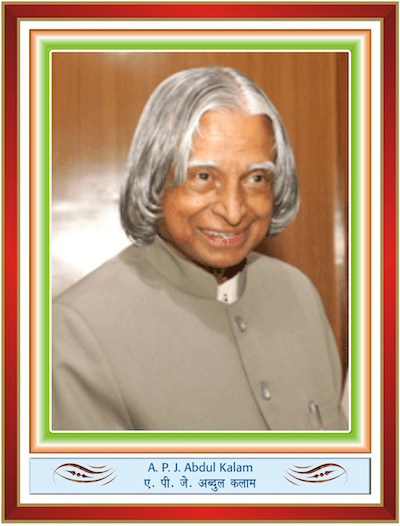
    Shakespeare may as well had APJ Abdul Kalam, an outstanding human being, teacher, scientist, thinker and much more, in mind, when he penned these words in Julius Caesar in which Antony pays tribute to the slain Caesar.

    The spontaneous outpouring of public grief at the passing away of Bharat Ratna Abdul Kalam was unprecedented. Be it the long queues of people ranging from VIPs to slum dwellers wanting to pay personal homage to the great man, top trending of tributes to him on the social media, focus of all main stream media channels and newspapers, the sentiment was simply overwhelming. Rather than the usual and clichéd messages of condolences from nation’s leaders, there was a genuine feeling of a huge loss and several international leaders joined in to pay their respects.

    Prime Minister Narendra Modi, instead of issuing a formal note of condolence, wrote an entire column on the country’s Missile man saying that `Bharat has lost a Ratna, but the light from this jewel will guide us towards Kalam’s dream destination : India as a knowledge superpower, in the first rank of nations”.

    Abdul-KalamModi wrote that Abdul Kalam, who was genuinely loved and admired by the masses, “never measured success by material possessions. For him, the counterpoint to poverty was the wealth of knowledge, in both its scientific and spiritual manifestations”. He concluded by saying that he was father to every Indian child and “the good that he did, will not be interred with his bones, because his children will preserve his memory through their lives and work, and gift it to their children”.

    US President Barack Obama, in his condolence message spoke of Dr. Kalam’s great contribution in promotion of US – India space cooperation and forging stronger ties between the two countries. “A scientist and statesman, Dr. Kalam rose from humble beginnings to become one of India’s most accomplished leaders, earning esteem at home and abroad. An advocate for stronger US-India relations, Dr. Kalam worked to deepen our space cooperation, forging links with NASA during a 1962 visit to the United States. His tenure as India’s 11th President witnessed unprecedented growth in US-India ties. Suitably named “the People’s President”, Dr. Kalam’s humility and dedication to public service served as an inspiration to millions of Indians and admirers around the world.”

    APJ2 APJ1In his event-filled 83 year long life, Abdul Kalam had evidently touched millions of lives and his life was in itself a message and inspiration. All those who were fortunate to interact with him, and he never let go an opportunity, he left a lasting impression which remained with that person for an entire life time. Be it the scientific community, the educators, the students, world leaders and even the media, everyone who met him left mesmerized by the man’s simplicity and humility. At the same time, all that weighed on his mind, all the time, was the development and growth of India and the improvement in the quality of life of its citizens, particularly those belonging to the rural areas. His pet and passionate project remained PURA (Providing Urban Facilities in Rural Areas) and he looked for opportunities to spread his vision.

    Such was the respect he commanded among all sections of the society, including the political parties, that he emerged as one of the rare consensus candidate for the post of president in 2002 yet he kept himself aloof from politics and never got into any discussion on the subject. Even when the then Pakistan President Parvez Musharraf visited India in 2005, he gave him a complete lesson on his vision on improving the living standards of the poor and the downtrodden. He advised Musharraf to initiate a program in his country on the lines of PURA and assured him all help in the area.

    He was not just a role model for millions of Indians and even those in other countries, he led by personal example. He led a simple life and immersed himself into studying. He was childlike in his approach towards learning. An example of never-say-die attitude was his desire to ride in a Sukhoi-30 fighter jet cockpit at the age of 74. It is not easy to ride the small jet and most youngsters one-third that age would fall sick of the speed and maneuvers of the fighter plane. Yet Kalam insisted and flew the jet for about 40 minutes. His pilot, Air Commodore Ajay Rathore, who sat next to him later said he behaved as excited as an eight year old boy and was in great spirits throughout.

    Born in a boatman’s family at Rameshwaram on October 15, 1931, Avul Pakir Jainulabdeen Abdul Kalam faced a tough childhood. He graduated in Physics in 1954 from St Joseph’s College, Tiruchirapalli and studied Aeronautical Engineering at the Madras Institute of Technology. He later joined Indian Scientific Research Organisation (ISRO) and made significant contribution as project director to develop the country’s first indigenous Satellite Launch Vehicle (SLV-III) which injected the Rohini Satellite in the earth’s orbit in 1980 thus making India a member of the exclusive international space club. After working at ISRO for two decades he was given the responsibility of developing guided missiles as chief executive of the Integrated Guided Missile Development Programme at the Defence Reseach and Development Organisation (DRDO) in 1982.

    He was responsible later for the development and operationalization of AGNI and PRITHVI missiles. He played a vital role in building indigenous capability in critical technologies. He was subsequently made the Scientific Adviser to Defence Minister and Secretary, DRDO from July 1992 to December 1999.

    He was the main force behind the weaponization of the strategic missile systems and the Pokhran-II Nuclear blasts in collaboration with the department of Atomic Energy which made India a Nuclear power state.

    He was awarded the Padma Bhushan in 1981, Padma Vibhushan in 1990 and was conferred the highest civilian award, the Bharat Ratna, in 1997 and served as the country’s 11th president from 2002 to 2007.

    Even as the President, he redefined the Indian presidency. Till he was elected with an overwhelming 9,22,884 votes (the only invalid vote had a note saying he would look much better with a hair cut !), the office of the president of India was considered that of a titular head. In fact his advent to the post came shortly after the 2002 riots in Gujarat when communal situation in the country was on a boil. The then Prime Minister Atal Behari Vajpayee, in a political masterstroke, proposed Kalam’s name as the president and the opposition Congress readily agreed to support him. He made it a point to visit riot ravaged Gujarat despite objections from the government of the day. Throughout his tenure he remained active and earned the epithet of People’s President.

    APJ3A devout Muslim, a player of Veena and a profound lover of Carnatic classical music, as comfortable with Quran as the Bhagwat Geeta, first unmarried Indian President, spiritual thinker and much more, he was a multi-faceted personality.

    Abdul Kalam often spoke at length about his childhood in Rameswaram as a boatman’s son. However, it was never about tragic struggles or of events that should be remembered with either pity or outrage. There was no anger or bitterness; it was always about hard work and hope. He believed in dignity of labor and was as comfortable with primary students as with scientists and thinkers, and world leaders.

    However, he was most passionate as a teacher. He once said : “If the people remember me as a good teacher that will be the biggest honour for me” .

    That’s what he was doing when the end came. In fact his last day on Mother Earth itself is a reflection of what a great man he was. Even at his age, he preferred to travel by the circuitous road from Guwahati to Shillong – to deliver a lecture and interact with students. While on his way to Shillong, he noticed that a pilot vehicle ahead of his convoy had a man (a security personnel) standing in a vehicle even as the convoy meandered its way up the 100-kilometer route to Shillong. He asked those sitting next to him to ask the man to sit down but was told that he was merely doing his duty.

    Not convinced by the explanation but helpless in view of the security drill, Abdul Kalam reached Shillong and the very first demand he made was to call that man over. He profusely thanked him even as the bewildered security man didn’t expect such a gesture from a former president of the country. The man somehow gathered his wits and responded that he respected Kalam so much that he could have stood for even six hours or more. The gesture reflected the humbleness and kind hearted nature of Kalam.

    He then went to the stage to deliver the lecture which was to be followed by an interaction with the students. However, merely five minutes into the lecture he slumped down and was rushed to the hospital where he was declared dead. The man who had passion for teaching and spreading the light of knowledge all his life, died in consummation of exactly the same love. What a glorious end to an illustrious life!

    Indeed, “This was a Man”.

  • Agni-V project director moved out

    Agni-V project director moved out

    NEW DELHI (TIP): The project director of the nuclear-capable Agni-V missile, RK Gupta, has been relieved of his charge at a time the Defence Research and Development Organisation (DRDO) is in the midst of a major shake-up. Gupta received the order on February 2, two days after the first successful canister launch of the 5,000-km range missile. While Gupta has alleged he is being victimised, government officials said it was a routine transfer. Former DRDO chief Avinash Chander had signed the order days before the government cut short his tenure on January 13 as it wanted someone younger to man the key post.

  • Defence Ministry plans DRDO overhaul

    Defence Ministry plans DRDO overhaul

    NEW DELHI (TIP): After the removal of Avinash Chander as Defence Research and Development Organisation (DRDO) chief, the Defence Ministry plans to overhaul the military research establishment by creating two separate posts of Secretary, Department of Defence Research and Scientific Adviser to the defence minister.

    The secretary would be ex-officio director general of the DRDO. The post of the secretary would be senior to the post of the scientific adviser.

    “We are thinking about splitting the dual position of the DRDO chief as Scientific Adviser to the Raksha Mantri. There should be two separate people for these two roles. Nothing has been finalised as yet,” a senior government official said. After Chander was suddenly sacked two days ago, Defence Minister Manohar Parrikar said he recommended the missile scientist’s ouster. But the minister maintained that he came to know about the sacking order from the media. Talking to journalists last month, Parrikar stated he would thoroughly review the functioning of the DRDO that came under criticism from Prime Minister Narendra Modi for its failure to deliver in time and the laid-back attitude.

    One of the transformation plans is to give more financial authority to the directors general who head seven clusters of laboratories working in the areas of naval systems; aeronautical systems; armament and combat engineering systems; missile and strategic systems; electronic and communication systems; life sciences and robotics; and computational systems.

  • NITI AAYOG repalces Planning Commission;  Indian American Arvind Panagariya appointed vice-chairman

    NITI AAYOG repalces Planning Commission; Indian American Arvind Panagariya appointed vice-chairman

    NEW YORK (TIP): Columbia University economist Arvind Panagariya will be the first vice-chairman of the National Institution for Transforming India (Niti) Aayog, which will have two full-time members — economist Bibek Debroy and former DRDO chief VK Saraswat, a statement issued by the Prime Minister’s Office (PMO) said Monday, January 5.

    Panagariya, 62, is a professor of economics at New York’s Columbia University, a former chief economist at the Asian Development Bank and has also worked with the IMF, WTO and World Bank in various capacities.

    A staunch advocate of free-market economics, Panagariya has over the last two years been writing advisories to the BJP about how to manage the fiscal situation, sources said.
    The PMO also nominated home minister Rajnath Singh, finance minister Arun Jaitley, railways minister Suresh Prabhu and agriculture minister Radha Mohan Singh as ex officio members.

    Transport minister Nitin Gadkari, HRD minister Smriti Irani and social empowerment minister Thawar Chand Gehlot will be special invitees of the Niti Aayog that replaces the 65-year-old Socialist-era Planning Commission.

    Prime Minister Narendra Modi will head the body and its governing council will include all chief ministers and lieutenant governors, in line with the PM’s thrust on cooperative federalism that advocates involving states in the Centre’s decision making.

    However, two elected chief ministers — of Delhi and Puducherry — will not be members of the new Niti Aayog.

    The Article 239 of the Constitution defines both Delhi and Puducherry as Union Territories and therefore, their administrators — lieutenant governors — will be members of the panel.

    Under the article, a law providing for assembly in Delhi was enacted in 1991. “As per law, Delhi is a Union Territory. It has been rephrased as National Capital Territory,” said SK Sharma, former secretary of Delhi Legislative Assembly.

    Government sources said that three more members will be appointed to the Niti Aayog soon. In all, the government plans to appoint five full-time members and two part-time members, who are expected to be representative for the academic world.

    Panagariya and other full-time members are expected to join office at Niti Bhawan,erstwhile Yojana Bhawan, in a couple of days.

    Officials could be seen Monday sprucing the rooms, lying vacant for the last eight months, for the new members.

    The government, meanwhile, archived the website of the Planning Commission, and an announcement on Twitter handle Niti Aayog said: “Administrative reforms are underway.

    The NITI Aayog website will be ready in a few days. The process for Transforming India has begun!”

    A new website of Niti Aayog will be launched once the new vice-chairman joins office as officials in Yojana Bhawan does not have authority to issue directions, sources said.

    The reason is that the government has not notified new business of transaction rules for Niti Aayog.

    Officials said Niti Aayog will primarily be an advisory body without having power to allocate funds. The government has allocated the fund disbursement job to the finance ministry, which is also mandated to generate revenue.

    Before the National Democratic Alliance (NDA) government came to power, the Planning Commission used to allocate funds to all central ministries and the state governments.

  • INDIGENOUSLY DEVELOPED CRUISE MISSILE ‘NIRBHAY’ TEST-FIRED

    INDIGENOUSLY DEVELOPED CRUISE MISSILE ‘NIRBHAY’ TEST-FIRED

    BALASORE (TIP): India’s indigenously developed nuclear capable sub-sonic cruise missile ‘Nirbhay’, which can strike targets more than 700km away, was on October 17 test-fired from a test range at Chandipur in Odisha. “The missile was test-fired from a mobile launcher positioned at launch pad 3 of the Integrated Test Range at about 10.03am,” said an official soon after the flight took off from the launch ground. “Flight details will be available after data retrieved from radars and telemetry points, monitoring the trajectories, are analysed,” the official said.

    It is the second test of the sub-sonic long range cruise missile ‘Nirbhay’ from the ITR. The maiden flight, conducted on March 12, 2013 could not achieve all the desired parameters as “the flight had to be terminated mid-way when deviations were observed from its intended course”, sources said. India has in its arsenal the 290km range supersonic “BrahMos” cruise missile which is jointly developed by India and Russia. But ‘Nirbhay’ with long range capability is a different kind of missile being developed by the Defence Research and Development Organisation (DRDO). Nirbhay has good loitering capability, good control and guidance, high degree of accuracy in terms of impact and very good stealth features.

  • INDIA DEPLOYS AKASH MISSILES IN NORTHEAST

    INDIA DEPLOYS AKASH MISSILES IN NORTHEAST

    NEW DELHI (TIP):
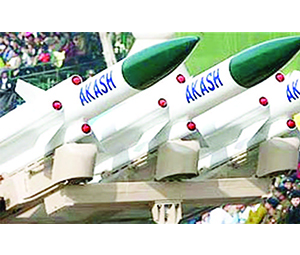
    India has begun deploying six Akash surface-to-air missile (SAM) squadrons in the northeast to deter Chinese jets, helicopters and drones against any misadventure in the region. Earlier, India based its most potent Sukhoi-30MKI fighters at Tezpur and Chabua. Indian Defence ministry sources on Thursday, August 21 said IAF has started getting deliveries of the six Akash missile squadrons, which can “neutralize” multiple targets at 25-km interception range in all-weather conditions, earmarked for the eastern theatre.

    “IAF has deployed the first two Akash squadrons at the Mirage-2000 base in Gwalior and Sukhoi base in Pune. The next six squadrons, as approved by the Cabinet Committee on Security, are to guard against any threat from the northern borders,” said a source. This long-delayed but finally successful induction of the Akash systems, developed by DRDO and manufactured by defence PSU Bharat Dynamics, has also led to scrapping of the protracted discussions to develop the ‘Maitri’ short-range SAMs with France at a cost of around Rs 30,000 crore.

    The Akash deployment in the northeast is in tune with the overall plan to progressively achieve “meaningful and credible deterrence” against China along the 4,057-km Line of Actual Control (LAC). While the Indian Navy is currently better placed to take on Chinese warships in the Indian Ocean, the stark military asymmetry with the People’s Liberation Army along the LAC, both in firepower as well as infrastructure, has long worried the Indian security establishment.

    The steps being taken now to “deter” China range from development of the over 5,000-km Agni-V inter-continental ballistic missile to raising of the new Army XVII Mountain Strike Corps with over 90,000 soldiers at a cost of Rs 64,678 crore. Then, there is also the border military infrastructure development plan for another Rs 26,155 crore, as reported by TOI earlier. IAF, on its part, has deployed Sukhoi squadrons at Tezpur and Chabua in the eastern sector as well as Bareilly in the middle sector of the LAC.

    Both Tezpur and Chabua are also getting their second Sukhoi squadrons, with IAF having inducted over 200 of these 272 fighters contracted from Russia for over $12 billion. The force has also re-activated advanced landing grounds (ALGs) at Nyoma and Daulat Beg Oldie in eastern Ladakh as well as Vijayanagar situated at the tri-junction of India, China and Myanmar in the Changlang district of Arunachal. Similar work is underway at other eastern sector ALGs like Pasighat, Mechuka, Walong, Tuting and Ziro.

    The new XVII Corps, which will fully be in place by 2018-2019, will give India muchrequired “quick-reaction ground offensive punch” for the first time against China. All this is considered crucial since China can rapidly deploy 21 fighter squadrons against India with its eight operational airbases in Tibet Autonomous Region (TAR) and some others just north of it.

    Moreover, the extensive road and rail links created in TAR ensure Chinese soldiers enjoy numerical superiority against Indian forces in a 3:1 ratio. China, incidentally, has been conducting major exercises with its J-10, Sukhoi-27UBK and Sukhoi-30MKK fighters in the high-altitude Qinghai-Tibet plateau in recent times.

  • After governors, NDA targets statutory bodies to purge UPA nominees

    After governors, NDA targets statutory bodies to purge UPA nominees

    NEW DELHI (TIP): After having its way with Congress-appointed governors, the NDA government has moved on to purge UPA nominees from statutory bodies, starting with the National Disaster Management Authority (NDMA). Following suggestions from the government asking them to quit, NDMA vice-chairman M Shashidhar Reddy and a majority of its eight members, including former Special Director of CBI, K Saleem Ali, have put in their papers.

    The resignations in the NDMA came amid indications that the government may also get those holding Cabinet and MoS-rank posts in bodies like Indian Council for Cultural Relations, National Commission for Women and others to step down. Membership of these bodies are distributed among nominees of the regime of the day as part of what has evolved into Indian version of the spoils system. NDA’s focus on these bodies came among signs it could be on the verge of ridding Raj Bhavans of Congress nominees.

    Sources in Congress said the leadership is reconciled to the reality of its nominees having little option save moving out of governors’ mansions if the Modi government wants them to make way for nominees of the new regime. ESL Narasimhan, Governor of both Andhra Pradesh and Telangana, and Mizoram governor K K Paul are mentioned as the only possible exceptions. NDMA vice-chairman Reddy, a Congress politician from Telangana, set the stage for the panel’s reconstitution by resigning on June 16.

    At least five or the eight NDMA members — K M Singh, K N Srivastava, Major Gen (Retd) J K Bansal, K Saleem Ali and B Bhattacharjea — resigned on Thursday, while J K Sinha, Harsh K Gupta and Muzaffar Ahmad are in the process of putting in their papers. Though sources in the government indicated that Reddy’s resignation followed a call from Union home secretary Anil Goswami suggesting that he relinquish the key post, the vicechairman, when contacted, insisted that he had quit on his own volition.

    “The first thought of quitting occurred to me on the day of the poll results itself. After all, the NDMA is headed by the Prime Minister himself and he must have the leeway to reconstitute the body according to the roadmap he has in mind. “However, the government formation took some time, and I delayed my resignation plans. Then, when I saw many governors were being nudged to quit, I put in my papers on June 16 itself,” Reddy said.

    While NDMA vice-chairman holds the rank of a Cabinet minister, its members enjoy the status of a minister of state. The Prime Minister is chairman of the NDMA. Even as he claimed to have resigned on his own, Reddy confirmed that separate calls were made to the 8 NDMA members on Wednesday seeking their resignation. “But they were specifically told to hold charge till an alternative arrangement is made…since there cannot be any vacuum in disaster management, we will continue doing our job till further orders,” he said.

    While Reddy, who has been with NDMA since 2005 as a member and then its vice-chairman, is a Congressman and has been active in both national and state-level politics, most NDMA members, by virtue of being retired bureaucrats or ex-officers of the Army/DRDO, are deemed to be political appointees. “Every new government comes with a certain vision and has the prerogative to choose its own people to realise that vision,” an NDMA member pointed out after putting in his papers on June 19

  • A National Security Doctrine is Imperative

    A National Security Doctrine is Imperative

    There must be no further delay in finalizing the National Security Doctrine, on the basis of which integrated threat assessments can be made”, says the author

    Over the years, continuing efforts have been made by the Ministry of Defence (MoD) to promote jointness through integration of the planning, training and other systems so that, progressively, a triservice approach could get fully established. However, certain issues continue to affect the efficient functioning of the defence apparatus: There must be no further delay in finalising the National Security Doctrine, on the basis of which integrated threat assessments can be made. While some improvements have been achieved in the past years, the MoD must enforce strict measures to ensure that the DRDO, ordnance factories, defence public sector undertakings and other concerned agencies function efficiently to deliver supplies and services as per the envisaged time and cost schedules. Prolonged delays cause serious difficulties for the armed forces and large economic losses as the lack of certainty about supplies from indigenous sources compels expensive imports. While there have been notable advances in the rationalisation of the procurement policies and procedures, there is still need to ensure against prolonged acquisition proceedings as such delays altogether nullify the “make or buy” approaches.

    The individual services enjoy the autonomy of taking decisions to make their own selections of weapons, equipment and systems. The Integrated Service Headquarters must take effective steps to establish a tri-service approach in regard to such decisions as doing so will engender very significant financial savings.

    Defence planning process has still to get established. The X and XI Plans were implemented without receiving formal approvals. While the Long Term Integrated Perspective Plan has since been finalised, it is still viewed as a totalling up of the wish lists of the individual services. The Integrated Defence Staff (IDS) must devote urgent attention towards finalising a fully integrated defence plan with at least a 10- 15 year perspective.

    The services enjoy the authority of virtually settling their own manpower policies. The pro-rata percentage representation of arms and services in the Army needs to be modified as it is virtually a “quota system” which breeds group loyalties and cuts at the very roots of jointness within the service.

    While the functioning of the defence apparatus has been getting steadily refined, the continuing lack of consensus among the three services is thwarting the achievement of the vital objective of “jointness”. A number of joint service institutions have come into existence in the post Kargil War period. Among the new institutions, frequent references are made to the IDS, Defence Intelligence Agency (DIA), Andaman & Nicobar Command and the Strategic Forces Command. While it may be far too early to rejoice over these inter-agency institutions, it is disconcerting to learn that the individual services are not doing all that is required to see that these get fully established without facing delays and difficulties. A former Army Chief is quoted to say that the IDS is “a redundancy in military bureaucracy”; the founder Director of DIA is quoted to bring out that “the DIA cannot deliver as the intelligence agencies of the three services feel threatened by it” and about the IDS it is stated that “the services will never allow this body to function as they feel threatened that it will start examining the basis of their budgetary proposals, acquisition plans and force structures”.

    Consequences of economic meltdown
    The time has come for the individual services to close their ranks and get collectively concerned about the major threats and formidable challenges which we face in our close neighbourhood and beyond. The global security environment is continuing to become growingly complex and huge uncertainties loom large on various fronts. Our military has to be also concerned about the consequences of the economic meltdown and the strong likelihood of the allocations for defence facing a significant decline. In this scenario, to prepare for successfully meeting future challenges, it is of the highest importance that the individual services shed all reservations and establish meaningful jointness. A truly tri-service approach will reduce functional overlaps, wasteful duplications and redundancies. The IDS have already promulgated a joint doctrine for the armed forces, which is presently undergoing revision because of the differing views of the service headquarters on several issues. Any delay in this regard would come in the way of the armed forces preparing themselves fully for delivering an effective response when any emergency arises in the future.

    The defence ministry must realise the need to keep a very close watch on the rising cost of maintaining the military apparatus and ensuring that the high cost of the longer term acquisitions can be met from within the future availability of resources. Urgent attention needs being paid to reducing dependency on imports. This would require a very vigorous revving up of the ongoing indigenisation programmes. In the years past, only the Navy initiated systematic steps to foster indigenisation of their major platforms and systems and deserve all praise for the wonderful outcomes which they have already been able to achieve. It also needs being noted that India is not the only country which is engaged in dealing with problems relating to the functioning of the defence management apparatus. Many democracies have been facing such problems and, benefitting from their own past experiences, several countries have established strong parliamentary oversight bodies to monitor all important issues relating to their armed forces. Some countries have even inducted external experts to monitor their ongoing defence reform processes.

    Evolving a model for jointness
    India cannot and must not be left behind in doing all that needs to be done for strengthening and enhancing our national security interests. We need to develop our own model of defence management which vigorously promotes and sustains military professionalism while being fully in tune with our constitutional framework and in harmony with our glorious traditions and soldiering. The model to be evolved should also not be excessively encumbered with varied hierarchical fixations which are rooted in our colonial past. Considering the threats and challenges which loom on our horizon it is extremely important that our higher defence management structures are founded in the need to maintain a sensitive balance between the civil and military components and, side by side, ensuring that the entire military apparatus functions strictly within the parameters of “jointness”. It would be an ideal situation if the service chiefs were to collaborate closely and for the Chiefs of Staff Committee to itself take the various required decisions to pave the way for the future and establish jointness, brick upon brick.

    In the past over two decades many useful opportunities were lost because of the lack of convergence in the views of the service headquarters. If jointness and a tri-service approach cannot be achieved soon enough then, perhaps, the only option left may be to proceed towards replacing the existing single service Acts by an Armed Forces Act which would lay a statutory basis for achieving jointness and delineating the roles, duties and missions of the armed forces, as also the procedures and modalities relating to the functioning of the defence apparatus. In this context, it may not be out of place to recall that the US achieved its objectives by promulgating the Goldwater Nichols Act in 1986, after nearly four decades of experimentation under the aegis of its National Security Act. More recently, because of the serious budgetary problems faced by the country, UK has been devoting a high level of attention to reforms in its defence management apparatus. In this context, the Levene Report has sought to clarify the respective roles and responsibilities of ministers, civilian officers and the military at the policy, strategic and operational levels.

    A dedicated security cadre
    In so far as the tenure of civilians working in the MoD are concerned, a dedicated security administration cadre should be established by drawing in the best available talent from the civil services, defence services, DRDO, science and technology, information and communication technology, broadcasting and media, et al. This dedicated cadre should enjoy open ended tenures and those found fit should be enabled to develop specialisation in dealing with security related matters and be deployed in the MoD, Ministry of Home Affairs, Research and Analysis Wing, Intelligence Bureau, National Security Council secretariat and other security management related areas for their entire careers.

    This recommendation is contained in the Report of the Task Force on Internal Security (2000). It was accepted by the Group of Ministers (GoM) and after hearing it, the GoM had gone further and added that as “the assignments in these ministries/agencies are perceived as exacting and unattractive, the members of such a pool should, therefore, be appropriately compensated by provision of non-monetary incentives”. It is time to resurrect and speedily implement this decision of the GoM. Another factor noted by the GoM was related to the marked difference in the perception of roles between the civil and military officers. A task force was set up to work out the curricula for organising a continuing Joint Civil and Military Training Programme on National Security, which would be undergone by Brigadier and Major General and equivalent rank officers, IAS, IPS, IFS, central police forces and, as the training settled down, participants would also be drawn from the media, industry and other arenas. On the basis of this task force’s recommendations the first two-week programme commenced at the IAS Training Academy at Mussoorie, in February 2003. This programme has been successfully continuing for over a decade now and the 20th course commenced at Mussoorie in November 2013. It would be beneficial if the MoD reviews this programme and suitably recast its contents to meet the existing and emerging scenarios.

  • MOVERS & SHAKERS

    MOVERS & SHAKERS

    Famous Indian nuclear physicist Homi Jehangir Bhabha was born on 30 October 1909 in Mumbai. Bhabha played a key role in the development of the Indian atomic energy program. Widely referred to as the father of India’s nuclear weapons program, Bhabha had his education at the Elphinstone College and the Royal Institute of Science before obtaining his doctorate from the University of Cambridge in 1934.

    He was influenced greatly by the legendary Paul Dirac. Bhabha was a research scientist at the Cavendish Laboratories at Cambridge. When he was stranded in India as a result of the Second World War, he set up the Cosmic Ray Research Unit at the Indian Institute of Science, Bangalore under Nobel Laureate C. V. Raman in 1939. Dr. Bhabha is credited with establishing the Tata Institute of Fundamental Research(TIFR) with the help of eminent industrialist J. R. D. Tata.

    After India won independence from the British, Bhabha established the Atomic Energy Commission of India in 1948. He represented India in various international forums including the United Nations and his tenure represented a high in terms of the progress of India’s atomic energy programme. The climax of this programme came on May 18, 1974 when India exploded a nuclear device at Pokhran, Rajasthan joining a select club of nations.

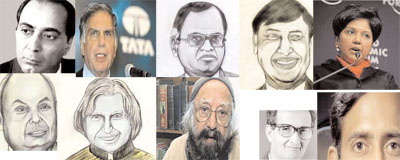
    Ratan Tata
    Ratan Tata is one of the most well-known and respected Indian businessman. He served as the Chairman of the Tata Group from 1991 till 2012. As a Mumbaibased conglomerate, he is also a member of the prominent Tata family of Indian industrialists and philanthropists. Ratan Tata was born on December 28, 1937 in Mumbai. When he was a child his parents separated and he was brought up by his grandmother Lady Navajbai.

    He went to Campion School in Bombay, Bishop Cotton School in Shimla and finished his schooling from Cathedral and John Connon School in Mumbai. He graduated with a degree in Architecture and Structural Engineering from Cornell University in 1962 and also did the Advanced Management Program from Harvard Business School in 1975. He is also a member of the Alpha Sigma Phi fraternity of Yale University, United States. In 1962, Ratan Tata began his career in the Tata group.

    At first he used to work on the shop floor of Tata Steel, shoveling limestone and handling blast furnace. In 1991, JRD Tata stepped down as the chairman of Tata Industries and named Ratan Tata as his successor. Under Ratan’s stewardship, Tata Tea attained Tetley, Tata motors attained Jaguar Land Rover and Tata Steel attained Corus. These triumphs turned Tata from a large India-centric company into a global business with 65% revenues from abroad. He also contributed in the development of Indica and Nano.

    Ratan Tata has also served in various organizations in India and abroad. He is a member of the Prime Minister’s Council on Trade and Industry and he is also on the board of governors of the East-West Center, which is the advisory board of RAND’s Center for Asia Pacific Policy. He also serves on the program board of the Bill & Melinda Gates Foundation’s India AIDS initiative. He was awarded the Padma Bhushan by the Government of India in January 2000.

    He serves on the boards of several leading organizations, both in the public as well as the private sector in India. He is a member of the International Investment Council set up by the President of South Africa and serves on the programme board of the Bill & Melinda Gates Foundation’s India AIDS initiative. Ratan Tata is credited for leading Tatas’ successful bid for Corus, an Anglo-Dutch steel and aluminum producer, which was acquired for an estimated £6.7 billion by Tata Sons.

    N.R. Narayanamurthy
    N.R. Narayana Murthy, the founder of Infosys Technologies is one of the most famous personalities in India’s I-T sector. Born on August 20, 1946, he obtained a degree in electrical engineering from the National Institute of Engineering under University of Mysore in 1967 and went on to do his Masters from IIT Kanpur in 1969. He joined Patni Computer Systems in Pune. While at Pune, he met his wife Sudha Murty.

    In 1981, he founded Infosys alongwith with six otherpeople. He served as president of the National Association of Software and Service Companies, India from 1992 to 1994. Murthy was the CEO of Infosys for twenty years, and was succeeded by Nandan Nilekani in March 2002. He functioned as the Executive Chairman of the Board and Chief Mentor from 2002 to 2006.

    Dhirubhai Ambani
    Dhirajlal Hirachand Ambani was born on 28 December 1932, at Chorwad, Junagadh in Gujarat, When he was 16 years old, he moved to Aden,Yemen. Initially, Dhirubhai worked as a dispatch clerk with A. Besse & Co. Married to Kokilaben. Dhirubhai also worked in Dubai for sometime. He returned to India and founded the Reliance Commercial Corporation with an initial capital of Rs 15000.

    Dhirubhai set up the business in partnership with Champaklal Damani from whom he parted ways in 1965. Dhirubhai started his first textile mill at Naroda, near Ahmedabad in 1966 and started the brand “Vimal”. Dhirubhai Ambani is credited with having started the equity cult in India.With the passage of time, Dhirubhai diversified into petrochemicals and sectors like telecommunications, information technology, energy, power, retail, textiles, infrastructure services, capital markets, and logistics.

    Lakshmi Nivas Mittal
    Lakshmi Nivas Mittal was born on June 15, 1950 in Sadulpur, Rajasthan, India and is presently the CEO & Chairman of Arcelor Mittal. Lakshmi Nivas Mittal was listed in the Forbes List of Billionaires in 2006 as the the richest Indian and the fifth richest man in the world with an estimated wealth around of $25.0 billion and is the richest man in the United Kingdom. Young Lakshmi Nivas Mittal spent his first years in Sadulpur, before his father moved to Kolkata. Lakshmi graduated from St. Xavier’s College, Calcutta. He founded Mittal Steel in 1976, which soon became a global steel producer with operations on 14 countries. His success mantra lies in the identification, acquisition and turnaround of many loss making steel companies all across the world.

    Dr. A.P.J. Abdul Kalam
    Dr. A.P.J. Abdul Kalam, former President of India, graduated in aeronautical engineering from the Madras Institute of Technology in 1958 and joined the Defense Research and Development Organization (DRDO). In 1962, Kalam joined the Indian Space Research Organization (ISRO). In 1982, he rejoined DRDO as the Chief Executive of Integrated Guided Missile Development Programme (IGMDP). Dr. Kalam is credited with the development and operationalization of India’s Agni and Prithvi missiles.

    He worked as the Scientific Adviser to the Defence Minister and Secretary, Department of Defence Research & Development from 1992 to 1999. During this period, the Pokhran-II nuclear tests were conducted. Dr. Kalam held the office of the Principal Scientific Advisor to the Government of India from November 1999 to November 2001. Dr. Kalam has received a host of awards both in India and abroad. He was awarded the Padma Bhushan in 1981, Padma Vibhushan 1990 and the Bharat Ratna in 1997.

    He is of the view that we should work wholeheartedly to make India a developed nation by 2020. Besides being a bachelor, Kalam is a strict disciplinarian, a complete vegetarian and teetotaler. Among the many firsts to his credit, he became India’s first President to undertake an undersea journey when he boarded the INS Sindhurakshak, a submarine, from Visakhapatnam. He also became the first president to undertake a sortie in a fighter aircraft, a Sukhoi-30 MKI.

    Khushwant Singh
    One of the most prominent novelists and journalists of India, Khushwant Singh was born on 2 February 1915 in Hadali, presently in Pakistan. He writes a weekly column, “With Malice towards One and All”, published in several leading newspapers all over the country. He graduated from Government College, Lahore before studying law at King’s College, London. He has been the editor of Yojana, The Illustrated Weekly of India, The National Herald and the Hindustan Times.

    He also served as a member of the Rajya Sabha. Though he was awarded the Padma Bhushan in 1974, he returned it in 1984 to protest the siege of the Golden Temple by the Indian Army. He was awarded the Padma Vibhushan in 2007. Some of his notable works include: The Sikhs; Train to Pakistan; The Sikhs Today; Ranjit Singh: The Maharajah of the Punjab; Delhi: A Novel; Sex, Scotch and Scholarship: Selected Writings; Not a Nice Man to Know: The Best of Khushwant Singh; Paradise and Other Stories; Death at My Doorstep; The Illustrated History of the Sikhs etc.

    Amartya Sen
    Nobel Prize winner Amartya Sen was born on 3 November 1933 in Santiniketan, West Bengal. Besides being a worldrenowned economist, Amartya Sen is also a philosopher. He served as a Master at the Trinity College at Cambridge University, the first Asian academic to head an Oxbridge college. Currently the Lamont University Professor at Harvard University, Amartya Sen traces his roots to an illustrious lineage. His father, Ashutosh Sen, taught chemistry at the Dhaka University.

    Amartya completed his high-school education from Dhaka in Bangladesh in 1941. After his family migrated to India in 1947, Sen studied at the Presidency College, Kolkata and at the Delhi School of Economics before moving over to the United Kingdom to complete his higher studies. He earned his doctorate from the Trinity College, Cambridge in 1959. He has taught at various reputed Universities including the University of Calcutta, Jadavpur University, Oxford, London School of Economics, Harvard and many others. His works helped to develop the theory of social choice.

    In 1981, he published his famous work Poverty and Famines: An Essay on Entitlement and Deprivation, where he showed that famine occurs not only due to shortage of food, but from inequalities in the mechanisms for distributing food. He had personally witnessed the Bengal famine of 1943. He has done valuable work in the field of development economics, which has had a tremendous influence on the formulation of the United Nations Development Programme’s Human Development Report.

    Sabeer Bhatia
    Sabeer Bhatia-co-founder of Hotmail, is one among select group of people who have made it big in America’s Silicon Valley. Born in Chandigarh, Sabeer Bhatia did his schooling from St. Joseph’s Boys’ High School, Bangalore. He graduated from Caltech and went to Stanford to pursue his MS in Electrical Engineering. Sabeer attended many lectures by famous like Steve Jobs and was determined to make it big. After completing his Masters, he joined Apple computers. He left Apple soon after.

    He teamed up with his partner to create a web-based e-mail system Microsoft bought Hotmail on December 30th, 1997, for a reported sum of $400M. After the success of Hotmail, Bhatia in April 1999, he started another venture, Arzoo Inc, which however had to be shut down. In 2006, Arzoo was relaunched. Bhatia has won many awards. Among the notable ones include the “Entrepreneur of the Year” awarded by the venture capital firm Draper Fisher Jurvetson in 1997, the “TR100” award, presented by MIT to 100 young innovators expected to have the greatest impact on technology in the next few years. Besides, he was named by TIME magazine as one of the “People to Watch” in International Business in 2002.

    Indra Nooyi
    Indra Nooyi is the president and chief executive officer of PepsiCo and is the highest-ranking Indian-born woman in corporate America. She helped to start PepsiCo’s fast-food chains in 1997. After a Bachelor’s degree from Madras Christian College and a Post Graduate Diploma in Management from the Indian Institute of Management Kolkata, she moved on to the Yale School of Management.

    She started her career with The Boston Consulting Group (BCG), moving on to companies like Motorola and Asea Brown Boveri.She serves on the board of directors of several organizations. In August 2006, she succeeded Steve Reinemund as chief executive officer of PepsiCo. She has been named the Most Powerful Woman in Business in 2006 by Fortune Magazine. Her name was included in the Wall Street Journal’s list of 50 women to watch in 2005.

    Kiran Bedi
    The first woman to join the coveted Indian Police Service (IPS) in 1972, Kiran Bedi was born on 9 June 1949 in Amritsar, Punjab. Recently appointed as Director General of India’s Bureau of Police Research and Development, Kiran Bedi has had an illustrious career, earning widespread adulation for her no-nonsense attitude and devotion to work. She served as Police Advisor in the United Nations peacekeeping department and was honored with the UN medal for outstanding service. She earned the nickname ‘Crane Bedi’ for towing away the then Indian PM Indira Gandhi’s car for parking violation.

    Kiran Bedi graduated in English before securing a Master’s degree in Political Science from Punjab University, Chandigarh. This gutsy police officer went on to secure an LL.B degree in 1988 from Delhi University and a Ph.D. from the Indian Institute of Technology, New Delhi, even while she was in service. She was good at sports too, having been an all- India and all-Asian tennis champion.

    She has served creditably in a host of appointments ranging from Deputy Inspector General of Police, Mizoram, Advisor to the Lieutanent Governor of Chandigarh, Director General of Narcotics Control Bureau and many others.

    Rakesh Sharma
    The first Indian to fly into space, Rakesh Sharma was born on January 13, 1949 in Patiala, Punjab. He was a squadron leader with the Indian Air Force, when he flew into space in 1984 as part of a joint programme between the Indian Space Research Organisation (ISRO) and the Soviet Intercosmos space program.

    He spent eight days in space on board the Salyut 7 space station. He joined two other Soviet cosmonauts aboard the Soyuz T- 11 spacecraft which blasted off on April 2, 1984. He was awarded the Hero of Soviet Union award on his return from space. The Government of India honoured him with the Ashok Chakra. He retired with the rank of Wing Commander. He joined the Hindustan Aeronautics Limited in 1987 and served as Chief Test Pilot in the HAL Nashik Division until 1992, before moving on to Bangalore to work as the Chief Test Pilot of HAL. He retired from test flying in 2001.

    Dr. Verghese Kurien
    The “father of the white revolution” in India, Dr. Verghese Kurien is acknowledged worldwide as the brain behind the success of the largest dairy development programme in the world by the name of Operation Flood. Also known as the “Milkman of India”, he was the chairman of the Gujarat Co-operative Milk Marketing Federation Ltd. (GCMMF) and his name became synonymous with the Amul brand. Born on November 26, 1921 in Kozhikode, Kerala, he graduated in Physics from Loyola College, Madras in 1940 and pursued a B.E.(Mechanical) course from the Madras University. He was instrumental in the success story of AMUL.

  • Tri-service commands for space, cyber warfare

    Tri-service commands for space, cyber warfare

    NEW DELHI (TIP): The armed forces are now finalizing the plan for creation of three new tri-Service commands to handle space, cyber and special forces, which will be “critical” in deploying capabilities for conventional as well asymmetric warfare in a unified manner. Contours of the Cyber, Aerospace and Special Operations Commands (SOC), after “a lot of spadework” over the past several months, are now being fine-tuned to ensure the “formal joint plan” can be presented to the government by end-July, say sources. “The Aerospace Command, for instance, can be based at Hyderabad because of the presence of ISRO, DRDO there.

    Similarly, the SOC can come up at Delhi since the C-130J `Super Hercules’ aircraft, which are customized for special operations, are based at Hindon airbase,” said a source. The chiefs of staff committee — headed by Air Chief Marshal N A K Browne and including General Bikram Singh and Admiral D K Joshi — as well as other forums of the top military brass have been mulling over the plan since last year, as was first reported by TOI. Though the “urgent need” for Army, Navy and IAF to “synergise” their efforts in tackling challenges in the domains of space, cyber and special forces is well-acknowledged, especially with China furiously developing counter-space and cyber weapons, there has been no final decision on who will “mother” which command.

    The experience of India’s only theatre command at Andaman and Nicobar islands (ANC), with its commander-in-chief (a three-star officer like Lt-General, Vice-Admiral or Air Marshal) being rotated among the three Services, has not been successful. “Turf wars ensure the Services are not very keen to part with their assets for ANC,” said the source. At present, each Service gets to head the three unified commands — ANC, Strategic Forces Command (SFC) and Integrated Defence Staff (IDS) — by rotation.

    “But it is felt one particular service should have stake in a specific command that can draw assets and manpower from all three but is steered by that Service,” he said. So, a view that has emerged is that while SFC, IDS and Cyber Command can continue to be “rotated”, ANC should be headed by Navy, Aerospace Command by IAF, and SOC by Army. “This fits in with the domain expertise of each Service. The government will of course have to take the final call on the new commands,” he said. India has floundered for long in setting up effective and unified structures to deal with threats in space and cyberspace as well as in strengthening its clandestine and “unconventional” warfare capabilities.

    The Aerospace Command, for instance, has been demanded by the armed forces in the past also but the government has kept it in cold storage despite China having an expansive military space programme that extends to advanced ASAT (antisatellite) capabilities with “directascent” missiles, hit-to-kill “kinetic” and directed-energy laser weapons. Cyber-warfare, too, is a frontline military priority for China. Cyberweapons can cripple an adversary’s strategic networks and energy grids, banking and communication, and even sabotage a country’s nuclear programme like Iran learnt after the Stuxnet software “worm” destroyed a thousand of its centrifuges a couple of years ago.

  • DRDO working on getting MIRV capability

    DRDO working on getting MIRV capability

    NEW DELHI (TIP): India’s premier Defence Research and Development Organisation (DRDO) is firing on in several directions with the work on hand involving MIRVs (multiple independently-targetable re-entry vehicles) and improvements in missiles, aircraft, tanks and artillery. DRDO director general and scientific adviser to the defence minister V.K. Saraswat told India Strategic (www.indiastrategic.in) magazine that in terms of missile range, Indian scientists had achieved whatever was assigned by the government (about 5000 km) but the effort was now to develop MIRV capability. “The building blocks, from boosters to radars, seekers and sophisticated mission control centres are there,” he added.

    Saraswat, who has just been awarded the country’s third highest civilian award, the Padma Bhushan, said that DRDO had been able to develop key RF (radio frequency) seeker technologies for missiles in cooperation with Russia, and that in the last missile test, the seeker used was made in India. Digital processing in any case is based on DRDO’s own software. Without the seekers, a missile would be an aimless vehicle. The RF and IR (infra red) seekers are meant for proximity and precision engagement of targets, and both these technologies are required for the anti-ballistic missile (ABM) capability as well as all kinds of missiles. Saraswat did not give details but said that India also was working on seeker technologies with other countries. ‘Today, we are able to design and develop RF seekers, and in about a year or so, we will be independent in this key technology,’ Saraswat added.

    As for an ABM shield, he said that DRDO had conducted four endo-atmospheric (within the atmosphere) and two exo-atmosphere (outside the atmosphere) missile interception tests and that all six had been successful. ‘We certainly need more tests but we can say we have been successful in developing this capability.’ The last one, designated Advanced Air Defence (AAD) interceptor missile, and fired on November 23, was in fact a hit-to-kill test. So far, DRDO has mostly been working on proximity, near-miss or zero-miss acquisition of targets. With these systems, an ABM missile blows itself up some nine metres from its targets. From now on, the effort will be to develop the hit-to-kill capability by directly impacting hostile targets.

  • India Working On Agni-VI Missile, To Be In World’s Elite Nuclear Club

    India Working On Agni-VI Missile, To Be In World’s Elite Nuclear Club

    NEW DELHI (TIP): India onFebruary 7 said it is developing a longrangenuclear-capable Agni-VIballistic missile that would carrymultiple warheads allowing oneweapon system to take out severaltargets at a time.”Agni-V is a major strategic defenceweapon. Now we want to make Agni-VI which would be a force multiplier,”DRDO chief V K Saraswat said here.

    Refusing to divulge the range of thenew under-development missile, hesaid the force multiplier capability ofthe missile would be because of itsMultiple Independently Targetable ReentryVehicle (MIRV) capability.The Agni-5 ballistic missile, whichwas test-fired in April last year, has arange of upto 5,500 kms and it isbelieved that the Agni-6 would have arange longer than its predecessor.

    “It will have force multipliercapability by the MIRV approachwhich would enable us to delivermany payloads at the same time usingonly one missile. Work is on in thisarea and designs have been completed.We are now in the hardwarerealisation phase,” he said.DRDO officials said once the Agni-6is developed, it would propel Indiainto the elite club of nations withsuch a capability including the US andRussia.The DRDO chief said hisorganisation was also workingtowards developing a cruise missiledefence programme which wouldenable the armed forces to defendagainst low-flying cruise missiles andenemy aircraft.

  • Narasimha Rao had asked Kalam to be ready for nuclear test

    Narasimha Rao had asked Kalam to be ready for nuclear test

    NEW DELHI (TIP): Just two days before announcement of results of the 1996 general election, then prime minister P V Narasimha Rao had directed A P J Abdul Kalam, scientific adviser to the defence minister at the time, to keep his team ready for a nuclear test. However, with the poll outcome throwing up a change in government, Rao ensured his impending successor Atal Behari Vajpaee was briefed in his presence on the nuke test plans and so enabled a smooth takeover of the nuclear programme. This was revealed by Kalam himself while delivering the 7th R N Kao Memorial Lecture, organized by the Research and Analyses wing of the Cabinet Secretariat, here on Thursday. “I still remember a scene during May 1996. It was 9 ‘o’ clock. I got a call ….that I should meet Prime Minister P V Narasimha Rao immediately,” Kalam said. According to the father of India’s missile programme, who later went on to become the President of India, Rao told him, “Kalam, be ready with the department of atomic energy and your team for the N-test and I am going to Tirupati. You wait for my authorization to go ahead with the test. DRDO-DAE teams must be ready for action”. Recounting Rao’s plans were not meant to be as “the election result was quite different from what he anticipated”, Kalam said he received yet another call from the then PM asking him to meet him along with Prime Minister-designate Vajpayee.

    This was “so that the smooth takeover of such a very important programme can take place,” he elaborated. However, the nuke test plans could not be carried out as the Vajpayee government lasted barely 13 days. Noting that Rao’s act of ensuring continuity of the nuclear programme “reveals the maturity and professional excellence of a patriotic statesman who believed that the nation is bigger than the political system,” Kalam revealed that the first task he was assigned after Vajpayee embarked on his second stint as the PM in 1998 was to conduct the nuclear test at the earliest.

    The Pokhran tests were finally carried out in May, 1998. Placing the focus of his lecture on cyber terrorism and counter measures, Kalam on Thursday suggested an empowered coordinating agency be set up to receive information about all cyber attacks. Apart from calling for continuous upgrade of technical capabilities by the intelligence agencies, the former President insisted that hacking skills be imparted by scientists, computer software and hardware experts, on the lines of China where virus writing is taught in its military schools. Kalam suggested human intelligence and electronic intelligence be used as a tool to penetrate terrorist groups, besides building offensive and defensive cyber capabilities on the lines of nuclear capabilities. “Technology-driven covert operations are becoming the order of the day and inflicting collateral damages through critical information infrastructure is threatening to change the conventional wisdom in warfare,” he said and sought crippling of the ability of terrorists to use technology for communication.

    Kalam also recommended creation of an intelligence cadre, like the Indian Intelligence Service, by recruiting specifically for intelligence agencies. All these recruits, he said, must be made to pass a strict personality test based on evolved and dynamic physiological and psychological aptitude tests.

  • Chandipur Beach Where The Sea Disappears

    Chandipur Beach Where The Sea Disappears

    Have you seen the sea disappear in front of your eyes? A unique phenomenon rarely seen anywhere else, the sea recedes by as much as five kilometres every day on the Chandipur beach in eastern India, not just enthralling the onlooker but also offering an opportunity to literally walk into the sea. One of nature’s many wonders, the sea recedes massively from the beach during ebb and returns to fill the emptiness during high tide. This hide-and-seek of the sea comes to play twice a day and seeing the sea disappear and then return is an unforgettable experience. Chandipur lies around 200 km from state capital Bhubaneswar.

    From here, one can either take the train to Balasore, the closest town at a distance of 10 km, and then travel by road, or take the entire journey by road on National Highway 5. One can be assured of a good journey thanks to the green scenery that follows you throughout and good roads. Adding to the peaceful ambience are the swaying casuarina trees and the solitary sand dunes, with the constant hum of the waves as they rise and fall gently. Considering its uniqueness, the beach supports a varied range of biodiversity.

    It’s not rare to thus find a horseshoe crab or red crab crawling beside you. While it’s still not very well known among tourists who flock to its cousin beaches of Puri, or the temple destination of Konark, local tourists often visit Chandipur. “My wife and I saw the sea disappear in front of our eyes, and we walked in the sea bed, almost for four kilometres, and then returned with the gentle water when the high tide came,” Anirban Mukherjee, a tourist from the nearby state of West Bengal, said. “It was like returning with the sea. The massive void left behind by the waters, the path we took, was soon filled up and it was as if we had walked into the sea. This beach is nothing like the other beaches,” said his wife Arpita.

    For some, it’s not just walking but also riding a bike into the sea. When asked if it was dangerous for people to ride a bike into the sea bed with the impending high tide, Dasarath Dash, a coconut seller by the beachside, said no. “The tide has its timings. Depending on the moon, the timings keep changing. It’s mostly the locals, familiar with the tide’s time, who take their bikes into the sea bed. The others are thrilled just to even walk that distance,” Dash said. “In any case, the sea is not rough here. The waves are gentle,” he said. Food is another plus point here. For those who love sea food, here’s a place which can offer you plenty, especially fresh prawns. The Chandipur beach is also well known for its proximity to the Defence Research and Development Organisation’s (DRDO) Integrated Test Range.

    A number of missiles have been launched from here, including Akash, Agni, Shaurya and Prithvi ballistic missiles. There is a handful of small hotels – with a tariff range of Rs.500 to Rs.2,500 per day – and a government guesthouse in Chandipur. There are no 5-Star hotels in the area. One can also opt to stay in Balasore. “The best time to visit Chandipur is winter, between November and March, and most tourists come during this time,” Dash said. The tourism department has also been trying to promote Chandipur and other spots nearby as potential tourist destinations. An elaborate beach festival, showcasing the dance forms, art and culture of the state, has become an annual affair here and takes place every February. “I really hope proper infrastructure can be put in place so that the Chandipur beach attracts more tourists and the locals around can benefit. Right now we mostly have local tourists and those from the neighbouring states. The number of foreign tourists is still very low compared to Puri,” said Ubachan Mohanty, a local.