Tag: Droupadi Murmu

  • India Celebrates 77th Republic Day with Grand Display of Military Strength, Culture and Global Engagement

    India Celebrates 77th Republic Day with Grand Display of Military Strength, Culture and Global Engagement

    NEW DELHI (TIP): India marked its 77th Republic Day on January 26 with a spectacular parade along Kartavya Path, blending military strength, rich cultural heritage and diplomatic symbolism. The ceremonial event unfolded before an audience of nearly 77,000 people, including the chief guests—European Commission President Ursula von der Leyen and European Council President Antonio Costa—underscoring India’s expanding global partnerships.

    Display of military power

    As in previous years, the parade was a powerful expression of national pride, with special emphasis this time on Operation Sindoor, India’s targeted military action against terror infrastructure in Pakistan following last year’s deadly attack in Pahalgam. The operation featured prominently through a tri-services tableau and a distinctive arrowhead formation during the flypast, highlighting jointness among the armed forces.

    A Fly past by Indian Air Force aircraft.

    The theme of the cultural segment revolved around the 150th anniversary of “Vande Mataram,” India’s national song. About 2,500 artists from across the country performed a meticulously choreographed dance presentation, fusing folk and classical traditions to celebrate the enduring legacy of the song penned by Bankim Chandra Chattopadhyay in 1875. The musical composition for the performance was created by Oscar-winning composer M.M. Keeravani and extended beyond the customary two stanzas.
    Prime Minister Narendra Modi, in a message on social media platform X, said the Republic Day parade showcased India’s robust security apparatus, technological capabilities and commitment to national defense, while also celebrating the country’s cultural diversity and unity.

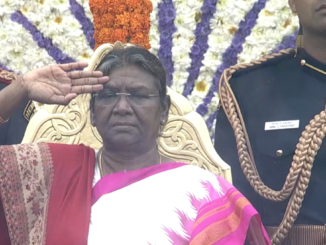
    The celebrations began with Prime Minister Modi paying homage to the fallen soldiers at the National War Memorial. Soon after, President Droupadi Murmu arrived at Kartavya Path with the chief guests in a ceremonial carriage drawn by six horses. The national flag was unfurled, followed by a 21-gun salute fired by the Army’s 172 Field Regiment using 105 mm light field guns.

    The Vande Mataram tableau featured the Father of the Indian Nation, Mahatma Gandhi.

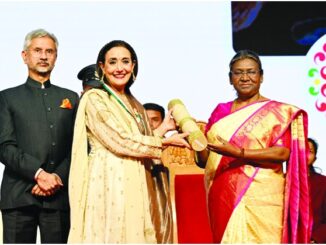
    Before the parade commenced, President Murmu conferred the Ashoka Chakra, India’s highest peacetime gallantry award, on astronaut and Indian Air Force officer Group Captain Shubhanshu Shukla for his role as pilot in last year’s historic Axiom Mission to the International Space Station.
    The military segment of the parade highlighted India’s growing emphasis on modern warfare and indigenous capabilities. Unmanned systems took Centre stage for the first time, reflecting their increasing role in surveillance, reconnaissance and precision strikes, particularly in the backdrop of Operation Sindoor. The parade adopted a phased battle array format, demonstrating how various platforms are deployed in real combat scenarios.
    Among the systems on display were new additions such as the Suryastra universal rocket launcher and a long-range anti-ship hypersonic missile capable of travelling at speeds exceeding Mach 5. Other showcased equipment included BrahMos and Akash missile systems, T-90 and Arjun tanks, Dhanush and ATAGS artillery guns, BMP-II infantry combat vehicles, and a range of all-terrain and light strike vehicles.
    In a first, the ceremonial procession also included double-humped Bactrian camels, Zanskar ponies, black kites used for surveillance and anti-drone roles, and five indigenous dog breeds—symbolizing both tradition and innovation within the armed forces.
    The flypast featured 29 aircraft and was conducted in two phases—during the parade and at its conclusion—aligning with the Indian Air Force’s role in the battle order. A special formation named “Sindoor”, comprising Rafale, MiG-29, Sukhoi-30 and Jaguar fighter jets, paid tribute to the Air Force’s contribution during Operation Sindoor.
    The tri-services tableau titled “Operation Sindoor: Victory Through Jointness” depicted coordinated air strikes, naval maneuvers, and ground offensives, reflecting India’s evolving doctrine of integrated military command.

    The tableaus displayed India’s culture.

    Adding a strong diplomatic dimension to the celebrations was the presence of a large delegation from the European Union. A small EU military contingent also participated in the parade, carrying flags associated with the bloc’s naval missions. Prime Minister Modi described the visit as a reflection of the growing India–EU partnership and shared democratic values, with the engagement expected to give momentum to cooperation across multiple sectors, including trade.
    Visually enriching Kartavya Path were reproductions of rare paintings created in 1923 by artist Tejendra Kumar Mitra, illustrating verses of Vande Mataram. Several state and ministry tableaux also echoed the national song, aligning with the parade’s overarching theme, “Swatantrata Ka Mantra – Vande Mataram.”
    The celebrations came amid renewed public discourse on the historical and political significance of Vande Mataram, a debate that had resonated in Parliament in the past year. Against that backdrop, the Republic Day parade stood as a reaffirmation of India’s democratic ideals, cultural continuity, and strategic resolve on the world stage.

  • US Ambassador Sergio Gor presents credentials to President Droupadi Murmu

    US Ambassador Sergio Gor presents credentials to President Droupadi Murmu

    Envoy pledges to deepen India-US cooperation amid challenges over trade and tariffs

    NEW DELHI (TIP): US Ambassador to India Sergio Gor on Wednesday, January 14, formally presented his credentials to President Droupadi Murmu at an official ceremony held at Rashtrapati Bhavan. With this, Gor has assumed charge as the 27th United States Ambassador to India.

    Following the ceremony, the US Embassy in New Delhi quoted Ambassador Gor as saying that he looked forward to working closely with the Government of India and the Indian people to advance shared priorities in defense, trade, technology and critical minerals. He added that his efforts would focus on further strengthening the partnership between the world’s two largest democracies.

    “It is an honor to serve in India at a time of such promise and opportunity in the US-India relationship,” Gor said.

    Before taking up his posting in New Delhi, Gor served as Assistant to US President Donald Trump and Director of Presidential Personnel at the White House.

    Earlier this week, after arriving in India, the ambassador described India-US ties as a relationship where “real friends can have disagreements but can resolve them.”

    Gor assumes office at a challenging time, with bilateral ties under strain following the imposition of a 50 per cent tariff on Indian goods entering the US market, a move that has impacted trade relations between the two countries.
    (Source: Tribune)

  • Canadian envoy presents credentials to Murmu, year after diplomatic row

    Canadian envoy presents credentials to Murmu, year after diplomatic row

    NEW DELHI (TIP): President Droupadi Murmu on Friday, October 3, accepted credentials from Canadian High Commissioner Christopher Cooter, who has taken charge of the diplomatic post nearly a year after bilateral ties broke down over the allegations of Indian links in the killing of Khalistani separatist Hardeep Singh Nijjar.

    In October last year, India recalled its high commissioner and five other diplomats after Ottawa attempted to link them to the Nijjar case. India had also expelled an equal number of Canadian diplomats.

    Prime Minister Narendra Modi and his Canadian counterpart Mark Carney in June this year agreed to pursue “constructive” steps to restore stability in India-Canada ties, including the early return of envoys to each other’s capitals.
    Following this, both countries appointed envoys to each other’s capitals in August, signaling their efforts to mend ties. While India named seasoned diplomat Dinesh K Patnaik as the next high commissioner to Ottawa, Canada appointed Cooter as its new envoy to New Delhi.

    Patnaik presented his credentials to Canada’s Governor General Mary Simon on September 25.

    Cooter has 35 years of diplomatic experience, having served most recently as Canada’s charge d’affaires to Israel and as Canada’s high commissioner to South Africa, Namibia, Lesotho, Mauritius and Madagascar. He also served as first secretary at the Canadian High Commission in New Delhi from 1998 to 2000.
    (Source: PTI)

  • President of India confers national awards on teachers

    President of India confers national awards on teachers

    NEW DELHI (TIP): On the occasion of the National Teachers’ Day, President Droupadi Murmu conferred National Awards on 82 educators, including 50 teachers, on Thursday, September 5. In addition, 16 teachers each from the Department of Higher Education and the Ministry of Skill Development and Entrepreneurship were also awarded. The President said teachers had to prepare such citizens, who are not only educated but also sensitive, honest and enterprising.

  • A vibrant parade marked Celebration of the 74th Republic Day of India

    A vibrant parade marked Celebration of the 74th Republic Day of India

    Nation’s  military prowess, cultural diversity, and other unique initiatives displayed

    NEW DELHI (TIP): The ceremonial boulevard of the national capital, the newly-christened Kartavya Path that has witnessed the country free itself from the clutches of colonial rule played host to the 74th Republic Day on January 26, 2023. President Droupadi Murmu led the nation in celebrating Republic Day, and Egypt’s President Abdel Fattah al-Sisi was the chief guest at the ceremonial event. This is the first time an Egyptian head of state has been invited to the ceremony. The invite also marks 75 years of diplomatic ties between Cairo and New Delhi.

    A total of 23 tableaux — 17 from States and Union Territories and six from various Ministries and departments depicting India’s vibrant cultural heritage, and economic and social progress were a part of the parade on the Kartavya Path.

    Indian Army, Indian Navy, and Indian Air Force along with other security forces presented a spectacular show in front of the nation as they marched past the dais where the President along with other dignitaries took the salute.

    World leaders conveyed Republic Day wishes to India on Thursday, January 26,  with Prime Minister Narendra Modi thanking them for their greetings and pledging to work together to further strengthen ties.

    Replying to the French president, PM Modi tweeted, “Grateful for your warm greetings my dear friend Emmanuel Macron on India’s Republic Day. I share your commitment to working together for the success of India’s G20 Presidency & 25th anniversary of the India-France Strategic Partnership. India and France together are a force for global good.” Macron said he looked forward to the two countries setting new ambitions together for the G20 and for the Indo-French strategic partnership as it turns 25 this year. Thanking his Israeli counterpart Benjamin Netanyahu, Modi said he looked forward to further strengthening the strategic partnership.

    He tweeted to Bhutan’s Prime Minister Lotay Tshering that India is committed to its unique partnership with his country for progress and prosperity of both the nations.

    PM Modi echoed similar sentiments in tweets to leaders of Nepal, Mauritius and Maldives among other countries.

    (With inputs from  PTI)

  • President Murmu confers Pravasi Bharatiya Samman Awards 2023 at PBD convention in Indore

    President Murmu confers Pravasi Bharatiya Samman Awards 2023 at PBD convention in Indore

    President Droupadi Murmu on January 10 graced the valedictory session of the 17th Pravasi Bharatiya Divas Convention and conferred the Pravasi Bhartiya Samman Awards today here upon 27 overseas Indians as part of the Pravasi Bharatiya Divas Convention on Non-Resident Indians, Persons of Indian Origin, or an organization established and run by Non-Resident Indians in recognition of their outstanding achievements both in India and abroad. Speaking to ANI, the awardees expressed their contentment and gratification over receiving the prestigious awards and said that the Indian diaspora is giving examples of shining in foreign lands that they moved to with India in their hearts.

    “This award has been amazing. First of all coming home, coming to India and my family, it is already humbling, and then to receive an award from the President herself has been a truly magical moment and a very big honour in my life,” said Archana Sharma from Switzerland who received the awards in the field of Science and Technology.

    “The Indian diaspora is shining diamonds in Switzerland because in Switzerland we have a very – very highly skilled and highly educated Indian diaspora and they are actually dotting very key positions. For example, in the United Nations, the WHO, and in all these kinds of international organizations in multinationals, and in the business community as well. So, we have a sterling diaspora in Switzerland and they are all very connected with India”, added the awardee. Thanking the Government of India for this honour, Reena Vinod Pushkarna from Israel who got the award in the field of business and community welfare said that she was delighted that the government did not forget them even when they leave their Motherland and go to other places.

    “Very honoured, extremely touched. My parents up in heaven must be very happy today. It started with food, led to culture then led to diplomacy. Now, there are so many exchange programs, between the citizens of India and Israel, and it all started with just two simple people so I thank the government of India for not forgetting its people and this is what PBD stands for, that they don’t forget their Indians even when they leave their Motherland and go to other places to carry on our journeys but with India in their hearts”, said Reena.

    Another awardee from Canada said that he was honoured to receive the award from his Matribhoomi and he will continue to serve both in Canada and India.

    “It is a privilege that I got this award from Bharat Mata our Mataribhumi and I will continue to offer our services I am blessed to be able to continue my service, for contributing to the field of education, health care, and clean technology, and continue to serve both Canada and India”, said Vaikuntam Iyer Lakshmanan.

    Getting the award for community welfare from Sri Lanka, Sivakumar Nadesan said that we can do better with the quality of life, improve it and make larger jobs and skills.

    “I got the award for community welfare. They have also mentioned that I have done media. So, I think that it is the combination of both. But especially on the community welfare side, we are talking about the Indian origin people who went there four generations ago and they have planted tea, worked on the bridges, worked on the roads and actually done lot of development for Sri Lanka during their lifetime. But I think we can do better with the quality of life, improve it and kind of make them more free to make a larger jobs and skills and housing”, he said.

    The 17th edition of the Pravasi Bharatiya Divas Convention was held at Indore in Madhya Pradesh. The awards were conferred by the President during the valedictory session of the Pravasi Bharatiya Divas celebrations. The recipients were chosen by a jury-cum-awards committee chaired by the vice-president with the External affairs minister S Jaishankar as the vice-chair of the panel, whose other members are drawn from various walks of life.

    Addressing the gathering, the President said that the Indian Diaspora today has become an important and unique force in the global system. It has grown into an energetic and confident community in every region and is making stellar contributions to world affairs in leadership positions.

    Referring the theme of this year’s Pravasi Bharatiya Divas Convention – “Diaspora: Reliable Partners for India’s Progress in Amrit Kaal”, the President said that it reflects India’s desire to make its Diaspora a partner in the achievement of its national developmental goals.

    In the next 25 years, India is going to embark on an ambitious journey of collective hard work, sacrifice, and intensive development to transform into a self-reliant world leader by 2047, when we would be celebrating the centenary of our independence, she said.

    Source: ANI

  • World looking up to India: PM Modi

    Prime minister Narendra Modi on January 9 addressed the 17th edition of the Pravasi Bharatiya Divas convention – this time in Madhya Pradesh’s Indore – and declared himself happy to see it organised in ‘the heart of India’. This year’s Pravasi Bharatitya Divyas theme is ‘Diaspora: Reliable partners for India’s progress in Amrit Kaal’.

    Chandrikapersad Santokhi, the president of the Republic of Suriname, and Dr Mohamed Irfaan Ali, the president of the Cooperative Republic of Guyana, were among the special guests, as was Madhya Pradesh chief minister Shivraj Singh Chouhan. More than 3,500 diaspora members – from 70 countries – registered for the event, news agency ANI said.

    Here are prime minister Modi’s top quotes from his address at the Pravasi Bharatiya Divas:

    1. This Pravasi Bharatiya Divas is special in many ways. The nation has entered ‘Amrit Kaal’ for the next 25 years and our Pravasi Bhartiya community has a significant role to play in further elevating India’s role on global levels.
    2. Each and every Pravasi Bhartiya present here has achieved unprecedented success in their respective fields. I’m happy that the Pravasi Bhartiya Divas is being organised in Madhya Pradesh, which also is called the ‘Heart of India’.
    3. I would like you all to relish food in Indore – a city which is known for its delicacies from namkeen to poha; everything here has an unforgettable taste. Chappan dukan is highly famous and the Sarafa market is a world-renowned venue.
    4. The digital exhibition displaying our freedom struggle has been organised here and it brings the glorious era in front of you all again.
    5. ‘Swadesho Bhuvantrayam’ means ‘for us, the whole world is our country, only human beings are our brothers and sisters’. It was on this ideological foundation that our forefathers shaped the cultural expansion of India.

    About the Pravasi Bharatiya Samman

    The Pravasi Bharatiya Samman (Overseas Indian Honour/Award) is the highest Indian award for Non-resident Indian and Overseas Citizen of India or an organisation or institution established and run by Non-Resident Indians or Persons of Indian Origin, constituted by the Ministry of Overseas Indian Affairs, Government of India in conjunction with the Pravasi Bharatiya Divas (Non-Resident Indian Day), to honour exceptional and meritorious contribution in their chosen field/profession. The award is given by the President of India. Since 2016, the Government of India has doubled the number of awardees each year to 30 after a decision to grant the award once every two years.

    “A jury-cum-awards committee, with (the) Vice President as the chairman and External Affairs Minister as the vice-chair and other distinguished members from various walks of life considered the nominations…and unanimously selected the awardees,” the Ministry of External Affairs stated in a release.

    When Pravasi Bharatiya Divas started?

    A High-Level Committee on Indian Diaspora, headed by jurist and Parliamentarian LM Singhvi, had recommended in January 2002 that the government must renew and strengthen linkages of overseas Indians to their place of origin, and with each other.

    The committee recommended that a Pravasi Bharatiya Bhavan should be set up to emerge as the focal point for networking between India and its overseas Indian community; and as a suitable place which to commemorate the stories of the Indian Diaspora. The idea of a day to have the government recognise the community flowed from this, and was held in 2003.

    January 9 was selected as it was the date when Mahatma Gandhi returned to India from South Africa in 1915. Over the years, he has often been described as the first non-resident Indian of the most famous NRI by various politicians, including PM Modi and Congress leader Rahul Gandhi. Since 2015, the centenary year of Gandhi’s return, the format was revised for the meeting to be held once every two years. Since the pandemic, this will be the first in-person meeting.

    List of Overseas Indians given the honor

    Sr. No.                        Person                                                Country                                 Field

    1                      Jagadish Chennupati                           Australia                    Science & Tech/ Education

    2                      Sanjeev Mehta                                   Bhutan                        Education

    3                      Dilip Loundo                                       Brazil                         Art & Culture/Education

    4                      Alexander Maliakel John                   Brunei                         Medicine

    5                      Vaikuntam Iyer Lakshmanan              Canada                       Community Welfare

    6                      Joginder Singh Nijjar                          Croatia                       Art & Culture/Education

    7                      Ramjee Prasad                                    Denmark                    Information Technology

    8                      Kannan Ambalam                               Ethiopia                      Community Welfare

    9                      Amal Kumar Mukhopadhyay             Germany                     Community Welfare

    10                    Mohamed Irfaan Ali                           Guyana                        Community Welfare

    11                    Reena Vinod Pushkarna                     Israel                           Business

    12                    Maqsooda Sarfi Shiotani                    Japan                          Education

    13                    Rajagopal                                            Mexico                       Education

    14                    Amit Kailash Chandra Lath                Poland                          Business

    15                    Parmanand Sukhumal Daswani          Congo                         Community Welfare

    16                    Piyush Gupta                                      Singapore                   Business

    17                    Mohanlal Hira                                     South Africa               Community Welfare

    18                    Sanjaykumar Shivabhai Patel              South Sudan              Business

    19                    Sivakumar Nadesan                            Sri Lanka                     Community Welfare

    20                    Dewanchandrebhose Sharman            Suriname                   Community Welfare

    21                    Archana Sharma                                  Switzerland                 Science & Technology

    22                    Frank Arthur Seepersad                      Trinidad                      Education

    23                    Siddharth Balachandran                     UAE                            Business

    24                    Chandrakant Babubhai Patel              UK                              Media

    25                    Darshan Singh Dhaliwal                     USA                            Community Welfare

    26                    Rajesh Subramaniam                           USA                           Business

    27                    Ashok Kumar Tiwary                         Uzbekistan                   Business

  • How to celebrate President Droupadi’s election

    How to celebrate President Droupadi’s election

    The report observes that the ‘development paradigm’ has aggravated the difficulties of the ‘marginalized’ as the benefits have been ‘disproportionately cornered by the dominant sections at the expense of the poor, who have borne most of the costs.’ In the case of the ‘tribes’, it resulted in their loss of cultural identity, destruction of their resource base and made them increasingly vulnerable to exploitation and daily violence.

    By Vappala Balachandran

    It is very unfair to link the election of President Droupadi Murmu with the anticipated future electoral gains of the BJP, as some commentators have done. They had cried hosanna to the BJP leadership for flummoxing the Opposition by selecting the ‘first tribal’ and ‘second woman’ as the presidential candidate. This is not the way to hail the election of such a remarkable lady from a backward region who has braved personal and social difficulties to reach this high office. And, that too, at a time when India has slipped from 112 to 140 among 156 countries on the 2021 Global Gender Gap index compiled by the World Economic Forum (WEF), which conducts the annual Davos Conference. In Asia, only Pakistan and Afghanistan are behind India. The WEF attributed this slippage to inadequate political and economic woman empowerment in India.

    Those opposed to the linking of electoral factors with her selection say that the new President would not be able to make much personal contribution for solving the deep-rooted problems faced by tribals or undo the wrongs done to them over centuries. This is because of the limitations built into her high constitutional position. Also, hyperbole or symbolic steps do not result in solving such underlying problems. This is true if history is any indication. An important milestone in their journey to correct these wrongs came in 1946 when attempts were made while drafting our Constitution on the eve of Independence. On December 11, 1946, Dr Rajendra Prasad, Chairman of the Constituent Assembly, introduced Jaipal Singh Munda as the “representative of the aboriginal tribes of Chhota Nagpur”.

    In the Assembly records, Munda mentioned his religion as ‘Adibasi’ and caste as ‘nil’ as opposed to the others, including Jawaharlal Nehru, who wrote religion ‘Hindu’ and caste ‘Brahmin’. The only other representative who recorded as ‘Adibasi’ was L Sahu from Orissa. Their presence gave voice to that underprivileged section of our society in the Constitution-making body which gave special protection to them. Munda said that the dispossession of Adivasis did not begin with the arrival of the British, nor would it end with their departure. He said that “for the real rehabilitation and resettlement of the original people of India”, it was necessary that not only the British should quit, but also the others who had been exploiting and dispossessing Adivasis for thousands of years.

    However, subsequent events would prove that independent India was not able to achieve even a modicum of reforms in this direction. Whatever we had attempted was diluted by political crosscurrents generated by upper classes, leading to frustration among this section, numbering 10.43 crore (8.6 per cent of our population) and divided among 705 notified tribes.

    On the other hand, there is an increasing tendency by the government to treat such frustrations as ‘law and order’ problems during which the ‘dispossessed’ become the ‘accused’. The second milestone in their quest for justice came on January 5, 2011 when the Supreme Court (SC) sharply criticized the ‘historical injustice’ done to the tribals by the governance system and how these protections were not implemented even by a high court. This was during the SC verdict overturning an Aurangabad (Maharashtra) High Court’s acquittal of accused persons on technical grounds in which a young Bhil woman was stripped naked and beaten publicly. The SC also said: “Despite this horrible oppression on them, the tribals of India have generally (though not invariably) retained a higher level of ethics than the non-tribals in our country.” We have produced thousands of official pages on what needs to be done to improve the situation. However, no government has sincerely implemented the reforms suggested. One such good report is that of 2008, titled ‘Development Challenges in Extremist Affected Areas’. It is the result of the deliberations by a 16-member ‘expert group’ convened by D Bandopadhayay, which was constituted by the now defunct Planning Commission. The report covered not only the problems of Adivasis but also of Dalits and women in the vast landscape of land reforms, access to basic resources, forests, common property resources, harm done to them by the Special Economic Zones, mining and displacement of the poor due to big projects and how they could be rehabilitated. Development, which is insensitive to the needs of these communities, has invariably caused displacement and reduced them to a sub-human existence: “The poor have depended upon common property resources such as forests, pastures, and water sources for the satisfaction of their basic survival needs. With the increasing tendency to see all such resources as sources of profit, the poor are being deprived of whatever access they had to such resources.”

    The report found that no government had seriously studied the underlying and foundational causes leading to unrest, discontent and extremism among the tribals nor had these subjects been “the subject matter of administrative or academic discourses in India.”

    An important chapter of the report is on the ‘Political marginalization of Scheduled Castes and Scheduled Tribes’. It lists several ways in which SCs and STs are marginalized by the dominant classes, resulting in ‘tokenism’ of their political presence and leading to the suppression of their voice or empowerment. The report makes an important observation that the ‘development paradigm’ since Independence has aggravated the difficulties of the ‘marginalized’ as the benefits have been “disproportionately cornered by the dominant sections at the expense of the poor, who have borne most of the costs.” In the case of the ‘tribes’, it had resulted in their loss of cultural identity, destruction of their resource base and made them increasingly vulnerable to exploitation and daily violence.

    Chapter 5 lists several important recommendations. Among them are an effective implementation of protective legislation, land-related measures, land acquisition for development and rehabilitation of those affected, livelihood security, standardization of social services and extension of the Panchayati Raj to Scheduled Areas Act and other administrative measures. No government since 2008 has done an open audit on how far these recommendations have been implemented. Thus, the best way to celebrate the election of President Murmu is that the Centre and the states should sincerely implement these recommendations as well as those made in other such reports.

    (The author is Ex-Special Secretary, Cabinet Secretariat, Government of India)

  • Droupadi Murmu  Elected 15th President of India; will be sworn in on July 25

    Droupadi Murmu  Elected 15th President of India; will be sworn in on July 25

    The  first Tribal woman , and the second woman to become the President in the Republic’s history

    NEW DELHI (TIP): Droupadi Murmu scripted history on Thursday, July 21,  by becoming India’s first tribal woman President in the one-sided contest, defeating Opposition candidate Yashwant Sinha. Murmu, 64, won by an overwhelming margin against Sinha after receiving over 64 per cent valid votes in a day-long counting of ballots of MPs and MLAs, comprising the electoral college, to succeed Ram Nath Kovid to become the country’s 15th president. After the end of the counting process that continued for more than 10 hours, returning officer P C Mody declared Murmu as the winner and said that she got 6,76,803 votes against Sinha’s 3,80,177 votes.

    She will be the first President to be born after independence and is the youngest to occupy the top post. She is also the  first Tribal woman , and the second woman to become the President. Her victory was sealed after the third round itself when the Returning officer announced that Murmu had already received over 53 per cent of the total valid votes even as Ballots from 10 states and Union territories are still being counted. Conceding defeat after the third round of counting, Sinha congratulated Murmu and said every Indian hopes that as the 15th President she functions as the “custodian of the Constitution” without fear or favor. In a statement, Sinha thanked the leaders of the Opposition parties for choosing him as their consensus candidate in this election.

    “I also thank all members of the Electoral College who voted for me. I accepted the offer of Opposition parties solely guided by the philosophy of Karma Yoga preached by Lord Krishna in the Bhagavad Gita—‘Do your duty without expectation of the fruits thereof’,” Sinha said. “I have performed my duty conscientiously out of my love for my country. The issues I had raised during my campaign remain pertinent,” he said. Immediately after the announcement of the NDA presidential nominee crossing the halfway mark, Prime Minister Narendra Modi and BJP president J P Nadda visited Murmu at her residence here to congratulate her. “India scripts history. At a time when 1.3 billion Indians are marking Azadi Ka Amrit Mahotsav, a daughter of India hailing from a tribal community born in a remote part of eastern India has been elected our President!,” Modi tweeted. He congratulated Murmu on being elected to the top Constitutional post.

    “Droupadi Murmu Ji’s life, her early struggles, her rich service and her exemplary success motivates each and every Indian. She has emerged as a ray of hope for our citizens, especially the poor, marginalized and the downtrodden,” he said in a series of tweets. The Prime Minister also thanked all MPs and MLAs across party lines who supported her candidature and said her “record victory” augurs well for our democracy.

    “Droupadi Murmu Ji has been an outstanding MLA and Minister. She had an excellent tenure as Jharkhand governor. I am certain she will be an outstanding President who will lead from the front and strengthen India’s development journey,” he said. Soon after counting began and she inched towards the halfway mark, celebrations began in her native town of Rairangpur congratulating “Odisha’s daughter”, with folk artists and tribal dancers performing on the streets. Murmu belongs to one of the largest tribal groups in the country, the Santhals.

    Traditional dancers celebrate Droupadi Murmu’s victory in the Presidential election at her New Delhi residence on Thursday. Mukesh Aggarwal Murmu’s tribal background not only helped catapult her to the top post, but the BJP by fielding her is also eyeing crucial votes of the ST community in upcoming assembly elections in Gujarat, Chhattisgarh, Rajasthan and Madhya Pradesh, which have a significant tribal population, besides the 2024 Lok Sabha polls.

    This also helped her get the support of a number of independent parties including BJD, YSRCP, AIADMK, TDP, BSP, JDS and SAD, besides opposition’s JMM, Shiv Sena and Suheldev Bharatiya Samaj Party in her victory run.

    By nominating her, the BJP is also seeking to get its foothold in Odisha’s tribal-dominated belt, which it has been eyeing ever since it snapped ties with BJD in 2009. Odisha goes to the polls along with the 2024 general elections and so does Andhra Pradesh, where there is a significant tribal population. Murmu had contested the 2014 assembly election from Rairangpur but lost to the BJD candidate. Born on June 20, 1958, in Odisha’s Mayurbhanj district, she catapulted into the national spotlight after being picked as the ruling NDA’s presidential nominee in the July 18 polls.

    It is from Rairangpur that she took her first step up the BJP ladder. She was a councilor in the local Notified Area Council in 1997 and rose to be a minister in Odisha’s BJD-BJP coalition government from 2000 to 2004. In 2015, she was appointed governor of Jharkhand and stayed in the post till 2021. She is an excellent orator in Santhali and Odia languages and has worked extensively to improve infrastructure such as roads and ports in Odisha.

    The low-profile Murmu, believed to be deeply spiritual, is a keen practitioner of the meditation techniques of the Brahma Kumaris, a movement she embraced after she lost her husband, two sons, mother and brother in just six years between 2009-2015. Nepal PM Sher Bahadur Deuba has congratulated newly elected President Droupadi Murmu on Twitter.  Odisha Chief Minister Naveen Patnaik congratulated Droupadi Murmu on Thursday for emerging victorious in the presidential poll, saying it was a very proud moment for everyone in Odisha. Patnaik said Murmu’s journey from a humble beginning to becoming the first citizen of the country was an inspiring and a shining example of women’s empowerment. Rajnath Singh has congratulated Droupadi Murmu on impressive win in presidential poll, says it’s proof of Indian democracy’s strength.

    (Source: Agencies)

  • Congress ally JMM, other parties back Droupadi Murmu for President

    Congress ally JMM, other parties back Droupadi Murmu for President

    New Delhi (TIP)- Jharkhand Mukti Morcha (JMM), on Thursday, July 14, became the latest non-National Democratic Alliance’s (NDA)-party to announce its support for presidential candidate Droupadi Murmu. JMM being an ally of the Indian National Congress, extended its support to the presidential candidate after she visited Jharkhand seeking the party’s support. “For the first time after Independence, a tribal woman is going to get the distinction of becoming the President. Therefore, after due deliberation, the party decides to vote in favour of Ms. Droupadi Murmu,” said JMM chief Shibu Soren. Over the past few weeks, the NDA candidate has received support from numerous parties who are part of the United Progressive Alliance (UPA).

    One such is Uddhav Thackeray’s, Shiv Sena.

    On Monday, 11 out of the 13 MPs from Sena who attended a meeting called by Thackeray, pitched for a rapprochement between the party and the rebel faction led by Shinde. Supporting Murmu would be part of this effort, people aware of the matter said. The next day, Sena chief addressing a press briefing announced his support for her. Thackeray insisted that this decision was not made under pressure and that he is “not so small-minded” to not support a Bharatiya Janata Party (BJP) candidate. Similarly, Andhra Pradesh’s ruling YSR Congress Party (YSRCP) and rival Telegu Desam Party, also agreed on Murmu’s nomination. TDP chief N Chandrababu Naidu on Monday said that the party is committed to social justice resulting in them supporting the tribal leader for the top post. Likewise, Punjab’s Shiromani Akali Dal (SAD), having two MPs in the Lok Sabha and three MLAs in Punjab also extended their support to Murmu in early July when BJP president JP Nadda reached out to the party president Sukhbir Singh Badal to support NDA’s nomination.

    “She (Murmu) has emerged as a symbol of the poor and tribal segments in the country,” reads a resolution passed by the SAD’s top leadership after a three-hour-long meeting at the party’s headquarters. Badal added, despite the two parties’ political differences, “we have decided to choose the right path”. Earlier, SAD had cut ties with the saffron party over the farm laws.

    The presidential election is scheduled for July 18. A combined 17 opposition parties have nominated former Union minister Yashwant Singh as their presidential candidate, as the NDA fielded Droupadi Murmu, a tribal from Odisha’s Mayurbhanj, as their candidate.     Source: HT