Tag: Dussehra

  • Dussehra: The eternal triumph of good over evil

    Dussehra: The eternal triumph of good over evil

    The arrival of autumn in India carries with it a unique vibrancy. The monsoon rains retreat, leaving the air crisp and the skies clear. The days are painted in shades of gold, and evenings are touched by gentle cool breezes. It is in this season, between September and October, that India celebrates one of its most significant festivals-Dussehra, also known as Vijayadashami.
    Across the country, the festival unfolds in myriad forms. In northern India, towering effigies of Ravana are set ablaze, their fiery demise accompanied by fireworks and jubilant cheers. In Bengal, elaborately crafted idols of Goddess Durga are carried in processions through the streets, before being immersed in rivers and seas. In Mysuru, the royal palace is lit up with thousands of bulbs, and caparisoned elephants parade in grandeur. In villages and towns, families honor tools, weapons, and vehicles with offerings of flowers, turmeric, and sandalwood paste, recognizing them as extensions of divine power.
    At its heart, however, Dussehra is more than celebration-it is a philosophy. It is the eternal story of the triumph of good over evil, righteousness over falsehood, humility over arrogance. It is the reminder that while evil may rise and flourish for a time, it is always destined to be defeated by virtue, truth, and divine power.
    To understand this festival fully, we must travel into its origins, legends, rituals, and diverse expressions across India, and even beyond.
    Origins and Ancient Roots
    The name Dussehra comes from the Sanskrit words dasha (ten) and hara (defeat), referring to the destruction of Ravana’s ten heads by Rama. Its alternate name, Vijayadashami, translates to “the tenth day of victory,” as it falls on the tenth day of the bright lunar fortnight (Shukla Paksha) in the month of Ashwin (September-October).
    Vedic and Puranic Foundations
    The origins of Dussehra reach deep into Vedic thought. The Rigveda contains hymns celebrating the victory of divine forces (devas) over demons (asuras), a recurring theme in Indian spirituality. The Atharvaveda refers to rituals marking the triumph of righteousness. By the time of the Puranas, these abstract cosmic battles had crystallized into the stories of Rama’s war against Ravana and Durga’s destruction of Mahishasura.
    Twin Traditions
    Two powerful traditions underpin Dussehra:
    – Vaishnavite Tradition: Dussehra marks the day Rama killed Ravana, symbolizing the victory of dharma (righteousness) over adharma (unrighteousness).
    – Shakta Tradition: It marks the day Goddess Durga, after nine nights of fierce battle, slew Mahishasura, symbolizing the triumph of divine feminine power (Shakti) over brute force and ignorance.
    Thus, Dussehra is both a masculine and feminine celebration of divine victory-making it a uniquely inclusive festival that unites different strands of Hindu spirituality.
    The Twin Legends of Victory
    Rama and Ravana: The Ramayana Story

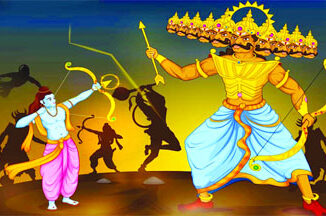
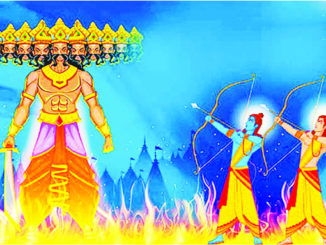
    The most widely known narrative of Dussehra is rooted in Valmiki’s Ramayana. When Ravana abducted Sita and carried her to Lanka, Rama, aided by Hanuman and the vanara sena, waged a great war to rescue her. The battle raged for ten days, culminating in Ravana’s defeat on the tenth day. Rama, with his divine bow, pierced Ravana’s ten heads, symbolically destroying his arrogance and vices.
    Symbolism of Ravana’s Ten Heads: They are often interpreted as representing the ten human weaknesses-lust, anger, greed, pride, envy, ego, mind, intellect, delusion, and will. Rama’s victory is therefore not just physical but spiritual: the conquest of inner demons.
    Durga and Mahishasura: The Devi Mahatmya
    Equally significant is the Shakta narrative, as told in the Devi Mahatmya. The asura Mahishasura, empowered by a boon that no man or god could kill him, terrorized heaven and earth. In desperation, the gods combined their energies, giving birth to Goddess Durga, an embodiment of cosmic power. For nine nights and ten days, Durga battled Mahishasura and his armies. On the tenth day, she slew the demon, restoring balance to the cosmos.
    – Symbolism: Mahishasura, the buffalo demon, represents ignorance, ego, and primal instincts. Durga, astride a lion, symbolizes supreme consciousness and the triumph of divine feminine energy.
    The Pandavas and Vijayadashami
    In the Mahabharata, the Pandavas, after their 13 years of exile, retrieved their weapons hidden in a Shami tree on Vijayadashami. They then launched their victorious campaign, making the day auspicious for new beginnings. This is why even today, people worship the Shami tree and exchange its leaves as symbols of prosperity.
    Rituals and Practices
    Navratri: The Nine Nights of Worship
    Dussehra is the culmination of Navratri, nine nights of worship dedicated to the goddess in her nine forms-Shailaputri, Brahmacharini, Chandraghanta, Kushmanda, Skandamata, Katyayani, Kalaratri, Mahagauri, and Siddhidatri. Each day symbolizes a step in the spiritual journey from ignorance to enlightenment.
    Shastra Puja and Ayudha Puja
    In many parts of India, especially the South, people worship their tools, weapons, and vehicles on Dussehra. This ritual, called Ayudha Puja, reflects gratitude for the instruments that sustain life and livelihood.
    Ramleela and Ravana Dahan
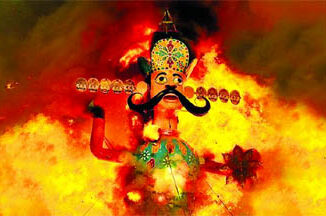
    In North India, Ramleela performances-folk plays enacting the Ramayana-are staged in villages and cities. On Dussehra evening, effigies of Ravana, Meghnath, and Kumbhakarna, often towering 50-100 feet high, are set ablaze amid fireworks. The spectacle draws massive crowds and symbolizes the destruction of evil.
    Durga Visarjan
    In Bengal, Odisha, and Assam, Dussehra marks the end of Durga Puja. Elaborate idols of Durga slaying Mahishasura are carried in processions with music and dance, before being immersed in water. The immersion represents the cyclical nature of creation and dissolution.
    Exchange of Shami Leaves
    In Maharashtra, families exchange Shami leaves (believed to symbolize gold) with wishes of prosperity, recalling the Pandavas’ return from exile.
    Regional Celebrations
    North India: Ramleela and Ravana Dahan
    Cities like Ayodhya, Varanasi, and Delhi host grand Ramleelas, culminating in Ravana Dahan. Ayodhya’s Dussehra, linked directly to Rama’s legend, is especially revered.
    West Bengal and the East: Durga Puja
    Nowhere is Dussehra celebrated with more artistry than in Bengal. For five days, massive Durga Puja pandals house idols depicting the goddess slaying Mahishasura. The immersion of idols on Vijayadashami is both joyous and sorrowful, accompanied by the farewell cry: “Asche bochor abar hobe” (She will return next year).
    Gujarat: Garba and Dandiya
    In Gujarat, the nine nights of Navratri are filled with Garba and Dandiya Raas, folk dances performed in honor of the goddess.
    Maharashtra: Shami
    Rituals and Processions
    In Maharashtra, processions and the exchange of Shami leaves define Dussehra. Families worship tools, vehicles, and books, marking the day as auspicious for beginning new ventures.
    Mysuru Dussehra – A Royal Spectacle
    Among all Dussehra celebrations in India, Mysuru Dussehra stands out as a spectacular fusion of devotion, pageantry, and royal heritage. Its origins date back over 400 years, during the reign of the Wodeyar dynasty, who established the tradition of celebrating Dussehra as a state festival. The festival is closely linked with Chamundeshwari, the presiding goddess of Mysore, believed to have killed the demon Mahishasura atop Chamundi Hill near the city.
    The grandeur of Mysuru Dussehra is unmatched:
    – Illuminated Palace: The Mysore Palace is adorned with over 100,000 bulbs, creating a breathtaking panorama of light visible from miles away.
    – Grand Procession (Jumbo Savari): On Vijayadashami, the idol of Goddess Chamundeshwari is placed on a richly decorated golden mantapa atop a caparisoned elephant. The procession winds through the city streets with folk dances, music, and cultural troupes, creating an immersive display of Karnataka’s heritage.
    – Cultural Programs: Throughout the nine-day Navratri festival, the city hosts classical music concerts, dance performances, wrestling competitions, and exhibitions, blending devotion with art and entertainment.
    – Royal Rituals: Historically, the Maharaja would participate in ceremonial worship, emphasizing Dussehra as a festival of civic pride and spiritual observance.
    Mysuru Dussehra is more than a visual spectacle; it is a symbol of Karnataka’s cultural identity, uniting devotion, tradition, and artistic expression in a way that transcends generations.
    Himachal Pradesh: Kullu Dussehra – A Weeklong Celebration of Local Deities
    In contrast to Mysuru’s royal grandeur, Kullu Dussehra in Himachal Pradesh is deeply rooted in tribal traditions and local faith, celebrated for a full week after Vijayadashami. Its origins trace back to the 17th century, when the Raja of Kullu invited the deity of Raghunath Temple, Rampur, to participate in a local fair, marking the festival as a celebration of community and faith.
    The festival is unique in its scale and duration:
    – Deity Processions: Local deities from villages across Kullu Valley are carried in ornate palanquins to the Dhalpur Maidan, forming a spiritual gathering unparalleled in India. Each deity is accompanied by devotees in traditional attire, folk dancers, and musicians, creating a lively confluence of color, sound, and devotion.
    – Traditional Arts: Kullu Dussehra showcases Himachali folk dances, music, and rituals, reflecting the rich tribal culture of the region.
    – Community Participation: Unlike urban festivals, Kullu Dussehra emphasizes collective celebration. Villagers travel for miles to witness the deities and participate in fairs that offer handicrafts, local produce, and cultural performances.
    – Spiritual Significance: For locals, Kullu Dussehra is a celebration of divine presence in everyday life, honoring the local gods who protect the valley’s communities.
    Kullu Dussehra exemplifies the diversity of Indian festivals, showing how Dussehra can take root in local tradition, transforming myth into a living cultural experience.
    Central and Tribal India: Bastar Dussehra
    Bastar in Chhattisgarh celebrates the longest Dussehra in India, lasting 75 days. Centered on the worship of Goddess Danteshwari, it is primarily a tribal festival featuring rituals, chariot processions, and performances that are unique to Bastar’s cultural identity. Unlike other Dussehra celebrations, Bastar focuses on community bonding, local folklore, and traditional governance systems, highlighting the festival’s tribal roots.
    Odisha and Northeast India
    In Odisha, Cuttack Durga Puja is famous for its silver and gold craftsmanship adorning pandals and idols. Assam and Tripura host grand Durga Puja celebrations blending Shakta worship with local folk traditions, including processions, music, and communal feasting.
    Art, Literature, and Theatre
    Classical Literature
    Sanskrit dramatists like Bhavabhuti in Uttara Ramacharita and poets like Kalidasa referenced Rama’s victory and Durga’s power in their works. These texts embedded the spirit of Dussehra into India’s literary imagination.
    Folk Theatre and Dance
    Ramleela remains the most iconic performance art tied to Dussehra. Recognized by UNESCO as intangible cultural heritage, Ramleela is not just a play but a community celebration blending drama, music, and devotion.
    Modern Reinterpretations
    In modern theatre and cinema, Ravana has often been reinterpreted-not merely as a villain but as a tragic, scholarly figure. Such reinterpretations highlight the festival’s evolving nature and its ability to engage new generations.
    Spiritual and Philosophical Significance
    Dussehra is not merely about mythological battles. It carries deeper meanings:
    – Ravana’s Ten Heads: A reminder to conquer inner vices.
    – Durga’s Victory: Affirmation of the power of the feminine principle (Shakti).
    – Auspicious New Beginnings: Vijayadashami is considered the most favorable day to begin learning, business, or journeys.
    Global Celebrations
    Nepal: Dashain
    In Nepal, Dussehra is celebrated as Dashain, the country’s longest and most important festival. It honors both Rama’s victory and Durga’s triumph. Families gather, elders place tika (vermillion mixed with yogurt and rice) on the foreheads of younger relatives, and goats are sacrificed in Durga’s honor.
    Sri Lanka
    In Sri Lanka, Dussehra is viewed with mixed feelings. While Ravana is vilified in Indian tradition, many Sri Lankans see him as a cultural hero. Some local festivals even honor Ravana as a wise king.
    Indian Diaspora
    In countries like the USA, UK, Canada, Trinidad, Guyana, and Mauritius, Dussehra is celebrated with Ramleela performances, Durga Puja pandals, and Ravana effigy burnings, keeping traditions alive far from home.
    Modern Relevance
    Even today, Dussehra holds lessons for contemporary life.
    – Confronting Modern Ravanas: Corruption, injustice, and social evils are today’s Ravanas that must be defeated.
    – Women’s Empowerment: Durga’s victory highlights the centrality of feminine strength and respect for women in society.

  • Dussehra: Embracing the triumph of good over evil

    Dussehra: Embracing the triumph of good over evil

    Vijayadashami, also known as Dussehra, marks the culmination of the ten-day festival of Navaratri, symbolising the triumph of good over evil. This day is celebrated with great fervour and enthusiasm across India and other parts of South Asia. The word Vijayadashami is derived from two Sanskrit words – Vijaya, meaning victory, and Dashami, referring to the tenth day of the lunar calendar. The festival falls on October 12 this year.

    The festival of Dussehra is celebrated every year on the tenth day of Shukla Paksha of Ashwin month. This festival symbolizes the victory over evil. Over the period of time, this festival also comes to instil a new energy into the cultural consciousness and the sense of patriotism in the country. Even today, the need to enliven the culture of this inspirational and motivational festival has become all the more necessary in order to fight the forces of darkness. The question is who should protect the culture? Who should lead the rise of ideals? Who should get his first name written in the foundation of life values? The process of fighting evil is very difficult. This practice of awakening brilliance and power is very difficult. It is very complex to give a high peak to self-existence and self-identity. After all, how to fight the evils hidden in our house, when Ravana is taking birth in the courtyard of the house, be it in the form of corruption, be it in the form of political criminalization, be it in the form of those spreading communal hatred, be it in the form of anti- national elements. Be it in the form of terrorists who break the law, or in the form of those who make education, medicine and justice a business. Celebrating this festival every year, where strength is prayed for, attention is drawn towards various issues of national importance. This provides new inspiration, new freshness, new strength, new dreams and new directions.
    The festival of Dussehra, which follows Navratri, is a very special festival for Hindus; it comes 20 days before the festival of Diwali. Dussehra is celebrated to mark the victory of Lord Shri Ram over the demon king Ravana. People stage the war between Shri Ram and Ravana in the form of a drama for ten days prior to the arrival of Dussehra. This dramatic life depiction is called Ram-Leela in North India– people organize Ram-Leela by wearing masks and through various dance forms, which they enjoy, making it a medium of Hindu culture, following the verses of Ramayana. They also make giant size effigies of the three great demons namely– Ravana, Meghnad and Kumbhakarna in which big fire-crackers are filled; and when the effigies are made to burn, they turn out to be the brilliant spectacles to watch on.
    Lord Shri Ram is, thus, the symbol of truth, while his opponent Demon King Ravana is the evil incarnate. This great religious festival and custom is celebrated by the Hindus with the worship of Goddess Durga. The traditions and procedures of celebrating this festival are different across the country. Lord Ram was a devotee of the war goddess Maa Durga, who worshiped Maa Durga for nine days preceding the war, and killed Ravana on the tenth day of war. After this, Shri Ram rescued His Divine consort Sita through fighting a big war in company with His brother Lakshman, devotee Hanuman, and an army of monkeys. Therefore, Vijayadashami is a very important day of the victory of Good over the Evil, of the Truth over the Falsehood and the Light over the Darkness. On this day, along with burning of Ravana, there is also a tradition of worshiping weapons, vehicles and worshiping Maa Durga, Lord Shri Ram and Ganpati Devata. Therefore, Vijayadashami has also been called as Vijaya Tithi. It is believed that this day is very auspicious to please Goddess Lakshmi.
    Dussehra has a cultural aspect also. It is also a festival to unite the cultural unity and integrity of the country. This year’s Vijayadashami festival has special significance, because with the positive revolutionary energy of this festival, not only a strong message has to be given to the negative and anti-national forces active in the nation, but also a challenge and caution against the misdeeds of neighbouring countries like Pakistan, China etc. After celebrating the Amrit Mahotsav year of Independence, the nation has to be strengthened for the Centenary Year that is 2047. The new consciousness that has come in the country with the strengthening of fundamental beliefs, nationalism is a living evidence of a powerful leadership. The efforts being made in search of renewable sources of energy for nationalism, self-identity, patriotic sentiments and the Hindu culture are unprecedented. The contemporary environment in which the nation is being led in accordance with the popular aspirations is extraordinary.
    Dussehra is also a festival of Shakti sadhana, karma, new creation and worship. During the last eight decades, there have been continuous political moves to weaken the Hindu religion and culture. Actually Hindu is not a religion, it is an idea, and a culture. Being a Hindu nation does not mean to be a theocratic state, but the all-embracing spirit of Hindu culture. Hindu culture is the inherent sound of generosity, because it is the only culture in the entire world which embraces pluralism i.e. all religions, ideas and cultures. This country also gave the title of Rishi to a materialistic philosopher- thinker like Charvak who had said that ‘Rinaam Kritva Ghritam Peevet’ i.e. whatever is there is today, who has seen tomorrow, hence today should be lived to the fullest and even if one has to take loans. If it has to be done, it should be done. Along with this, our other sages also gave us this advice that ‘Satyam Buryat Na Buryat Satyam Apriyam’ i.e. speak the truth, but do not speak the bitter truth. The greatness and specialty of Hindu culture has been that it advocates the beloved truth, but also asks for its prohibition when it becomes harsh.
    The Hindu culture is that of non-violence, but it also talks about self-defence by taking up arms if necessary. The word ‘Hindu’ itself gives the sense of ‘Swarashtra’ which is a part of the larger form of Hindu culture. Vijayadashami festival is a powerful medium to strengthen this ideology. Through this festival, everyone’s voice and objective is to destroy evil and encourage goodness. After Navratri, the last i.e. tenth day of Dussehra is Vijayadashami, which means that you have conquered all the three gunas – Tamas, Rajas or Satva. You passed through these three qualities, saw all three, participated in all three, but you were not attached or tied to any of these three in any way, you overcame all three of them. This is Vijayadashami – the day of your victory.
    Indian culture is a worshiper of bravery and valour. The festival of Dussehra has been organized to display bravery in the blood of individuals and society. The festival of Dussehra provides good inspiration to give up ten types of sins – lust, anger, greed, attachment, jealousy, ego, laziness, violence and theft. One who is full of hatred, full of anger, full of malice, full of jealousy, full of greed, is increasing fear. All these lead to fear and powerlessness. While celebrating Dussehra festival of force and bravery, the biggest need is to burn these vices within us.
    India never supported war or violence, but when somebody challenged us and created war-like situations, the skill of Indian politics is to attack and defeat the enemy, instead of waiting for his attack. Since the time of Lord Ram, this day is the symbolic day of victory. Lord Ram had left for the war against Ravana on this day. Maratha Ratna Shivaji also protected Hindu religion by leaving for war against Aurangzeb on this day. There are many examples in Indian history when Hindu kings used to march in victory on this day. The celebration of Dussehra symbolizes protection of religion, display of power and coordination of power. Apart from this, Dussehra symbolizes the victory of positive forces over negative forces.

    Celebrations in Different Regions of India?
    1.Mysore Dussehra
    Mysore’s Dussehra or Dasara as they call it is one of the most spectacular Dussehra celebrations in the country. The royal heritage of Mysore interspersed with the ritualistic celebration is worth witnessing. Celebrated elaborately over a span of 10 days, the city honors Goddess Chamundeswari, who killed the great demon Mahishasura. The biggest highlight of the festival has to be the beautifully illuminated Mysore palace, which is decorated with 100,000 light bulbs from 7 P.M to 10 P.M on each day of the festival. Many cultural and religious programs, song and dance performances are also organized in front of the palace. The festivities culminate with a procession through the streets, carrying an idol of the Goddess Chamundeshwari atop an elephant adorned in gold and lavish accessories. The ride is taken through the city of Mysore, from the historical Mysore Palace to the Banni Mantapa. The revelry continues till late in the evening with a torch-light parade that takes place in the outskirts of the city.
    2. Dussehra in Bengal, Tripura and Orissa
    Come September and the excitement of Durga Puja takes over the state of Bengal, Orissa and Tripura. In these states, Dussehra celebrations are not quite tied to the epic battle of the Ramayana unlike the other parts of the country, rather they celebrate the victory of Goddess Durga over buffalo king Mahishasura. The five day long extravaganza starts from Shashti (6th day of Navratri) and goes on till last day known as Vijaya Dashmi. The preparations begin months in advance – from setting up pandals, organising various cultural activities like poetry recitation, singing, dancing and painting competitions to the simple joy of purchasing new clothes. A lavish bhog is offered, and may traditional delicacies are served in the pandals. On the tenth day, married women bid a tearful goodbye to Goddess Durga. After the ritual of Sindoor daan, they offer sweets, betel leaves and prasad to the idol of Durga , and later distribute sweets amongst themselves. Women also put sindoor on each other’s cheeks and foreheads (symbolizing the well-being of their married life). People gather again one last time in the evening, to wish each other ‘Shubho Bijoya’and later feast on some good mutton biryani, ghugni or mutton kosha with pooris.
    3.Dussehra In Kullu
    The Dussehra celebrations in the valley are imbued with rich culture, traditions and a rich legacy of the yesteryears. On Vijay Dashmi, Kullu valley’s Dhalpur maidan is beautifully decorated with flowers and lights to celebrate Dussehra. In the 17th century, local King Jagat Singh installed an idol of Raghunath(Lord Ram) on his throne on Dussehra and from thereon God Raghunath was declared as the ruling deity of the Kullu Valley. In Kullu, they don’t burn the effigies of Ravana. On the first day of the celebrations, Goddess Hadimba is carried from the temple in Manali down to Kullu, from where she’s taken to the palace of the royal family. Later, in a procession she is taken to Dhalpur and is joined by the idol of Lord Raghunath or Lord Rama where they stay until the end of the festival with many more Gods and Goddesses. Cultural performances, fairs and exhibitions are spread across the maidan and they further add to the excitement. On the last day of the festivities, the chariot carrying all the Gods and Goddesses is immersed in the Beas river. There is also a tradition of setting a pile of bushes on fire which is believed to depict the burning of Lanka.
    4.Dussehra of Gujarat
    Navratri or Navratra is celebrated with great enthusiasm in Gujarat. Devotees fast through the day, and perform pujas. In the evening, men and women gather, clad their vibrant clothes, to play Garba and Dandiya (Gujarat’s folk dance). The folk melodies, and a lot of singing and dancing makes for a fascinating sight on the last few days of Navratri. Several devotees also take a tour of iconic pilgrimages like the temples of Goddess Ashapura Mata, Ambaji temple, and Chamunda Mata Temple.
    5. North India’s Spectacular Ram Lila
    Navratri is one of the most significant festivals up north. Celebrated with much grandeur and enthusiasm, Sharad Navratri brings alive the festive spirit in all devotees. Devotees observe ritualistic fasts and do pujas to please their beloved deity. On the eighth or ninth day, there is a ritual of doing Kanya puja. Nine girls(seen as the nine avatars of Goddess Durga) are welcomed into the house by first washing their feet and then tying moli (red thread) around their wrists. These girls are seated in a line and given halwa, poori and chole . There is also a practice of organizing grand bhandaras, in honour of the Goddess, where Prasad is distributed to the neighbours and the needy in the locality. The Ram Lila depicting the historic tale of Rama defeating Ravana and winning back his wife Sita is also a common part of the festivities On the last day, the celebrations culminate with the splendid Dussehra festivities, wherein Ravana’s effigies are burnt, symbolizing his epic defeat at the hands of Lord Ram and the ultimate victory of good over evil.
    6.Telengana’s Floral Bathukamma
    The newest state in the country, Telangana is a melting pot people and cultures. Apart from visiting temples and conducting the ritualistic pujas, Telangana also celebrates the Bathukamma Panduga or the Bathukamma festival during Navratri. This is a flower festival where the women of the house create beautiful flower arrangements and decorations in seven concentric layers in the shape of the Temple of Gopuram. ‘Bathukamma’ literally translates into ‘Mother Goddess come Alive’. The flower arrangements are an attempt to invoke the Goddess and seek her blessings. Each year, this festival is celebrated as per the Shalivahana calendar for nine days starting Bhadrapada Amavasya (also known as Mahalaya Amavasya ) till Durgashtami.

  • Dussehra: Triumph of good over evil

    Dussehra: Triumph of good over evil

    Dussehra and Vijay Dashmi represent different names for the same Hindu festival, observed on the tenth day of the Ashvin month in the Hindu calendar. This significant festival symbolizes the triumph of good over evil and is alternatively referred to as Dasara, Dashain, and Navratri Puja in different regions. It is going to be celebrated across the country on October 24 this year. Dussehra or Dusshera is celebrated to mark Lord Rama’s victory over the demon Ravana that signifies the triumph of good over evil. On Dussehra, huge effigies of Ravana are burnt with fireworks which symbolize the quelling of darkness by light. Dussehra also paves the way for the next big festival of Diwali (the festival of lights) which is celebrated across India with great pomp and fervour. Diwali is celebrated twenty days after Dussehra and signifies the return of Lord Rama, Sita and Lakshman to Ayodhya after killing the demon Ravana.The word ‘Dussehra’ signifies the meaning of the festival itself. The word is formed from two words – Dus and Ahara. ‘Dus’ means ten and ‘Ahara’ means day, so tenth day. Another meaning comes from the mythology of the festival where ‘Dus’ signifies the ten heads of Ravana or bad or evil and ‘hara’ means to defeat or removal. In the northern and western states of India Dussehra is celebrated in the honour of Lord Rama who was an avatar of Lord Vishnu. Plays based on Ramayana and Ramcharitmanas called Ramlila are performed at outdoor fairs by theatre troupes. Dussehra is also celebrated as Vijayadashami and also signifies the killing of demon Mahishasura by Goddess Durga on the tenth day of Navratri.
    Victory of Ram over Ravan
    On this day Ram (the seventh avatar of Vishnu) killed Ravan, who had abducted Ram’s wife Sita to his kingdom Lanka. Ram, his brother Lakshman, their disciple Hanuman and an army fought a battle to rescue Sita. The story is recorded in the Hindu epic, the Ramayan.
    On the day of Ashvin Shukla Dashami, Ram defeated Ravana and rescued Sita. Based on inferences from Valmiki’s Ramyan, Kalidas’s Raghuvasa, Tulsidas’ Ramcharitmanas and Keshavdas’ Ramchandrika, Ram, Sita and Lakshman returned to Ayodhya on the 30th day of Ashwin (19–20 days after Vijayadashami). To celebrate Ram’s return, in the evening the city’s residents lit millions of earthen lamps (deepak); the day is celebrated in India as Deepawali.
    Durga’s victory over Mahishasur
    Some of the demigods (asurs) were powerful and ambitious, and tried to defeat the devs and capture heaven. One asur, Mahishasur, grew powerful and wreaked havoc on earth. Under his leadership, the asurs defeated the devs. The devs combined into Shakti (a mass of incandescent energy) to kill Mahishasur. A bolt of lightning emerged from the mouths of Brahma, Vishnu and Shiva, and a young, beautiful female virgin with ten hands appeared. The gods gave her their weapons, and Shakti coalesced to form the goddess Durga. On a lion who assisted her, Durga fought Mahishasur for nine days and nights; on the tenth day, Mahishasur was killed. Durga, as Shiv’s consort, represents two forms of female energy: mild and protective, and fierce and destructive.
    Durga’s homecoming
    Daksha (Brahma’s son) and his wife, Prasuti, had a daughter named Sati. As a child, Sati worshiped Shiva as her would-be husband. Shiva, pleased with her worship, married her. Although Daksha opposed the marriage, he could not prevent it. He arranged a yajna, to which everyone but Shiva was not invited. Sati, ashamed of her father’s behavior, killed herself. Shiva, anguished when he discovered this, lifted Sati’s body on his shoulders and began dancing; the world was on the verge of destruction.
    Pandav exile
    In the age of Dvapar Yug, the pandavs (the five sons of Pandu with his wife, Kunti) lost to the Kaurav in a dice game and were exiled in the forest for twelve years. The brothers hid their weapons in a hole in a Shami tree before they entered the kingdom of Virat to complete their final year of exile. After that year, on Vijayadashmi they recovered the weapons, declared their true identities and defeated Kauravas, who had attacked King Virat to steal his cattle. Since that day, Shami trees and weapons have been worshiped and the exchange of Shami leaves on Vijayadashmi has been a symbol of good will.
    Kautsa’s gift
    Kautsa, the young son of a Brahmin named Devdatt, lived in Paithan. After completing his education with Rishi Varatantu, he insisted that his guru accept a present. The guru said, “Kautsa, to give dakshina in return for learning wisdom is not appropriate. Graduation of the disciple makes the guru happy, and that is the real Guru Dakshina.”
    Kautsa was not satisfied, since he still felt it his duty to give his guru something. The guru said, “All right, if you insist on giving me dakshina, then give me 140 million gold coins—10 million for each of the 14 sciences I have taught you.” Kautsa went to King Raghu, an ancestor of Rama who was known for his generosity. However, at that time he had spent all his money on the Brahmins. Raghu asked Kautsa to return in three days, and left to get gold coins from Indra. Indra summoned Kuber, the god of wealth. Indra told Kuber, “Make gold coins rain on the Shanu and Aapati trees around Raghuraja’s city of Ayodhya.” The rain of gold coins began. King Raghu gave the coins to Kautsa, who offered them to Varatantu Rishi. Since the guru had requested only 140 million, he returned the rest to Kautsa. Kautsa, considering honour more valuable than wealth, asked the king to take the remaining gold coins. The king refused, since kings do not take back a daan (gift). Kautsa distributed the gold coins to the people of Ayodhya. To commemorate this, leaves are plucked form the Aapati tree and given as gifts.
    Celebrations
    In Kashmir, Himachal Pradesh, Uttar Pradesh, Haryana, Punjab, Uttarakhand and western Bihar, it is tradition to plant barley in earthen pots on the first day of Navratri. On the day of Dussehra, the nine-day-old sprouts (called noratras or nortas) are used for luck; men place them in their caps or behind their ears.
    In most of northern India and some parts of Maharashtra, Dasha-Hara is celebrated in honour of Rama. Plays based on the Ramayana (Ramlila) are performed at outdoor fairs, and large parades with effigies of Ravana (a king of ancient Sri Lanka), Kumbhakarna and Meghanada are held. The effigies are burnt on bonfires in the evening. After Dasara, the hot summer ends (especially in North India) and the onset of cold weather is believed to encourage infections. The burning of the effigies, filled with firecrackers containing phosphorus, supposedly purifies the atmosphere.
    In the Kumaon region of Uttarakhand, Dasara begins with the performance of a Ramlila based on theatrical traditions begun by Uday Shankar during his stay in Almora and elaborated by Mohan Upreti and Brijendra Lal Sah. Known as the Almora or Kumaon style, the Ramlila was recognised by UNESCO in its 2008 report as a representative Indian style.
    Kullu Dussehra, celebrated in the Kullu valley of Himachal Pradesh, begins on the tenth day of the rising moon and continues for seven days. Its history dates back to the 17th century, when King Jagat Singh installed an idol of Raghunath on his throne as a gesture of penance. After this, Raghunath was declared the ruling deity of the valley.
    Mysore Dussehra as is the Nadahabba (state-festival) of the state of Karnataka in India. It is also called Navaratri (Nava-ratri = nine-nights) and is a 10-day festival with the last day being Vijayadashami, the most auspicious day of Dasara. Dasara usually falls in the month of September or October. According to a legend, Vijayadashami denotes the victory of truth over evil and was the day when the Hindu Goddess Chamundeshwari killed the demon Mahishasura. Mahishasura is the demon whose slaying by the Goddess gave the name Mysore. The city of Mysore has a long tradition of celebrating the Dasara festival with utter grandeur and pomp to mark this day and the festivities there are an elaborate affair, attracting a large audience including foreigners.

  • Dussehra: The victory of good over evil

    Dussehra: The victory of good over evil

    Dussehra festival is round the corner. Also known as Vijayadashami, it is one of the major Hindu festivals celebrated across the country. Dussehra 2021 is falling on October 15, Friday. Dussehra marks the end of Navratri and signifies the victory of good over evil as Lord Ram had defeated Lanka king Ravana. People also celebrate this day to mark the victory of Goddess Durga over demon Mahishasur.

    SIGNIFICANCE OF DUSSEHRA

    The name Dussehra is derived from Sanskrit words dasha (ten) and hara (defeat). It signifies the victory of Ram over Ravan (the 10-headed demon king). Dussehra or Vijayadashmi is celebrated on the 10th day of Ashvin month (September-October) of the Hindu calendar. Dussehra also marks the culmination of the nine-day Navratri festival. Dussehra, for many, marks the beginning of preparation for the Diwali festival – when Lord Ram returned to Ayodhya – which falls 20 days after Dussehra.

    CELEBRATIONS AND RITUALS

    A precursor to Diwali, people celebrate Dussehra with all fanfare and full religious zeal. Hindu devotees in North India organise Ramleela – a theatrical enactment of Lord Ram’s life story – in the days leading to, and on Dussehra. On Dussehra, massive effigies of Ravan, sometimes along with his son Meghand and brother Kumbhkaran, are set ablaze in open grounds.

    In West Bengal, people celebrate the occasion as Durga Puja festival to mark the Goddess’s victory over demon Mahishasur. Devotees worship Durga at various theme-based pandals.

    In Gujarat, people celebrate the festival through garba – the famous folk dance of the state. Both during Navratri and on Dussehra, people wear colorful clothes and celebrate the festival to the max.

    In South India, people bring home idols of Goddesses Durga, Lakshmi and Saraswati. Married women also visit each other’s houses and exchange gifts like coconut, betel nuts and even money.

    MUHURAT TIME

    According to, the Vijay Muhurat time is from 2:02 pm to 2:47 pm, while the Aparahna Puja time will start at 1:16 pm and end at 3:33 pm.

    The Dashami Tithi begins at 6:52 pm on October 14 and ends at 6:02 pm on October 15.

    Mythological Significance

    Victory of Lord Rama over Ravana

    As per our Hindu mythology, the day Lord Ram killed Ravan who abducted Ram’s wife Sita is celebrated as “Vijaya Dashami”.

    The term Vijaya Dashmi is made from two words Vijay and Dashmi. As per our Hindu Calendar the day when Ram defeated and killed Ravana was Ashwin ( Hindi Month) Shukla Dashami (Tenth day of month). Hence the name originated. Many people perform “Aditya Homa” as a “Shanti Yagna” on the day of Dussehra.

    These Yagna performances are thought to create powerful agents in the atmosphere surrounding the house that will keep the household environment clean and healthy. These rituals are intended to rid the household of the ten bad qualities, which are represented by 10 heads of Ravana as follows:

    1. Kama vasana (Lust)
    2. Krodha (Anger)
    3. Moha (Attraction )
    4. Lobha (Greed)
    5. Mada (Over Pride)
    6. Matsara (Jealousy)
    7. Swartha (Selfishness)
    8. Anyaaya (Injustice)
    9. Amanavata (Cruelty)
    10. Ahankara (Ego).

    Victory of Durga Maa over Mahishasura

    This is again a well known reason for celebrating Dussehra. One Asura, Mahishasur, in the form of a buffalo, grew very powerful and created havoc on the earth.

    Under his leadership, the Asuras defeated the Devas. To fight against Mahishasura’s tyranny, the Devas joined their energies into Shakti, a single mass of incandescent energy.

    A very powerful band of lightning emerged from the mouths of Brahma, Vishnu and Shiva and a young, beautiful female with ten hands appeared.

    All the Gods gave their special weapons to her. This Shakti coalesced to form the goddess Durga. Riding on a lion, who assisted her, Durga fought Mahishasur.

    The battle raged for nine days and nights. Finally on the tenth day of Ashvin shukla paksha, Mahishasur was defeated and killed by Durga. Hence we celebrate this day as victory over evil.

    Homecoming of Parvati

    Do you know about this? I came to know about it recently when I was reading about Dussehra. Okay so Parvati was Sati in her previous birth. Sati was a great devotee of Shiva and prayed for getting Shiva as her husband. Being pleased with her worship, Shiva married her. Sati’s father was against this marriage but couldn’t prevent it.

    Dasksh arranged a Yagna in which he invited everyone except Shiva. Being ashamed of by his father’s act and seeing the insult of her husband by father Dasksh, she jumped in the fire of Yagna and killed herself. Lord Shiva was anguished when he came to know this. He lifted Sati’s body on his shoulders and started dancing. As the supreme power was dancing with wrath, the world was on the verge of destruction. Then Lord Vishu came forward as a savior and used his Chakra to cut Sati’s body into pieces. Those pieces fell from the shoulders of the dancing Shiva and scattered throughout the Indian subcontinent. Shiva was pacified when the last piece fell from his shoulder. In her next birth, Sati was born as Parvati, the daughter of Himavat, ruler of the Himalayas. Lord Vishnu asked Shiva to forgive Daksha. Ever since, peace was restored and Parvati visits her parents of previous birth each year during the season of Sharatkal or autumn, when Durga-Puja is celebrated.

    End of Agyatawas of Pandavas

    In the age of Dvapara Yuga, Pandavas lost to Kauravas in a game of dice, and spent twelve years of Vanawas, or exile to the forest, followed by one year of Agnyatawas(exile incognito).

    The brothers hid their weapons in a hole in a Shami tree before entering the Kingdom of Virat to complete the final year of Agnyatawas .After that year, on “Vijaya Dashami”, they recovered the weapons, declared their true identities and defeated Kauravas, who had attacked King Virat to steal his cattle.

    Since that day, Shami trees and weapons have been worshiped and the exchange of Shami leaves on Dussehra has been a symbol of good will and victory.

    Mysore Dussehra or Dasara : Mysore Dasara or Dussehra is the Nadahabba (state festival) of the state of Karnataka in India. It is a 10-day festival, starting with nine nights called Navaratri and the last day being Vijayadashami. The festival is observed on the tenth day in the Hindu calendar month of Ashvin, which typically falls in the Gregorian months of September and October.

    The Hindu festival of Dasara, Navratri and Vijayadashami celebrates the victory of good over evil. It was the day in the Hindu legends when Goddess Chamundeshwari (Durga) killed the demon Mahishasura. Mahishasura is the demon whose slaying by the Goddess gave the city the name Mysuru. The Mysuru tradition celebrates the warriors and the state fighting for the good during this festival, ritually worshipping and displaying the state sword, weapons, elephants, horses along with Hindu Devi goddess in her warrior form (predominantly) as well as the Vishnu avatar Rama. The ceremonies and a major procession is traditionally presided by the king of Mysuru.

    The city of Mysuru has a long tradition of celebrating the Dasara festival with grandeur and pomp to mark the festival. The Dasara festival in Mysuru completed 409th anniversary in the year 2019, while evidence suggests the festivities were observed in Karnataka state by the Vijayanagara Empire kings in the 15th century.

    History

    The Dasara festivities began with the Vijayanagar kings as early as the 15th Century. The festival played a historical role in the 14th-century Vijayanagara Empire, where it was called Mahanavami and the festivities are shown in the relief artwork of the outer wall of the Hazara Rama temple of Hampi.

    The Italian traveller Niccolò de’ Conti described the festival’s intensity and importance as a grandeur religious and martial event with royal support. The event revered Durga as the warrior goddess (some texts refer to her as Chamundeshwari). The celebrations hosted athletic competitions, singing and dancing, fireworks, a pageantry military parade and charitable giving to the public.

    After the fall of the Vijayanagar to Deccan Sultanates, these Hindu celebrations came to an end under Muslim rulers. The Wodeyars of Mysore formed a kingdom in Southern parts of the Vijayanagara Empire and continued the Mahanavami (Dasara) festival celebration, a tradition started initially by Raja Wodeyar I (1578-1617 CE) in mid September 1610 at Srirangapatna.

    Festivities

    The festivities included a special durbar (royal assembly). It was during the reign of Krishnaraja Wodeyar III in the year 1805, when the king started the tradition of having a special durbar in the Mysore Palace during Dasara; which was attended by members of the royal family, special invitees, officials and the masses. After the death of Srikanta Wadiyar in December 2013, this tradition has been continued by placing the “Pattada Katti” (royal sword) on the golden throne. The ninth day of Dasara called as Mahanavami is also an auspicious day on which the royal sword is worshipped and is taken on a procession involving elephants, camels and horses.

    Lightings in Mysore Palace

    The main attraction of the ten-day Mysore Dasara festival is the Mysore Palace which is lighted daily with nearly 100,000 light bulbs from 7 pm to 10 pm on all days of the festival. Various cultural and religious programs highlighting the dance, music and culture of the State of Karnataka are performed in front of the illuminated Palace.

    Procession

    On Vijayadashami, the traditional Dasara procession (locally known as Jumboo Savari) is held on the streets of Mysore city. The main attraction of this procession is the idol of the Goddess Chamundeshwari which is placed on a golden mantapa (which is around 750 kilograms of gold) on the top of a decorated elephant. This idol is worshipped by the royal couple and other invitees before it is taken around in the procession.

    Colorful tableaux, dance groups, music bands, decorated elephants, horses and camels form a part of the procession which starts from the Mysore Palace and culminates at a place called Bannimantap where the banni tree (Prosopis spicigera) is worshipped. According to a legend of the Mahabharata, banni tree was used by the Pandavas to hide their weapons during their one-year period of Agnatavasa (living life incognito). Before undertaking any warfare, the kings traditionally worshipped this tree to help them emerge victorious in the war. The Dasara festivities would culminate on the night of Vijayadashami with an event held in the grounds at Bannimantap called as Panjina Kavayatthu (torch-light parade).

    In Mysore, India, the Vijayadashami Elephant procession during Mysore Dasara is called Jumbo Savari (from the British during their control of Mysore State). The original name to this procession is Jumbi Savari (“going to the Shami (Banni) tree”). Now Goddess Chamundeshwari is taken in procession on an Elephant. But the “Jumbo” name is still intact.

    After the Jamboo Savari, a torchlight parade takes place in the evening at the Bannimantap Parade Grounds.

    Kullu Dussehra

    Kullu, the “Valley of Gods”, is one of the most breathtakingly beautiful parts of Himachal Pradesh. This serene hill town of Northern India is famous for attracting visitors from far and wide. Also known as “Kulanthapitha”, the valley has always been a favourite destination for travellers to experience the mystical land and rustic way of life.

    The valley is also renowned for its grand Dussehra celebrations; the festival of a triumph of good over evil. Kullu Dussehra was declared an international event in 1972 and is witnessed by around 4-5 Lac people from across the globe.

    Kullu Dussehra 2020 Dates

    Dussehra is celebrated on the tenth day of Navratri i.e. on Vijay Dashmi day, around the month of October according to the Gregorian calendar. Kullu Dussehra is slightly different because its celebrations begin when the rest of the country closes the nine-day long festival. This year, Kullu Dussehra would be organised from 15th October to 21st October, 2021. Dussehra in Kullu is a week-long festival, which is famous for its large number of visitors and grand celebrations.

    Processions and Celebrations

    Dussehra in Kullu valley is a much-awaited and celebrated festival. This week-long festival starts with a procession of Lord Raghunath, along with other deities, carried on a Ratha across the town. The village gods and minor deities are also a part of this celebration. The centre of the festivities is the Dhalpur maidan. The pleasant weather and breathtaking beauty of the valley along with the celebrations fill the visitors with eternal happiness and satisfaction. The festival gets merrier with dancing, drinking and feasting for a week. The Kala Kendra festival is held at night where several activities and cultural events take place. Thousands of people from all over the country and world visit this place during Dussehra. The festival is very well organized which only makes the experience worth remembering.

    Last Day of Celebrations of Kullu Dussehra Festival

    On the 6th day of the festival, an assembly of village Devtas takes place which is definitely a sight which one must watch. The last day of the celebrations is marked by sacrifices; a fish, a crab, a rooster, a buffalo and a lamb are sacrificed and a huge bonfire is lit. These mega-festival witnesses the worshipping of around 250-300 idols from the adjoining villages of Kullu. The idol of Ragunath Ji is brought back to its original place through a grand procession. Various cultural processions from different countries are invited, almost like the processions during our national festivals. Thus one can see the difference between the Kullu Dussehra and the Dussehra being celebrated in different parts of the country. The grandeur and celebration at Kullu Dussehra is something which every visitor here will always treasure.