Tag: DY Chandrachud

  • The message from two SC verdicts

    The message from two SC verdicts

    • The ruling party’s confidence should not prompt its supporters to shake foundations of Indian democracy

    “The Election Commission of India (ECI) was a fiercely independent institution when it was helmed by TN Seshan. Herein lies the sad story of Indian institutions. The character of most of these institutions changes with the person at the top. The court’s order on electoral bonds is a wake-up call for the ECI. Indian elections are free and fair. But the first-past-the-post system seeks its credibility entirely from the institution that conducts the polls. And if the conductor falters, the process gets easily accused of manipulation.”

    By Rajesh Ramachandran

    The Supreme Court’s judgments on the electoral bonds and the Chandigarh mayoral election are epoch-making. There cannot be a graver offence to democracy than anonymous election funding. Anonymity is synonymous with deception and corruption. While nameless funders possibly conceal their business and personal objectives, only transparency can help make the voter do a cost-benefit analysis between a funder and the funded political entity. So, it is imperative for the voter to know who is funding his or her chosen candidate.

    A local poll to elect a mayor became a test case, and the court has majestically ensured that the Indian system passes it to prove that it still works.

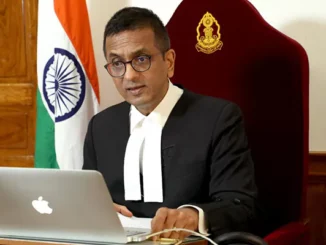
    By delivering a verdict annulling the electoral bond scheme, the apex court Bench headed by Chief Justice of India DY Chandrachud has saved the constitutional foundations of the Republic. This ruling, while enhancing the SC’s stature as the final institutional bulwark of constitutional morality, also points fingers at other constitutional bodies that have begun to behave like government appendages.

    The Election Commission of India (ECI) was a fiercely independent institution when it was helmed by TN Seshan. Herein lies the sad story of Indian institutions. The character of most of these institutions changes with the person at the top. The court’s order on electoral bonds is a wake-up call for the ECI. Indian elections are free and fair. But the first-past-the-post system seeks its credibility entirely from the institution that conducts the polls. And if the conductor falters, the process gets easily accused of manipulation.

    That is something the Indian democracy can ill afford, particularly in the context of all the barbs of it being an elected autocracy hurled by the Western academia and its media.

    Equally important is the SC verdict reversing the Chandigarh mayoral poll result. Presiding officer Anil Masih was caught on camera blatantly defacing ballot papers to make valid votes for the AAP-Congress candidate invalid. This was nothing short of ‘murder of democracy’, no doubt.

    A local poll to elect a mayor became a test case, and the court has majestically ensured that the Indian system passes it to prove that it still works. But how many such tests and shocks can the system withstand before it capitulates is a question that the votaries of the strong government need to ask themselves. A strong government derives its strength from the people’s conviction, not from arm-twisting tactics of its storm-troopers.

    Despite the two setbacks from the top court, the BJP is on an unassailable electoral upswing. The consecration of the Ram Temple in Ayodhya has created such a groundswell of religious goodwill for PM Modi among temple-going ordinary Hindus that it is now a mundane exercise for him to convert it into political capital for the polls. Then, of course, there is the added advantage of the Opposition remaining a house divided. Going by the last election’s schedule, there are less than 50 days left for the first phase of polling. Yet, the Opposition has not firmed up poll tie-ups.

    All those who may call the Indian democracy names after the elections should seriously look at the sorry state of the Opposition right now. As of today, it is not clear whether AAP and the Congress will have an alliance in Punjab. Even in Delhi, where a 4-3 formula of seat-sharing is being talked about, there is no official announcement so far. The Samajwadi-Congress alliance in Uttar Pradesh is the only one that has been sealed. Meanwhile, Rahul Gandhi has taken a break from his yatra to lecture at Cambridge, as if Oxbridge scholars’ votes count in Amethi or Wayanad.

    The urgency of a group preparing to take on a juggernaut is glaringly missing in the terribly slow pace at which Opposition parties move. Incidentally, the Left, which is the fulcrum on which the Opposition in Delhi turns, has announced its candidates, including the one who would take on Rahul, if he contests from Wayanad. But a political understanding with Mamata Banerjee that could have altered the scene in West Bengal is still eluding the Congress as the BJP tries to project itself as her biggest challenger in the state.

    Unless there is an unseen anti-incumbency storm gathering amongst the masses, there is no chance of a serious challenge to PM Modi’s electoral pole position in these circumstances. The possibility of a third term for Modi looks strong. However, that confidence should not prompt his followers to shake the foundations of Indian democracy — which is the message from the SC verdicts.

    A recent issue of The Economist magazine has a brilliant leader on the perils of national conservatism. In the context of the American elections, the magazine talks about Trump’s aides readying a programme “to capture the federal bureaucracy”. To eulogize Ronald Reagan and Margaret Thatcher as torchbearers of virtuous conservatism while condemning all newbie national conservatives as liberals opposed to multilateralism abroad and pluralism at home is obviously polemical. Reagan’s initiation into politics was as an FBI informer ratting out communists in Hollywood; but for the Falklands War, Thatcher would never have found her feet. Both appealed to fiercely nationalist sentiments.

    Nationalism is undeniably the core of conservatism. It suddenly cannot become dirty when bandied about by populists and anti-elites. But the difference now is the new attempt to subsume the entire system within the underbelly of the political executive. Indian bureaucracy has for some time now been caged parrots and pet falcons who sing and hunt for their political master. This situation cannot be blamed on any one party. A former bureaucrat, who had hunted down Subrata Roy for the UPA, was given cabinet rank long after retirement by a Left government this week.

    Well, the capture of the bureaucracy by the Indian political class predated the global trend of national conservatism. Nevertheless, the two SC verdicts point towards the slippery slope we have reached. All that is left between the pinnacle of proud national achievements and the abyss of complete systemic breakdown are a few constitutional bodies. Remember, there can be no Ram Rajya without strong democratic institutions!
    (The author is editor-in-chief of Tribune Group of Newspapers)

  • Electoral bonds: Apex court rightly annuls contentious scheme

    Mired  in controversy since its inception, the electoral bond scheme for political funding has been annulled by the Supreme Court. A five-judge Constitution Bench headed by Chief Justice DY Chandrachud said the scheme was violative of the right to freedom of speech and expression under Article 19(1)(a) of Constitution, adding that the fundamental right to privacy also included the citizens’ right to ‘political privacy and affiliation’. The court has directed the State Bank of India (SBI) to disclose the details of each electoral bond encashed by various parties over the years.

    The verdict is a big blow to the BJP-led NDA in the run-up to the Lok Sabha elections. Notifying the scheme in January 2018, the Modi government had touted it as a ‘transparent’ alternative to cash donations made to political outfits. Then Finance Minister Arun Jaitley had exuded confidence that the electoral bond scheme would considerably cleanse the political funding system. However, the initiative ran into rough weather over allegations of ‘selective confidentiality’ and denial of a level playing field.

    The government’s insistence on ensuring the anonymity of the donors and keeping the citizens in the dark struck at the heart of the scheme, whose avowed main objective was transparency. Paradoxically, the government itself was in a position to access the donors’ details by demanding their data from the SBI. The Opposition had every reason to tear into the scheme as the BJP grabbed the lion’s share of the bonds, even as the Election Commission of India (ECI) adopted an evasive approach. Last year, the apex court had rapped the ECI for not maintaining data on funding received through electoral bonds despite the interim order it had passed in April 2019. It is hoped that the poll panel and the SBI will finally lift the dubious veil of secrecy and make the details public.

    (Tribune, India)

  • Kejriwal seeks meeting with Rahul amid battle with Centre over ordinance

    Kejriwal seeks meeting with Rahul amid battle with Centre over ordinance

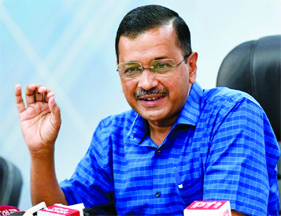
    New Delhi (TIP)– Chief Minister Arvind Kejriwal on Friday, May 26, sought time to meet Congress president Mallikarjun Kharge and Rahul Gandhi to get party’s support in Delhi services ordinance issue.
    Kejriwal tweeted: “Sought time this morning to meet Cong President Sh Kharge ji and Sh Rahul Gandhi ji to seek Cong support in Parl against undemocratic n unconstitutional ordinance passed by BJP govt and also to discuss general assault on federal structure and prevailing political situation.”
    West Bengal chief minister Mamata Banerjee on Tuesday, May 23, said that she would support her Delhi counterpart Arvind Kejriwal’s efforts to fight against the Union government’s ordinance to retake control of appointments and transfers of bureaucrats working for the NCT government.
    Shiv Sena (UBT) leader Uddhav Thackeray and NCP president Sharad Pawa have also extended complete support to Kejriwal. Kejriwal has pitted this battle as a semi-final to the 2024 Lok Sabha elections. “If the BJP loses this in the Rajya Sabha, then Modi won’t come to power in India next year,” Kejriwal said in Mumbai.
    Last week, a five-judge constitution bench headed by Chief Justice DY Chandrachud, in a unanimous verdict, put an end to the dispute between the centre and the Delhi government running since 2015.
    Later, the centre issued a special order – known as an ordinance – to create an authority for the transfer and posting of senior officers in Delhi. The ordinance seeks to set up a National Capital Civil Service Authority for the transfer of and disciplinary proceedings against bureaucrats.
    In a statement attributed to “government sources”, it said it was forced to issue the order because of the Delhi government’s regular “instigation” and “acrimonious attacks” on the centre and the city’s unique character.

  • ‘An Independent Press is Necessary’, says Supreme Court; Lifts telecast ban on Malayalam news channel MediaOne

    ‘An Independent Press is Necessary’, says Supreme Court; Lifts telecast ban on Malayalam news channel MediaOne

    NEW DELHI (TIP): The Supreme Court on Wednesday, April 5, quashed the Centre’s telecast ban on Malayalam news channel MediaOne and pulled up the Ministry of Home Affairs for raising national security claims in “thin air” without facts. Observing that the State can’t impose unreasonable restrictions on press as it would have a chilling effect on press freedom, a bench headed by Chief Justice DY Chandrachud set aside the Kerala High Court order which had upheld the Centre’s decision to ban the channel’s telecast on security grounds. The top court said critical views of the channel against government policies cannot be termed as anti-establishment as an independent press is necessary for a robust democracy. “Press has a duty to speak truth to power and present citizens with hard facts enabling them to make choices that propel democracy in the right direction. The restriction on freedom of press compels citizens to think along the same tangent. “Homogenized views on issues that range from socio-economic polity to political ideologies would pose great dangers to democracy,” the bench said, adding that non-renewal of license for a channel is a restriction on the right to freedom of speech. The top court said the alleged link of the channel’s shareholders to Jamaat-e-Islami Hind is not a legitimate ground to restrict the rights of the channel.
    It said the State is using national security as a tool to deny citizens remedies that are provided under the law.
    “National security claims cannot be made out of thin air, there must be material facts backing it,” the bench said.
    Here are the top 5 observations from the Supreme Court verdict.
    “There is nothing to show terrorist links. National security claims cannot be made on the basis of thin air. It is seen that none of the material is against national security or threatens public order,” the bench led by Chief Justice of India DY Chandrachud said. “National security can’t be raised to deny people their rights… it was raised by the MHA in a cavalier manner in this case,” the court added.
    “Government cannot be allowed to have a stand that press must support the government,” the court said, adding that criticism of government cannot be a ground to revoke license of a TV channel.
    “An independent press is necessary for the robust functioning of a democratic republic. Its role in the democratic society is crucial, for it shines a light on the functioning of the State,” the court said.
    “All investigation reports cannot be termed secret as these affect the rights and liberty of the citizens,” the court said, adding that there cannot be a “blanket immunity” to the government from disclosing information.

  • Hindenburg: SC sets up six-member probe panel, wants report in 2 months

    Hindenburg: SC sets up six-member probe panel, wants report in 2 months

    NEW DELHI (TIP): The Supreme Court on Thursday, March 2, set up a six-member expert committee headed by former SC judge Justice AM Sapre to investigate if there had been a regulatory failure in dealing with the alleged contravention of laws pertaining to the securities market in relation to the Adani Group or other companies in the wake of the Hindenburg Research report. A three-judge Bench led by Chief Justice of India DY Chandrachud asked the committee to suggest measures to strengthen the regulatory framework and secure compliance with the existing framework for the protection of investors.
    “To protect Indian investors against volatility (in the securities market) of the kind that has been witnessed in the recent past, we are of the view that it is appropriate to constitute an expert committee for the assessment of the regulatory framework and for making recommendations to strengthen it,” said the Bench, which had earlier refused to accept the names suggested by the Centre for the expert committee. Other members of the committee are former SBI chairman OP Bhatt, former Bombay High Court judge JP Devadhar, Infosys co-founder Nandan Nilekani, former chief of New Development Bank of BRICS KV Kamath and advocate Somasekhar Sundaresan, who was recently recommended for appointment as a judge of the Bombay High Court. The Bench, which included Justice PS Narasimha and Justice JB Pardiwala, asked the expert committee to submit its report in a sealed cover to it in two months. The top court also directed market regulator SEBI to investigate if there was any manipulation of stock prices in contravention of existing laws. It took note of the fact that SEBI was already investigating the allegations made in the January 24 Hindenburg Research report. On February 20, it had said it couldn’t start with the presumption of a regulatory failure.
    “The above directions shall not be construed to limit the contours of the ongoing investigation. SEBI shall expeditiously conclude the investigation within two months and file a status report,” the Bench clarified.
    “Further, SEBI shall apprise the expert committee of the action taken in furtherance of the directions of this court as well as steps taken in furtherance of its ongoing investigation. The constitution of the expert committee does not divest SEBI of its powers or responsibilities in continuing with its investigation into the recent volatility in the securities market,” it further clarified.