Tag: ECI

  • The ECI’s ring fence is the Constitution and the law

    The ECI’s ring fence is the Constitution and the law

    The Election Commission of India has a constitutional obligation to carefully examine a complaint or a disclosure highlighting serious irregularities in electoral rolls

    By P.D.T. Achary

    Two major press conferences held in recent weeks have attracted a good deal of national attention. The first was held by the Leader of the Opposition (LoP) in the Lok Sabha, Rahul Gandhi, on August 7, 2025, in New Delhi, where he highlighted specific instances of manipulation of the voter list in the Mahadevapura Assembly segment of the Bangalore central parliamentary constituency during the 2024 general election. His disclosures included the fact that a large number of voters were enrolled in the voters list having the same address. In some cases, the ‘father’s name’ was given as ‘xyz’ and the house number as ‘0’. According to Mr. Gandhi, these facts were unearthed by his team after painstaking research of the Election Commission of India (ECI) documents over six months. These disclosures by Mr. Gandhi have created consternation among the citizens of India — if these are true, the entire electoral system in India would lose its credibility and India’s democracy will cease to be a genuine democracy.

    The second press conference, also in New Delhi, was held by the Chief Election Commissioner (CEC) and his colleagues on August 17, 2025. It was expected that the CEC would clarify the issues raised by the LoP. However, the statements made by the CEC were a kind of a pushback against what the LoP had said in his press conference. As a matter of fact, the press conference by the CEC left citizens none the wiser as many basic questions were just ignored. The press conference ended with the CEC issuing an ultimatum to the LoP — to either submit the details of his disclosures with a sworn affidavit or apologize to the nation. This unusual stand of the ECI shows that it too has joined the political slugfest. This is a stand that will continue to rattle political parties for a long time.

    The ECI is a high constitutional body that is entrusted with the task of superintending, directing and controlling the preparation of electoral rolls and conducting elections to Parliament, State legislatures and to the offices of the President and the Vice President of India. Article 324 of the Constitution vests enormous powers in the ECI to perform this task. It is mandated to conduct elections in a free and fair manner, which is a part of the basic structure of the Constitution. The Supreme Court of India has held that Article 324 is a reservoir of powers which the ECI can draw from in order to ensure that the elections are free and fair. However, it has to function within the Constitution and law.

    Issuing an ultimatum to the LoP is not a part of the exercise of power under Article 324 or the election statutes. It is also not a part of the exercise of the powers of the ECI to join the adversarial political discourse in India.

    The episode in Bangalore clearly points to the possibility of electoral lists being tampered with at some level. It is true that Mr. Gandhi’s disclosures months after the general election do not fit into the procedural mold created by the Representation of The People Act, 1950. This Act and the rules made thereunder contain a just, fair and transparent procedural framework which provides for multiple layers of scrutiny and public inspection and a just procedure for resolution of disputes. Further, the election statutes assume that there is a finality about elections. Therefore, these statutes cannot deal with the issues which Mr. Gandhi has raised.

    The question is how to deal with it. Attempts to counter it with senseless technicalities and a demand for sworn affidavits are non-productive. Article 324 confers enormous powers on the ECI so that it would prepare the rolls and conduct elections in a fair manner. Article 324 implies responsibilities and obligations to exercise that power judiciously. So, when a citizen makes a complaint or a disclosure highlighting serious irregularities in the preparation of the electoral rolls, it is the constitutional obligation of the ECI to examine this carefully and fix the faults in the system. How could 80 voters be registered under the same address when it is clear that they cannot be ordinarily resident there? They voted because their names were on the roll. Who enrolled them and under whose directions are serious questions which need an answer. A person can be registered in a voters’ list only if he is ordinarily resident there. This term has been defined as permanent stay at a place. Are all these 80 people residing at one address permanently?

    The Representation of The People Act 1950 provides for the revision of the electoral rolls. These rolls can be revised before every election or every year on the direction of the ECI or a special revision in a few constituencies or part thereof for which the ECI needs to record the reasons (Section 21 of The Representation of The People Act, 1950). Rule 25 of the Registration of Electors Rules, 1960 shows that the revision done annually can either be summary revision or intensive revision (intensively or summarily or partly intensively and partly summarily).

    The Bihar SIR

    The ECI is presently engaged in a special intensive revision (SIR) of electoral rolls in Bihar, a State where Assembly elections are due later this year. Actually, neither the Act nor the Rules contain any term such as special intensive revision.

    There are separate provisions for intensive revision and special revision. This writer is of the view that SIR suffers from certain legal infirmities. Intensive revision can be done only in January which is the qualifying date whereas a special revision can be done at any time; but this will be limited to certain constituencies or parts thereof.

    The Bihar SIR has the qualifying date as July 1, which is in violation of Section 14(b) in The Representation of The People Act, 1950, which says that the 1st day of January shall be the qualifying date. Qualifying date is the date on which the revision or preparation of the roll begins.

    There are a number of media reports on the chaotic conditions in Bihar as a result of the SIR. Intensive revision within a month is a contradiction in terms. Rule 25(2) of the Registration of Electors Rules, 1960, says that intensive revision means rolls have to be prepared afresh and Rule 8 says that the registration officer shall have to visit every dwelling house in the constituency to prepare the roll. It is anybody’s guess whether the registration officers would be able to visit every dwelling house in the whole State within one month and complete the enumeration formalities in accordance with the procedure. This has sparked off a huge political agitation in the State.

    The ECI claims that the enumeration process has been completed and 65 lakh voters have been deleted from the roll. Much against the wishes of the ECI, the Supreme Court, in an interim order, directed the ECI to publish the names and the reasons for their deletion. This order of the Court has been welcomed by all.

    Prescient words

    The ECI is a powerful constitutional authority. But the ECI does not have unfettered powers. The Constitution has not given anybody or any authority it created untrammeled powers which may be misused to the detriment of democracy.

    In A.C. Jose vs Sivan Pillai and Ors. (1984), Justice S. Murtaza Fazal Ali said, “If the Commission is armed with such unlimited and arbitrary powers and if it ever happens that the persons manning the commission shares or is wedded to a particular ideology, he could by giving odd directions cause a political havoc or bring about a constitutional crisis, setting at naught the integrity and independence of electoral process, so important and indispensable to the democratic system.” These are prophetic words.

    (P.D.T. Achary is former Secretary General, Lok Sabha)

  • ECI dismisses Cong allegations of irregularities in Haryana assembly polls

    The Election Commission of India (ECI) has dismissed as “baseless” the Indian National Congress’ allegations challenging the outcome of the Haryana assembly elections, which saw the BJP secure a historic third consecutive win.
    In a strong response to Congress’ allegations about alleged wrongdoing in certain electoral processes, the ECI on Tuesday, Oct 29, said the Congress has once again cast a “smoke of a generic doubt” over the electoral process in a manner similar to its past actions.
    The ECI’s rebuttal came in response to a series of grievances submitted by the Congress, which raised suspicions regarding the handling of electronic voting machines (EVMs) across 26 of the total 90 assembly constituencies. Among the Congress’ allegations were concerns about tampering, citing EVMs showing a 99% battery status during the counting process, which the Congress argued could indicate possible manipulation. The party had also accused the ECI of deliberately slowing down the counting process and questioned the transparency and security of EVM handling.
    “The commission categorically rejects all baseless allegations and apprehensions conveyed by Indian National Congress regarding all aspects of the electoral process in the recently concluded election to the state assembly of Haryana,” the ECI said in an eight-page letter addressed to Congress president Mallikarjun Kharge.

  • Ph-4 turnout higher than earlier phases

    Ph-4 turnout higher than earlier phases

    New Delhi (TIP)- The overall turnout in the so-far concluded four phases of the 2024 Lok Sabha elections is 66.95%, the Election Commission of India (ECI) said in a statement on Thursday. However, while the poll body did not release disaggregated data for the fourth phase, an analysis shows that it had the highest voter turnout so far – 69.16%.
    In absolute terms, of the 674 million people who could have cast their ballot in the first four phases, a total of 451 million have exercised their franchise so far, ECI said.
    While ECI did not give a separate number for voter turnout in the fourth phase in its press release, HT used the data published by ECI after the first three phases to determine the percentage as well as the absolute turnout in the fourth phase of polling, under which 96 seats voted across 9 states and one Union territory on Monday.
    This makes the fourth phase turnout 69.16%, the highest so far among the four phases, excluding service voters. The absolute turnout in the fourth phase was 122.5 million.
    This means that the fourth phase had the highest turnout so far. The turnout in the first three phases was 66.14%, 66.71%, and 65.68%.
    Because, the 69.16% turnout for the fourth phase derived from ECI’s press release is the same as what the Voter Turnout application of the ECI displayed at 6pm on May 16, HT has used the PC-level percentage turnout figures from the app to make parliamentary constituency-level comparisons.
    These numbers can be used to calculate turnout for the PCs which voted in the fourth phase excluding the Srinagar PC whose boundaries have changed since the 2019 Lok Sabha election due to delimitation.
    The aggregate turnout in the 95 PCs (excluding Srinagar) that voted in the fourth phase was 69.5%, the same as in 2019. In absolute terms, the turnout in these 95 PCs was 121.8 million, 7.7% more than in 2019.
    This also means that the fourth phase was the only one where turnout did not fall from what the figure was in the 2019 Lok Sabha elections.
    In the first three phases, the turnout percentage had declined 3.9 percentage points, 3.5 percentage points, and 1.2 percentage points, respectively. In absolute terms, the turnout had declined by 0.2% in the first phase, and grew by 1.8% and 6.2% in the second and third phase.
    To be sure, not all PCs in which voted in the fourth phase saw an increase in voter turnout. It fell in 48 out of the 95 PCs for which this comparison can be made. 76% PCs in the first three phases had registered a decline in turnout percentage.
    Only 18% of fourth phase PCs registered a decline in turnout of more than 2%. 63% PCs of the first three phases had registered a decline in turnout percentage of more than 2%. To be sure, all PC-level comparisons of turnout with that in the 2019 Lok Sabha election can only be made after excluding all Assam and Jammu and Kashmir PCs, where PC boundaries have changed since 2019 because of delimitation. Phase-level comparisons with 2019 have to exclude the Outer Manipur in addition because the PC went to polls in two separate phases. Source: HT

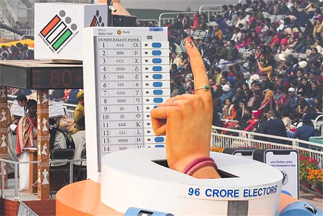
  • 2024 Lok Sabha polls: 96 crore citizens, including 47 crore women, eligible to cast vote

    2024 Lok Sabha polls: 96 crore citizens, including 47 crore women, eligible to cast vote

    Over 96 crore people, including 47 crore women, are eligible to cast vote in the upcoming Lok Sabha elections, for which more than 12 lakh polling booths would be set up across India. Over 1.73 crore of those eligible to vote are in the age group of 18 to 19 years, according to Election Commission (EC) data.
    As many as 1.5 crore polling personnel would be deployed to ensure smooth conduct of the parliamentary elections to elect members of the 18th Lok Sabha.
    According to a 2023 letter sent by the EC to political parties, India had 17.32 crore registered voters in 1951, which rose to 19.37 crore in 1957.
    There were 91.20 crore voters in the 2019 polls. Out of the total voters registered in the electoral rolls, nearly 18 lakh are persons with disabilities. In the first Lok Sabha elections, the voter turnout was recorded at 45 per cent. It was 67 per cent in the last parliamentary polls.

  • Tripura election: 81% voter turnout recorded, EC says polls ‘largely violence-free’

    Tripura election: 81% voter turnout recorded, EC says polls ‘largely violence-free’

    New Delhi (TIP)- The tentative voter turnout for the 60-member Tripura Assembly today was recorded at 81% with the final figures to be known only by Friday, February 17, the Election Commission of India (ECI) said.

    The polling passed off “largely violence-free”, the commission said, adding that eligible Bru migrant voters, displaced from Mizoram 26 years ago due to ethnic trouble, were able to exercise their franchise for the first time in the state. Poll panel officials said no major complaints had been received so far by the ECI. “There have been no reports of any major violence or attack on candidates or (polling) agents or intimidation of voters. As against 168 repolls in the state in the 2019 Lok Sabha polls, today’s poll for 60 Assembly seats in Tripura has been largely peaceful with no (demand for) repoll reported so far,” the poll panel said in a statement.

    “Minor instances” of violence which were reported were promptly looked into by local officials,” the panel added. “For the first time in many years, Bru migrant voters were able to exercise their franchise. Special efforts were made to enrol them. Some 14,055 eligible Brus were enrolled in the state in 12 locations. They cast their votes at these locations spread across four districts,” it said. Meanwhile, the ECI said it had seized drugs, cash, and freebies worth over Rs 147 crore in Tripura, Nagaland and Meghalaya.

    According to officials, the seized items included Rs 14 crore in cash, foreign liquor valued at over Rs 9 crore and drugs worth Rs 85.76 crore. The highest seizures were made in Meghalaya at over Rs 63 crore, followed by Tripura (Rs 44.67 crore) and Nagaland (Rs 39.19 crore). Nagaland and Meghalaya will go to the polls on February 27.

    The poll panel said the seizures in the three states marked a significant increase as compared to 2018 polls.

    For more than 30 years, Tripura was ruled by the CPM till the upset in 2018, when the BJP won 36 of the 60 seats in a state where it practically had no presence. Though the score pushed the BJP well above the majority mark of 31, it still formed alliance with regional IPFT (Indigenous Progressive Front of Tripura) – which got eight seats — as insurance against any defection by its MLAs.

    The CPM, which ruled Tripura for 35 years, has joined forces with the Congress this time, and its campaign is being led by its four-time Chief Minister Manik Sarkar. The Left Front will contest 47 of the state’s 60 seats, leaving just 13 seats for the Congress.

    While the CPM won 16 seats in 2018, the Congress – main opposition in the previous assembly — drew a blank. The CPM is hoping that their alliance will help add votes in around 13 seats. But the alliance has raised eyebrows among the Kerala units of both parties where they have been sworn enemies for decades.

    The Tipra Motha – the new party formed by former royal Pradyot Kishore Debbarma with a core demand of Greater Tipraland — might queer the pitch for the BJP. While the BJP has the local party IPFT in its corner, its hold on some seats have loosened over the last five years. In 2021, IPFT was wiped out in the Tribal Areas Autonomous District Council polls and had to accept only five seats to contest in this election.

    The BJP had initially attempted to build a rapport with the Tipra Motha, but its overtures were met with rebuff. After the BJP declared that it would not allow any division of Tripura, the Tipra Motha also hardened its stand, flinging Union minister Amit Shah’s allegation of its being the “B Team of CPM-Congress” back at the BJP.

    Assam Chief Minister Himanta Biswa Sarma, the BJP’s pointsperson in the northeast, has predicted a hugely improved performance by the party in all three northeastern states that are going to polls in this round. Elections are due in Meghalaya and Nagaland on February 27. Counting of votes will be held on March 2.

  • Election Commission of India’s Gesture

    Putting off Punjab polls welcome, but Covid concerns persist

    The Election Commission of India (ECI) deserves praise for accepting a genuine demand by the state government and various political parties to postpone the Punjab Assembly polls in view of Guru Ravidas Jayanti. Chief Minister Charanjit Singh Channi and other leaders had appealed to the poll panel to reschedule voting, which was initially slated for February 14, so that followers of Guru Ravidas — a revered poet-saint of the Bhakti movement — could travel from Punjab to Uttar Pradesh to celebrate his birth anniversary on February 16. Lakhs of devotees converge on Varanasi, the birthplace of Guru Ravidas, to pay obeisance on Magha Purnima every year.

    Unanimity among political parties is rare, especially during the election season. What has made all stakeholders speak in one voice in this case is the importance of the Ravidasia community as a vote bank. Doaba, which sends 23 MLAs to the 117-seat Punjab Assembly, accounts for lakhs of followers of Guru Ravidas. No party can afford to ignore the interests of this influential group, considering that this is apparently a ‘no wave’ election which might throw up a hung House. The bottom line is that every seat counts. However, amid the electoral compulsions, various parties have conveniently chosen to ignore the fact that the celebrations in Varanasi will witness a huge congregation under the shadow of the pandemic. The event could become a coronavirus superspreader if the third wave does not subside by mid-February. Varanasi is represented in the Lok Sabha by PM Narendra Modi, who has been repeatedly urging citizens of the country to follow Covid protocols. It will be a big challenge for the BJP government in poll-bound UP to make large crowds toe the line, particularly since cancellation of the festivities is not an option in view of the religious sentiments at stake. Last year, the Kumbh Mela in Uttarakhand was one of the contributory factors to the massive surge in infections during the devastating second wave. It remains to be seen whether adequate steps will be taken this time to ensure a Covid-safe pilgrimage.

    (Tribune, India)

  • Hate speeches: Onus on Supreme Court, ECI to stem the rot

    Hate speeches have come under judicial scrutiny, with the Supreme Court agreeing to hear a public interest litigation (PIL) seeking an ‘independent, credible and impartial’ investigation by an SIT into the inflammatory remarks made by speakers at last month’s Dharma Sansad in Hardwar and an event in New Delhi. The petitioners have claimed that no effective steps have been taken by the Uttarakhand and Delhi police to arrest those who targeted the Muslim community in their speeches. Another petition, filed by the Jamiat Ulama-i-Hind in the apex court, has sought a ban on anti-Muslim speeches and programs, saying that ‘it is not just a matter of religion but of the Constitution, law, unity and integrity of the country.’

    Uttarakhand is among the five states going to the polls next month. The Election Commission of India (ECI) has already cautioned political parties over hate speeches and said that it is keeping tabs on social media posts. Even as a SIT formed by the BJP government in the hill state is probing the Hardwar case, the ruling party is being accused of dragging its feet on the sensitive issue due to electoral considerations. What seems to have emboldened the hate-mongers is the silence of the Central and state governments on the ‘genocidal’ speeches, which were also delivered at a recent conclave in Raipur, Chhattisgarh.

    ‘Practise your religion but don’t abuse and indulge in hate speech and writings’ — that’s what Vice President M Venkaiah Naidu said at an event held in Kerala last week to mark the 150th death anniversary of Saint Kuriakose Elias Chavara, a 19th-century Catholic priest and social reformer. His strong disapproval of attempts to ridicule other religions and create dissensions in society ought to spur politicians of all hues to call out the black sheep. However, most of them are preferring to remain mute spectators with an eye on their vote banks. With the political class generally reluctant to condemn bigotry and intolerance, the courts and the ECI would have to go the extra mile to ensure exemplary action against those spreading hatred and inciting violence in the name of religion.

    (Tribune, India)

  • Election Commission of India in the dock

    Constitutional body is being held responsible for Covid surge

    The Madras High Court has pulled no punches in holding the Election Commission of India (ECI) ‘singularly’ responsible for the spread of the second wave of Covid-19 in the country. The court has even said that ECI officials may be booked on murder charges. This is a scathing indictment of the poll panel’s conduct of the elections in four states and a UT over the past month amid the devastating pandemic. Sadly, the strictures have shown the ECI in a poor light because of its decisions, though the polling staff had accomplished the Herculean task of holding elections during a health emergency. There is no doubt that polls are a constitutional obligation that the ECI has to fulfil, come what may, but the sheer chaos they unleashed could have been avoided with foresight and planning. The poll schedule for West Bengal — eight phases spread over 34 days — had come under fire from the outset. Such a long-drawn-out exercise was a recipe for disaster as the virus was getting uncontrollable by the day. Even as Covid cases kept rising in recent weeks, the ECI refused to club the remaining phases, citing logistic challenges and legal constraints. Though the specter of large gatherings becoming superspreaders of infection loomed large, the commission allowed crowded roadshows and rallies. It was as late as April 22, with only two phases of polling left, that the ECI imposed a ban on roadshows and vehicle rallies in the state. The poll panel has now prohibited all victory processions and celebrations after the counting of votes on May 2. The move is welcome, but it will all boil down to enforcement. It remains to be seen what action, if any, would be taken against the offenders. There is a growing perception that the ECI is reluctant to act against certain big fish. The credibility of this constitutional body has repeatedly come under a cloud as doubts have been raised about its neutrality. The ECI needs to go the extra mile to dispel such notions and reaffirm its commitment to remain Indian democracy’s watchdog.

    (Tribune, Chandigarh)