
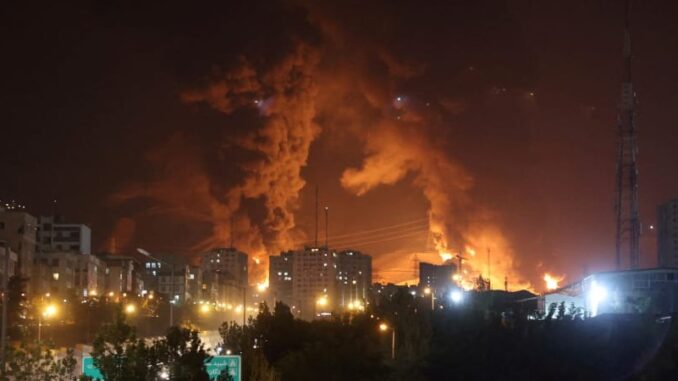


There are moments in history when the world stands at a precipice—when reason trembles, when power intoxicates, and when humanity appears to lose its moral compass. The unfolding tensions in the Middle East today, particularly the dangerous confrontation involving the United States, Israel, and Iran, represent one such moment. The rhetoric is harsh, the mistrust deep, and the consequences of miscalculation potentially catastrophic.
We are told that ceasefires are being negotiated, that pauses in hostilities may open a window for dialogue. Reports suggest that a temporary halt—five days, perhaps—has been proposed to bring parties to the table. But let us ask a simple, uncomfortable question: must peace always be negotiated under the shadow of annihilation? Must humanity come to the brink of destruction before it learns to step back?
This editorial is not written from the vantage point of power, nor from the corridors of diplomacy. It is, quite deliberately, a common man’s plea—a voice that seeks neither victory nor dominance, but survival, dignity, and peace.
A REGION ENTANGLED IN FEAR AND HISTORY
The Middle East is not merely a theatre of contemporary conflict; it is a land burdened with centuries of history, faith, empire, and identity. The divide between Sunni and Shia Islam, rooted in events of the 7th century following the death of Prophet Muhammad, continues to echo in modern geopolitics. Iran, predominantly Shia, sees itself as a civilizational state with a long imperial history, predating many of its neighbors. Many Arab nations, largely Sunni, view Iran’s ambitions with suspicion and fear.
Overlaying this is the unresolved and deeply painful question of Palestine. Since the establishment of Israel in 1948, the region has witnessed multiple wars, uprisings, and cycles of violence. Israel speaks of existential threats—from non-state actors such as Hezbollah and Hamas, whom it accuses Iran of supporting. Iran, in turn, perceives Israel as an aggressive outpost, backed militarily and politically by the United States, capable of destabilizing the entire region.
Thus, fear feeds fear. Suspicion breeds suspicion. And history, instead of teaching restraint, is often invoked to justify further confrontation.
THE PERILS OF POWER POLITICS
The involvement of global powers has only complicated matters. The United States, long a steadfast ally of Israel, has maintained a significant military presence in the Middle East for decades. From Iraq to Afghanistan, from Syria to the Gulf, American bases dot the region, often justified in the name of security and stability.
Yet, for many, this presence has also been a source of resentment. It has fueled perceptions of bias, of selective justice, and of geopolitical maneuvering that prioritizes strategic interests over human lives.
Israel, for its part, has emerged as a formidable military power, technologically advanced and politically assertive. But strength, when not tempered by restraint, risks breeding isolation. To many observers, Israel appears as a state that reacts with overwhelming force, often blurring the line between defense and domination.
Iran, on the other hand, is frequently portrayed as a destabilizing force—supporting militant groups, challenging Western influence, and pursuing nuclear capabilities that alarm the international community. Yet, Iran too sees itself as encircled, sanctioned, and misunderstood—a nation seeking security in a hostile environment.
In this complex web, there are no simple villains and no simple victims. There are, instead, nations driven by fear, pride, and the dangerous illusion that security can be achieved through supremacy.
A COMMON MAN’S PLAN FOR PEACE
It is time to step back and ask: what would a reasonable, humane, and sustainable path to peace look like?
The answer may not lie in grand strategies or secret negotiations, but in principles that are simple, transparent, and just.
- A United Nations Guarantee of Non-Aggression
The United Nations must reclaim its moral authority. It cannot remain a passive observer while the world teeters on the edge of conflict.
A binding international framework should be established, under UN supervision, whereby:
Israel and Iran formally commit to non-aggression
Both nations renounce the development or deployment of nuclear weapons
Any violation triggers collective international response—not by a single power, but by the global community
This is not idealism. It is necessity. The alternative—a nuclear arms race in the Middle East—is unthinkable.
- A Just and Permanent Solution to Palestine
No peace in the region can endure without addressing the Palestinian question.
A two-state solution, long discussed but rarely realized, must be implemented with sincerity:
Clearly defined and internationally recognized borders for Israel and Palestine
Security guarantees for both states
Jerusalem treated with sensitivity, acknowledging its sacred significance to multiple faiths
This is not merely a political issue; it is a moral one. Generations have grown up in conflict. It is time to offer them a future in peace.
- Neutral Guarantors of Peace
Trust cannot be built if mediation is perceived as biased.
Therefore, peace guarantees must come not from parties directly involved in the conflict, but from neutral nations—countries with no strategic stakes in the region. These nations, acting under UN mandate, can serve as:
Observers
Peacekeepers
Mediators
Their neutrality is their strength.
- Gradual Withdrawal of Foreign Military Bases
The continued presence of foreign military bases in the Middle East has often intensified tensions rather than alleviated them.
A phased and mutually agreed withdrawal of such bases—beginning with major powers like the United States—would:
Reduce perceptions of occupation and control Encourage regional ownership of peace processes
Signal a shift from dominance to cooperation True security cannot be imposed from outside. It must emerge from within.
- A Global Commitment to Dialogue Over War
All nations, not just those in the Middle East, must reaffirm a simple principle:conflicts must be resolved through dialogue, not destruction.
The UN must evolve from a forum of speeches to a mechanism of action—where disputes are addressed promptly, fairly, and effectively.
A MORAL AWAKENING
Beyond politics and policy lies a deeper truth: humanity must evolve.
Science has taken us to the moon, technology connects continents in seconds, and yet, in matters of conflict, we remain trapped in primitive instincts. As Charles Darwin explained evolution in physical terms, one must ask: have we evolved morally?
Education, culture, and faith have the power to refine human instincts—but only if we choose to listen.
THE RESPONSIBILITY OF LEADERS
Leaders today carry a burden far greater than those of the past. In an age of nuclear weapons, cyber warfare, and global interdependence, a single misstep can have consequences for all humanity.
The United States, as a global power, must move beyond fear-driven policies and rediscover the strength of trust. Israel must temper its power with compassion and foresight. Iran must choose engagement over confrontation.
And all nations must recognize that dominance is fleeting—but peace is enduring.
A FINAL APPEAL
This is not a call for weakness. It is a call for wisdom.
War has never brought lasting peace. It has only deepened wounds, destroyed civilizations, and left generations to rebuild what should never have been broken.
The world does not need more victories. It needs understanding.
It does not need more weapons. It needs courage—the courage to forgive, to trust, and to change.
Let us, as a global community, step back from the brink. Let us choose dialogue over destruction, cooperation over conflict, and humanity over hatred.
Let us remember that beyond borders, beyond religions, beyond ideologies, we share a common destiny.


Be the first to comment