
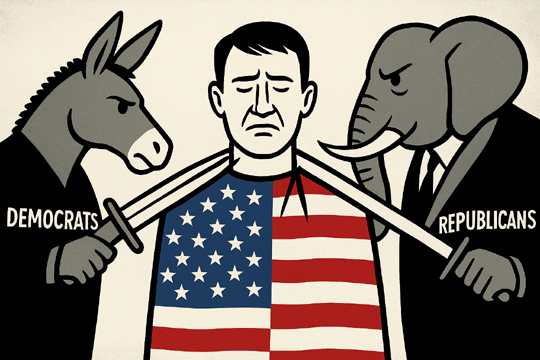


Americans suffered enormously because of the government shutdown—an ordeal that millions across the nation widely believe was both unnecessary and entirely avoidable. For 43 days, the “land of the free and the home of the brave” watched its own people scourged by political brinkmanship: federal workers lining up at food banks, families forced to choose between rent and groceries, airports pushed to the brink, and businesses frozen in uncertainty. But thank God, after weeks of hardship and chaos, the shutdown has finally ended. The relief is palpable—among employers, employees, lawmakers, and every American who felt the tremors of a government brought to a halt.
Yet as the nation exhales, another set of questions rises urgently to the surface: Why did this shutdown happen at all? What did it accomplish? Who gained, who lost—and what does it mean for the American people going forward? The Readers of The Indian Panorama deserve a clear and analytical examination grounded in facts, figures, and the lessons this painful episode has left behind.
How It Began: A Political Showdown With National Consequences
At the heart of the shutdown was a bitter standoff over federal spending, tied to a contentious border-security funding demand. Though disagreements over the national budget are not new, the scale and duration of this shutdown were unprecedented. It became the longest in American history—43 days—surpassing the previous record of 35 days in 2018–19.
The immediate victims were the 800,000 federal employees who were either furloughed or forced to work without pay. Millions more—federal contractors, small-business owners, service workers, and families dependent on federal operations—felt the shockwaves. Approximately 4 million federal contract workers lost income, much of which was never reimbursed. Scientific research projects halted, court proceedings slowed, IRS operations were compromised at a critical tax-season moment, and food-safety inspections were scaled back.
This raised a critical question: Was it necessary to shut down the world’s most powerful government to resolve a political disagreement? To millions of Americans, the answer was clearly no.
The Economic Cost: Billions Lost, Recovery Partial
Shutdowns have always been costly, but the severity of this one left a measurable dent in the national economy. The Congressional Budget Office (CBO) produced a clear, data-driven assessment:
$11 billion in total economic losses.
$3 billion permanently lost—never to be recovered.
Thousands of delayed loans to small businesses by the Small Business Administration,
Hundreds of millions lost by airlines and airport-service vendors.
National parks, operating without staff, suffered millions of dollars in damage from vandalism, littering, and infrastructure wear. In Washington, D.C., restaurants that depend heavily on federal workers reported revenue drops of 30–50%. Across the country, families canceled vacations, postponed purchases, and withdrew from local commerce.
No political objective—whatever its merit—justifies economic losses of this magnitude.
Political Gains and Losses: Costly Gamble for All
Shutdowns are often viewed through the prism of political victory and defeat. Yet this episode revealed something unusual: there were no winners.
For the Administration
The administration framed the shutdown as a strategic necessity to secure funding for a central policy commitment. But public opinion told a different story.
Surveys showed:
53% of Americans blamed the administration for the shutdown.
34% blamed the opposition party.
Presidential approval ratings dropped nearly 4 percentage points during the crisis.
More importantly, the shutdown ended without achieving the policy goal that triggered it. This raised doubts about whether the strategy had ever been viable—or merely symbolic.
For Congress
Congressional leaders projected firmness, arguing that yielding would set a dangerous precedent allowing any President to shut down government to extract concessions. In that sense, Congress succeeded in protecting the constitutional balance of powers.
Yet within this broader struggle, it is important to acknowledge the courage of Democratic lawmakers who chose principle over partisanship to help end the impasse. Among them was Congressman Tom Suozzi, who represents this writer in Congress and who broke from party lines in the interest of the American people. At a time when political polarization seemed immovable, leaders like Suozzi—willing to step across the aisle and support measures to reopen the government—played a meaningful role in easing the suffering of millions. Their commitment to country over political calculation deserves recognition and appreciation.
Still, in terms of public perception, the legislature as a whole appeared dysfunctional. Nearly 70% of Americans expressed frustration with both parties’ inability to compromise and avert the crisis.
For the American People
The greatest burden fell on federal workers and ordinary citizens. The shutdown produced images that shook the nation:
TSA agents working without pay.
Coast Guard families visiting food pantries
Air-traffic controllers filing stress and hardship reports.
Federal prison guards unable to pay utility bills.
Scientists forced to stop critical experiments mid-stream.
These are not abstract policy consequences; they are snapshots of real American lives thrown into turmoil.
Why Americans Believe the Shutdown Was Unnecessary
Public frustration stemmed from a simple perception: there were multiple alternative paths to negotiation that would not have required halting government services. Past administrations—Republican and Democratic alike—have navigated bitter disagreements without shutting the nation down.
Three core arguments shaped public sentiment:
Shutdowns do not work.
Historically, they have rarely produced policy concessions.
Shutdowns inflict severe and disproportionate harm.
The economic losses far outweigh any political leverage gained.
Shutdowns undermine global confidence in American governance.
Allies and markets watch closely. Political chaos weakens the credibility of a nation that prides itself on stability.
The shutdown was widely seen as a political gambit whose costs far exceeded any conceivable benefits.
Lessons Learned: A Warning for the Future
The episode leaves the nation with sobering lessons.
First, America must acknowledge that governing through brinkmanship is unsustainable. Essential governmental functions cannot be weaponized in political disputes.
Second, lawmakers must consider structural reforms.
Automatic continuing resolutions to prevent shutdowns.
Protection of essential workers from unpaid labor.
Faster dispute-resolution processes.
Stronger bipartisan budget negotiations.
Third, the shutdown highlighted the fragility of public trust in national institutions. When the world’s richest democracy cannot pay its own employees for more than a month, the credibility of its governance comes into question.
A Moment of Relief—But Not Without Reflection
With the shutdown finally over, the nation feels relief—but also anxiety. Relief that paychecks will resume. Relief that airports and national parks will function properly again. But anxiety that another shutdown may loom in the future, should political divisions once again reach a boiling point.
For the sake of federal workers, the economy, and the very reputation of American democracy, this episode must serve as a clear warning: shutdowns do not strengthen the nation—they fracture it.
The longest shutdown in American history should remain exactly that: the longest ever, never to be repeated. The suffering of “the free and the brave” should not become a recurring cost of political ambition. America deserves better—more responsible leadership, more principled negotiation, and a government that never again turns its own people into collateral damage.
Readers are requested to post their Comment, or email it to editor@theindianpanorama.news


Be the first to comment