

The 2025 New York City mayoral election will go down in the annals of the city’s political history as one of the most remarkable — not merely for its result, but for the message it conveys about the evolving identity of New York and, indeed, of America itself.
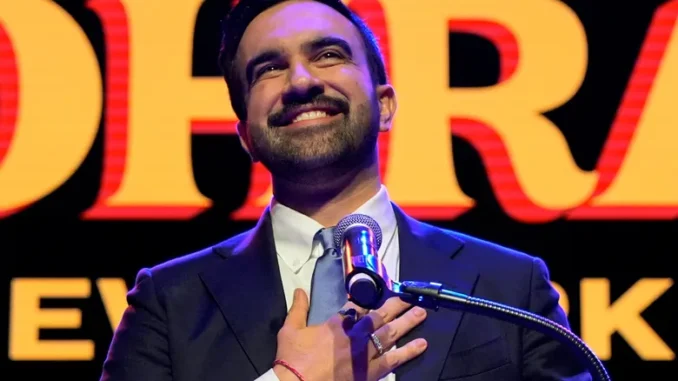
For the first time in history, New York City has elected a Muslim, Indian-origin, Social Democrat, and the youngest mayor ever at 34 — Mr. Zohran Mamdani. His victory, with 51 percent of the vote against Andrew Cuomo’s 41 percent, signals a generational and ideological shift in the political consciousness of the city. This was an election that drew the highest voter turnout in five decades, with youth participation surging to unprecedented levels.
Despite fierce opposition, including overt attempts by President Donald J. Trump to delegitimize Mamdani’s candidacy and warn of dire consequences if he were elected, the people of New York exercised their right to choose — emphatically, decisively, and democratically.
The People Have Spoken
Mr. Mamdani’s victory speech was both emotional and visionary. “This city belongs to all who build it, clean it, teach in it, and dream in it,” he declared to thunderous applause in Queens. Indeed, New York’s choice of Mamdani is a reaffirmation of America’s enduring faith in democracy, pluralism, and inclusivity — the very principles enshrined in the Preamble of the U.S. Constitution, which promises to “establish justice, insure domestic tranquility, provide for the common defense, promote the general welfare, and secure the blessings of liberty.”
It is worth recalling the words of President Abraham Lincoln, who said, “The ballot is stronger than the bullet.” The voters of New York have, by their ballot, chosen a new direction for their city — a direction that calls for social justice, economic reform, and fairness.
The Challenge Ahead
However, as the saying goes, winning an election is one thing; governing after it is another.
In an earlier editorial (See the June 28th edition of The Indian Panorama-https://www.theindianpanorama.news/opinion/comments/zohran-mamdanis-stunning-victory-in-nyc-mayoral-primary-a-tale-of-promises-populism-and-political-miscalculation/), we had raised valid questions about how Mr. Mamdani planned to fund his ambitious promises — free transportation, free baby-sitting, rent stabilization, and wage increases — all of which appeal strongly to working-class and middle-income New Yorkers. We had asked for clarity on his resource mobilization plans. Unfortunately, there was no response from his campaign then.
Now that he is Mayor, rhetoric must give way to reality. It is time for Mr. Mamdani to move from the poetry of campaigning to the prose of governing.
Trump’s Threat and the Federal Factor
Among the immediate challenges Mamdani faces is political hostility from Washington. President Trump, now in his second term, has already hinted at withholding federal grants from New York City as a form of punishment for electing Mamdani — a move both dangerous and undemocratic.
Let us be clear: any such action by the President would amount to punishing the citizens of New York for exercising their constitutional right to vote. It would be an affront to the sovereignty of the people, violating the very oath the President takes under Article II, Section 1 of the U.S. Constitution: “to faithfully execute the office of President of the United States, and to preserve, protect and defend the Constitution of the United States.”
The Constitution does not give the President power to discriminate between states or cities based on political leanings. The Tenth Amendment preserves the rights of states and municipalities in managing their own affairs. For a President to interfere in city-level governance out of political spite is not only unprincipled but deeply unethical.
Moreover, such interference demeans the dignity of the Presidency. As Theodore Roosevelt once said, “The Presidency is not an office to be used for the gratification of personal ambition.” The people’s mandate must be respected — whether or not one agrees with it politically.
Call for Cooperation
The politicians who opposed Mamdani during the campaign must now put aside partisanship and work with him in the larger interest of New York City. Democracy demands magnanimity in victory and grace in defeat. It is time to close ranks, not deepen divides.
Mamdani’s success or failure will not be his alone — it will be New York’s. The city’s economic revival, infrastructure renewal, and social cohesion depend on cooperation between the Mayor’s office, City Council, State government, and the federal administration.
As John F. Kennedy once reminded Americans, “Let us not seek the Republican answer or the Democratic answer, but the right answer.” That wisdom must guide New York’s leaders today.
Mayor for All New Yorkers
For Mr. Mamdani himself, the challenge is to prove that he is not merely a symbol of representation, but a servant of all New Yorkers. He must lead as a Mayor for every community — white, Black, Latino, Asian, Arab, Jewish, Sikh, Christian, Hindu, and Muslim alike. While he may rightly feel pride in being the first Muslim to lead America’s largest city, he must also remember that he is not the Mayor of Muslims, but the Mayor of New York City — a city whose greatness lies in its diversity and secular spirit.
He must ensure that no group feels alienated or excluded. His leadership should echo the words of George Washington, who in his 1790 letter to the Touro Synagogue wrote: “The Government of the United States gives to bigotry no sanction, to persecution no assistance.”
Governance and the Road Ahead
Mr. Mamdani’s policy platform is ambitious, even audacious. Free transportation, free baby-sitting, rent stabilization, and wage increases are noble goals — but they will require robust fiscal management.
New York’s infrastructure is visibly struggling. Roads and bridges need urgent repair. The subway system, once the pride of the city, now suffers chronic delays, equipment breakdowns, and safety concerns. Sanitation and public cleanliness remain subpar for a global metropolis that aspires to world-class status.
To realize his promises, Mamdani must first fix the fundamentals — efficiency, accountability, and transparency in governance. One possible step is to trim the city’s top-heavy bureaucracy, where layers of management often stifle decision-making. Redirecting funds from administrative excess to essential services could help balance the books.
Yet, Mamdani must also learn an old truth of economics: charity cannot cure poverty. Sustainable prosperity requires employment, not entitlement. The new Mayor would do well to focus on job creation, reviving small businesses, and supporting local entrepreneurship — the very backbone of New York’s economy.
While social welfare has its place, it should be a safety net, not a permanent cushion. Handouts may provide temporary relief, but opportunity provides dignity. The people of New York deserve both compassion and competence from their leaders.
Consultation and Collaboration
The Mayor should convene roundtable consultations with business leaders, labor unions, educators, transit experts, housing advocates, and community representatives to design practical solutions. Governance is not a solo act; it’s a symphony of stakeholders.
As we wrote before the election, the real test of leadership lies not in making promises, but in keeping them. The time has come for Mr. Mamdani to translate his ideals into policies, and his policies into measurable outcomes.
Beyond the politics, Mamdani’s victory carries a profound symbolic weight. It tells every child of immigrant parents, every Muslim, every South Asian American that the American Dream — though battered and bruised — still breathes.
In a time of deep polarization, his election reminds us that democracy remains capable of renewal. The Founding Fathers, in their wisdom, created a republic flexible enough to evolve with its people. As Thomas Jefferson said, “We do not have government by the majority. We have government by the majority who participate.”
The youth of New York participated — and they changed history.
Mr. Mamdani now carries the hopes of millions — those who voted for him and those who did not. His success will depend on his ability to unite, to listen, and to deliver. The city’s problems are immense, but so are its possibilities.
As the world watches this young, first-of-his-kind Mayor step into City Hall, the message from the voters is clear: Enough talk. It’s time for action.
We wish Mayor Zohran Mamdani a tenure marked by integrity, innovation, and inclusivity — one that truly serves the people of New York, honors their trust, and justifies their faith in democracy.
Be the first to comment