
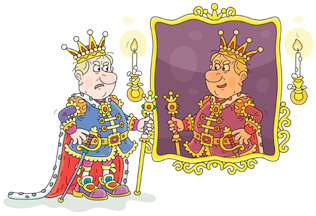


There is an old Latin phrase from the Book of Ecclesiastes: Vanitas vanitatum, omnia vanitas — “Vanity of vanities; all is vanity.” The author was reflecting on the fleeting nature of earthly glory. He could scarcely have imagined that centuries later, the phrase would find fresh relevance in the political theatre of 21st-century America — in the era of President Donald Trump.
Vanity is not a new companion of power. Emperors built monuments, monarchs embossed their crowns with jewels, and presidents have all, in subtle or visible ways, left their personal stamp upon public office. But what distinguishes Mr. Trump is not merely the scale of his personal branding — it is the unapologetic flamboyance with which he fuses governance and self-projection.
Let us begin with the latest flourish: the reported repainting vision for Air Force One in what many have described as a darker, more dramatic red, white, and blue scheme aligned with Mr. Trump’s aesthetic tastes. Presidential aircraft have traditionally reflected a sober, calming palette introduced during the John F. Kennedy administration in 1962 — a light blue and white design symbolizing dignity rather than dominance. Mr. Trump’s preference, critics say, leans toward spectacle. The aircraft, after all, is not merely transportation; it is airborne symbolism. For him, it appears to be airborne branding.
The Ballroom Presidency
Before the debate about aircraft exteriors, there was the perennial fascination with interiors. Mr. Trump’s well-known affinity for gilded décor — visible for decades at Mar-a-Lago — shaped public discussions about potential expansions or enhancements to the White House entertainment spaces, including talk of building or redesigning large ballroom facilities befitting state dinners “with style.”
Now, the White House has hosted balls and grand receptions for centuries, but few presidents have publicly discussed décor with the enthusiasm of a real estate developer fine-tuning a flagship property. Critics suggested that the presidency is not a resort; supporters countered that a successful businessman bringing aesthetic ambition to 1600 Pennsylvania Avenue is hardly a scandal. Still, one cannot ignore that gold accents and marble grandeur remain part of Mr. Trump’s unmistakable signature.
The Mirror and the Megaphone
Vanity in the digital age no longer requires bronze statues. It requires platforms. Mr. Trump has long displayed a unique symbiosis with media — from his early days hosting The Apprentice to his later prominence on Truth Social, the network he helped launch after departing mainstream social media platforms.
No president in American history has exercised self-commentary quite like Mr. Trump. His posts often read like headline, counter-headline, and applause line combined. To critics, this constant narration of personal triumph verges on self-mythologizing; to supporters, it is unfiltered transparency. Either way, the mirror is no longer passive — it has a megaphone.
One cannot forget the dramatic unveiling of official portraits, carefully chosen lighting, the assertive gaze — images that speak almost more loudly than speeches. Presidential portraiture has always sought gravitas. Yet in the Trump era, the image often seems to say: “You’re fired — but beautifully framed.”
Branding the Republic
Consider the persistent use of signature slogans — “Make America Great Again,” emblazoned across hats, banners, and rallies. To be sure, all politicians brand themselves. Barack Obama had “Hope” and “Change.” Ronald Reagan spoke of “Morning in America.” Yet Mr. Trump’s branding ascended to retail ubiquity. The line between campaign merchandise and political identity blurred almost completely.
There were also discussions, in previous terms, of renaming buildings, altering décor, and foregrounding personal achievement in official spaces. The presidency, in Trump’s conception, often feels less like a temporary stewardship and more like a gilded extension of a lifelong brand.
Of Statues and Self-References
Political cartoonists have had a field day. One popular caricature shows Mr. Trump gazing into a mirror, but the reflection is that of a Roman emperor — laurel wreath intact. Another depicts Air Force One with racing stripes and a gold-plated tailfin, roaring across the sky like a luxury jet from central casting. Humor, after all, is democracy’s pressure valve.
There have also been moments when Mr. Trump suggested that his achievements warranted extraordinary historical recognition — even at times hinting at constitutional barriers such as term limits with a rhetorical wink. Admirers applaud confidence; detractors diagnose narcissism.
The Art of Self-Praise
Perhaps the most distinctive feature of Mr. Trump’s political persona is his comfort with self-commendation. “Nobody has done more…” is a phrase that surfaces frequently in his rhetoric. Previous presidents often delegated praise to historians or allies; Mr. Trump dispenses it personally.
Yet history teaches us that self-confidence, when fused with power, walks a narrow ridge. It can inspire decisive leadership, but tip too far and it risks eclipsing humility — that quiet virtue that steady republics cherish.
The United States has long prided itself on institutional continuity. The White House belongs not to a man, but to a people. George Washington refused a crown. Abraham Lincoln spoke of “government of the people, by the people, for the people.” Even when presidents possessed towering egos — and many did — tradition reined excess with ceremony.
Mr. Trump often tests those ceremonial boundaries. Whether through visual redesign, architectural ambition, or digital proclamation, he ensures that the spotlight does not dim.
A Republic or a Reality Show?
Mr. Trump’s genius, one must concede, lies in performance. Governance in his hands often carries the cadence of showmanship. Press conferences are theatrical. Campaign rallies become arenas. Policy announcements arrive with cliffhanger flair. It is politics in high-definition color.
But here is the question beneath the gilded surface: does spectacle serve democracy, or distract from it?
The repainting of Air Force One may seem trivial, yet symbolism matters. The building of grand ballrooms may appear cosmetic, yet priorities are revealed in architecture. When self-presentation becomes central to governance, citizens must ask whether the mirror has grown larger than the window.
And yet — let us inject a touch of humor. If Mr. Trump ever commissioned a presidential coin, one suspects it might feature him on both sides: heads and… heads again. If Mount Rushmore had space, perhaps he would volunteer engineering assistance.
Democracy, however, is sturdy enough to survive flamboyance. The American Constitution — with its checks and balances — has weathered ambition before. Vanity fades; institutions endure.
The Biblical Reminder
Ecclesiastes ends not in cynicism, but in perspective. Earthly glory, it says, passes away. In a republic, even the most colorful presidency is a chapter, not the book.
Vanity in leadership is hardly new. What is new is the speed with which image amplifies. Today, a fresh coat of paint on a presidential jet becomes global headline. A chandelier suggestion becomes an international meme.
For readers of The Indian Panorama — especially many who cherish both Indian and American democratic traditions — this moment offers reflection. Power should carry dignity. Confidence should be accompanied by restraint. Pride, by humility.
To be clear, criticism of vanity is not condemnation of achievement. Confidence drives enterprise. Style enlivens ceremony. But when style eclipses substance, democracies must gently — sometimes humorously — hold up their own mirror.
Vanitas vanitatum. The Latin phrase is not an accusation; it is a reminder. Leadership is temporary. Legacy is judged not by paint palettes or chandeliers, but by justice, unity, and the welfare of the people.
President Trump’s flair guarantees that historians will write colorful chapters. Whether those chapters shimmer as statesmanship or sparkle merely as spectacle will depend not on gold trim, but on moral trim — the quiet molding of humility that strengthens institutions.
And perhaps, one day, even Air Force One will return to calmer hues.
After all, in a republic, the sky belongs not to vanity — but to history.


Be the first to comment