Tag: Egypt

  • Prime Minister Modi’s foreign visits from 2021-24 cost the nation USD 34,114,449 (Rs 295 cr)’;  USD 7,746,345 (Rs 67 cr ) on trips to 5 countries in 2025: Govt data

    Prime Minister Modi’s foreign visits from 2021-24 cost the nation USD 34,114,449 (Rs 295 cr)’; USD 7,746,345 (Rs 67 cr ) on trips to 5 countries in 2025: Govt data

    NEW DELHI (TIP): Over Rs 67 crore (USD 7,746,345) was incurred on Prime Minister Narendra Modi’s visit to five countries, including the US and France, in 2025, while the total expenditure figures related to his foreign trips from 2021 till 2024 stood at nearly Rs 295 crore (USD 34,114,449) , according to data shared by the government, says a PTI report.

    As per the country-wise and year-wise data, the corresponding figures for Modi’s visits to Mauritius, Cyprus, Canada and Croatia, and Ghana, Trinidad & Tobago, Argentina, Brazil and Namibia this year were not available.

    For these visits, the column for ‘total expenditure’ in the data shared by Minister of State for External Affairs Kirti Vardhan Singh on Thursday, in his written response to a query by TMC MP Derek O’Brien in Rajya Sabha, said, “Bills under settlement. Total expenditure is not yet available.” Of these visits, the costliest one was to France, which incurred over Rs 25 crore (USD 2,890,009) , while the one Modi undertook to the US in June 2023 incurred over Rs 22 crore (USD 2,542,900) .

    On March 20, the ministry had shared data in in Rajya Sabha, according to which nearly Rs 258 crore ( USD 29,821,291) was incurred on 38 foreign visits of Modi between May 2022 and December 2024.

    In 2025, Modi had travelled to France and the US from February 10-13. In Paris, he held bilateral talks with President Emmanuel Macron and attended an AI Summit, while in the US he met and held talks with President Donald Trump, among other engagements.

    According to the data shared, the country-wise figures for these five countries Modi visited in 2025 are–Rs 25,59,82,902 (France); Rs 16,54,84,302 (US); Rs 4,92,81,208 (Thailand); Rs 4,46,21,690 (Sri Lanka) and Rs 15,54,03,792.47 (Saudi Arabia).

    The cumulative figures for the preceding four years are–about Rs 109 crore (2024) spanning 16 countries, including Russia, Ukraine, the US and Brazil; nearly 93 crore (2023); Rs 55.82 crore (2022) and about Rs 36 crore (2021).

    In 2021, Modi visited Bangladesh (Rs 1,00,71,288–total expenditure); the US (Rs 19,63,27,806); Italy (Rs 6,90,49,376); and the UK (Rs 8,57,41,408). His trips in 2022 included visits to Germany (Rs 9,44,41,562); Denmark (Rs 5,47,46,921); France (Rs 1,95,03,918); Nepal (Rs 80,01,483) and Japan (Rs 8,68,99,372), it said. For Modi’s 2023 visit to Egypt, the expenditure on advertising and broadcasting was Rs 11.90 lakh, according to the data.

  • Arab leaders gather in Saudi Arabia to hash out recovery plan for Gaza

    RIYADH (TIP): Arab leaders were gathering in Saudi Arabia on Feb 21 to hammer out a recovery plan for Gaza aimed at countering President Donald Trump’s proposal for US control of the territory and the expulsion of its people.
    Trump’s plan has united Arab states in opposition to it, but disagreements remain over who should govern the war-ravaged Palestinian territory and how to fund its reconstruction.
    “We’re at a very important historic juncture in the Arab-Israeli or Israeli-Palestinian conflict… where potentially the United States under Trump could create new facts on the ground that are irreversible,” Andreas Krieg, a King’s College London expert said.
    Trump triggered global outrage when he proposed the United States “take over the Gaza Strip” and relocate its more than two million residents to Egypt and Jordan. A source close to the Saudi government told AFP that Arab leaders would discuss “a reconstruction plan to counter Trump’s plan for Gaza”.
    The Gaza Strip is largely in ruins after more than 15 months of war between Israel and Hamas, with the United Nations recently estimating that rebuilding would cost more than $53 billion.
    During a meeting with Trump in Washington on February 11, Jordan’s King Abdullah II said Egypt would present a plan for a way forward.
    The Saudi source said the delegates would discuss “a version of the Egyptian plan”.
    The official Saudi Press Agency, citing an official, confirmed on Thursday that Egypt and Jordan were participating in the Riyadh summit along with the six country members of the Gulf Cooperation Council (GCC).
    It also said decisions issued by the “unofficial fraternal meeting” would appear on the agenda of an emergency Arab League summit to be held in Egypt on March 4.
    An Arab diplomat told AFP the meeting was supposed to start at 3 pm (1200 GMT).
    Egyptian President Abdel Fattah al-Sisi arrived in Saudi Arabia on Thursday, his office said. (AFP)

  • Landmark events that made headlines in 2024

    Landmark events that made headlines in 2024

    From national politics and international affairs to environmental concerns and advances in science and technology, here are the top issues that captured everyone’s attention this year

    The year 2024 has been a whirlwind of significant events across the globe, spanning politics, science, technology, culture, and natural phenomena. From breakthroughs in artificial intelligence to groundbreaking diplomatic agreements, here’s an in-depth look at the events that shaped the world in 2024.
    Iran-Israel Conflict
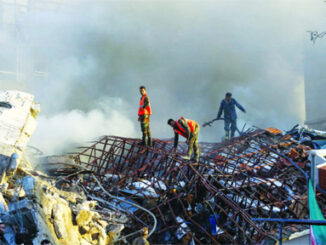
    On April 14, Iran launched hundreds of drones and missiles towards Israel in retaliation for an Israeli attack on its consulate that occurred in Damascus, Syria, on April 2. This attack became the immediate cause of the escalating conflict between Iran and Israel.
    Although Iran and Israel have a long history of bitter conflict and covert military actions against each other, this was the first time Iran has launched a direct attack of this scale aimed at targets within Israel.
    Heatwaves
    Higher daily peak temperatures and longer, more intense heatwaves are becoming increasingly common worldwide. This summer, India also experienced the impact of more frequent heatwaves, which have had devastating effects on human health and the environment.
    According to the India Meteorological Department (IMD)- A heatwave is a period of abnormally high temperatures, more than the normal maximum temperature that occurs during the summer season in the North-Western parts of India. Heatwaves typically occur between March and June, and in some rare cases even extend till July. The extreme temperatures and resultant atmospheric conditions adversely affect people living in these regions as they cause physiological stress, sometimes resulting in death.
    Misuse of Deepfakes
    In the General Elections of 2024, the widespread misuse of deepfakes significantly complicated the battle against misinformation. A deepfake video featuring actors Ranveer Singh and Aamir Khan purportedly endorsing a particular political party went viral during the elections. Earlier, a video that supposedly shows actress Rashmika Mandanna entering an elevator sparked a major controversy online. What initially appeared to be genuine was, in fact, a deepfake of the actress. The original video featured a British Indian girl, whose face was morphed to replace Mandanna’s.
    Deepfakes constitute fake content — often in the form of videos but also other media formats such as pictures or audio — created using powerful artificial intelligence (AI) tools. It is an amalgamation of the words “deep learning” and “fake” and it means fabricated videos generated from existing face-swapping techniques and technology.
    They are called deepfakes because they use deep learning technology, a branch of machine learning that applies neural net simulation to massive data sets, to create fake content. It employs a branch of artificial intelligence where if a computer is fed enough data, it can generate fakes that behave much like a real person.
    Bangladesh Political Upheaval
    The political upheaval in Bangladesh in August 2024 resulted in the ouster of former Prime Minister Sheikh Hasina and the establishment of an interim government led by Nobel laureate Muhammad Yunus. This event is considered a significant turning point in Bangladesh’s history and has introduced new dynamics in regional politics.
    India and Bangladesh share a unique relationship rooted in a common cultural heritage, shared principles, and values. However, recent regime changes in Bangladesh are affecting this relationship, particularly with the rising concern over atrocities against Hindus in Bangladesh, which has become a significant challenge in their bilateral relations.
    India-Canada Diplomatic Row
    In mid-October 2024, the sharp escalation of the diplomatic row between India and Canada, a first-of-its-kind situation in India’s diplomatic relations with the West, raised concerns about potential ripple effects in a range of areas, including trade and people-to-people ties.
    Notably, the diplomatic tension between India and Canada escalated on October 14, when India ordered the expulsion of six Canadian diplomats while also announcing its decision to withdraw the Indian High Commissioner to Canada and “other targeted diplomats,” citing security concerns after Ottawa identified them as “persons of interest” in its investigation into the killing of Khalistan separatist Hardeep Singh Nijjar.
    The bilateral ties between India and Canada are long-standing and significant. Canada is home to a high percentage of Sikhs. However, the two countries’ bilateral relations have been affected by various issues, such as Khalistani separatism and Canada’s position on human rights in India. These issues have led to increased tensions and have impacted diplomatic interactions.
    Political Upheaval in Syria
    The Syrian civil war saw major developments in December this year. The government of President Bashar al-Assad, who has ruled the Middle Eastern country since 2000, faced sudden and intense attacks from the rebel group Hayat Tahrir al-Sham. On December 8, the group reached the capital, Damascus, and celebrated the fall of Assad’s regime.
    Notably, New Delhi was preparing to revive its political and economic ties with Damascus late last month. On November 29, India and Syria held Foreign Office Consultations in New Delhi. India has been a keen developmental partner for Syria and is also actively involved in the capacity-building of the Syrian youth
    The Syrian civil war began around the “Arab Spring” of 2010, dubbed so as many countries in the Middle East and North Africa saw uprisings against authoritarian governments that had been in power for decades. Foreign governments, such as the United States and Russia, also engaged with the conflict based on their respective strategic interests.
    The Arab Spring also echoed in street protests in Syria. But Assad put it down with force unleashing a harsh crackdown on those opposing the regime. This set off a civil war, with the US backing the rebels while Russia, Iran and Hezbollah backing Assad.
    One Nation, One Election Debate
    The discussion on simultaneous elections has been a prominent topic throughout the year. Recently, the Union Cabinet approved the Constitution (One Hundred and Twenty-Ninth Amendment) Bill, 2024, along with the Union Territories Laws (Amendment Bill), 2024. This has reignited the debate over “One Nation One Election” (ONOE). Some believe that simultaneous elections would benefit the citizens, while others argue that it would undermine the basic structure of the Constitution of India.
    Notably, the high-level committee headed by former President Ram Nath Kovind has recommended that the government take a “one-time transitory measure”, which would require the Union government to identify an “appointed date” immediately after a Lok Sabha election and all state assemblies that go to poll after the said date would have their terms expire with the Parliament.
    Simultaneous elections, popularly referred to as “One Nation, One Election”, means holding elections to Lok Sabha, all state Legislative Assemblies, and urban and rural local bodies (municipalities and panchayats) at the same time. Currently, all these elections are held independently of one another, following timelines dictated by the terms of every individual elected body.
    Trump comes back to power
    Donald Trump won the election in the US to become the 47th President of the United States of America. Trump got 312 electoral college votes, while his rival, Kamala Harris from the Democratic Party could manage only 226. Trump’s victory in the US is likely to ensure the revival of ‘America First’ as well as America pulling back from several international organisations, which Trump thinks drain American taxpayers’ money.
    PM Modi gets third consecutive term
    In India, Narendra Modi’s Bharatiya Janata Party (BJP) won the general elections for the third consecutive term, defeating the alliance, dubbed INDIA. The election victory of PM Modi is slated to propel India towards strategic autonomy, meaning India will be able to make decisions that are best suited to its national interests, regardless of what major powers in the world want India to do.
    South Korean President imposes emergency, impeached
    South Korean President Yoon Suk Yeol declared an “emergency martial law” on December 3, accusing the opposition of controlling the parliament; however, within some hours, it was lifted. Following this, the South Korean leader was impeached by the parliament. Notably, the president had survived the first vote after members of his ruling People Power Party boycotted the vote.
    German chancellor loses confidence vote
    German Chancellor Olaf Scholz lost a confidence vote in the Bundestag, the German federal parliament. Scholz got only 207 in the 733-seat lower house against 394 voting against him while 116 abstained. The no confidence vote followed after the chancellor fired his finance minister in a long-running dispute over how to revitalise Germany’s stagnant economy. This saw Scholz’s three-party government collapsing in Germany.
    Labour Party wins in the UK
    UK’s Labour Party won the election in the UK on July 5TH, which dramatically reshaped the political landscape in the country. Keir Starmer became the Prime Minister defeating the Conservative Party’s Rishi Sunak, ending the Tories’ 14-year continued control of the British parliament.
    India-China reach border consensus
    In October, both India and China confirmed that they reached an agreement to end the standoff between both the Asian giants. After the Galwan clash in 2020, the agreement melted the ice as relations between both countries stooped to very low. In December, China and India reached a six-point consensus to address border issues during crucial talks between National Security Advisor (NSA) Ajit Doval and Foreign Minister Wang Yi.
    Vladimir Putin gets presidency again
    In Russia, Vladimir Putin cemented his position by winning the election. Putin will leave Josef Stalin behind if he completes his current six-year term. Putin got 87 per cent of the total votes polled.
    Five nations join BRICS
    Egypt, Ethiopia, Iran, Saudi Arabia, and the United Arab Emirates joined BRICS in 2024. This will see a major portion of the world get represented in one of the most prominent non-western groups.
    Bitcoin’s meteoric rise
    Bitcoin’s meteoric rise to over $100,000 is reminiscent of previous post-election surges. Notably, the cryptocurrency had already hit $81,000 shortly after Donald Trump’s victory in the US presidential elections earlier this year. Historically, Bitcoin’s price has shown a pattern of significant gains following the US presidential elections, which often coincide with its halving cycles – events that reduce its supply and drive up prices.
    Pakistan general election
    Pakistan also went to the polling booths in 2024, in February, to elect members of the 16th National Assembly. But the election was anything but fair. Pakistan Tehreek-e-Insaf (PTI), led by Imran Khan, was not allowed to contest the elections, due to which its leaders appeared as independent candidates on the ballot.
    Despite this and alleged rigging by the military, PTI-backed independents defied the odds and emerged as the largest bloc. However, they were not allowed to form the government, and a last-minute coalition of PML-N, PPP, MQM and others was given the green light.

    Vinesh Phogat’s Olympic Disqualification
    Indian wrestler Vinesh Phogat was disqualified from the Paris 2024 Olympics after being found 100 grams overweight for the women’s 50kg category just before her gold medal bout. After defeating top contenders, including defending Olympic champion Yui Susaki, Phogat was on the cusp of gold, only to see her dreams shattered at the mandatory weigh-in.
    This disqualification ended her bid to become the first Indian woman to win an Olympic gold in wrestling. Despite an appeal to the Court of Arbitration for Sport, the decision stood, leaving India reeling from a missed Olympic medal. A dejected Phogat soon announced her retirement, marking a tragic conclusion to her career.
    India’s Triumph in the T20 World Cup
    India clinched their second T20 World Cup title after a 17-year hiatus, defeating South Africa by seven runs in a thrilling final. Captain Rohit Sharma made history by becoming the first-ever captain to win 50 T20Is, further solidifying his legacy in the sport.
    Expansion of Cricket in the United States
    The 2024 T20 World Cup featured matches in the United States, including a high-profile India vs. Pakistan game held at a pop-up stadium in Long Island. This initiative was part of the ICC’s broader strategy to globalize cricket and tap into new markets, marking a pivotal moment in the sport’s history.
    Typhoon Yagi (Enteng)
    In early September, Typhoon Yagi struck parts of East Asia, leading to approximately 844 deaths. The typhoon brought torrential rains and strong winds, causing severe flooding and landslides.
    Enga Landslide in Papua New Guinea
    On May 24, a catastrophic landslide in the Enga Province of Papua New Guinea resulted in a tragic loss of life, with estimates ranging from 670 to over 2,000 fatalities. The disaster buried entire villages, making rescue operations challenging.

  • Christmas: Celebrating the anniversary of Jesus’ birth

    Christmas: Celebrating the anniversary of Jesus’ birth

    Christmas is celebrated on December 25 and is both a sacred religious holiday and a worldwide cultural and commercial phenomenon. For two millennia, people around the world have been observing it with traditions and practices that are both religious and secular in nature. Christians celebrate Christmas Day as the anniversary of the birth of Jesus of Nazareth, a spiritual leader whose teachings form the basis of their religion. Popular customs include exchanging gifts, decorating Christmas trees, attending church, sharing meals with family and friends and, of course, waiting for Santa Claus to arrive. December 25—Christmas Day—has been a federal holiday in the United States since 1870.
    How Did Christmas Start?
    The middle of winter has long been a time of celebration around the world. Centuries before the arrival of the man called Jesus, early Europeans celebrated light and birth in the darkest days of winter. Many peoples rejoiced during the winter solstice, when the worst of the winter was behind them and they could look forward to longer days and extended hours of sunlight.
    In Scandinavia, the Norse celebrated Yule from December 21, the winter solstice, through January. In recognition of the return of the sun, fathers and sons would bring home large logs, which they would set on fire. The people would feast until the log burned out, which could take as many as 12 days. The Norse believed that each spark from the fire represented a new pig or calf that would be born during the coming year.
    The end of December was a perfect time for celebration in most areas of Europe. At that time of year, most cattle were slaughtered so they would not have to be fed during the winter. For many, it was the only time of year when they had a supply of fresh meat. In addition, most wine and beer made during the year was finally fermented and ready for drinking.
    In Germany, people honored the pagan god Oden during the mid-winter holiday. Germans were terrified of Oden, as they believed he made nocturnal flights through the sky to observe his people, and then decide who would prosper or perish. Because of his presence, many people chose to stay inside.
    Saturnalia and Christmas
    In Rome, where winters were not as harsh as those in the far north, Saturnalia—a holiday in honor of Saturn, the god of agriculture—was celebrated. Beginning in the week leading up to the winter solstice and continuing for a full month, Saturnalia was a hedonistic time, when food and drink were plentiful and the normal Roman social order was turned upside down. For a month, enslaved people were given temporary freedom and treated as equals. Business and schools were closed so that everyone could participate in the holiday’s festivities.
    Also around the time of the winter solstice, Romans observed Juvenalia, a feast honoring the children of Rome. In addition, members of the upper classes often celebrated the birthday of Mithra, the god of the unconquerable sun, on December 25. It was believed that Mithra, an infant god, was born of a rock. For some Romans, Mithra’s birthday was the most sacred day of the year.
    Is Christmas Really the Day Jesus Was Born?
    In the early years of Christianity, Easter was the main holiday; the birth of Jesus was not celebrated. In the fourth century, church officials decided to institute the birth of Jesus as a holiday. Unfortunately, the Bible does not mention date for his birth (a fact Puritans later pointed out in order to deny the legitimacy of the celebration).
    Although some evidence suggests that Jesus’ birth may have occurred in the spring (why would shepherds be herding in the middle of winter?), Pope Julius I chose December 25. It is commonly believed that the church chose this date in an effort to adopt and absorb the traditions of the pagan Saturnalia festival. First called the Feast of the Nativity, the custom spread to Egypt by 432 and to England by the end of the sixth century.
    By holding Christmas at the same time as traditional winter solstice festivals, church leaders increased the chances that Christmas would be popularly embraced, but gave up the ability to dictate how it was celebrated. By the Middle Ages, Christianity had, for the most part, replaced pagan religion.
    On Christmas, believers attended church, then celebrated raucously in a drunken, carnival-like atmosphere similar to today’s Mardi Gras. Each year, a beggar or student would be crowned the “lord of misrule” and eager celebrants played the part of his subjects. The poor would go to the houses of the rich and demand their best food and drink. If owners failed to comply, their visitors would most likely terrorize them with mischief. Christmas became the time of year when the upper classes could repay their real or imagined “debt” to society by entertaining less fortunate citizens.
    When Christmas Was Cancelled
    In the early 17th century, a wave of religious reform changed the way Christmas was celebrated in Europe. When Oliver Cromwell and his Puritan forces took over England in 1645, they vowed to rid England of decadence and, as part of their effort, cancelled Christmas. By popular demand, Charles II was restored to the throne and, with him, came the return of the popular holiday.
    The pilgrims, English separatists that came to America in 1620, were even more orthodox in their Puritan beliefs than Cromwell. As a result, Christmas was not a holiday in early America. From 1659 to 1681, the celebration of Christmas was actually outlawed in Boston. Anyone exhibiting the Christmas spirit was fined five shillings. By contrast, in the Jamestown settlement, Captain John Smith reported that Christmas was enjoyed by all and passed without incident.
    After the American Revolution, English customs fell out of favor, including Christmas. In fact, Christmas wasn’t declared a federal holiday until June 26, 1870.
    Washington Irving Reinvents Christmas in America
    It wasn’t until the 19th century that Americans began to embrace Christmas. Americans re-invented Christmas, and changed it from a raucous carnival holiday into a family-centered day of peace and nostalgia. But what about the 1800s piqued American interest in the holiday?
    The early 19th century was a period of class conflict and turmoil. During this time, unemployment was high and gang rioting by the disenchanted classes often occurred during the Christmas season. In 1828, the New York city council instituted the city’s first police force in response to a Christmas riot. This catalyzed certain members of the upper classes to begin to change the way Christmas was celebrated in America.
    In 1819, best-selling author Washington Irving wrote The Sketchbook of Geoffrey Crayon, gent., a series of stories about the celebration of Christmas in an English manor house. The sketches feature a squire who invited the peasants into his home for the holiday. In contrast to the problems faced in American society, the two groups mingled effortlessly. In Irving’s mind, Christmas should be a peaceful, warm-hearted holiday bringing groups together across lines of wealth or social status. Irving’s fictitious celebrants enjoyed “ancient customs,” including the crowning of a Lord of Misrule. Irving’s book, however, was not based on any holiday celebration he had attended—in fact, many historians say that Irving’s account actually “invented” tradition by implying that it described the true customs of the season.
    ‘A Christmas Carol’
    Also around this time, English author Charles Dickens created the classic holiday tale, A Christmas Carol. The story’s message-the importance of charity and good will towards all humankind-struck a powerful chord in the United States and England and showed members of Victorian society the benefits of celebrating the holiday.
    The family was also becoming less disciplined and more sensitive to the emotional needs of children during the early 1800s. Christmas provided families with a day when they could lavish attention-and gifts-on their children without appearing to “spoil” them.
    As Americans began to embrace Christmas as a perfect family holiday, old customs were unearthed. People looked toward recent immigrants and Catholic and Episcopalian churches to see how the day should be celebrated. In the next 100 years, Americans built a Christmas tradition all their own that included pieces of many other customs, including decorating trees, sending holiday cards and gift-giving.
    Although most families quickly bought into the idea that they were celebrating Christmas how it had been done for centuries, Americans had really re-invented a holiday to fill the cultural needs of a growing nation.
    Who Invented Santa Claus?
    The legend of Santa Claus can be traced back to a monk named St. Nicholas who was born in Turkey around A. D. 280. St. Nicholas gave away all of his inherited wealth and traveled the countryside helping the poor and sick, becoming known as the protector of children and sailors. St. Nicholas first entered American popular culture in the late 18th century in New York, when Dutch families gathered to honor the anniversary of the death of “Sint Nikolaas” (Dutch for Saint Nicholas), or “Sinter Klaas” for short. “Santa Claus” draws his name from this abbreviation.
    In 1822, Episcopal minister Clement Clarke Moore wrote a Christmas poem called “An Account of a Visit from St. Nicholas,” more popularly known today by it’s first line: “‘Twas The Night Before Christmas.” The poem depicted Santa Claus as a jolly man who flies from home to home on a sled driven by reindeer to deliver toys.
    The iconic version of Santa Claus as a jolly man in red with a white beard and a sack of toys was immortalized in 1881, when political cartoonist Thomas Nast drew on Moore’s poem to create the image of Old Saint Nick we know today.
    Christmas Facts
    – Each year, 25-30 million real Christmas trees are sold in the United States alone. There are about 15,000 Christmas tree farms in the United States, and trees usually grow for between four and 15 years before they are sold.
    – In the Middle Ages, Christmas celebrations were rowdy and raucous—a lot like today’s Mardi Gras parties.
    – When Christmas was cancelled: From 1659 to 1681, the celebration of Christmas was outlawed in Boston, and law-breakers were fined five shillings.
    – Christmas was declared a federal holiday in the United States on June 26, 1870.
    – The first eggnog made in the United States was consumed in Captain John Smith’s 1607 Jamestown settlement.
    – Poinsettia plants are named after Joel R. Poinsett, an American minister to Mexico, who brought the red-and-green plant from Mexico to America in 1828.
    – The Salvation Army has been sending Santa Claus-clad donation collectors into the streets since the 1890s.
    – Rudolph, “the most famous reindeer of all,” was the product of Robert L. May’s imagination in 1939. The copywriter wrote a poem about the reindeer to help lure customers into the Montgomery Ward department store.

  • Calls for revenge echo at Haniyeh’s funeral; Tehran vows ‘punishment’

    Calls for revenge echo at Haniyeh’s funeral; Tehran vows ‘punishment’

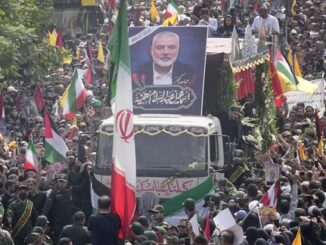
    TEHERAN (TIP): Iran held a funeral ceremony on August 1 with calls for revenge after the killing in Tehran of Hamas political chief Ismail Haniyeh in a strike blamed on Israel.

    Thousands of mourners paid respects to Haniyeh as the Israeli military confirmed that an air strike in Gaza last month killed the Hamas military chief, Mohammed Deif.

    Iran’s Supreme Leader Ayatollah Ali Khamenei led prayers for Haniyeh ahead of his burial in Qatar, having earlier threatened a “harsh punishment” for his killing.

    In Tehran’s city center, crowds, including women shrouded in black, carried posters of Haniyeh and Palestinian flags in a procession and ceremony that began at Tehran University.

    Iran’s Revolutionary Guards announced the day before that Haniyeh and a bodyguard were killed in a pre-dawn strike on Wednesday, July 31, on their accommodation in Tehran.

    It came just hours after Israel killed a top Hezbollah commander, Fuad Shukr, in a retaliatory strike in the south of Lebanon’s capital Beirut, raising fears of a wider regional conflict as the Israel-Hamas war in Gaza continues.

    Senior Iranian officials including President Masoud Pezeshkian and the Islamic Revolutionary Guard Corps chief, General Hossein Salami, attended the ceremony for Haniyeh, state TV showed. Qatar-based Haniyeh had been visiting Tehran for Mr. Pezeshkian’s inauguration ceremony on Tuesday. Khalil al-Hayya, Hamas’s foreign relations chief, vowed during the funeral ceremony that Haniyeh’s message will live on and “we will pursue Israel until it is uprooted from the land of Palestine”.

    Mr. Pezeshkian later told Mr. Hayya that Iran “will continue to support with firmer determination on the Axis of Resistance”, Iran-aligned regional groups that include Hamas, the official IRNA news agency said.

    Iran’s parliamentary speaker Mohammad Bagher Ghalibaf said, “It is our duty to respond at the right time and in the right place.” UN Secretary-General Antonio Guterres said the strikes in Tehran and Beirut represented a “dangerous escalation”.

    All efforts, he said, should be “leading to a ceasefire” in Gaza and the release of hostages taken during Hamas’s October 7 attack on southern Israel.

    US Secretary of State Antony Blinken also said Wednesday, March 31, that a ceasefire in Gaza was still the “imperative”, with White House National Security Council spokesman John Kirby later adding that the twin killings “don’t help” regional tensions.

    The killings come with regional tensions already inflamed by the war in Gaza, a conflict that has drawn in Iran-backed militant groups in Syria, Lebanon, Iraq and Yemen.

    One of those groups, Yemen’s Huthi rebels, “declared three days of mourning” for Haniyeh, with political leader Mahdi al-Mashat expressing “condolences to the Palestinian people and Hamas” over his killing, according to the group’s Saba news agency.

    Saudi Foreign Minister Prince Faisal bin Farhan, meanwhile, spoke by phone after the attack with his acting Iranian counterpart Ali Bagheri to discuss “the latest developments in the region”.

    The UN Security Council also convened an emergency meeting Wednesday, March 31 at Iran’s request to discuss the strike, with Tehran’s envoy Amir Saeid Iravani urging members to take “immediate action to ensure accountability for these violations of international law”.

    Hamas has for months been indirectly negotiating a truce and hostage-prisoner exchange deal with Israel, with Egypt, Qatar and the United States facilitating the talks.

    Analysts told AFP that Haniyeh was a moderating influence within the Islamist group, and that while he would be replaced, the dynamics within Hamas could change.

    Israeli Prime Minister Benjamin Netanyahu has vowed to destroy Hamas in retaliation for the October 7 attack that ignited war in Gaza.

    That attack resulted in the deaths of 1,197 people, mostly civilians, according to an AFP tally based on official Israeli figures.

    Militants also seized 251 hostages, 111 of whom are still held captive in Gaza, including 39 the military says are dead.

    Israel’s retaliatory campaign against Hamas has killed at least 39,445 people in Gaza, according to the Hamas-run territory’s health ministry.

    The prime minister of key ceasefire broker Qatar said Haniyeh’s killing had thrown the whole mediation process into doubt. “How can mediation succeed when one party assassinates the negotiator on the other side?” Sheikh Mohammed bin Abdulrahman Al-Thani said in a post on social media site X.
    (Source: AFP)

  • Ukraine War, Chinese Protest, Imran Khan’s Ouster; top global Events in 2022

    The year 2022 has been a tumultuous one, with many uprisings, new faces coming to prominence and dictators losing hold of power. It has been a year of economic shockers, from the West to the East. Needless to say, it has been a year of clashes and of new alliances.

    This year saw a significant rise of leaders like Ukraine President Zelensky, French President Macron and Chinese leader Xi Jinping. On the other hand, prominent international leaders, considered to have clout, including former US President Trump and Brazilian President Bolsonaro lost their power.

    There were several prominent events which shaped 2022 in their own ways. To name a few, the Ukraine War, Sri Lankan Economic crisis and the unprecedented protests in China defined the year in their unusual ways.

    UKRAINE WAR

    The Russian invasion of Ukraine, which began earlier this year in February, has entered its 300th day this month, proving to be a tough challenge for both Russia and Ukraine. Russian President Vladimir Putin, who began a blitzkrieg assault on Kyiv taking over the eastern and southern part of the country, is now facing challenge to keep the war going amid reports of ailing health and internal strife.

    So far, over 100,000 Russian and 100,000 Ukrainian soldiers have been killed or injured in the war in Ukraine. For the Ukrainians, this winter is going to be tough with Russian attacks on Ukrainian power plans and consecutive Russian missile attacks. However, the war has shaped the hero out of Ukraine’s President Zelensky, who not only stood against the Russian aggression, but also managed to forge a western unity.

    SRI LANKAN CRISIS

    The Sri Lanka protests which started in April had led to the ouster of President Gotabaya Rajapaksa and two-time President and former Prime Minister Mahinda Rajapaksa. The Sri Lankan crisis, which started as a protest in Colombo, spread across the country with the people demanding reforms in the government.

    Ranil Wickremesinghe was elected President through a parliamentary vote, in which the Rajapaksas’ party backed him in July. The government blamed the Covid pandemic, which badly affected Sri Lanka’s tourist trade, and later led to a shortage of fuel and foreign dollars. However, many experts blame President Rajapaksa’s poor economic mismanagement.

    The country continues to remain under crisis with Colombo anticipating the IMF loan to secure the country’s economy.

    OUSTER OF IMRAN KHAN

    Former Pakistan Prime Minister Imran Khan, who came to power in 2018, is the only Pakistani Prime Minister to be ousted in a no-confidence vote in Parliament earlier this year.

    Khan was ousted from power in April after losing a no-confidence vote in his leadership, which he alleged was part of a US-led conspiracy targeting him because of his independent foreign policy decisions on Russia, China, and Afghanistan.

    Since he lost the vote in Parliament, Khan has mobilized mass rallies across the country, whipping up crowds with claims that he was a victim of a conspiracy by his successor, Prime Minister Shahbaz Sharif, and the United States.

    IRAN PROTESTS

    Iran has been rattled by protests over opposition to the mandatory hijab law as thousands of common citizens have taken to the streets.

    Iran has been rocked by protests since September 16, with the death of 22-year-old Mahsa Amini, who died after being detained by the morality police. The protests have since morphed into one of the most serious challenges to Iran’s theocracy installed by the 1979 Islamic Revolution.

    So far, the country’s police have arrested renowned actresses, footballers, actors and influencers for supporting the protests. It has also executed two protestors for participation in the protests.

    RARE PROTEST IN CHINA

    China saw two major developments this year- Xi Jinping becoming President for the third time and rare protests weeks after against tough anti-Covid restrictions.

    In November, thousands of people took to the streets in several major cities across China, including Beijing and Shanghai, to call for an end to lockdowns and greater political freedoms, in a wave of protests not seen since pro-democracy rallies in 1989 were crushed.

    Despite heavy crackdown, surveillance and censorship, the protests expanded into calls for broader political freedom and left a major negative impact on the reputation of Xi and the Party.

    US MIDTERM ELECTIONS

    The midterm elections in the US, which is usually seen as a mandate against the ruling government, failed to make a Republican sweep as the Democrats gained razor-thin control of the Senate, while the Republicans got a narrow margin against the dems in the House of Representatives.

    However, the misterms was special in the sense that it rained down on the ambitions of former President Donald Trump, who was looking forward to run for the second term, his “Make America Great Again” movement and the broader Republican agenda.

    A silver lining which came out of the midterm elections for the Republicans has been the victory of Florida Governor Ron DeSantis. DeSantis is seen as the possible challenger to Trump and a possible source of revival for the GOP.

    Surging inflation, ongoing strikes, economic crisis and war in Europe: the new UK Prime Minister Rishi Sunak faces these major challenges. Sunak came to Power after his predecessor Truss resigned after just 44 days in power.

    After 12 years in power, the Conservative party is more divided than ever. Earlier this year, Boris Johnson had resigned as PM in July after losing the confidence of some 60 ministers.

    Sunak has become the fifth Tory prime minister since 2016 — following David Cameron, Theresa May, Johnson and Truss. The challenges continue to mount for Sunak, who hopes to get his country out of the economic and political mess.

    BOLSONARO’S EXIT

    Brazilian President Jair Bolsonaro, lost election in October in a nail-biting presidential vote count against Luiz Inacio Lula da Silva.

    Almost from the start of his controversial mandate in 2019, Bolsonaro racked up accusations and investigations for everything from spreading disinformation to crimes against humanity. He survived more than 150 impeachment bids — a record.

    Most of these were over his flawed management of the coronavirus pandemic, which claimed the lives of more than 685,000 people in Brazil — the world’s second-highest toll after the United States.

    On January 1, 2023, Bolsonaro’s arch-rival, leftist ex-president Luiz Inacio Lula da Silva will take over the reins once more and Bolsonaro loses his presidential immunity.

    COP27 SUMMIT

    The UN COP27 climate summit in Egypt had some success and some failures. While the summit achieved a landmark deal on funding to help vulnerable countries cope with devastating climate impacts, the talks stalled on key issues and failed to secure commitments to stop greenhouse gas emissions.

    Though the participating nations agreed to contribute to the cost of the harm an overheated planet causes to developing nations, but they concluded the talks without doing anything more to address the burning of fossil fuels, which is the primary cause of these catastrophes.

  • HRWFF RETURNS WITH 33RD EDITION

    By Mabel Pais

    The Human Rights Watch Film Festival (HRWFF), now in its 33rd year, will present a hybrid full edition of 10 groundbreaking new films, available both in-person and online nationwide in the U.S., from May 20 to 26, 2022.

    For the first time in two years, the New York festival will be back with a full program of in-person screenings at Film at Lincoln Center and IFC Center, with in-depth discussions with filmmakers, film participants, activists and Human Rights Watch researchers. The festival will continue to offer the opportunity to watch all 10 new films online across the U.S. with a full digital edition of the film festival.

    This year’s edition highlights activism and features courageous individuals around the world standing up to powerful forces and demanding change. John Biaggi, Director of the Human Rights Watch Film Festival, said, “We are thrilled to be back in theaters after two years away, bringing our audience a full slate of powerful films tackling urgent human rights issues including China, Russia, the climate crisis and reproductive rights.” Lesli Klainberg, President of Film at Lincoln Center said, “History has shown that film not only empowers understanding, but also ignites urgent public dialogues about how to help the most vulnerable.” John Vanco, Senior Vice President and General Manager at IFC Center said, “IFC Center is proud to continue our partnership with the Human Rights Watch Film Festival and support their mission to use cinema to shine a light on important issues.”

    FILM LINEUP

    REBELLION – OPENING NIGHT

    U.S. Premiere

    Dirs: Maia Kenworthy & Elena Sanchez Bellot l 2021 l UK, Poland l Eng l Doc l 1h 22m

    Opening Film (Photo / www.ff.hrw.org, 2022.)

    “Rebellion” brings viewers behind-the-scenes with Extinction Rebellion (XR), as the group confronts the climate emergency – reminding the world there is no time to wait. Emerging as action on climate change dangerously slipped from the political agenda, XR took bold steps to break through the deadlock: mass civil disobedience. It worked. “Rebellion” reminds viewers to question white Western environmentalism and push back against a fight that ignores structural racism and oppression.

    In-person screening:

    Friday, May 20, 7:00pm, Film at Lincoln Center, Walter Reade Theater

    THE JANES – CLOSING NIGHT

    Dirs: Tia Lessin & Emma Pildes l 2022 l USA l Eng l Doc l 1h 41m

    Grand Jury Prize Documentary Nominee, Sundance Festival, 2022

    Closing Film. (Photo / www.ff.hrw.org, 2022.)

    Seven women were part of a clandestine network that built an underground service for women seeking safe, affordable abortions in the pre-Roe v. Wade era. They called themselves “The Janes.” This galvanizing documentary tells the story of the past and, potentially, the future.

    In-person screening:

    Thursday, May 26, 7:00pm, IFC Center

    CLARISSA’S BATTLE         

    World Premiere

    Dir: Tamara Perkins l 2022 l USA l Eng l Doc l 1h 30m

    Single mother and organizer Clarissa Doutherd is building a powerful coalition of parents fighting for childcare and early education funds, from her own experience of losing childcare and becoming unhoused, desperately needed by low-and middle-income parents and children across the United States. “Clarissa’s Battle” offers an insight into an erupting movement, as communities across the country follow Clarissa’s successes, setbacks and indomitable resilience.

    In-person screenings:

    Saturday, May 21, 8:00pm, Film at Lincoln Center, Elinor Bunin Munroe Film Center

    Sunday, May 22, 5:15pm, Film at Lincoln Center, Elinor Bunin Munroe Film Center

    DELIKADO          

    New York Premiere

    Dir: Karl Malakunas l 2022 l Philippines, Hong Kong, Australia, USA, UK l Eng, Filipino l Doc l 1h 34m

    Official Selection, Hot Docs 2022

    A small network of environmental crusaders, Bobby, Tata and Nieves – a charismatic lawyer, a former illegal logger and a fearless politician – are three magnetic leaders fighting to stop corporations and governments seeking to plunder increasingly valuable natural resources in Palawan in the Philippines.

    In-person screenings:

    Sunday, May 22, 8:00pm, Film at Lincoln Center, Elinor Bunin Munroe Film Center

    Tuesday, May 24, 9:00pm, IFC Center

    ETERNAL SPRING     

    U.S. Premiere

    Dir: Jason Loftus l 2022 l Canada l Eng, Mandarin Chinese l Doc l 1h 26m

    In March 2002, members of the outlawed spiritual group Falun Gong hijacked a state TV station in China. Their goal was to counter the government narrative about their practice. In the aftermath, police raids sweep Changchun City, and comic book illustrator, Daxiong (Justice League, Star Wars), a Falun Gong practitioner, is forced to flee.

    In-person screenings:

    Monday, May 23, 6:15pm, Film at Lincoln Center, Elinor Bunin Munroe Film Center

    Tuesday, May 24, 6:30pm, IFC Center

    MIDWIVES     

    New York Premiere

    Dir: Snow Hnin Ei Hlaing l 2022 l Myanmar, Germany, Canada l Rohingya, Rakhine, Burmese l Doc l 1h 31m

    Winner, World Cinema Documentary Special Jury Award: Excellence in Verité Filmmaking, Sundance 2022

    Hla is a Buddhist and the owner of an under-resourced medical clinic in western Myanmar, where the Rohingya (a Muslim minority community) are persecuted and denied basic rights. Nyo is a Rohingya and an apprentice midwife who acts as assistant and translator at the clinic. Risking her own safety daily by helping Muslim patients, she is determined to become a steady healthcare provider and resource for the families who desperately need her.

    In-person screenings:

    Saturday, May 21, 5:15pm, Film at Lincoln Center, Elinor Bunin Munroe Film Center

    Monday, May 23, 6:30pm, IFC Center

    THE NEW GREATNESS CASE

    World Premiere

    Dir: Anna Shishova l 2022 l Finland, Croatia, Norway l Russian l Doc l 1h 32m

    In “The New Greatness Case” with hidden camera footage, and an intimate relationship with the protagonists, the director, Anna Shishova, shows the complete repression of present-day Russia, and how young, free-thinking people are seen as a threat to the government.

    In-person screenings:

    Tuesday, May 24, 9:00pm, Film at Lincoln Center, Elinor Bunin Munroe Film Center

    Wednesday, May 25, 6:30pm, IFC Center

    NO U-TURN

    New York Premiere

    Dir: Ike Nnaebue l 2022 l France, Nigeria, South Africa, Germany l Eng, Igbo, French, Nigerian Pidgin l Doc l 1h 34m

    Special Mention, Documentary Award, Berlinale 2022

    In his first documentary, “No U-Turn,” Nigerian director Ike Nnaebue retraces the life-changing journey he made over 20 years ago. Overlaid with a powerful poetic commentary, this self-reflective travelog hints at the deep longing of an entire generation for a better life.

    In-person screenings:

    Tuesday, May 24, 6:15pm, Film at Lincoln Center, Elinor Bunin Munroe Film Center

    Wednesday, May 25, 9:00pm, IFC Center

    UP TO G-CUP

    World Premiere

    Dir: Jacqueline van Vugt l 2022 l Netherlands l Kurdish, Arabic l Doc l 1h 20m

    Northern Iraq’s first lingerie store not only sells underwear, but also acts as a meeting place where women connect to their bodies and sensuality after overcoming the traumas of oppression, war, and conservative morality. Director Jacqueline van Vugt captures intimate stories about love, sex, shame, and war.

    In-person screenings:

    Monday, May 23, 9:00pm, IFC Center

    Wednesday, May 25, 9:00pm, Film at Lincoln Center, Elinor Bunin Munroe Film Center

    YOU RESEMBLE ME

    New York Premiere

    Dir: Dina Amer l 2021 l  France,Egypt,USA l Arabic, French l Drama l 1h 31m

    Who was Hasna Aït Boulahcen? After the November 2015 Paris bombings, she was labelled “Europe’s first female suicide bomber.” Director Dina Amer, in this nuanced drama shows what happens when society fails to protect a child, and how discrimination, poverty, and abuse facing young people can allow radicalization to plant roots and grow, with devastating impact on the wider community.

    Digital Screenings:

    DIGITAL SCREENINGS for each film are available to watch at your own pace, any time between May 20-26, 2022 on the festival’s digital streaming platform.

    TICKETS

    TICKETS can be purchased at the IFC Center, Film at Lincoln Center and Human Rights Watch. In-Theater tickets are available online or at the Film at Lincoln Center (FLC) and the IFC box offices. For individual film tickets or a Festival Pass at a discounted price, visit ff.hrw.org/newyork, filmlinc.org or ifccenter.com. The entire Festival can be rented on the festival streaming site May 20, 9 a.m. EDT until May 26, 11:59 PST. For more information and accessibility options for each digital presentation, visit ff.hrw.org.

    HUMAN RIGHTS WATCH FILM FESTIVAL

    For Details and Program updates, visit ff.hrw.org. For more information and accessibility options for each digital presentation, visit ff.hrw.org.

    FESTIVAL IN-PERSON SAFETY PROTOCOLS

    For Festival disclaimers, and other Safety Protocols, visit ff.hrw.org

    (Mabel Pais writes on Social Issues, The Arts and Entertainment, Cuisine, Health & Wellness and Spirituality)

  • “The UN: if it doesn’t exist, we would have to invent it”

    “The UN: if it doesn’t exist, we would have to invent it”

    By George Abraham

    Here is a special article on the occasion of the diamond jubilee of the United Nations. The United Nations officially came into existence on 24th October 1945 when the Charter was ratified by China, France, the Soviet Union, the United Kingdom, the United States of America , and a majority of other signatories.

    George Abraham who has had a long association with the United Nations underscores the relevance of the world body  in the past, in the present, and in the future. -EDITOR

    Today, thousands of Indian citizens are employed by the United Nations around the world. The Asian Headquarters for the World Health Organization is located in New Delhi. UNICEF is highly active in India, helping Children in responding to emergencies and providing them essentials to survive. India’s own contribution to the regular budget assessment is less than half of what the Netherlands pays. Therefore, all the casual talk about getting out of the UN from certain circles are not only ludicrous but a disservice to the people of India.

    Peace, dignity and equality on a healthy planet.
    The San Francisco Conference: Egypt signs the UN Charter. A facsimile copy of the Charter is superimposed on the photo. The Charter of the United Nations was signed on 26 June 1945, in San Francisco, at the conclusion of the United Nations Conference on International Organization, and came into force on 24 October 1945. Preamble to the UN Charter was read out by Sir Lawrence Olivier. Photo / Courtesy UN

    “The International Community must ask if the UN is still relevant 75 years after its founding”, said Prime Minister Narendra Modi addressing the General Assembly in a virtual conference in its 75th session. He demanded that a UN reform is the need of the hour and questioned whether the Organization has been effective in tackling Covid-19. Some commentators even went further to say that India should get out of the UN, and it no longer serves any purpose. Sir Brian Urquhart, a former Under-Secretary-General of the United Nations with special responsibility for peacekeeping operations, once quoted as saying, “to be called irrelevant is, I suppose, the most biting insult you can possibly give to anything, a person or an institution, and it’s been used quite a bit about the UN. But it is still here. And for better or worse, I think that its demise is somewhat unlikely, certainly in the near future”.

    It again shows the United Nations’ predicament, where it is a challenging job to get everybody to agree on any single issue. If we look back at history, the United Nations was founded in 1945 to save the succeeding generations from the scourge of another war just as the world was emerging out of World war II. It is also important to remember that the UN Charter and the UN’s whole concept was the brainchild of Franklin D. Roosevelt. The assumption then was that the Allies who were on the way to victory then would continue to observe the peace and, if necessary, enforce it.

    The World war has led to the cold war between the United States and the Soviet Union, resulting in proxies fighting all over the globe. However, the United Nations may still take consolation because it has succeeded in thwarting a large-scale war between nuclear-armed superpowers. Moreover, in the Cold war era, peacekeeping became a strategic tool in the UN’s hands in containing regional conflicts in places like the Middle East, Kashmir, Cyprus, Congo, Sudan, and so forth.

    The critics are often eager to paint a negative view of the UN primarily because of its failures on the political front. However, if one closely examines the structure of the Security Council, the most important organ of the United Nations, it still reflects the status quo in the immediate aftermath of World War II.  It is almost as if it was built to fail. All permanent members of the Security Council have one time, or another misused their right to veto in preventing a potential solution to a crisis and often leaving the UN remain largely paralyzed with expanding rifts and mounting tensions. Although the challenge is to shake up the Council’s structure, most governments continue to pay lip service to the need for reform, and the public seems to direct their fire and fury at the Organization.

    There is great merit to the argument that Security Council is woefully ill-prepared to deal with the contemporary challenges, and the chamber should accommodate countries like India, Germany, Japan, and Brazil with or without veto powers. However, it is a tall order that would require two-thirds of the votes in the General Assembly and the endorsement of all five permanent members. The growing ideological division among council members in dealing with sanction regimes or protracted regional conflicts may not give any ray of hope that the status-quo may change anytime soon. Nevertheless, it provides an excellent forum for the global community to air their grievances and let off steam.

    Apart from the political front, the United Nations and its Specialized Agencies have done a phenomenal job, especially in the Social and Economic arena. Having worked for the Organization on two different continents, I have had the opportunity to view the UN activities from a front-row seat. UN personnel have been directly involved as advisors and technical experts in many projects in many developing countries, especially in Africa. I have witnessed some of those valuable contributions from dedicated civil servants around the world, often under very trying conditions, working with the local officials, whether in the areas of food security, land use planning, deforestation, water, sanitation, or preventive medicine.  Of course, these efforts may not make headlines anywhere but have made an incredible difference in the daily lives of those ordinary folks who live in some of the remotest parts of the world.

    India played a seminal role in the early history of the United Nations. Although not part of the Security Council, India focused its attention on the General Assembly and worked with the newly independent nations in Asia and Africa on decolonization and socio-economic development. India may have a lot to do with the Organization’s evolution from a security-driven one to a developmental and promotional body.

    India was also one of the leaders that led the campaign against Apartheid resulting in the General Assembly adopting a resolution against racial discrimination in South Africa. Sanctions were also imposed on South Africa and Rhodesia (now, Zimbabwe) as part of the continuing opposition to Apartheid, and India played a significant role in that effort. India was also at the forefront in advocating reforms for the global economic order and was instrumental in setting up the UNCTAD to provide developmental assistance to developing countries.

    India is a major contributor to the UN’s peacekeeping efforts across the globe. As per the 2019 data, it has provided about 240,000 personnel in 49 of the 71 peacekeeping operations. Currently, Indian Military personnel is participating in 9 out of 14 peacekeeping missions. More than 160 Indian peacekeepers have paid the ultimate price in service to peace, losing lives serving under the UN flag.

    UN  is also known for its work on behalf of democracy and human rights.  With so much pride, India can remember that it has contributed significantly to the Universal Declaration of Human Rights content. Indian leadership – represented by Indian National Congress – articulated its concern for human rights and called upon the world body to learn from the coalescing of ideas and vision learned from India’s freedom struggle and urged for peoples’ self-determination everywhere.

    India truly deserves to be in the Security Council, given the demographics and its rising economic might. However, it is worth remembering that India has influenced and changed the UN’s trajectory from a security organ to a developmental body and has been a trailblazer for emerging nations towards a path forward in freedom and self-sufficiency. It was all done without having a seat at the Security Council.

    Today, thousands of Indian citizens are employed by the United Nations around the world. The Asian Headquarters for the World Health Organization is located in New Delhi. UNICEF is highly active in India, helping Children in responding to emergencies and providing them essentials to survive. India’s own contribution to the regular budget assessment is less than half of what the Netherlands pays. Therefore, all the casual talk about getting out of the UN from certain circles are not only ludicrous but a disservice to the people of India. “The UN: if it doesn’t exist, we would have to invent it.”

     (The author is a former Chief Technology Officer of the United Nations)

  • A Young Student’s Perception of Mesopotamian and Egyptian Civilizations

    A Young Student’s Perception of Mesopotamian and Egyptian Civilizations

    By Chitagam Saluja

    Egypt was a more stable civilization compared to Mesopotamia and also fuller of life and fun. Economically perhaps Mesopotamia flourished more than Egypt, and in art and culture Egypt edged over Mesopotamia”, says the young scholar.

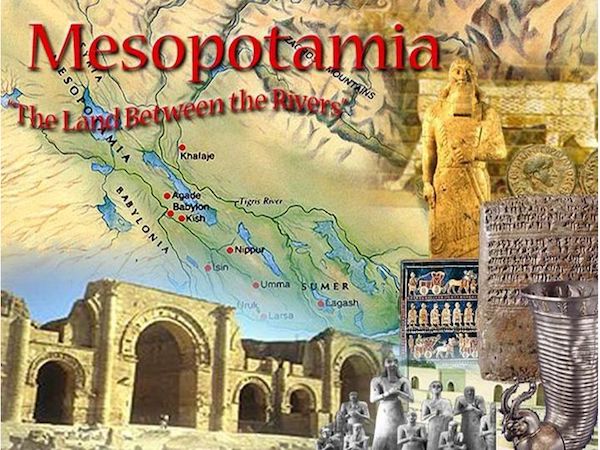
    Mesopotamian and Egyptian Civilizations of Middle East and North Africa were closely interlinked and influenced by each other. In more ways than one these civilizations grew up in contrast of each other.

    The structure of Government of Egypt was central and authoritative and Mesopotamian stressed mostly on city state layout. The difference in architecture was huge. Where the Egyptians liked majestic structures, the Mesopotamian art was simple and had a strong literary element which Egypt lacked.

    The bureaucracy was endlessly affected by the structures.  Mesopotamians were more practical in their thinking and did not believe in the Egyptian preparation for afterlife.

    Both these civilizations carried out extensive trading, but the economic implication varied in most cases. Mesopotamia was more technological in its approach and the environment was very difficult to manage than the Nile valley. The contacts of trade were a lot vaster and far flung and special importance was given to the merchant class and commercial law.

    The social differences were also huge. Like the difference in social status of women in the two contrary civilizations. It is concluded that in Egyptian society women were given more importance as well. To stabilize the Egyptian monarchy women of the upper class were important and were treated with much care and respect which wasn’t the case in Mesopotamian.

    Since these civilizations grew up in similar environments they had a symbiotic relationship. Their origins are largely different; so is their way of working.

    Egypt- The prosperity of the ancient civilization came partly from the ability to adapt to the condition of the Nile valley

    Egypt was a more stable civilization compared to Mesopotamia and also fuller of life and fun.
    Economically perhaps Mesopotamia flourished more than Egypt, and in art and culture Egypt edged over Mesopotamia.

    (The author is an undergraduate student at Nassau County Community College in New York. He can be reached at agysaluja1@gmail.com)

     The Indian Panorama invites young students to contribute their articles. They may write on any subject under the Sun. Articles may please be submitted to editor@theindianpanorama.com


  • Saudi Arabia chief foreign promoter of Islamist extremism in UK: Report

    Saudi Arabia chief foreign promoter of Islamist extremism in UK: Report

    LONDON (TIP): Oil-rich Saudi Arabia is the chief foreign promoter of Islamist extremism in the UK, a new report has claimed, asserting that a “clear and growing link” can be drawn between overseas money and the recent wave of attacks in Britain and Europe.

    The Henry Jackson Society, a foreign affairs think-tank, called for a public inquiry into the role of Saudi Arabia and other Gulf nations, BBC reported.

    The think-tank said there was a “clear and growing link” between Islamist organisations in receipt of overseas funds, hate preachers and Jihadist groups promoting violence.

    However, the UK’s Saudi Arabian embassy says the claims are “categorically false”. Ministers are under pressure to publish a report on UK- based Islamist groups.

    The Home Office report into the existence and influence of Jihadist organisations, commissioned by former Prime Minister David Cameron in 2015, has reportedly yet to be completed amid questions as to whether it will ever be published.

    Critics have suggested it could make uncomfortable reading for the government, which has close and longstanding diplomatic, security and economic links with the Gulf, particularly Saudi Arabia.

    Today’s report says a number of Gulf nations, as well as Iran, are providing financial support to mosques and Islamic educational institutions which have played host to extremist preachers and been linked to the spread of extremist material.

    At the top of the list, the report claims, is Saudi Arabia. It alleges individuals and foundations have been heavily involved in exporting what it calls “an illiberal, bigoted Wahhabi ideology”, quoting a number of examples.

    In a minority of cases, the report alleges institutions in the UK that receive Saudi funding are run directly from Saudi Arabia, although in most instances the money appears to “simply buy foreign donors’ influence”.

    In a statement, the Saudi embassy here said any accusations that the Kingdom had radicalised “a small number of individuals are baseless and lack credible evidence”.

    And it pointed out that the country has itself been subject to numerous attacks by al-Qaeda and so-called Islamic State.

    It added: “We do not and will not condone the actions or ideology of violent extremism and we will not rest until these deviants and their organisations are destroyed.”

    The report’s release comes at a time when Saudi Arabia, the UAE, Bahrain and Egypt are all accusing Qatar of supporting extremism – a charge the report says is hypocritical. Arab foreign ministers are meeting in Cairo to discuss possible further sanctions on Qatar, while the Qatari foreign minister will be making his own country’s case at a press conference in London.

    Endorsing the report, Labour MP Dan Jarvis said it shed light on “very worrying” links between Saudi Arabia and the funding of extremism and he called for the government to release its report on foreign funding. (PTI)

  • Former Egyptian President Hosni Mubarak to be released

    Former Egyptian President Hosni Mubarak to be released

    CAIRO (TIP): Hosni Mubarak, who was overthrown as president of Egypt in an uprising in 2011, will be released from detention in a military hospital, the public prosecutor ruled on March 14, his lawyers and judicial sources said.

    “He will go to his home in Heliopolis,” Mubarak’s lawyer Farid El Deeb said, adding the ageing former president would likely be released Tuesday or soon after.

    Mubarak was cleared of murder charges this month in his final trial, having faced various charges ranging from corruption to ordering the killing of protesters who ended his 30-year-rule.

    He had one more jail sentence to serve but was cleared after serving time for the murder charges, judicial sources and the state news agency said.

    The prosecution subtracted the time served in the murder case from the time he was meant to serve for a separate case in which he was found guilty of appropriating funds reserved for maintaining presidential palaces.

    Mubarak was originally sentenced to life in prison in 2012 for conspiring to murder 239 demonstrators during the 18-day revolt – an uprising that sowed chaos and created a security vacuum but also inspired hope for democracy and social justice.

    An appeals court ordered a retrial that culminated in 2014 in the case against Mubarak and his senior officials being dropped. An appeal by the public prosecution led to a final retrial by the Court of Cassation, the highest in the country, which acquitted him on March 2. (Reuters)

  • Dabur takes a small step in southern Africa

    Dabur takes a small step in southern Africa

    NEW DELHI (TIP): An acquisition worth a mere Rs 4,700 is rarely expected to give rich dividends, especially if it means venturing into a market as big as Rs 30,000 crore. However, home-grown fast-moving consumer goods firm Dabur is trying something similar.

    The company recently acquired a newly incorporated company in South Africa and is planning to set up a manufacturing unit in that country. The move would help it expand its presence in the southern parts of the African continent, sources said.

    Dabur India on Monday informed the BSE that it acquired Discaria Trading, registered in South Africa, for Rs 4,679 (1,000 South African Rand). Dabur’s wholly-owned subsidiary Dabur International acquired 100 per cent of Discaria, it informed the BSE.
    “Discaria Trading (Pvt.) Ltd. has been acquired to do the business of manufacturing and trading of cosmetics products in South Africa,” it said.

    Currently, Dabur has two manufacturing plants in the continent— one each in Nigeria and Egypt. The acquisition cost of the company, incorporated on March 30, 2015 to trade and manufacture cosmetic products, is lower than any such recent acquisition by Dabur. The real value of the company lays in its potential to become a gateway for Dabur in the crucial southern African markets.

    Earlier, Dabur made its first foreign acquisition by buying Hobi Kozmetik Group, a leading personal care products company in Turkey, for $69 Million (Rs 462 crore). In 2010, it also acquired Namaste Laboratories in the US for
    $100 million (Rs 670 crore).

    However, Dabur’s recent acquisition was aimed at setting up production units in South Africa, sources said. Dabur is also considering expanding its presence with its international personal care brand Namaste.

    The cosmetics markets in the southern parts of Africa – South Africa, Zimbabwe, Namibia and Mozambique – is estimated in excess of Rs 30,000 crore and is growing in double digits. Dabur currently gets a third of its Rs 8,454-crore revenue from foreign markets.

  • WHY WOMEN LIVE LONGER THAN MEN

    WHY WOMEN LIVE LONGER THAN MEN

    It’s queer but true – women have a longer lifespan compared to men.

    Researchers Steven Austad and Kathleen Fischer of the University of Alabama explored this riddle in their latest perspective piece.

    “Humans are the only species in which one sex is known to have a ubiquitous survival advantage,” the researchers write in their review covering a multitude of species.

    “Indeed, the sex difference in longevity may be one of the most robust features of human biology,” they added.

    Though other species, from roundworms and fruit flies to a spectrum of mammals, show lifespan differences that may favour one sex in certain studies, contradictory studies with different diets, mating patterns or environmental conditions often flip that advantage to the other sex.

    With humans, however, it appears to be all females all the time.

    “We don’t know why women live longer. It’s amazing that it hasn’t become a stronger focus of research in human biology,” said Austad.

    One of the evidences of the longer lifespan for women includes ‘The Human Mortality Database,’ which has complete lifespan tables for men and women from 38 countries that go back as far as 1751 for Sweden and 1816 for France.

    Again, longer female survival expectancy is seen across the lifespan, at early life (birth to 5 years old) and at age 50. It is also seen at the end of life, where Gerontology Research Group data for the oldest of the old show that women make up 90 percent of the super centenarians, those who live to 110 years of age or longer.

    Longevity may relate to immune system differences, responses to oxidative stress, mitochondrial fitness or even the fact that men have one X chromosome (and one Y), while women have two X chromosomes.

    But the female advantage has a thorn.

    “One of the most puzzling aspects of human sex difference biology,” write Austad and Fischer, “something that has no known equivalent in other species, is that for all their robustness relative to men in terms of survival, women on average appear to be in poorer health than men through adult life.”

    This higher prevalence of physical limitations in later life is seen not only in Western societies, they say, but also for women in Bangladesh, China, Egypt, Guatemala, India, Indonesia, Jamaica, Malaysia, Mexico, the Philippines, Thailand and Tunisia. But this is just one of several plausible hypotheses for the mystery of why women live longer, on aver age, than men.

  • King Tut’s dagger made from meteorite, say researchers

    King Tut’s dagger made from meteorite, say researchers

    CAIRO (TIP): The iron blade of an ornate dagger buried in Egypt with King Tutankhamen probably came from a fallen meteorite, researchers have determined — a form of metal so prized by ancient Egyptians that they called it “iron from the sky.”

    The dagger, which was discovered in the folds of the wrapping around the mummified boy king, has long intrigued historians and archaeologists for its great beauty — it has a gold and crystal handle, and an ornate sheath— and because ironwork was rare in ancient Egypt.

    Using X-ray fluorescence spectrometry, Italian and Egyptian experts found that the blade’s composition of iron, nickel and cobalt was an approximate match for a meteorite that landed in northern Egypt. The result “strongly suggests an extraterrestrial origin” for the blade, according to their results published this week in the journal Meteoritics and Planetary Science.

    The finding could add to secrets unlocked from an ancient tomb that is still a source of global fascination almost a century after its discovery by the English archaeologist Howard Carter in 1922. The dagger was found in 1925.

    Earlier studies, in the 1970s and 1990s, examined whether the blade came from a meteorite but they were inconclusive or disputed. Newer technology allowed the Italian and Egyptian team, led by experts from Polytechnic University of Milan, the University of Pisa in Italy and the Egyptian Museum in Cairo, to perform new tests that, they say, appear to settle the matter.

    Comparing the composition of the dagger with meteorites that landed within a radius of 1,250 miles, they found a close similarity with one that hit the seaport city of Marsa Matruh, 140 miles west of Alexandria, on the Mediterranean coast. That finding may help explain why, from the 13th century B.C., Egyptians started using a hieroglyph that translates as “iron from the sky,” the paper said.

    “The ancient Egyptians, in the wake of other ancient people of the Mediterranean area, were aware that these rare chunks of iron fell from the sky,” it said.

    The intense attention paid by experts to Tutankhamen’s tomb has not always been matched by staff members at the rundown Egyptian Museum. In January the government said eight people at the state-run museum were being disciplined for their role in a botched repair job that caused minor but lasting damage to King Tut’s golden burial mask. The repair job was an attempt to correct the damage caused by workers who had accidentally knocked the beard from the 3,300-year-old artifact in August 2014 as they repaired a light fixture in its display case. Tutankhamen has recently become the focus of renewed interest after a British Egyptologist, Nicholas Reeves, promoted a tantalizing theory that behind the king’s burial chamber lies the long-sought tomb of Queen Nefertiti. Other archaeologists, however, strongly dispute that idea, and say nothing of any significance is concealed in the walls of the burial chamber.

  • EgyptAir plane crash | Terror attack likely

    EgyptAir plane crash | Terror attack likely

    CAIRO (TIP): A massive search was underway on Friday, May 20, for the wreckage of an EgyptAir plane en route from Paris to Cairo that crashed into the Mediterranean Sea with 66 people on board, with authorities saying the incident was likely a terror attack.

    The search for EgyptAir Flight 804 was ongoing after reports that the plane’s wreckage had been found turned out to be false, prompting Egyptian President Abdel Fattah al-Sisi to demand an “intensified search”. There were no signs of survivors after the Airbus A320 “swerved and then plunged” into the Mediterranean. The plane, on its fifth journey of the day, was travelling at 37,000 feet when it disappeared from radar. It had made a stop in Tunisia before flying to Paris.

    The Egyptian navy, air force and army are searching the sea to the north of Egypt’s coast, with French, Greek, British and US support. The plane made “sudden swerves” before dropping off radar over the Mediterranean, Greek defense minister Panos Kammenos said. It made a 90-degree turn left, and then dropped from 37,000 feet to 15,000 feet before swerving 360 degrees right.

    The plane was carrying 56 passengers and 10 crew: two cockpit crew, five cabin crew and three security personnel.

    EgyptAir said two babies and one child were on board. Among the passengers were 30 Egyptians, 15 French, two Iraqis, and one person each from the UK, Belgium, Kuwait, Saudi Arabia, Sudan, Chad, Portugal, Algeria and Canada.

    The airline said captain Mohamed Said Shoukair had 6,275 flying hours, including 2,101 on the A320; while the copilot, Mohamed Mamdouh Ahmed, had 2,766. The plane was manufactured in 2003. EgyptAir initially said that Egyptian Foreign Ministry has “confirmed finding the wreckage” but later withdrew the claim. EgyptAir’s vice-chairman Ahmed Adel told CNN that when searchers got close to debris found in the Mediterranean Sea they realized it did not come from the missing airliner. “We stand corrected on finding the wreckage because what we identified is not a part of our plane. So the search and rescue is still going on,” Adel said.

    He added that maintenance checks on the plane had been done on time and “no snags were reported”. In a statement issued by Sisi’s office, he also ordered an investigative committee formed by the civil aviation ministry to immediately start probing the causes of the plane’s disappearance. He ordered the civil aviation ministry, the army’s search and rescue center, the navy, and air force to take all necessary measures to locate debris from the jet.

    Egyptian Civil Aviation Minister Sharif Fathi said technical failures and terror each are possible explanations.

    “But if you analyses this situation properly, the possibility of having a different action aboard, of having a terror attack, is higher than having a technical problem,” Fathi said.

    French-Egyptian cooperation

    Three French investigators and a technical expert from Airbus arrived at Cairo International Airport early Friday morning to help investigate the fate of a missing EgyptAir plane that disappeared on Thursday, airport sources said.

    The French investigators are part of the French civil aviation ministry’s office of investigations and analysis, the sources said.

    France is participating in an Egypt-led investigative committee as it is the country where the plane was manufactured and the one with the second-most number of passengers on board.

    The incident brought back horrors of the bombing of a Russian passenger jet by the Islamic State over Egypt last October that killed all 224 people on board. (Source: Agencies)

  • EGYPTAIR HIJACKER REVEALS WHY HE TOOK OVER THE PLANE

    EGYPTAIR HIJACKER REVEALS WHY HE TOOK OVER THE PLANE

    CYPRUS (TIP)The man suspected of hijacking an EgyptAir flight and redirecting it to Cyprus has appeared in court and said he acted in a bid “to see his wife and children”.

    Seif Eldin Mustafa, 59, flashed “v” signs for victory as he left the court in Larnaca following a short hearing, where he was remanded in custody for eight days on suspicion of hijacking, abduction, threatening violence, terrorism-related offences and two counts related to possession of explosives.

    Police said the latter charges would relate to Mr Mustafa’s alleged claim that he had a bomb vest, even though Cypriot officials later said the “explosives” were in fact iPhone covers bound together with cloth.

    It has previously been reported that the hijacker made a range of demands after the plane from Alexandria landed at Larnaca airport with 72 passengers and crew on board.

    After a six-hour stand-off, the suspect identified by Egyptian and Cypriot authorities as Mr Mustafa walked off the plane and handed himself in to police.

    In a statement to Cypriot police, Mr Mustafa said: “When someone hasn’t seen his family for 24 years and wants to see his wife and children, and the Egyptian government doesn’t allow it, what should one do?”

    The suspect allegedly commandeered the aircraft 15 minutes after takeoff from Alexandria. He approached a flight attendant and showed off the belt, attached to a remote control he held in his hand, investigating officer Andreas Lambrianou told the court.

    “The suspect asked all passengers and crew to hand in their passports, then gave two messages to a member of the crew, asking that the pilot be informed that he was a hijacker and wanted to land at an airport in Turkey, Greece or Cyprus, but preferably Cyprus,” Lambrianou said. “In a note, he stressed that if the airplane landed on Egyptian territory he would immediately blow the plane up.”

    In Cyprus, Mustafa dropped an envelope on the runway addressed to a Cypriot woman, later ascertained to be his ex-wife. In the letter, the suspect demanded the release of 63 female prisoners held in Egypt.

  • Toddler gets life in prison for rioting in Egypt

    Toddler gets life in prison for rioting in Egypt

    Feb 23: In a surreal verdict, a military court last week found the boy, Ahmed Mansour Qorany Sharara, and 115 other people guilty of killing three people and sabotaging public and private property during a political demonstration in January 2014.

    Ahmed was 16 months old at the time of the alleged crime.

    The guilty verdict, handed down February 16, provoked an uproar after which The military released a statement the following day saying the person wanted in the case was a 16-year-old who had fled authorities, and who had the same name as Ahmed.

    Family members of a 3-year-old Egyptian boy say they feel relieved after receiving assurances from officials that neither the boy nor his father will be arrested.

    When the police first came to arrest Ahmed in early 2014 and realized he was a toddler, they took the boy’s father, Mansour Qorany Sharara, into custody instead. Sharara was detained for four months before a judge released him.

    Sharara has now returned to the family home in the southern Egyptian province of Fayyoum after nearly 18 months on the run. He had been avoiding authorities who had previously detained him when they came to arrest his young son.

  • THE RISE AND RISE OF ISIS

    THE RISE AND RISE OF ISIS

    ISIS ushered in 2015 with the terrifyingly typical displays of brutality which initially put the group in the international community’s crosshairs. They beheaded Japanese hostages, burned a Jordanian pilot alive in a cage and announced the death of American captive Kayla Mueller.

    The Sunni militants seized Ramadi in May and later the ancient city of Palmyra.

    David Phillips, a former senior adviser to the State Department on Iraq, said ISIS was “on a roll” at the beginning of the year.

    “They started off at a gallop,” explained Phillips, now director of the program on peace-building and human rights at Columbia University.

    But something was shifting as the year progressed.

    If 2014 was all taking and consolidating territory – Mosul, Tikrit and more – the seizures of Palmyra and Ramadi this year were overshadowed by losses on the ground. Key leaders were killed and territory slipped away.

    “In 2015, they’ve consistently had to abandon territory,” Phillips said.

    ISIS has been prevented from expanding operations in Iraq and Syria because of resistance they’ve encountered on the battlefield from Kurdish fighters backed by Western airstrikes, and Iran-backed militias, according to Phillips.

    “The caliphate has been restricted, hemmed in and is under more pressure now than it ever has been particularly with the start of the Russian airstrikes,” echoed Matthew Henman, head of IHS Jane’s Terrorism and Insurgency Center.

    But he and other analysts warned not to count ISIS out just yet: It’s important to note that the caliphate has survived another full year.

    “They remain hanging on,” Henman said. “They’re still in the game.”

    ISIS is still controlling “priority areas” in Syria and Iraq, Henman noted. The key cities of Fallujah, Ramadi, Mosul, Raqqa and Palmyra are still in ISIS hands despite billions of dollars worth of airstrikes against ISIS.

    “The group doesn’t need territory,” Henman added. “If it loses control of those cities it reverts back to insurgent operations – the threat doesn’t go away.”

    That’s also because ISIS in 2015 has experienced a great deal of international expansion, with operations in Libya, Yemen, Saudi Arabia, Pakistan, Egypt and Afghanistan. Even if ISIS is wiped out in Iraq and Syria, Henman warned it’s still got its hooks into other places.

    “That ideology now is something which can’t just be bombed away,” he said.

    ISIS appears to be driving that point home by increasing its attacks internationally and outside of their strongholds in Iraq and Syria, showing that it can strike out and hit its adversaries on their home turf.

    The group claimed responsibility for massive terror attacks in Tunisia, France, Yemen and the downing of a Russian passenger plane.

    “They’ve shown a consistent ability to project their terrorist goals,” Phillips said. “It’s a stark reminder that you’re not safe anywhere.”

    Those attacks outside Iraq and Syria serve several purposes, analysts said.

    First, it’s direct retribution for Western airstrikes. It also serves as a distraction from whatever losses ISIS may be suffering, according to Henman.

    “It’s that show of strength to inspire fear into the heart of their enemies but also to buoy up their supporters at a time when they’re coming under pressure,” Henman said. “It’s all about distracting away from their losses and reinforcing that narrative of continued expansion and momentum and winning victories.”

    It’s also partially about pulling the West further into the fight, Henman and other experts said.

    Analysts note that the first thing France did in response to the Paris attacks was to intensify airstrikes – which might play right into the ISIS-driven narrative.

    “They’re targeting farther abroad because they’re trying to draw the West into a major conflict and use that as a basis for a third world war,” Phillips said. “Their ideology is about the end of days and civilization as we know it being destroyed.”

    Whatever the goal – baited or otherwise -external actors have gotten more directly involved in the battle against ISIS this year.

    The killing of the Jordanian pilot drew Amman into the fight against ISIS. Moscow intensified airstrikes against ISIS following the downing of the Russian passenger plane. The U.S. said it was sending special operations forces into Syria and the Paris attacks provoked further action, confirming longstanding fears about the potential of returned foreign fighters to carry out mass-casualty attacks in the West.

    “It underlined that that threat is very real… It has catalyzed nations into acting,” Henman said.

    It also looks like the end of the year could hit ISIS particularly hard: an offensive against ISIS to retake Ramadi got under way on Tuesday and Iraqi forces have continued to advance in the days since.

    Still, ISIS released a new audio message purportedly from its leader on Saturday mocking the U.S. for not putting boots on the ground. Abu Bakr al-Baghdadi said in the clip that airstrikes against ISIS were failing and the group was thriving.

    It’s become increasingly difficult to ascertain how ISIS really is faring in terms of financing and fighter strength, analysts said. The group is particularly good at managing its image and keeping their propaganda tightly controlled.

    But while the various coalitions against ISIS have been criticized for a lack of cohesion or strategy, analysts note their impact can’t be discounted.

    “There’s a lot going on in terms of the lack of unity by the international community but nevertheless ISIS has been hit quite severely,” said Dr. Nelly Lahoud, a senior fellow for political Islamism at the London-based International Institute for Strategic Studies.

    She said some of that is clear from ISIS’ own propaganda releases. For example, ISIS has released several videos denouncing the recently-announced Saudi Arabian coalition against terrorism.

    “If you read what ISIS is saying they are very annoyed. They are alarmed,” Lahoud said. “It’s more preoccupied with attacking others on the rhetorical level and on the ideological level more so than showing the territorial victories because they don’t have any.”

    That level of alarm could bode worse for the West and the territories under ISIS control, she warned.

    “One has to be scared and concerned about what the group might decide to do when it is losing,” Lahoud said. “Mercy is not something that ISIS has shown to be part of its vocabulary … It is perhaps even more dangerous when it is losing.”

  • Gunmen attack tourist bus of Arab-Israelis in Egypt’s Giza

    Gunmen attack tourist bus of Arab-Israelis in Egypt’s Giza

    CAIRO (TIP): Motorcycle-borne masked gunmen opened fire on a tourist bus of Arab-Israeli citizens and a hotel close to the Giza pyramids in Egypt during a rally of Muslim Brotherhood supporters today, but the tourists escaped unhurt.

    The attackers, apparantely part of a group of around 15 Brotherhood supporters, used birdshot and targeted the tourists while they entered the hotel on Al-Haram Street, the official said.

    No casualties have been reported, however. But the attack caused some damages to the bus and the hotel gate and facade.

    A suspect was arrested and police were searching for the rest of the group, the Interior Ministry said in a statement.

    The passengers on the bus were Arab-Israeli citizens, Al-ahram reported, citing a statement by Israeli government.

    The attack on the tourists came on a day when Egypt’s Coptic Orthodox Christians were celebrating Christmas in the predominantly Muslim country.

    Egypt’s security forces have been battling insurgency in North Sinai, which has witnessed many violent attacks by militants since the January 2011 revolution that toppled president Hosni Mubarak.

    The attacks targeting police and military increased after the ouster of Islamist president Mohamed Morsi in 2013 by military following massive protests against his rule. More than 600 security personnel have been reported killed since then.

    Some extremists in the restive Sinai peninsula have pledged allegiance to the Islamic State terrorist group. They have also claimed the downing of a Russian jet that killed 224 people there last year.

    Al-Haram Street in Giza, close to the Pyramids, regularly witnesses pro-Morsi rallies and protests.

  • Prabhu Dayal serves hot Karachi Halwa

    Prabhu Dayal serves hot Karachi Halwa

    NEW YORK (TIP): Why would Zia want to climb five floors of a hotel? Why did someone think Zia could fix his TV? Was Zia practicing Urine therapy? What did Christopher Lee and Alyque Padamsee have in common?

    Prabhu DayalAmbassador Prabhu Dayal who had a very highly successful diplomatic career as Indian Consul General in New York for five years has penned all his memories of his posting in Pakistan and aptly named the book “Karachi Halwa”.

    Karachi Halwa is witty and insightful portrayal of Zia ul Haq’s rule in Pakistan. Ambassador Prabhu Dayal shares his recollections of that period and keeps you laughing throughout his account of the bumpy ride of Pakistan’s domestic politics and its relationship with India. He tells you how a Sahiwal cow was brought into the equation, and where an elephant comes in.

    Karachi HalwaHe says, ‘The past, the present and the future are in one continuous motion. Whatever I witnessed in Pakistan during Zia’s rule extends its long shadow not only over the present times but will do so well into the future also’. He poses the ultimate question whether the two South Asian giants can live as friends, offering his own suggestions.’

    Ambassador Prabhu Dayal is an illustrious officer of the Indian Foreign Service with a career spanning 37 years. He served in various diplomatic positions in Egypt, Pakistan, Iran and the Permanent Mission to the UN at Geneva before being appointed as Consul General, Dubai in 1994. This was followed by his appointment as Ambassador to Kuwait (1998-2001) and to Morocco
    (2004-2008). He also served as Deputy Secretary (Pakistan) and later as Joint Secretary (SAARC).

    He was Consul General, New York from 2008 until his retirement in 2013-ranking next in seniority to the Ambassador. From the magnificent heritage building in Manhattan which houses the Consulate General of India, he handled matters relating to 10 US States–New York , New Jersey, Pennsylvania, Ohio, Connecticut, Rhode Island, Massachusetts, Vermont, Maine, New Hampshire. His jurisdiction also included Puerto Rico and the US Virgin Islands.

    Having been a student of International Relations at the University of Allahabad, it was perhaps natural for him to opt for the Foreign Service when he stood second in the Order of Merit in the Civil Services Examination. “Nation states have always engaged in warfare and diplomacy” he says, adding “the world needs skillful diplomats more than ever before in history”. He puts his rich experience and intellectual abilities to good use in his first book- ‘Karachi Halwa’. His wife Chandini Dayal has provided illustrations with her deft pen for all the chapters.

    ‘Karachi Halwa’ is published in India by Zorba Books and kindle books are available online at Amazon. The hard copy version is being sold at a moderate price of Rs.199 on Amazon.in and Flipkart. It is also available on uRead.com, which will deliver worldwide.

    Karachi HalwaIn his prologue, Prabhu Dayal says: “My diplomatic career has taken me to several continents, but I must admit that in no country did I feel such an overpowering sense of a common heritage as I did in Pakistan. In both countries, the issues in focus are the ones which divide us. This is of course unfortunate since present day India and Pakistan have existed under similar influences for millennia and have remarkable similarities in a number of areas such as language, literature, art and architecture.

    “I found that there was something rather unique about the experience of living amidst my colonial cousins. The warmth and affection which I often received was very moving, and many occasions remain etched in my memory”.

    Dayal recalls in his book: “One occasion that I remember fondly was when I wanted to buy a camel-skin lamp and found a shop which had just what I wanted. As I was paying the bill, the elderly shop keeper somehow figured out that I was from India, and asked me as to which city did I hail from. When I told him that I was from Allahabad, he refused to take any money from me as his wife was also from there! Finally, he agreed to let me pay, as long as I would accept two lamps for the price of one”.

    “During my stay in Karachi, I met several people who were the very embodiment of sophistication and refinement. Remnants of the legendary ‘Nawabi’ era, they were a charming blend of wealth and culture– poignant reminders of an age that was fast receding into the past, he said.

    “Again, there were also many enchanting evenings which I spent at spell-binding concerts of Pakistani maestros or attending mushairas (Urdu poetic symposia) graced by the participation of renowned Pakistani poets. I felt truly enriched by such cultural fiestas.

    “Then there were those equally enjoyable evenings which I spent just relaxing in the company of a few close Pakistani friends. These occasions gave me the opportunity to savor the best of Karachi humor, always original though at times, somewhat cynical.

    “These and many other memories fill me with sweetness even today. On the other hand, I was often witness to that unabashed lying and duplicity which Pakistani leaders have developed into a fine art. Their pronouncements were often at such variance with ground realities that they were difficult to digest. “Though I embarked on my stint in Karachi with no hint of enthusiasm, the three and a half years which I spent turned out to be unforgettable in several respects and fill me with nostalgia even today after the passage of three decades, he recollects with nostalgia.

  • ISIS: Muslim-majority countries across the world overwhelmingly detest terrorist group

    ISIS: Muslim-majority countries across the world overwhelmingly detest terrorist group

    LONDON (TIP): ISIS is almost universally detested across the Middle East, Asia and Africa, even in Muslim-majority countries, a new poll has shown.

    Despite rhetoric about supposed “sympathy” for the terrorist group among Muslims in the UK and around the world, research by the Pew Research Centre indicated almost non-existent support in 11 surveyed countries and territories.

    In Lebanon, where ISIS’ recent bombing in Beirut killed 43 people, 99 per cent of respondents said they had a “very unfavourable” opinion of the group, while 94 per cent of Israelis and 89 per cent of Jordanians felt the same.

    In the Palestinian territories, 84 per cent of people had a negative view of ISIS, both in the Gaza Strip (92 per cent) and the West Bank (79 per cent).

    Chris Doyle, director of the Council for Arab-British Understanding (Caabu), told The Independent that the results were no surprise.

    “I think it emphasises that ISIS are seen as a threat to communities across the Arab world – Muslims have been their primary victims after all, as was the case with al-Qaida,” he said.

    “The brutal nature of their rule, the way they have treated women, all the beheadings, have not endeared them to people.

    “(Respondents) also know that by their actions, ISIS are trying to turn the non-Muslim world against them.”

    Mr Doyle said that while all the surveyed areas had experience of jihadist groups, Lebanon was particularly conscious of the carnage next door in Syria, which has driven hundreds of thousands of refugees across its borders.

    In no country surveyed did more than 15 per cent of the population declare support for ISIS, but in Pakistan views appeared more mixed.

    The majority of respondents – 62 per cent – said they did not know how they felt, while almost a third held negative opinions and around nine per cent thought positively of the group.

    Mr Doyle said the high proportion of “don’t knows” could be a sign of reluctance to answer the question.

    “ISIS don’t have as much of presence there so I would like to see further analysis,” he added.

    Opinions differed across religious groups in some areas including Nigeria, where Boko Haram declared allegiance to ISIS earlier this year while attempting to establish its own “caliphate” with a bloody insurgency.

    Around three quarters of Nigerian Christians had an unfavourable view of ISIS, as did 61 per cent of Nigerian Muslims, although a fifth of the same group supported the so-called Islamic State.

    The Pew Research Centre took the figures from its Global Attitudes Survey conducted in spring this year, before ISIS’ latest round of atrocities targeting France, Russia, Lebanon, Egypt, Tunisia, Iraq and Syria.

    Its latest findings came after The Sun was criticised for claiming that one in five British Muslims “have sympathy” for extremists going to fight with ISIS in Syria.

    One in five respondents to the poll did say they had “some” or “a lot” of sympathy with people going to Syria but did not specify who they would be fighting for, following high-profile coverage of volunteers going to combat ISIS with the Kurds and other forces.

    It was also pointed out that the word “sympathy” does not necessarily indicate approval. (Source: Reuters)

  • The enduring legacy of Nehru:  a tribute to the architect of modern India

    The enduring legacy of Nehru: a tribute to the architect of modern India

    A moment comes, but comes rarely in history, when we step out from the old to new, when an age ends, and when a soul of a nation, long suppressed, finds utterance’. Pandit Jawaharlal Nehru delivered these inspiring words in his speech, ‘Tryst of Destiny’ in1947. He is still remembered for his vision and commitment to bring India from out of oppression into freedom, modernity, and self-reliance.

    As we have celebrated the 125th birth anniversary of Jawaharlal Nehru on November 14th, 2015, we are in awe as we recollect his contribution, not only towards gaining India’s independence but also for laying a strong foundation of a pluralistic and forward looking India. Yet, half a century after his death, the current leadership of India is busy trying to downplay his legacy for political expediency, and to re-create a nation away from the democratic and secular tradition he has championed.

    Jawaharlal Nehru laid the foundation of strong institutions that helped India preserve freedom and democracy and move on to become a modern nation.
    Jawaharlal Nehru laid the foundation of strong institutions that helped India preserve freedom and democracy and move on to become a modern nation.

    When India gained Independence, there were monumental challenges resulting from the partition and the ongoing violence between Hindus and Muslims. The urgent task facing the leadership at the time was the resettlement of 6 million refugees, and arresting the spread of further violence. Nehru put together a team of dedicated patriots such as Sardar Tarlok Singh, Sarojini Naidu and S.K. Ghosh to limit the violence, as well as rescue and recover abandoned and abducted women and children.

    When the British left, the Government, headed by Nehru, faced another important task: the national integration of 562 princely states. A newly created State department under the decisive leadership of Sardar Vallabhai Patel along with Nehru ensured the integration of the country in a remarkably short period of time.

    If we look back at history for a moment, we would admire how Nehru brought together exceptional people of different ideologies such as Dr. B.R. Ambedkar, S.P. Mookerjee, John Mathai, C.H. Bhabha and Shanmukham Chetty to be reflective of India’s secular and multi-faceted character in the Constituent Assembly. The Congress party delivered on the promise that the constitution they were about to create would reflect the aspirations of the Indian people.

    The constitution of India was amongst the largest in the world with 395 Articles and 9 Schedules. The preamble spells out the basic philosophy and the solemn resolve of the people of India to secure justice, liberty, equality and fraternity for all its citizens. What Nehru has accomplished through this document with significant help and support from Ambedkar also is part of his vision to empower marginalized sections of the society.Nehru was committed to ensuring social justice and the welfare of the masses as far back as 1938 by setting up the National Planning Committee under the banner of the Congress Party for the very purpose of improving the quality of life of ordinary citizens. These efforts culminated in creating a permanent planning commission to establish a just social order to ensure the equitable distribution of income and wealth. Nehru’s actions in these matters paint him as a socialist, however, he strongly believed that planning was essential to the development needs of a poor country with scarce resources, which needed to be managed optimally.

    He was also concerned about the unequal access to land which was a big problem in rural India. After independence, the issue was prioritized, and by 1949, different states had passed land reform legislations to abolish the ‘Zamindari’ system and empowering the rural peasantry while doing away with the institutionalized exploitation by the feudal lords.

    Nehru was a strong proponent of self-reliance, clearly recognizing that underdevelopment was the result of a lack of technological progress. Consequently, a new Industrial policy was enacted to develop key industries. While Independent India was in its infancy, he identified the production of power and steel for self-sufficiency and planning. In collaboration with other countries, India built steel plants in Rourkela (Orissa), Bhilai (M.P.) and Durgapur (W. Bengal). Dam projects were undertaken in various places to produce hydro-electric power, including the flagship Dam at Bhakra Nangal, Punjab. The first oil refinery was inaugurated in Noonmati, Assam in 1962 as another leap forward towards industrialization. Nehru called them ‘the temples of modern India’.

    Nehru was determined to foster a ‘scientific temper’ as he provided leadership in establishing many new Engineering Institutes, the most important being the premier Indian Institute of Technology, 5 of which were started between 1957 and 1964. His farsightedness is also evident in granting deemed university status to the Indian Institute of Science in Bangalore, and setting up the Council of Scientific and Industrial Research, and the Defense Research and Development Organization, and laying the foundation stone for the Tata Institute of Fundamental Research. Nehru’s own words stated that these would become ‘visible symbols of building up the new India and of providing life and sustenance to our people’.

    The architects of free India- Nehru, Gandhi and Sardar Patel
    The architects of free India- Nehru, Gandhi and Sardar Patel

    Soon after independence, India embarked upon a nuclear program aimed at developing its nuclear capacity for peaceful purposes. As we know by now, Dr. Homi Bhabha’s pioneering work in this regard is widely acclaimed in enhancing India’s capabilities in this area. Dr. Vikram Sarabhai, the father of the Indian Space Program helped to establish the Indian Space Research Organization.

    Nehru recognized the importance of education as a tool for empowerment and the establishment of the University Education Commission under the Chairmanship of Dr. S. Radhakrishnan and Secondary Education Commission under the chairmanship of Dr. A. L. Mudaliar laid the foundation of education and higher education. The Indian Council of Cultural Relations was also established under Maulana Azad to promote policies pertaining to India’s external cultural relations.

    Nehru also played a crucial role as a leader of the non-aligned world, shaping India’s foreign policy for the post-independence period. His charismatic personality, along with deep understanding of the country and the world enabled him to be an effective spokesman for the developing world and an advocate for liberation movements across the globe.

    Undoubtedly, Nehru helped to build institutions that stood the test of time. The emerging nations during that period such as Yugoslavia, Egypt and Ghana failed in this regard, and results are quite evident for all of us to see. Nehru’s vision and leadership were critical in shaping India as we know it today. According to ‘Journey of a Nation’, edited by Anand Sharma, Nehru laid the foundation of a self-reliant, productive and confident India, creating many of its Institutions leaving an indelible stamp on every aspect of the country.

    Sadly, there are regressive forces at work now to undo the Nehruvian legacy and to take us back to the age when the soul of the nation was suppressed. Among reflective Indians, especially NRIs, it is time to realize that the ongoing Nehru bashing has been somewhat counterproductive. Nehru’s respect for democratic procedures and his inclusive vision will continue to remain relevant, without which a modern India might cease to exist! To revise a famous quote to fit this narrative, ‘if India is to progress, Nehru is inescapable… we may ignore him at our own risk’.

  • Egypt’s president visits Britain to discuss terror and trade

    LONDON (TIP): Egypt’s leader has defended anti-terror legislation enacted in August, arguing that the country needs stability and time to achieve a democratic future for his nation.

    In a BBC interview before his first official visit to Britain on Wednesday, Abdel-Fattah el-Sissi batted away questions on human rights concerns and said he wanted to carry out the will of the people. El-Sissi led the July 2013 military ouster of former Islamist President Mohammed Morsi.

    Since then, the government has waged a sweeping crackdown on Morsi’s Muslim Brotherhood. Thousands of political detainees are behind bars, and human rights activists say the measures enshrine a permanent state of emergency in Egypt.

    El-Sissi says that Egypt has “experienced turbulence and revolution. We want some stability. We don’t want to do this by force or suppression.” (Source: PTI)

  • A US-Pak nuclear deal would be a threat to India’s security

    A US-Pak nuclear deal would be a threat to India’s security

    If a report in a US newspaper is to be believed, a US-Pakistan nuclear deal might be on the cards. The report says that such a deal is being considered around Prime Minister Nawaz Sharif’s visit to Washington this month.

    The report would not have appeared credible but for the evasive comment of the State Department on the subject and the official reaction of the spokesperson of our Ministry of External Affairs cautioning the US authorities against any such decision.

    Ever since the India-US nuclear deal was signed, the Pakistanis, obsessed with the idea of parity with India, have been seeking a similar deal.

    Besides calling the India-US nuclear deal discriminatory, Pakistan has condemned it as threat to its security and warned that it would take all necessary steps to safeguard its interests. Pakistan’s Foreign Affairs Adviser Sartaj Aziz aggressively reiterated this on the occasion of President Barack Obama’s visit to India in January this year.

    By remaining silent, the US has only encouraged this absurd posturing by Pakistan.

    US soft on Pakistan

    Some western nonproliferation specialists have been advocating for some time a nuclear deal with Pakistan in order to remove its sense of grievance. They feel it would give Pakistan an incentive to limit the expansion of its nuclear arsenal and stabilize the nuclear situation in the sub-continent.

    Such advocacy is largely prompted by negative attitudes towards India which, with its historical opposition to the NPT, is seen as the one responsible for nuclearizing South Asia. In their eyes, this is one way of denying India any one-sided advantage in nuclear status.

    Until now, the US Administration has been differentiating India’s case from that of Pakistan and disclaiming any move to offer the latter a similar deal, thought the tenor of its statements has not been sufficiently convincing.

    In fact, both the US and China, to different degrees, have aided Pakistan in achieving its nuclear and missile ambitions.

    A US-Pak nuclear deal will erode the strategic importance of the Indo-US nuclear deal

    In the past, knowing the China-Pakistan nuclear and missile nexus, the US has waived the application of its laws for larger geopolitical reasons linked to the combat against the Soviets in Afghanistan. The Afghanistan factor has, unfortunately, continued to condition US thinking on Pakistan’s nuclear and other errant behavior.

    The US was remarkably soft with Pakistan on the AQ Khan case. It has tolerated Pakistan’s tactics to obstruct discussions on the FMCT at Geneva at a time when fissile material control was still on the US agenda.

    It has overlooked supplies of additional Chinese nuclear reactors to Pakistan in violation of China’s NSG commitments.

    One could speculate that having settled the nuclear question with India, this was one way for the US to allow Pakistan to be a beneficiary of external cooperation in its nuclear sector, as part of the traditional policy of “hyphenation”.

    US agencies and think tanks have been propagating information about the frenetic pace at which Pakistan has been expanding its nuclear arsenal, without any visible reaction from the US government.

    At one time, worried about the rise of radicalism in the country, the US was expressing concern about the security of Pakistan’s nuclear arsenal. But such fears are no longer being expressed.

    US conduct over the years suggests that it has favored the idea of a Pakistani nuclear capability to balance India’s. Remarkably, its complaisance towards the Pakistani nuclear program has continued long after the end of the Cold War.

    Adding to all this, US treatment of Iran’s nuclear ambitions contrasts strikingly with its handling of Pakistan’s nuclear transgressions. While draconian sanctions have been applied on Iran, in Pakistan’s case the US has argued that sanctions might hasten its slide towards failure as a state and increase the risk of its nuclear assets falling into the hands of religious extremists.

    This is specious logic as the US has not taken any precautionary step to curb the development of Pakistan’s nuclear assets, including its decision to introduce tactical nuclear weapons in the subcontinent. An expanded Pakistani nuclear arsenal is even more likely to fall into the wrong hands.

    US reaction to Pakistan’s loose talk about using nuclear weapons against India has been, moreover, notably mild. It could and should have been much stronger.

    The hesitation to impose sanctions on Pakistan contrasts also with the willingness to impose sanctions even on a powerful country like Russia, including its most senior leaders and functionaries.

    What inhibits the US to strong arm Pakistan despite its provocations remains unclear.

    The argument that for dealing with the situation in Afghanistan the US needs Pakistan’s assistance is not convincing. The US needs Russia even more for dealing with yet more complex and fraught problems as Iran and West Asia in general, including the rise of the Islamic State, not to mention the fall-out of mounting tensions in Russia-West relations.

    China-Pakistan axis

    It is mystifying why the US should want to politically legitimize Pakistan’s nuclear conduct through an India-like nuclear deal.

    In India’s case, the US wanted to make a geopolitical shift with the rise of China in mind. It saw India as a counterweight to China in Asia, but for this the nonproliferation issue which inhibited India’s international role had to be resolved.

    Pakistan is in fact China’s closest ally. The geopolitical purpose of a nuclear deal with Pakistan will only legitimize the China-Pakistan nuclear and security relationships and undermine India’s strategic interests vis-a-vis both these adversaries.

    The US has wanted to build a strategic relationship with India largely around shared interests in the Indian Ocean and Asia-Pacific regions in view of mounting signs of Chinese political and military assertiveness and its ambitious naval expansion program.

    Through the China-Pakistan Economic Corridor and the development of Gwadar, Pakistan is facilitating an increased Chinese strategic presence in the Indian Ocean, which contradicts this US strategy.

    Shocking rationale

    According to reports, the underlying reasoning offered by the US, if correctly reported, is almost shocking. In return for an NSG waiver, Pakistan will be asked to restrict its nuclear program to weapons and delivery systems that are appropriate to its actual defense needs against India’s nuclear threat, and not to deploy missiles beyond a certain range.

    This implies that the US accepts that India’s nuclear program is Pakistan-centric and that it poses a threat to Pakistan.

    The Chinese threat to India is being overlooked and the fact that India faces a double Pakistan-China nuclear threat – in view of the close nuclear collaboration between the two countries- is being ignored.

    The US, it appears, would be comfortable if only India would be exposed to the Pakistani nuclear threat, not others.

    US has been consistently soft on Pakistan’s errant behavior in matters like nuclear weapons

    But then, Pakistan’s nuclear arsenal, according to its own leaders, is India-centric. Pakistan is not threatening China, Iran or Saudi Arabia with its nuclear weapons. Which are the countries that the US wants to protect against the use of nuclear weapons by Pakistan?

    Pakistan is developing delivery systems to reach any point in India. The US would apparently be comfortable with that, but not if it developed missiles of longer range. But whose security is US worried about if Pakistan did that? US itself, Japan, Australia, Singapore, China, Iran, Saudi Arabia, Israel?

    China, we know, opposes India’s NSG entry without Pakistan. It would seem the US would be willing to accommodate both China and Pakistan if the latter limited its nuclear threat to India.

    By implication then, the US has no stakes in India’s security from an unstable and adventurous Pakistan, despite our so-called strategic partnership.

    A reward for Pakistan’s military

    The timing of a nuclear deal would be odd too. It is now universally recognized that it is General Raheel Sharif and not Nawaz Sharif who really hold the reins of power in the country. A nuclear deal will be a reward for the Pakistan military and not the civilian power, as Pakistan’s nuclear program is under military control.

    Does the US want to reward the Pakistan military for its operations in North Waziristan against the Pakistani Taliban and is this considered meritorious contribution to the fight against Al Qaeda and terrorism?

    One would have thought far more important for the US and the West is the rise of the Islamic State and its ideology. Compared to which North Waziristan is a side-show. In any case, the Pakistani military is not fighting the Haqqani group.

    Worse, while Pakistani is being accepted as an honest mediator in the Afghan reconciliation process, the Taliban showed its mounting force by occupying Kunduz.

    One hopes that the US report does not accurately reflect President Obama’s thinking.

    If it does, it will show how hollow is the strategic relationship between India and the US, and why it would not be wise to trust the US.

    The India-US nuclear deal will be eroded of much of its strategic importance bilaterally, as result. The US would have, in addition, administered a big political blow to Prime Minister Narendra Modi who has gone out of his way to improve strategic understanding with the US.

    But then, news reports are news reports, and they could merely be political kite-flying. In which case, the India-US relationship will not receive a big jolt for all the reasons mentioned in this article.

    (The author is a former foreign secretary of India. He has also served as India’s ambassador to Turkey, Egypt, France and Russia. He can be reached at sibalk@gmail.com)

  • The Context of the Cease-Fire Decision in the 1965 India-Pakistan War

    The Context of the Cease-Fire Decision in the 1965 India-Pakistan War

    By declaring a ceasefire with effect from 3.30 a.m. on 23 September 1965, did India miss an opportunity to attain decisive victory over Pakistan? Yes, according to the existing narrative, which attributes the ceasefire decision solely to the advice tendered in this regard by General J. N. Chaudhuri, the then Chief of the Army Staff and Chairman of the Chiefs of Staff Committee. In this account, Prime Minister Lal Bahadur Shastri was willing to consider extending the war “for some days” if the Indian Army could attain “a spectacular victory” in that timeframe.1 But Chaudhuri advised Shastri to agree to an immediate ceasefire because he was under the ‘false’ impression that the war effort could no longer be sustained given that “most of India’s frontline ammunition had been used up and there had been considerable tank losses also.”2 The reality was, however, quite different. By 22 September, the Indian Army had used up only 14 per cent of its frontline ammunition and it possessed “twice the number” of tanks than the Pakistan Army.3 In contrast, the Pakistan Army is believed to have been “short of supplies” and “running out of ammunition” by then.4 And a high attrition rate was “daily reducing the number of operational aircraft available” to the Pakistan Air Force.5 As argued by K. Subrahmanyam, under these circumstances, if India had continued the war “for another week, Pakistan would have been forced to surrender.”6

    There are, however, four problems with this narrative. First, it is based on the erroneous claim that the Indian Army possessed twice the number of tanks than the Pakistan Army at the end of the war. Second, it rests on the unverified assumption that the Pakistan Army’s ammunition and spare parts would not have lasted for more than a few days after 22 September. Third, the narrative fails to comprehend the context of the conversation between Shastri and Chaudhuri about extending the war for some more days. And finally, it fails to take into account military and diplomatic factors that actually determined the Cabinet’s ceasefire decision, some of which Chaudhuri himself highlighted in a written assessment he shared with Defence Minister Y. B. Chavan.

    Tank Strengths of India and Pakistan at the end of the War

    The official history of the war produced by the History Division of the Ministry of Defence claims that the Indian Army possessed twice the number of tanks than the Pakistan Army at the end of the war.7 It cites two sources in support of this claim: first, an interview given to its authors on 13 April 1988 by L. P. Singh, Home Secretary during the war; and, second, a letter sent to them on 12 April 1990 by K. Subrahmanyam, Deputy Secretary (Budget and Planning) in the Ministry of Defence during the war. It is not known what data source L. P. Singh and Subrahmanyam used to arrive at their conclusion. But their data source definitely could not have been the one used by the authors of the official history. If Singh and Subrahmanyam had used the same data source as the authors of the official history, they would not have been able to conclude that the Indian Army possessed twice the number of tanks the Pakistan Army did at the end of the war.

    The official history provides two sets of specific numbers that help to derive the actual number of tanks possessed by the Indian and Pakistan Armies at the end of the war. One, it provides the actual number of tanks the two armies possessed on September 1, the day the war began. And two, it provides the number of tanks that each army lost during the course of the war. Subtracting the number of tanks each army lost during the war from the total number of tanks each possessed on September 1 would give the net number of tanks each possessed at the end of the war.

    According to the official history, as on 1 September 1965, the Indian Army possessed 720 tanks and the Pakistan Army 765 tanks. That is, the Pakistan Army possessed 45 tanks more than the Indian Army on the day the war began. The official history’s source for these figures is Lt. Col. Bhupinder Singh’s book Role of Tanks in India-Pakistan War. Bhupinder Singh, in turn, had taken these figures from the 1965-66 edition of the Military Balance published by the London-based International Institute for Strategic Studies.8 During the course of the war, the Indian Army lost 128 tanks according to the official history, which cites a statement made to this effect by Defence Minister Chavan on 25 September 1965.9 Subtracting these 128 tanks lost from the pre-war strength of 720 gives a net figure of 592 tanks for the Indian Army at the end of the war.

    As for the Pakistan Army’s tank losses during the course of the war, the official history provides two figures, one the Indian estimate and the other the Pakistani estimate. The Indian estimate is that the Pakistan Army lost 200 tanks during the war. And the Pakistani estimate is that the Pakistan Army lost 165 tanks during the war. Subtracting the Indian estimate of 200 Pakistani tanks lost from the pre-war tank strength of 765 tanks gives a net figure of 565 tanks for the Pakistan Army at the end of the war. And subtracting the Pakistani estimate of 165 tanks lost from the pre-war strength of 765 tanks gives a net figure of 600 tanks for the Pakistan Army at the end of the war.

    In sum, at the end of the war, the Indian Army possessed 592 tanks; and the Pakistan Army possessed either 565 tanks or 600 tanks. In other words, the Indian Army possessed either 27 tanks more than the Pakistan Army or it possessed eight tanks less than the Pakistan Army. These numbers derived from the data cited in the official history itself discredit the claim that the Indian Army possessed twice the number of tanks than the Pakistan Army at the end of the war.

    That, in turn, calls into question the contention that the Indian Army would have been able to attain a spectacular victory if the war had been extended by a few more days. For, on 20 September, 1 Armoured Division, which had been “staked to turn the tide of the war” in India’s favour, had assumed the defensive and began to engage in refit and recoupment. And it did so after twice failing to capture the crucial town of Chawinda.10 By this time, moreover, it was being opposed not only by Pakistan Army’s 6 Armoured Division but also by a substantial portion of Pakistan’s 1 Armoured Division which had been moved from Khem Karan to the Sialkot front. Further, the two opposing Corps on this front, both named I Corps, were by then evenly matched in their non-armoured component, with seven brigades each.11 Under these circumstances of marked numerical inferiority in armoured strength and evenly matched infantry numbers, it would have been extremely difficult for the Indian Army’s I Corps and 1 Armoured Division to effect a break through the entrenched Pakistani defences or even batter them down through sheer attrition especially in a timeframe of a few days. In effect, a swift and spectacular victory would have been impossible if the war had been extended only by a few days or a week.

    Pakistan Army’s Materiel Situation

    The second problem with the existing narrative is its unverified assumption that the Pakistan Army was on the verge of running out of ammunition and spare parts. According to K. Subrahmanyam, it was US policy to provide six weeks’ worth of ammunition at war wastage reserves (WWR) to countries receiving American military aid. Further, such WWR of ammunition was provided at US rates, “which were lower than our rates”; Subrahmanyam does not, however, specify by how much or by what factor US WWR of ammunition were lower than “our rates”. This US policy applied to Pakistan as well, whose armed forces were equipped principally with American weapons and equipment during the 1950s and early 1960s.12

    The 1965 War began on 1 September with the Pakistani offensive in Chhamb, and ended on the early morning of 23 September. That is, it lasted 22 days or three weeks and one day. That means that the Pakistan Army would have used up three weeks’ worth of ammunition and spares. In effect, it would have possessed another three weeks’ worth of war wastage reserves. Such a conclusion is not difficult to arrive at. India, according to Subrahmanyam, had war wastage reserves worth 90 days at that time. And, as the official history of the war notes, the Indian Army had used up only 14 per cent of frontline ammunition at the end of 22 days of war. There is no reason to assume that the other party to this war, the Pakistan Army, consumed far greater quantities of ammunition; although the WWR, consisting of equipment and ammunition, is only a figure for planning and the actual expenditure of ammunition or loss of equipment varies depending upon intensity of engagement in battle(s). During war time the stocks from WWR are utilised to replenish the expenditure of ammunition or equipment getting destroyed or damaged beyond immediate repairs, during the battle. Of course, provision of Pakistan’s WWR would have been at US rates – not Indian rates – but in the absence of any indication about the exact differential between these two rates and actual expenditure, it is impossible to come to a definite conclusion that the Pakistan Army would have run out of ammunition if the war had continued for some more days or a week.

    Context of the Shastri-Chaudhuri Conversation

    The third inadequacy of the narrative that India could have attained a decisive victory is the inability of its advocates to comprehend the context of the Shastri-Chaudhuri conversation. In his interview to the authors of the official history, L. P. Singh stated that “towards the end of the war” Shastri asked Chaudhuri “whether India could win a spectacular victory if the war was prolonged for some days”, to which Chaudhuri responded that the army has already used up most of its frontline ammunition and had suffered considerable tank losses as well.13 In effect, by highlighting what turned out to be a non-existent ammunition shortage, Chaudhuri provided Shastri an indirect answer, namely, that “a spectacular victory” was no longer possible in “some days” given this deficiency. In the light of the subsequent revelation that the army had used up only 14 per cent of its frontline ammunition, analysts have exclusively focused upon Chaudhuri’s error, his fearfully cautious nature, and his tendency to act in an arbitrary and imperious manner.14 But what has been missed in these analyses is the context of the Shastri-Chaudhuri conversation.

    That context lies in the discussions that took place on 13 and 14 September 1965 in the Emergency Committee of the Cabinet (ECC). On these two days, the ECC was debating the pros and cons of agreeing to a ceasefire with effect from 6.30 p.m. on 14 September, which was being urged by the United Nations Secretary General, U Thant, who was actually present in Delhi between 12 and 15 September. The ECC stood divided on the question of whether to accept or reject U Thant’s plea, and the Security Council’s demand, for an early ceasefire. Acutely concerned about the impact of the war on the economy, Prime Minister Shastri, Finance Minister T. T. Krishnamachari and Food Minister C. Subramaniam were all in favour of agreeing to a ceasefire on the basis of the UN Security Council Resolution of 6 September. But they were strongly opposed by Defence Minister Chavan, who was not only reflecting his own views but also that of the leadership of the armed forces. Further, Selig Harrison, the then South Asia Bureau chief of The Washington Post, had reported at that time that Chaudhuri actually “urged” the ECC “to avoid a cessation of hostilities” at that point in time because the army was “on the verge of a decisive victory in the Punjab and should be allowed to inflict the maximum damage on Pakistani power.”15

    Shastri and other members of the ECC had to convince Chaudhuri to relent from his opposition to the government accepting an immediate ceasefire. The argument that they employed for this purpose went as follows: even if India accepted a ceasefire, Pakistan was probably not likely to do so; consequently, the war could well continue; and that would afford an opportunity for the army to attain its decisive, spectacular, victory, even as the government earned diplomatic points among world opinion by contrasting its own earnestness for peace with Pakistan’s attachment to war. It is on the basis of this understanding – that the war would probably continue and India would gain both diplomatically and militarily – that Chaudhuri accepted Shastri’s and the ECC’s decision to convey to the UN Secretary General India’s consent to the ceasefire.16

    Thereupon, Shastri wrote to U Thant on 14 September accepting the latter’s ceasefire proposal with effect from 6.30 a.m. on 16 September, provided Pakistan also agreed to do so. In this letter, Shastri also noted that military operations will continue against existing or future armed infiltrators from Pakistan and that the Security Council needs to make a distinction between Pakistan the aggressor and India the victim of aggression.17 When U Thant pointed out that these latter statements amounted to conditions for the ceasefire to come into effect, Shastri, with the concurrence of the ECC, sent “a more agreeable” follow-up letter to the UN Secretary General on 15 September.18 In this follow-up letter, after noting that he did not ask U Thant to give any undertaking on the issues of Pakistan’s aggression and armed Pakistani infiltrators, Shastri reaffirmed his “willingness, as communicated yesterday, to order a simple cease-fire and cessation of hostilities as proposed by you, as soon as you are able to confirm to me that the Government of Pakistan has agreed to do so as well.”19 But a ceasefire did not come into effect on 16 September and the war continued for another week because Pakistan insisted upon a precondition: that the ceasefire be accompanied by concrete steps that would “lead to a final settlement of the Kashmir dispute.”20

    What these events demonstrate is that the political leadership had taken a considered decision to accept an unconditional ceasefire with effect from 16 September. In the process, Shastri and his colleagues in the ECC had to convince Chaudhuri to relent from his strong opposition to that decision. Given this reality, it is inconceivable that only a week later Shastri seriously contemplated an extension of the war beyond 22 September, especially when neither the military nor diplomatic situation had improved in any significant way and when it was also clear that Pakistan will “ultimately agree to the ceasefire” without insisting upon any precondition this time around.21

    These developments help explain the manner in which Shastri phrased his question to Chaudhuri a week later: “whether India could win a spectacular victory if the war was prolonged for some days”? It is quite conceivable that Chaudhuri’s vehement opposition to the ceasefire decision and his assertion that the army was on the verge of a decisive victory at the ECC meetings on 13 and 14 September made a strong impression upon Shastri. After all, as Chief of the Army Staff and Chairman, Chiefs of Staff Committee, Chaudhuri represented the views of the entire military establishment. The very fact that the appropriateness of the ceasefire decision is still being discussed 50 years later in military circles attests to the enduring views that the armed forces have held in this regard. Consequently, before conveying to the United Nations his willingness to order a ceasefire that will bring the war to an end, Shastri may have felt compelled to ask Chaudhuri whether the decisive, spectacular, victory, which the army chief had earlier asserted was within reach, could still be attained if the war were to be extended for some days beyond 22 September.

    While it is not known when exactly Shastri posed this question to Chaudhuri, Chavan’s diary throws light on how and when the ceasefire decision was actually arrived at. The decision was made on the evening of 20 September at a meeting that Shastri held with Chavan, Chaudhuri and P.V.R. Rao, in which the Prime Minister’s Secretary L.K. Jha also participated. Chavan’s diary entry for that date states: “After some preliminary discussion about the military point of view, it was agreed that Prime Minister should send to U Thant … (a message) confirming our willingness to order simple ceasefire if Pakistan is agreeable.”22 In effect, the decision was taken by the Prime Minister on 20 September in consultation with the top leaders of the defence establishment – Defence Minister, Army Chief who was also Chairman, Chiefs of Staff Committee, and Defence Secretary. It was only subsequently, on 21 September, that the ECC endorsed the Prime Minister’s prior decision to accept the ceasefire “without much discussion”.23

    But what explains the difference between Chaudhuri’s initial opposition to a ceasefire and the erroneous excuse he offered for accepting the ceasefire a week later? Chaudhuri had expressed his strong opposition to a ceasefire on 13 and 14 September and asserted that the army was on the verge of a decisive victory because he believed that the armoured offensive in the Sialkot Sector, which was then underway, would turn the tide of war in India’s favour. I Corps’ objective was to secure Pakistani territory up to the Marala-Ravi Link Canal, thus driving a wedge between Sialkot and Lahore fronts, and in the process considerably attrite Pakistani forces. 1 Armoured Division had already captured Phillora on 11 September and in the process had inflicted heavy attrition on Pakistani armour. And on the morning of 14 September it began its advance against Chawinda. The capture of Chawinda would have severed a crucial rail link between Sialkot and Lahore and maintained the momentum of the forward advance towards the Marala-Ravi Link Canal. But fierce Pakistani resistance and misunderstandings between Indian commanders prevented Chawinda’s capture despite two successive attempts, the first on 14 September by 1 Armoured Division and the second on 19 September by 6 Mountain Division. Thereupon, 1 Armoured Division, which had by then lost 70 tanks through damage or destruction, assumed the defensive and began the process of refitting and recouping. In effect, as Harbakhsh Singh notes, the war on the Sialkot front had reached “a virtual stalemate”.24 By this time, moreover, the war on the Lahore front had settled down to a series of relatively minor actions that could not fundamentally change the frontline.

    4 Mountain Division failed to retake Khem Karan. While 7 Infantry Division managed to improve its position slightly, it could not fully mop up Pakistani pockets or destroy the bridges on the Ichhogil. The only major success was the capture of Dograi by 15 Infantry Division, but that came on 22 September, two days after the ceasefire decision had already been taken.25

    In the light of this turn of events, Chaudhuri could no longer assert to the Prime Minister that the army would be able to attain a spectacular victory if the war were to be extended by some more days beyond 22 September. Perhaps, in the light of his previous assertion about attaining a decisive victory within a few days, he felt compelled to offer the excuse that the army had used up most of its frontline ammunition and suffered considerable tank losses. As D. K. Palit notes, this was an “off-the-cuff answer” that Chaudhuri delivered without, as was his habit, verifying it first with his staff.26 But whatever Chaudhuri’s motive or fault or actual belief for providing the answer that he did, the fact of the matter is that the Indian Army was simply not in a position at that point in time to attain a spectacular victory in a matter of a few days or a week.

    Military and Diplomatic Factors that Influenced the Ceasefire Decision

    Finally, what has been missed through this exclusive focus upon Chaudhuri’s ‘erroneous’ belief about the army’s materiél position are other military and diplomatic factors that compelled the government to accept an early ceasefire. That the ceasefire decision did not solely hinge on Chaudhuri’s advice and incorrect statement about ammunition stocks, but was instead a function of other diplomatic and military factors, is evident from a written assessment that Chaudhuri himself had prepared and shared with Defence Minister Chavan on the morning of 20 September. As noted earlier, the Prime Minister took the ceasefire decision in consultation with the leaders of the defence establishment that very evening.

    During the morning meeting on 20 September, Chavan asked the three Chiefs of Staff about “their view” on the government agreeing to a ceasefire given that the UN Security Council was “expected” to pass another resolution that day demanding an immediate termination of hostilities. Chaudhuri responded that he had “prepared an assessment from (the) military point of view”, and after the morning meeting he “came back alone” to share this assessment with Chavan.  The “thesis” of Chaudhuri’s assessment, as briefly recorded by Chavan in his diary, was that India had achieved both its war objectives: defeating Pakistan’s attempt to conquer Jammu & Kashmir, and inflicting damage on Pakistan’s “war potential and military machine”. Since India was “on top of the situation” militarily, the army would support the government’s decision to agree to a ceasefire. Further, the resulting “respite … will be good to put things right as far as supplies were concerned.” In addition, the assessment highlighted two other factors that necessitated a ceasefire. First, India stood “completely isolated” in the diplomatic arena. Second, rejecting a ceasefire would also be “unwise” from the long-term military point of view because of the China factor. China, the assessment noted, is keen to ensure that the India-Pakistan war continued so that it can “fish in the troubled waters”. After recording this gist of Chaudhuri’s assessment on the ceasefire in his diary, Chavan noted: “I think it is good that the military and political thinking was moving in the same direction.”27

    In this assessment, Chaudhuri refers to the opportunity that the ceasefire would provide to replenish war supplies, although he does not expressly state whether most supplies had been used up. More importantly, he highlights two other factors that had a considerable bearing on the government’s calculations: the prospect of China initiating hostilities against India, and India’s diplomatic isolation and the international diplomatic pressure that was being exerted upon it to agree to an early ceasefire.

    The prospect of China initiating hostilities became evident as early as 7 September, when it issued a statement contending that India’s expansion of the “local conflict … in Kashmir into a general conflict” constituted “a grave threat to peace in this part of Asia.” Further, in an apparent attempt to lay the ground for a Chinese military intervention, the statement asserted that “India’s aggression against any one of its neighbours concerns all of its neighbours”.28 The very next day, on 8 September, China sent an ultimatum demanding that India either “dismantle” certain “military structures”, “withdraw” its armed forces from the border and “stop all its acts of aggression and provocation against China” or else “bear responsibility for all the consequences arising therefrom.”29 After a week-long lull, another ultimatum followed on 16 September demanding that India either “dismantle” 56 military works along the Sikkim border, “immediately stop all its intrusions” into Chinese territory, and “pledge to refrain from any more harassing raids across the boundary” or “bear full responsibility for all the grave consequences arising therefrom.”30 On the very next day, 17 September, Chinese troops began to move closer to the border in the Sikkim and Ladakh Sectors.31 And, three days later, on 20 September, Chinese troops fired upon Indian positions at several places along the border including Nathu La.32

    Although Indian leaders discounted a large-scale Chinese attack, they did think that China might initiate limited military action in order to divert India’s attention from the war against Pakistan. They believed that a Chinese attack could occur either through Chumbi Valley or more worryingly through the Karakoram Pass “in vicinity of Kargil” with a view to cutting off the Srinagar-Leh road”.33 Seriously concerned about such a possibility, the prime minister’s secretary, L. K. Jha, made a request to the US Ambassador in Delhi, Chester Bowles, that secret consultations be commenced between Indian and American military personnel with a view to “speed up” US military assistance in the event of a Chinese attack. But the United States expressed its unwillingness to initiate any such “contingency planning” given President Lyndon Johnson’s decision “to avoid commitment of any sort”.34

    China’s entry into the war, however limited its military intervention might have been, would have made it impossible for India to fully focus on the war with Pakistan. Continuing the war with Pakistan under these circumstances may not have yielded any appreciable advantages. In addition, China would have had an opportunity to once again “bruise India’s morale” or even pose a challenge to the Indian military presence in Ladakh.35 Under these circumstances, the ceasefire decision became impossible to postpone.

    Another factor that made the ceasefire decision impossible to postpone was lack of diplomatic support for India’s position in the international arena as well as the enormous diplomatic pressure that was being exerted, particularly by all the major powers in unison, to terminate the hostilities.

    The Soviet Union adopted a position of studied neutrality. Premier Alexie Kosygin repeatedly urged Shastri and Ayub Khan to cease hostilities and even offered to mediate between them. Further, for the first time since the United Nations was formed, the Soviet Union voted along with the United States in favour of three successive Security Council resolutions calling for an immediate ceasefire. What drove Soviet policy was concern about its communist rival, China, exploiting the India-Pakistan war to acquire a prominent role in South Asia.

    Preventing China from entering the war and denying it an opportunity to do so was also an important factor in US policy. For this purpose, even as it privately warned China against intervening in the India-Pakistan war, the United States worked with the Soviet Union to pass successive UN Security Council resolutions that contained explicit language about the undesirability of third-party military intervention. At the same time, to deny China an opportunity to intervene, the United States, along with the United Kingdom, suspended all economic and military assistance to India and Pakistan in order to compel them to end the war. In addition, the United States also began to exert subtle pressure on both countries by
    “dribbling” out food aid “slowly”.36 That this subtle pressure did register is evident from Indian Ambassador B. K. Nehru’s question to US Undersecretary of State George Ball as to “why you are trying to starve us out?37

    India could not even obtain diplomatic support from its non-aligned friends such as Egypt and Yugoslavia. These and several other countries in Asia and Africa also urged an early ceasefire.38 In effect, India stood isolated diplomatically and faced enormous international diplomatic pressure, a circumstance that had a major impact on the ceasefire decision.

    Conclusion

    For 25 years since the compilation of the official history and the series of books published in the 1990s, a simplistic narrative has dominated the debate on the decision to agree to a ceasefire. But this narrative is not only based on one erroneous claim and another unverified assumption, but it also fails to take into account the stalemate on the war front as well as other military and diplomatic factors that ultimately influenced the ceasefire decision. As a result, myth had usurped the place of history and the context in which that history unfolded. The history is that the ceasefire decision was influenced not by Chaudhuri’s ‘erroneous’ belief that the army had run out of ammunition but by the combination of the absence of the prospect of a swift victory, concerns about Chinese military intervention and its consequences, and concerted diplomatic pressure from the major powers.

    Views expressed are of the author and do not necessarily reflect the views of the IDSA or of the Government of India.


    1 Shastri’s poser to Chaudhuri sometime “towards the end of the war”. This was recalled on 13 April 1988 by L. P. Singh (Home Secretary during the war) in an interview with the official historians of the 1965 War. Cited in B. C. Chakravorty, History of the Indo-Pak War, 1965, Chapter 12, pp. 333-34, 339. This account has subsequently been published as S. N. Prasad and U. P. Thapliyal, The India-Pakistan War of 1965: A History (New Delhi & Dehra Dun: Ministry of Defence, Government of India & Natraj Publishers, 2011), p. 314.

    2 Chaudhuri’s response to Shastri’s poser, recalled on 13 April 1988 by L. P. Singh. Cited in Chakravorty, History of the Indo-Pak War, 1965, Chapter 12, pp. 333-34; Prasad and Thapliyal, India-Pakistan War of 1965, p. 314.

    3 Chakravorty, History of the Indo-Pak War, 1965, Chapter 12, p. 334; Prasad and Thapliyal, India-Pakistan War of 1965, p. 315.

    4 Russell Brines, The Indo-Pakistani Conflict (London: Pall Mall Press, 1968), p. 346; Altaf Gohar, Ayub Khan: Pakistan’s First Military Ruler (Karachi: Oxford University Press, 1996), p. 237.

    5 Asghar Khan, The First Round: Indo-Pakistan War 1965 (Ghaziabad: Vikas Publishing House, 1979 Indian edn.), p. 98.

    6 K. Subrahmanyam, “Guilt Gen of ’65,” Indian Express, 12 June 2005.

    7 Chakravorty, History of the Indo-Pak War, 1965, Chapter 12, pp. 334, 339. See Endnote 15 on page 339.

    8 Chakravorty, History of the Indo-Pak War, 1965, Chapter 1, p. 10; Prasad and Thapliyal, India-Pakistan War of 1965, p. 10; Bhupinder Singh, 1965 War: Role of Tanks in India-Pakistan War(Patiala: B. C. Publishers, 1982), pp. 20-21.

    9 Chakravorty, History of the Indo-Pak War, 1965, Chapter 12, pp. 333, 339. Prasad and Thapliyal, India-Pakistan War of 1965, pp. 312, 316.

    10 Prasad and Thapliyal, India-Pakistan War of 1965, pp. 187-221; Harbakhsh Singh, War Despatches: Indo-Pak Conflict 1965 (New Delhi: Lancer International, 1991), p. 158.

    11 Prasad and Thapliyal, India-Pakistan War of 1965, pp. 188-90.

    12 Subrahmanyam, “Guilt Gen of ’65”.

    13 Chakravorty, History of the Indo-Pak War, 1965, Chapter 12, pp. 333, 339; Prasad and U. P. Thapliyal, India-Pakistan War of 1965, p. 314.

    14 K. Subrahmanyam, “Guilty Gen of ’65”; Chakravorty, History of the Indo-Pak War, 1965, Chapter 12, p. 334; D. K. Palit, War in High Himalaya: The Indian Army in Crisis, 1962 (New Delhi: Lancer International, 1991), pp. 401-28.

    15 Selig S. Harrison reported on this episode in The Washington Post on 14 and 15 September 1965. Cited in Brines, Indo-Pakistani Conflict, pp. 367, 464.

    16 Brines, Indo-Pakistani Conflict, p. 367.

    17 Text of Shastri’s letter to U Thant dated 14 September 1965, reprinted as “Offer to Ceasefire,” in Selected Speeches of Lal Bahadur Shastri: June 11, 1964 to January 10, 1966 (New Delhi: Publications Division, Ministry of Information and Broadcasting, Government of India, 2007 reprint), pp. 334-35.

    18 In his diary entry for 15 September, Chavan noted that the ECC “decided after some discussion to reply in a more agreeable way” to U Thant. R. D. Pradhan, Debacle to Resurgence: Y. B. Chavan – Defence Minister 1962-66 (New Delhi: Atlantic Publishers & Distributors, 2013), p. 273.

    19 Cited in Brines, Indo-Pakistani Conflict, p. 368.

    20 Brines, Indo-Pakistani Conflict, pp. 368-69.

    21 Quoted phrase from Chavan’s entry in his diary on 21 September. Pradhan, Debacle to Resurgence, p. 307.

    22 Chavan’s diary entry on 20 September. Pradhan, Debacle to Resurgence, p. 306.

    23 Chavan’s diary entry on 21 September. Pradhan, Debacle to Resurgence, p. 307.

    24 Harbakhsh Singh, War Despatches, pp. 158, 122; Prasad and Thapliyal, India-Pakistan War of 1965, pp. 187-221.

    25 Harbakhsh Singh, War Despatches, pp. 112-21.

    26 Palit, War in High Himalaya, p. 427.

    27 Pradhan, Debacle to Resurgence, pp. 285-86. All quotations in this paragraph are from this source.

    28 “Statement of the Government of the People’s Republic of China, 7 September 1965,” reprinted as Appendix I in White Paper No. XII: Notes, Memoranda and Letters Exchanged Between The Government of India and China, January 1965-February 1966 (New Delhi: Ministry of External Affairs, Government of India, 1966), pp. 134-35.

    29 “Note given by the Ministry of Foreign Affairs, Peking, to the Embassy of India in China, 8 September, 1965,” reprinted in White Paper No. XII, pp. 38-39.

    30 “Note given by the Ministry of Foreign Affairs, Peking, to the Embassy of India in China, 16 September, 1965,” reprinted in White Paper No. XII, pp. 42-44.

    31 Srivastava, Lal Bahadur Shastri, p. 279.

    32 Pradhan, Debacle to Resurgence, p. 290; Defence Minister’s diary entry of 21 September 1965.

    33 B. K. Nehru, Indian Ambassador in Washington, to George Ball, US Undersecretary of State. See “Telegram From the Department of State to the Embassy in India,” 19 September 1965, Document 216, Foreign Relations of the United States, 1964-1968: Volume XXV, South Asia; Srivastava, Lal Bahadur Shastri, pp. 275-76.

    34 “Telegram From the Embassy in India to the Department of State,” 18 September 1965, Document 211, Foreign Relations of the United States, 1964-1968: Volume XXV.

    35 Srivastava, Lal Bahadur Shastri, p. 276.

    36 “Memorandum From Robert Komer of the National Security Council Staff to the President’s Special Assistant for National Security Affairs (Bundy),” Document 203, Foreign Relations of the United States, 1964–1968, Volume XXV.

    37 “Telegram From the Department of State to the Embassy in India,” 19 September 1965, Document 216, Foreign Relations of the United States, 1964-1968: Volume XXV.

    38 For an overview of the international diplomatic efforts to bring about a ceasefire and the positions adopted by the major powers, see Brines, Indo-Pakistani Conflict, pp. 353-81.