Tag: Eid

  • COUNCIL MEMBER JOINS CULTURAL PARTNERS TO CELEBRATE EID AL-FITR AT BCM

    COUNCIL MEMBER JOINS CULTURAL PARTNERS TO CELEBRATE EID AL-FITR AT BCM

    • Mabel Pais

    The Brooklyn Children’s Museum (BCM – brooklynkids.org) will host Celebrate Eid al-Fitr on Sunday, April 14, a fun-filled festival of music, dance, art, and food that will take place from 11 am to 4 pm.

    Eid al-Fitr marks the end of the holy month of Ramadan and the month-long dawn-to-sunset fasting. Traditionally, people celebrate the holiday by gathering with family and friends, exchanging gifts, and greeting each other.

    At Brooklyn Children’s Museum, visitors will learn the story of Eid al-Fitr, enjoy hands-on activities, and celebrate cultural traditions from across the Muslim world with New York City Council Member Shahana Hanif and an array of cultural partners, artists, and performers.

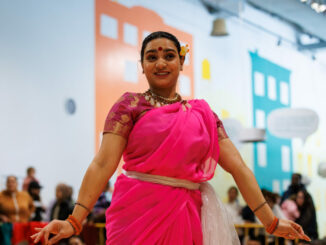
    Visitors of all ages will be experiencing the intricate rhythmic patterns of Indian classical dance with the Bangladesh Institute of Performing Arts (bipainc.com), discover the story of Eid at an engaging puppet show presented by The Culture Tree (theculturetree.com), hear Turkish, Kurdish, and Islamic classical music performed by the Wahab Orchestra, and learn Sufi-inspired songs at an interactive drumming circle led by Brother Mustafa.

    Celebrate Eid al-Fitr is presented in partnership with Council Member Shahana Hanif (council.nyc.gov), Turkish Cultural Center (turkishculturalcenter.org), The Culture Tree (theculturetree.com), and Bangladesh Institute of Performing Arts (bipainc.com).

    “I am proud to join the Brooklyn Children’s Museum on our joint and annual celebration of Eid al-Fitr on April 14th!”  says New York City Council Member Shahana Hanif.  “This festival embodies the spirit of the diversity of Muslim communities and cultures, offering a wonderful opportunity for families and young ones from across the borough and beyond to come together and learn about the significance of Eid. This year, more than ever, our unity as a community is essential. It’s been an honor collaborating with this vital Brooklyn institution to curate an inclusive and family-centered event. I always look forward to engaging with visitors as we explore the diverse traditions of our Muslim neighbors through music, dance, art, and food. It’s events like these that truly enrich our city and foster empathy and appreciation.”

    “We’re thrilled to collaborate with New York City Council Member Shahana Hanif and our amazing cultural partners to present a truly inclusive and engaging Eid al-Fitr celebration, now in its seventh year,” says Atiba T. Edwards, President and CEO of Brooklyn Children’s Museum. “Working with such a diverse and dedicated group of organizations is an incredible opportunity, and we look forward to sharing this special day with families from all backgrounds.”

    TICKETS

    Tickets are priced based on general admission, discounted for grandparents, and FREE for children under one-year-old. General admission tickets include access to all special programs and Museum exhibits. To purchase tickets, visit brooklynkids.org/programs/eid-al-fitr.

    The Festival Partners

    Shahana Hanif (council.nyc.gov/district-39)

    New York City Councilmember Shahana Hanif represents the 39th Council District, which includes parts of Kensington, Borough Park, Windsor Terrace, Park Slope, Gowanus, Carroll Gardens, Cobble Hill, and the Columbia Waterfront. Born and raised in District 39 to Bangladeshi immigrant parents, Shahana has spent her life fighting for working-class families and a city rooted in care, equity, and justice for all.

    The Turkish Cultural Center (turkishculturalcenter.org)

    The Turkish Cultural Center is a non-political, non-governmental, not-for-profit civic entity that was established in 2006 by Turkish Americans that want to promote a strong Turkish American friendship with the hopes that it would promote peace throughout not just between these two great nations but the rest of the world.

    The Culture Tree (theculturetree.com)

    The Culture Tree’s mission is to promote South Asian culture through educational and enrichment programs.

    The Bangladesh Institute of Performing Arts (bipainc.com)

    The Bangladesh Institute of Performing Arts (BIPA), works to promote Bengali arts and language in New York City’s growing multicultural communities by offering accessible classes and providing platforms for emerging artists and performers.

    Brooklyn Children’s Museum (brooklynkids.org)

    Inspired by the energy and diversity of the borough of Brooklyn, Brooklyn Children’s Museum creates experiences that ignite curiosity, celebrate identity and cultivate joyful learning. Founded in 1899 as the world’s first children’s museum,  the Brooklyn Children’s Museum (BCM) is New York City’s largest cultural institution designed especially for families. Proudly based in Crown Heights, Brooklyn, BCM serves 300,000 children and caregivers annually with exhibits and programs grounded in visual arts, music and performance, natural science, and world cultures. For more information, visit brooklynkids.org.

    (Mabel Pais writes on The Arts and Entertainment, Social Issues, Spirituality, Education, Cuisine, Health & Wellness, and Business)

  • Should Muslims sacrifice cattle on Eid-al-Adha?

    Should Muslims sacrifice cattle on Eid-al-Adha?

    Should Muslims sacrifice cattle on Eid-al-Adha?

                                                By  Dr. Mike Ghouse


    Special article on the occasion of Eid-al-adha which falls on July 31.

    We wish our Muslim readers a Happy Eid


    Rituals are the pathways to accomplish milestones of peace for oneself and with what surrounds one; life and environment. None of us can escape from the ceremonies. Each of us instinctively follows certain routines, from waking up to the time we go to sleep. Whether we shower, eat breakfast, go to the office, or gym, we follow the rituals.

    The essence of Islam is to create cohesive societies where every human feels secure about his/her faith, race, religion, region, or ethnicity. It is time for Muslims to consider the essence of sacrifice rather than the ritual itself.

    Real sacrifice requires us to give up some of what is dear to us. It is about parents going to sleep without food but feeding their kids; it is clothing their kids while waiting to get their own. In the case of extremities, we would instead get the bullet and save our loved ones, we are willing to rescue an individual from a freezing lake risking our own lives, and even strangers do that. 

    A thousand years ago, a man’s assets were made up of his goats, camels, and cattle. The ultimate sacrifice one would make was to give away his precious assets in gifts. Today, the most cherished possession is money, and people must be willing to part some of it to give the ability to the receiver to spend on his/her critical needs.

    One of the examples set up for guidance was the test of Abraham’s faith, love, and devotion to God, which humans do routinely, “If you love me, you would do this for me.” A simple assurance would suffice, be it your fiancé, spouse, kids, siblings, or parents.

     It was Abraham’s turn to face the command of God to sacrifice his son. Upon hearing this, he prepared to submit to God’s will and places his son on the block. Right at that moment, a lamb appears as an alternative. Then God revealed to Abraham that his “sacrifice” has already been fulfilled.

    Does God want animals to be sacrificed?  

    Not at all. Qur’an, Al-Hajj 22:37 (The Pilgrimage) is clear: “Never does their flesh reach God, and neither their blood. It is only your God-consciousness that reaches Him. It is to this end that we have made them subservient to your needs so that you might glorify God for all the guidance with which He has graced you. And give thou this glad tiding unto the doers of good.”

    The act symbolizes our willingness to give up a part of our bounties to strengthen and preserve the web of the universe and help those in need. We recognize that all blessings come from God, and we should open our hearts and share with others. 

    What would you sacrifice instead?

    It is customary for Muslims to sacrifice an animal on the day of the Hajj, a symbolic representation of Prophet Abraham’s act. What are our alternatives? 

    We can put that money to a different use that will do greater good like lending to a street hawker who can sell things from a cart and take care of his family or a single mom who can weave baskets or make sweaters to take care of her family. The beauty of this practice is you can make the same money repeatedly work for the common good. Muslims call it Sadaq-e-Jariah, which is continual giving.

     Dr. Nauman Anwar: “Sacrificing animals without making a public spectacle is still a good idea, as long as no wastage of the meat and hides occur. Many Muslim countries have a lot of poverty, and if the meat reaches the deserving population, it will help improve the nutritional status of the poor.

    Let your single sacrifice multiply rather than the one-time sacrifice of animals. Prophet Muhammad had emphasized service to fellow humans as the highest service to God. Quran (4:152) says, if you are kind to your fellow humans, which is my creation, you will earn my grace regardless of your faith.

    Honoring police, firemen, and soldiers

     Every day our police officers and firemen risk their own lives to protect ours, our freedom is protected by our men and women in the uniforms. I urge fellow Muslims to stop and salute every one of these men and women, honoring them for their love for humanity. Better yet, call the firemen, policemen, and let them know that as a Muslim you appreciate their sacrifice, and this festival is about appreciation for such sacrifice.

    I did that in Louisville; within minutes, the officer had emailed the article to his fellow officers, appreciating the Muslims.

    Prophet Muhammad (pbuh) had said the least you can do as a charity is to smile and appreciate the otherness of the others.

     You can wish your Muslim friends by saying, Eid Mubarak, Eid Saeed, Happy Eid, Happy Festivities, etc.

      ( Dr. Mike Ghouse is the founder and president of the Center for Pluralism. He is a speaker, thinker, author, community consultant, pluralist, activist, newsmaker, and an interfaith wedding officiant. More about him at www.TheGhousediary.com)