Tag: Election Commission of India

  • Tripura election: 81% voter turnout recorded, EC says polls ‘largely violence-free’

    Tripura election: 81% voter turnout recorded, EC says polls ‘largely violence-free’

    New Delhi (TIP)- The tentative voter turnout for the 60-member Tripura Assembly today was recorded at 81% with the final figures to be known only by Friday, February 17, the Election Commission of India (ECI) said.

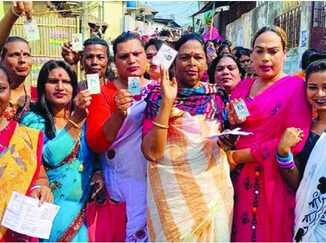
    The polling passed off “largely violence-free”, the commission said, adding that eligible Bru migrant voters, displaced from Mizoram 26 years ago due to ethnic trouble, were able to exercise their franchise for the first time in the state. Poll panel officials said no major complaints had been received so far by the ECI. “There have been no reports of any major violence or attack on candidates or (polling) agents or intimidation of voters. As against 168 repolls in the state in the 2019 Lok Sabha polls, today’s poll for 60 Assembly seats in Tripura has been largely peaceful with no (demand for) repoll reported so far,” the poll panel said in a statement.

    “Minor instances” of violence which were reported were promptly looked into by local officials,” the panel added. “For the first time in many years, Bru migrant voters were able to exercise their franchise. Special efforts were made to enrol them. Some 14,055 eligible Brus were enrolled in the state in 12 locations. They cast their votes at these locations spread across four districts,” it said. Meanwhile, the ECI said it had seized drugs, cash, and freebies worth over Rs 147 crore in Tripura, Nagaland and Meghalaya.

    According to officials, the seized items included Rs 14 crore in cash, foreign liquor valued at over Rs 9 crore and drugs worth Rs 85.76 crore. The highest seizures were made in Meghalaya at over Rs 63 crore, followed by Tripura (Rs 44.67 crore) and Nagaland (Rs 39.19 crore). Nagaland and Meghalaya will go to the polls on February 27.

    The poll panel said the seizures in the three states marked a significant increase as compared to 2018 polls.

    For more than 30 years, Tripura was ruled by the CPM till the upset in 2018, when the BJP won 36 of the 60 seats in a state where it practically had no presence. Though the score pushed the BJP well above the majority mark of 31, it still formed alliance with regional IPFT (Indigenous Progressive Front of Tripura) – which got eight seats — as insurance against any defection by its MLAs.

    The CPM, which ruled Tripura for 35 years, has joined forces with the Congress this time, and its campaign is being led by its four-time Chief Minister Manik Sarkar. The Left Front will contest 47 of the state’s 60 seats, leaving just 13 seats for the Congress.

    While the CPM won 16 seats in 2018, the Congress – main opposition in the previous assembly — drew a blank. The CPM is hoping that their alliance will help add votes in around 13 seats. But the alliance has raised eyebrows among the Kerala units of both parties where they have been sworn enemies for decades.

    The Tipra Motha – the new party formed by former royal Pradyot Kishore Debbarma with a core demand of Greater Tipraland — might queer the pitch for the BJP. While the BJP has the local party IPFT in its corner, its hold on some seats have loosened over the last five years. In 2021, IPFT was wiped out in the Tribal Areas Autonomous District Council polls and had to accept only five seats to contest in this election.

    The BJP had initially attempted to build a rapport with the Tipra Motha, but its overtures were met with rebuff. After the BJP declared that it would not allow any division of Tripura, the Tipra Motha also hardened its stand, flinging Union minister Amit Shah’s allegation of its being the “B Team of CPM-Congress” back at the BJP.

    Assam Chief Minister Himanta Biswa Sarma, the BJP’s pointsperson in the northeast, has predicted a hugely improved performance by the party in all three northeastern states that are going to polls in this round. Elections are due in Meghalaya and Nagaland on February 27. Counting of votes will be held on March 2.

  • Election Commission of India’s Gesture

    Putting off Punjab polls welcome, but Covid concerns persist

    The Election Commission of India (ECI) deserves praise for accepting a genuine demand by the state government and various political parties to postpone the Punjab Assembly polls in view of Guru Ravidas Jayanti. Chief Minister Charanjit Singh Channi and other leaders had appealed to the poll panel to reschedule voting, which was initially slated for February 14, so that followers of Guru Ravidas — a revered poet-saint of the Bhakti movement — could travel from Punjab to Uttar Pradesh to celebrate his birth anniversary on February 16. Lakhs of devotees converge on Varanasi, the birthplace of Guru Ravidas, to pay obeisance on Magha Purnima every year.

    Unanimity among political parties is rare, especially during the election season. What has made all stakeholders speak in one voice in this case is the importance of the Ravidasia community as a vote bank. Doaba, which sends 23 MLAs to the 117-seat Punjab Assembly, accounts for lakhs of followers of Guru Ravidas. No party can afford to ignore the interests of this influential group, considering that this is apparently a ‘no wave’ election which might throw up a hung House. The bottom line is that every seat counts. However, amid the electoral compulsions, various parties have conveniently chosen to ignore the fact that the celebrations in Varanasi will witness a huge congregation under the shadow of the pandemic. The event could become a coronavirus superspreader if the third wave does not subside by mid-February. Varanasi is represented in the Lok Sabha by PM Narendra Modi, who has been repeatedly urging citizens of the country to follow Covid protocols. It will be a big challenge for the BJP government in poll-bound UP to make large crowds toe the line, particularly since cancellation of the festivities is not an option in view of the religious sentiments at stake. Last year, the Kumbh Mela in Uttarakhand was one of the contributory factors to the massive surge in infections during the devastating second wave. It remains to be seen whether adequate steps will be taken this time to ensure a Covid-safe pilgrimage.

    (Tribune, India)

  • Democracy put to test: Change in paradigms of contemporary polity

    Democracy put to test: Change in paradigms of contemporary polity

    By KC Singh
    The debate now veers around the reliability of the EVMs. Would they be the determinant of victory rather than public’s will? Two recent books and a Belfer Center, Harvard Kennedy School, report on the risks to democratic elections of cyber attacks and information operations raise some uncomfortable questions. How Democracies Die by Steven Levitsky and Daniel Ziblatt and People v. Democracy by Yascha Mounk debate the direction of democracy globally. The lessons apply to India under Modi.

    While Prime Minister Narendra Modi accompanied visiting French President Emmanuel Macron on the Ganges at Varanasi, at times hand-in-hand, for an iconic view of the Ghats, India hovered over multiple domestic inflexion points. While agreements were signed with France for strategic engagement, either by “reciprocal logistics” to enable mutual utilization of military facilities in the Indian Ocean or by advancing opaque defense purchases like the Rafale deal, or the kick-starting of the stalled giant nuclear project at Jataipur, promising untested EPR design reactors; farmers marched, many barefooted and hungry, towards the center of India’s financial capital Mumbai. Rural India, where still a majority of Indian voters reside, was signaling that India could not become a great power by lopsided growth and mere promises of achhe din.

    The Modi government has, at best, just a year left or less, if early Lok Sabha elections are held, in tandem with the crucial state elections, due by December, in Rajasthan, Madhya Pradesh and Chhattisgarh, where the BJP faces anti-incumbency. But the Modi slogan of a corruption-free India is no longer paraded. The Nirav Modi and Mehul Choksi duo fleeing after swindling Punjab National Bank of over Rs 13,000 crore have dented the government’s reputation. A photo of Nirav amid top Indian businessman with PM Modi, and a video with prominent jewelers where the PM identifies “Mehul Bhai” by name while speaking, are  seen as clues to their coziness with the regime.

    The BJP’s poor performance in the recent bypolls in Rajasthan, Madhya Pradesh and even Uttar Pradesh fuel the debate that the re-election of Modi, taken as a given months ago, may no longer be certain. The debate now veers around the reliability of the EVMs. Would they be the determinant of victory rather than public’s will? Two recent books and a Belfer Center, Harvard Kennedy School, report on the risks to democratic elections of cyber attacks and information operations raise some uncomfortable questions. How Democracies Die by Steven Levitsky and Daniel Ziblatt and People v. Democracy by Yascha Mounk debate the direction of democracy globally. The lessons apply to India under Modi.

    Levitsky-Ziblatt argue that in the 21st century democracies are endangered, not so much by military coups, like in the 20th century South Asia, or by younger hereditary rulers in the Gulf or by clerical rule (supreme leader in Iran), but the election of populist autocrats. The playbook is old, as Mussolini and Hitler also took the electoral route, albeit laced with threat of street violence, but the methodology is now subtler. The elected leader debases state institutions by weakening the judiciary, putting compliant appointees in control of the Election Commission, handing over investigative agencies to reliable and ruthless protégés for targeting businessmen and opposition figures, emasculates Parliament by negating its checks and balances. Intelligence agencies are co-opted or devalued, as Trump does regularly, and media bought or bludgeoned into submission.

    The Mounk book explores flagging interest in democracy amongst youth and the millennials. While 71 per cent of those born in the 1930s in Europe and the US value living in a democracy, only 29 per cent of those born in the 1980s are so inclined. In fact, a quarter of the millennials think democracy is a bad way to run a nation. In polls in India, there is a tendency to favor authoritarian rulers, something that feeds Modi’s persona as a leader unmatched by his peers. Social media algorithms entrap users in vacuum chambers of similar prejudices and thus curtail debate. The leaders use the reach of Twitter and Facebook to perpetuate their skewed thoughts and browbeat opponents directly, or by their armies of bots. President Donald Trump routinely terms independent news outlets as “fake news”. A former Indian Army Chief, and now minister of state in the Modi government, coined the phrase “presstitutes”. As Rudyard Kipling wrote: “For the colonel’s lady and Judy O’Grady, Are sisters under their skins”. It seems so are the new breed of populist, rabble-rousing politicians across all continents.

    The Belfer report is more worrisome as it reflects a debate in India that the Aam Aadmi Party initiated but was ignored — the possibility of integrity of EVMs being compromised — and thus the electoral process itself getting highjacked by the ruling party. In the US, the states have greater control over the electoral process, but two methods are used for vote casting. One, is optical scanners (OS), where voters cast a ballot by traditional pen and paper, or electronic ballot marking device, and then, the ballot is run through scanning machines. Thus, while an electronic tabulation is retained in the machine, so are the original paper ballots as physical record for subsequent audit or vote verification. Two, is direct recording electronic (DRE), as is done in India with option, as now proposed, of voter-verified paper audit trail (VVPAT). The problem is that the test audit of VVPATs by the Election Commission is of small samples and in a few constituencies.

    The Belfer report concludes that “voting machines can be compromised via physical tampering (including using removable media) or through external connectivity (e.g. WiFi)”. It recommends that the OS method is safer than the DRE machines, including with VVPATs. This is a matter that needs debate in India, as a second time, after Indira Gandhi in the 1970s, a powerful Prime Minister is bending institutions to his own will. Therefore, the integrity of the electoral process needs to be not only safeguarded against the slightest doubt, but also done so publicly.

    The next year is critical for Indian democracy, as indeed the idea of India as enshrined in the Constitution. While in 1975-77, when the Emergency was declared, the world was still mired in Cold War and democratic rule had not flowered globally. Now even the US and its Western allies are casting doubts on the efficacy of its functioning. President Xi Jinping having seized almost total power from the party and the military posits the Chinese model of economic success via authoritarian structures. Can India keep the flame of democracy and liberalism alive in Asia as a counterpoint? That is the drama that is about to unfold in coming year.

    (The author is a former Secretary, Ministry of External Affairs)

  • Parties issuing whip to face penal action  EC on Prez poll

    Parties issuing whip to face penal action EC on Prez poll

    NEW DELHI (TIP): Political parties which issue directions to their members to vote in a particular manner in presidential elections can face penal action, the Election Commission said today.

    It, however, said parties were free to canvas or seek votes of the electors for any candidate or request them or appeal to them to refrain from voting.

    Since there is no whip and the vote in presidential poll is through a secret ballot, voters are free to decide whether they want to cast vote or not.

    The set of clarifications from the commission came after it was approached by some voters who wanted to know whether a member of a political party voting in defiance of the party’s decision would attract disqualification on the ground of defection or the party would be liable to any penalty for asking their members to vote in a particular manner.

    The EC said parties which issue whip or give directions can face action under section 171C of the IPC dealing with “voluntarily interferes or attempts to interfere with the free exercise of any electoral right”.

    The total strength of the electoral college President’s poll comprises all elected MPs and members of legislative assemblies of all states and UTs of Delhi and Puducherry. The total comes to 10,98,903 votes with each MP carrying a vote value of 708.

    The vote weight of an MLA depends on the population of the state he or she represents. A candidate needs 50 per cent plus votes to win the poll. The halfway mark comes at 5,49,452.

  • I cared about EC’s image, not my own, during EVM controversy: Zaidi

    I cared about EC’s image, not my own, during EVM controversy: Zaidi

    NEW DELHI (TIP): It was the Election Commission’s integrity and image and not his personal reputation that he cared about during the entire EVM controversy, former Chief Election Commissioner (CEC) Nasim Zaidi has said.

    “I was neither angry nor amused. I was very concerned about the integrity of the Commission, which it enjoys for decades. What was in my mind was how to preserve the integrity of the Commission and to retain and further enhance people’s confidence in the institution. It is not a question of me as an individual,” Zaidi told IANS in an interview when asked if he felt hurt or just laughed at the allegations during the EVM controversy.

    Zaidi, who demitted office on Wednesday, said the entire controversy was “most avoidable” as electronic voting machines (EVMs) were in use for a long time and several expert committees had vouched for their soundness. “I feel that this (EVM) controversy was most avoidable, in the sense that the EC has been a pioneer in deployment of EVMs in consultation with political parties, and with so many technical committees saying that these cannot be tampered with. By using the same EVMs we have conducted 107 assembly elections and three general elections in 2004, 2009, 2014. They have always thrown correct results. This controversy was clearly avoidable,” Zaidi said.

    He said that instead of “levelling wild allegations”, political parties could have brought up specific cases of tampering with proof or credible information. “But we haven’t had any such evidence. We are waiting for it even today,” Zaidi said with a smile.

    Zaidi said the Commission had always been open to suggestions and measures to further enhance the EVMs’ credibility. After results to the assembly elections in Uttar Pradesh, Uttarakhand, Punjab, Goa and Manipur were declared, in which the BJP swept the crucial state of Uttar Pradesh, some opposition parties raised doubts over the integrity of the EVMs. Many other parties joined the chorus that was sparked by BSP supremo Mayawati, who lost majorly in the state.

    In Punjab, the Arvind Kejriwal-led Aam Aadmi Party raised the same issue, and also after his party lost the Delhi civic elections. However, the EC was prompt in issuing rebuttals every time such charges were levelled. In June, the EC threw a challenge to political parties to come and hack the machine. Only the Nationalist Congress Party (NCP) showed interest in taking up the challenge. The poll panel had put in place several strictures for holding the exercise, after which most parties decided to keep away.

    Source: IANS

  • Achal Joti takes over as CEC

    Achal Joti takes over as CEC

    NEW DELHI (TIP): Achal Kumar Joti today took over as the 21st Chief Election Commissioner (CEC). After taking over, he said his focus would be to “vigorously pursue the mandate of holding free, fair, inclusive and credible polls.

    He said the poll panel’s mission of “no voter is left behind” would continue to be his priority even as the focus area would be to actively promote e-governance for holding state and LS polls. Joti, a 1975-batch Gujarat cadre IAS officer, was the Chief Secretary of the state while Narendra Modi was the CM.