Tag: Eric Adams

  • Dr. Hari Shukla Honored with Key to New York City; Joins a Distinguished Lineage of Global Luminaries

    Dr. Hari Shukla Honored with Key to New York City; Joins a Distinguished Lineage of Global Luminaries

    • By I.S. Saluja

    NEW YORK CITY (TIP): Dr. Hari Shukla, a highly reputed pediatrician based in Queens, New York, was on December 29, presented with the prestigious Key to New York City by Mayor Eric Adams at a special ceremony honoring his lifetime of service to children, community welfare, and humanitarian causes. The award recognizes Dr. Shukla’s groundbreaking and compassionate contributions to pediatric healthcare, which have improved the lives of countless families across New York City.

    Mayor Eric Adams in his speech described Dr. Shukla as “a titan in medicine, a man whose work has changed medical science across the entire globe”.

    Speaking on the occasion, Mayor Adams recognized Dr. Shukla as a renowned medical expert, celebrated for his groundbreaking immunization strategies, and his pioneering work in neonatal care, which is now standard globally. He also recognized Dr. Shukla for his humanitarian efforts, including disaster relief in India, Haiti, Sri Lanka, and co-founding a free breast cancer clinic for South Asian women. Mayor noted that Dr. Shukla has enrolled over 3000 children in public health insurance programs and advocated for various social causes. Mayor then presented Dr. Shukla the key to the city for his extraordinary public service and impact on global medical science and community welfare.

    Dr. Hari Shukla delivers acceptance speech in which he thanked Mayor Eric Adams for the recognition.

    Dr. Shukla’s professional journey spans decades of clinical excellence. Beyond his medical practice, he has been socially and politically engaged, advocating for public health awareness, education, and the wellbeing of immigrant communities. Widely known for his generosity, Dr. Shukla has extended liberal financial assistance to numerous charitable organizations and institutions dedicated to education, healthcare, and cultural promotion—quietly transforming lives far beyond the walls of his clinic.

    It may be of special interest to readers of The Indian Panorama that Dr. Shukla now joins a rare and illustrious group of global figures who have received the Key to New York City over the decades. Among past recipients are Nelson Mandela, honored for his historic struggle against apartheid and reconciliation; Mother Teresa, recognized for her selfless service to humanity’s poorest; Pope John Paul II, for his spiritual leadership and message of peace; and Dalai Lama, for championing compassion and non-violence worldwide.

    Mayor Eric Adams poses for a photograph with the family of Dr. Hari Shukla.

    The honor has also been bestowed upon cultural and social icons such as Muhammad Ali, celebrated for both athletic greatness and moral courage, and Oprah Winfrey, recognized for her transformative influence in media, education, and philanthropy. In more recent years, recipients have included Narendra Modi, for strengthening India–U.S. ties; Malala Yousafzai, for her courageous advocacy of girls’ education; Angelina Jolie, for her extensive refugee work; Serena Williams, for excellence in sport and philanthropy; and Jon Bon Jovi, for his commitment to hunger relief and community service. The City has also honored frontline heroes, including healthcare workers and first responders, for extraordinary service during times of crisis.

    Family and friends of Dr. Hari Shukla with Mayor Eric Adams.

    By welcoming Dr. Hari Shukla into this distinguished company, New York City affirms that service to humanity—whether on a global stage or in a neighborhood clinic—deserves its highest civic honor. The Indian Panorama warmly congratulates Dr. Shukla on this rare and well-earned recognition.

    Read below the full speech of Mayor Eric Adams.
    “To put the conclusion of the amazing run of being a mayor of this amazing city, I am here today to give the key to the city to Dr Hari Shukla, and you know, just my good friend Fernando Mateo, both of you have made a mark on our city. And I want to first start with Dr Shukla. He’s a titan in medicine, a man whose work has changed medical science across the entire globe. When I was reading up on what you have accomplished in the lives that you have saved, every child that you save, that child goes on to have families and contribute to our society, and so you can’t just look at what you did in medicine as just saving the life of a family member, but you have really saved the lives of what we will become as the entire Human race, and I cannot thank you enough for helping our children.
    A proud Indian American humanitarian and a true New Yorker, Dr Hari, I’ve said this before, not all heroes wear capes. They wear white hospital gowns, police uniforms- all the other items that we show every day, and you win a lab coat using your skill as a doctor to save our families. And you are a true hero. Born in India, Dr Shukla, pursuing a career in medicine to serve others, he answered the higher calling to help his brothers and sisters in need with his polio research in India, leading to revised immunization strategies in developing nations. Immigrating to the US in 1980 he continued this groundbreaking medical research, from pioneering medical advances that are now the global standard to his work to help premature infants that is now used in the majority of hospitals in United States and throughout the world, helping countless sick infants to being triple board certified in pediatrics, neonatal parent, prenatal medicine and forensic medicine, and serving as a professor at the NYU School of Medicine, Dr Shukla has changed the face of medical science for 60 years, with passion, integrity and scientific curiosity. His dedication to medical science is only matched by his dedication to helping his fellow, brothers and sisters, giving back to his community through his humanitarian work, leading relief efforts in India, Haiti, Sri Lanka, and response to floods, earthquakes and tsunamis, and co- founded a free breast cancer clinic for South Asian women, and helped enroll over 3000 children in public health insurance programs, as well as advocating for gun violence prevention, drug addiction prevention and flood victims through his nonprofit organizations, which included South Asia of New York, incorporation in the new American voters Association. Incorporation. His extraordinary medical work has touched the lives of so many children and families. The children of New York City and the world are healthier, stronger and safer because of him. And to be able to save a child is probably the most God like effort you can ever do, and you’ve done that, and as we continue to lift up great New Yorkers, I’m just so proud that at the end of my term that I can give you the key to the city for your extraordinary public safety service and for working to better the lives of our precious children, and now for this lasting impact in medicine on the globe, in New York City, it is my honor to present the key to the city of New York, to a New Yorker, a Queens legend. You have opened our hearts, and we’re going to give you the key because we want to open your heart with the love and admiration we have for you.”

  • Mayor Adams Will Conduct Private Polling, Could Determine Future Of Campaign: Reports

    Mayor Adams Will Conduct Private Polling, Could Determine Future Of Campaign: Reports

    Adams made the comments to the Association for a Better New York​ during a closed-door meeting on Wednesday, September 10

    NEW YORK CITY (TIP): New York City Mayor Eric Adams hinted to a group of business leaders on Wednesday, September 10, that he would conduct his own polling that could determine whether he continues his reelection campaign. Adams made the comments to the Association for a Better New York during a closed-door meeting, according to the New York Times.

    According to NBC News, Adam implied that if his poll numbers do not move, he would put the best interests of the city first. He told members of the association that he loves “the city more than I dislike Andrew.”

    Last Friday, Adams reiterated that he is still running for reelection, despite a previous New York Times report that claimed he could potentially drop out of the race and take a job with the Trump administration.

    Todd Shapiro, a spokesman for the Adams campaign, told NBC News and the New York Times, that the mayor never “alluded to leaving the race” during the meeting.

    “He clearly indicated that he will be spending resources to get his message out and will then look at his own independent poll to make a decision,” Shapiro told the Times. “Nothing he said should give any indication that he has abandoned the race.”

    A Siena College and the New York Times poll released on Tuesday, September 9, showed that Democratic candidate Zohran Mamdani remains in the lead in the mayor’s race.

    The poll found in a four-man race that Mamdani would lead the pack with 46 percent of the vote, Cuomo got 24 percent and GOP nominee Curtis Sliwa ended up with 15 percent. Mayor Eric Adams finished with nine percent of the vote.

  • Zohran Mamdani likely to be New York’s next mayor unless 2 of his opponents quit race: Trump

    Zohran Mamdani likely to be New York’s next mayor unless 2 of his opponents quit race: Trump

    US President denies encouraging any candidates to drop out but says the race is winnable if it is one-on-one

    WASHINGTON, D.C. (TIP): US President Donald Trump has said he thinks Democrat Zohran Mamdani is likely to become New York City’s next mayor unless two of the three major candidates running against him drop out of the race.

    But the Republican didn’t say which two candidates he’d like to see quit. Trump said “No” when he was asked by a reporter on Thursday, September 4  night if he’d urged or encouraged any of the candidates in the race to drop out, but went on to say he would like to see that happen.

    “I don’t think you can win unless you have one-on-one, and somehow he’s gotten a little bit of a lead,” Trump said of Mamdani.

    “I have no idea how that happened.”

    The president, who spoke as he hosted a dinner at the White House with tech executives, went on, “I would like to see two people drop out and have it be one-on-one, and I think that’s a race that could be won.”

    Mamdani, a 33-year-old democratic socialist, has been the presumptive favorite in the election since soundly beating former governor Andrew Cuomo in the Democratic primary in June.

    But Cuomo is still on the ballot as an independent, as is incumbent Mayor Eric Adams. Joining those three Democrats in the field is Republican Curtis Sliwa, the founder of the Guardian Angels crime patrol group.

    Recently, intermediaries for Trump reached out to people close to Adams to talk about whether he would consider abandoning his reelection campaign to take a federal job, according to people familiar with those conversations who spoke to The Associated Press on condition of anonymity because of the private nature of the talks.

    On a recent trip to Miami, Adams met with Steve Witkoff, a former real estate developer in New York who is now one of Trump’s main diplomatic envoys in Washington, according to one of the people briefed on the discussions.

    Adams acknowledged meeting with “several political figures” on his Florida trip, which he said was to “deal with some personal issues.” But he has repeatedly insisted he won’t quit.

    Adams reiterated his intention of staying in the race Thursday, adding that he wasn’t bothered by growing calls for him to end his campaign.

    “No pressure, no diamonds,” Adams told reporters at an event touting an endorsement from some Muslim leaders.

    “Just because people yell at you and call your names, and just because a number of people ask you to step down or don’t do what you believe, you’re supposed to succumb to that? That’s not what I do.”       Adams’ campaign was deeply wounded when he was indicted on corruption charges last year, then developed a warm relationship with Trump that bothered many Democrats in one of the country’s most liberal cities.

    There was further backlash from Democrats after the Justice Department said it was dropping the case so that Adams could assist with Trump’s immigration crackdown.

    At a news conference on Thursday, September 4,  Cuomo called on Adams to drop out. “If Mamdani is the existential threat, if you believe that, then at a point you should defer to the strongest candidates,” Cuomo said.

    Sliwa, meanwhile, has cast himself as the best candidate to take on Mamdani.

    “The assumption here is that Eric Adams’ voters, if he does drop out, are all going to jump to Cuomo. That ain’t happening,” Sliwa said in an interview.

    “There’s a lot of anger toward Cuomo. They’ve been going back and forth like two scorpions in a brandy glass.”

    Sliwa added that he also isn’t quitting, and said no one from the Trump administration had reached out yet to urge him to do so.

    “I can assure you for 9,852nd time in this campaign I’ve had to answer this: I’m not dropping out. I’m in it until November 4,” he said.

    “I don’t care if people drop out. I’d encourage them to stay in. Let people decide. That’s what democracy is about, a vote.”

  • The Danger of Imported Nationalism: A Challenge for America’s Unity

    The Danger of Imported Nationalism: A Challenge for America’s Unity

    By Prof. Indrajit S Saluja
    By Prof. Indrajit S Saluja

    When New York Mayor Eric Adams addressed the Federation of Indian Associations (FIA) gala at Cipriani Wall Street on August 17, his words sounded celebratory but carried troubling implications. He suggested that immigrant groups should first identify with their country of origin before calling themselves American — Chinese American, Indian American, Polish American, and so on. To some, this may sound harmless, a token of multicultural pride. But to many others, it raises an uncomfortable question: at what point does celebrating one’s roots cross into promoting nationalism of one’s homeland — potentially at the expense of allegiance to the United States?

    History teaches us that the dangers of divided national loyalty are neither theoretical nor trivial. Nations that fail to integrate immigrants under a shared civic identity often find themselves grappling with sectarian divisions, imported conflicts, and, in the worst cases, outright disintegration. America, a nation forged by immigrants, must take this challenge seriously if it is to preserve its unique democratic experiment.

    Citizenship has always been more than a legal contract; it is a covenant of loyalty. When a person becomes an American citizen, they swear an oath to “support and defend the Constitution and laws of the United States of America against all enemies, foreign and domestic.” There is no clause about placing one’s country of origin alongside the United States. The allegiance is singular, not hyphenated.

    Yet in practice, many immigrant communities do carry with them not just cultural traditions — which enrich America — but also political nationalism and religious dogma that risk creating enclaves of foreign identity. The problem is not pride in one’s heritage; the problem is when that pride turns into active political nationalism, advocacy for foreign governments, or rigid adherence to imported religious ideologies that undermine the pluralism of American society.

    History is replete with examples of what happens when immigrant groups — or minorities within a nation — allow imported nationalism or sectarian loyalty to override allegiance to their new homeland.

    The Fall of the Roman Empire: Historians debate the causes of Rome’s collapse, but one recurring theme is the inability of the empire to fully integrate the diverse tribes and groups it absorbed. Instead of becoming “Romans first,” many maintained loyalty to their ancestral tribes or faiths. When barbarian groups such as the Visigoths settled within the empire, their primary allegiance remained tribal rather than imperial, ultimately contributing to Rome’s disintegration.

    The Ottoman Empire’s Decline: The Ottoman Empire thrived for centuries on a system of “millets” — self-governing religious communities. While initially pragmatic, this arrangement institutionalized difference rather than forging unity. By the 19th century, imported nationalisms — Greek, Serbian, Armenian, Arab — flourished within Ottoman lands. Rather than seeing themselves as “Ottoman citizens,” many subjects identified primarily with their ethnic or religious nation. The result was the steady fragmentation of the empire.

    Lebanon’s Civil War (1975–1990): Lebanon is a cautionary tale of sectarian identities overwhelming national identity. Imported ideologies and loyalties to external powers — whether Syrian, Palestinian, Iranian, or Western — destabilized the fragile balance of the Lebanese state. The inability to cultivate a shared national allegiance resulted in a devastating civil war that scarred the country for decades.

    The Partition of India (1947): Even in the modern era, the pull of religion and nationalism across borders can rip nations apart. India’s independence movement succeeded in uniting diverse groups against colonial rule, but when religion and imported nationalism took precedence over a shared Indian identity, the result was partition — one of the bloodiest episodes of mass migration and communal violence in human history.

    These examples highlight a common truth: when immigrants or minorities see themselves first and foremost as representatives of another nation or faith, they risk undermining the unity of their adopted homeland.

    The United States has historically managed better than most nations at integrating immigrants into a shared civic identity. The idea of the “melting pot” — later refined into the “salad bowl” — was always about one essential principle: no matter where you come from, when you adopt America as your home, you are American first.

    But recent decades have witnessed worrying trends. Political polarization, identity politics, and global migration have combined to challenge the old model of assimilation. Many immigrant communities maintain strong transnational ties, not only culturally but politically. For example, Chinese diaspora networks have been accused of promoting Beijing’s political interests, sometimes under pressure from the Chinese Communist Party. U.S. intelligence agencies have repeatedly warned of Chinese government attempts to co-opt diaspora organizations to advance Chinese state goals.

    Indian diaspora groups have actively mobilized around Indian politics — fundraising for Indian political parties, staging demonstrations in U.S. cities for or against Indian policies, and sometimes carrying communal tensions (Hindu-Muslim, Sikh-Hindu) into American streets. At one point, the Prime Minister of India, Mr. Modi, at a rally of Indians in America,  in Houston, in the presence of Trump, exhorted them to elect Trump as President. The world has not forgotten how his slogan “Abki baar Trump Sarkar” was a direct interference in the electoral process of the US.

  • Thousands join the 43rd India Day Parade in NYC to Celebrate India’s 79th Independence Day

    Thousands join the 43rd India Day Parade in NYC to Celebrate India’s 79th Independence Day

    Hon. Satnam Singh Sandhu, Member of Parliament, Member of the Standing Committee on External Affairs and Consultative Committee on Education, and New York City Mayor Eric Adams at the Parade

    NEW YORK CITY, NY (TIP): The Federation of Indian Associations (FIA) NY-NJ-CT-NE, the largest non-profit organization on the East Coast of USA, successfully hosted the 43rd Annual India Day Parade in New York city on Sunday, August 17. The parade drew hundreds of thousands of participants and spectators to Madison Avenue in a spectacular celebration of Indian culture and heritage. This year’s parade theme, “Sarve Bhavantu Sukhina ” (May All Be Happy and Prosperous), embodied the spirit of universal well-being and unity that defines the Indian-American community.

    At the helm of affairs as Grand Marshals were iconic stars of the Indian film industry: the immensely popular Rashmika Mandanna and the charismatic Vijay Deverakonda. Their presence electrified the crowd, with fans thronging the barricades, cheering wildly, and waving flags, many expressing overwhelming excitement to see their favorite idols in person. They were joined by a distinguished group of honorees, and together these renowned celebrities captivated audiences with patriotic songs and cultural presentations, including renditions of “Vande Mataram” and “Bharat Mata Ki Jai,” creating an atmosphere of national pride and cultural unity.

    The parade was honored by the presence of Hon. Eric Adams, New York City Mayor, who praised the Indian-American community’s significant contributions to the city. “Such a beautiful turnout, beautiful weather. We want to say keep doing the great things you’re doing in the city,” Mayor Adams remarked, congratulating organizers on a wonderful parade.

    Hon. Consul General of India New York, Amb. Binaya S. Pradhan delivered inspiring remarks, welcoming the diaspora and acknowledging the momentous celebration. “It’s a truly momentous day to see India being celebrated on Madison Avenue with hundreds of thousands of people. This only signifies the prominence of the Indian-American community and what you have achieved in this country,” Ambassador Pradhan stated.

    Consul General Binaya Srikanta Pradhan, Mayor Eric Adams, and Grand Marshal Rashmika Mandanna at the Parade.

    The event was further elevated by the special participation of Hon. Satnam Singh Sandhu, Member of Parliament, Member of the Standing Committee on External Affairs and Consultative Committee on Education, making his second appearance at the parade. He traveled specifically to attend the two-day celebration and serve as a voice connecting the diaspora with the motherland. Also participating were Shri Thanedar, U.S. representative for Michigan’s 13th congressional district, Montgomery Township Mayor Neena Singh, and Sibu Nair, Director of Asian American and Pacific Islander Affairs, New York State Executive Chamber, demonstrating strong support from local and state leadership.

    FIA President Saurin Parikh expressed his gratitude for the overwhelming community support and participation. “This parade represents the strength and unity of our community. Seeing families from across the tri-state area come together to celebrate our rich heritage fills me with immense pride. The success of this event reflects our collective commitment to preserving and sharing Indian culture with future generations.”

    FIA Chairman Ankur Vaidya emphasized the parade’s significance in strengthening cultural bonds. “The 43rd India Day Parade has once again demonstrated the vibrant spirit of the Indian-American community. This celebration honors our traditions while showcasing how beautifully our culture integrates with American values. We are proud to organize this platform that brings together diverse communities in celebration of our shared heritage.”

    A marching group at the Parade.

    The parade featured 34 spectacular floats, 21 marching groups, and 20 cultural performances representing India from east to west and north to south. Among the highlights was the majestic Divine Jagannath Rath Yatra Chariot by ISKCON NYC, adding spiritual significance to the celebration.

    The Indian Panorama float depicted the martyrdom of Guru Tegh Bahadur ji, the Ninth Master of the Sikhs who sacrificed his life to protect the Hindus from the persecution of the Mughal rulers of the time.

    The parade route stretched through Manhattan, captivating onlookers with its stunning array of culturally, religiously, and artistically significant floats, each symbolizing the incredible diversity of India’s history and regions. Participants adorned in vibrant traditional costumes moved to the energetic rhythms of Indian music, creating an immersive experience that honored India’s deep heritage while showcasing its dynamic modern contributions to global arts and entertainment.

    Title sponsor Cricmax Connect’s float reflected the American youth cricket revolution, scaling new possibilities across every American playground. A large number of children played box cricket at Madison and Park Avenue, showcasing cricket development initiatives that promote the sport among American youth and highlight the growing cricket movement in America.

    The celebration extended beyond the parade with 38 cultural booths featuring community exhibitions and interactive programs showcasing India’s rich heritage. Following the parade, the festivities continued at the Cultural Stage with a variety of captivating performances spanning both timeless traditional forms and exciting contemporary expressions of Indian music and dance, further showcasing the nation’s rich artistic tapestry. Adding a touch of festive fun was one of the main attractions: the lively Paani Puri Contest, which saw enthusiastic participation from the community.

    The parade received extensive coverage from national and international media including Times Network, Sony, and Zee TV. Crucial amplification was provided by media outlets like TV Asia, PTI, ANI, Parikh Worldwide Media, South Asian Times, The Indian Eye, New India Abroad, The Indian Panorama, Mahaa News, AVS TV, Melody Mocktail, Radio Zindagi, Radio Dil, EBC Radio, Daily Hunt and many others, providing comprehensive coverage of the festivities.

    Grand Marshals Rashmika Mandanna and Vijay Deverakonda with dance performers at the Parade

    The Federation of Indian Associations, as the organizing body, demonstrated its continued dedication to celebrating Indian culture while fostering integration within American society. The organization’s transparent, youth-oriented approach ensures efficient and impactful service to Indian individuals and families across North America.

    The 43rd India Day Parade stands as the largest celebration of Indian culture in New York City, reinforcing the strong bonds between India and America while showcasing the vibrant contributions of the Indian-American community to the cultural fabric of the United States. This massive undertaking was made possible through the generous support of numerous sponsors, including The Consulate General of India-NY, Dunkin, Mount Sinai, Axria, SBI, RWJ Barnabas, Times Network, JetBlue, ICICI Bank, Option Group, AIF, Bansal Foundation, Mehta Foundation, Tak Group, Insta Service, Faith Home Healthcare, Bombino, Andaaz, Siddhivinayak Temple-USA, BJANA, GANA, AAPI, MOCAAPI, and Empire State Building.
    (Based on a press release issued by Rohit Korat)

  • New York City Mayor Eric Adams’ historic federal corruption case has been dropped

    New York City Mayor Eric Adams’ historic federal corruption case has been dropped

    NEW YORK CITY (TIP): Judge Dale Ho has agreed to the U.S. Department of Justice’s request to drop the charges against Adams, but he did so “with prejudice.” That means Adams cannot be re-tried on the same charges at a later time – a stipulation the Justice Department sought in its initial request to dismiss the case.

    The decision to formally drop the case comes after Judge Ho appointed Paul Clement as a “friend of the court” to present arguments over the DOJ’s request. The initial hearing on the request did not include anyone who opposed the move. In his filing to the court, Clement argued the case should be dropped with prejudice to prevent the appearance that Adams remains under political pressure.

    The outcome appears to put an end to the legal jeopardy that Adams had been in ever since he was indicted last September on five counts of bribery, conspiracy and campaign finance violations.

    “The case against Eric Adams should have never been brought in the first place—and finally today that case is gone forever. From Day 1, the mayor has maintained his innocence and now justice for Eric Adams and New Yorkers has prevailed,” Adams’ attorney Alex Spiro said.

    “This case was an example of political weaponization and a waste of resources. We are focused on arresting and prosecuting terrorists while returning the Department of Justice to its core mission of keeping Americans safe,” the Department of Justice said in a statement.

    In the DOJ request to drop the case, prosecutors said having it hang over Adams interfered with his 2025 mayoral campaign and his ability to cooperate with the Trump administration’s crackdown on immigration.

    The initial request to drop the charges made note that the decision was not based on “the strength of the evidence or the legal theories on which the case is based.”

    That triggered concerns that Adams could not effectively govern the city because he would be beholden to the Trump administration, as long as the possibility of the charges returning remained in place.

    Adams and his attorneys have vehemently denied any wrongdoing.

    Mayor Adams responds to charges being dropped

    Adams spoke at Gracie Mansion after the case against him was dropped.

    “As I’ve said all along, this case should have never been brought and I did nothing wrong,” Adams said. “I am now happy that our city can finally close the book and focus solely on the future of our great city. I want to thank New Yorkers who stood by my side, who prayed for me, who supported me from day one and stuck with me while we focused on the work at hand.”

    He offered an apology to New Yorkers.

    “I also want to apologize to New Yorkers for having to go through this with me, a baseless case that should have never been brought in the first place,” Adams said.

    Adams said New Yorkers are his “north star” and he thinks about them every day.

    “I’m a New Yorker, and this is the greatest city on the globe, and it’s a privilege being your mayor, something I did not take for granted one day, and I’m going to continue to serve you,” Adams said. “As I have repeatedly said, I have always been solely beholden to the people of this city. No special interests, no political opponents, but just everyday New Yorkers. Just you, and I’m going to continue to do that. So today we turn the page, we move forward together.”

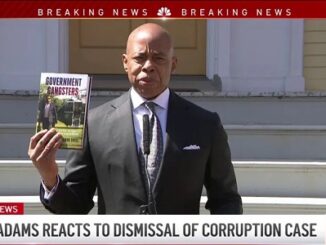
    Before he went back into Gracie Mansion, Adams held up a copy of “Government Gangsters,” a book by FBI Director Kash Patel.

    “Read it and understand how we can never allow this to happen to another innocent American,” Adams said.

    More on the judge’s ruling

    Judge Ho’s decision includes words Adams’ opponents are sure to focus in on: “Everything here smacks of a bargain, dismissal of the indictment in exchange for immigration policy concessions.”

    In his ruling to dismiss the case with prejudice, Judge Ho took issue with the Department of Justice’s request to dismiss the case without prejudice, meaning he could’ve faced trial on the same charges again at a later time.

    Judge Ho summarized the DOJ’s reasoning to drop the case as based on three things: It’s tainted with impropriety, detrimental to national security and immigration enforcement, and was a weak case to begin with.

    “There may or may not be good reasons to drop this prosecution. But the reasons articulated by DOJ, if taken at face value, are inconsistent with a decision to leave the charges in the Indictment hanging like the proverbial Sword of Damocles over the Mayor,” Judge Ho wrote. “And there are many reasons to be troubled by DOJ’s proffered rationales—further supporting dismissal with prejudice.”

    Judge Ho also addressed why he couldn’t continue to pursue the case after the DOJ moved to dismiss it.

    “Some will undoubtedly find today’s decision unsatisfying, wondering why, if DOJ’s ostensible reasons for dropping this case are so troubling, the Court does not simply deny the Motion to Dismiss altogether. But, as explained above, the Court cannot order DOJ to continue the prosecution, and it is aware of no authority (outside of the criminal contempt context) that would empower it, as some have urged, to appoint an independent prosecutor,” Judge Ho wrote. “Therefore, any decision by this Court to deny the Government’s Motion to Dismiss would be futile at best, because DOJ could—and, by all indications, unequivocally would—simply refuse to prosecute the case, inevitably resulting in a dismissal after seventy days for violating the Mayor’s right to a speedy trial. That route would simply postpone finality in this case to a date uncomfortably close to the June 24 mayoral primary. The public interest would not be served by such an outcome.”


    “To be clear, the Court again emphasizes that it does not express any opinion as to the merits of the case or whether the prosecution of Mayor Adams ‘should’ move forward,” Judge Ho added.

    “Legally speaking, he is innocent until proven guilty, and he will never be proven guilty – that is an unequivocal, it is rare when we can rarely say things that definitively – but he will never face legal consequences for the allegations that were against him in this case,” Hofstra Law Professor James Sample said.

    Impact on the mayor’s race

    The timing of the decision to drop the case was critical for Adams, who faced a Thursday deadline to file petitions to run for mayor in New York City’s Democratic primary. He later announced he will run as an independent candidate.

    The decision means Adams is now free to run without the threat of going to jail, or facing a politically damaging trial.

    CBS News New York has learned that Adams is immediately jumping into the political fray, and he plans to participate in a mayoral candidates forum sponsored by the National Action Network Thursday, April 3.

    “He looks forward to engaging with fellow candidates and community leaders to discuss the future of our great city,” a spokesman said.

    Since there’s no possibility of the charges against him resurfacing, Adams can also say he is not beholden to President Trump or his administration, since they can no longer bring the same case against him. Adams has repeatedly said that, and just Tuesday night, New York City joined a suit against the Trump administration to challenge cuts that would cost New York City $100 million in CDC funding.

    “When federal policies directly impact our city, we have been, and will continue to be, the first and loudest to advocate for New Yorkers. These funds are crucial in protecting public health, and the reversal will have serious consequences for communities across the five boroughs,” Adams said in his statement Tuesday night.

    Even before Adams officially learned that his case had been dropped, Adams made it clear at a National Action Network event Wednesday that suggestions he was “under the finger” of President Trump were, in his mind, false.

    “I do not know who you think I’m under the finger of,” Adams said Wednesday morning. “But I’m on the finger of Eric Adams, the mayor of the city of New York, and I’m going to continue to do so.”

    Adams also made an argument voters can expect to hear if he seeks another term.

    “I’m the same person that made sure we put $17 billion in the [minority and women-owned businesses] in this city, that invested in foster care children, that built more housing in year one and year two of our administration than in the history of this city,” Adams said.

    Adams has previously told CBS News New York’s Marcia Kramer to expect twists and turns in the upcoming mayoral election.

    Adams’ opposition speaks out The mayor’s detractors were also speaking out.

    “Either way, I think there was tremendous damage that was done to this city because of an Adams administration, so the quickest we can get away from this administration, I think the better for the city,” Public Advocate Jumaane Williams said.

    “It’s absolutely disgusting. You have a man that broke the law. We want to remind people that it wasn’t just about flight upgrades. This was a man who illegally held a campaign donor scheme, and the fact that the judge unfortunately bowed to Trump is appalling,” mayoral candidate Michael Blake said.

    “The ruling does not change the facts: Eric Adams works for Donald Trump, not New Yorkers,” mayoral candidate and city Comptroller Brad Lander said.

    “Eric Adams has sold out New Yorkers and put himself above the public at every chance he could. Even the judge in the case agrees: this slimy deal reeks of a quid pro quo with the Trump administration. In exchange for his freedom, Adams has looked the other way while the federal government detains and disappears New Yorkers, steals money from our city, and wages war on working people. Adams should resign in disgrace,” mayoral candidate Zohran Mamdani said.

    Move to drop charges sparked resignations

    The DOJ memo seeking to drop the charges set off a spate of resignations that started in City Hall, at the very heart of Adams’ inner circle, and reached all the way to the U.S. attorney’s office. At issue was then-Acting U.S. Attorney of the Southern District of New York Danielle Sassoon’s allegation that the request to dismiss the case amounted to a quid pro quo, namely Adams’ cooperation on President Trump’s immigration enforcement in exchange for his charges being dropped. Sassoon resigned, rather than drop the charges, as did several other people in the U.S. attorney’s office.

    The mayor and his attorney pushed back strenuously against the notion of a quid pro quo.

    “The idea that there was a quid pro quo is a total lie. We offered nothing and the department asked nothing of us,” Adams’ attorney  Alex Spiro said.

    Allegations that Adams had been compromised by the Trump administration and was operating, essentially, under its thumb led four New York City deputy mayors to resign and spurred numerous calls for Adams to step down. Gov. Kathy Hochul, who has the power to remove Adams from office, then met with key leaders to discuss his future. She ultimately acted to limit Adams’ powers in a bid to restore trust in government, but said she wouldn’t remove him.

    What Adams has been accused of Last September, federal prosecutors alleged Adams had been abusing his power for almost a decade. They said he solicited illegal campaign donations from wealthy foreigners and corporations, including a Turkish government official.

    In the 57-page indictment, Adams was accused of receiving gifts he didn’t disclose, including luxury travel, worth more than $100,000, in return for political favors.

    “These upgrades and freebies were not part of some frequent flyer or loyalty program available to the general public. As we allege, this was a multi-year scheme to buy favor with a single New York City politician on the rise,” then-U.S. District Attorney for the Southern District Damian Williams said as he announced the indictment.

    Prosecutors accused Adams of pressuring FDNY officials to approve the Turkish consulate building in Manhattan, despite fire safety concerns.

    The Adams campaign was also accused of using “straw donors” for illicit contributions, enabling it to tap into $10 million in matching funds.

    “These are bright red lines, and we allege that the mayor crossed them again and again for years,” Williams said.

    Before the DOJ stepped in, prosecutors appeared to be ramping up their case, claiming they had uncovered “additional criminal conduct.”

    Adams’ associates are also under investigation

    The historic indictment came amid multiple investigations into Adams’ campaign, as well as other administration officials.

    Numerous top members of the Adams administration resigned before the indictment was announced, including former NYPD Commissioner Edward Caban and his twin brother, James Caban. Former Schools Chancellor David Banks and his wife, former Deputy Mayor Sheena Wright, and his brother, former Deputy Mayor Philip Banks III, were also investigated.

    Ingrid Lewis-Martin, a longtime Adams advisor, pleaded not guilty to bribery, money laundering and conspiracy in a case involving her son and two real estate developers. The mayor’s former liaison for the Muslim community, Mohamed Bahi, was also charged with conspiracy for his role in collecting illegal donations for Adams’ 2021 mayoral campaign and has agreed to plead guilty, according to court documents.

    Here is a timeline of his alleged crimes and the investigation swirling around his inner circle.

    According to the indictment, Adams received free airplane tickets and upgrades on several occasions between 2016-2021, when he was Brooklyn borough president.

    2016: Received two free upgrades to business class on a roundtrip from New York to India via Turkey, valued at over $12,000

    2017: Received three free business class tickets on a roundtrip from New York to France, Turkey and China, along with a “heavily discounted” stay in a suite at the luxury St. Regis Istanbul hotel, valued at over $41,000

    2017: Received two free business class tickets on a roundtrip from New York to China via Turkey, valued at over $16,000

    2018: Received two free upgrades to business class on a roundtrip from New York to Hungary via Turkey, valued at over $12,000

    2019: Received a free upgrade to business class on a flight from New York to Turkey, along with a free stay at a suite at the St. Regis Istanbul hotel, free meals, free transportation and free entertainment, valued at over $9,000

    2021: Received two free upgrades to business class on a roundtrip from New York to Ghana via Turkey, along with a free meal and transportation during a layover in Istanbul, valued at over $12,000

    Adams was also accused of soliciting and accepting two free upgrades to business class on a roundtrip from New York to Turkey in 2021, along with free or “steeply discounted” luxury hotel and resort stays, transportation, entertainment and meals, but he later canceled.

    NYC Mayor Eric Adams’ inner circle under investigation

    Nov. 2, 2023 — Adams abruptly cancels a trip to Washington, D.C. to discuss the asylum seeker crisis with senior White House officials. A spokesperson says the mayor returned to New York City to deal with a matter related to the campaign.

    CBS News New York later reports that the FBI carried out a raid at the home of one of the mayor’s top fundraisers, Brianna Suggs, that morning.

    Adams later insists he complied with the rules of the campaign and says he was surprised by the investigation.

    Nov. 3, 2023 — The Adams campaign announces its own investigation into contributions.

    Nov. 6, 2023 — FBI agents seize Adams’ iPhones and iPad (This was not known until Nov. 10).

    Nov. 8, 2023 — For nearly an hour, Adams fields questions from reporters about why he suddenly left the White House meeting.

    Nov. 13, 2023 — Adams and City Hall officials ask the FBI to stop leaking information about the investigation.

    Nov. 17, 2023 — Sources tell CBS News New York the FBI searched the homes of Rana Abbasova, who worked in the Mayor’s Office for International Affairs, and Cenk Ocal, a former Turkish Airlines executive on Adams’ transition team.

    Nov. 18, 2023 — Adams sets up a legal defense fund amid the corruption investigation into his 2021 campaign.

    Nov. 28, 2023 — Adams says Suggs was reassigned and no longer raising money for his reelection campaign.

    Dec. 6, 2023 — A Quinnipiac University poll says Adams’ approval rating sunk to a record low.

    Feb. 29, 2024 — The FBI raids the homes of Winnie Greco, Adams’ director of Asian affairs and a prolific fundraiser who worked with him for over a decade.

    April 5, 2024 — CBS News New York reports the FBI is investigating expensive upgrades Adams received on flights to Turkey.

    May 21, 2024 — CBS News New York reports Abbasova, Adams liaison to the Turkish community, is cooperating with federal investigators probing the 2021 campaign.

    Aug. 15, 2024 — CBS News New York reports Adams and members of his staff were issued new subpoenas in July.

    Sept. 4, 2024 — Federal agents raid the homes of four top members of the Adams administration, including Police Commissioner Edward Caban, First Deputy Mayor Sheena Wright, Deputy Mayor Philip Banks, and Timothy Pearson, an advisor to the mayor and former high-ranking NYPD official.

    Sept. 12, 2024 — Caban resigns as New York City police commissioner, saying the raids had “created a distraction.”

    Sept. 14, 2024 — Adams’ chief counsel Lisa Zornberg resigns.

    Sept. 21, 2024 — Federal agents search multiple homes belonging to Interim NYPD Commissioner Tom Donlon. Donlon says the agents “took materials that came into my possession approximately 20 years ago and are unrelated to my work with the New York City Police Department.”

    Sept. 23, 2024 — New York City Health Commissioner Dr. Ashwin Vasan submits his resignation for personal and family reasons, effective in January 2025.

    Sept. 24, 2024 — Adams addresses reports of the federal investigation expanding to his dealings with six foreign governments, including Turkey.

    Sept. 25, 2024 — Rep. Alexandria Ocasio-Cortez joins the calls for Adams to resign “for the good of the city.” Hours later, CBS News New York reports Adams will be indicted.

    Sept. 26, 2024 — Adams is indicted on federal bribery, conspiracy and campaign finance charges in the Southern District of New York, becoming the first sitting mayor of New York City to be criminally charged.

    Sept. 27, 2024 — Adams is arraigned in Lower Manhattan and pleads not guilty to all charges. Federal agents also subpoena Adams’ chief advisor, Ingrid Lewis-Martin, and seize her phone in another incident involving the mayor’s inner circle.

    Sept. 28, 2024 — Adams speaks publicly for the first time since his arraignment before a church event in Queens.

    Sept. 30, 2024 — Adams’ attorney, Alex Spiro, moves to dismiss the bribery charge. The same day, Pearson announces his resignation.

    Oct. 1, 2024 — Spiro asks the court to sanction federal prosecutors for allegedly leaking details of the case to the media. The mayor also fills two appointments, nominating Muriel Goode-Trufant to serve as corporation counsel and naming Allison Stoddart as his chief counsel.

    Oct. 2, 2024 — Prosecutors say they will likely file a superseding indictment that could include more charges against Adams and additional defendants. Later that evening, Schools Chancellor David Banks says his retirement will be effective Oct. 16, months earlier than he had announced.

    Oct. 7, 2024 — Adams confirms Philip Banks III, the schools chancellor’s brother, is stepping down. Later that night, CBS News New York learns three other top officials are leaving: Abbasova, Greco and Mohamed Bahi.

    Oct. 8, 2024 — Another federal indictment drops, charging Bahi with destroying evidence and witness tampering. Hours later, Adams confirms Wright’s resignation and names Housing, Economic Development, and Workforce Maria Torres-Springer as her replacement.

    Oct. 9, 2024 — Reports say a fifth investigation has been launched into Adams’ inner circle, involving the Manhattan District Attorney’s Office and the city’s Department of Investigation. Sources say it involves the leasing of commercial properties and a number of officials, including Lewis-Martin, who has been his confidant for decades.

    Oct. 10, 2024 — Adams is said to be considering Sanitation Commissioner Jessica Tisch or former NYPD First Deputy Police Commissioner Ben Tucker to fill the police commissioner role on a permanent basis.

    Also, that day, the NYPD School Safety Division’s former commanding officer, Kevin Taylor, has his home searched and phones seized, sources say. The New York Times reports investigators are looking into a consulting firm run by Terence Banks and a potential bribery scheme involving city contracts, including one with SaferWatch, a company that sells panic buttons to schools and police across the country.

    NYC Mayor Eric Adams’ case dropped before reaching trial

    Nov 1, 2024 — A judge sets Adams’ corruption trial to start in April 2025.

    Nov. 15, 2024 — President-elect Donald Trump announces he will replace U.S. Attorney Damian Williams, sparking questions about the future of the Adams investigation once he takes office.

    Nov. 16, 2024 — Trump says he might consider pardoning Adams, adding, “I think he was treated pretty unfairly.”

    Dec. 15, 2024 — Lewis-Martin announces her retirement from the Adams administration amid reports that Manhattan prosecutors presented new evidence against her to a grand jury. Lewis-Martin later says she is “being falsely accused of something.”

    Dec. 17, 2024 — A federal judge refuses to dismiss the bribery charge against Adams.

    Dec. 19, 2024 — Lewis-Martin is indicted for bribery, money laundering and conspiracy by the Manhattan district attorney. She denies doing anything wrong.

    Jan. 7, 2025 — Federal prosecutors say they uncovered “additional criminal conduct,” by Adams, but do not disclose the nature of the allegations.

    Jan. 10, 2025 — Court papers reveal a grand jury looking into corruption charges against Adams hears from more witnesses.

    Jan 17, 2025 — Adams meets with President-elect Trump at his golf club in Palm Beach, Florida, provoking opponents who suspect the mayor is seeking a pardon. After the meeting, Adams releases a statement saying, “To be clear, we did not discuss my legal case.”

    Jan. 20, 2025 — Adams attends Mr. Trump’s presidential inauguration after accepting a last-minute invite to Washington, D.C. and later in the week dismisses criticism.

    Jan. 29, 2025 — A source familiar with the discussions confirms to CBS News that senior Justice Department officials discussed the possibility of dropping Adams’ corruption charges with Manhattan federal prosecutors.

    Jan. 31, 2025 — DOJ attorneys meet with Adams’ defense team and federal prosecutors about dropping the charges, sources say.

    Feb. 10, 2025 — DOJ tells prosecutors to drop the case against Adams.

    Feb. 11, 2025 — Adams addresses the DOJ’s order to drop the corruption case and vows to earn New Yorkers’ trust back. The mayor’s critics worry he is compromised and beholden to the president.

    Feb. 12, 2025 — At a news conference, Adams’ attorney Spiro criticizes prosecutors leading the corruption case and argues it was politically motivated.

    Feb. 13, 2025 — Danielle Sassoon, Manhattan’s top federal prosecutor, resigns with other DOJ officials in the wake of orders to drop the criminal case against Adams.

    Feb. 14, 2025 — Adams appears on “Fox & Friends” with Mr. Trump’s border czar and denies Sassoon’s quid pro quo allegations. Later that day, federal prosecutors file a motion to formally drop the corruption charges against him.

    Feb. 16, 2025 — Four of Adams’ eight deputy mayors say they are stepping down, citing the recent “extraordinary events” and the need “to stay faithful to the oaths we swore to New Yorkers and our families.”

    Feb. 18, 2025 — Hochul meets with House Minority Leader Hakeem Jeffries and other key leaders to discuss Adams’ future as mayor. The governor has power to remove the mayor from office, but it has never been done in New York’s 235-year history.

    Feb. 19, 2025 — Adams returns to court, where Judge Dale Ho questions him, his lawyers and the DOJ about the motion to dismiss, but does not make a final ruling.

    Feb. 20, 2025 — Hochul announces three actions aimed at limiting Adams’ power and establishing “guardrails” around his administration. In a statement, Adams responds saying, “While there is no legal basis for limiting New Yorkers’ power by limiting the authority of my office, I have told the governor, as we have done in the past, that I am willing to work with her to ensure faith in our government is strong.”

    Feb. 21, 2025 — Judge Ho appoints outside attorney Paul Clement to argue before the court and orders the case to continue. Meanwhile, Adams tells CBS News New York’s Marcia Kramer he’s sleeping “like a baby” as he continues to lead the city.

    Feb. 26, 2025 — The mayor’s attorney files a motion to dismiss the case “with prejudice,” claiming prosecutorial misconduct involving Sassoon’s leaked resignation letter. A dismissal with prejudice would prevent the charges from being re-filed in the future.

    March 3, 2025 — Top Democrats on the House Judiciary Committee, Reps. Jamie Raskin of Maryland and Jasmine Crockett of Texas, launch an investigation of the DOJ’s move to dismiss the case.

    March 5, 2025 — Adams joins the mayors of Boston, Chicago and Denver testifying about sanctuary city policies before a House Oversight Committee. Many of the questions directed his way are related to the corruption case, and he reiterates there was no quid pro quo for his cooperation.

    March 7, 2025 — Paul Clement, the outside counsel brought in to argue over whether the Adams case should be dismissed, files his brief to the court saying it should be dismissed with prejudice, meaning the charges against couldn’t be brought again. Clement argued that such a dismissal would prevent the appearance that Adams remains under political pressure.

    March 20, 2025 — Adams taps attorney Randy Mastro to fill the role of first deputy mayor.

    April 2, 2025 — Judge Ho rules the case should be dismissed with prejudice.

    (Source: CBS News)

  • The Danger of Executive Overreach: The Case of Dropping Corruption Charges Against Mayor Eric Adams

    By Prof. Indrajit S Saluja
    By Prof. Indrajit S. Saluja

    The American democratic experiment, as envisioned by the founding fathers, was predicated on a system of governance rooted in the principle of checks and balances. By distributing power among three co-equal branches—the Executive, the Legislature, and the Judiciary—they sought to protect the nascent republic from the concentration of power that had led to tyranny in the old world. In their wisdom, they foresaw the dangers of an overreaching government and ensured that no single branch could function without being held accountable by the others.

    But this balance, once the pride of the American system, now appears dangerously frayed. The second term of President Donald Trump has brought into sharp focus the creeping—and now galloping—centralization of power in the Executive branch. The recent decision by the Trump administration to drop the corruption case against New York City Mayor Eric Adams exemplifies this alarming trend. In doing so, the administration has not only overridden serious investigative processes but also ignored the collective voice of public opinion. The implications of this are profound and deeply troubling.

    This isn’t just about one case or one mayor. It is about the slow erosion of democratic norms and the growing tendency of the Executive to function as judge, jury, and kingmaker. A few months ago, The Indian Panorama noted with concern that the United States—often described as the world’s greatest democracy—was increasingly beginning to resemble an oligarchy, one in which power is concentrated in the hands of a few, with minimal regard for transparency, fairness, or the rule of law. That warning rings even louder today.

    In democratic societies, the rule of law is paramount. The judiciary serves as the guardian of that law, ensuring that no individual—however powerful—is above it. When the Executive branch interferes with or outright nullifies judicial processes, it undermines the very foundation of democracy. The dropping of serious corruption charges against a political figure—particularly one seen to be close to or useful to the ruling administration—raises disturbing questions. Was the decision based on merit, or was it a politically motivated maneuver aimed at consolidating influence and rewarding loyalty?

    It is worth remembering that the charges against Mayor Adams were not trivial. They involved serious allegations of misuse of public funds, campaign finance violations, and unethical associations with foreign entities. Federal investigators had spent months building the case, collecting evidence, and issuing subpoenas. The public, too, had taken note, with numerous editorials, civic organizations, and watchdog groups calling for accountability and a fair trial. Yet, in one sweeping move, the Trump administration’s Department of Justice dropped the charges—without a satisfactory explanation, and certainly without public consultation.

    This is not an isolated incident. In recent months, we have witnessed a disturbing pattern: presidential pardons being issued not as acts of mercy or justice, but as political tools. Allies, donors, and former aides—many of them convicted on serious charges—have found themselves the beneficiaries of executive clemency. Meanwhile, critics and whistleblowers face relentless persecution. The message is clear: loyalty is rewarded, dissent is punished.

    This weaponization of executive power threatens to fundamentally alter the nature of American democracy. When the President can bypass the judicial process to protect political allies, when legal accountability becomes a matter of partisan convenience, and when public institutions are turned into instruments of personal power, we move from democracy towards autocracy.

    The danger is not merely theoretical. History offers grim lessons. Democracies do not fall overnight; they erode slowly, often under the guise of patriotism, strong leadership, or “draining the swamp.” Institutions are hollowed out from within, norms are discarded, and power becomes increasingly centralized. By the time the public awakens to the change, it is often too late.

    The Founding Fathers envisioned a government “of the people, by the people, and for the people.” But today, we must ask: whose government is this? When public opinion is ignored, when legal processes are subverted, and when transparency is sacrificed at the altar of partisanship, we risk becoming a government of the few, by the few, and for the few.

    Some may argue that the President is acting within his legal authority. Technically, perhaps. But legality is not the same as legitimacy. A president has the legal power to pardon, to appoint judges, and to direct federal prosecutions. But how those powers are exercised determines the moral and democratic legitimacy of the administration. Power wielded without restraint or accountability—even if legal—can still be tyrannical.

    In a functioning democracy, the legitimacy of action is derived not just from the Constitution, but from public trust. When that trust is broken—as it has been in the case of the Adams investigation—governance becomes coercive, not consensual.

    So where do we go from here?

    First, the people must stay vigilant. Democracy is not self-sustaining; it requires constant engagement from its citizens. Silence and apathy are the allies of autocracy. Every time the Executive oversteps, it must be challenged—not only in courtrooms, but in town halls, newsrooms, and in the ballot box.

    Second, the media must continue to serve as the fourth estate, holding power to account. In an age of misinformation and manufactured narratives, investigative journalism remains one of the most powerful tools to expose corruption and abuse of power.

    Third, institutions must resist co-optation. From federal prosecutors to career civil servants, from judges to election officials, those who serve the public must remember their duty is to the Constitution, not to any political figure.

    Lastly, it is up to Congress to reassert its constitutional authority. The legislative branch must no longer be a silent spectator to executive overreach. Through oversight hearings, subpoenas, and legislation, it must reclaim its role as a check on the presidency.

    The United States has long stood as a beacon of democracy for the rest of the world. But that reputation is at risk. The dropping of corruption charges against a politically connected mayor may seem like a minor skirmish in the broader political battlefield. In truth, it is a warning flare—a sign that democratic norms are being sacrificed for expediency and control.

    The question before us now is stark: Will America wake up to the danger? Or will it continue to drift into complacency, only to awaken one day and find the democratic republic it cherished has quietly given way to oligarchy—or worse, dictatorship?

    History is watching. So are the people. The soul of American democracy depends on what we do next.

  • A Happy Holidays Thought: New York City Mayor Eric Adams’ Challenges and Opportunities

    By Prof. Indrajit S Saluja
    By Prof. Indrajit S Saluja

    New York City Mayor Eric Adams finds himself navigating a labyrinth of challenges in his tenure as leader of the world’s largest cosmopolitan hub. His administration faces criticism from multiple fronts—political opposition, a law-and-order crisis, an unrelenting influx of immigrants, strained city finances, and a visible decline in public services. With New York’s reputation as a global epicenter at stake, Adams must address these pressing issues to restore the city’s grandeur.

    One of the foremost challenges facing Mayor Adams is the City Council, a body often seen as resistant to his policies. Dominated by opposing voices, the council has consistently pushed back against Adams’ proposals, whether related to policing, housing, or budgetary measures. This gridlock has hindered swift decision-making, exacerbating the city’s pressing problems. The clash between the executive and legislative branches of city governance underscores the need for greater collaboration and compromise to address New York’s multifaceted crises.

    New York City’s law-and-order situation has reached a critical point. Crime rates, particularly violent crimes and property-related offenses have surged. For instance, NYPD statistics from 2023 revealed a 15% increase in felony assaults and a 10% rise in robberies compared to the previous year. This alarming trend has sparked widespread concern among residents and businesses alike.

    Frequent changes in the police leadership further reflect the administration’s struggle to find a stable, effective approach to policing. In just two years, the city has seen three different police commissioners. Each change signifies Mayor Adams’ attempt to identify a leader capable of addressing these challenges, but stability and clear strategic direction remain elusive.

    The influx of immigrants into New York City has added another layer of complexity. In 2023 alone, the city received over 100,000 migrants, many seeking asylum. This unprecedented wave has overwhelmed shelters, public schools, and healthcare facilities. According to city officials, the crisis could cost New York more than $4 billion by 2024, straining an already tight budget.

    Public sentiment toward the situation has also soured. Many New Yorkers view the arrival of migrants as an unwelcome burden, leading to protests and growing divisions within the community. The city’s inability to accommodate the influx effectively has amplified frustrations, making it a political and social powder keg.

    New York’s streets and public spaces have seen a noticeable decline in cleanliness and maintenance. Piles of garbage are a common sight along sidewalks, causing not only aesthetic concerns but also public health issues. Mayor Adams’ recent initiative to implement covered garbage bins is a step in the right direction, but more comprehensive measures are needed to address the root causes of the problem.

    The city’s infrastructure further exacerbates the situation. Roads riddled with potholes and uneven surfaces make commuting a daily ordeal. For instance, a 2023 survey found that over 60% of New York’s streets were rated in poor condition, with repair backlogs spanning years. The current 25-mile-per-hour speed limit is more a reflection of necessity than policy, as driving at higher speeds on these roads is virtually impossible.

    Another area of concern is the near disappearance of greenery in the city. Parks and tree-lined streets, once a hallmark of New York’s urban charm, have given way to concrete expanses. Restoring greenery would not only improve the city’s aesthetic appeal but also provide much-needed environmental and mental health benefits for its residents.

    During the COVID-19 pandemic, outdoor dining structures were a lifeline for restaurants and a creative solution to social distancing measures. However, their continued presence in a post-pandemic era has become a source of contention. These structures occupy valuable street space, contributing to traffic congestion and reducing already limited parking availability.

    With winter approaching, the utility of these outdoor spaces is further diminished. Mayor Adams has the opportunity to take decisive action by ordering their removal, offering both residents and visitors a more navigable and less cluttered urban experience. Such a move would also symbolize a shift toward normalcy and signal that New York is ready to reclaim its pre-pandemic vibrancy.

    Despite these challenges, New York City’s potential for greatness remains undiminished. Mayor Adams must adopt a multi-pronged approach to tackle the city’s issues effectively:

    Strengthening Law and Order: Establishing a clear, long-term strategy for crime reduction is paramount. Stability in police leadership, combined with community policing initiatives, could help restore trust and safety.

    Managing Immigration: The city must collaborate with state and federal governments to secure additional resources for housing, healthcare, and education for migrants. A transparent and equitable approach can mitigate public backlash.

    Improving Cleanliness and Infrastructure: Expanding sanitation services, enforcing stricter waste disposal regulations, and accelerating road repair projects are critical steps. Increasing greenery through tree-planting drives and park restoration could also rejuvenate public spaces.

    Addressing Political Gridlock: Mayor Adams must work toward building consensus with the City Council. Open communication and shared priorities can pave the way for more effective governance.

    Removing Pandemic-Era Structures: Clearing outdoor dining setups and reclaiming street spaces for traffic and parking can significantly improve the city’s functionality and aesthetics.

    New York City is undeniably at a crossroads. The challenges facing Mayor Eric Adams are formidable, but they also present an opportunity for transformative leadership. By addressing the city’s most pressing issues with urgency and vision, Adams can restore New York’s reputation as a global beacon of culture, innovation, and resilience.

    A concerted effort to clean up the streets, enhance public safety, and invest in infrastructure can make the city not just livable but exceptional once again. In the words of those who hold New York close to their hearts, “Let’s make New York a great city again.” With the right measures, Mayor Adams has the potential to deliver on that promise.

    Happy Holidays!

  • Eric Adams axes $547 million from NYC Education Department budget, more cuts on the way

    Eric Adams axes $547 million from NYC Education Department budget, more cuts on the way

    NEW YORK CITY (TIP): New York City’s Education Department will cut nearly $550 million from its budget this year as part of a sweeping round of citywide reductions ordered by Mayor Eric Adams.

    Many of the cuts are expected to take effect immediately. They will touch a wide range of programs and positions that directly affect students, from the city’s massive free preschool program, to community schools that support families with out-of-school needs, to the popular pandemic-era Summer Rising program.

    A big chunk of this year’s savings will come through a hiring slowdown and the elimination of 432 vacant non-classroom positions, which officials said on Thursday will lead to a combined $157 million in savings.

    Budget officials didn’t specify which roles would be eliminated but emphasized cuts to central offices and other roles that support schools. A hiring freeze has been in place since earlier this fall, but has not applied to teaching positions. Education Department officials didn’t immediately say whether the agency would continue to spare teaching positions from the freeze.

    A mandate to rein in spending on “supplemental pay for administrative staff” is expected to save another $86 million this year, but officials didn’t immediately provide details on what that means.

    In September, Adams directed all city agencies to find cuts equal to at least 5% of the city’s contribution to their annual budgets by November, in response to what he described as unsustainable levels of spending on the ongoing influx of asylum seekers. Additional cuts of 5% are expected in January and again in spring 2024.

    In all, that means the Education Department could face up to $2.1 billion in cuts. The department’s overall budget is roughly $37.5 billion this school year. Starting next fiscal year, the department will cut $120 million from the Universal Pre-K program, which enrolled about 100,000 3- and 4-year-old this year and is the signature legacy of former Mayor Bill de Blasio’s administration. The program has been beset by payment delays to childcare operators and enrollment declines during the pandemic.

    Officials said they’re reducing the size of the program because there are about 37,000 vacant seats, but did not specify how many of those slots they plan to eliminate. “While we don’t know many details yet, there is no way a cut this large would not hurt the services available to children and families,” said Gregory Brender, the chief of policy and innovation at the Day Care Council of New York, a membership organization of childcare providers.

    A range of longstanding programs with a direct presence in schools are also facing small cuts.

    An initiative to expand the teaching of computer science is losing $3.5 million this year, while the budget for community schools will be cut by $10 million this year. Community schools were another major educational priority of de Blasio’s administration, and have continued to grow under Adams.

    Separately, nearly $20 million in funding for Summer Rising, the pandemic-era free summer school program that served roughly 110,000 students last year, is being slashed from the budget of the city’s Youth and Community Development Department, which jointly operates the program with the Education Department. The cuts will mean reduced hours and no Friday programs for some middle-schoolers, officials said.

    The program has proved immensely popular with families and had about 45,000 more applicants than slots last year.

    “For months, we have warned New Yorkers about the challenging fiscal situation our city faces,” Adams said in a Thursday statement. “To balance the budget as the law requires, every city agency dug into their own budget to find savings, with minimal disruption to services. And while we pulled it off this time, make no mistake: Migrant costs are going up, tax revenue growth is slowing, and COVID stimulus funding is drying up.”

    Budget analysts have pointed out that the cuts ordered by Adams are far greater than the expected costs of serving the asylum seekers. The city also collected nearly $8 billion more in revenue last fiscal year than anticipated, according to a recent analysis from Comptroller Brad Lander. Michael Mulgrew, the president of the United Federation of Teachers, called the cuts “unnecessary” and “driven by City Hall’s false political narrative that New York City is about to fall off a fiscal cliff.” “Revenues are higher than expected, investment from Albany is up, and reserves are at a near-record high,” he added. Other groups warned that the city’s hiring and budget freeze is already affecting services for vulnerable children, and that further cuts could threaten their legal rights.

    Advocates for Children, a nonprofit group, said the city has been unable to hire 15 additional staffers to help families living in shelters navigate the education system, an urgent concern given the influx of migrant families.

    The organization also said short staffing appeared to be causing delays in providing preschool special education evaluations and services in the Bronx. “We are particularly concerned that these budget plans will result in even more egregious violations of the rights of students with disabilities, English Language Learners, and students in temporary housing or foster care,” Advocates for Children executive director Kim Sweet said in a statement.

    More cuts ahead for NYC schools
    The city-directed budget cuts are part of a perfect storm of fiscal trouble facing city schools. About $7.7 billion in one-time pandemic aid from the federal government has padded the Education Department’s budget in recent years and funded critical initiatives, including expanded preschool and summer enrichment programs. That money will dry up next September, and the looming expiration of that aid has already prompted some painful cuts. For the first time in four years, the Education Department clawed back money this week from schools where enrollment numbers fell short of projections.Because enrollment went up overall across the city, the majority of schools didn’t have to return money, and instead got extra funding because of higher-than projected enrollment. But there were still more than 650 schools that saw a total of $109 million in midyear cuts, according to a United Federation of Teachers analysis.
    (Source: Chalkbeat)

  • Indian festival Diwali to be school holiday in New York City

    Indian festival Diwali to be school holiday in New York City

    NEW YORK (TIP): Diwali, the festival of lights, will now be enshrined as a school holiday in New York City, authorities announced here and described it as a “victory” for the city’s residents, including the Indian community.
    New York City Mayor Eric Adams said he was proud that the State Assembly and the State Senate have passed the bill making Diwali a New York City Public School holiday.
    “And we feel confident that the governor is going to sign this bill into law,” he said at a special announcement from City Hall on Monday.
    “This is a victory, not only from the men and women of the Indian community and all communities that celebrate Diwali, but it’s a victory for New York,” Adams said.
    Diwali will be a public-school holiday in New York City beginning this year.
    New York Assembly Member Jenifer Rajkumar, the first Indian American woman ever elected to a New York State office, said for over two decades, the South Asian and Indo-Caribbean community has fought for this moment.
    “Today, the mayor and I are proud to stand before the whole world and say that from now on and forever, Diwali will be a school holiday in New York City.”  Rajkumar said the Diwali holiday is to be enshrined in law.

  • NYC Mayor Eric Adams celebrates Diwali in Times Square


    NEW YORK (TIP): NYC Mayor Eric Adams inaugurated Diwali celebrations in Times Square on October 15. The festival of Diwali marks the beginning of the Indian New Year. Deepavali – the Festival of Lights, this year falls on Oct 24 but the celebrations started a week before, in Times Square. Mayor Eric Adams, Senator Charles E. Schumer, India’s Consul General in New York Randhir Jaiswal, NY State Assemblywoman Jennifer Rajkumar – the first Indian American Assemblywoman, and Manhattan Borough President Mark Levine attended the event along with hundreds of Indian American community members.

    “We acknowledge the Diwali, and we need to acknowledge the power of women and the significant role women play in our country, in our city. Let’s continue to lift our women as we lift up our country – our city,” said NYC Mayor Adams.
    On October 20, Mayor announced that Diwali will be a public-school holiday in New York City starting in 2023. This sends a message about the significance of the city’s inclusiveness and the “long overdue” step will encourage children to learn about the festival of lights.
    Consul General of India Randhir Jaiswal said, “Every year, we celebrate Diwali in Times Square but this year, it is somewhat different. It happened to be part of India’s 75th year of Independence.”

    Renowned Oncologist Padma Shri Dr. Dattatreyudu Nori was recognized and honored for his lifetime excellent services to Health and Medicine by Mayor Eric Adam.

    Times Square witnessed huge participation of members of Indian American community, Americans and others dressed up in traditional outfits from different states of India, showcasing India’s rich art, culture, and diversity. The Diwali Bazaar provided a variety of traditional Indian cuisines and sweets and merchandise for Diwali festivities.
    The variety of traditional performances and lively acts by world-renowned artists like Jay Sean, Arjun, Rimi Nique, and Social Media fame artists Kiran + Nivi and Hrishi kept the audience glued for hours. 100s of students of Arya Dance Academy and Shiamak Davar School of Dance, Heeray, DanceX, presented dazzling dance shows at the event.
    “We love our community, our Indian community, and we love that we all come together here in New York with our diversity,” said Senator Charles E. Schumer. He has been celebrating the festival of Diwali with the Indian American community in New York for many years.
    “The Hindu, Sikh, Jain, and Buddhist communities, you are so important to the city, and I wish you a holiday of light, prosperity, of happiness, health, and a wonderful year ahead,” said Manhattan Borough President Mark Levine in his address.

    Jennifer Rajkumar, the first Indian American NY State Assemblywoman was introduced by Mayor Eric Adams on the stage. “On the street, they call him – Mayor Eric Adams – a Hindu Mayor. A plant-based diet, and meditation, he does it all. I am honored to be the first Hindu elected to be in the NYS office. The first Indian woman but defiantly, not the last one,” she said.

    Attendees were encouraged to take the advantage of Bivalent Vaccines at nearby COVID Clinics with the partnership of the “We Can Do This” campaign of Vaccines.gov, a Health & Human Services initiative. T

    “We appreciate the support and cooperation from the authorities of the City of New York, NYPD, FDNY, Heath Department, Times Square Alliance, and other Government organizations to create yet another successful event at Times Square,” AR Helping Hands Foundation Diwali at Times Square organizer, Neeta Bhasin and Naresh Kumar said in a statement.

  • MAYOR ADAMS ANNOUNCES EMERGENCY PROCUREMENT DECLARATION TO RAPIDLY PROCURE SHELTER, SERVICES FOR ASYLUM SEEKERS

    MAYOR ADAMS ANNOUNCES EMERGENCY PROCUREMENT DECLARATION TO RAPIDLY PROCURE SHELTER, SERVICES FOR ASYLUM SEEKERS

    • Emergency Procurement Declaration will allow City to rapidly Contract with Shelter and Service Providers
    • City in discussions with Federal Government to seek reimbursements for emergency costs

    NEW YORK (TIP): New York City Mayor Eric Adams  announced, August 1,  an emergency procurement declaration to rapidly procure shelter and other services for people seeking asylum in New York City.

    “New York is a city of immigrants, and we will always welcome newcomers with open arms. Over the past two months, we have seen a significant increase in the number of asylum seekers arriving in our city’s shelter system,” said Mayor Adams. “To fulfill our city’s legal and moral mandate to provide quality shelter to anyone experiencing homelessness, and to ensure we are providing appropriate services to asylum seekers, we are immediately issuing an emergency procurement declaration to rapidly procure additional shelter and services to serve these individuals and families. We are working across city agencies and with not-for-profit partners to ensure these individuals have access to a range of services, including legal support, health care, and education. We can no longer wait — and this declaration will allow the city to procure sorely needed additional resources as quickly as possible. We are deeply committed to providing shelter and support to everyone who needs it, and we cannot do this work alone. We will continue to work with federal and state partners to procure additional financial resources immediately.”

    “New York’s commitment to providing shelter is an essential part of what makes our city a welcoming safe haven,” said New York City Comptroller Brad Lander. “We will work closely with the administration to appropriately expedite contracts and ensure New York City can deliver the shelter and services that families seeking asylum here urgently need.” Approximately 4,000 asylum seekers have entered the New York City shelter system since late May — the primary driver of the approximately 10 percent increase in the New York City Department of Homeless Services’ census. Additionally, on average, the city’s shelter system is currently receiving over 100 additional asylum seekers looking for some form of housing per day. To protect individuals from federal detainment or deportation, and because the city provides shelter to all who need it — regardless of immigration status — the city does not track individuals’ immigration status on intake forms. Accordingly, this is a conservative estimate based on comprehensive interviews of people entering the city shelter system. An influx of approximately 4,000 individuals requires a significant number of new shelter sites to ensure appropriate capacity.

  • MAYOR ERIC ADAMS AND SCHOOLS CHANCELLOR DAVID C. BANKS PARTNER WITH PLANET FITNESS TO PROVIDE FREE SUMMER ACCESS TO FITNESS FOR ALL NYC HIGH SCHOOL STUDENTS

    MAYOR ERIC ADAMS AND SCHOOLS CHANCELLOR DAVID C. BANKS PARTNER WITH PLANET FITNESS TO PROVIDE FREE SUMMER ACCESS TO FITNESS FOR ALL NYC HIGH SCHOOL STUDENTS

    NEW YORK (TIP):  Mayor Eric Adams and Chancellor David C. Banks . June 23  joined Planet Fitness and 15 student athletes at Boys and Girls High School in Brooklyn to promote the High School Summer Pass program to New York City teenagers. New York City teens ages 14 – 19 are invited to get active this summer with free access to Planet Fitness clubs across the five boroughs, through August 31. High School Summer Pass gives teens a zero-cost, judgement free space where they can prioritize their mental and physical wellbeing during the summer, when many have limited access to sports programming, gym classes, and after fitness activities.

    Teens can sign up and learn more about the program by visiting PlanetFitness.com/SummerPass. Teens under 18 must register with a parent or guardian online or in-club. “As teenagers gear up for the summer, it is important to provide activities and recreation to keep them busy and out of harm’s way,” said New York City Mayor Eric Adams. “We are thrilled to announce this partnership with Planet Fitness, which will allow our young New Yorkers to focus on their physical and mental health in a judgment-free space, free of charge.”

    “The health and wellbeing of our students goes beyond the classroom, lunchroom, and school gymnasium,” said Schools Chancellor David C. Banks. “It’s important that we provide our students with tools and opportunities to make healthy choices and to build a healthier lifestyle no matter how much your family makes — and the High School Summer Pass initiative does just that. Thank you to Planet Fitness for giving our teenagers a free, safe environment to practice and build life-long healthy habits this summer.”

    Additionally, High School Summer Pass participants have access to 15 trainer-led workout videos and 10 downloadable workouts exclusively for teens across all fitness levels. To promote and encourage a healthy lifestyle beyond the gym, all parents and guardians of High School Summer Pass participants have the ability to download a free digital copy of Robert Irvine’s “Family Table” cookbook once their teen signs up for the program. All participants who sign up are also automatically entered into The Planet Fitness High School Summer Pass Sweepstakes. Planet Fitness will award one $500 scholarship in each state (and the District of Columbia) and one grand prize $5,000 scholarship at the end of the summer[i]. These scholarships can be used for academic or athletic activities or programs. “By encouraging teens to start working out now, they can start to build healthy habits that will last a lifetime,” said James Innocenti, Chief Operating Officer of PF Supreme LLC, a Planet Fitness franchise. “The pandemic really served as a reminder of the importance of exercise for improved physical and mental health and we hope as many teens as possible use this program as an opportunity to get active in an environment that welcomes all.”

    “Kids should be given affordable opportunities to stay active and occupied during their summer breaks and this is just what High School Summer Pass at Planet Fitness is bringing to our communities,” said Brooklyn Borough President Antonio Reynoso. “Thank you to Mayor Adams and Chancellor Banks on this partnership.”

    Teens across the nation are feeling the emotional and physical toll of the pandemic. This administration is proud to prioritize the wellness of all New Yorkers and to promote a healthy lifestyle for teens and families. The Department of Education is prioritizing the physical and mental wellbeing of this city’s young folks by providing access to a 5,000-member-strong-network of school-based social workers and guidance counselors and investing in a major PSAL expansion that will provide our schools with over 200 new sports teams across the five boroughs, giving students from every zip code access to vital athletic programs, and more. High School Summer Pass gives all of New York City’s teenagers the opportunity to get up, get active, make healthy lifestyle choices, and prioritize their mental and physical health and wellness.

    About Planet Fitness

    Founded in 1992 in Dover, NH, Planet Fitness is one of the largest and fastest-growing franchisors and operators of fitness centers in the United States by number of members and locations. As of March 31, 2022, Planet Fitness had more than 16.2 million members and 2,291 stores in 50 states, the District of Columbia, Puerto Rico, Canada, Panama, Mexico and Australia. The Company’s mission is to enhance people’s lives by providing a high-quality fitness experience in a welcoming, non-intimidating environment, which we call the Judgement Free Zone®. More than 90% of Planet Fitness stores are owned and operated by independent businessmen and women.

  • GOPIO led community delegation meets Mayor Eric Adams and his top officials

    NEW YORK (TIP): GOPIO officials along with other Indian community organizations were invited to New York city Hall on March 1st to discuss issues of the Indian community and perspectives on how the community can be involved in the city. It all started with GOPIO’s condemnation of the defacing of Mahatma Gandhi statue at the Union Square Park in February and GOPIO requesting Mayor Eric Adams to increase police presence in the park area as well as to apprehend and punish culprit.

    Indian American community leaders with New York City officials after an interactive meeting at the City Hall.
    From L to R: Mukund Mehta, Kavita Motwani, Lal Motwani, Braj Aggarwal, Ketan Shah, Karthikeya Parashar, Prof. Rajasekhar Vangapaty, Gobind Munjal, Sudhir Vaishnav, Deputy Mayor Meera Joshi, Chief Advisor Ingrid Lewis-Martin, Dr. Thomas Abraham, Dr. Vimal Goyle, Girish Patel and Beena Kothari

    City Hall was represented by Mayor Adam’s Chief Advisor Ingrid Lewis-Martin and Deputy Mayor Meera Joshi. The Indian community delegation was headed by GOPIO Chairman Dr. Thomas Abraham along with GOPIO-Manhattan Executive VP Prof. Rajasekhar Vangapaty, VP Dr. Vimal Goyle and Treasurer Braj Aggarwal as well as GOPIO-New York Chapter Hon. Chair Lal Motwani and President Beena Kothari. Other community representatives were Association of Indians in America (AIA) President Gobind Munjal, Bharatiya Vidya Bhavan Executive Director Sudhir Vaishnav, Bhakti Center Program Coordinator Kartikeya Parashar, Society of Indian American Engineers and Architects (SIAEA) President Ketan Shah, BAPS Shri Swaminarayan Mandir National Coordinator for Public Affairs Girish Patel and Mukund Mehta, President of India Home and Indo-American Senior Citizen Center of New York.

    At the beginning of the meeting, GOPIO Chairman Dr. Abraham thanked Mayor Adams for appointing many Indian Americans in high position of the city administration. In addition to the issue of defacing of Mahatma Gandhi statue, many other issues were discussed at this power meeting of the City officials with the community. The community representatives urged the mayor to keep status que on gifted and talented classes for elementary classes. The delegation told the city officials that the gifted should always be given the opportunity to advance further in pursuit of knowledge and to achieve their full academic potential. Other issues brought out include discrimination, civil rights violations and violence against religious institutions in New York city. Chief Advisor Lewis Martin suggested to set up a committee from the community to work closely with NYPD on some of these issues. The following have been nominated to work on these issues with Girish Patel coordinating this effort along with Braj Aggarwal, Lal Motwani, and Beena Kothari. This committee will reach out to the larger Indian community on these issues.

    Indian American community leaders with New York Mayor Eric Adams in front of the CityHall,
    Front Row, from L to R: Girish Patel, Gobind Munjal, Beena Kothari, Dr. Thomas Abraham, Mayor Adams, Prof. Rajasekhar Vangapaty, Braj Aggarwal and Mukund Mehta,. Rear row, from l. to r.: Karthikeya Parashar, Lal Motwani, Dr. Vimal Goyle, Kavita Motwani, Ketan Shah and Sudhir Vaishnav.

    Once major part of the discussion was on how to bring businesses to New York City, vis-à-vis New York businesses setting up business in India. The delegation told city officials that many Indian companies are setting business outfit in the US and that Indian Americans in New York city could serve as conduit to reach out to businesses in India. It was suggested that whenever trade and business delegations come to New York, City’s International Affairs Department must reach them out and hold meetings with them. Another Business Promotion Committee headed by Dr. Abraham was nominated along with Prof. Rajasekhar Vangapaty, Sudhir Vaishnav, Mukund Mehta, Ketan Shah and Karthikeya Parashar.

    The delegation also suggested the city officials to continue with Diwali celebration and to hold a special celebration from the City for the 75th Anniversary of India’s Independence to honor the largest democracy of the world.

    After the meeting with city officials, the delegation met Mayor Eric Adams and interacted with him. Mayor Adams gave high marks for the community’s contribution to make New York an exciting city to live.

    (Based on a Press Release)

  • ERIC ADAMS UNVEILS RESILIENCY PLAN FOR NEW YORK CITY

    ERIC ADAMS UNVEILS RESILIENCY PLAN FOR NEW YORK CITY

    CONEY ISLAND, NY (TIP):  Democratic mayoral nominee Eric Adams, on September 24, unveiled his resiliency plan for New York City to address the rising threat of climate change to New Yorkers’ safety, underlined by the destruction and loss of life caused by the remnants of Hurricane Ida earlier this month. He was joined by local elected officials and resiliency advocates outside Haber Houses, a NYCHA senior development in Coney Island that is one of more than two dozen public housing sites citywide still rebuilding from Hurricane Sandy.

    Adams’s plan, developed in consultation with leading resiliency advocates and experts, focuses on keeping New Yorkers physically and financially safe from climate events — in the short-term and in the future — as well as shoring up the city’s ability to thrive and grow long-term through the adverse effects of climate change.

    You can view the full plan at https://www.scribd.com/document/527292110/The-Adams-Resiliency-Plan-for-NYC

    “Coney Island and other marginalized communities in New York knew the hard truth before many in this city: Climate change is here. Making New York City more resilient and protecting our people from extreme weather is not some far-off consequence of the things we do today—it is an urgent public safety issue, right now. As the flooding from Ida underlined with devastating effect, our focus can no longer solely be on climate change prevention; it must also be on the interventions we need right now to warn, educate, and insulate New Yorkers from damage and death,” Brooklyn Borough President Adams said. “We must be bold and ambitious. We need a City government that protects future generations while taking care of those most in need right now–especially those lower-income communities and communities of color who are most impacted by climate change, and who will benefit the most from investments in resiliency that create green jobs. With preparedness and protection, we can create the New York City we want to live in — and we want our grandchildren to live in — while becoming an example for the world. That is the mission powering my resiliency plan.”

  • Eric Adams Wins Democratic Nomination for NYC Mayor; Garcia and Wiley Concede

    Eric Adams Wins Democratic Nomination for NYC Mayor; Garcia and Wiley Concede

    NEW YORK CITY (TIP): The city’s Board of Elections released updated preliminary numbers Tuesday, July 6, —now counting absentee ballots—which show the Brooklyn Borough President leading over former Sanitation Commissioner Kathryn Garcia with 50.5 percent of votes after eight elimination rounds of Ranked Choice Voting.

    It may be mentioned here that The Indian Panorama was among the first to endorse Eric Adams.

     The city’s Board of Elections released an updated preliminary vote count Tuesday, July 6, in the city’s primary election, showing Brooklyn Borough President Eric Adams leading over former Sanitation Commissioner Kathryn Garcia with 50.5 percent of votes after eight elimination rounds of Ranked Choice Voting. Garcia and Maya Wiley, who placed second and third respectively, both conceded to Adams on Wednesday.

    The new tally, which included absentee ballots, put Adams ahead by 8,426 ballots over Garcia. While official election results won’t be certified for another few days, Adams’ lead was enough to prompt the Associated Press to declare him the winner and Democratic mayoral nominee.

    Some affidavit and cured ballots still need to be tallied, but likely not enough to shift the outcome of the primary race. BOE officials said Tuesday that 942 ballots are eligible to cure—a chance for voters who filled out their ballot incorrectly to fix and resubmit them—and are due back by July 14, at which points election results will be certified and an official winner declared.

    “While there are still some very small amounts of votes to be counted, the results are clear: an historic, diverse, five-borough coalition led by working-class New Yorkers has led us to victory in the Democratic primary for Mayor of New York City,” Adams said in a statement Tuesday night. “Now we must focus on winning in November so that we can deliver on the promise of this great city for those who are struggling, who are underserved, and who are committed to a safe, fair, affordable future for all New Yorkers.”

    Adams is expected to face off in the November general election against Guardian Angels founder Curtis Sliwa, the presumed Republican primary winner, who had 68.1 percent of his party’s votes in Tuesday’s preliminary count, beating out rival Fernando Mateo. Democratic voters greatly outnumber Republicans in New York City, meaning Sliwa will face an uphill battle in the race for City Hall this fall. Should Adams win as many anticipate, he’ll become the second Black mayor in the city’s history. Garcia, who campaigned as a government-savvy fixer and who had 49.5 percent of votes in the BOE’s most recent preliminary count, addressed supporters at a press conference in Manhattan Wednesday, where she congratulated Adams but noted that his win was “only by a razor-thin margin.” “For 400 years, no woman has held the top seat at City Hall. This campaign has come closer than any other moment in history to breaking that glass ceiling,” Garcia said in her speech, in which she urged other women to run to elected office. “We cracked the hell out of it, and it’s ready to be broken.”

    Maya Wiley, a former de Blasio administration lawyer who positioned herself as the more progressive Democratic candidate in the race after Dianne Morales’ left-leaning campaign was consumed by staff complaints about working conditions, also conceded the race during a press event outside the Lucerne Hotel in Manhattan, which has been the scene of a bitter fight over where and how the city should house New Yorkers experiencing homelessness.

    “Though the City has continued its inhumane policy of moving men out of hotels back into congregate shelters, they aren’t giving up their fight. And neither will I,” Wiley said in a statement following her concession speech. “I didn’t run for Mayor because I wanted to be a politician and sit at a big desk. I ran because I have a mission—a mission to make the City we love more fair, more just and more affordable.”

    In an earlier statement, Wiley—who after Tuesday’s updated preliminary count trailed Garcia by 12,367 votes in the seventh round of Ranked Choice Voting before being eliminated in the eight—criticized the BOE’s handling of the initial primary count.

    “It would be an understatement to express dismay at the BOE’s administration of this election,” Wiley said in a statement, referring to last week’s bungle when the board released its first batch of preliminary ranked choice primary votes, only to retract them hours later, saying they’d mistakenly included some 135,000 test ballots in the initial tally.

    State Senate Majority Leader Andrea Stewart-Cousins has pledged to hold hearings in the coming weeks to explore how to reform the beleaguered agency.

    (Source: CityLimits)

  • The Indian Panorama announced endorsements for NY City Elections

    The Indian Panorama announced endorsements for NY City Elections

    The publication has endorsed Eric Adams for Mayor, David Weprin for Comptroller, and Jumaane Williams for Public Advocate

    NEW YORK (TIP); The Indian Panorama publisher and chief editor Prof. Indrajit S Saluja has written to Eric Adams, David Weprin and Jumaane Williams conveying to them the endorsement of the publication for Mayor, Comptroller and Public Advocate respectively. Prof. Saluja has appealed to friends and the community to get out and vote for the endorsed candidates who are the best and will prove to be excellent elected officials committed to serving the great people of the City of New York.


  • ERIC ADAMS UNVEILS “WeRISE” AGENDA TO RAISE IMMIGRANT SAFETY AND EMPOWERMENT

    ERIC ADAMS UNVEILS “WeRISE” AGENDA TO RAISE IMMIGRANT SAFETY AND EMPOWERMENT

    NEW YORK (TIP): Front running mayoral candidate Eric Adams, on June 3, unveiled his “WeRISE” agenda to raise immigrant safety and empowerment,  at a town hall for ethnic and community media. The Indian Panorama editor Prof. Indrajit S Saluja was one of the attendees. Adams noted that New York City is “not only home to the United Nations; we are the home of people from every nation.” A 2015-19 estimate from the U.S. Census Bureau showed that 36.8 percent of this city’s residents — more than one out of every three — is foreign-born, living across the five boroughs.

    “My Administration will lift up immigrants as high as Lady Liberty lifts her torch in our harbor, as a beacon of hope for all who come to our shores,” said Eric Adams. “Too many of our neighbors live in the shadows, scarred by the abusive rhetoric and tactics of the Trump era and fearing a denial of their rights. The intimidating complexity of our City bureaucracy is compounded by the challenges that immigrants with limited English proficiency face in navigating everything from education to housing to healthcare. In addition to building on our existing efforts to increase civic engagement to new levels and foster the leadership of voices from every community, we will ensure that together WeRISE.”

    Adams announced that he would launch a $50 million annual Immigrant Venture Fund for small businesses started by first- and second-generation New Yorkers, with a special weight toward businesses that support the immigrant community. According to a 2018 report from the Mayor’s Office of Immigrant Affairs (MOIA), 52 percent of the city’s businesses are immigrant-owned. To pay for this Venture Fund, his administration would divert funds from the New York City Economic Development Corporation (EDC)’s budget that are historically allocated for discretionary tax benefits and tax-exempt financing for major companies seeking City support.

    Regarding immigrant safety, Adams declared that he would direct all city agencies to make their services accessible without putting immigrants at risk of law enforcement action, expand already existing legal services, and severely restrict cooperation between the New York City Police Department (NYPD) and Immigration and Customs Enforcement (ICE) — including ensuring that ICE is removed from all City buildings and facilities — until there is major federal reform, including the use of body cameras by all ICE agents. He also reaffirmed that he would combat hate crime with a zero-tolerance policy, including attacks targeting immigrant communities.

    Noting that more than 150 different languages are spoken in the city, Adams said he would direct the NYPD to prioritize language justice for victims to make it easier to safely report, as well as work in partnership with district attorneys to ensure that they have the resources they need to swiftly identify, apprehend, and prosecute those who prey on innocent New Yorkers through these cowardly acts. Additionally, his administration would take a more robust approach with the Office for the Prevention of Hate Crimes that includes rapid graffiti removal, support for expanded anti-hate curriculums in our public schools, and innovative cross-cultural dialogue initiatives like his “Breaking Bread, Building Bonds” program at Brooklyn Borough Hall that brings together everyday people each from all various ethnicities, identities, and faiths around a dinner and conversation.

    Adams’ “WeRISE” agenda also includes:

    • Boosting funding for NYC Cares to expand outreach to immigrant communities and enroll them in the City’s health plans for which they are already eligible;
    • Creating one-stop-shop health centers in underserved communities, sited in NYCHA complexes and open storefronts that are accessible to any New Yorker — no matter their legal status in the U.S., as well as pairing safety-net hospitals with wealthier ones to share cost burdens;
    • Prioritizing language justice, and funding it, with qualified City translators and stipend-based fellows expand language access for City services and resources.
    • Enhancing the IDNYC program with extraordinary security to protect users, an improved MyCity platform that provides direct connection to social services through a single portal, and mandating access to this program for any person leaving Rikers Island and needing proof of identity.
    • Using our leverage as a client to create a fairer economy for immigrants, rewarding businesses that hire local workers and benefit minority and female owners and workers — especially on City-financed projects.
    • Hiring a Chief Diversity Officer to drive change on equity for minorities and women, and also create a tool to track the share of M/WBE contracts and how much the City is spending on those companies versus others in real-time.
    • Bolstering City legal services battling discrimination in the workplace, such as cases of wage theft and unjust denial of Section 8 vouchers, as well as any other forms of harassment based on immigration status.
    • Instituting a robust program for culturally aware professional development of educators.
    • Opening a new Mayor’s Office of Community and Ethnic Media, to expand the resources they need to continue bringing vital information to New Yorkers.

    “Eric is a proven champion for immigrants in our city,” said Bronx Borough President Ruben Diaz Jr. “He knows that when they rise, we all rise. The focus that he will bring to empowering immigrants and keeping them safe, as shown in this plan, shows how committed he is to making the American Dream a citywide reality.”

    “New York City has always been a beacon of opportunity for immigrants to live, grow, and thrive,” said Council Member Adrienne Adams. “We continue to welcome, with open arms, those who want to create better lives for themselves and their families. I am proud to endorse Eric Adams’ immigrant empowerment plan, which will further help, protect, and support immigrants in New York City. We must continue to address the issues facing our immigrant communities to ensure that their voices are heard, and that they are safeguarded in all levels of government.”

    “Eric Adams’ ‘WeRISE’ plan demonstrates that he totally gets that our greatest asset as New Yorkers is our diversity–but that diversity must be supported and nurtured in order for this City to grow,” said Council Majority Leader Laurie Cumbo. “A lot of candidates are giving lip service to the value of our immigrant community, but few are backing it with a plan that is backed by experience except Eric Adams.”

     “As the first Haitian-American woman and first African-American woman to lead the largest Democratic County in our city, I am proud to support a mayoral candidate in Eric Adams who respects and values all our immigrant communities,” said Assembly Member Rodneyse Bichotte-Hermelyn. “He sees us and he knows that combating inequality and injustice means lifting all of us up. From empowering our M/WBEs to battling hate crimes, I look forward to working with Eric in City Hall to support our immigrant neighbors.”

    “I thank Eric Adams for his strong support of immigrant entrepreneurship and defense of any New Yorker facing discrimination,” said Council Member Peter Koo. “Eric is a true friend to immigrants, and his ‘WeRISE’ plan is the right plan to connect every New Yorker — no matter where they come from or what language they speak — to the City services and resources that will help them succeed.”

    “Eric Adams has been assisting individuals and families of immigrant New Yorkers for the past four decades, even in isolated neighborhoods many average New Yorkers didn’t know existed,” said Sheikh Musa Drammeh, head of the National Community Peacebuilding Commission. “His ability to build the largest and most diverse networks of supporters is the result of the investment he has made in building relationships through public service. Every immigrant group thinks they know Eric Adams better than anyone else. Eric Adams is the only public servant that walks into any room anywhere in the city and knows half of them. He will be the most effective political leader to articulate and efficiently provide constituent services for the immigrant communities, because he knows them and their needs and they know him and his leadership.”

    “Mr. Adams is a long-standing friend of the Bangladeshi community,” said Shamsul Haque, president of Rise Up New York. “He has visited dozens of Bangladeshi events, mosques, mingled with community leaders, and cultivated friendships. Seeing the recent spike in violent crimes, the Bangladeshi community feels the city is going back to the 1990’s. Mr. Adams’ campaign slogan, ‘public safety is prerequisite to prosperity,’ struck a chord with Bangladeshi New Yorkers. When public safety deteriorates, our families, friends, and neighbors will not be safe. People and businesses will leave the city, which will cause a decline in revenue.”

    “Every American should have the opportunity to pursue entrepreneurship,” said Emil Skandul, immigrant rights advocate and entrepreneur. “The defining characteristic of the immigrant experience is the drive to build a better economic foundation for one’s family in this country. For so many immigrants and first-generation Americans, entrepreneurship is their raison d’etre — a chance to control their future by working hard and smart. However, too often traditional networks of fundraising are the limiting factors for ventures. An Immigrant Venture Fund will establish a path toward achieving the American Dream.”

  • ASHLEY SHARPTON ENDORSES ERIC ADAMS FOR MAYOR

    ASHLEY SHARPTON ENDORSES ERIC ADAMS FOR MAYOR

    NEW YORK (TIP):  Prominent activist and community leader Ashley Sharpton, on May 27, endorsed Eric Adams for mayor outside the historic National Action Network headquarters in Harlem. “Eric Adams has been consistent in showing up and taking action against injustice no matter who it is. We are electing a mayor at a very crucial time in this city and in this country where we are coming out of a pandemic where so many New Yorkers are broken mentally, spiritually, financially, and physically. We need a visionary who is not afraid to take the necessary steps to revive New York back into the thriving city it can be,” said civil rights activist Ashley Sharpton. “From education, public safety, homelessness, mental health reform, and health and wellness, Eric Adams is the transformative leader who can execute his vision and implement change Borough by Borough. He has the courage, the work ethic, the strategy, the honesty, the record, the reach, the voice, and the heart to lead New York back to better, and he is the candidate who doesn’t just talk the talk, he walks the walk.”

    “Ashley is here endorsing me today because she knows that I am the only candidate in this race with the experience to keep New York safe and fight for justice–because I have been there and done it before,” Brooklyn Borough President Adams said. “As mayor I will continue this fight and uplift every New Yorker by looking out for their civil rights, their city, and their future.”

    Adams has also been endorsed by 32BJ SEIU; ATU Locals 726, 1056, 1179, and 1181; CSEA Local 1000; DC37; the Hotel Trades Council; OPEIU Local 153; PEF; TWU Local 100; the Uniform Fire Officers Association, and UNITE HERE Local 100, as well as more than 50 current and former elected officials, including Borough Presidents Ruben Diaz Jr. and Donovan Richards; Representatives Adriano Espaillat and Tom Suozzi; State Senators Joe Addabbo, Jr.,  Andrew Gounardes, Roxanne Persaud, James Sanders, and Diane Savino; Assembly Members Peter Abbate, Rodneyse Bichotte Hermelyn, Carmen de la Rosa, Inez Dickens, Erik Dilan, Charles Fall, Alicia Hyndman, Stacey Pheffer Amato, Jenifer Rajkumar, José Rivera, Clyde Vanel, and Jaime Williams; City Council Members Adrienne Adams, Alicka Ampry-Samuel, Diana Ayala, Justin Brannan, Selvena Brooks-Powers, Laurie Cumbo, Darma Diaz, Oswald Feliz, Peter Koo, Farah Louis, Alan Maisel, I. Daneek Miller, Francisco Moya, and Ydanis Rodriguez; former State Comptroller Carl McCall; former Representatives Charlie Rangel and Ed Towns; former Bronx Borough President Fernando Ferrer, as well as former Assembly Members Karim Camara and the late Aurelia Greene.