Tag: ESA

  • Perseverance rover boasts its first construction on Mars

    Perseverance rover boasts its first construction on Mars

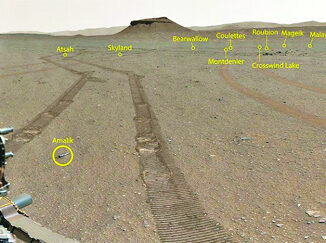
    Nearly two years after it was launched to the Red Planet, the Perseverance rover has done more than just science. It has now constructed a sample depot on the planet that will be used by future missions to return samples to Earth. The rover has beamed back a portrait of the 10 backup sample tubes. The rover has sent a panoramic view of the recently completed sample depot, which is a big milestone for the mission and humanity’s first collection of samples on another planet. The image has been made from 368 images that were sent to Earth.
    Nasa said that eight of those tubes are filled with rock and regolith from Mars, while one is an atmospheric sample and one is a “witness” tube. The rover used its Mastcam-Z camera on the top of its head to capture the images that were then stitched together to form the panoramic view.
    Nasa said that the depot represents a backup collection of samples that could be recovered in the future by the Mars Sample Return campaign, a joint effort between Nasa and ESA (European Space Agency) that aims to bring Mars samples to Earth for closer study.
    Perseverance built the depot at “Three Forks,” a location within Jezero Crater. Billions of years ago, a river flowed into the crater, carrying sediment that formed a steep, fan-shaped delta that the rover will drive up in the months ahead. Astrobiologists suspect that while the Martian surface is now cold, dry, and generally inhospitable to life, ancient Mars was likely similar to Earth – and could have supported microbial life if any ever formed on the Red Planet. The work to build a depot on another world was not easy and the first critical requirement was finding a level, rock-free stretch of terrain which has room for each tube to be deposited. The next target was to figure out exactly where and how to deploy the tubes within that location.
    While Perseverance has dropped these sample tubes, work is underway on Earth to ready for the retrieving mission that will launch to Mars, pick up these samples and return home.

    Source: India Today

  • European Space Agency chooses team to make oxygen on the moon

    European Space Agency chooses team to make oxygen on the moon

    The European Space Agency (ESA) announced the winning industrial team that will design and build an experimental payload to extract oxygen from the regolith (lunar soil) on the surface of the Moon.The team is led by UK-based Thales Alenia Space and is tasked with producing a small solar-powered prototype device that will be used to evaluate the prospect of building oxygen-generation plants on the moon. This could be useful for generating oxygen that can be used as a propellant and for astronauts to breathe.

    The compact payload designed by the team will have to extract between 50 and 100 grams of oxygen from the lunar regolith while targeting the extraction of 70 per cent of all available oxygen within the sample. The device will also have to do all this within a period of ten days, which is how long solar power will be available within a single lunar day before the pitch-black and freezing lunar night.

    The payload is also required to be low power and able to fly on many different lunar landers including ESA’s own European Large Logistics Lander, EL3. The winning team that also consists of AVS, Metalysis, Open University and Redwire Space Europe was selected by the ESA’s Directorate of Human and Robotic Exploration in 2021 after conducting a detailed study including three rival designs.

    According to David Binns, Systems Engineer at ESA’s Concurrent Design Facility (CDF), the ability to extract oxygen and other useable materials from lunar regolith will be a game-changer for lunar exploration, allowing astronauts to ‘live off the land’ without depending on long and expensive supply lines from the earth.

    It had already previously been discovered that lunar regolith from the moon’s surface consists of 40-45% oxygen by weight. The problem is that this oxygen is bound up with other chemicals as oxides in the form of minerals or glass, making it unavailable for use without processing.

    In 2020, the ESA had set up a prototype oxygen plant in the Materials and Electrical Components Laboratory of the European Space Research and Technology Centre, ESTEC, based in the Netherlands. The lab is used to extract oxygen from simulated regolith to fine-tune the process for efficiency.

                Source: The Indian Express