Tag: Exploitation

  • India’s freedom struggle: From first invasion to midnight of Independence

    India’s freedom struggle: From first invasion to midnight of Independence

    India’s journey to freedom was neither swift nor simple-it was a centuries-long saga of resilience, rebellion, and renaissance. While the climax arrived on 15 August 1947, the struggle had its roots in the earliest invasions that disrupted the subcontinent’s autonomy. This story spans from medieval conquests to colonial exploitation, from fragmented resistance to unified nationalism, and from armed uprisings to non-violent mass movements.
    Before the Raj: Early Invasions
    The Turkish and Mughal Periods

    The first significant foreign incursions into India’s political structure began with Mahmud of Ghazni’s raids in the 11th century, followed by Muhammad Ghori’s conquests in the late 12th century. These invasions led to the establishment of the Delhi Sultanate (1206-1526), which reshaped governance and trade but also saw resistance from local rulers like the Rajputs.
    The arrival of the Mughals in 1526, under Babur, ushered in a new imperial order. While the Mughal period (especially under Akbar) was known for cultural synthesis, by the 18th century, weakening central control allowed European trading companies to gain influence.
    The European Footprint: Traders to Rulers
    Portuguese and Dutch Presence
    The Portuguese, led by Vasco da Gama’s arrival in 1498, were the first Europeans to establish a foothold, controlling ports like Goa. The Dutch East India Company followed, though their influence remained largely in trade.
    The British East India Company
    An official of the East India Company in processionSurrounded by Indians, a colonial official of the British East India Company moving on horseback in a procession. Watercolor on paper, c. 1825–30. The British first arrived not as conquerors, but as merchants, drawn by India’s extraordinary wealth, which had been famous in the West since Greek times. They arrived to find India dominated by the vast Mughal empire, which had been established in the 16th century by the conqueror Babur and now ruled most of the subcontinent. In 1613, the Mughal emperor Jahangir granted the British permission to establish a trading post in Surat, Gujarat, which would become the first British foothold in India.
    Over the following century, the British East India Company established additional trading posts and also gradually increased its economic and political influence throughout the subcontinent. After the death of Emperor Aurangzeb in 1707, the Mughal empire entered a rapid phase of decline, providing an opening for various regional powers, including the Marathas, the Sikhs, and the northern Rajput chiefs to assert their sovereignty. By the middle of the 18th century, there was no longer a single dominant power in the subcontinent, leaving the region vulnerable to colonial ambitions.
    The Battle of Plassey
    The Battle of Plassey in 1757, part of the larger Seven Years’ War between Britain and France, was a turning point in the British conquest of India. The East India Company had increasingly solidified its position and was now regarded by native rulers as a serious threat. The nawab (ruler) of Bengal, Siraj al-Dawlah, favoring an alliance with the French, had previously attacked company trading posts. With the help of some of the nawab’s own generals, the British were able to defeat and depose the nawab at the Battle of Plassey and appointed their own administration in Bengal. This crucial victory marked the transformation of the British East India Company from a mere mercantile presence into a military and political power in India. The company would go on to consolidate its power over the Indian subcontinent through a series of military campaigns. It established its dominance in Bengal and Bihar with the Battle of Buxar (1764), in southern India with Tipu Sultan’s defeat in the fourth Mysore War (1799), and in the Punjab following the second Sikh war (1848-49).
    The Rebellion of 1857 and the British raj
    By the 1850s, the company had consolidated its rule over much of India, fostering widespread discontent and a pattern of unrest that produced localized uprisings such as the Sannyasi Rebellion in the late 18th century and the Santhal Rebellion of 1855–56. On May 10, 1857, however, a rebellion erupted in Meerut that would profoundly alter the dynamic between India and Britain. Sepoys (Indian soldiers) in the company’s service shot their British officers and marched to Delhi, rallying local troops to their cause. By the evening of May 11, they had declared the aged Bahadur Shah II the emperor of India, symbolically restoring the Mughals to power and rejecting British rule.
    The Rebellion of 1857, often called as the Sepoy Mutiny in traditional British historiography, spread rapidly across northern and central India. It produced fierce battles at Delhi, Kanpur, and Lucknow, and it eventually involved leaders such as Nana Sahib, Tantia Tope, and Lakshmi Bai, the rani (“queen”) of Jhansi. Lakshmi Bai in particular became a legendary symbol of resistance against British rule; after the British attempted to annex Jhansi using the pretext of the doctrine of lapse, Lakshmi Bai took command of the rebels in the Bundelkhand region and fought valiantly before being killed in battle on June 17, 1858.
    By the end of 1858, the revolt was largely suppressed. The British captured Bahadur Shah II and exiled him to Rangoon (now Yangon, Myanmar [Burma]), where he died in 1862, marking the end of the Mughal dynasty. In response to the revolt, the British government recognized the administrative failures of the East India Company, and the British crown assumed direct rule of India, initiating the period known as the British raj.
    The failure of the revolt had a profound psychological impact on the people of India. The sepoys, the native princes, the queen of Jhansi, and the heir of Mughal grandeur had made their stand against the British—and they had failed. From this time all serious hope of a revival of the past or an exclusion of the West diminished. The traditional structure of Indian society began to break down and was eventually superseded by a Westernized class system, from which emerged a strong middle class with a heightened sense of Indian nationalism.
    Formation of the Indian National Congress
    Yet the struggle continued. On December 28, 1885, the Indian National Congress (Congress Party) was formed, marking the inception of the first major nationalist movement to emerge in the British Empire outside Britain. Led largely by Allan Octavian Hume, a retired British civil servant sympathetic to the cause of Indian freedom, the Congress Party was initially established as a platform for educated Indians to discuss political issues and advocate for a greater role in governance. The first meeting was held in Bombay (now Mumbai), drawing 72 delegates from across the Indian subcontinent. These initial delegates were largely Western-educated and from elite backgrounds and focused on moderate reforms rather than outright independence.
    By the early 20th century, a strong “extremist” faction emerged within the Indian National Congress in response to British policies, especially after the 1905 partition of Bengal, which was widely viewed as an attempt to weaken nationalist sentiment in the region. The partition of Bengal sparked the Swadeshi Movement (swadeshi: “of one’s own country”), the first organized mass action against British rule; though it declined by 1908, its central aim was achieved when the partition was annulled in 1911. By 1907, a clear delineation existed within the Congress between the “extremists,” led by Bal Gangadhar Tilak, Bipin Chandra Pal, and Lala Lajpat Rai, and the “moderates,” led by Gopal Krishna Gokhale.
    Formation of the All-India Muslim League
    The All-India Muslim League, the first political party for Muslims in India, was founded in Dhaka (now the capital of Bangladesh) on December 30, 1906. This development was driven by the increasing dissatisfaction among Indian Muslims with the Indian National Congress, which many perceived as primarily representing Hindu interests. The party was heavily influenced by the visionary Indian Muslim leader Sir Sayyid Ahmad Khan, who had died in 1898, and was founded by leaders including Mian Muhammad Shafi, Nawab Waqar-ul-Mulk, Nawab Mohsin-ul-Mulk, Syed Ameer Ali, Mualana Mohammad Ali Jouhar, and Sir Sultan Mohammed Shah (the league’s first president, also known as Aga Khan III). Sir Muhammad Iqbal would emerge as a key voice within a few years of the party’s founding.
    The league aimed to safeguard the rights of Indian Muslims and initially espoused loyalty to the British raj as a means to achieve greater civil rights and counterbalance the dominance of the Congress Party. The Muslim League would eventually lay the groundwork for modern Pakistan. Mohammed Ali Jinnah, who joined the league in 1913, would later transform the political party into a mass movement for Muslim autonomy.
    Gandhi’s return from South Africa
    Mohandas Karamchand Gandhi, later known as Mahatma (“Great Soul”) Gandhi, was born in 1869 in Porbandar, India, and initially trained as a lawyer in England before relocating to South Africa. There, he advocated for civil rights and developed his foundational philosophy of nonviolent resistance. After spending over two decades in South Africa, Gandhi returned to India in 1915 amid the backdrop of World War I and joined the Indian National Congress. Initially, he remained at the periphery of the movement, supporting the British war effort and refraining from political agitation. However, his perspective shifted dramatically following the enactment of the Rowlatt Act in 1919.
    The Rowlatt Act is passed
    In February 1919 the British government passed the Rowlatt Act, which empowered authorities to imprison suspected independence activists without trial and allowed for certain political cases to be tried without juries. The object of this act was to replace the repressive provisions of the wartime Defence of India Act with a permanent law. Indians felt profoundly betrayed after their support of Britain throughout World War I, and resentment spread throughout the country. Gandhi, provoked by the act, announced his initial satyagraha (“clinging to truth”) struggle, advocating nonviolent civil disobedience, which would lead to a political earthquake throughout the spring of 1919.
    The Jallianwala Bagh Massacre
    On April 13, 1919, British troops under the command of Gen. Reginald Dyer fired on a crowd of unarmed civilians in Amritsar. Following Gandhi’s calls for resistance and a one-day general strike earlier that month, protests had broken out across the country, particularly in Punjab. In Amritsar, following the arrests of prominent Indian leaders, protests had turned violent on April 10. A force of several dozen troops commanded by General Dyer was tasked with restoring order, and among the measures taken was a ban on public gatherings.
    On the afternoon of April 13, a crowd of at least 10,000 men, women, and children gathered in the Jallianwala Bagh, a public garden near the Golden Temple that was nearly completely enclosed by walls and had only one exit. It is not clear how many people there were protesters who were defying the ban on public meetings and how many had come to the city from the surrounding region to celebrate Baisakhi, a spring festival. Dyer and his soldiers arrived and sealed off the exit. Without warning, the troops opened fire on the crowd, reportedly shooting hundreds of rounds until they ran out of ammunition. It is not certain how many died in the bloodbath, but, according to one official British report, an estimated 379 people were killed, and about 1,200 more were wounded. After they ceased firing, the troops immediately withdrew, leaving behind the dead and wounded.
    The shooting was followed by the proclamation of martial law in Punjab that included public floggings and other humiliations. Indian outrage grew as news of the shooting and subsequent British actions spread throughout the subcontinent. The Bengali poet and Nobel laureate Rabindranath Tagore renounced the knighthood that he had received in 1915. Gandhi was initially hesitant to act, but he soon began organizing the noncooperation movement (1920–22), his first large-scale and sustained nonviolent protest campaign.
    The noncooperation movement
    Launched in 1920 Gandhi’s noncooperation movement, backed by the Congress Party, was a mass protest against British authority advocating nonparticipation in colonial institutions. Indians were encouraged to resign from their titles; boycott government educational institutions, courts, government services, foreign goods, and elections; and, eventually, refuse to pay taxes. The noncooperation movement rapidly gained momentum amid growing national anger toward the British raj, particularly in the wake of the Rowlatt Act and the Jallianwala Bagh massacre. The heavy-handedness of the British government and its failure to adequately address the actions of General Dyer only intensified the Indian resolve for self-governance.
    By 1921 the British government, confronted with a united Indian front for the first time, was visibly shaken. The noncooperation movement had definitively shown the potential of united, nonviolent civil disobedience against the colonial regime; additionally, it marked the transition of Indian nationalism from a middle-class movement to a nationwide struggle. Gandhi, at this point, emerged as the de facto leader of both the Indian National Congress and the independence movement itself. The noncooperation movement also drew support from the Khilafat movement, which was mobilizing Muslim protest against the dissolution of the Ottoman empire after World War I. Gandhi’s solidarity with the Khilafat movement helped strengthen Hindu-Muslim unity during this phase of the independence struggle.
    However, Gandhi called an end to the noncooperation movement in 1922 after an angry mob in Chauri Chaura killed 22 police officers. Gandhi feared that the movement was becoming violent, contrary to its principles. Gandhi was arrested for sedition that year and sentenced to six years in prison. Jawaharlal Nehru, a young leader within the Congress Party who would later become India’s first prime minister, had been arrested the previous year for anti-government activity and released a few months later.
    Gandhi was released in 1924 after serving only two years of his sentence. By the time of his release, the political landscape had changed significantly. The Indian National Congress had split into two factions: one led by Chittaranjan Das and Motilal Nehru (the father of Jawaharlal Nehru), favoring participation in the British-dominated legislative councils as a means to gain political influence, and the other led by Chakravarti Rajagopalachari and Vallabhbhai Patel, opposing this approach and advocating for a more assertive stance against British authority. Additionally, the unity between Hindus and Muslims had deteriorated. In 1924 Gandhi was named president of the Congress Party, a position he held for a year.
    Declaration of Purna Swaraj
    On January 26, 1930, the Indian National Congress publicly declared its Purna Swaraj (“Complete Self-Rule”) resolution, decisively rejecting the idea of dominion status within the British Empire and establishing full sovereignty as the goal of the independence movement. Initially, some leaders within the movement had aimed for dominion status, which would have given India a position similar to that of Canada and Australia within the British Empire. However, as the movement progressed, this idea was increasingly viewed as inadequate by Congress Party leaders.
    The resolution was initially passed by the Congress Party on December 19, 1929, during the presidency of Jawaharlal Nehru, who at the time was the youngest person to hold that position in the party. The resolution was publicly declared the following month, with the Congress Party urging Indians to celebrate January 26 as Independence Day. Although August 15 was later chosen as India’s official Independence Day after achieving independence in 1947, the date January 26 remained significant. The constitution of India was drafted to take effect on January 26, 1950, to honor the 1930 declaration, marking India’s transition to a republic. Today, January 26 is celebrated annually as Republic Day in India.
    The Salt March
    In March 1930 Gandhi launched the Salt March (popularly known as the Dandi March), a satyagraha campaign against the British monopoly on salt. Salt production and distribution in India had long been a lucrative monopoly of the British. Through a series of laws, the Indian populace was prohibited from producing or selling salt independently, and instead Indians were required to buy expensive, heavily taxed salt that often was imported. This affected the great majority of Indians, who were poor and could not afford to buy it. Indian protests against the salt tax began in the 19th century and remained a major contentious issue throughout the period of British rule.
    Gandhi decided to mount a highly visible demonstration against the increasingly repressive salt tax by marching through what is now the western Indian state of Gujarat from his ashram (religious retreat) at Sabarmati (near Ahmadabad) to the town of Dandi (near Surat) on the Arabian Sea coast. He set out on foot on March 12, accompanied by several dozen followers. After each day’s march the group stopped in a village along the route, where increasingly larger crowds would gather to hear Gandhi speak about the unfairness of the tax on poor people. Hundreds more would join the core group of followers as they made their way to the sea, until on April 5 the entourage reached Dandi after a journey of some 240 miles (385 km). On the morning of April 6, Gandhi and his followers picked up handfuls of salt along the shore, thus technically “producing” salt and breaking the law.
    In May Gandhi was arrested after informing Lord Irwin, the viceroy of India, of his intention to march on the Dharasana saltworks. Gandhi’s arrest further fueled the movement, prompting tens of thousands more people to join the satyagraha. On May 21 Sarojini Naidu, a well-known political activist and poet, led a march to the saltworks, where many of the 2,500 peaceful marchers were brutally attacked and beaten by police. By the end of 1930 approximately 60,000 people were imprisoned as part of the civil disobedience campaign. In January 1931 Gandhi was released from custody and began negotiations with Irwin, leading to the Gandhi-Irwin Pact, signed on March 5, 1931. This truce ended the satyagraha campaign and allowed Gandhi, accompanied by Naidu, to represent the Indian National Congress at the second section of the Round Table Conference in London later that year. This session, however failed to reach agreement, either on a constitutional framework or on communal representation.
    The Poona Pact, Ambedkar, and the movement against “untouchability”
    The Poona Pact, signed on September 24, 1932, was a significant agreement between Hindu leaders and Dalit representatives, granting new rights to Dalits, Hindu caste groups then labeled “untouchables.” This agreement arose from the British government’s Communal Award, which proposed separate electorates for Dalits to ensure their political representation. Bhimrao Ramji Ambedkar, the most prominent Dalit leader, supported the proposal, believing that it would allow Dalits to advance their interests. However, Mahatma Gandhi opposed separate electorates, fearing that it would divide the Hindu community and weaken India’s fight for independence. While imprisoned, Gandhi began a fast unto death on September 18, 1932, to protest the separate electorates. Faced with Gandhi’s deteriorating health, Ambedkar and Hindu leaders negotiated the Poona Pact, which increased Dalit representation within the Hindu electorate instead of creating separate electorates.
    Ambedkar’s advocacy of Dalit rights was rooted in his personal experiences of discrimination and his extensive education. Born on April 14, 1891, into a Dalit Mahar family, Ambedkar faced severe social exclusion from an early age. Nonetheless, he excelled academically, to the extent that he came to the attention of Sayajirao Gaekwad III, the maharaja of Baroda (now Vadodara). The maharaja provided financial support for Ambedkar’s education at Bombay’s Elphinstone College and later at Columbia University in the United States and the London School of Economics in Britain. Ambedkar would use this education to champion the cause of Dalit rights upon his return to India. Ambedkar would also later become the chairman of the Drafting Committee of the Constitution for the future Republic of India.
    Although the Poona Pact was a significant development in the movement against “untouchability,” Ambedkar felt coerced into the agreement by Gandhi’s threat of suicide by starvation. Nonetheless, Ambedkar’s work would continue. He would found several journals for Dalits and, through his later role in drafting the Indian constitution, secure special representation for them in legislative councils. His efforts laid the foundation for future advancements in social justice and the eventual outlawing of untouchability, although cultural caste prejudice continues to persist in India.
    Provincial elections of 1937
    Following the Government of India Act of 1935, which granted significant autonomy to the provinces of India in response to increasing momentum in the struggle against British rule, elections were held during the winter of 1936–37, and results were declared in February 1937. The Indian National Congress emerged victorious in seven provinces, demonstrating its popularity with the Indian populace. This allowed the Congress Party to form provincial governments, giving Indians significant control over local governance for the first time in over a century. The Muslim League, however, was unable to establish a government in any province, even the Muslim-majority provinces of Punjab and Bengal. The Congress Party ministries resigned only a few years later, in 1939, in protest against India being declared a belligerent nation in World War II without consultation.
    World War II begins
    With the outbreak of World War II in 1939, the Indian Independence Movement entered its last, crucial phase. The viceroy of India, Victor Alexander John Hope (commonly known as Lord Linlithgow), declared that India was at war with Germany, to the dismay of the Congress Party, which had not been consulted. Throughout the war, Indian soldiers would fight for Britain in Asia, Africa, and Europe.
    The Indian National Congress, under the leadership of figures like Mahatma Gandhi and Jawaharlal Nehru, grappled with how to respond to the war. Gandhi, a staunch anti-fascist, was fundamentally opposed to all forms of violence, including war. However, he was equally critical of British colonialism. Initially, the Congress Party was willing to support the British war effort, provided that Britain assured India of eventual self-governance. However, the British did not agree to this condition, leading the Congress Party to distance itself from Britain as the war progressed. In contrast, the Muslim League fully supported the war effort.
    The Lahore Resolution and the idea of Pakistan
    In March 1940 the Muslim League fully resolved to chart its own path. In Punjab’s ancient capital of Lahore, the league called for the creation of a separate state for Muslims, under the leadership of Mohammad Ali Jinnah. The famous Lahore Resolution, later known as the Pakistan Resolution, was passed by the largest gathering of league delegates just one day after Jinnah informed his followers that “the problem of India is not of an inter-communal but manifestly of an international character.” The league resolved, therefore, that any future constitutional plan proposed by the British for India would not be “acceptable to the Muslims” unless it was so designed that the Muslim-majority “areas” of India’s “North-Western and Eastern Zones” were “grouped to constitute ‘independent States’ in which the constituent units shall be autonomous and sovereign.” Although the term “Pakistan” was not mentioned in the resolution itself, it was popularized by the Hindu press in their coverage shortly after the resolution was passed, and the term was then widely adopted by Muslims. Jinnah later clarified that the resolution envisioned the establishment of not two separately administered Muslim countries but rather a single Muslim nation-state—namely, Pakistan.
    The Quit India Movement
    On July 14, 1942, the Congress Party passed its “Quit India” resolution calling for an immediate end to British rule in India. The involvement of India in the war outraged many Indian political leaders, who, despite a range of opinions on the just nature of the war, thought it was morally wrong for the British to force their subjects into the fighting without consulting Indian leadership and to use Indian resources for the effort. By the war’s end 2.5 million Indians had served in the British armed forces, though the majority were volunteers.
    As the war continued and Japanese armies swept through Britain’s Southeast Asian colonies—Singapore, Malaya (now Malaysia), and Burma (now Myanmar)—a faction of the Congress Party began to call for India to gain immediate independence from Britain in order to avoid a Japanese invasion. Japanese forces moved into the Bay of Bengal, attacked British ships, and bombed the east coast ports of Visakhapatnam and Kakinada, thus making the threat of full-scale war on Indian soil seem imminent. Gandhi became more adamant about the departure of the British colonists and less concerned about internal squabbles among Indian leadership. He notably demanded of the British in his magazine Harijan on May 24, 1942: “Leave India to God. If that is too much leave her to anarchy.”
    The Congress Party’s resolution authorized Gandhi to lead a mass nonviolent protest movement if independence was not granted. The slogan “Quit India” was coined by the mayor of Bombay (now Mumbai), Yusuf Meherally. When the British government failed to meet its demands, the Congress Party met in Bombay and voted on August 8 to initiate the Quit India Movement. During that meeting, Gandhi delivered his “Do or Die” speech, in which he famously declared: “The mantra is ‘Do or Die.’ We shall either free India or die in the attempt; we shall not live to see the perpetuation of our slavery.”
    The morning after the Quit India resolution was agreed upon in Bombay, British authorities invoked the Defense of India Act, which permitted detention without a trial, to arrest Gandhi and dozens of other leaders of the Congress Party, including Jawaharlal Nehru, Abul Kalam Azad, and Vallabhbhai Patel. Concern for Gandhi’s age and fear of worldwide condemnation persuaded the British not to jail Gandhi, and instead they confined him in the Aga Khan summer palace in Pune along with his wife, Kasturba, his secretary, and some followers. The British authorities erroneously hoped they could stifle the movement by imprisoning its leaders.
    The British authorities were, however, misguided. Younger leaders stepped forward; among the most prominent of these was Aruna Asaf Ali, who presided over the August 9 Congress session in Bombay, hoisted the Congress flag, and galvanized protesters across the country. The absence of senior Congress leaders also enabled more militant forces to turn the movement in a more incendiary direction. The British government, particularly secretary of state Leopold Amery in a radio address, further fanned the flames by justifying the arrests of the Congress Party leaders as a means of preventing mass violence. Amery’s description of the movement’s disruptive tactics might have inadvertently given voice and legitimacy to those very actions among more militant protesters. Also partly due to the lack of Congress Party leaders emphasizing nonviolence, many demonstrations turned into attacks on the British themselves and parts of the British raj’s infrastructure. Telegraph lines and railroads were destroyed, and hundreds of railway stations, post offices, and police stations were burned down or damaged.
    The British response to these protests was often brutal. The military, already present in India in larger than usual numbers for the war effort, was deployed to disperse rioters, and in a few cases airplanes were instructed to fire their machine guns on the crowds from the air. Parts of the United Provinces, Bihar, the North-West Frontier, and Bengal (now West Bengal state and Bangladesh) were bombed and strafed by pilots as the British raj resolved to crush all Indian resistance as swiftly as possible. Thousands of people were killed or wounded, and roughly 60,000 arrests were made in the first few months. Most of those arrested, along with the leaders of the Congress Party, were imprisoned for the duration of World War II to prevent further protests, although Gandhi was released on May 6, 1944, because of his failing health.
    Although the movement failed to achieve its stated aim of gaining India’s immediate independence from British rule, its impact was profound. The Quit India Movement demonstrated the willingness of ordinary Indians to take action to advance their independence and proved to the British government the necessity of decolonization after World War II.
    Subhas Chandra Bose and his Indian National Army
    Running parallel to the activities of Gandhi, Nehru, and the other nationalist leaders was the career of Subhas Chandra Bose, an individual with a biography worthy of Shakespearean tragedy. Commonly known as Netaji (“Respected Leader”), he was at times an ally and at other times an adversary of Gandhi. Dedicated to the independence movement from a young age, he advocated for broad industrialization, in contrast with Gandhi’s preference for cottage industries, and favored a militant approach to the independence struggle, as opposed to Gandhi’s insistence on nonviolence.
    During World War II, Bose sought alliances with Germany and Japan. Desperate for military support, he believed that they could aid India in driving the British out. In 1943, with Japanese aid and assistance, he proclaimed the establishment of a provisional independent Indian government and formed a trained army of about 40,000 troops in Japanese-occupied Southeast Asia, which he called the “Indian National Army” (Azad Hind Fauj). Alongside Japanese troops, his forces advanced to Rangoon (now Yangon) and thence overland into India, reaching Indian soil on March 18, 1944, and moving into Kohima and the plains of Imphal.
    In a stubborn battle, the mixed Indian and Japanese forces, lacking Japanese air support, were defeated and forced to retreat; the Indian National Army nevertheless for some time succeeded in maintaining its identity as a liberation army, based in Burma (now Myanmar) and later broader Southeast Asia. With the defeat of Japan, however, Bose’s fortunes ended. A few days after Japan’s announced surrender in August 1945, Bose, fleeing Southeast Asia, reportedly died in a Japanese hospital in Taiwan as a result of burn injuries from a plane crash.
    World War II ends
    By the end of World War II, Britain was greatly diminished, under immense international pressure to decolonize and, following the Quit India Movement, increasingly recognizing the necessity of withdrawal from India. In the 1945 United Kingdom general elections, Churchill’s Conservative Party government was voted out of power, and the new Labour Party prime minister, Clement Attlee, appointed one of Gandhi’s old admirers, Lord Frederick William Pethick-Lawrence, as Secretary of State for India and Burma. With the dawn of the atomic age in August and Japan’s surrender, London’s primary concern in India was how to find the political solution to the Hindu-Muslim conflict that would most expeditiously permit the British raj to withdraw its forces and to extricate as many of its assets as possible from what seemed to the Labour Party to have become more of an imperial burden and liability than any real advantage for Great Britain.

    The 1946 Cabinet Mission
    In 1946 Pethick-Lawrence personally led a three-man cabinet deputation to New Delhi with the hope of resolving the Congress Party–Muslim League deadlock and, thus, of transferring British power to a single Indian administration. Richard Stafford Cripps was responsible primarily for drafting the ingenious Cabinet Mission Plan, which proposed a three-tier federation for India, integrated by a minimal central-union government in Delhi, which would be limited to handling foreign affairs, communications, defense, and only those finances required to care for such unionwide matters. The subcontinent was to be divided into three major groups of provinces: Group A, to include the Hindu-majority provinces of the Bombay Presidency, Madras (now Chennai), the United Provinces (now Uttar Pradesh), Bihar, Orissa, and the Central Provinces (virtually all of what became independent India a year later); Group B, to contain the Muslim-majority provinces of Punjab, Sindh, the North-West Frontier, and Balochistan (the areas out of which the western part of Pakistan was created); and Group C, to include the Muslim-majority Bengal (a portion of which became the eastern part of Pakistan and in 1971 the country of Bangladesh) and the Hindu-majority Assam. The group governments were to be virtually autonomous in everything but matters reserved to the union center, and within each group the princely states were to be integrated into their neighboring provinces. Local provincial governments were to have the choice of opting out of the group in which they found themselves should a majority of their populace vote to do so.
    Punjab’s large and powerful Sikh population would have been placed in a particularly difficult and anomalous position, for Punjab as a whole would have belonged to Group B, and much of the Sikh community had become anti-Muslim since the start of the Mughal emperors’ persecution of their Gurus in the 17th century. Sikhs played so important a role in the British Indian Army that many of their leaders hoped that the British would reward them at the war’s end with special assistance in carving out their own country from the rich heart of Punjab’s fertile canal-colony lands, where, in the kingdom once ruled by Ranjit Singh (1780–1839), most Sikhs lived. Since World War I, Sikhs had been equally fierce in opposing the British raj, and, though never more than 2 percent of India’s population, they had as highly disproportionate a number of nationalist “martyrs” as of army officers. A Sikh Akali Dal (“Party of Immortals”), which was started in 1920, led militant marches to liberate gurdwaras (“doorways to the Guru”; the Sikh places of worship) from corrupt Hindu managers. Tara Singh (1885–1967), the most important leader of the vigorous Sikh political movement, first raised the demand for a separate Azad (“Free”) Punjab in 1942. By March 1946 many Sikhs demanded a Sikh nation-state, alternately called Sikhistan or Khalistan (“Land of the Sikhs” or “Land of the Pure”). The Cabinet Mission, however, had no time or energy to focus on Sikh separatist demands and found the Muslim League’s demand for Pakistan equally impossible to accept.
    Direct Action Day
    As a pragmatist, Jinnah—terminally afflicted with tuberculosis and lung cancer—accepted the Cabinet Mission’s proposal, as did Congress Party leaders. The early summer of 1946, therefore, saw a dawn of hope for India’s future prospects, but that soon proved false when Nehru announced at his first news conference as the reelected president of the Congress Party that no constituent assembly could be “bound” by any prearranged constitutional formula. Jinnah read Nehru’s remarks as a “complete repudiation” of the plan, which had to be accepted in its entirety in order to work. Jinnah then convened the league’s Working Committee, which withdrew its previous agreement to the federation scheme and declared August 16, 1946, to be “Direct Action Day,” a day of nationwide protest by the “Muslim Nation.” Thus began India’s bloodiest year of civil war since the mutiny nearly a century earlier. The Hindu-Muslim rioting and killing that started in Calcutta sent deadly sparks of fury, frenzy, and fear to every corner of the subcontinent, as all civilized restraint seemed to disappear.
    Lord Mountbatten’s arrival
    Lord Louis Mountbatten (served March–August 1947) was sent to replace Archibald Percival Wavell as viceroy as Britain prepared to transfer its power over India to some “responsible” hands by no later than June 1948. Shortly after reaching Delhi, where he conferred with the leaders of all parties and with his own officials, Mountbatten decided that the situation was too dangerous to wait even that brief period. Fearing a forced evacuation of British troops still stationed in India, Mountbatten resolved to opt for partition, one that would divide Punjab and Bengal, rather than risk further political negotiations while civil war raged and a new mutiny of Indian troops seemed imminent. Among the major Indian leaders, Gandhi alone refused to reconcile himself to partition and urged Mountbatten to offer Jinnah the premiership of a united India rather than a separate Muslim nation. Nehru, however, would not agree to that, nor would his most powerful Congress Party deputy, Vallabhbhai Patel, as both had become tired of arguing with Jinnah and were eager to get on with the job of running an independent government of India.
    The Indian Independence Act
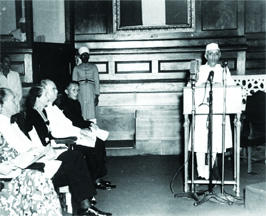
    Britain’s Parliament passed in July 1947 the Indian Independence Act. It ordered that the dominions of India and Pakistan be demarcated by midnight of August 14–15, 1947, now celebrated annually as Independence Day in both Pakistan (August 14) and India (August 15). It was both a glorious and a tragic moment. The peoples of the subcontinent, though deeply divided, were now free and the masters of their own destinies. Just before midnight, Nehru made his famous “Tryst with Destiny” speech to the Indian Constituent Assembly in the Parliament House.
    The Partition of India and Pakistan
    The Indian Independence Act ordered that the assets of the world’s largest empire—which had been integrated in countless ways for more than a century—be divided within a single month. Racing the deadline, the Boundary Commission, appointed by Mountbatten, worked desperately to partition Punjab and Bengal in such a way as to leave the maximum practical number of Muslims to the west of the former’s new boundary and to the east of the latter’s. The commission consisted of four members from the Congress Party and four from the Muslim League and was chaired by Cyril Radcliffe, a lawyer who had never before been to India. With little agreement between the parties and the deadline looming, Radcliffe made the final determination of the borders, which satisfied no one and infuriated everyone.
    Dividing Punjab and Bengal, the provinces with a slim Muslim majority, caused tremendous problems, as the demographic distributions of those regions were heterogeneous and diverse. The new borders ran through the middle of villages, towns, fields, and more. When Pakistan was created, East and West Pakistan were separated by about 1,000 miles (1,600 km).
    The commission also effectively cut in half the large Sikh population in Punjab. The western half of the community reacted with great concern over potential Muslim rule: the Mughal emperors had persecuted the Sikh Gurus in the 17th century, and the legacy of that persecution remained deeply felt. Although the commission had placed Amritsar, the Sikhs’ most sacred city, under Indian dominion, many other important Sikh shrines and landed estates were set to become part of Pakistan. Some Sikhs of western Punjab tried initially to retain control over their estates by pushing out local Muslims, but their attempts were met with violent reprisals. Nearly the entirety of the Sikh community ultimately fled to areas that would become part of India.
    The transfer of power was completed on August 14 in Pakistan and August 15 in India, held a day apart so that Mountbatten could attend both ceremonies. With the birth of the two independent countries, the British raj formally came to an end on August 15, 1947.
    The borders of the new countries were not published until August 17, two days after the end of British rule. This set the stage for an immediate escalation of communal violence in areas around the new borders. Many people did not understand what partition meant until they were in the middle of it, sometimes literally. If a border village was roughly evenly divided between Hindus and Muslims, one community could argue that the village rightly belonged to India or Pakistan by driving out or killing members of the other community.
    As soon as the new borders were announced, roughly 15 million Hindus, Muslims, and Sikhs fled from their homes on one side of the newly demarcated borders to what they thought would be “shelter” on the other. Some people were able to take trains or buses from one country to another, but most were forced to flee on foot, joining refugee columns that stretched for miles. These columns were the target of frequent ambushes, as were the trains that carried refugees across the new borders. In the course of that tragic exodus of innocents, as many as 2 million people were slaughtered in communal massacres (although scarce documentation left a wide range of estimates). Sikhs, settled astride Punjab’s new division, suffered the highest proportion of casualties relative to their numbers.
    While the worst of the violence took place during the first six weeks of partition, the consequences of those weeks played out for decades. Even provinces that had initially escaped violence later saw outbreaks of conflict; for example, Sindh struggled to absorb large numbers of refugees (muhajirs) from India who, although Muslim, belonged to different ethnolinguistic groups from the local population. Disparities that arose from the hasty creation of Pakistan led ultimately to a devastating war in 1971 between its eastern and western provinces, which resulted in the independence of East Pakistan as Bangladesh. Territorial disputes between India and Pakistan, particularly the question of the Kashmir region, have also led to multiple wars. Moreover, tensions over the rights of Sikhs and the preservation of their communal integrity have also led to violent confrontations in India, most notably with the storming of the Harmandir Sahib in 1984 and the subsequent assassination of Indira Gandhi.
    The assassination of Mahatma
    Gandhi and aftermath
    Amid growing communal violence, Gandhi traveled to New Delhi, India’s capital, to take part in a fast for peace and to participate in prayer meetings. His presence on the day of his death, January 30, 1948, attracted a crowd of followers estimated at between several hundred and 1,000 people. About 5:15 PM, Gandhi and his two granddaughters left Birla House, where he had been living, with the intent of leading his followers to a nearby summer pagoda where he often made his evening devotions. Nathuram Godse approached the frail politician, greeted him, then fired three shots at close range from a small-caliber revolver that he had hidden in his clasped hands, striking Gandhi in the upper thigh, abdomen, and chest. As Gandhi fell to the ground, he put his hand to his forehead in the Hindu gesture of forgiveness. He was quickly carried back into Birla House and placed on a couch, his head resting in the lap of his granddaughter Mani, who minutes later told the crowd: “Bapu is finished.” His final words were, allegedly, “He Ram, He Ram” (“Oh God, Oh God”).
    News of Gandhi’s death spread quickly throughout India, generating a sometimes violent response. In Bombay (now Mumbai), riots set fundamentalist Hindus against terrified Muslims. In New Delhi, throngs of people left their homes and businesses to mourn at Birla House. Troops were sent to maintain order. A few hours after Gandhi’s death, a balcony window at Birla House was opened and Gandhi’s body was carried outside and placed in a chair facing the crowd. Prime Minister Jawaharlal Nehru gave a radio address later in the evening in which he proclaimed a day of national mourning and appealed for calm:
    The light has gone out of our lives, and there is darkness everywhere. I do not know what to tell you and how to say it. Our beloved leader, Bapu as we called him, the Father of the Nation, is no more.…We will not run to him for advice and seek solace from him, and that is a terrible blow….The light has gone out, I said, and yet I was wrong….The light that has illumined this country for these many years will illumine this country for many more years, and a thousand years later, that light will be seen in this country and the world will see it and it will give solace to innumerable hearts.
    At the end of his speech, Nehru informed listeners that Gandhi’s body would be brought out at 11:30 AM the following day and taken to the banks of the Yamuna River, a tributary of the Ganges, and cremated there at 4 PM.
    Nathuram Godse was an acolyte of a right-wing fundamentalist political ideology known as Hindutva, championed at the time by the Rashtriya Swayamsevak Sangh (RSS), a Hindu nationalist organization. Godse was tried by a special court inside the historic Red Fort in May 1948. When it came time for him to speak, Godse read a 30,000-word confession in which he referred to Gandhi’s murder as “wholly and exclusively political” and held Gandhi responsible for partition and communal violence. Godse said he acted alone, although seven others were later convicted in relation to the murder. Godse and an accomplice, Narayan Apte, were executed by hanging on November 15, 1949; the other six were sentenced to life in prison.
    Yet Nehru carried on at India’s helm, and, owing in part to his secular enlightened leadership, not only did India’s flood of religious hatred and violence recede, but also some progress was made toward communal reconciliation and economic development. Nehru spoke out fearlessly against India’s “caste-ridden” and “priest-ridden” society, which, as a Hindu Brahman pandit, he could do without fear of too much upper-caste criticism. His charismatic brilliance, moreover, continued to make him a major vote-winner in each election campaign that he led (1951–52, 1957, and 1962) throughout his 17 arduous years in office as the Indian National Congress—opposed only by minor parties and independent candidates—dominated political life. Nehru’s modernist mentality and cosmopolitan popularity helped to hide the traditional continuity of India’s internal problems, few of which disappeared under his leadership.
    The promulgation of the Indian constitution
    The dominion of India was reborn on January 26, 1950, as a sovereign democratic republic and a union of states. That day is celebrated annually as Republic Day, a national holiday commemorating the adoption of India’s constitution on January 26, 1950. The constitution was crafted under the chairmanship of Bhimrao Ramji Ambedkar and resolved to secure for its citizens liberty, equality, and fraternity.
    With universal adult franchise, India’s electorate was the world’s largest, but the traditional feudal roots of most of its illiterate populace were deep, just as their religious caste beliefs were to remain far more powerful than more recent exotic ideas, such as secular statehood. Elections were to be held, however, at least every five years, and the major model of government followed by India’s constitution was that of British parliamentary rule, with a lower House of the People (Lok Sabha), in which an elected prime minister and a cabinet sat, and an upper Council of States (Rajya Sabha). Nehru led his ruling Congress Party from New Delhi’s Lok Sabha until his death in 1964. The nominal head of India’s republic, however, was a president, who was indirectly elected. India’s first two presidents were Hindu Brahmans, Rajendra Prasad and Sarvepalli Radhakrishnan, the latter a distinguished Sanskrit scholar who had lectured at the University of Oxford. Presidential powers were mostly ceremonial, except for brief periods of “emergency” rule, when the nation’s security was believed to be in great danger and normal constitutional procedures and civil rights were feared to be too cumbersome or threatening.

  • Symbols and tenets of Sikhism

    Symbols and tenets of Sikhism

    A Path of Oneness, Courage, and Compassion
    Sikhism, or Sikhi, is more than a religion-it’s a spiritual way of life rooted in devotion, equality, and service. It began in the late 15th century with the teachings of Guru Nanak Dev Ji and was developed over 239 years by Ten Gurus who collectively shaped a powerful synthesis of spiritual discipline, social reform, and community service.
    The Sikh worldview is expressed not only through profound philosophical teachings but also through distinctive symbols that offer constant guidance in daily life. These tenets and symbols help the Sikh remain connected to the Divine, conscious of their duties, and committed to justice in society.
    Fundamental Tenets of Sikhism: The Building Blocks of a Sikh Life
    – Belief in One Timeless God (Ik Onkar)
    At the very heart of Sikh belief lies Ik Onkar-“There is but One God.”
    – God is Formless (Nirankar), without image, gender, or limits
    – God is Truth (Satnam), the Eternal Creator (Karta Purakh)
    – God is accessible through Naam Simran (meditation on the Name)
    This universal God is not exclusive to Sikhs but is present in all creation, transcending caste, religion, or race.
    “There is but One God, whose Name is Truth, the Creator, Fearless, Timeless, Unborn, Self-existent.” – Guru Granth Sahib Ji (Japji Sahib)
    – Three Pillars of Sikh Practice (Guru Nanak’s Code)
    Guru Nanak Dev Ji established a revolutionary lifestyle model based on spiritual awareness within society, not outside of it.
    – Naam Japna (Remembering God’s Name)
    – A meditative practice that focuses on internal connection with the Divine
    – Promotes humility, detachment from ego (Haumai), and spiritual peace
    – Encouraged through recitation (Jap), singing (Kirtan), and contemplation (Simran)
    – Kirat Karni (Honest Living)
    – Earn your livelihood through truthful and fair means
    – Avoid cheating, corruption, or exploitation
    – Work is seen as divine duty, not separate from worship
    – Vand Chakna (Sharing with Others)
    – Sharing wealth, food, and time with those in need
    – Builds community, reduces inequality, and promotes compassion
    – Practiced practically through Langar, charity, and volunteering (Seva)
    – Rejection of Ritualism and Superstition
    Sikhism encourages direct connection with God, free of:
    – Idol worship
    – Ritual sacrifices
    – Astrology, fasting, or pilgrimage as a substitute for inner devotion
    Instead, it teaches ethical conduct, prayer, and honest effort.
    “Superstition is the root of bondage. Seek the truth within.” – Guru Nanak Dev Ji
    Equality and Social Reform
    The Sikh Gurus fought entrenched social hierarchies:
    – Caste system was firmly rejected. The Gurus dined and served with people of all backgrounds.
    – Women’s equality was emphasized. Sikh women were empowered as spiritual leaders, warriors, and scholars.
    “Why call her inferior, from whom kings are born?” – Guru Nanak Dev Ji
    – Seva (Selfless Service) and Compassion
    Seva is sacred work done without desire for reward. It embodies:
    – Compassion for all beings (Daya)
    – Egolessness (Nimrata)
    – A sense of universal responsibility
    From local Gurdwaras to global disaster relief, Seva is a core expression of love and spirituality in Sikh life.
    – Justice and Righteous Action (Sant-Sipahi)
    Sikhs are encouraged to live as saint-soldiers (Sant-Sipahi), combining:
    – Spiritual wisdom (Sant) with
    – Moral courage (Sipahi)
    Standing up against injustice is not just a right-it’s a duty.
    “When all other means fail, it is righteous to draw the sword.” – Guru Gobind Singh Ji
    Sacred Symbols of Sikhism:
    Expressions of the Inner Journey
    Sikh symbols are visible commitments to the Guru’s teachings and reminders of one’s spiritual and moral obligations.
    – Ik Onkar
    – Pronounced “Ik Oangkar”
    – The first word in Guru Granth Sahib Ji
    – Represents unity of God, creation, and eternal truth
    It is the starting point of Sikh theology, often inscribed at the top of scriptures, Gurdwaras, and Sikh literature.
    – Khanda: The Sikh Emblem
    The Khanda symbolizes divine sovereignty, justice, and spiritual balance.
    Three Elements:
    – Double-edged sword (Khanda): Power of truth and spiritual knowledge
    – Chakkar (circle): Unity of all creation and eternity
    – Two Kirpans: Miri (temporal power) and Piri (spiritual authority)
    This symbol reflects the Khalsa ideal: devotion, discipline, and defense of righteousness.
    – Nishan Sahib: The Sikh Flag
    – A tall triangular flag outside every Gurdwara Sahib
    – Saffron/orange for courage, sacrifice, and humility
    – Flown as a beacon of sanctuary, community, and unity
    During celebrations, the flag and its pole are respectfully washed and rewrapped with fresh cloth in a Nishan Sahib Seva ceremony.
    – The Five Ks (Panj Kakaar): Living the Khalsa Code
    Introduced at the historic event of Khalsa Sajna Diwas (1699), these articles are worn by baptized Sikhs (Khalsa) as daily discipline and identity.
    Kakkar Symbolizes Spiritual Significance
    – Kesh (Uncut Hair) Respect for God’s creation Spiritual wisdom, submission to divine will
    – Kangha (Wooden Comb) Cleanliness and order Daily hygiene, mental clarity
    – Kara (Steel Bracelet) Bond with God Infinity, moral restraint
    – Kachera (Cotton Undergarment) Chastity and modesty Self-control, alertness
    – Kirpan (Ceremonial Sword) Courage and justice Duty to protect the innocent
    These symbols transform the body into a spiritual instrument and a living shrine of discipline.
    Guru Granth Sahib Ji: The Eternal Guide
    After Guru Gobind Singh Ji, the scripture itself became the Guru:
    – Comprises hymns (Shabads) of Sikh Gurus and Bhagats (saint-poets of Hindu and Muslim backgrounds)
    – Written in Gurmukhi, blending Punjabi, Sanskrit, Persian, and Braj
    – Focuses on Naam, truth, service, and divine love
    It is read with utmost reverence, and its teachings are central to Sikh worship and decision-making.
    The Gurdwara: House of Worship and Service
    – Open to all people, regardless of faith
    – No idols or images-only Guru Granth Sahib Ji as the spiritual focus
    – Langar (free communal meal) offered daily
    – Core values practiced: equality, humility, hospitality
    Five Takhts: Seats of Sikh Authority
    – Akal Takht Sahib (Amritsar) – Supreme temporal authority
    – Takht Sri Keshgarh Sahib (Anandpur Sahib) – Birthplace of Khalsa
    – Takht Sri Damdama Sahib (Talwandi Sabo) – Site of Guru Granth Sahib Ji’s final compilation
    – Takht Sri Patna Sahib (Bihar) – Birthplace of Guru Gobind Singh Ji
    – Takht Sri Hazur Sahib (Nanded) – Where Guru Gobind Singh Ji passed the Guruship to the scripture
    Universal Message and Modern Relevance
    – Equality for all, regardless of background
    – Environmental stewardship as part of spiritual responsibility
    – Humanitarian service through global Sikh organizations
    – Moral leadership in politics, military, medicine, and public service

  • Odisha: A journey through history, culture, tradition and architecture

    Odisha: A journey through history, culture, tradition and architecture

    Odisha’s history, culture, tradition, and architecture are intertwined in a rich tapestry that reflects its ancient glory and resilience. From the grandeur of the Kalinga Empire to the magnificence of the Jagannath Temple and the artistic finesse of Odissi dance, the state stands as a testament to India’s diverse heritage. Odisha’s political history, marked by conquests, colonial rule, and modern progress, adds depth to its narrative. As a land of spirituality, art, and history, Odisha continues to inspire and captivate people from all over the world, earning its rightful place as the cultural soul of India.

    Odisha, located on the eastern coast of India, is a land of timeless heritage, magnificent architecture, rich cultural traditions, and a fascinating political history. Known as the “soul of India,” Odisha has been a cradle of civilization, art, and spirituality. With its ancient temples, vibrant festivals, and storied past, the state beckons travelers, historians, and cultural enthusiasts alike. This article explores Odisha’s glorious history, cultural riches, architectural marvels, and political evolution over the centuries.
    Ancient History of Odisha
    Early Human Settlements
    The history of Odisha dates back to prehistoric times, with evidence of human settlements as early as the Stone Age. Excavations at sites like Kuliana and Mayurbhanj indicate that the region was inhabited by early human societies practicing rudimentary agriculture and crafting tools.
    Kalinga: The Ancient Name of Odisha
    In ancient history, Odisha was known as Kalinga. It gained prominence as a powerful kingdom that played a significant role in Indian politics, trade, and culture.
    The Kalinga region stretched across modern Odisha and parts of Andhra Pradesh. The first recorded mention of Kalinga appears in Mahabharata and Jain texts.
    The Kalinga War (261 BCE)
    One of the most defining moments in Odisha’s history was the Kalinga War fought between the Mauryan emperor Ashoka and the Kalinga kingdom in 261 BCE. The war was brutal, with massive casualties. However, its aftermath marked a turning point in Indian history. The devastation of the war led Ashoka to embrace Buddhism, promoting peace, compassion, and non-violence. The war’s significance is captured in Ashoka’s inscriptions at Dhauli and Jaugada.
    Maritime Trade and Cultural Exchange
    During ancient times, Odisha’s coastline facilitated extensive maritime trade with Southeast Asian countries like Java, Sumatra, Bali, and Sri Lanka. Traders and sailors from Kalinga established cultural and commercial ties, leading to the spread of Indian art, architecture, and religion, especially Buddhism and Hinduism.
    Rich Cultural Heritage
    Odisha’s culture is a harmonious blend of tradition, spirituality, art, and festivals, which have been preserved for thousands of years.
    Performing Arts
    Odissi Dance
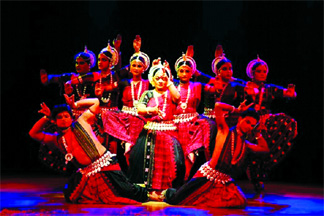
    Odisha is the birthplace of Odissi, one of the eight classical dance forms of India. With its roots in ancient temple rituals, Odissi is characterized by graceful movements, expressive gestures, and intricate footwork. Dancers use mudras (hand gestures) to convey stories from Hindu mythology.
    Folk Dances
    Odisha boasts a variety of folk dances like Chhau, Sambalpuri, and Ghumura, each reflecting local traditions and cultural vibrancy. The Chhau dance, particularly from Mayurbhanj, combines martial arts and folk elements.
    Music
    Odisha has a rich musical tradition rooted in Odissi Sangeet, which is a form of classical music. The music, often accompanied by instruments like the veena, mardala, and bansuri, complements Odissi dance performances and devotional songs.
    Festivals
    Odisha’s festivals are colorful and deeply rooted in spirituality:
    Rath Yatra
    The annual chariot festival at the Jagannath Temple in Puri is one of the largest religious gatherings in the world.
    Durga Puja
    Celebrated with grandeur across the state, Durga Puja marks the victory of good over evil.
    Bali Yatra
    This festival commemorates Odisha’s ancient maritime connections and is celebrated on the banks of the Mahanadi River.
    Makar Sankranti and Nuakhai
    These harvest festivals celebrate agrarian traditions and community bonding.
    Handicrafts and Textiles
    Odisha’s artisans are renowned for their craftsmanship:
    Pattachitra
    Traditional scroll paintings depicting mythological themes and intricate designs.
    Applique Work
    Pipili appliqué craft, often seen during temple festivals, involves colorful fabric cutouts stitched onto cloth.
    Ikat Weaving
    Odisha’s handwoven Ikat sarees from Sambalpur and Sonepur are globally acclaimed.
    Stone Carving
    The art of stone carving, seen in Odisha’s temples, continues to thrive.
    Architectural Marvels
    Odisha is home to some of India’s most impressive architectural treasures. The state’s architecture reflects its religious and cultural history, particularly influenced by Hindu, Jain, and Buddhist traditions.
    Temples of Odisha
    The temples of Odisha are a testament to the state’s rich architectural heritage. Built primarily during the Kalinga period, these temples follow the Kalinga style of architecture, characterized by curvilinear spires, intricate carvings, and spacious courtyards.
    Lingaraj Temple (Bhubaneswar)
    Built in the 11th century, this temple is dedicated to Lord Shiva and represents the zenith of Kalinga architecture. The sanctum, tower, and carvings display exceptional craftsmanship.
    Jagannath Temple (Puri)
    One of the Char Dhams of Hindu pilgrimage, the Jagannath Temple is dedicated to Lord Jagannath (a form of Vishnu). Its massive structure and annual Rath Yatra attract millions of devotees.
    Konark Sun Temple
    A UNESCO World Heritage Site, the Konark Sun Temple is shaped like a colossal chariot with intricately carved stone wheels, pillars, and sculptures. Built in the 13th century by King Narasimhadeva I, it remains a masterpiece of Kalinga architecture.
    Mukteshwar Temple
    Known as the “Gem of Odisha Architecture,” this 10th-century temple is renowned for its exquisite carvings and arched gateway.
    Buddhist Monasteries and Stupas
    Odisha has a rich Buddhist heritage reflected in its ancient stupas and monasteries:
    Ratnagiri, Udayagiri, and Lalitgiri
    Known as the Diamond Triangle of Odisha, these sites contain remains of stupas, monasteries, and sculptures from the Buddhist era (7th-12th centuries CE).
    Dhauli
    The site where Ashoka embraced Buddhism after the Kalinga War, Dhauli houses the Shanti Stupa (Peace Pagoda).
    Forts and Palaces
    Barabati Fort
    Located in Cuttack, this 14th-century fort was a prominent military stronghold during the medieval period.
    Chilika Lake and Kalijai Temple
    Though not an architectural site, the Kalijai Temple on Chilika Lake is a significant cultural landmark.
    Political History of Odisha
    Odisha’s political history is marked by the rise and fall of powerful dynasties, colonial domination, and post-independence development.
    Ancient Dynasties
    Mauryas and Ashoka
    The Mauryan conquest of Kalinga marked a significant chapter in Odisha’s history.
    Mahameghavahana Dynasty
    Under King Kharavela (1st century BCE), Odisha witnessed a resurgence of Jainism and territorial expansion. Kharavela’s Hathigumpha inscription at Udayagiri provides insights into his reign.
    Medieval Period
    Somavamshi Dynasty
    Between the 9th and 12th centuries, the Somavamshis established their rule in Odisha, contributing to temple construction.
    Ganga Dynasty
    The Ganga rulers, particularly King Anantavarman Chodaganga Deva, ushered in a golden era of Odisha’s art and architecture. The Jagannath Temple was built during this period.
    Eastern Ganga Dynasty
    The Ganga rulers continued their legacy, with the construction of the Konark Sun Temple marking the pinnacle of their achievements.
    Surya Vamsi Gajapati Dynasty
    In the 15th century, the Gajapati kings ruled Odisha with great prowess, expanding their influence to neighboring regions.
    Colonial Rule
    In the 16th century, Odisha came under Mughal rule and later the Marathas in the 18th century. In 1803, the British East India Company annexed Odisha, marking the beginning of colonial exploitation. The region became part of the Bengal Presidency until it gained separate identity as Odisha Province in 1936.
    Modern Odisha
    Post-independence, Odisha became a state of the Indian Union on April 1, 1936, celebrated as Utkal Divas. Since then, Odisha has made significant strides in socio-economic development while preserving its cultural heritage.
    BJP term in Odisha
    The Bharatiya Janata Party (BJP) assumed power in Odisha on June 12, 2024, marking a significant shift after five consecutive terms under the Biju Janata Dal (BJD).
    Since 1946, Odisha has had 14 chief ministers. Serving from 2000 till 2024, Naveen Patnaik of the Biju Janata Dal was the longest-serving chief minister in Odisha’s history. The current Chief Minister of Odisha since 12 June 2024 is Mohan Charan Majhi of the Bharatiya Janata Party.
    In collaboration with the state government, the 18th Pravasi Bharatiya Divas (PBD) Convention is scheduled to take place in Bhubaneswar from January 8 to 10, 2025. Prime Minister Narendra Modi is set to inaugurate the event, which will focus on the theme “Diaspora’s contribution to a Viksit Bharat.” The convention aims to engage the Indian diaspora in India’s development journey.
    The BJP government in Odisha has been proactive in implementing policies to enhance the state’s growth trajectory. Prime Minister Modi has acknowledged these efforts, emphasizing the government’s commitment to development.
    Additionally, the new administration has initiated investigations into alleged corruption during the previous BJD regime. Chief Minister Mohan Charan Majhi has pledged to probe all corruption cases from the BJD’s tenure, aiming to ensure transparency and accountability in governance.
    The BJP’s rise to power in Odisha signifies a transformative period, with the government focusing on development, anti-corruption measures, and strengthening ties with the Indian diaspora through events like the upcoming PBD Convention.

  • Constitution of India

    Constitution of India

    January 26 marks the date on which the Constitution of India came into effect in 1950 and is celebrated as Republic Day. On this date, India became a sovereign nation free from the British Monarchy. On the 72nd anniversary of Republic Day, we look at some key facts about the Indian Constitution.

    HISTORY

    The Constitution of India became the supreme law of this nation, replacing the Government of India Act of 1935, adapted from the Parliament of the United Kingdom. After India’s independence from British rule in 1947, The Constituent Assembly of India got elected to create the Constitution of India. It was passed and adopted on November 26, 1949, and came into force on January 26, the following year.

    The Drafting Committee was headed by its chairman, Dr. BR Ambedkar, the jurist, economist and social reformer who worked to uplift the Dalits of India. K.M. Munshi, Alladi Krishnaswamy Iyer, Muhammed Saadullah, N Madhava Rao and Gopala Swami Ayyangar were the other six members of the committee. Dr. Rajendra Prasad, the first President of India, was the president of the Drafting Committee.

    FEATURES

    The Indian Constitution is the longest one in the world and is the second-largest active Constitution. It has 470 articles in 25 parts and 12 schedules with five appendices. It had 395 articles in 22 parts and 8 schedules, originally. Additions took place through amendments or changes to the Constitution.

    SEPARATION OF POWERS

    The Constitution of India lays down the distinctions in the political power structure in the country between the Centre and the states. It provides for the checks and balances between the organs of the government, namely, the Judiciary, the Executive and the Legislature, to prevent the concentration of power in one particular branch.

    DEMOCRACY

    The preamble to the Constitution of India declares India to be a ‘Sovereign Socialist Secular Democratic republic,’ having a parliamentary governance system. Six fundamental rights, namely, the right to equality, liberty, right against exploitation, freedom of religion, cultural and educational rights, and right to constitutional remedies, are recognised by the Indian Constitution.

    Background

    The major portion of the Indian subcontinent was under British rule from 1857 to 1947. When the Constitution of India came into force on 26 January 1950, it repealed the Indian Independence Act. India ceased to be a dominion of the British Crown and became a sovereign democratic republic. The date of 26 January was chosen to commemorate the Purna Swaraj declaration of independence of 1930.

    Articles 5, 6, 7, 8, 9, 60, 324, 366, 367, 379, 380, 388, 391, 392, 393 and 394 of the Constitution came into force on 26 Nov 1949 and the remaining articles on 26 Jan 1950.

    Previous legislation used as sources

    It is drawn from many sources. Keeping in mind the needs and conditions of India its framers borrowed different features freely from previous legislation viz. Government of India Act 1858, Indian Councils Act 1861, Indian Councils Act 1892, Indian Councils Act 1909, Government of India Act 1919, Government of India Act 1935 and the Indian Independence Act 1947. The last legislation which led to the creation of the two independent nations of India and Pakistan provided for the division of the erstwhile Constituent Assembly into two, with each new assembly having sovereign powers transferred to it, to enable each to draft and enact a new constitution, for the separate states.

    Constituent assembly

    It was drafted by the Constituent Assembly, which was elected by elected members of the provincial assemblies. The 389 member Constituent Assembly took almost three years (two years, eleven months and eighteen days to be precise) to complete its historic task of drafting the Constitution for independent India, during which, it held eleven sessions over 165 days. Of these, 114 days were spent on the consideration of the draft Constitution. On 29 August 1947, the Constituent Assembly set up a Drafting Committee under the Chairmanship of Dr. B.R. Ambedkar to prepare a draft Constitution for India. While deliberating upon the draft Constitution, the assembly moved, discussed and disposed of as many as 2,473 amendments out of a total of 7,635 tabled. Dr B.R. Ambedkar, Sanjay Phakey, Jawaharlal Nehru, C. Rajagopalachari, Rajendra Prasad, Sardar Vallabhbhai Patel, Kanaiyalal Munshi, Ganesh Vasudev Mavalankar, Sandipkumar Patel, Maulana Abul Kalam Azad, Shyama Prasad Mukherjee, Nalini Ranjan Ghosh, and Balwantrai Mehta were some important figures in the assembly. There were more than 30 members of the scheduled classes. Frank Anthony represented the Anglo-Indian community, and the Parsis were represented by H. P. Modi. The Chairman of the Minorities Committee was Harendra Coomar Mookerjee, a distinguished Christian who represented all Christians other than Anglo-Indians. Ari Bahadur Gurung represented the Gorkha Community. Prominent jurists like Alladi Krishnaswamy Iyer, Benegal Narsing Rau and K. M. Munshi, Ganesh Mavlankar were also members of the Assembly. Sarojini Naidu, Hansa Mehta, Durgabai Deshmukh, Rajkumari Amrit Kaur and Vijayalakshmi Pandit were important women members

    The first temporary 2-day president of the Constituent Assembly was Dr Sachchidananda Sinha. Later, Rajendra Prasad was elected president of the Constituent Assembly.The members of the Constituent Assembly met for the first time on 9 December 1946.

    Drafting

    On the 14 August 1947 meeting of the Assembly, a proposal for forming various committees was presented. Such committees included a Committee on Fundamental Rights, the Union Powers Committee and Union Constitution Committee. On 29 August 1947, the Drafting Committee was appointed, with Dr B. R. Ambedkar as the Chairman along with six other members assisted by a constitutional advisor. These members were Pandit Govind Ballabh Pant, Kanaiyalal Maneklal Munshi (K M Munshi, Ex- Home Minister, Bombay), Alladi Krishnaswamy Iyer (Ex- Advocate General, Madras State), N Gopalaswami Ayengar (Ex-Prime Minister, J&K and later member of Nehru Cabinet), B L Mitter (Ex-Advocate General, India), Md. Saadullah (Ex- Chief Minister of Assam, Muslim League member) and D P Khaitan (Scion of Khaitan Business family and a renowned lawyer). The constitutional advisor was Sir Benegal Narsing Rau (who became First Indian Judge in International Court of Justice, 1950-54). Later B L Mitter resigned and was replaced by Madhav Rao (Legal Advisor of Maharaja of Vadodara). On D P Khaitan’s death, T T Krishnamachari was included in the drafting committee. A draft Constitution was prepared by the committee and submitted to the Assembly on 4 November 1947, which was debated and over 2000 amendments were moved over a period of two years. Finally on 26 November 1949, the process was completed and the Constituent Assembly adopted the Constitution. 284 members signed the document and the process of constitution making was complete. This day is celebrated as National Law Day or Constitution Day.

    The assembly met in sessions open to the public, for 166 days, spread over a period of 2 years, 11 months and 18 days before adopting the Constitution, the 308 members of the assembly signed two copies of the document (one each in Hindi and English) on 24 January 1950. The original Constitution of India is hand-written with beautiful calligraphy, each page beautified and decorated by artists from Shantiniketan including Beohar Rammanohar Sinha and Nandalal Bose. The illustrations on the cover and pages represent styles from the different civilisations of the subcontinent, ranging from the prehistoric Mohenjodaro civilisation, in the Indus Valley, to the present. The calligraphy in the book was done by Prem Behari Narain Raizda. It was published in Dehra Dun, and photolithographed at the offices of Survey of India. The entire exercise to produce the original took nearly five years. Two days later, on 26 January 1950, the Constitution of India became the law of all the States and territories of India. Rs.1,00,00,000 was official estimate of expenditure on constituent assembly. It has undergone many amendments since its enactment. The original 1950 Constitution of India is preserved in helium cases in the Parliament house, New Delhi. There are two original versions of this – one in Hindi and the other in English.

    Preamble to the Constitution of India

    India on Sunday, Jan 23,  kicked off its Republic Day celebrations with ‘Parakram Diwas,’ a day dedicated to iconic freedom fighter Netaji Subhash Chandra Bose. January 23 is also Netaji’s birth anniversary.

    January 26th is significant for the country’s political history as it is the day when the country formally adopted its constitution in 1950. It replaced the Government of India Act (1935) as the governing document of India and thus, turning the nation into a newly formed republic.

    What is Preamble to the Constitution of India?

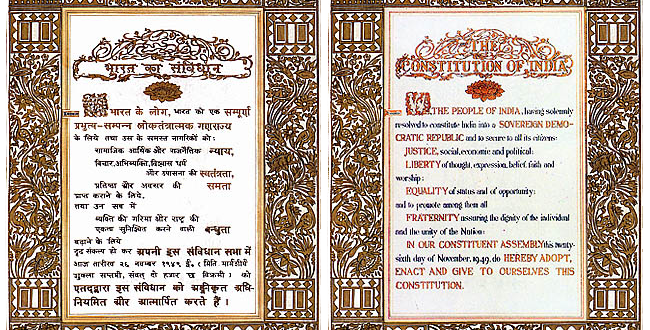
    The Preamble to the Constitution of India is an introductory statement that presents the key principles of the Constitution. It was adopted on 26 November 1949 by the Constituent Assembly and came into effect on 26 January 1950, celebrated as the Republic day in India.

    Full text of Preamble to the Constitution

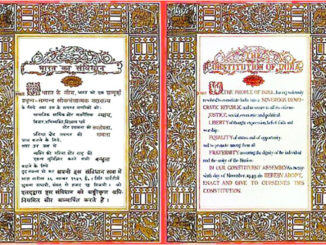
    WE, THE PEOPLE OF INDIA, having solemnly resolved to constitute India into a SOVEREIGN SOCIALIST SECULAR DEMOCRATIC

    REPUBLIC and to secure to all its citizens:

    JUSTICE, social, economic and political;

    LIBERTY of thought, expression, belief, faith and worship;

    EQUALITY of status and of opportunity; and to promote among them all

    FRATERNITY assuring the dignity of the individual and the unity and integrity of the Nation;

    IN OUR CONSTITUENT ASSEMBLY this twenty-sixth day of November, 1949, do HEREBY ADOPT, ENACT AND GIVE TO OURSELVES THIS CONSTITUTION.

    Preamble embodies Constitution’s vision

    The Preamble manifests the vision of the draftspersons of the Constitution. In adopting it after the draft Constitution was approved, the Constituent Assembly ensured that the Preamble exhibited conformity with the provisions of the Constitution. Yet, the content of the Preamble traces its origins to even before the task of drafting the Constitution began. The foundations of the Preamble were laid down in the Objectives Resolution moved by Jawaharlal Nehru before the Constituent Assembly in December 1946.

    The purpose of the resolution was to “proclaim India as an Independent Sovereign Republic and to draw up for her future governance a Constitution”, which would secure “to all the people of India justice, social, economic and political; equality of status, of opportunity, and before the law; freedom of thought, expression, belief, faith worship, vocation, association and action”, among other goals. Seconding the resolution, one member remarked that equality was “its underlying theme”. Another member supporting the resolution firmly believed that the Indian Republic would “be both democratic and socialist”. The resolution was enthusiastically supported by most of the members and was adopted in January 1947.

    Later, Nehru pointed out that Objective Resolution could be adopted with certain changes as the Preamble. The Drafting Committee headed by BR Ambedkar felt that the Preamble should be restricted to defining the essential features of the new State and its basic socio-political objectives and that the other matters dealt with in the resolution could be more appropriately provided for in the substantive parts of the Constitution.

    The Committee modified the content of the Objectives Resolution to formulate the Preamble, while clarifying that it followed the spirit and, as far as possible, the language of the resolution. The Committee adopted the expression “Sovereign Democratic Republic” instead of “Sovereign Independent Republic”, as it considered independence to be implied in the word “Sovereign”. The Committee introduced a clause on “Fraternity” to emphasize upon the need for fraternal concord and goodwill in India, which was specifically greater than ever, after the Partition.

    The draft Preamble, as it is in current form, was tabled before the Constituent Assembly in October 1949. One member sought to include “In the name of God” in the beginning of the Preamble. The Assembly rejected the proposed amendment. Another member argued that inclusion of God would amount to compulsion of faith and violate the fundamental right to freedom of faith. Another member stated that invoking the name of God in the Preamble would resemble “a narrow, sectarian spirit, which is contrary to the spirit of the Constitution.” The Assembly adopted the Preamble as presented by the Drafting Committee.

    The Preamble recognizes and proclaims that the Constitution has its root, its authority, and its sovereignty, from the people. “Sovereign Democratic Republic” reflects the establishment of a democratic form of government, where ultimate power is vested with the public and exercised through universal adult franchise. Commenting upon this aspect of the Preamble, Acharya Kriplani observed that “democracy is inconsistent with caste system”, and that we must do away with castes and classes. “Justice, social, economic and political” symbolizes the commitment of the framers to put an end to status quo of inequalities and historical injustices and to replace fundamental wrongs with fundamental rights. As Kriplani remarked, “Liberty of thought, expression, belief, faith and worship” can only be guaranteed on the basis of non-violence and mutual respect for each other. “Equality of status and of opportunity”, in Ambedkar’s words, means absence of glaring inequalities and discrimination in the society. The expression “to promote among them all” is linked with “Fraternity”. Ambedkar defined “Fraternity” as “a sense of common brotherhood of all Indians” and “an attitude of respect and reverence towards fellow men”, which give “unity and solidarity to social life”. The principles of liberty, equality and fraternity would ensure dignity of each individual, thus leading to unity of the nation. Ambedkar considered liberty, equality and fraternity to be forming “a union of trinity in the sense that to divorce one from the other is to defeat the very purpose of democracy”.

    The addition of the words “Socialist” and “Secular” into the Preamble by the 42nd constitutional amendment during the Emergency in 1976 did not alter its nature or identity. It merely provided a label to what was already in existence. There are three key points in support of this contention. First, in support of Nehru’s Objectives Resolution, one member explained that the content of economic democracy and rejection of the existing social structure reflected through the phrases “justice, social, economic and political” and “equality of opportunity” represent the socialist aspect of the Resolution, without providing it with an open label. These phrases were later adopted into the Preamble. Second, by rejecting inclusion of any phrase on God in the Preamble, the Assembly adopted a secular document instead of a sectarian one. Third, the Preamble embodies the philosophy of the Constitution, which is reflected through its provisions and the basic structure. As Justice DY Chandrachud held in one of his judgments, the addition of the word “secular” solidified the basic structure of the Constitution, which enshrines secularism in the fundamental rights chapter.

    The Court has often engaged with interpretation of the Constitution by relying upon the vision and values contained in the Preamble. While the flourishing of a constitutional order demands an active institutional role of courts, it also requires a responsive participation of the citizenry. The response of the citizens to their elected representatives has a powerful role in giving a meaning to the words of the Constitution. The content of the Preamble not only embodies events which predate the adoption of the Constitution, but also incorporates the citizens’ experiences in the unfolding of the Constitution over the past seventy years. The hopes and aspirations of the people enshrined in the Preamble have sustained due to years of practice, effort, and experience to make society work with those values. The recent events of claiming the Preamble and the Constitution by the citizens as their very own resemble a path towards the professed collective destiny of India.

  • Indian couple from Nebraska sentenced to one year for staying illegally, harboring another illegal alien

    Indian couple from Nebraska sentenced to one year for staying illegally, harboring another illegal alien

    OMAHA (TIP): An Indian couple, illegally staying in the US, was sentenced to one-year jail term for alien harboring. Vishnubhai Chaudhari, 50, and Leelabahen Chaudhari, 44, of Kimball, Nebraska, were sentenced to one year and one day in federal prison on Monday, March 19, by the federal court in Omaha.

    The couple has pleaded guilty to alien harboring for financial gain and conspiracy to harbor an alien in December last year. They have also agreed to a stipulated judicial order of removal to India at the completion of their sentences and paid the victim $40,000 in restitution as a condition of their guilty pleas.

    The couple admitted to conspiring to harbor the victim, who was an illegal alien from India, at a Super 8 Motel in Kimball between October 2011 and February 2013, said a statement issued by US Immigration and Customs Enforcement (USICE).

    The victim was forced to work long hours, seven days a week at the motel. He did manual labor, including cleaning rooms, shoveling snow and doing laundry.

    Though the couple promised to pay him a salary, they cheated him by not making the payment. The defendants claimed to apply the victim’s earned pay to a debt the victim owed. He was verbally abused and physically assaulted for not meeting the expectations of the couple.

    Leelabahen Chaudhari slapped his face several times because he had failed to clean a bathtub to her standards, said the USICE statement.

    Vishnubhai and Leelabahen also tried to restrict the victim’s movement and threatened to find him if he tried to escape.

    “Today’s sentence, and the restitution awarded to the victim, sends a clear message that the Justice Department will use its full resources to prosecute defendants like this one who motivated by their greed violate our immigration laws and exploit a vulnerable individual who lacked immigration status,” said Acting Assistant Attorney General John Gore of the Department of Justice’s Civil Rights Division.

    “This case is a reminder that labor exploitation occurs in the United States, not just overseas, and federal law targets those who profit from human trafficking and related crimes,” said US Attorney Joe Kelly for the District of Nebraska. “This case is a testament that such conduct will be vigorously investigated and prosecuted in the District of Nebraska.”

    This case was prosecuted by Trial Attorneys Olimpia Michel and Shan Patel of the Civil Rights Division’s Criminal Section and Human Trafficking Prosecution Unit, and Assistant U.S. Attorney Frederick D. Franklin of the District of Nebraska.

    (Source: DOJ)


  • Officials say 76 police officers hurt in clashes with anti-G20 protesters

    Officials say 76 police officers hurt in clashes with anti-G20 protesters

    HAMBURG (TIP): At least 76 police officers were hurt on Thursday in clashes with anti-G20 protesters in Hamburg, German authorities said, as a demonstration dubbed “Welcome to Hell” erupted in violence shortly after it began.

    “Police are still being attacked,” said a spokesman for Hamburg’s police force, adding that most of the officers hurt sustained light injuries.

    Demonstrations turned violent late Thursday, as German police clashed with a group of masked anti-capitalist activists hurling bottles and stones.

    What should have been a peaceful march by around 12,000 people in Hamburg protesting against globalisation was halted as police used water cannon and tear gas to disperse around 1,000 far-left militants.

    Police called with loudspeakers on protestors to remove their masks but this was ignored and after more objects were thrown, authorities decided to separate them from the other protestors, police said on Twitter.

    “Unfortunately it has come to the first clashes. We are implementing corresponding measures,” read another tweet.

    Protesters were seen scrambling to leave the scene, while others defiantly stood in the way of water cannon trucks as they moved in surrounded by riot police with helmets and batons.

    Police tweeted a photo of a car and flames and said shop windows were smashed. The main “Welcome to Hell” march was then called off but thousands of people remained as night fell and demonstrators engaged in smaller skirmishes in the back streets of Germany’s second city, AFP correspondents said.

    Up to 100,000 demonstrators are expected before and during the two-day Group of 20 meeting gathering Trump, Russia’s Vladimir Putin and Xi Jinping of China starting on Friday.

    There were 20,000 police on standby together with armoured vehicles, helicopters and surveillance drones. A holding centre for detainees has been set up in a former hardware store with space for 400 people.

    “War, climate change, exploitation are the result of the capitalist system that the G20 stands for and which 20,000 police are here to defend,” demonstrator Georg Ismail told AFP.

    Major events like the G20 have in recent years usually been held in remote locations, but Germany was forced by its logistical demands to host it in a large city with a big venue and dozens of hotels.

    Hamburg is desperate to avoid a rerun of the kind of major clashes seen at the 2001 G8 summit in Genoa or the Frankfurt opening of the new European Central Bank building in 2015.

    In Hamburg, some 30 demonstrations have been announced, organised by anti-globalisation activists and environmentalists, trade unions, students and Church groups.

    “Welcome to Hell” organiser Andreas Blechschmidt said the motto is “a combative message… but it’s also meant to symbolise that G20 policies worldwide are responsible for hellish conditions like hunger, war and the climate disaster”.

    The main focus of attention inside the G20 venue on the first day of the summit on Friday will be Trump’s first face-to-face meeting with Putin. Speaking in the Polish capital earlier on Thursday in front of 10,000 people, Trump didn’t mince his words about Moscow.

    “We urge Russia to cease its destabilising activities in Ukraine and elsewhere, and its support for hostile regimes — including Syria and Iran — and to instead join the community of responsible nations in our fight against common enemies and in defence of civilisation itself,” he said.

    Arriving in Hamburg later Thursday, Trump headed to talks with German Chancellor Angela Merkel, who has vowed to defend the 2015 Paris climate accord despite the US leader’s decision to withdraw.

    Merkel said before meeting the US president that Trump was facing isolation within the G20 over the issue — one of several topics where the new US leader is likely to clash with his fellow leaders. (Reuters)

  • Indian-American CEO to pay $135K to former domestic worker for Abuse

    Indian-American CEO to pay $135K to former domestic worker for Abuse

    SACRAMENTO (TIP): An Indian-American CEO has been ordered to pay USD 135,000 to her former domestic worker after a Labor Department investigation found she underpaid and mistreated her.

    Himanshu Bhatia, CEO of Rose International and IT Staffing, will have to pay her former live-in domestic service worker back wages and damages under the terms of a consent judgement entered into the US District Court for the Central District of California.

    The judgement, entered on April 11, resolves a complaint filed by the US Department of Labor in August last year. An investigation by the department’s Wage and Hour Division found that Bhatia willfully and repeatedly violated federal labor laws’ minimum wage and record keeping provisions from July 2012 to December 2014.

    The complaint alleged that Ms Bhatia paid her domestic service worker, who had been identified in an earlier complaint as Sheela Ningwal, a fixed monthly salary of USD 400 plus food and housing at Ms Bhatia’s home in San Juan Capistrano and other residences in Miami, Las Vegas and Long Beach.

    Investigators found that the employee suffered “callous abuse” and retaliation, including being forced to sleep on a piece of carpet in the garage when ill, while Ms Bhatia’s dogs slept on a mattress nearby. The complaint also alleged that Ms Bhatia confiscated Ms Ningwal’s passport.

    Ms Bhatia terminated the worker in December 2014 after she allegedly found her employee researching labor laws online, and after the worker refused to sign a document stating she was being paid an adequate salary and had no employment dispute with Ms Bhatia.

    “This consent judgement underlines the department’s commitment to protecting workers from exploitation,” said Janet Herold, solicitor for the Department of Labor’s Western Region.

    “The department will take strong and immediate action to ensure that workers are protected against retaliation.”

  • Bacha bazi: Afghan practice of child sex slavery

    Bacha bazi: Afghan practice of child sex slavery

    Afghanistan is set to criminalise the practice of “bacha bazi”, sexual exploitation of boys, with a slew of stringent punishments laid out for the first time in a revised penal code.

    The move comes after an AFP report last year found the Taliban are exploiting the centuries-old practice, one of the most egregious violations of human rights in the country, to mount deadly insider attacks in the volatile south.

    Powerful warlords, commanders, politicians and other members of the elite often keep “bachas” as a symbol of authority and affluence. Bachas, sometimes dressed as women, are often sexually exploited. They can also be used as dancers at private parties.

    Bacha bazi is not widely seen as homosexual behaviour- popularly demonised as a deviant sexual act, prohibited in Islam- and is largely accepted as a cultural practice.

    “Women are for child-rearing, boys are for pleasure” is a common saying across many parts of Afghanistan.

    The ancient custom, banned under the Taliban’s 1996-2001 rule, has seen a resurgence in recent years. It is said to be widespread across southern and eastern Afghanistan’s rural Pashtun heartland, and with ethnic Tajiks across the northern countryside.

    Tight gender segregation in Afghan society and lack of contact with women have contributed to the spread of bacha bazi, rights groups say. Several other factors such as an absence of the rule of law, corruption, limited access to justice, illiteracy, poverty, insecurity, and the existence of armed groups have also helped the practice spread, the Afghanistan Independent Human Rights Commission (AIHRC) said in a report in 2014. AIHRC points out that Afghanistan’s criminal law prohibits rape and pederasty, but so far there are no clear provisions on bacha bazi. “There is a gap and ambiguity in the laws of Afghanistan regarding bacha bazi and the existing laws do not address the problem sufficiently,” the report said. (AFP)

  • MAHASWETA DEVI 1926-2016 | She gave voice to those on the margins

    MAHASWETA DEVI 1926-2016 | She gave voice to those on the margins

    Mahasweta Devi, the 90-year-old eminent writer-activist who passed away, July 28, symbolized writing for life’s sake. As she herself said, “It is my conviction that a storywriter should be motivated by a sense of history that would help her readers to understand their own times. I have never had the capacity nor the urge to create art for art’s sake. Since I haven’t ever learnt to do anything more useful, I have gone on writing. I have found authentic documentation to be the best medium for protest against injustice and exploitation.”  Mahasweta was no ivory-tower writer, a crusader’s zeal propelled her. Be it her involvement with the Singur agitation in West Bengal or welfare of tribals of Bihar, Orissa, Bengal and Madhya Pradesh that won her the Padma Shri in 1986, she chronicled the struggles of the subaltern classes. She fought for the rights of the landless and peasants, taking on corporate and politically entrenched interests. The recipient of the Jnanpith Award for 1996, explored motifs in modem Indian life through figures and narratives of indigenous tribes of India.

    Born in 1926, she was reared in a Dhaka family whose bread-winner, a lawyer, chose against all odds to fight the imperialists. As she said: “My grandfather had to suffer a lot for fighting the cases of freedom fighters. But right from childhood, I was brought up in an atmosphere where compromise was taboo…”. Her father, poet Manish Ghatak, uncles Sachin Choudhury, the founder-editor of the Economic and Political Weekly, and Ritwik Ghatak, an avant garde filmmaker were dominant influences. Her mother and grandmother too wrote. In fact, the women in the family had a lively relationship with books. In 1948, Mahasweta married the legendary playwright Bijon Bhattacharya of IPTA, the author of Navanno.

    Mahasweta studied literature but loved history and experienced life in varied ways – be it as a teacher or during a stint at the office of the DAG Posts and Telegraphs, assignments as a roving village reporter of the Bengali daily Jugantar. All these combined to hone the social realism that characterized her fiction. Besides 42 novels, 20 collections of short stories, five books for children, a collection of plays and translations, she also co-authored a book in Hindi – Bharat Mein Bandhua Mazdoor. Mahasweta created a span of history, allowing individuals to evolve through their interactions with the historical process. While chronicling history, she captured tones of oral narratives, in the raw idiom of everyday speech, often drawing words from several sources simultaneously. She was aghast at the casual way in which peasant up risings had been dismissed by chroniclers of India’s freedom movement. By documenting the lives and times of folk heroes, Mahasweta felt she was lending voice to the voiceless sections of society. Winning the Sahitya Akademi award for Aranyer Adhikar (1977) was a personal triumph. She had reconstructed the career of Birsa Munda, leader of a millenarian tribal revolt at the turn of the century. Her first published work, Jhansir Rani (1956), was a fictional reconstruction of the career of feudal chieftain Laxmibai, who fought against the British for her rights. For this, Mahasweta delved into archival records and travelled through the desert villages and plateau where the queen had lived and fought more than a 100 years ago.

    With painstaking care, she collected scraps of legends and folk ballads treasured in the collective memory of the region. Some of her other works are Not, (1957), Ki Basantj Ki Sorate (1958), Amrita Sanchay (1964), Andhar Manik (1967), Hajar Churashir Ma (1974), Aranyer Adhikar (1977), Agnigaritha (1978) and Chotti Munda o Tar Teer (1979). Besides this, Sunghursh, (1968) Rudaali (1993), Hazar Churasi Ki Ma (1998), Maati Maay (2006) and Gangor were movies made on her stories.

    From the late 1970s, the subjects of her stories became the subjects of her life and she got more and more involved with her work with tribals and underprivileged communities in the districts of Mednapur, Purulia, Singhbhum and Mayurbhanj. She set up several voluntary organizations for their welfare and helped bring their grievances to the view of an indifferent bureaucracy. With the funds sent by her translator Gayatri Spivak, she set up five schools in the tribal heartland of Purulia.

    While working with the tribals, Mahasweta noticed the peculiar paradox of tribal women’s life – their almost superhuman lifestyle and their fierce independence. From this flowed greatest short stories – Standayini, Draupadi, Douloti and Gohuinni.

    She was surprised at, the red-carpet treatment given to her when she visited Delhi to receive her Sahitya Akademi Award in 1979. All those who listened to her, at the India International Centre were struck by her sharp manner. No glib urban sophistication. After all, she came to Delhi very often and made the rounds of offices to collect funds for her cause. This time it was in the air-conditioned confines where she was being questioned about feminism. For a woman with a cause, her preoccupations transcended boundaries of gender and facile generalizations.

    Two classes of characters dominate Mahasweta’s stories The first are mothers bearing the brunt of social and political oppression and resisting with indomitable will. The other are sensitive individuals, initially apolitical, bound to the community with strong ties. As the individual absorbs the dehumanizing experience of exploitation, he grows to the role of a leader. Mahasweta’s Bashai Tudus, Chotu, Mundas and Mastersaabs are products of exploitation, direct and inhuman. Right from Chandi, cast out by a superstitious community in Baoen (1971), to the tribal Naxalite Draupadi in the story named after her, Mahasweta’s mothers are too earthy and emotion-charged to bear overtones of any mystical, mythical or archetypal motherhood.

    The most famous novel, Hajar Churashir Ma (Mother of 1084) is set against the climactic phase of the annihilation of urban Naxalite movement and its aftermath. Sujata,the mother of corpse number 1084, can find a moral rationale for her son Brati’s revolt only when she can piece together, exactly two years after his killing, part of her son’s life she had never known. She can see in Brati’s revolt an articulation of the silent resentment she has against her corrupt but respectable husband, her other children, their spouses and friends.

    Urvashi o Johnny,the story about the relationship between a ventriloquist and his talking doll, is just about the Emergency.The cancer of the throat of the doll is a metaphor for the suppression of democratic rights. The shock, pain and utter helplessness which the Emergency plunged Indian sensibility is captured in this strange story. In an age where books are more about hype and market-savvy tricks, writers like Mahasweta are rare. Digging a well is a leitmotif in her stories and that is what she did even in life – digging away and carving out an existence for the people whom she had given herself to. In an era of liberalization and, fast-changing beliefs (if any), the much-awarded writer embodied the triumph of substance over style.

    (The author can be reached at arutinayar@gmail.com)

  • Nation salutes Bhagat Singh, Rajguru and Sukhdev on their martyrdom day

    Nation salutes Bhagat Singh, Rajguru and Sukhdev on their martyrdom day

    23rd March is the day that Bhagat Singh, Rajguru and Sukhdev attained martyrdom. One example of the resoluteness of Bhagat Singh and his associates remains inspirational even today. In order to disgrace Bhagat Singh and his associates, the then British Government informed them,’ If you feel that you should be spared from being hanged, then you must apply for mercy.’ The spirited answer to that advice, as given by Bhagat Singh, was: “The government says that we should apply for mercy. But why should we do so? Are we thieves or dacoits or goondas? We are political prisoners in this war for freedom. The blood of complete freedom is circulating in every blood vessel of ours. Whatever bold action we did was for the sake of freedom alone! We may not be worshippers of non-violence; our path may not be devoid of atrocities but is it not true that we are freedom-fighters? If the government has even a fraction of justice left within it, it has to treat us as political prisoners. We will never beg for mercy.

    We do not intend to face this death sentence by saying ‘Do whatever you like but spare us from being hanged’. We dislike even climbing on the foot board meant for hanging. We are brave soldiers and true men!Hence treat us like that by either shooting us with bullets or blast us with cannons. Who wants to face such a feeble sentence as hanging? We request you to respect this last wish of ours!”

    Bhagat Singh | Born: 27th Sept. 1907, Punjab | Hanged on 23rd March 1931

    As a freedom fighter, he was considered to be one of the most famous revolutionaries of Indian Independence movement. For this reason, he is often referred to as Martyr Bhagat Singh. At such a young age, if anyone was smiling just before being hanged to death, it was Martyr Bhagat Singh. His uncle, Sardar Ajit Singh as well as his father, were both great freedom fighters, so Bhagat Singh grew up in a patriotic atmosphere.

    At an early age, Bhagat Singh started dreaming of uprooting the British Empire. Never afraid of fighting during his childhood, he thought of ‘growing guns in the fields’, so that he could fight the British. The Ghadar Movement left a deep imprint on his mind. Kartar Singh Sarabha, hanged at the age of 19, became his hero. The massacre at Jallianwala Bagh on 13th April, 1919 drove him to Amritsar, where he kissed the earth sanctified by the martyrs’ blood and brought back home a little of the soaked soil. At the age of 16, he used to wonder why so many Indians could not drive away a fistful of invaders.

    In search of revolutionary groups and ideas, he met Sukhdev and Rajguru. Bhagat Singh, along with the help of Chandrashekhar Azad, formed the Hindustan Socialist Republican Army (HSRA). The aim of this Indian revolutionary movement was now defined as not only to make Bharat independent, but also to create a socialist Bharat.

    A brutal attack by the police on veteran freedom fighter Lala Lajpat Rai at an anti-British procession caused his death on 17th November 1928, in Lahore. Bhagat Singh was determined to avenge Lajpat Rai’s death by shooting the British official responsible for the killing, Deputy Inspector General Scott.

    However he shot down Assistant Superintendent Saunders instead, mistaking him for Scott. Then he made a dramatic escape from Lahore to Calcutta and from there to Agra, where he established a bomb factory.

    The British Government responded to the act by imposing severe measures like the Trades Disputes Bill. It was to protest against the passing of the Bill that he threw bombs in the Central Assembly Hall (now our Loksabha) while the Assembly was in session. The bombs did not hurt anyone, but the noise they made was loud enough to wake up an enslaved Nation from a long sleep.

    After throwing the bombs, Bhagat Singh and his friend deliberately courted arrest by refusing to run away from the scene. During his trial, Bhagat Singh refused to employ any defense counsel.

    Despite great popular pressure and numerous appeals by political leaders of Bharat, Bhagat Singh, Sukhdev and Rajguru were accorded the death sentence and hanged in the early hours of 23rd March 1931. Their bodies were cremated on the bank of the Sutlej in Ferozepur. Bhagat Singh was just 23 years old at that time. Old timers say that in many places, not a single hearth fire burned that day.

    The last paragraph of the leaflet that he distributed (and wrote) in the Assembly Hall said: “We are sorry that we who attach such great sanctity to human life, we who dream of a very glorious future when man will be enjoying perfect peace and full liberty, have been forced to shed human blood. But sacrifice of individuals at the altar of the Revolution will bring freedom to all, rendering exploitation of man by man impossible. Inquilab Zindabad (Long live the Revolution).”

    Sukhdev Thapar | Born: 15th May 1907, Punjab

    He was an active member of the HSRA, being one of its senior most leaders. He is known to have started study circles at the National College (Lahore), in order to delve into Bharat’s past as well as to scrutinize the finer aspects of the world’s revolutionary literature. Along with Bhagat Singh and others he started the ‘Naujawan Bharat Sabha’ at Lahore. The main aims of this organization were to activate the youth for the freedom struggle, inculcate a rational scientific attitude, fight communalism and end the practice of untouchability.

    His letter to Mahatma Gandhi written just prior to his hanging, protesting against the latter’s disapproval of revolutionary tactics, throws light on the disparities between the two major schools of thought among Indian freedom fighters at that time.

    Shivram Rajguru | Born: 1908, Pune 

    He was born in an average middle-class Hindu Brahmin family at Khed in Pune District in 1908. He came to Varanasi at a very early age where he learnt Sanskrit and read the Hindu religious scriptures. He had a great admiration for Shivaji and his guerrilla tactics.

    At Varanasi, he came in contact with revolutionaries. He joined the movement and became an active member of the Hindustan Socialist Republican Army (HSRA). Rajguru had a fearless spirit and indomitable courage. The only object of his adoration and worship was his motherland, for whose liberation, he considered no sacrifice too great. He was a close associate of Chandrashekhar Azad and Bhagat Singh and his field of activity was UP and Punjab, with Kanpur, Agra and Lahore as his headquarters.

    Rajguru was a good shot and was regarded as the gunman of the party. He took part in various activities of the revolutionary movement, the most important being Saunder’s murder. Chandrashekhar Azad, Shivram Rajguru, Bhagat Singh and Jai Gopal were deputed for the job. On 17th December 1928, while Saunders came out of his office and started his motor-cycle, he was shot dead in front of the police headquarters at Lahore by Rajguru.

  • Reflections on the 67th Republic Day of India

    Reflections on the 67th Republic Day of India

    As India celebrates 67th year of Republic, it will be worthwhile to consider whether or not the nation has been moving in the direction that was envisaged by the architects of the Constitution of India. Going by the ground realities obtaining in the country, one would not miss the fact that the country has been forced in a direction not intended by thefounding fathers of free India and the framers of the Constitution.

    66 years after India became a Republic the country is still suffering the scourge of inequality, discrimination and intolerance. The fundamental rights speak of Right to Equality, Right to Freedom, Right against Exploitation, Right to Freedom of Religion, Cultural and Educational Rights and Right to Constitutional Remedies. Lofty thoughts. But when it comes to implementation part, the people of India realize with considerable pain that the rights promised are not theirs and within their each.

    All talk of India making rapid economic progress and getting ready to be one of the three world economic powers in the foreseeable future is simply insulting when one looks at the poverty, injustice, discrimination and intolerance reigning supreme over the lives of people.

    The greatness of a country lies not in the wealth some in the country come to have but in the system in which the poorest of the poor is able to live in dignity, without any fear of discrimination and oppression. India has to go a long way to provide to its people the basic human conditions before the dream of the founding fathers of the free India can be realized.

  • Constitution of India  ‘Of the people, for the people and by the people’

    Constitution of India
    ‘Of the people, for the people and by the people’

    The Indian Constitution, the longest of any sovereign nation in the world, provides a comprehensive framework to guide and govern the country, keeping in view her social, cultural and religious diversity.

    A distinctive document with many extraordinary features, the Constitution of India is the longest written constitution of any sovereign nation in the world. The original text of the Constitution contained 395 articles in 22 parts and eight schedules. It came into effect on January 26, 1950, the day that India celebrates each year as the Republic Day. The number of articles has since increased to 448 due to 100 amendments.

    The Constitution was framed by the Constituent Assembly of India, established by the members of the provincial assemblies elected by the people of India. Dr Sachidanand Sinha was the first president of the Constituent Assembly. Later, Dr Rajendra Prasad was elected its president. Dr BR Ambedkar, the chairman of its Drafting Committee, is considered the chief architect of the Indian Constitution which provides a comprehensive and dynamic framework to guide and govern the country, keeping in view her unique social, cultural and religious diversity. It establishes the main organs – executive, legislature and judiciary, defining their powers, demarcating their responsibilities and regulating the inter-se relationship. It inter alia lays down the basic structure of governance and the relationship between the government and the people. The rights and duties of citizens are also spelt out. The Constitution applies to the state of Jammu and Kashmir with certain exceptions and modifications as provided in Article 370 and the Constitution (application to Jammu and Kashmir) Order, 1954. It is the mother of all other laws of the country. Every law enacted by the Government has to be in conformity with the Constitution.

    The preamble to the Constitution declares India to be a Sovereign Socialist Secular Democratic Republic and a welfare state committed to secure justice, liberty and equality for the people and for promoting fraternity, dignity of the individual and unity and integrity of the nation. The objectives specified in the preamble constitute the basic structure of the Indian Constitution which cannot be amended. The opening and last sentences of the preamble: “We, the people… adopt, enact and give to ourselves this Constitution” signifies the power is ultimately vested in the hands of the people.

    The Preamble to the Constitution

    Although Article 1 of the Constitution says India shall be a Union of States, the Constitution provides for a federal structure with clear division of powers between the Centre and the states, each empowered by the Constitution to enact and legislate within their sphere of activity. The seventh schedule contains three legislative lists which enumerate subjects of administration viz union, state and concurrent legislative lists. The Central Government enjoys exclusive power to legislate on the subjects mentioned in the Union list. The state governments have full authority to legislate on the subjects of the state list. And both the Centre and the state can legislate on the subjects mentioned in the concurrent list with the residuary powers vested in the Central Government. It can be said that India has cooperative federalism. The Constitution provides for the Parliamentary form of Government with a bicameral legislature at the Centre consisting of Lok Sabha (Lower House of Parliament) and Rajya Sabha (Upper House of Parliament).While the Lok Sabha consists of the elected representatives of people, the Rajya Sabha consists of representatives elected by the state legislative assemblies. The President is the nominal head of the state and the Parliament. In actual practice, the Prime Minister, aided by the Council of Ministers, heads the executive and is responsible for governance.

    An impartial judiciary, independent of the legislature and the executive, is one of the main features of the Constitution. The Supreme Court of India is the highest court of the country and acts as guardian of the Constitution and serves as the final court of appeal. Each state has a High Court as its highest court. Under powers of judicial review, the Supreme Court and High Court can declare a law as unconstitutional or ultra vires if it contravenes any provisions of the Constitution. This power of judicial review constitutes a middle path between the American judicial supremacy on one hand and British Parliamentary supremacy on the other. In order to ensure the impartiality of the judiciary, the judges are appointed by a process free of influence of the executive. The judges can only be removed by a rigorous process of impeachment to be approved by both the houses of the Parliament.

    The Constitution vests many fundamental rights in citizens. These are (i) Right to Equality, (ii) Right to Freedom, (iii) Right against Exploitation, (iv) Right to Freedom of Religion, v) Cultural and Educational Rights and vi) Right to Constitutional Remedies. These rights are justiciable and an individual can move the Supreme Court or the High Courts if there is an encroachment on any of these rights. However, Fundamental Rights in India are not absolute. Reasonable restrictions can be imposed. By 42nd Amendment in 1976, fundaments duties were added in the Constitution to remind people that while enjoying their right as citizens, they should perform their duties for rights and duties are correlative.

    Another novel feature of the Constitution is that it contains a chapter on the directive principles of state policy, that are in the nature of directives to the Government to implement them for establishing social and economic democracy in the country. Though not justiciable, these principles are considered fundamental in the governance of the country.

    There are many autonomous institutions set up under the Constitution which perform a key role, such as, Election Commission (responsible for holding free and fair elections), Public Service Commission (responsible for selection to main government services) and an Auditor General (for independent audit of accounts of the government and its agencies).

    One of the strengths of the Constitution is that it is a dynamic instrument that can evolve with time either by its interpretation or amendment. On paper, an amendment to the Constitution is a difficult affair, and normally needs, at least, two-thirds of the Lok Sabha and Rajya Sabha to pass it. However, the Constitution of India is one of the most frequently amended constitutions in the world so as not to stand in the way of the growth and development of the nation and her people.

    The success of the Indian Constitution, for a country as diverse and complex as India, continues to intrigue, impress and inspire experts around the world.

     By Sumant Batra - The author is a corporate and policy lawyer
  • Rakesh Punn Gets 30 Years Jail For Child Sex Exploitation

    Rakesh Punn Gets 30 Years Jail For Child Sex Exploitation

    NEW YORK: A 57-year-old Indian-origin pediatrician in the US has been jailed for 30 years for sexual exploitation of a child and producing child pornography.

    Rakesh Punn
    Rakesh Punn

    Rakesh Punn, of New York had pleaded guilty in April last year to producing child pornography, Assistant Attorney General Leslie Caldwell of the Justice Department’s Criminal Division said yesterday.

    Mr Punn admitted that in September 2007, he sexually exploited a minor paediatric patient during a medical appointment at his home-office.

    Mr Punn falsely diagnosed the child with an illness so that he could obtain unfettered access to her without her parents being present and then drugged and secretly photographed the girl.

    At sentencing, the court found that Mr Punn engaged in a pattern of similar conduct with other patients and enhanced his sentence accordingly.

    Mr Punn awaits sentencing on state charges also related to this conduct. He was arrested in July 2010 on preliminary charges of videotaping patients.

    He was initially charged with abusing three children under the guise of giving them medical treatment. He admitted in April 2014 to sexually abusing an 11-year-old girl who was a patient in his office in Bethpage.

  • Indian American Group Express Support to Journalist VP Rajeena

    Indian American Group Express Support to Journalist VP Rajeena

    WASHINGTON: An Indian-American Muslim group has called for an internal but independent and transparent assessment by community leaders in India into claims by woman journalist VP Rajeena who recently described instances of alleged sexual abuse of children in a Madrasa.

    Ms Rajeena, who works for a Malayalam newspaper, posted on Facebook about her childhood experiences at a Madrasa, where an “ustad” (teacher) allegedly engaged in alleged sexual exploitation of children.

    “We support Rajeena’s right not only to speak up about past abuse but also warn the community about the potential for such abuse, that would victimize innocent children,” Umar Malick, president of Indian American Muslim Council (IAMC).

    In a statement, IAMC called for an internal but independent and transparent assessment by credible community leaders, leading up to an investigation by law enforcement in all instances where there are grounds to believe the law has been violated.

    “Unfortunately, instead of taking the journalist’s revelations with the seriousness they deserve, many Muslims questioned her motives or launched a harassment campaign online including threats and hateful remarks,” IAMC said.

  • The enduring legacy of Nehru:  a tribute to the architect of modern India

    The enduring legacy of Nehru: a tribute to the architect of modern India

    A moment comes, but comes rarely in history, when we step out from the old to new, when an age ends, and when a soul of a nation, long suppressed, finds utterance’. Pandit Jawaharlal Nehru delivered these inspiring words in his speech, ‘Tryst of Destiny’ in1947. He is still remembered for his vision and commitment to bring India from out of oppression into freedom, modernity, and self-reliance.

    As we have celebrated the 125th birth anniversary of Jawaharlal Nehru on November 14th, 2015, we are in awe as we recollect his contribution, not only towards gaining India’s independence but also for laying a strong foundation of a pluralistic and forward looking India. Yet, half a century after his death, the current leadership of India is busy trying to downplay his legacy for political expediency, and to re-create a nation away from the democratic and secular tradition he has championed.

    Jawaharlal Nehru laid the foundation of strong institutions that helped India preserve freedom and democracy and move on to become a modern nation.
    Jawaharlal Nehru laid the foundation of strong institutions that helped India preserve freedom and democracy and move on to become a modern nation.

    When India gained Independence, there were monumental challenges resulting from the partition and the ongoing violence between Hindus and Muslims. The urgent task facing the leadership at the time was the resettlement of 6 million refugees, and arresting the spread of further violence. Nehru put together a team of dedicated patriots such as Sardar Tarlok Singh, Sarojini Naidu and S.K. Ghosh to limit the violence, as well as rescue and recover abandoned and abducted women and children.

    When the British left, the Government, headed by Nehru, faced another important task: the national integration of 562 princely states. A newly created State department under the decisive leadership of Sardar Vallabhai Patel along with Nehru ensured the integration of the country in a remarkably short period of time.

    If we look back at history for a moment, we would admire how Nehru brought together exceptional people of different ideologies such as Dr. B.R. Ambedkar, S.P. Mookerjee, John Mathai, C.H. Bhabha and Shanmukham Chetty to be reflective of India’s secular and multi-faceted character in the Constituent Assembly. The Congress party delivered on the promise that the constitution they were about to create would reflect the aspirations of the Indian people.

    The constitution of India was amongst the largest in the world with 395 Articles and 9 Schedules. The preamble spells out the basic philosophy and the solemn resolve of the people of India to secure justice, liberty, equality and fraternity for all its citizens. What Nehru has accomplished through this document with significant help and support from Ambedkar also is part of his vision to empower marginalized sections of the society.Nehru was committed to ensuring social justice and the welfare of the masses as far back as 1938 by setting up the National Planning Committee under the banner of the Congress Party for the very purpose of improving the quality of life of ordinary citizens. These efforts culminated in creating a permanent planning commission to establish a just social order to ensure the equitable distribution of income and wealth. Nehru’s actions in these matters paint him as a socialist, however, he strongly believed that planning was essential to the development needs of a poor country with scarce resources, which needed to be managed optimally.

    He was also concerned about the unequal access to land which was a big problem in rural India. After independence, the issue was prioritized, and by 1949, different states had passed land reform legislations to abolish the ‘Zamindari’ system and empowering the rural peasantry while doing away with the institutionalized exploitation by the feudal lords.

    Nehru was a strong proponent of self-reliance, clearly recognizing that underdevelopment was the result of a lack of technological progress. Consequently, a new Industrial policy was enacted to develop key industries. While Independent India was in its infancy, he identified the production of power and steel for self-sufficiency and planning. In collaboration with other countries, India built steel plants in Rourkela (Orissa), Bhilai (M.P.) and Durgapur (W. Bengal). Dam projects were undertaken in various places to produce hydro-electric power, including the flagship Dam at Bhakra Nangal, Punjab. The first oil refinery was inaugurated in Noonmati, Assam in 1962 as another leap forward towards industrialization. Nehru called them ‘the temples of modern India’.

    Nehru was determined to foster a ‘scientific temper’ as he provided leadership in establishing many new Engineering Institutes, the most important being the premier Indian Institute of Technology, 5 of which were started between 1957 and 1964. His farsightedness is also evident in granting deemed university status to the Indian Institute of Science in Bangalore, and setting up the Council of Scientific and Industrial Research, and the Defense Research and Development Organization, and laying the foundation stone for the Tata Institute of Fundamental Research. Nehru’s own words stated that these would become ‘visible symbols of building up the new India and of providing life and sustenance to our people’.

    The architects of free India- Nehru, Gandhi and Sardar Patel
    The architects of free India- Nehru, Gandhi and Sardar Patel

    Soon after independence, India embarked upon a nuclear program aimed at developing its nuclear capacity for peaceful purposes. As we know by now, Dr. Homi Bhabha’s pioneering work in this regard is widely acclaimed in enhancing India’s capabilities in this area. Dr. Vikram Sarabhai, the father of the Indian Space Program helped to establish the Indian Space Research Organization.

    Nehru recognized the importance of education as a tool for empowerment and the establishment of the University Education Commission under the Chairmanship of Dr. S. Radhakrishnan and Secondary Education Commission under the chairmanship of Dr. A. L. Mudaliar laid the foundation of education and higher education. The Indian Council of Cultural Relations was also established under Maulana Azad to promote policies pertaining to India’s external cultural relations.

    Nehru also played a crucial role as a leader of the non-aligned world, shaping India’s foreign policy for the post-independence period. His charismatic personality, along with deep understanding of the country and the world enabled him to be an effective spokesman for the developing world and an advocate for liberation movements across the globe.

    Undoubtedly, Nehru helped to build institutions that stood the test of time. The emerging nations during that period such as Yugoslavia, Egypt and Ghana failed in this regard, and results are quite evident for all of us to see. Nehru’s vision and leadership were critical in shaping India as we know it today. According to ‘Journey of a Nation’, edited by Anand Sharma, Nehru laid the foundation of a self-reliant, productive and confident India, creating many of its Institutions leaving an indelible stamp on every aspect of the country.

    Sadly, there are regressive forces at work now to undo the Nehruvian legacy and to take us back to the age when the soul of the nation was suppressed. Among reflective Indians, especially NRIs, it is time to realize that the ongoing Nehru bashing has been somewhat counterproductive. Nehru’s respect for democratic procedures and his inclusive vision will continue to remain relevant, without which a modern India might cease to exist! To revise a famous quote to fit this narrative, ‘if India is to progress, Nehru is inescapable… we may ignore him at our own risk’.

  • Give greater rights to children below 6 years: Law Commission of India

    NEW DELHI (TIP): The Law Commission of India on Wednesday recommended amending the Constitution to ensure that children below six years of age are protected from “all forms” of neglect, harm and exploitation.

    The Commission also recommended that their right to basic care and assistance be made an enforceable right, while noting that the current legal framework in India does not place enough emphasis on the rights of young children.

    It said that the early childhood is the phase of “maximum vulnerability” and deprivation can seriously impact a child’s health and learning potential.

    The Commission, in its report submitted to the Law Ministry today, also recommended amendments to the Right to Education Act, Maternity Benefit Act and creation of a statutory authority for early childhood development to ensure “proper emphasis” on the promotion of early childhood development.

  • Indians need Freedom, not just Independence

    Indians need Freedom, not just Independence

    editorial Perspective - 3rd PartyIndependence is a sweet sounding word. However, mere political independence does not guarantee freedom. The constitution may enumerate freedoms available to a nation’s citizens yet people may not enjoy them. That’s what has been precisely happening in India during 68 years of independence.

    Indians are entering on August 15th in to 69th year of independence.  Yet freedoms elude the large mass of Indians. Going by the statistics, India has developed and made great progress. Politicians in India do not tire repeating that Indian economy is one of the most stable economies, growing at a reasonably good rate despite global recession. They keep telling the people of the country that it is a matter of pride for India that she will be the second largest economy, replacing USA,   of the world by 2050.

    Nobody will dispute that India’s GDP has shown remarkable progression and that Indian economy has survived the scare of global recession. India has wealth, no doubt. But this wealth is concentrated in the hands of a small percentage of the Indian population. Benefits of national growth have not percolated down to the common people. It is the unequal distribution of wealth that is the bane of India.

    India’s claim to democracy will be a hollow claim if India cannot reach the benefits of growth to every single person. In the absence of means of sustenance, freedoms enshrined in the Constitution have no real worth, no meaning, and no relevance.

    On the 68th anniversary of India’s independence let each Indian ponder how he can have real freedom which means freedom from hunger, from ignorance, from exploitation.

    One of the worst enemies of freedom not reaching people is the corrupt system obtaining in the country. Hordes of scandals involving politicians, businessmen, government officials are an indication that our society is sick. There is a mad race for amassing wealth. There is a wanton desire to have power.

    Gandhi Ji who prized means so much must be an uncomfortable soul in heavens to see the by hook or by crook approach being adopted by the people of the country he rid from hundreds of years of slavery. He must be very uncomfortable that no body has the vision he so much cherished to wipe every tear in every eye.

    Let us resolve to annihilate the corrupt and the corrupt system and ensure the people have not just independence but freedom. The sooner the better it will be.  We will well be reminded of an Urdu couplet which reads: “Kaun rahata hai teri zulf ke sir hone tak”? which means who can wait for all that long to happen? Indian people, particularly, the youth will not wait long.

  • UN chief sacks CAR mission head over sex abuse claims

    UNITED NATIONS (TIP): UN Secretary-General Ban Ki-moon has fired his mission chief in the Central African Republic amid “disturbing allegations” of sexual abuse, even as he reposed “full confidence” in the Indian diplomat Atul Khare, his senior-most peacekeeping official in the country.

    Babacar Gaye, 64, of Senegal “tendered his resignation at my request,” Ban told reporters here yesterday.

    “I cannot put into words how anguished, angered and ashamed I am by recurrent reports over the years of sexual exploitation and abuse by UN forces,” he said.

    The unprecedented move by Ban followed fresh accusations that a peacekeeping soldier had raped a 12-year-old girl.

    The allegations have also raised questions over the responsibility of UN’s peacekeeping and field support wings, one of which is headed by Khare.

    “The Secretary-General has full confidence in (UN peacekeeping head Herve) Ladsous, the peacekeeping department, and, of course, Khare, the head of the Department of Field [Support].

    “Both DPKO [Department of Peacekeeping Operations] and DFS [Department of Field Support] are dedicated to ensuring the highest level of standards and accountability among personnel,” Ban’s spokesperson Stephane Dujarric said.

    Khare, 55, was appointed head of the Department of Field Support, in January this year.

    Deployed in early 2014, the UN Multidimensional Integrated Stabilization Mission (MINUSCA) in the CAR, is currently aiming to defuse sectarian tensions across the country, but it has been plagued by a series of sexual abuse allegations.

    More than two years of civil war and violence have displaced thousands of people amid ongoing clashes between the mainly Muslim Seleka alliance and anti-Balaka militia, which are mostly Christian.

    The UN estimates that some 450,000 people remain displaced inside the country while thousands of others have sought asylum across the borders.

  • Conscience and the Body Politic

    Conscience and the Body Politic

    Bureaucrats have social status and power. They also possess personal knowledge of the rules. So, as a reasonably educated Indian citizen knows, it is pointless to argue with a bureaucrat: one can only plead with him or her. The case of politicians is different. They seem to be one of “us”, as they derive their power from their popularity among ordinary men and women. Also, we learn at school that democratic politics is all about discussion and debate. So, when we grow up and attain adult citizenship, we live in the hope that our views will be heard by those who represent us.

    This hope — and the belief that keeps it alive — received a body blow during the 21 months of Emergency rule, in effect from June 25, 1975 until its withdrawal on March 21, 1977. Ordinary citizens realized with shock that they had no rights whatsoever under the new system. When Indira Gandhi became supreme leader, the politicians surrounding her became small dictators. The new style of exercising control was copied all the way to the municipal level. Civil servants radiated jubilation over the clarity of orders they had from above. Many prominent public voices turned into sycophants.

    The exceptions took refuge overseas. The ethos of everyday life turned bleak quite smoothly while the totalitarian state apparatus took charge. Many chose to rejoice following the new sense of normality — trains ran on time while some people you knew went missing. The initial shock that this could happen in India faded within a few weeks though arrests continued as though it was a routine matter.
    Relevant lessons

    The benchmark of totalitarian power set under the Emergency continues to serve both politicians and civil servants as a secretly inspiring feat. Memories of the Emergency differ, depending on who remembers what. Stories also differ because cities, towns and villages suffered differently. It was not merely a dark period as many kept saying it was. It demonstrated how vulnerable the democratic system was in India. It also showed how weak some of our key institutions were.

    Forty years on, the messages of the Emergency still remain sharp and relevant. When faced with a crisis, the ordinary citizen who does not know at least a few important people, does tend to end up feeling lonely and helpless. The democratic system, especially the electoral process, remains open to misuse and chicanery. Institutions remain weak and dependent on individual whims. Someone in charge of running a public institution can substantially distort its functioning without being noticed or stopped. Not everyone in the new, richer middle class regards dictatorial behavior as a high cost to pay for efficiency. Rather, appreciation of authoritarian use of power is quite common. The fragile balance between power and reason was jolted during the Emergency. Ultimately, reason returned, almost as a gesture of courtesy from someone of good upbringing. Nothing in particular happened to suggest that those with power and status will from now onwards bow to reason and practice moderation. The Emergency changed politics in a manner that reason alone cannot address or influence. That was the real damage and we are still coping with it.
    State’s opacity

    After the Emergency was over and the electoral process was resumed, one expected that the new regime would be sustained by its claim to taking the moral high ground. That did not happen. The tall figure of Jayaprakash Narayan (popularly known as JP) failed to keep politicians within the bounds of reason. Ideological interests and habits wrecked the first experiment of bandaging the injury that India’s body politic had suffered. Indira Gandhi’s return to power accompanied no public acknowledgement of regret. It conveyed the indispensability of her style. From that point onwards, the citizen’s bewilderment could only grow.

    In the 1980s, it became clear that politics was not so much about representation and debate over alternatives as about launching of personal visions. The Emergency had intensified the state’s opacity; it now seemed like its nature. New social forces and forms of communication established the impression that arguing was not worth the time it took. Getting on with life and having an income were more desirable than making sense of the whims and deeds of politicians. A generation of youth grew up groomed in the conviction that politics was essentially murky; therefore, it was better to leave it to politicians and their progeny. Neither schools nor colleges had the pedagogic will and rigor to tell the young what had happened in the mid-1970s and why.

    Politics as entertainment

    Soon enough, a better way to cope with politics became accessible through television. In the first round, news bulletins underwent a facelift. News designers, editors and readers worked together to serve politics as an evening drink. Bad news posed no problem. It was the job of designers to make all news fit for pleasant consumption. The meaning and purpose of news changed quite dramatically. Accidents offered opportunities to bash up state officials; explosions created an occasion for sound and light effects. A whole new world of entertainment opened up for everyday exploitation and profit. Then came the live debates that now dominate prime time television. They work on the principle of theatre: all participants must follow their scripts. If no one is supposed to deviate from an expected role, what is the attraction? It comes from scratchiness and the anticipation of a few drops of blood. The participants know each other well and often use first names to display intimacy and a commonality of business. They act like verbal acrobats, making repetitious, circular arguments to defend the positions they have been called to represent. Their skilled ease at ignoring the opposition or questions makes the seasoned anchor smile as an aside, and we laugh.

    The slogans painted in buses during the Emergency marked the beginning of this cynical, simplified democracy. Some of the slogans directly mocked the citizen’s right to grasp what was going on. One that was painted inside every Delhi bus specifically asked us to “Smile all the time”. Another said, “Talk less, Work more [baatein kam, kaam zyada”]. The all-powerful regime wanted us to think positive thoughts rather than worry about the loss of our crucial rights, liberties and dignity. The Hindi poet and journalist, Raghuvir Sahay, used the regime’s injunction to be positive in the title of his collection of poems written during the Emergency, “Laugh, Laugh, Laugh, hurry up and laugh [Hanso hanso jaldi hanso”]. If you felt cheated and cynical, you had to learn to shed these feelings. Humor and satire had no relevance or place either. When Shankar’s Weekly declared its closure, in 1975, an era ended and another started. This modest magazine symbolized the citizen’s right to be an ordinary human in the face of powerful people. K. Shankar Pillai — its founder, and considered to be the father of political cartooning in India — and his associates drew cartoons and wrote funny articles in an ethos where tolerance was taken for granted. It didn’t have to be eulogized as a great quality of India’s ancient civilization or taught in the moral-education period. When asked to submit the contents of each issue for prepublication scrutiny by censor officials, Shankar chose to close down his magazine with voluntary grace.

    Forgotten legacy

    Shankar’s decision reminds us of a legacy of the Emergency that has now been forgotten. It is about the role of conscience. JP mentioned it in a public speech. At the historic Ramlila grounds on the night of June 25, endorsing the call for Indira Gandhi to step down, JP recited Ramdhari Singh Dinkar’s evocative poem, “Singhasan khaali karo/ke janata aati hai (surrender your throne, for the people are coming”). His plea that government servants, even the police, should not ignore their conscience while following orders from above was perceived as a provocation.

    As an idea, it was neither new nor original. Gandhiji had used it several times to mobilize people against colonial rule — both its excesses and its normality. By appealing to the conscience of those who directly served the state, JP was trying to remind them that they too were human, like all other citizens. He was also reminding the audience that citizens matter, not merely as constituents of a powerful nation, but as ordinary human beings as well.

    The idea that human beings have a conscience offers an interesting perspective on democracy. If politics is about a competitive opportunity to serve and build the nation, loyalty and a sense of duty are naturally important but not sufficient. Both politicians and citizens need space to demonstrate their humanity by acting on their conscience. Emphasis on accountability and transparency does not necessarily help, especially when they are enforced by technological means. The exercise of conscience in the public space has to do with examples, set and followed in the course of ordinary life. If this lesson is learnt and remembered, the damage and hardships that the Emergency caused would not look wasted.

    (The author is Professor of Education at the University of Delhi and a former Director of NCERT.)

  • CBI arrests alleged MMS Porn kingpin from Bengaluru

    CBI arrests alleged MMS Porn kingpin from Bengaluru

    NEW DELHI: In probably the biggest ever scandal involving leak of obscene MMS clips on social networking platforms and porn websites, CBI has arrested the alleged kingpin in Bengaluru and recovered around 500 porn clips showing women and even kids in compromising position.

    Sources said the agency stumbled upon the organized syndicate, in which many other men from various states including West Bengal, Odisha, Andhra Pradesh and Karnataka are suspected to be involved, while probing 10 videos clips which were in circulation on WhatsApp earlier this year. The Supreme Court had asked CBI to probe the videos which showed exploitation of women and kids.

    The accused has been identified as Kaushik Kuonar, in his late 20s, who was caught on Thursday evening on a specific input.

    The agency has also recovered advanced editing software, machines, stealth cameras and hard disks from him. It is suspected that he used to earn a lot by uploading the videos on porn websites and by circulating them on social messaging platforms.

    Kuonar is being interrogated about other members of the syndicate.

    TOI had first reported on April 6 that an organized gang was behind the leak of videos depicting women indulging in sexual acts and even kids being beaten up.

    The Supreme Court had taken suo-motu cognisance of a letter written by a Hyderabad-based NGO to Chief Justice of India HK Dattu along with a pen drive carrying nine clips. The apex court ordered a CBI probe on the issue.

    In none of the cases, time and place of crime, identity of victim and offenders was clear, leaving the agency to hunt in the dark.

    CBI used sophisticated forensic software to track the origin of the video messages which went viral on the social messaging platforms. Three out of nine clips given to the agency were traced to Kuonar. For another clip, the agency has already arrested two persons from Odisha.

    Sources said the suspect belongs to a well-to-do family and lives in an affluent locality in Bengaluru. He had allegedly made a profession out of creating such titillating videos which he posted on Internet.

    “Every click or every visit viewing these clips would apparently reward him with money,” an official said.

    The agency has already registered six FIRs for alleged gangrape and one FIR for rape.

  • CABINET APPROVES CHANGES TO CHILD LABOUR ACT, BANS EMPLOYMENT OF THOSE BELOW 14 YEARS

    NEW DELHI (TIP): The Cabinet on May 13 approved a ban on employment of children below 14 years, with a caveat that children can pursue family businesses, entertainment and sports activities after school or in vacations. The penalty provisions for employing a child have been increased to jail term of three years and fine of up to Rs 50000.

    Children can be employed only in non-hazardous family enterprises, TV serials, films, advertisements and sporting activities (except circus) with a condition that they would be made to do these jobs after school hours.

    The decision has been slammed by child rights activists as retrograde advocating a complete ban saying it was in contravention with the Right to Education Act.

    Activist lawyer Vrinda Grover described the cabinet decision as “regressive” impacting the most vulnerable people in the country. “It goes against the RTE law that says equal opportunity must be provided to children. The provision home based industries will be used for exploitation of children and betrays the real intent of this government. We are legalizing a horrible reality instead of banning it.”

    A new definition of adolescent has also been introduced to further prohibit employment of those aged 14-18 years in hazardous jobs, a government statement said.

    The amendments to the Child Labour (Prohibition & Regulation) Act has, however, relaxed the penal provisions for parents or guardians, who were earlier subjected to same punishment as applicable to the employer of the child.

    The amendment bill, approved by the Union Cabinet chaired by PM Narendra Modi, provides that there would be no punishment for parents or guardians in case of first offence, while a maximum penalty of Rs 10,000 can be levied in case of the second and subsequent offences.

    Under the existing law, any violation attracts imprisonment of a minimum three months to a maximum of one year for the first offence, while the fine is Rs 10,000- 20,000. This has been enhanced to imprisonment of six months to two years and fine of Rs 20,000-50,000 for the first offence. For the second offence, the jail provision has been increased from 6-24 months to 12-36 months.

    The current law prohibits employment of children, aged below 14 years, only in 18 specified occupations and 65 processes and regulates the conditions of working of children in other occupations/processes.

    The new bill provides that employment of children below 14 years will be prohibited in all occupations and processes. Besides, the age of prohibition of employment will be linked to age under Right of Children to Free and Compulsory Education Act, 2009.

    The new provisions are part of the official amendments to the Child Labour (Prohibition & Regulation) Amendment Bill, 2012.

    The bill also provides for constitution of Child and Adolescent Labour Rehabilitation FUND for one or more districts for the rehabilitation of the child or adolescent rescued. Thus, the Act itself will provide for a fund to carry out rehabilitation activities, said the official statement.

    On the exceptions made in the new laws proposed, it said: “While considering a total prohibition on the employment of child, it would be prudent to also keep in mind the country’s social fabric and socio-economic conditions.”

    It added: “In a large number of families, children help their parents in their occupations like agriculture, artisanship etc. While helping the parents, children also learn the basics of occupations.”

  • A BENEVOLENT LAW ABUSED – Racketeers use SIJS to make big money

    A BENEVOLENT LAW ABUSED – Racketeers use SIJS to make big money

    [vc_row][vc_column width=”2/3″][vc_column_text]

    It has been said the crooks will always find creeks to enter any system in the world. And when the system is welcoming and benevolent, the infiltration is much easier. Special Immigrant Juvenile Status law (Please read the article below by eminent attorney Anand Ahuja on page 6) was enacted with a humanitarian objective to provide protection to those minors who are victims of domestic abuse. Over the years, the law stands abused. It has become a booming business in many countries to push young boys and girls, mainly boys (77%), in to the United States territory and make them take advantage of SIJS.

    The Indian Panorama Investigative team came across quite a few people in Queens and Long Island in New York who are part of the thriving racket to smuggle in young boys and girls from India. The reports received by us indicate that it is a big business in many South Asian countries, in particular, India, Sri Lanka and Pakistan as also in many other countries across the world. We were taken for a shock to get to know how elaborate the racket’s dragnet is, which involves agents in countries from which the young people are sent, agents at the Mexican side of the US border who help them cross over in to the United States, agents in the US who manage a guardian for the boy/girl and so on so forth. All this involves huge money. In India, the price to send a young boy or a girl in to USA is anywhere between $80,000 to $100,000.

    Another shocking revelation was the involvement of church in this racket. During our talk with some who are involved in the racket told us, on condition of anonymity, that at least, one    priest from a Christian Church in New York and a Sikh priest from a Sikh Gurudwara in Arizona are actively involved in running the racket. The authorities do not suspect the priests of any wrong doing and the latter take advantage of it. Our source told us that the Christian Priest who is based in New York and comes from Punjab, India, visits his home state in India to “recruit” the youth who want to come to USA. It was pointed out to us that the pries has been making regular trips for the job. He arranges the incoming youth’s stay and finds him a guardian. Interestingly, all the young people who come here and come to have guardians, work and stay elsewhere, not necessarily with their guardians. The person agreeing to be a guardian to a youth is offered a payment of between $5000.00 to$10,000. The attorney’s fees is anywhere between $3000.00 and $5000.00. We were also told about two attorneys whose services the priest utilizes regularly. Also, there are some attorneys who specialize in such cases. The gentleman who offered to be guardian to a young man confided in us that the young man had disappeared and that he had to report the disappearance to the court.

    The malaise is much deeper and goes beyond simple monetary racket. It has serious implications for America’s security. With ISIS and Al Qaeda stepping up recruitment of young people from all over the world, USA is threatened as never before because of such soft laws  which allow easy infiltration in to the country. Our source, on condition of anonymity, told us that he had come to know that the enemies of USA are all set to push in young people in to USA to carry out their agenda in America, which is to harm the country in every way.

    A thorough investigation by the US administration  agencies concerned in to the racket and  the possible infiltration of enemies of USA in to the country, taking advantage of the benevolent soft humanitarian laws needs to be  done sooner than later. And the earlier, the better.

    [/vc_column_text][/vc_column][vc_column width=”1/3″][vc_column_text]

    (National Juvenile Justice Network)  (The Pew Charitable Trusts: May 9, 2013)

    Hundreds of thousands of youth (under age 18) attempt to enter the U.S. every year. Some come with their families, others alone, either of their own will seeking jobs, protection and family reunification or they are smuggled into the country for sweatshop labor or sexual exploitation. The exact number of children who attempt to enter the country is unknown. In 2005 granted legal permanent resident (LPR) status to 175,000 children under 14 years of age and to 196,000 youth ages 15 to 24. Twenty thousand youth ages 17 and under were accepted as refugees and 2,000 were granted asylum in the same year. Customs and Border Protection (CPB) apprehended almost 122,000 juveniles in the U.S. in 2004. Of this total, 84.6 percent were released back to Mexico, or in rare cases to Canada.

    [/vc_column_text][vc_column_text]

    (The Migrationist: August 8, 2013)

    Each year, thousands of unaccompanied alien children
    (UACs) risk harrowing journeys and travel alone to seek refuge in the United States. These children come from all over the world for many reasons, including to escape persecution in their home countries, to reunify with family members and to look for a better life. In recent years, the U.S. government has had roughly 6,000-8,000 of these children in its care and custody each year. While these children may be as young as infants, most (approximately 70 percent) have been between the ages of 15 and 17. -Women’s Refugee Commission

    [/vc_column_text][/vc_column][/vc_row]

  • SAARC SUMMIT: ENERGY PACT SEALED, ROAD AND RAIL PACTS ON ANVIL

    SAARC SUMMIT: ENERGY PACT SEALED, ROAD AND RAIL PACTS ON ANVIL

    KATHMANDU (TIP): The 18th SAARC Summit concluded on November 27 in this scenic Nepalese capital with the eight South Asian nations signing a pact on energy cooperation and adoption of the Kathmandu Declaration that called for deeper regional cooperation in core areas of trade, investment, finance, energy, infrastructure and connectivity.

    The two-day South Asian Association for Regional Cooperation summit started on a discordant note on November 26 with Pakistan blocking three proposed agreements. But it ended on a bright and positive note on Thursday with the eight countries signing the Saarc Framework Agreement on Energy Cooperation and promising to sign two other deals — the SAARC Motor Vehicles Agreement for the Regulation of Passenger and Cargo Vehicular Traffic, and the SAARC Regional Agreement on Railways — within three months. The energy agreement will enable greater cooperation in the power sector among South Asian countries.

    It is expected to improve power availability in the entire SAARC region and would facilitate integrated operation of the regional power grid. According to the Kathmandu Declaration adopted at the closing ceremony Thursday, the summit decided to accelerate the process of creating free trade in the region and formulation and implementation of projects, programmes and activities of SAARC in a prioritised, focused and result-oriented manner. Similarly, the summit also agreed to launch regional and sub-regional projects in the agreed areas of cooperation, especially in the area of poverty alleviation, infrastructure building, connectivity and energy.

    Strengthening the SAARC Development Fund, effective implementation of the SAARC Action Plan on Poverty Alleviation with a view to making South Asian free from poverty and hunger and enhancing regional connectivity through building and upgrading roads, railways, waterways infrastructure, energy grids, communications and air links, was also agreed on. The declaration called for combating terrorism in all its forms and manifestations and having effective cooperation among the member states for preventing the trafficking of people, arms and drugs and exploitation of children for forced labour.

    Increasing agricultural productivity and ensuring food and nutritional security is also the part of the Kathmandu Declaration. Providing quality education, eliminating illiteracy, providing vocational education and training, and making South Asia an attractive common tourist destination by promoting public-private partnership, are also mentioned in the declaration. In the opening ceremony on Wednesday, Indian Prime Minister Narendra Modi, who was the cynosure of all eyes, exhorted the eight SAARC member states nations to “walk in step” as he proposed a slew of measures, including ease for business travel, a level playing field in trade, and initiatives in healthcare and tourism.

    He referred to terrorism, especially the 26/11 Mumbai terror attack, in which 10 Pakistani terrorists unleashed mayhem in India’s commercial capital in 2008. “Today, as we remember the horror of the terror attack in Mumbai in 2008, we feel the endless pain of lost lives. Let us work together to fulfill the pledge we have taken to combat terrorism and trans-national crimes,” he said, without naming Pakistan. Urging for seamless connectivity in the region, Modi said “for India, our vision for the region rests on five pillars — trade, investment, assistance, cooperation in every area, and contacts between our people”. “There is a new awakening in South Asia; a new recognition of inter-linked destinies; and a new belief in shared opportunities,” he said. Host of the summit, Nepal Prime Minister Sushil Koirala, said that SAARC would focus on connectivity, security and eradicating extreme poverty.

    While Bangladesh Prime Minister Sheikh Hasina sought implementation of the SAARC free trade agreement (FTA) that was signed nearly a decade ago, Pakistan’s Nawaz Sharif called for a dispute-free South Asia. Afghan President Ashraf Ghani asserted that his country would not endanger regional security. While Maldivian President Abdulla Yameen sought a common SAARC platform on climate change, Bhutan’s Prime Minister Tshering Tobgay called for greater integration among South Asian countries to bolster growth. Sri Lanka President Mahinda Rajapaksa called for a common voice among South Asian nations on international issues and cooperation on eradicating terrorism. The heads of state and government also held bilateral meetings on the sidelines of the summit.

    After having met Nepal Prime Minister Koirala soon after his arrival here on Tuesday, Prime Minister Modi met his Bangladeshi and Bhutanese counterparts Hasina and Tobgay, and later the presidents of Afghanistan, Sri Lanka and Maldives — Ghani, Rajapaksa and Yameen. Though there was no meeting scheduled between the Indian Prime Minister and Pakistan’s Sharif, the two eventually greeted and informally spoke with each other at the retreat organised for the delegates at the Dhulikhel hill resort near Kathmandu on Thursday. Modi and Sharif shaking hands on the podium in the closing ceremony was the lasting image of the summit.

  • FBI director warns new phone encryption could thwart probes

    FBI director warns new phone encryption could thwart probes

    WASHINGTON (TIP): US FBI director James Comey on October 16 made his strongest comments yet about encryption features built into new cell phones by Google Inc and Apple Inc, warning they could hurt law enforcement efforts to crack homicide and child exploitation cases. Speaking before an audience at the Brookings Institution think tank, Comey said the new phones, which limit the ability for the companies themselves to access data stored on the units, have “the potential to create a black hole for law enforcement.” FBI agents are generally able to access information stored on cell phones with a court order related to a specific investigation that forces the company to retrieve the information.

    But handset makers have marketed more secure cell phones amid concerns of broad government surveillance programs revealed by Edward Snowden, and of hackers who might be able to exploit any vulnerabilities in the security of the phones. In a statement, a Google spokeswoman said the company wanted to provide additional security for its users to protect personal documents but would still work with law enforcement when appropriate. An Apple representative did not immediately respond to a request for comment.

    Comey said FBI agents have come across a growing number of cases for which they believe evidence was in a phone or a laptop that they were unable to crack, though he did not provide specific examples. “If this becomes the norm, I suggest to you that homicide cases could be stalled, suspects walk free, child exploitation not discovered and prosecuted,” he said.

    Comey also urged Congress to update the law that governs law enforcement’s ability to intercept communications, which was enacted two decades ago and does not address some newer technologies. In his speech, he gave examples of cases that agents were able to piece together from evidence contained on cell phones, including against a Louisiana man who was convicted of murdering a 12-year-old boy and a drug trafficking ring in Kansas City.

    The American Civil Liberties Union on Thursday criticized Comey’s remarks, arguing that the law did not force telecommunications companies to build an avenue for decryption into their products. In an interview, ACLU legislative counsel Neema Singh Guliani said it was not clear if FBI agents will be hindered in their investigations through the new encryption since they already have access to other types of information. “A couple of anecdotes from the FBI isn’t enough,” Singh said.

  • Nobel Peace Prize for Indian Subcontinent: Kailash of India and Malala of Pakistan share the coveted prize

    Nobel Peace Prize for Indian Subcontinent: Kailash of India and Malala of Pakistan share the coveted prize

    LONDON (TIP): History was made on October 10 when an Indian and a Pakistani jointly shared the Nobel Peace Prize for 2014. India’s Kailash Satyarthi and Pakistan’s Malala Yousafzai were awarded the Nobel Peace Prize for “showing great personal courage” and their struggle against the suppression of children and young people and for the right of all children to education. Malala is the youngest to be awarded the globally prestigious annual prize.

    The committee said Kailash Satyarthi maintained Mahatma Gandhi’s tradition and headed various forms of protests and demonstrations, all peaceful, focusing on the grave exploitation of children for financial gain. He has also contributed to the development of important international conventions on children’s rights”. “Children must go to school and not be financially exploited. In the poor countries of the world, 60% of the present population is under 25 years of age.

    It is a prerequisite for peaceful global development that the rights of children and young people be respected. In conflict-ridden areas in particular, the violation of children leads to the continuation of violence from generation to generation,” the committee said. Talking about Malala, it said “Despite her youth, Malala has already fought for several years for the right of girls to education, and has shown by example that children and young people, too, can contribute to improving their own situations. This she has done under the most dangerous circumstances. Through her heroic struggle she has become a leading spokesperson for girls’ right to education”.

    Who is Kailash Satyarthi?

    Satyarthi is an Indian child rights activist born in Vidisha, about 50km from Bhopal. He studied engineering at the Govt Engineering College, Vidisha and gave up his career as an electrical engineer over three decades ago to start Bachpan Bachao Andolan, or Save the Childhood Movement. Today, the non-profit organization Bachpan Bachao Andolan he founded is leading the movement to eliminate child trafficking and child labour in India. The organisation has been working towards rescuing trafficked children for over 30 years.

    It receives information from a large network of volunteers. “My philosophy is that I am a friend of the children. I don’t think anyone should see them as pitiable subjects or charity. That is old people’s rhetoric. People often relate childish behaviour to stupidity or foolishness. This mindset needs to change. I want to level the playing field where I can learn from the children. Something I can learn from children is transparency. They are innocent, straightforward, and have no biases.

    I relate children to simplicity and I think that my friendship with children has a much deeper meaning than others,” he said. Satyarthi, 60, admires Mahatma Gandhi and has likewise headed various forms of peaceful protests “focusing on the grave exploitation of children for financial gain,” the Nobel committee said. While announcing the historic Nobel peace prize to an Indian and a Pakistani jointly, the Nobel Committee said, “The Nobel Committee regards it as an important point for a Hindu and a Muslim, an Indian and a Pakistani, to join in a common struggle for education and against extremism.”

    ‘Honour to children in slavery’

    “It’s an honour to all those children who are still suffering in slavery, bonded labour and trafficking,” Satyarthi said after he shared the prestigious award with Pakistani teenager Malala. “It’s an honour to all my fellow Indians. I am thankful to all those who have been supporting my striving for more than the last 30 years,” said Satyarthi. “A lot of credit goes to the Indians who fight to keep democracy so alive and so vibrant, where I was able to keep my fight on,” said Satyarthi. “Something which was born in India has gone globally and now we have the global movement against child labour. After receiving this award I feel that people will give more attention to the cause of children in the world.”

    Malala Yousafzay: An idol to the world, outcast at home

    Malala Yousafzay, who won the Nobel Peace Prize on Friday, is hailed around the world as a champion of women’s rights who stood up bravely against the Taliban to defend her beliefs. But in her deeply conservative homeland, many view her with suspicion as an outcast or even as a western creation aimed at damaging Pakistan’s image abroad. Malala, now aged 17, became globally known in 2012 when Taliban gunmen almost killed her for her passionate advocacy of women’s right to education.

    She has since become a symbol of defiance in the fight against militants operating in Pashtun tribal areas in northwest Pakistan – a region where women are expected to keep their opinions to themselves and stay at home. “The terrorists thought that they would change our aims and stop our ambitions but nothing changed in my life except this: Weakness, fear and hopelessness died. Strength, power and courage was born,” she told the United Nations last year. “I do not even hate the Talib who shot me. Even if there is a gun in my hand and he stands in front of me.

    I would not shoot him,” she said in a speech which captivated the world. Malala has also won the European Union’s human rights award and was one of the favourites to win the Nobel Prize last year. Now based in Britain, she is unable to return to her homeland because of Taliban threats to kill her and her family members. The current Taliban chief, Mullah Fazlullah, was the one who ordered the 2012 attack against her. Yousafzai has enrolled in a school in Birmingham and become a global campaigner for women’s right to education and other human rights issues, taking up issues such as the situation in Syria and Nigieria.

    In her native Swat valley, however, many people view Malala – backed by a supportive family and a doting father who inspired her to keep up with her campaign – with a mixture of suspicion, fear and jealousy. At the time of her Nobel nomination last year, social media sites were brimming with insulting messages. “We hate Malala Yousafzai, a CIA agent,” said one Facebook page.

    She was a young student in the Swati town of Mingora in Pakistan’s northwestern Khyber Pakhtunkhwa province when she became interested in women’s rights. At the time, the Taliban were in power in the strategic valley after they took control over the region and imposed strict Islamic rules, including their opposition to women’s education. She wrote an anonymous blog describing her life under the Taliban controlled the region.

    In October 2012, after the Taliban were pushed out of Swat by the Pakistani army, she was shot in the head on her way to school by a Taliban gunman. She survived after being airlifted to Britain for treatment and recovered from her lifethreatening wounds. “The wise saying, ‘The pen is mightier than sword’ was true. The extremists are afraid of books and pens,” she told the United Nations. “The power of education frightens them. They are afraid of women. The power of the voice of women frightens them.”