Tag: Fakhruddin Ali Ahmed

  • India in history this Week-May 13, 2022, to May 19, 2022

    13 MAY

    1905 Birth of former President of India Fakhruddin Ali Ahmed.

    1952 The first session of Parliament was called in independent India.

    1962 Sarvepalli Radhakrishnan became the second President of the country.

    1978 The country’s first flag carrier INS Delhi was relieved

    1998 India conducted two more nuclear tests, regardless of the criticism and pressure around the world.

    2001 The death of RK Narayan, one of the biggest names in Indian literature.

    1648 Construction of the Red Fort in Delhi was completed.

    2000 Lara Dutta of India was elected Miss Universe.

    1956 Sri Sri Ravi Shankar, the spiritual leader who founded the Art of Living Foundation, was born.

    1918 The famous Bharatanatyam dancer T. Balasaraswati was born.

    14 MAY

    1992 India banned LTTE, a Sri Lankan rebel organization known as the Tamil Tigers. Apart from India, many other countries also banned the Tamil Tigers.

    1944 British troops captured Kohima in 1944.

    2001 Seven agreements in India and Malaysia.

    2010 Considering 22 between India and Russia in 2010 in defense, nuclear energy, space, science and technology, hydrocarbons, trade and investment etc.

    1923 Mrinal Sen, the famous producer and director of Indian films, was born.

    1981 Indian inventor and computer scientist Pranav Mistry was born.

    1943 Allah Baksh died during the British rule, was a zamindar, government contractor, freedom fighter fighter and politician.

    15 MAY

    1907 Birth of Sukhdev Thapar hanging on the noose hanging with Bhagat Singh and Rajguru.

    1967 Bollywood actress Madhuri Dixit was born.

    1817 Birth of social reformer Devendra Nath Tagore.

    1242 Sultan of Delhi Muizuddin Bahram Shah’s army revolted and killed Sultan.

    1933 India’s’ First Army Commander in Chief Field Marshal K.M. Cariappa passed away.

    2005 Indian aircraft landed in Canada after 20 years.

    2008 Manjula Sood of Indian origin became the first Asian woman to become mayor in Britain.

    1923 Indian comedian Johnny Walker was born in 1923.

    1817 Eminent scholar and religious leader Devendranath Thakur was born in 1817.

    16 MAY

    2014 The demise of Indian industrialist Rustomji Homaji Modi.

    1911 Construction of Tallah Water Tank in Calcutta (now Kolkata) completed. It was called the world’s largest overhead water tank at that time.

    1960 Start of international telex service between India and UK.

    1975 Sikkim was incorporated into the Indian Union as the 22nd state.

    1996 Atal Bihari Vajpayee was sworn in as the tenth Prime Minister of India.

    2008 The Supreme Court rejected the decision of the Kolkata High Court to ban the 27% OBC quota in postgraduate courses of central educational institutions.

    17 MAY

    1769 The East India Company imposed a variety of restrictions on weavers to ruin Bengal’s textile industry.

    1918 Birth of India’s famous industrialist and top member of Tata group, Russian Modi

    1987 Sunil Gavaskar retired from Test cricket.

    2007 The fourth round of the India-Pakistan Composite Dialogue commenced in Rawalpindi.

    2010 Promoting the country’s oldest traditional sports, Kabaddi, the Punjab government announced the hosting of the Kabaddi World Cup next month.

    2014 The death of CP Krishnan Nair, the famous hotel industrialist of India and founder of the ‘Hotel Leela Group’.

    1865 Celebration of World Communication Day started.

    2018 BS Yeddyurappa took the oath of office of Chief Minister of Karnataka for the third time.

    1980 A record of standing for 33 hours on one leg was set by VS Kumar Anand.

    1995 The Restricted Area Permit (RAP) was abolished by the three northeastern states of the country.

    18 MAY

    1912 The first Indian feature length film Sri Pundalik was released.

    1974 India became a nuclear power country with its first underground atomic bomb test in Pokhran, Rajasthan. The trial was named ‘Smiling Buddha’.

    2008 Indian-origin writer Indra Sinha was awarded the Commonwealth Award in 2008 for her book Animal People.

    1914 S. Tenth Governor of Reserve Bank of India. Jagannathan was born.

    1933 HD Deve Gowda, the twelfth Prime Minister of India was born.

    1966 India’s famous botanist Panchanan Maheshwari died.

    19 MAY

    1913 Neelam Sanjeeva Reddy was born, who later became the President of the country.

    1954 The National Film Board was formed by the government in the country.

    1969 Andhra Pradesh came under a terrible storm which took 608 lives. Not only this, around 20000 people were rendered homeless in this storm.

     1971         The first naval submarine station was built at Visakhapatnam.

    1980 TN Raina died when he was General of India.

    1992 Tennis player Leander Paes was awarded the Arjuna Award.

    1993 The government had decided to link the power with Indian Airlines.

    1904 One of the first industrialists of India, Jamsetji Nusrawanji Tata was killed.

  • India in history this Week-March 18, 2022, to March 24, 2022

    18 MARCH

    1910  On 18 March 1910, Gopal Krishna Gokhale proposed before the British Legislative Council for the provision of free and compulsory primary education.

    1944  On 18 March 1944, Azad Hind Fauj of Netaji Subhash Chandra Bose crossed the border of Burma.

    1922  The British court sentenced Mahatma Gandhi to six years in the sedition case in 1922 after the Civil Disobedience Movement.

    2006  In 2006, the United Nations approved the proposal to set up a ‘Human Rights Council’.

    2009  The Union Cabinet recommended imposition of President’s rule in Meghalaya in 2009.

    19 MARCH

    1944  The Azad Hind Fauj hoisted the national flag in 1944 in Northeast India.

    1972  Signed the Friendship Agreement between India and Bangladesh in 1972.

    1998  Atal Bihari Vajpayee became Prime Minister for the second time in 1998.

    1848  On this day in 1848, Shatapatra Kaulam was started in a newspaper called Prabhakar.

    1935  In 1935, on this day, 20,000 Muslims were fired upon by British Troops.

    1954  On this day in 1954, the first helicopter was operated in the country.

    20 MARCH

    2014  Khushwant Singh, a journalist, writer and historian who was recognized for his impeccable comment, died.

    1351  Muhammad Tughlaq Shah Do died in 1351.

    1921  Doctor Alexander was born in 1921.

    1970  The Satyashodhak Samaj was formed in 1970.

    1992  The great creator Satyajit Rai received the Bharat Ratna.

    1987  The Food and Drug Administration approved the anti-AIDS drug AZT. It was the first drug approved by the US government to treat AIDS.

    21 MARCH

    1836  First public library started in Kolkata, now its name is National Library.

    1858  Rebel soldiers of Lucknow surrender.

    1887  Establishment of Prathana Samaj in Bombay.

    1916  Shehnaist Ustad Bismillah Khan was born.

    1791  British army defeated Tipu Sultan of the then Bangalore.

    1975  The then President Fakhruddin Ali Ahmed declared Emergency under Section 352 at the request of Prime Minister Indira Gandhi in 1975.

    22 MARCH

    1882  The deadly infectious disease ‘TB’ was identified.

    1890  Ramachandra Chatterjee became the first person to get off parachute in 1890.

    1972  Mrs. Indira Gandhi resigned as Prime Minister in 1977.

    1964  First rally of old cars held in Kolkata.

    1957  A national calendar based on suspicion was adopted.

    1993  World Water Day is celebrated.

    1969  Inauguration of Indian Petrochemicals Corporation Limited.

    23 MARCH

    1910  Dr. Ram Manohar Lohia was born in Faizabad district of Uttar Pradesh.

    1931  During the 1931 Indian independence movement, revolutionary Bhagat Singh and his associates Rajguru and Sukhdev were hanged on this day.

    1986  1986 First company of women was trained in Central Reserve Police Force.

    1940  The All India Muslim League demanded a separate country for Muslims in 1940.

    24 MARCH

    1855  Long-distance telegraph message was sent from Calcutta to Agra for the first time.

    1977  Morarji Desai became the fourth Prime Minister of India in 1977 and formed the first non-Congress government at the Center.

    1990  The Indian Army left Sri Lanka and returned home in 1990.

    1999  PN Bhagwati (India) was elected vice-president of the United Nations Human Rights Committee for a second consecutive term in 1999.

    1855  British Cabinet Mission reaches India.

  • 46 years of Emergency: What India experienced in its darkest hour

    46 years of Emergency: What India experienced in its darkest hour

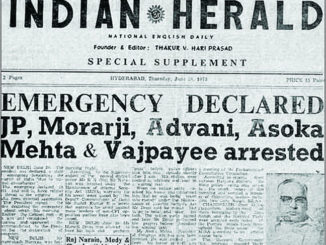
    On June 25 in 1975, emergency was declared in India, for a 21-month period by the then Prime Minister Indira Gandhi. On this day, Independent India experienced it’s darkest hour of the history.

    Officially issued by President Fakhruddin Ali Ahmed under Article 352 of the Constitution due to the prevailing “internal disturbance”, the Emergency was in effect from June 25, 1975, until its withdrawal on March 21, 1977.

    The order vested upon the Prime Minister the authority to rule by decree, allowing elections to be suspended and Freedom of Press was curtailed. Several human rights violations were reported in that time, including a forced mass-sterlisation campaign spearheaded by Indira’s son Sanjay Gandhi.

    The final decision to impose an Emergency was proposed by Indira Gandhi, agreed upon by the President, and thereafter ratified by the Cabinet and the Parliament (from July to August 1975), based on the rationale that there were imminent internal and external threats to the Indian state. The Emergency is considered to be one of the most controversial periods of independent India’s history.

    Union Home Minister Amit Shah on Friday remembered June 25 of 1975 and said that the Emergency was imposed in the nation to quell the voices against one family and termed it as a dark chapter in the history of independent India.

    Taking to Twitter, Shah said: “Emergency imposed to quell the voices against one family is a dark chapter in the history of independent India. Salute to the sacrifice of all the countrymen who fought relentlessly for the protection of the Constitution and democracy of the country while suffering the brutal tortures of the ruthless rule for 21 months.”

    Shah further said that on this day in 1975, in the selfishness and arrogance of power Congress killed the world’s largest democracy by imposing an Emergency on the country.

    “On this day in 1975, Congress killed the world’s largest democracy by imposing emergency on the country in the selfishness and arrogance of power. Innumerable Satyagrahis were imprisoned overnight and the press was locked. Taking away the fundamental rights of the citizens, made the Parliament and the court a mute spectator,” he added.

    46 years of Emergency in India

    In March–April 1974, a student agitation by the Bihar Chatra Sangharsh Samiti received the support of Gandhian socialist Jayaprakash Narayan, referred to as JP, against the Bihar government. In April 1974, in Patna, JP called for “total revolution,” asking students, peasants, and labour unions to non-violently transform Indian society.

    Raj Narain, who had been defeated in the 1971 parliamentary election by Indira Gandhi, lodged cases of election fraud and use of state machinery for election purposes against her in the Allahabad High Court. Shanti Bhushan fought the case for Narain. Indira Gandhi was also cross-examined in the High Court which was the first such instance for an Indian Prime Minister.

    On 12 June 1975, Justice Jagmohanlal Sinha of the Allahabad High Court found the prime minister guilty on the charge of misuse of government machinery for her election campaign. The court declared her election null and void and unseated her from her seat in the Lok Sabha. The court also banned her from contesting any election for an additional six years. Serious charges such as bribing voters and election malpractices were dropped and former PM was held responsible for misusing government machinery.

    Indira Gandhi challenged the High Court’s decision in the Supreme Court. Justice V. R. Krishna Iyer, on 24 June 1975, upheld the High Court judgement and ordered all privileges Gandhi received as an MP be stopped, and that she be debarred from voting. However, she was allowed to continue as Prime Minister pending the resolution of her appeal.

    Siddhartha Shankar Ray, the Chief Minister of West Bengal, proposed to the prime minister to impose an “internal emergency”. He drafted a letter for the President to issue the proclamation based on information Indira had received that “there is an imminent danger to the security of India being threatened by internal disturbances”.

    Later, President Fakhruddin Ali Ahmed declared a state of internal emergency upon the prime minister’s advice on the night of 25 June 1975, just a few minutes before the clock struck midnight.

    Invoking article 352 of the Indian Constitution, Indira Gandhi granted herself extraordinary powers and launched a massive crackdown on civil liberties and political opposition.

    Vijayaraje Scindia, Jayaprakash Narayan, Raj Narain, Morarji Desai, Charan Singh, Jivatram Kripalani, Atal Bihari Vajpayee, Lal Krishna Advani, Arun Jaitley, Satyendra Narayan Sinha, Gayatri Devi, the dowager queen of Jaipur, and other protest leaders were immediately arrested.

    Organisations like the Rashtriya Swayamsevak Sangh (RSS) and Jamaat-e-Islami, along with some political parties, were banned. Strong resistance was seen during the time of the emergency from the RSS and the Sikh community.

    On 18 January 1977, Gandhi called fresh elections for March and released all political prisoners, though the Emergency officially ended on 23 March 1977. The opposition Janata movement’s campaign warned Indians that the elections might be their last chance to choose between “democracy and dictatorship.”

    Historically a Congress stronghold, voters in Uttar Pradesh, turned against Gandhi and her party failed to win a single seat in the state. Also, Congress hit an all-time low in West Bengal.

    Opponents emphasised the issues of corruption in Congress and appealed to a deep desire by the voters for fresh leadership.

                    Source: India TV