Tag: FDI

  • FDI flows to India slip 26 per cent in 2021: UN report

    FDI flows to India slip 26 per cent in 2021: UN report

    United Nations (TIP)- Foreign Direct Investment (FDI) flows to India in 2021 were 26 per cent lower, mainly because large M&A deals recorded in 2020 were not repeated, the UN trade body has said.

    The UN Conference on Trade and Development (UNCTAD) Investment Trends Monitor published on Wednesday said global foreign direct investment flows showed a strong rebound in 2021, growing 77 per cent to an estimated USD 1.65 trillion, from USD 929 billion in 2020, surpassing their pre-Covid level.

    “Recovery of investment flows to developing countries is encouraging, but the stagnation of new investment in the least developed countries in industries important for productive capacities, and key Sustainable Development Goals (SDG) sectors – such as electricity, food or health – is a major cause for concern,” said UNCTAD Secretary-General Rebeca Grynspan. The report said developed economies saw the biggest rise by far, with FDI reaching an estimated USD 777 billion in 2021 – three times the exceptionally low level in 2020.

    FDI flows in developing economies increased by 30 per cent to nearly USD 870 billion, with a growth acceleration in East and South-East Asia (+20 per cent), a recovery to near pre-pandemic levels in Latin America and the Caribbean, and an uptick in West Asia.           Source: PTI

  • Rajya Sabha clears Bill to raise FDI in insurance sector to 74%

    Rajya Sabha on Thursday, March 18,  passed the Insurance (Amendment) Bill, 2021 that seeks to raise the FDI in insurance sector to 74 per cent from the current 49 per cent, despite opposition push to refer the Bill to a standing committee. “The FDI policy is brought in only to supplement domestic capital. This will only supplement what is available in the country because what is now available is not sufficient,” Finance Minister Nirmala Sitharaman told the House. Responding to the opposition’s criticism against the amendment, Sitharaman said the law has “enough safeguards” built in. “Under the new structure, the majority of directors on the board and key management persons would have to be resident Indians, which will make them accountable under the Indian law. At least half of directors are to be independent directors which also ensures accountability,” she said.

    On the criticism that the move might dilute reservation in state insurance players, the minister said the Narendra Modi government is committed to the protection of the Scheduled Castes, Scheduled Tribes and Backward Classes.

    “All the places connected with Dr BR Ambedkar have been protected by the Modi government. This shows that the government is committed to the SC community and that the reservation policy will not be changed,” she said.

    During the discussion earlier, Leader of Opposition Mallikarjun Kharge said the Bill will put people in trouble.

  • PM Modi hardsells India advantage as he invites global investors

    PM Modi hardsells India advantage as he invites global investors

    New Delhi (TIP): Urging global investors to invest in India, Prime Minister Narendra Modi on Thursday, November 5,  said the government will do “whatever it takes to make India the engine of global growth resurgence”. Speaking at a Virtual Global Investor Roundtable with leaders of top pension and sovereign wealth funds and domestic business leaders, Modi said:

    “If you want returns with reliability, India is the place to be. If you want demand with democracy, India is the place to be. If you want stability with sustainability, India is the place to be. If you want growth with a green approach, India is the place to be. India’s growth has the potential to catalyse global economic resurgence.” He added, “Any achievement by India will have a multiplier impact on the world’s development and welfare. A strong and vibrant India can contribute to stabilisation of the world economic order. We will do whatever it takes to make India the engine of global growth resurgence. There is an exciting period of progress ahead.” Stating that he is conscious of investors’ requirement for safe, long-term returns, Modi said the government is finalising a master plan for connectivity infrastructure with an investment target of $1.5 trillion under the National Infrastructure Pipeline. The government has already undertaken several policies like GST, lowering the corporate tax, incentive scheme for new manufactures, new labour laws, ease of doing business and production linked incentives, he said.

    “We have an ambitious plan to invest $1.5 trillion under the National Infrastructure Pipeline. A pioneering multi-modal connectivity infrastructure master plan is being finalised. India has embarked on a massive infrastructure building spree of highways, railways, metros, water-ways, airports across the country. We are building millions of affordable houses for the neo-middle class. We want investments not just in big cities but smaller cities and towns too,” he said.

    Reforms in the agricultural sector have opened up “new exciting possibilities to partner with the farmers of India”, the Prime Minister said, adding that the country can emerge as an agricultural export hub with use of technology and modern processing solutions. The last five months have seen a 13 per cent rise in FDI inflows compared to last year, he said.

    Modi said the country’s quest for self-reliance or Aatmanirbhar Bharat is not a vision but a well-planned economic strategy. “A strategy that aims to use the capabilities of our businesses and skills of our workers to make India into a global manufacturing powerhouse,” he said.

    The Virtual Global Investor Roundtable was organised by the Finance Ministry and National Investment and Infrastructure Fund. Global institutional investors, Indian business leaders, top government officials and financial market regulators were part of the meeting. Union Finance Minister Nirmala Sitharaman, Union Minister of State for Finance Anurag Thakur, and RBI Governor Shaktikanta Das also participated.

    “The VGIR 2020 roundtable was a very productive and helpful forum which provided us insight into the government’s vision to build out the India economy and accelerate the growth of international institutional investment in India. India is key to our long-horizon investment strategy, focused on growth markets, and we have a strong appetite to build on our existing investments across infrastructure, industrial and consumer sectors,” Mark Machin, President & CEO of CPP Investments was quoted as saying in a release issued by the Prime Minister’s Office.

  • SECURITY AGENCIES’ ALERT CALL ON 100% FDI IN DOMESTIC AIRLINES

    SECURITY AGENCIES’ ALERT CALL ON 100% FDI IN DOMESTIC AIRLINES

    NEW DELHI (TIP): The security agencies, including the Intelligence Bureau (IB), have raised concerns over the Centre’s decision to allow 100% foreign direct investment (FDI) in domestic airlines’ operations.

    Recently, Union Home Secretary Rajiv Mehrishi chaired a meeting to discuss the matter, where sources said, the IB and other agencies expressed concerns over the government’s decision on allowing 100% FDI for running domestic airlines.

    Sources said, the meeting, which was attended by senior officials from the Civil Aviation Ministry and the Ministry of Home Affairs (MHA), including the IB, was called to discuss issues related to proposed amendments to the Aircraft Rules, 1937.

    It is learnt that the amendments are required to operationalise the framework for allowing foreign non airline players to own up to 100% stake in domestic carriers. “As the government had decided to put in place liberal FDI policy last year only, this can become reality only once the relevant rules are put in place,” a senior MHA official said.

    Noting that aviation is a “highly sensitive sector”, the IB, during the meeting, suggested that it would be prudent to allow 100% FDI in the sector. To justify its claim, the IB also contended that even developed countries such as the US and Canada have permitted foreign entities to have only up to 25% stake in their respective domestic carriers.

    Source: The Tribune

  • SPICEJET, INDIGO RAISE RED FLAG OVER FDI NORMS

    SPICEJET, INDIGO RAISE RED FLAG OVER FDI NORMS

    NEW DELHI (TIP): IndiGo and SpiceJet have raised “security” concerns over the government’s decision to allow 100% foreign ownership by non-airline players in the Indian carriers. SpiceJet CMD Ajay Singh and IndiGo president Aditya Ghosh recently raised this issue during their meeting with commerce and industry minister Nirmala Sitharaman. According to sources, the two airlines said aviation is a “sensitive sector” and the FDI policy relaxation would have “security implications”.

    Spokespersons of IndiGo and SpiceJet could not be immediately reached for comments. The meeting also assumes significance as the government is considering removal of an anomaly restricting FDI in the civil aviation sector. The sector is facing a Catch-22 situation where a foreign investor, excluding overseas airlines, can acquire up to 100% stake in a local carrier. However, at present they cannot seek a scheduled operator’s permit since it can only be given to a company where substantial ownership and effective control is in the hands of Indian nationals

    As this condition restricts and prevents foreign investors from acquiring a domestic airline, there is a need to amend Aircraft Rules, 1937, to facilitate FDI in the sector.Due to this anomaly , the moment foreign investors buy 51% or a controlling stake in a domestic airline, the scheduled air operator permit gets withdrawn. “So, this sectoral norm needs to be amended,” sources added.

    As per the current policy, 100% foreign investment is allowed in scheduled air transport service, domestic scheduled passenger airlines and regional air transport. Only non-airline players will be allowed to bring in 100%FDI in local carriers.

  • On his third US tour, Chhattisgarh CM eyes investment in ‘Priority Industries’

    On his third US tour, Chhattisgarh CM eyes investment in ‘Priority Industries’

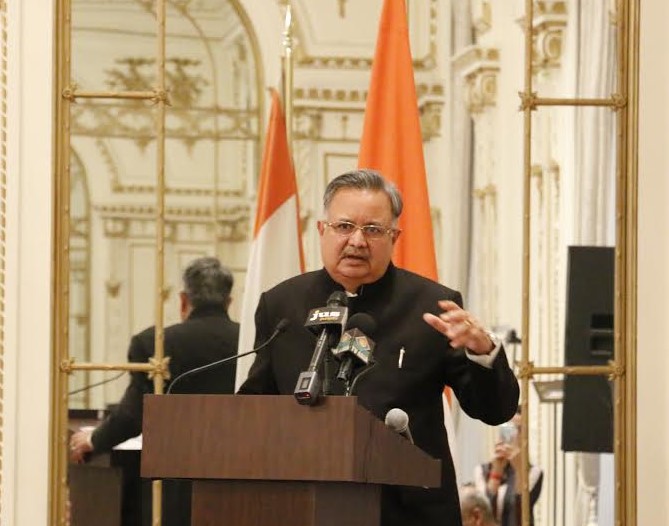
    NEW YORK CITY (TIP): Every time he comes to the US, he ‘takes home something new.’ On his third US tour, Chief Minister of Chhattisgarh, Dr Raman Singh wooed investors to invest in new sectors, highlighting the tremendous potential across those sectors in the state that has been declared as the ‘Best fiscally managed State’ by Reserve Bank of India. Singh, currently on an official tour of the US, highlighted investment opportunities in Chhattisgarh in front of a gathering at the Indian Consulate, New York on November 29. Senior state government officials accompanied him at the interactive luncheon event, jointly hosted by US India Business Council (USIBC) and the Consulate.

    In his welcome address, Subodh Kumar Singh, Secretary to Chief Minister and Commerce & Industries, described how some of the key initiatives under Raman Singh’s leadership including railway network, industrial infrastructure and smart cities in Chhattisgarh has become the main driver of growth and development in the State. He also briefed the audience about the priority industries for investment – food processing, energy, life sciences, defense, information technology, electronics, and manufacturing.

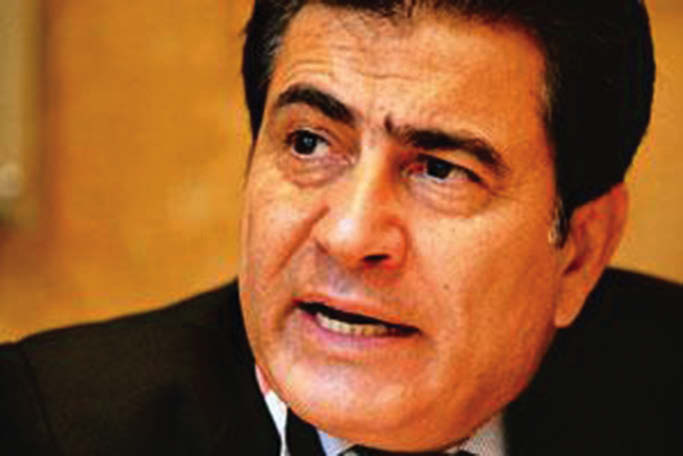
    Dr Mukesh Aghi, President of USIBC in his special remark, stressed on enhanced investment partnership between US and India.

    There was a brief Power Point presentation by Vivek Dhand, Chief Secretary of Chhattisgarh, that highlighted recently implemented reforms including single window system, tax reforms, construction permits, environment & labor reforms, inspection reforms and commercial dispute and paperless courts. Given that the state came into existence only 16 years ago, he took the opportunity to mention that the World Bank has recently ranked Chhattisgarh fourth in Ease of Doing Business as per Ranking 2016 among all Indian states and Union Territories.

    While giving introduction of Dr Raman Singh, the longest ever serving Chief Minister from BJP, Deputy Consul General Dr Manoj Kumar Mohapatra said, “Indo-US relationship is measured by number of visits. In the last two years Prime Minister Modi and President Obama met more than 12 times. That shows the defining partnership.”

    Describing Chhattisgarh as ‘Heart of India’, the Chief Minister said, “I just want to tell you what it was 16 years back and what it is today.” Mentioning the reforms and policies undertaken during his tenure that has made the state a frontrunner in ease of doing business, Dr Singh said, “Chhattisgarh is the best destination for investment not just in the core sectors of mines and minerals but also in areas like IT, engineering and solar energy.”

    Noting that investors may not be fully aware of the investment opportunities in the young, not so known resource-rich state, Dr Singh invited investors to visit Chhattisgarh to see the investment potential of the state. “Come, see, and then invest.”

    A token of appreciation was presented to him by Dr Mukesh Aghi, followed by a Q&A session.

    During the brief Q & A session, Prof. Indrajit S Saluja asked the chief minister to clarify on the allegation of a Rs. 36000 crore scam in the public distribution system in the State. Dr. Singh categorically denied there was any scam. He said it was a conspiracy. 60 lakh families benefitted from the scheme and nobody complained. “Our PDS model is unique. So far, no other state could follow that model”, Mr. Singh said.


    Later, speaking with The Indian Panorama Chief Editor I S Saluja, in an exclusive interview, Dr Singh appealed to the NRIs to invest in Chhattisgarh. “Our state is the destination for investment. You will get all facilities there. The infrastructure is top class. I want investments in sectors like IT, engineering and solar energy. I am sure if they (NRIs) visit the state they will be convinced to invest. So, I want them to visit (Chhattisgarh).”

    When asked if he wants to invite the media to visit Chhattisgarh so that they can project the bright side of the state, Dr Singh said, “Of course. I would invite my media friends here to visit Chhattisgarh. Every year in the first week of November we organize special event to showcase the development activities of our state. I will invite the media from US to come and have a fair idea about our activities.”

    Dr Singh also said that he will ask his officials to be in direct touch with the ethnic media in US for a closer relationship to help boost the image of his state.

  • RBI allows foreign investors to buy PNB shares

    RBI allows foreign investors to buy PNB shares

    MUMBAI (TIP): The Reserve Bank of India (RBI) on Friday lifted the almost seven year old restriction on fresh purchase of shares of state-owned Punjab National Bank by foreign investors.

    The RBI on Monday notified that the aggregate foreign share holdings by foreign institutional investors/NRIs /PIOs/FDI and others under Portfolio Investment Scheme (PIS) in PNB have gone below the prescribed threshold caution limit stipulated under the extant FDI policy.

    “Hence, the restrictions placed on the purchase of shares of the above company vide Press Release No 2008-2009/1914 dated May 22, 2009 have been withdrawn with immediate effect,” the central bank said.

    Reeling under bad loans, PNB posted the largest quarterly loss by any public sector lender at Rs 5,367 crore for the fourth quarter ended March 31, 2016.

    A three-fold surge in provisioning for bad loans, including those extended to power discoms and for foodgrain purchase in Punjab, were the main drag on the bank’s performance and it expects the pain to continue for some more time.

    The second-largest public sector bank posted a net profit of Rs 306.56 crore in the corresponding period of 2014-15.

  • USIBC endorses Indian Budget as Attractive

    USIBC endorses Indian Budget as Attractive

    WASHINGTON (TIP): American companies, either those with a foothold or who are planning to set foot in India, are bullish on the latest budget presented by the Modi government, business advocacy group U.S.-India Business Council has said.

    “We talked to some of our members on the feedback, and they have been bullish about the budget itself. I feel that its investment in infrastructure, in trying to provide ease of doing business and providing certain tax certainties is good for U.S. investors,” Mukesh Aghi, USIBC president, told PTI in an interview Feb. 29.

    Aghi said the annual budget presented by Union Finance Minister Arun Jaitley maintains the fiscal deficit at 3.5 percent from 3.9 percent and gives international investors an assurance that India can provide discipline among emerging markets.

    Referring to the fact that foreign direct investment in India is up by 40 percent, Aghi, who was recently in India for the Make in India summit in Mumbai, said the move sent a positive signal to the global market.

    “The sentiment (on India among U.S. companies) is on the positive side,” Aghi said in response to a question, hoping that this would bring much greater American investment to India.

    U.S. companies have made $15 billion worth of FDI in India in the last 18 months and are expected to invest another $27 billion this fiscal year, he said, adding that with the latest budget, this figure is expected to go up.

    The infrastructure sector and food retail industry provide a lot of opportunities for investment, he said. Allowing 100 percent FDI in the marketing of food produced in India will likely bring in new investors who will provide the needed manufacturing and retail jobs, he said.

    “This will help farmers increase sales, spur investment in cold chain and storage infrastructure to make sure food is better preserved, and bring new and diverse food products to a larger percentage of the Indian population than ever before,” Aghi said.

    The USIBC president also lauded the Union Finance Minister for creating an investment-friendly climate even as he said U.S. firms are expecting to roll out of the Goods and Services Tax, which can be a “game changer” for the country’s economy.

    “Tax reforms presented in this budget are unprecedented and lay the road map to creating an attractive environment for foreign investors. U.S. companies are still eager for the implementation of GST that has the potential to be a game changer for the economy. This is also an inclusive budget -one that creates opportunities for increasing domestic demand,” Aghi said.

    “The message is that U.S. companies are very bullish on India,” Aghi said, adding that the large section of U.S. FDI in India is going into the IT sector and manufacturing environment.

    Responding to a question, he said USIBC members feel India could move a bit faster on the corporate tax reduction. The American corporate sector, he noted, is looking forward to the intellectual property policy coming out. “I would say a big chunk of the issues were addressed (in the budget),” he said.

    “Yes, we have made progress. But the issue is we should benchmark every state with let’s say Singapore or Hong Kong. We should not measure states within India with each other. We need to raise the bar,” he said.

  • FOREIGN FIRMS RUSH TO INDIA’S ONLINE MARKETPLACE

    FOREIGN FIRMS RUSH TO INDIA’S ONLINE MARKETPLACE

    NEW DELHI (TIP): India’s booming online marketplace business has attracted a new wave of merchants and sellers from countries such as China, South Korea, Japan, Singapore and the US. In fact, thousands of sellers are getting into tie-ups with Indian e-commerce players to kick-start operations in the country.

    According to industry insiders, around 50,000 sellers from China, South Korea and Singapore are planning to enter India through online marketplace players.

    “In business-to-business (B2B) segment, there is no online organised player in the country right now. The market is being created for the online businesses,” said Sanjay Sethi, co-founder and CEO of Shopclues. The company has brought in DHgate, the second largest player in China after Alibaba, on to its platform. It’s also getting 25,000 South Korean merchants on board. Tie-ups are also in process with Singapore Traders Association to enable them to sell on Shopclues.

    WINDS OF CHANGE
    Around 50,000 sellers from China, South Korea and Singapore want to enter India through online marketplace players
    American retail major Walmart is also exploring ways to tie up with leading e-commerce companies in India, including Flipkart, Snapdeal and others
    Metro Cash and Carry is also in talks with e-commerce marketplace players to sell its products online
    E-commerce giant Alibaba is looking to make a big bang entry into India’s marketplace via One97 Communications-owned Paytm

    American retail major Walmart is also exploring ways to tie up with leading e-commerce companies in India, including Flipkart, Snapdeal, ShopClues, Grofers and Bigbasket. It is learnt that German wholesale giant Metro Cash and Carry is also in talks with e-commerce marketplace players to sell its products online.

    Meanwhile, e-commerce giant Alibaba is looking to make a big bang entry into India’s marketplace via One97 Communications-owned Paytm.

    Alibaba is expected to be the support behind Paytm’s China product portfolio. With that in place, Paytm will aim to become the biggest Indian player insofar as the number of sellers on the platform is concerned. With eight million sellers, Alibaba has the widest seller range as well as product portfolio.

    This is not for the first time that Paytm is planning to sell Alibaba’s product range. During Diwali last year, Paytm had the whole product catalogue sourced from Alibaba and merchants from China were directly shipping products to customers in India, saving Paytm the hassle of finding warehouses.

    As for the second top player in China, DHgate, online B2B would be a gateway into India and an opportunity to get connected to 350,000 sellers through the Shopclues portal.

    DHgate plans to list its products across categories, including electronics, accessories, beauty products and sports. “From China we are getting around 10,000 SKUs (stock keeping units) listed. It is not a retail business and the target audience for this business are other businesses in India,” said Sethi.

    The foreign investment rules vary across retail platforms and companies often resort to complex structuring to bypass policy. While foreign direct investment (FDI) is capped at 51 per cent in multi-brand retail with states having the last say on whether international players would be permitted to operate or not, there’s no limit of foreign investment in single-brand and business-to-business or cash and carry.

    In e-commerce, however, FDI is not permitted. But, e-commerce players are mostly run with foreign money by operating marketplace platforms, where rules have not been framed yet.

  • USIBC names two new vice chairs to push India trade

    USIBC names two new vice chairs to push India trade

    WASHINGTON (TIP): The US-India Business Council (USIBC) has named Punit Renjen, CEO of Deloitte Touche Tohmatsu Limited (Deloitte Global),and Edward Monser, President of Emerson, as USIBC Vice Chairs to further build on US-India relationship.

    The leading business advocacy organization comprised of 350 top-tier US and Indian companies advancing US-India commercial ties recently appointed former Cisco CEO John Chamber as USIBC Chairman.

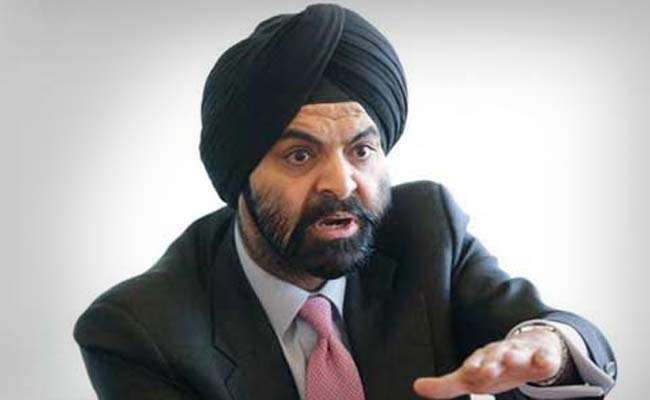
    Chambers, immediate past USIBC Chairman and CEO of MasterCard Ajay Banga, and Edward Monser, will embark on the USIBC Chairman’s Executive Mission to India in mid-February, and also participate in the inaugural Make in India week.

    “I believe that there are tremendous opportunities this year to build on the US-India relationship,” said Monser. “With India’s push for advancement across industries, and initiatives like Make in India gaining momentum, I see several channels for collaboration, exchange of ideas, and exchange of technology between the two countries.”

    “I am optimistic about the continued trajectory of US-India relations and the positive impact this will have, not only for our two countries, but indeed for the world,” said Punit Renjen.

    “In growing the exchange of talent between our two countries and further opening channels for increased trade and investment, we will be able to deepen innovation, create high-quality jobs and fuel our industries’ global competitiveness for the 21st century.”

    Congratulating the “two great business leaders,” USIBC President Mukesh Aghi said: “Together, with our combined experience, we can tackle some of the most difficult challenges on both sides.

    “We have already seen the expansion of FDI into the media and entertainment, single brand retail, and defense sectors. Indian states are also actively reaching out to investors here in the US, showcasing the power of competitive federalism.

    High on the priority list this year includes the passage of the Goods and Services Tax and land acquisition reform in India, as well as growing the manufacturing sector in order to consolidate India’s presence as a key player in the global economy.”

    Chambers said the two new appointees “have done great work in promoting trade between our two countries” and “Our job for this year is to build on this momentum and shape and further the Council’s priorities.”

    “We still have challenges ahead and there are areas we must discuss, however, I am positive we can do so in a way that befits our community and our leaders’ ambitions.”

    IANS

  • 2015: A Year of Work-in-Progress for Defense

    2015: A Year of Work-in-Progress for Defense

    One does not know what the Ministry of Defense (MoD) set out to achieve in the calendar year 2015 or the current financial year that will draw to a close in another three months (in March, 2016). But if one were to hazard a guess, the objective would have been to take steps, if not to completely resolve, at least address the issues that kept the MoD in the news throughout the year. A quick survey of where we stand on those issues at the end of the year would be instructive.

    To cut to the chase, the issues confronting the defense establishment at the beginning of the year broadly related to defense policy, human resource management and operational preparedness, though not necessarily in that order.

    The policy-related issues are not new. Questions about India’s national security objectives and defense strategy, in all their manifestations, have persisted for long. To be fair, these larger issues were not in the forefront at the beginning of the year but a related issue was. It concerned the appointment of a Chief of Defense Staff (CDS) or Permanent Chief of the Chiefs of Staff Committee (PC COSC). The year has gone by without one being appointed. If anything, the excitement seems to have somewhat ebbed over the past few months.

    It will take some doing to create this institution with clearly defined responsibilities and an appropriate support structure. Assuming that the present system of three-tiered defense planning will continue and, among other things, the CDS/PC COSC will be responsible for defense planning, it is time the issue is taken up on priority as the 13th Defense Five-year Plan is to commence from April 1, 2017.

    In contrast, it has been a year of palpable vibrancy in defense diplomacy, with India simultaneously engaging the United States, Russia, Japan, France, the United Kingdom, Germany and others at one level and countries in the neighborhood at another. But the tangible outcome of this outreach is awaited. The contract for the medium multi-role aircraft, which was the highlight of the prime minister’s visit to France earlier this year, is yet to be finalized. There has been little progress on the ‘pathfinder projects’ or other technologies offered by the United States. The US-2 amphibious aircraft project with Japan continues to hang fire, and so does the FGFA project with Russia. There will be many other projects of this kind. It is necessary to wrap up some of these programs to establish credibility and lay the foundations for a more meaningful engagement.

    The most significant development has been the recent outreach to Pakistan after the cancellation of the NSA-level talk in August 2015. It would be naive to expect immediate results but this is the only way forward for both the countries. There is absolutely no alternative to talks. Sustaining this engagement in the coming year without raising expectations of a breakthrough in respect of any of the several contentious issues will be a great achievement.

    As for issues concerning human resources management, the one-rank-one-pension (OROP) log-jam and the reaction of the armed forces to the recommendations of the seventh central pay commission eclipsed all other issues, reinforcing perceptions of deteriorating civil-military relations. The vitriol underlying the discourse on these issues does not bode well for a country that has one of the largest armed forces in the world. In today’s world, perception management is as important as resolving the core issues underlying those perceptions.

    Going by the coverage it got in the media in 2015, the MoD invested a tremendous amount of effort in addressing the issues concerning operational preparedness with a clear emphasis on promoting self-reliance in defense production through greater participation of the Indian private sector, coupled with the decision to go ahead with some off-the-shelf procurements, especially from the United States through the Foreign Military Sales (FMS) route.

    The finance minister gave a glimpse of the government’s thinking on this approach when he said the following in his budget speech of 28 February 2015:

    “86. Defense of every square inch of our mother land comes before anything else. So far, we have been over dependent on imports, with its attendant unwelcome spin-offs. Our Government has already permitted FDI in defense so that the Indian-controlled entities also become manufacturers of defense equipments, not only for us, but for export. We are thus pursuing the Make in India policy to achieve greater self-sufficiency in the area of defense equipment, including aircraft. Members of this august House would have noted that we have been both transparent and quick in making defense equipment related purchase decisions, thus keeping our defense forces ready for any eventuality.”1

    The gamble did not pay off, however, prompting the government to put FDI up to 49 per cent on the automatic route, while FDI beyond that limit would now require the approval of the Foreign Investment Promotion Board (FIPB) rather than the Cabinet Committee on Security (CCS). This might help but promoting self-reliance in defense would require simultaneous movement on three other fronts.

    One, the key to involving the Indian industry in defense manufacturing is to offer it with a business case. Two, it needs to be ensured that the procurement proposals do not get entangled in procedural complexities and bureaucratic indolence. And three, an industry-friendly eco-system is required to galvanize the industry.

    The year saw many efforts being made at easing the procedural rigors, as in the case of creating a level-playing field for the private sector vis-a-vis the public sector and easing the offset norms. But these efforts were disjointed. The big bang reforms in the procurement procedure based on the recommendations of the committee of experts set up by the MoD did not fructify. Measures such as setting up of a Defense Technology Fund announced in the budget speech of 2014 were not on the radar in 2015.

    The new Defense Procurement Procedure, with a revamped policy on offsets and ‘Make’ projects, continues to be eagerly awaited after having missed a few deadlines. In particular, the policy on ‘Make in India’ in defense remained the subject of much speculation in 2015. How is the new initiative different from what the MoD has been doing all these years? Where do the foreign vendors figure in this new matrix and what role they are expected to play?

    The Defense Acquisition Council would have accorded Acceptance of Necessity (AoN) for procurement proposals for more than INR 100,000 crore during the year. Their fate is not known, but considering that AoN lapses if the Request for Proposal (RFP) is not issued within a year of the date on which it is accorded, the advantage of having cleared so many proposals would be lost if it is not ensured that the RFPs get issued within time.

    The Defense Procurement Board (DPB) could play an important role in not only monitoring the situation but also proactively steering every procurement proposal at the post-AoN stage till the signing of the contract, as well as monitoring the progress of the ongoing contracts.

    Lastly, there is the question of budgetary support. The gap between the requirement projected by MoD and the allocation made in the union budget halved this year but was still more than INR 40,000 crore. The share of pay and allowances in the revenue segment of the defense budget has been increasing and presently stands at 66 per cent. This could increase further next year on account of implementation of the recommendations of the seventh pay commission, adversely affecting availability of funds for procurement of ordnance stores, spares and ammunition, among other things. On the other hand, the capital budget ironically generally remains underutilized. The trend this year so far does not show a significant improvement.

    The pension budget (INR 54,500 crore for the current year) will also go up for the same reason, as also on account of OROP. Though it is not a part of the defense budget, it could impact the government’s ability to increase the defense budget in any substantial manner next year.

    The current year has been a year of work-in-progress on several fronts. There is no reason to doubt that the coming year will witness the beginning of a transformative phase in the management of defense with all these efforts reaching fruition

    (Source :IDSA )

  • Invitation to Invest in Karnataka

    Invitation to Invest in Karnataka

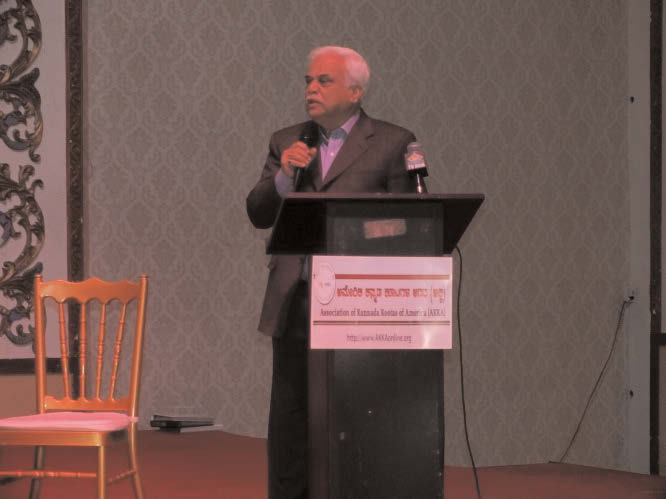
    NEWYORK (TIP): A high level delegation led by Sri R.V. Deshpande, Minister for Large & Medium Industries and Tourism, Government of Karnataka, was warmly welcomed by Consul General Ambassador Dnyaneshwar. M. Mulay at the India House in New York, December 4.

    In the Interaction with members of USIBC, TiE and AKKA, Mr. Deshpande strongly pitched for inward investments into Karnataka highlighting several steps that are being taken by Government of India to ease business, physical and digital infrastructure and taxation. He specifically spoke of the steps initiated by Government of Karnataka to decongest Bengaluru and disperse industry to tier 2 and tier 3 cities.

    Invest in KarnatakaAddressing a gathering of industry captains, Minister Deshpande said that it is a great honor to release a report on India, on foreign soil.

    Mr. Deshpande released EY’s India Attractiveness Survey 2015 report which observes that international corporations with a presence in India are far more optimistic about the country’s prospects than those who are not yet established in the country.

    A whopping 32% of the respondents said that India is the most attractive place for investments in the next 3 years. India has already emerged as the No. 1 FDI destination globally with capital inflows of US$ 30.8 Billion in 2014. 62% of those interested to expand or enter India over the next year, say that they plan manufacturing activities in the country. The Government’s flagship programs Make in India and Digital India have had a positive impact on investor sentiment. Make in India has gained considerable momentum and industry is a lot more optimistic about its success now than about a year ago.

  • PE investments in real estate touch $2.8 bn in January-September | India’s top real estate companies stare at Rs 30,000 crore debt

    PE investments in real estate touch $2.8 bn in January-September | India’s top real estate companies stare at Rs 30,000 crore debt

    Private equity funds committed $2.8 billion to Indian real estate projects in the first nine months of 2015, global real estate consultancy firm Cushman & Wakefield and Global Real Estate Institute said in a report. The funds invested across 61 deals between January and September, against $1.63 billion across 52 deals during the same period last year.

    Apart from the increase in deal activity, the average transaction size too increased to $47 million, from $30 million during the same period last year.

    The report adds that around two-third of the allocated capital was invested through structured debt and mezzanine debt route. Pure equity or entity-level deals that had dried up by 2012 have started to make a comeback, with 22% of the capital going into these deals.

    The investments have been led by foreign funds that have committed $1.6 billion, or nearly 59% share of the total investment volume so far in 2015, followed by domestic funds that have invested around $1.2 billion. The majority of foreign capital that has been invested were from funds in the Asia-Pacific region (excluding India) followed by North America.

    Interestingly, among this year’s 61 deals, 45 deals totaling $1.2 billion were struck by domestic funds, while foreign capital chased only 16 assets. Even though residential project sales have lagged in Mumbai, nearly 40% of the invested capital this year was deployed in this region, followed by the Delhi-National Capital Region (NCR). Fund managers invested 78% of their capital in these two cities.

    On the other side, Sushmita Majumdar, director at Crisil Ratings, said India’s top 25 realtors make up around 95% of the market capitalization of the sector. These 25 developers also account for half of bank lending to the real estate sector and most of those facing high refinancing risk are in the national capital region (NCR).

    “With net exposure of banks expected to decline by around 5% for the first time in the current fiscal – banks used to meet around 90% of the requirements of these realtors till last year — an increasing proportion of the funding gap is being bridged by costlier NCDs and private equity monies,”Majumdar said.

    These 25 real estate companies face risks from as much as Rs 30,000 crore borrowings maturing in the immediate future amid high debt, weak demand and rising construction costs, credit ratings agency Crisil said.

    Crisil said that recent regulatory measures such as relaxation in foreign direct investment (FDI), and recourse to funding through non-convertible debentures (NCDs) and private equity, are expected to provide some respite in the short term for the sector.

    “The flipside, however, is the high returns expected by private equity investors compared with the relatively low cost of bank loans. Assuming this to be 20% per annum, the cumulative payout by the sector over a 5-year horizon can be as high as Rs 85,000 crore. This can amplify refinancing risks by an order of magnitude unless demand picks up substantially,” Crisil said.

    Crisil estimates that stagnating collections in the wake of declining sales velocity had resulted in debt taken for residential projects by these developers surging by 25% to Rs 61,500 crore in fiscal 2015.

    Please add your comments below on:Is India headed for a real estate bubble burst?


  • U.S. India Business Council Applauds Conclusion of U.S.- India Trade Policy Forum

    U.S. India Business Council Applauds Conclusion of U.S.- India Trade Policy Forum

    WASHINGTON (TIP): Following the successful conclusion of the ninth round of U.S.-India Trade Policy Forum, the USIBC hosted a reception, providing an opportunity for deeper engagement between industry stakeholders and government officials from both the United States and India. The U.S.-India Trade Policy Forum (TPF) is a government-to-government trade dialogue aimed at increasing bilateral investment between the two nations.

    The trade policy forum comes on the back of U.S.-India Strategic and Commercial as well as Prime Minister Modi’s visit to the west coast of the United States. The talks focused on four primary areas of bilateral ties-agriculture, services, promoting investment in manufacturing, and intellectual property. USIBC member companies submitted recommendations under these four working groups to the USTR.

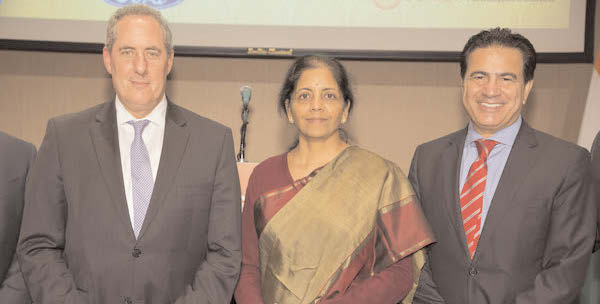
    The reception was attended by high ranking government officials such as Minister of Commerce and Industry Nirmala Sitharaman, United States Trade Representative Michael Froman, Commerce Secretary of India Rita Teotia and Deputy USTR Ambassador Holleyman.

    The event received broad representation from USIBC’s diverse membership base of 300+ companies that include Ford, MasterCard, Pfizer, Lockheed Martin, Bank of America, PayPal and Boeing.

    During the discussion, Minister Sitharaman and Ambassador Froman highlighted the direction in which the two nations are working together to foster a robust and open bilateral trade environment. Following Prime Minister Narendra Modi’s visit to the west coast and a series of successful dialogues over the last few months, both nations view the bilateral relationship with greater enthusiasm.

    Mukesh Aghi, President of the U.S.-India Business Council said, ” The trade policy forum couldn’t have come at a better time. We have seen India rise in World Bank’s Ease of Doing Business Index under the leadership of Prime Minister Modi. The Trade Policy Forum represents another important step towards strengthened trade relations between the U.S. and India. India is growing to be one of the most open economies in the world today and USIBC member companies are excited by the opportunity to grow the bilateral trade five-fold. Increasing FDI projects in sectors like manufacturing, defense, Smart Cities and clean technology along with positive environment fostered by initiatives like Make in India and Digital India are proving to be game changers and creating jobs for the Indian economy.”

    “We have seen enhanced engagement between the United States and India in the course of the past year, with a high bar set by President Obama and Prime Minister Modi,” said United States Trade Representative Michael Froman. “Our work this week under the Trade Policy Forum focused on translating engagement into tangible results that will increase the pace of trade growth between our economies. To that end, Minister Sitharaman and I focused our work on forward looking policy initiatives in intellectual property, manufacturing, agriculture and services that can expand trade and investment and benefit our manufacturers, workers, innovators, service providers, farmers, and ranchers.”

    Minister Sitharaman congratulated Ambassador Froman on the successful conclusion of the Trans-Pacific Partnership (TPP) after eight years of painstaking efforts and said, “The U.S.-India Trade Policy Forum was an intense engagement, one which we can say with confidence is moving forward with a lot of positive outcomes.”

    “Abbott continues to see India as a promising market for growth. The government’s vision for promoting ease of doing business and attracting investment enables Abbott to help more people live healthier, better lives,” said Claude Burcky, Vice President of International Government Affairs, Abbott.

  • 100 Indian companies invested $15 billion in United States creating 91,000 jobs so far: Report

    100 Indian companies invested $15 billion in United States creating 91,000 jobs so far: Report

    New York (TIP) July 15: A total of one hundred India-based companies have invested over $15 billion across the US and have created more than 91,000 jobs in a wide range of sectors across 35 American States, according to a latest report released by the Confederation of Indian Industry (CII) and Grant Thornton (GT).

    The southern State of Texas received the maximum ($3.84 billion) foreign investment from Indian companies followed by Pennsylvania ($ 3.56 billion), Minnesota ($1.8 billion), New York ($1.01 billion) and New Jersey ($1 billion), said the report titled “Indian Roots, American Soil”.

    More than 20 top lawmakers including Senators, John Cornyn and Mark Warner, attended the report released yesterday at the Capitol Hill.

    “As India surges forward to become the fourth fastest growing source of FDI into the US, it is critical that we recognise the positive impact of Indian business investments in the country,” said Senator Warner, co-chair of the Senate India Caucus.

    The top five states where the Indian companies have generated maximum employment are New Jersey (9300 jobs), California (8400), Texas (6,200), Illinois (4,800) and New York (4,100) and are home to the most Americans directly employed by Indian companies.

    The CII study draws attention to the growing contribution and influence of the Indian industry, which forms an important component of our growing and vibrant relationship with the United States, said Indian Ambassador to the US Arun K Singh.

    “Today Indian companies are not just investing and creating jobs, they have also become significant stakeholders in the growth and prosperity of their local communities,” Mr Singh said.

    Highlights

    * Together, 100 Indian companies employ more than 91,000 people across 35 states and the Washington DC, the American capital.

    * The total value of tangible investments made by these 100 companies exceeds $15.3 billion.

    * The top five states in which Indian companies have generated maximum employment are: New Jersey (9,278 jobs), California (8,937 jobs), Texas (6,230 jobs), Illinois (4,779 jobs) and New York (4,134 jobs).

    * The top five states in which Indian companies have contributed the highest foreign direct investment are: Texas ($3.84 billion), Pennsylvania ($3.56 billion), Minnesota ($1.8 billion), New York ($1.01 billion) and New Jersey ($1 billion).

    * The average amount of investment received from Indian companies per state is $443 million.

    * 84.5% of the companies plan to make more investments in the US.

    * 90% of the companies plan to hire more employees locally in the next five years.

  • Maharashtra CM Devendra Fadnavis creates vision of  his State as a top destination for investments

    Maharashtra CM Devendra Fadnavis creates vision of his State as a top destination for investments

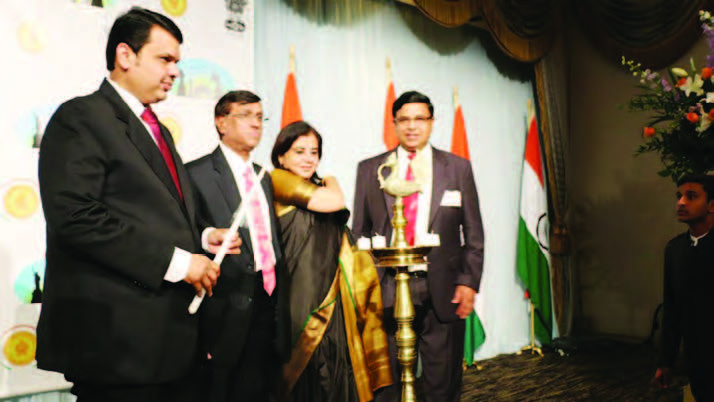
    NEW YORK (TIP): Maharashtra Chief Minister, Devendra Phadnavis was given a rousing welcome, June 29, by the Indian American community at a Community Reception, appropriately named  ‘Maharashtra meets Manhattan’. The reception in his honor was  hosted by Friends of Maharashtra and Consulate General of India at the Taj Pierre in New York City, where  Prime Minister Modi was hosted last year.

    Maharashtra Chief Minister lauded the contribution of NRI’s. He said, “The success of Indians here gives me immense pride. But now it’s time to give back.”

    Phadnavis spoke of the demographic advantage of India where 50% population is below the age of 25. He said  India was in a position to provide human resource to the entire world and the time to fulfill the dream of becoming the topmost nation of the world had arrived.

    Pitching for ‘Make in Maharashtra’, he mentioned that his government has reduced the number of permissions from 148 to 20 to make Maharashtra investor friendly. He also spoke about different upcoming projects undertaken by him like coastal road, Mumbai-New Mumbai connecting  road, and second international airport near Navi Mumbai. He said the projects of roads and bridges the government was contemplating would decongest entire Western Mumbai. He also spoke of the project to have 30 smart cities, each with a different theme and another project, an automobile hub in Aurangabad.

    “Maharashtra is full of possibilities. There are huge opportunities”, he said. He invited the gathered Indian Americans to invest in Maharashtra and assured them of his personal attention to their needs . He said he works 24/7 and is available 365 days of the year.

    Others who spoke included Consul General Dnyaneshwar Mulay who welcomed the Chief Minister and the Industries Minister Subhash Desai who outlined the opportunities for investors in the industries sector in his State.

    Earlier, in the day, a group of U.S. industry executives from the U.S.-India Business Council (USIBC) met with him for a discussion about investment opportunities in the state.

    The Chief Minister engaged with senior business executives on important topics that have dominated the bilateral commercial relationship in recent months and addressed areas such as Maharashtra’s comparative edge as an investment destination, regulatory reform measures that have been undertaken by the government to promote ease of doing business in the state, and cultural dialogues that can enhance the bilateral relations between India and the United States.

    Emphasizing the investment opportunities that are available in Maharashtra, Chief Minister Fadnavis said, “The Government has taken a variety of measures to promote ease of doing business in the state and we want to be viewed as a top destination for both domestic as well as international investments. The state eagerly awaits the formation of joint ventures in critical projects such as the Delhi – Mumbai Industrial corridor, Smart Cities and in sectors such as manufacturing, agriculture, aviation, engineering and IT. Our Government is committed to providing a boost to both Make in India and Make in Maharashtra campaigns, provide business to both medium and small enterprises and create much-needed jobs. We invite investors from the United States to be a part of Maharashtra’s growth story.”

    Lauding the vision of Chief Minister Fadnavis, Mukesh Aghi, President of USIBC, said, “The Council’s member companies have been encouraged by the ease of doing business in Maharashtra. Many of the companies have significant investments in the state. Therefore, appropriate and timely policy measures are critical. USIBC and member companies look forward to participating in the state’s investment opportunities that will not only promote entrepreneurship, but also inclusive growth, positioning it as a model state both in India and globally. I have no hesitation in saying that the state has the potential to emerge as a high ranking state on the ease of doing business index.”

    Ashok Vasudevan, Chairman and CEO of Preferred Brands International, manufacturer and marketer of the natural foods brand, Tasty Bite, said, “Tasty Bite has been operating in Maharashtra since the early 90’s and has become one of India’s largest exporter of prepared foods. The state is remarkably resilient due to its diversified base of industry that includes energy, agriculture, food processing, entertainment, engineering, chemicals, pharmaceuticals and financial services. The infrastructure, a mature workforce, a series of business friendly administrations over the last few decades makes it an attractive FDI destination.”

    The event was also attended by companies and senior leaders from every major sector of business- Monsanto, Taj Hotels, HSBC, Caterpillar, Cargill, Johnson and Johnson, KPMG, Baker & McKenzie, Citi, New Silk Route and Pfizer.

  • IN INDIA-US TIES, THE LONG DISTANCE RACE HAS NOW GOT UNDERWAY

    [quote_box_right]”The key to attracting much needed investment in the country is predictability and transparency in areas like tax and intellectual property. When these principles are consistently applied, business will boom for both the US and India as investors will have the certainty they need to proceed in projects that require long-term commitment. Laws, rules and policies have to be framed in a manner that eliminates ambiguity, whimsical discretion, and interpretation”, says the author.[/quote_box_right]

    The India-US Delhi Declaration of Friendship, which was upgraded from a bilateral strategic dialogue to a strategic and commercial dialogue, has provided a renewed sense of optimism to the business community in the US. If the first year of the NDA government was about the formation of this alliance and setting the tone of the friendship, the second year will focus on bringing ideas to fruition. Undoubtedly, this journey will be one that takes a U-turn from past trends and it requires political manoeuvrings and skilful negotiations.

    Much like US President Barack Obama, Prime Minister Narendra Modi too acquired a troubled economy, desperately in need of a facelift and new direction. During Modi’s first year in office, the economic and strategic partnership between the US and India has gone forward in a sure-footed manner. Businesses in the US have been encouraged by the government’s commitment to ‘ease of doing business’. A survey conducted by Forbes India-BMR Advisors shows a positive affirmation for Modi’s ‘minimum government and maximum governance’ agenda. He has led by example -cutting down red tape and bureaucracy in his own office.

    The cornerstone of Modi’s campaign and reforms agenda has been trade and investment relations – the passage of the significant coal mines Bill, mines and mineral amendment Bill, and raising FDI in insurance and pension have sent powerful signals to investors that the PM is serious about getting the economy back on track.

    Government-led initiatives like Make in India, Digital India, Smart Cities, Swachh Bharat Abhiyan and Jan Dhan Yojna will be Modi’s calling card in the next year. But the key to breathing life into these initiatives rests on the overarching theme of ‘ease of doing business’ at both the central and state levels. The Centre should fund states based on whether they have implemented ‘ease of doing business’ policies. Flexible environmental clearances, increasing single-window clearance for FDI proposals to attract new investments, increased budgetary allocation to infrastructure, railways, power and urban development will be the recipe for long-term success for this government. In a nutshell, what Modi did in Gujarat needs to be replicated for retooling the economy and opportunities to the people of India.

    However, in thriving democracies like the US and India, consensus building is an uphill task. Modi’s government will be tested this year as it tries to pass critical legislation such as the Land Acquisition Bill and Goods and Services Tax (GST) Bill. Bilateral trade between the US and India currently stands at $100 billion. Increasing that number five-fold is achievable if the countries work as partners and avoid protectionist tendencies. The next chapter of Make in India will be reliant on ensuring that all these policies are translated into action, where states and local municipal authorities have a shared vision with the government.

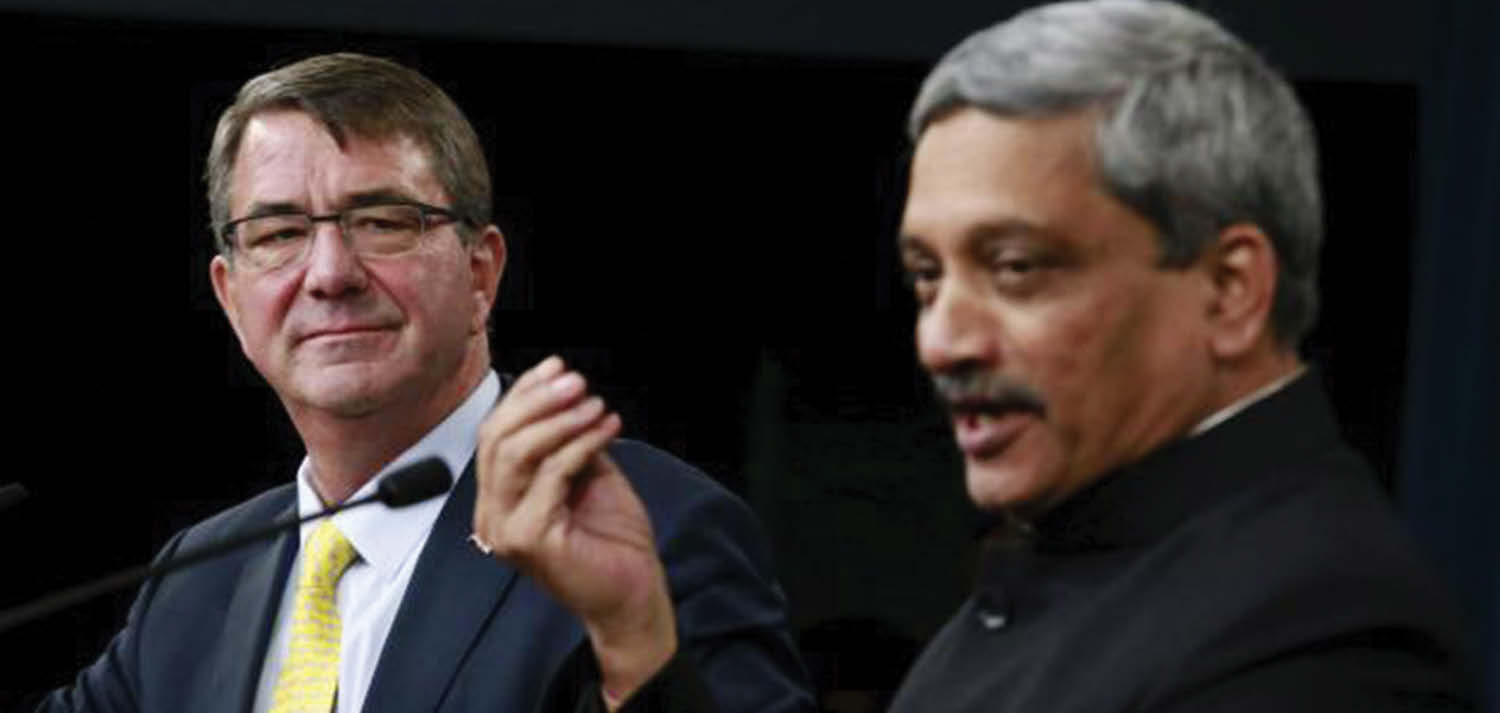
    An important step in further strengthening the partnership will be US defence secretary Ashton B Carter’s on-going visit. Carter has been widely credited for ‘upgrading’ the US-India defence relationship through the formation of the iconic Defence Technology & Trade Initiative (DTTI). His first visit as defence secretary promises a framework for defining the scope of an upgraded defence relationship with India – one that has seen explosive growth in bilateral defence trade and an increase in the number of joint exercises and intelligence sharing. As we embark on the next chapter of bilateral defence ties, US companies will seek close collaboration with India’s defence industry to co-produce and co-develop defence capabilities that serve common interests and mutual benefit. A time-bound commitment to procurement, more transparent and decisive offset policy and regime, and closer consultation with industry will serve to advance the bilateral defence relationship.

    The key to attracting much needed investment in the country is predictability and transparency in areas like tax and intellectual property. When these principles are consistently applied, business will boom for both the US and India as investors will have the certainty they need to proceed in projects that require long-term commitment. Laws, rules and policies have to be framed in a manner that eliminates ambiguity, whimsical discretion, and interpretation.

    Innovation is an intrinsic part of India’s DNA. But innovation too needs to be backed by appropriate policy measures. Young start-up companies and India’s vibrant informal sector will gain from uniform tax standards. Their success will place India on a firm growth trajectory.

    The speediness of economic reforms and avoidance of politically driven distractions will determine the success of the government. Few political leaders have been so closely watched in their first year of assuming office as Modi. The close scrutiny has been for obvious reasons -the expectations of 1.25 billion people who gave him the mandate to lead the nation to economic prosperity rest on his shoulders. Further private sector investment in areas of skill development and early education can fast track India’s growth story. The time is ripe to tap into the skills and enthusiasm of the youth population and prepare them for better opportunities. Hope, optimism and working with a strategy – all these lie before the nation and the PM in this next phase.

    (The author is  president, US-India Business Council)

  • NRI investments to be considered domestic

    New Delhi (TIP): In an attempt to attract overseas funds, the Centre on Thursday said non-repatriable investments by non-resident Indians (NRIs), overseas citizens of India (OCIs) and persons of Indian origin (PIOs) will be treated as domestic investments and will not be subject to FDI caps.

    The Cabinet approved some amendments, including changes in definition of NRI, to be incorporated in the FDI policy.

    “Investment by NRIs under Schedule 4 of FEMA (Transfer or issue of security by persons residing outside India) Regulations will be deemed to be domestic investment at par with the investment made by residents.” an official statement said.

    The NDA government, which has liberalised the FDI policy for sectors such as Defence, Railways, infrastructure, medical devices and insurance, is keen to tap NRIs, OCIs and PIOs.

    The government wants to channelise the funds of NRIs, who now have set up large companies abroad, by treating their non-repatriable investments as domestic investment.

    NRIs have been demanding the government that their investment be considered as domestic investment.

    A committee set up to look into the possibility of treating non-repatriable NRI funds as domestic investment, had earlier said that NRIs might prefer investing through corporate entities.

    “It was intended to provide NRIs an incentive to bring funds into India without repatriation rights, at a time when foreign exchange reserves were limited and capital inflows were modest,” the statement said.

    The provision should continue to incentivise investments by NRIs, including OCIs and PIOs, resulting in increased investments in the country.

    “This will enable investments by NRIs, OCI and PIO cardholders under Schedule 4 on non-repatriation basis, across sectors without being subjected to any of the conditions associated to foreign investment,” it said.

    During the April-February period of the previous fiscal, FDI rose by 39 per cent to $28.81 billion as against $20.76 billion in the same period last fiscal.

  • US-India Business Council Inducts 6 New Board Members

    US-India Business Council Inducts 6 New Board Members

    WASHINGTON:  The US-India Business Council (USIBC) comprising more than 300 top-tier US and Indian companies advancing commercial ties between the two countries has inducted six global business leaders to serve as members of the board.

    The new appointees are Anurag Bhargava, Chairman, IREO; Marc Allen, President of Boeing International; David M Cordani, President and CEO, Cigna Corporation; Patrick Dewar, Chairman, Lockheed Martin Global; Kenneth C Frazier, Chairman and CEO, Merck; and Edward Monser, President and COO, Emerson Electric.

    USIBC and the board of directors remain committed to advancing the commercial relationship between the US and India, said Ajay Banga, USIBC Chairman and MasterCard President and CEO.

    “Our members are encouraged by Government of India’s commitment to economic growth, to attracting the investment needed to achieve that growth, and improving the ease of doing business in India,” he said.

    They “look forward to contributing to India’s growth story through any number of Government of India initiatives, including Smart Cities and Make in India.”

    The new group of directors is “joining the Council at a time when India is poised for tremendous growth and will undoubtedly provide valuable leadership to USIBC and its members,” said Mukesh Aghi, President of USIBC.

    Anurag Bhargava, Chairman of IREO, the largest FDI investor in the construction development sector in India said, “IREO is committed to delivering world-class homes and supporting efforts to build smart cities and urban infrastructure that enables India’s continued economic growth and middle class expansion.”

    “Promoting an innovation-based economy supports not only the growth of the life sciences industry, but also helps to expand health care access for its people,” said Kenneth C Frazier, Chairman and CEO, Merck.

    “As Cigna works to improve both health and vitality in India, we look forward to increasing our presence in the dynamic Indian market,” said David M Cordani, President and CEO of Cigna.

    “India has a lot to offer to the world as a market and US companies have a lot to consider and gain from the opportunity,” said Edward Monser, President and COO of Emerson Electric.

    “Boeing’s relationship with India dates back several decades, and we look forward to an enduring partnership for decades to come,” said Marc Allen, President of Boeing International.

    “Lockheed Martin’s commitment to teaming with the Indian Government and enterprise aligns well with the spirit of the Council’s mission to advance the bilateral relations,” said Patrick Dewar, Chairman of Lockheed Martin.

    As board members, this dynamic group of CEOs along with existing members will help promote the USIBC policy advocacy priorities across critical areas such as health, defence, designing liveable cities, technology, manufacturing and financial services, said the trade association.

  • It’s Flipkart, Snapdeal vs Amazon, eBay

    It’s Flipkart, Snapdeal vs Amazon, eBay

    NEW DELHI (TIP): The government on Thursday began consultations on FDI in B2C e-commerce amid a sharp divide between Indian and foreign players. While domestic companies such as FLIPKART and Snapdeal opposed FDI during a meeting by commerce and industry minister Nirmala Sitharaman, foreign players such as Amazon and eBay made a strong case for it.

    “We have always maintained that opening up this sector to FDI will be good for consumers and Indian businesses as it will allow us to partner with local manufacturers to source products not carried by other sellers on the marketplace, and support the Make in India vision,” said an Amazon India spokesperson.

    Around 60 players from the industry, including representatives of Amazon India, Snapdeal, Ikea, Japan Plus, eBay and FLIPKARTattended the meet.

    Domestic e-tailing companies fear it will allow global giants such as Amazon to bring its inventory-based model here, which works on the principle of buying goods in bulk at a low price from small businesses and selling them at a discount to consumers. Currently, e-tailers operate through a marketplace model where independent sellers use their websites to reach out to customers.

    “FDI in e-commerce will not have a good impact on the Make in India model. It will allow Amazon to squeeze and manipulate small businesses and flood the mar mar Chinese goods. The e-commerce industry has already received around $9 billion FDI. It has created thousands of jobs. What is the point of changing the policy now,” said an executive with a large Indian e-tailing company.

    At present, 100% FDI is allowed in B2B e-commerce space, which helps global retailers such as Walmart operate cash-and-carry business. A Snapdeal spokesperson said, “The government must tread this issue with caution to ensure that there is no adverse impact on the growth of MSMEs in the country.”

    A CII spokesperson said, “E-commerce in India is at relatively nascent stage and the market is yet to attain full maturity level. While CII is favourably inclined towards 100% FDI in B2C route, the sector should be given some time to come to a level where it can compete globally.”

    FLIPKART also flagged tax issues at the meeting, where Sitharaman said it was only the first in a series of consultations and it will take more such meetings to come to a conclusion about FDI in B2C e-commerce.

  • The Black Money Bill is like a ‘Medu Vada’

    The Black Money Bill is like a ‘Medu Vada’

    The government has used the extended session of parliament to pass a new bill in the Lok Sabha as part of its efforts to persuade the nation that it is serious about tackling the problem of “black money”.

    Assuming it is soon enacted – which it will be, since it has been deemed to be a “money bill” and so the Rajya Sabha can do nothing about it but discuss it and return it to the Lower House – we will soon have a law on the books to punish Indians who have undeclared accounts or other assets abroad. Any undeclared amount above Rs.5 lakhs will incur a 120% penalty and result in a stiff jail term for the offender. But before the righteous pop the champagne corks to celebrate the prospect of the cells of Tihar Jail overflowing with well-heeled elites, a few sobering demurrals are in order.

    None of us disagrees, obviously, that black money is a serious problem. The Congress Party has made it very clear that we would support any serious effort by the Government to bring back black money to this country. But this Bill has four fatal flaws. Though my party did support the bill, we did not do so blindly. It has some real limitations we would have liked to have seen improved.

    [quote_box_center]Also Read: Rs 6,400 crore deposited in 339 accounts by Indians in Swiss bank, SIT tells SC[/quote_box_center]

    The first is that this Bill rests on the premise that foreign assets and foreign accounts are the principal problem in black money. They are not. Of course, no one has any real idea of the scale of the problem. The Ministry of Finance says that there is no official estimate of black money abroad, and they are right. A number of figures were advanced during the Lok Sabha debate, with the highest, from a more objective source than Baba Ramdev – the US-based agency Global Financial Integrity – placing the sum of illicit transfers out of India at about Rs. 28 lakh crore. But that figure still doesn’t amount to the 15 lakhs per Indian that the BJP promised to put into every citizen’s account; it actually works out to under Rs. 25,000 per Indian in black money outside the country. So, first of all, the scale of the problem is much smaller than the public has been led to assume.

    The fact is that domestic black money is a much bigger figure (some say it may be almost as much as the entire official economy) and is a much larger problem. Yet, domestic tax evasion remains a civilian offence whereas this Bill criminalizes foreign assets. Let’s face it: this Bill is a pure political diversion by the BJP to distract the people from the Government’s failure to actually tackle black money generation within India.

    In fact, even black money generated abroad is brought back to India as FDI through so-called round-tripping, especially via investment havens like Mauritius (from which$4.9 billion dollars came into India during the last financial year). In other words, there’s much more black money here than abroad, including black money that was once abroad.

    So, if this Bill is indeed as ambitious as the Minister says, the ambition seems to consist of scratching the tip of the iceberg. The second fatal flaw is that there is no mechanism to actually retrieve information on the defaulters, which requires agreements with foreign governments. There are governments with which we have concluded agreements within the UPA era. Are there any new governments that have come on board to give us information?

    How many governments are willing to cooperate with us in this effort?

    We know that foreign countries are just not waiting to hand over information to us about Indians holding black money in their countries. The fact is that their domestic laws and International Treaty obligations will prevail. For example, the Swiss Government will not reveal information on Swiss Bank deposits, and cannot reveal them under their own laws, until we provide the names of individuals we are investigating, the names of the banks where they have their money, and evidence of criminality in the acquisition of this money. The Swiss government has said that they will not support any “fishing expedition” by the Indian government looking for Indian names in their banks. The government of India has announced harsh punitive measures in today’s Bill, but how will punitive measures alone promote compliance when the Government has no way of knowing who has assets  abroad, or of getting information that will inculpate people?

    ***This is why I joked in Parliament that the Finance Minister, who once used to enjoy good South Indian food, has given us a medu vada Bill – a Bill with a big hole in the middle of it*** [emphasis added]. That big hole is the lack of means of obtaining information about those whom the government actually wants to prosecute. You can announce threats of jail and hefty fines, but you cannot fine or jail “persons unknown”.

    The third flaw is, paradoxically enough, that this Bill gives unbridled powers to the tax authorities, assessing officers, Enforcement Directorate, CBDT and others, while overlooking the great failures of tax administration in our country. The Bill essentially recreates the Inspector Raj of the pre-liberalization days. It does so by giving the taxman judicial powers, powers to scrutinize files for 16 years, levy penalties, make people criminally liable, and more.

    This is all the more ironic since this is a government that has disempowered most of its Ministers and bypassed most bureaucrats except the ones who are in the PMO. The only people who are gaining power now in this government are the taxmen. If these powers are exercised and abused, the Government will drive people away from India: there is already a surge of inquiries about becoming NRIs. There are no safeguards for protecting the innocent. Those who provide inadequate information in good faith will still be punished. The bigger worry is that this kind of tax tyranny will drive away businesses as well. It does not square with the government’s vaunted determination to improve India’s ease of doing business. Worse, the Bill completely overlooks the very poor quality of tax administration in this country. There are real questions about the integrity of our tax process. There are also capacity issues, including a large number of vacancies in the Enforcement Directorate.

    One concrete example of the system’s limitations is that the Government missed its deadline of 31st March, 2015 for prosecuting black money holders abroad under the existing Income Tax Act, 1961. Out of 427 actionable cases in the HSBC list, the Special Investigation Team has prosecuted only 200 of them. If the Government does not have the capacity even to go after the names which it already has, what is it going to do with the ones it doesn’t know about under this new Bill?

    The fourth and final flaw is a fundamental one — this Bill is not part of an overall strategy. An overall strategy should focus on controlling the generation of black money, which will need a comprehensive approach that includes serious tax reforms and rationalization; reforming real estate practices (and there are a whole series of things which need to be done there); improving the quality of education so that black money does not come into the education system; tackling black money in politics, which we never talk about in Parliament, though every MP knows that politics is awash in black money; and taking action against hawala networks. No such larger comprehensive strategy has been articulated by the Government. Instead, it has offered a Bill that, like modern dating, offers short-term gratification without long-term commitment. This Bill is an attempt to look tough and to seem to be taking decisive action, but it is not anchored or integrated into such a sensible strategy.

    We need a comprehensive approach to black money. This isn’t it.

  • YES BANK READIES US LISTING PLAN

    MUMBAI (TIP): Yes Bank is gearing up to become the third Indian bank to have its shares listed on American stock exchanges. The youngest private bank has received a go-ahead from its board to raise up to $1 billion by way of American Depository Receipts or through a Qualified Institutional Placement. The permission follows a proposal to hike investment by foreign investors to 74% of the bank’s paid-up share capital from the existing limit of 49%.

    The shares of Yes Bank jumped 7% to close at Rs 851 on BSE following the announcement on Thursday. At the current market price, the market capitalization of the bank stands at Rs 35,566 crore. “We are fully geared up for an ADR or any other form of capital-raising. For an ADR, we will have to additionally file the accounts in US GAAP,” said Rana Kapoor, MD & CEO, Yes Bank. The only two other Indian banks to be listed in the US are ICICI Bank and HDFC Bank.

    Besides US Accounting norms, Yes Bank will also have to comply with the demanding Sarbanes Oxley (Sox) Act of 2002. In addition to changes in practices, Sox involves high legal costs for certifying compliance.

    According to Kapoor, capital raising will be through primary issuance. “Depending on when we go to the market, we see a stake dilution of between 12-15%. Following the decision to do away the distinction between FII and FDI, we have the headroom to increase total foreign investment by another 28% of our capital,” he said. The enabling provision gives the bank room to time the issue in line with market conditions.

  • India’s Land Acquisition Act: Bonanza for Rulers & their Financiers

    India’s Land Acquisition Act: Bonanza for Rulers & their Financiers

    India has a long history of its ruler’s fascination with farm land. Whether it was ancient Kings or Moghuls or British invaders turned rulers as well as the current rulers after independence; every one has been robbing the farmers of their land in broad daylight by claiming that they are doing it for the sake of development.

    Let us have a close look at the largest democracy of the world. India is a country of 1.35 billion, where 665 million practice open defecation against 37 million doing so in China. India has the world’s largest army of 85 million child labor out of 830 million poor living in extreme poverty. India’s elite, world famous billionaires, part of the 56 million rich Indians, live side by side with almost a billion poor and treat them as sub humans who are viewed as burden for the country.

    A former diplomat, politician, author and thinker Pavan Varma wrote in his book “Being Indian” that in the Indian elite “there is a remarkable tolerance for inequality, filth and human suffering”. He adds that “concern for the deprived and the suffering is not a prominent feature of the Indian personality. The rich in India have always lived a life, quite oblivious to the ocean of poverty around them”. Less than 10-15 minutes from every slum in any major city of India there are very expensive heavily guarded residential areas with mini palaces costing from a few million dollars to $1 billion Mukesh Ambani’s Palace. One city: two universes.

    India’s Land Acquisition Act was enacted in 1894 by British rulers. It gave unlimited power to the government to acquire any land. The Act allowed governments all over India to acquire land from the public. After independence India adopted the same Land Acquisition Act and no one bothered to make any changes in it because it was an easy way for the politicians and corporations to make money. The only person who lost money and livelihood was the individual and his family whose land was acquired. In 1985, an amendment made it easier for politicians and corporate to take over land at throw away prices. “Whenever it appears to the [appropriate Government] the land in any locality [is needed or] is likely to be needed for any public purpose [or for a company], a notification to that effect shall be published in the Official Gazette [and in two daily newspapers circulating in that locality of which at least one shall be in the regional language], and the Collector shall cause public notice of the substance of such notification to be given at convenient places in the said locality.” Practically for 66 years, from 1947 to 2013, every political party and at the center as well as all the states chose not to do anything and has been using this law as a source to generate black money to fight elections. It was only in 2013, the Congress led United Progressive Alliance (UPA) brought in “The Right to Fair Compensation and Transparency in Land Acquisition, Rehabilitation and Resettlement Act 2013. Although this also has some major flaws but it was the first time that some one thought of protecting the farmers, tribals and landless poor. However, UPA could not implement this law as it lost power and in 2014 a new government under Modi was installed at the center by the corporate world.

    Corporations and politicians all these years, in daylight robbery, after taking over farm land at throw away prices, have been getting the “land use” changed overnight and land becomes 1,000 to 10,000 times more its original price. Then the scam of acquiring Panchayat land or Shamlat land that is owned by the entire village marked for animal grazing especially for marginal farmers and landless owners of a few animals has been going on for over a century. This is done by the prospective buyer with bribes to revenue officials, from Patwari, Gram Panchayat members, Nayab Tehsildar, Tehsildar, District Collector, to ministers and judges, in case if a petition against an allotment is made for stay and, of course, the Chief Minister of the State who gets his/her share before any one else and only then a green signal is issued to go ahead with the project. Now after acquiring the farm land, to get its “land use” changed the buyer once again pays bribes to Chief Minister of the State, the District Collector, the Minister concerned, never forgetting the judicial officials in case a petitioner approaches the court for stay. The buyer also pays the usual development charges as per the rules.

    Farm Land has always been the biggest black money source for every ruling party in every state. If a serious investigation is done one can find how the real estate companies came into existence and some of the famous 5 star hotels, resorts, malls, luxury farm houses and residential complexes were built on farm land as well as Shamlat or Panchayat Land. The worst part is the farmers and their family members who used to own this land are now working as help- gardener, watchman, cleaner, cook and drivers on these properties.
    The forest land on which millions of people specially tribal and landless villagers depend for their survival by collecting minor wild oil seeds, herbs, fruits and flower, is much easier to acquire. Bribe all the concerned politicians, bureaucrats, Judges and environmentalists and get the land for a paltry sum per year on a per yard lease for 99 years. There is absolutely no need to buy and spend money on stamp papers etc.! And, in the long rum, have it to yourself, almost for free.
    Every central and state government in India believed that it owned the country’s resources. That is the reason we had numerous scams under Congress, Janata Party and BJP governments and their allies. But this time BJP that has come to rule the country at the Center as a single party with a massive majority for any party, after 30 years, has gone a step forward. It is openly sending a message that they own the resources. BJP must understand that “Country’s resources belong to the people and the land owned by farmers must remain with the farmers.” Let them decide what is to be done with the resources in the best interest of the country. Let the issue be decided by the majority of India’s citizens, not by the 1% that own the politicians and are trying to take over the country.
    Governments in India have always advanced the argument that the land is required for public use. That, it is required to build infrastructure- roads, bridges, power plants etc. That the land is required for the vital defense projects. For each of these projects that go in to private sector, the players get their profits. Even in case of government projects, governments get to recover the cost through various taxes. Where is the need to provide land at subsidized rates to any of them? The Indian industrial houses -Reliance, Adani, Tata, Jindal, Ruia etc have unprecedented political access and power. All these corporations, unlike East India Company, do not have their private army but soon will be making all kinds of warheads, missiles, helicopters, airplanes, ammunition and other sophisticated military gadgets because BJP’s Finance Minister Arun Jaitley has increased the FDI limit to 49% from 26% for defense industry. Just a few days before the budget the institution of Lobbyist ( Middleman) has been legalized in India for deals with the government, including defense deals. Now there won’t be any shortage of Radias openly operating in the corridors of power to influence law makers for favors for their corporate clients. Do these multi-billionaires really need to be given land at a subsidized rate?
    Even after Congress party’s catastrophic defeat in 2014 due to rampant corruption and massive scams the country’s crony capitalists are unlikely to suffer as a result. The nexus between business and politics, today under BJP rule, is as tight as it has ever been. BJP spent Rs 32,000 crore to bring Narendra Modi to power with massive corporate donations. BJP is estimated to have spent at least Rs 6,200 crore on print and broadcast advertising alone. Of these donations, around 90% comes from unlisted corporate sources who will be rewarded when the times comes. May be, under Land Acquisition Act it is pay back time for BJP to its financial supporters with cheap land besides the Rs. 62,398.6 crore for 2014-2015, the revenue government is expected to forego because of exemptions and deductions given to corporates.

    Modi’s Finance Minister Arun Jailey is bringing down the Corporate Tax from 30 per cent to 25 per cent in the next four years. In USA where the corporate Tax is 35% according to CAG ; US Corporation’s effective rate of tax was 12.1% in 2011 that is 40 years low. If the effective rate in USA is 12.1% in India it has to be under 10% or in some cases 0 because Indian Corporations are more innovative; they get subsidized loans, land, electricity, break on all kinds of taxes including custom, excise, dividend tax and can book their profits in foreign countries by over invoicing or under invoicing and route it back through government approved Mauritius route. Besides with the plethora of credits and deductions in tax code they buy super luxury cars, luxury homes & farm houses, air planes, yachts and expensive holidays abroad in their corporation’s name for their personal, family, executive and for the use of politicians and top bureaucrats. Interestingly, the bigger the corporate the more deductions and exemptions they take.!
    PM Modi has been going to every country in the world and telling investors: ‘Come to India; make in India; we will give you cheap land and labor’. PM Modi is certainly not lying. After robbing the farmers of their land, the farmers and their family members will have no choice but to become cheap laborers for his financial supporters- the MNC’s and the local industrial houses.
    (The New Jersey based author is a regular contributor to The Indian Panorama. He can be reached at davemakkar@yahoo.com)

  • INDIA’S RELATIONS WITH THE US MUST NOT BE ONE-SIDED

    INDIA’S RELATIONS WITH THE US MUST NOT BE ONE-SIDED

    ‘It is in the interest of both sides that the visit is seen as being successful. Both sides have invested considerable political capital in it…….This rapid exchange of visits and the decisions taken have to be justified, beyond the symbolism, which is no doubt important in itself. This opportunity to impart a fresh momentum to ties should not be missed………. What we need is a pragmatic approach by both sides. On the side this is assured by Modi. He has shown that he is essentially pragmatic. The only principle he is attached to is India First”, says the author. 


    Prime Minister Narendra Modi’s ready acceptance of United States President Barack Obama’s invitation to visit Washington in September 2014 came as a surprise against the background of the visa denial humiliation heaped on him for nine years.


    Modi’s invitation to Obama to visit India as chief guest at our 2015 Republic day celebrations came as an equal surprise, as did Obama’s acceptance at such short notice.


    The messaging from both sides is clear. Modi wants to give a fresh impetus to the India-US relationship, seen as languishing for some time now. Obama has conveyed that he is ready to respond.


    Now that Obama is coming and the two sides want to reinvigorate the relationship, the outcome of the visit will be watched closely not only in India and the US, but internationally too.


    To look ahead, we should look backwards a little bit so that the potential for the future can be seen through a better understanding of the past.


    There are no instant solutions to the issues in India-US relations. The US demands in many cases require policy, legislative and administrative responses by India, not to mention care by us that a balance in our external relations is maintained.


    Obama had said during his visit to India in 2009 that he saw the India-US relations as potentially a ‘defining partnership of the 21st century.’ It is very hard to define what a defining partnership is, but what he meant presumably is that relations between the oldest and the largest democracy, between the world’s foremost economic power and, in time, the third biggest economy will define the contours of international relations in the decades ahead.


    Our leaders say that India and the US are natural partners. This is not borne out objectively by the history of the relationship, the differences that currently exist on a whole host of issues and the inherently unequal nature of the relationship.


    The US is the world’s only superpower with global interests whose contradictory pulls and pressures they have to manage even in our region, and we are not even a credible regional power yet.


    If the argument is that it is the shared values of democracy, pluralism and respect for human rights make us natural partners, then the US relationship with Pakistan and China — often at our cost — which are not democracies, has to be explained. US interests often take precedence over its declared values.


    Even if rhetoric does not measure up to realities, the fact remains that improvement of India-US ties has been the most important development in India’s external relations in the last decade.


    It is the 2005 nuclear deal that opened the doors to a transformative change in bilateral ties. Reflecting the new intensity of bilateral engagement, about 28 dialogues were set up between the two sides covering the fields of energy, health, education, development, S&T, trade, defence, counter-terrorism, nonproliferation, high technology, innovation etc.


    The US now supports India’s permanent membership of the UN Security Council in principle. It is backing India’s membership of the four international export control organisations — the Nuclear Suppliers Group, the Missile Technology Control Regime, the Wassenaar Arrangement and the Australia Group.


    Trade in goods and services between the two countries has grown to almost $100 billion (about Rs 620,000 crore).


    A big breakthrough has been made in defence. In the last five or six years the US has bagged defence orders worth about $10 billion (about Rs 62,000 crore). These include C-130, C-17 and P-80 I aircraft and heavy lift, attack and VIP helicopters. The US has emerged as the biggest supplier of arms to India in this period.


    The US has proposed joint manufacture of several defence items in India under its Defence Trade and Technology Initiative. While India has overcome its mistrust of the US and fears that at critical moments the US may cut off spares for its equipment as part of its liberally used sanctions instrument, India has been reticent in its response to the DTTI, possibly because it is still not convinced that the US will transfer the technologies that India would want or not tag unacceptable conditions to it.


    The US proposed at one time three ‘foundational’ agreements covering the areas of logistics, interoperability and access to high technology equipment, but India has been cautious, presumably because it was concerned about slipping into the US defence orbit and losing its autonomy.


    To balance this, India and the US have been conducting a large number of military exercises, far more than with any other country. The naval exercises in the Indian Ocean to protect the sea lanes of communication are particularly important because of their geopolitical implications. Trilateral India-US-Japan naval exercises have obvious significance.


    In Obama’s second term, however, the ties lost momentum for various reasons. Economic reforms in India slowed down, its growth rates fell, India was seen as reluctant to deepen the strategic partnership, it was lukewarm to the US pivot towards Asia, US nuclear firms saw their business opportunities in India blocked because of our Nuclear Liability Act, major US corporations began campaigning against India’s trade, investment and intellectual property rights policies in the US Congress and instigated investigations into them by the US International Trade Commission and the US Trade Representative.


    The US began criticising India for being a fence sitter, a free-loader on the international system because of its reluctance to uphold it even at the cost of its interests as other Western powers were supposedly doing. This was the sense of the ‘burden sharing’ demand of the US.


    India had its own complaints against the US regarding the implications of the new US immigration legislation for India’s IT industry, the movement of its professionals, the increase in cost of H1B and L1 visas, the totalisation agreement and outsourcing.


    During his Washington visit, Modi struck an unexpectedly good rapport with Obama who accompanied him personally to the Martin Luther King Jr Memorial and later in Myanmar described him as a ‘man of action.’


    Modi clearly signalled during the visit that he intends to reinvigorate bilateral ties and that he views them as vital for his development agenda at home.


    The joint press conference by the two leaders and their joint statement set an ambitious agenda, with many positives, if all goes according to plan.


    The two leaders agreed to increase the bilateral trade five-fold to $500 billion (about Rs 36 lakh crore).


    Modi asked publicly for more openness and ease of access to the US market for Indian IT companies, even if Obama failed to give any response.


    In order to raise investment by institutional investors and corporate entities, it was agreed to establish an Indo-US Investment Initiative led by India’s finance ministry and the US department of treasury, with special focus on capital market development and financing of infrastructure.


    It was also agreed to establish an Infrastructure Collaboration Platform convened by the ministry of finance and the US department of commerce to enhance participation of US companies in infrastructure projects in India.


    Modi invited the US to send two trade missions to India in 2015 focused on India’s infrastructure needs with US technology and services.


    It was decided to activate the Trade Policy Forum that had not been convened for a long time. An empowered annual working group was approved for addressing IPR issues and it was agreed to set up a contact group for implementing the India-US civil nuclear deal.


    US involvement was sought in the railways sector and in smart city projects (Ajmer, Visakhapatnam and Allahabad).


    It was also agreed that USAID will serve as knowledge partner to support Modi’s 500 Cities National Urban Development Mission and Clean India Campaign.


    Obama offered to reinvigorate the higher education dialogue, which has languished. He welcomed India’s proposal to establish the Global Initiative of Academic Networks under which India would invite and host up to 1,000 American academics each year to teach in centrally-recognised Indian universities, at their convenience.


    The decisions and understandings reflected in the joint statement on the energy front are potentially problematic as they could give the US more handle to put pressure on India on climate change issues.


    Both leaders expressed their commitment to work towards a successful outcome in Paris in 2015 of the conference of the UN Framework Convention on Climate Change, including the creation of a new global agreement on climate change.


    The two leaders, in recognition of the critical importance of reducing greenhouse gas emissions and improving resilience in the face of climate change, agreed to ‘a new and enhanced strategic partnership’ on energy security, clean energy, and climate change, to further which a new US-India Climate Fellowship Programme to build long-term capacity to address climate change-related issues in both countries was launched.


    A MoU was concluded between the Export-Import Bank and the Indian Renewable Energy Development Agency, which would make up to $1 billion (about Rs 6,200 core) in financing available to bolster India’s transition to a low-carbon and climate-resilient energy economy, while boosting US renewable energy exports to India.


    Modi and Obama stated their intention to expand defence cooperation to bolster national, regional, and global security. This broad-based formulation has important geopolitical implications. They agreed to renew for ten more years the 2005 Framework for the US-India Defence Relationship with plans for more ambitious programs and activities.


    They welcomed the first meeting under the framework of the DTTI in September 2014 and its decision to establish a task force to expeditiously evaluate and decide on unique projects and technologies for enhancing India’s defence industry and military capabilities.


    To intensify cooperation in maritime security, the two sides considered enhancing technology partnerships for India’s Navy, besides upgrading their existing bilateral exercise Malabar.


    They committed to pursue provision of US-made mine-resistanta ambush-protected vehicles to India.


    On terrorism, they stressed the need for dismantling of safe havens for terrorist and criminal networks, to disrupt all financial and tactical support for networks such as Al Qaeda, Lashkar-e-Tayiba, Jaish-e-Mohammad, the D-Company, and the Haqqani Network.


    The two countries also expressed the intention to start a new dialogue on space situational awareness.


    Obama affirmed that India met MTCR requirements and was ready for NSG membership. Noting India’s ‘Act East’ policy and the United States’ rebalance to Asia, the leaders committed to work more closely with other Asia Pacific countries through consultations, dialogues, and joint exercises. They underlined the importance of their trilateral dialogue with Japan and decided to explore holding this dialogue among their foreign ministers.


    Modi spoke of great convergence on the issue of peace and stability in Asia-Pacific and more joint exercises with Asia-Pacific countries.


    Very significantly, he stated that the US was intrinsic to India’s Look East and Link West policies, according thus a central role for the US in India’s foreign policy.


    They agreed to continue close consultations and cooperation in support of Afghanistan’s future.


    The principal points agreed during Modi’s visit will serve as a guide to what can be realistically achieved during Obama’s visit. To assess that, we should take into account some limitations and negatives that mark the India-US relationship.


    Already, what was agreed to is mostly not capable of quick implementation or rapid results. These are largely medium term objectives and not always clear in implications. In the course of implementation, many issues will provoke internal political debates, will require detailed processing and negotiations, parliamentary approval and intensive diplomatic effort on the international front by both parties. In some cases real differences have been glossed over by use of diplomatic language.


    On IPR issues it will not be easy to reconcile US demands on IPRs and our position that our IPR policies are in conformity with the World Trade Organisation’s Trade-Related Aspects of Intellectual Property Rights agreement. Legal issues involving our courts are involved.


    The USTR decided to put unilateral pressure on India by investigating India’s IPR policies under Section 301, but this has been halted in November 2014 in view of some forward looking announcements by the Modi government. The USTR’s ‘cautiously optimistic’ statements during his Delhi visit in November suggest that the US will wait and watch what the Modi government actually delivers.


    The US Congress has extended the investigation of India’s investment, trade and IPR policies by the USITC by another year.


    On climate change issues, under cover of its ‘political’ agreement with China, the US seems determined to put pressure on India to agree to some reduction commitments. In actual fact, this is political pressure unrelated to the merits of India’s case. Climate change is a multilateral issue, but the US is making it a bilateral one, with the commercial interests of its companies in mind.


    While the US claims that what it is offering under the DTTI has the green light from all those in the US who control technology exports, it can be doubted whether the US will be as liberal in transfer of technologies as it would have us believe. The US record in this regard with even its allies and partners is not inspiring.


    The US has shown no activism in pushing for India’s membership of NSG or MTCR as a start. It is to be hoped that it is not looking


    for a resolution of the nuclear liability issue and the finalisation of the vexed question of ‘administrative arrangements’ that is needed to complete the India-US nuclear deal before


    it does the heavy lifting again to promote India’s membership of the cartels in question.


    Surprisingly, the list of terror organisations against whom US and India have agreed to work together excludes the Taliban, pointing to a crucial difference between the two countries on the issue of accommodating this extremist force with its close Pakistani links into the power structure in Afghanistan.


    In reaching out to the Taliban the US gives priority to orderly withdrawal of its forces from Afghanistan, treating India’s concerns as secondary. The language on Afghanistan in the Modi-Obama joint statement in Washington was remarkably perfunctory.


    Worse, the US wants to retain complete freedom of action in dealing with Pakistan, irrespective of India’s concerns about its continuing military aid to that country. General Raheel Sharif, the Pakistani army chief, was accorded high level treatment during his recent visit to the US, meeting Secretary John Kerry who indirectly endorsed the role of the Pakistani army in nation building and politics by terming it as a truly binding force.


    It is worth recalling that after accepting the invitation to visit India, Obama felt diplomatically obliged to phone Premier Nawaz Sharif to say he could not visit Pakistan now and would do so later.


    The US involvement in developing our inadequate infrastructure — our ports, airports, railways highways etc — seems unrealistic as its companies are hardly likely stand up to international competition in India.


    As regards our nuclear liability legislation, it appears that the US government may be moving away from its fundamentalist position that supplier liability cannot be accepted and may be open to some practical solution to the issue in terms of limiting the liability in time and costs. The lawyers at Westinghouse and General Electric will, of course, have to be convinced.


    This is a highly charged issue politically and it is doubtful whether the decks can be cleared before Obama’s visit. The larger question of the economic viability of US-supplied nuclear power plants remains, not to mention the fact that GE does not have as yet a certified reactor.


    Work on a bilateral investment treaty will take time It appears that our side wants to be able to announce a couple of projects under the DTTI during Obama’s visit. In this connection anti-tank missiles, naval guns, pilotless aircraft and magnetic catapult for our aircraft carrier are being mentioned as possibilities.


    The US would want at least one project to be announced. Defence Minister Manohar Parrikar has let it be known publicly that US proposals are being seriously examined.


    The announcement of a more ambitious Defence Cooperation Framework Agreement valid for another 10 years is a certainty.


    The government’s decision on the GST, raising the FDI ceiling in insurance, the amendment to the land acquisition law are advance signals of its commitment to reform and attracting FDI, which is a positive from the US point of view.


    The emphasis on Make in India and developing India’s manufacturing sector, coupled with a commitment to ease doing business in India, have begun to change investor sentiment towards India, and this creates a better atmosphere for Obama’s visit.


    It is in the interest of both sides that the US President’s visit is seen as being successful. Both sides have invested considerable political capital in it.


    This rapid exchange of visits between the two leaders, leaving little time to process the decisions taken in Washington in September, has to be justified, beyond the symbolism, which is no doubt important in itself. This opportunity to impart a fresh momentum to ties should not be missed.


    But there is need also to be clear-headed about the relationship that is not easy to manage given US power, expectations, impatience and constant endeavour to do things the way it wants.


    It is a bit disturbing that an atmosphere has been created in which the focus is on what we can do for the US and Obama and not what the US must do to meet our needs and concerns. The agenda has become one-sided.


    The US should not expect India to support all its demands and polices, however questionable. India does not have to prove it is a responsible country by supporting even irresponsible US policies. Of course, India too should not expect the US to always adjust its policies to suit us.


    What we need is a pragmatic approach by both sides. On the side this is assured by Modi. He has shown that he is essentially pragmatic. The only principle he is attached to is India First.


    (By Kanwal Sibal who is a former Foreign Secretary of India)
    (British English)

  • India-US strategic partnership

    India-US strategic partnership

    In future, India may be willing to conduct joint military operations with the US in its area of strategic interest in a contingency in which India’s vital national interests are threatened, preferably as a Chapter 7 intervention under the UN flag and failing that, as part of a “coalition of the willing”, says the author.


    President Barack Obama’s forthcoming visit as the chief guest on Republic Day is likely to give a fresh impetus to the Indo-US strategic partnership. While the relationship is substantive and broad based, the impressive achievements of the strategic partnership are to a large extent attributable to the successful implementation of the 10-year Defence Framework Agreement signed in June 2005. The renewal of this agreement will be a major item on the bilateral agenda during the summit meeting.


    During the Obama-Narendra Modi meeting in September 2014, the two leaders had stated their intention to expand defence cooperation to bolster national, regional, and global security. It was agreed that the two countries would build an enduring partnership in which both sides treat each other at the same level as their closest partners, including defence technology transfers, trade, research, co-production, and co-development.


    Prime Minister Modi and President Obama welcomed the first meeting under the framework of the Defence Trade and Technology Initiative in September 2014 and endorsed the decision to establish a task force to expeditiously evaluate and decide on unique projects and technologies which would have a transformative impact on bilateral defence relations and enhance India’s defence industry and military capabilities.


    For several decades, India’s procurement of weapons platforms and other defence equipment had remained mired in disadvantageous buyer-seller, patron-client relationships like that with the erstwhile Soviet Union and Russia. While India has been manufacturing Russian fighter aircraft and tanks under licence, the Russians never actually transferred weapons technology to India.


    The country has now diversified its acquisition sources beyond Russia to Western countries and Israel. From the US, India has purchased weapons platforms and other items of defence equipment worth around US $10 billion over the last five years. However, none of the recent deals with the US have included the transfer of technology clauses. There is now a growing realisation in India that future defence acquisitions must simultaneously lead to a transformative change in the country’s defence technology base and manufacturing prowess. Hence, it is imperative that whatever India procures now must be procured with a transfer of technology clause being built into the contract even though it means having to pay a higher price. The aim should be to make India a design, development, manufacturing and export hub for defence equipment in two to three decades.


    In September 2013, Deputy Secretary of Defence Ashton Carter, now the US Defence Secretary designate, had offered India a “Defence Trade and Technology Initiative” under which the US will share sensitive cutting-edge defence technology and permit US companies to enter into joint production and co-development ventures in India. Carter had then said, “We changed our mindset around technology transfer to India in the Department of Defence from a culture of presumptive no to one of presumptive yes.” 


    The Javelin anti-tank guided missile is another key candidate for joint production, though so far the US has been hesitant to offer its seeker and warhead technology. India is also looking for high-end counter-IED technologies. In future, the two countries will conduct joint research and development for new weapons systems and the US may offer even nuclear power packs for submarines and aircraft carriers and fighter aircraft engines. Cooperation of such a high order will raise India’s technology base by an order of magnitude and help the country move several notches higher in its quest for self-reliance in defence production. stepping down as Secretary of Defence, Chuck Hagel had nominated Frank Kendall, the Department’s Undersecretary for Acquisition, Technology and Logistics, as the defence initiative’s American lead. With Ashton Carter soon to become Secretary of Defence, the initiative will get a fresh boost. The biggest boost will come from a show-piece joint development project like the BrahMos supersonic cruise missile jointly developed with Russia.


    The extended Defence Framework Agreement should take stock of the goals of the 2005 agreement that have not been fully achieved. For example, there has been no progress in cooperation on BMD technology. This needs to be rectified. Intelligence sharing is limited to ongoing counter-terrorism operations at present. It should be extended to the sharing of data bases as well, particularly the terrorism data base maintained by the US NCTC and India’s NATGRID.


    Prime Minister Modi’s government has raised the FDI limit for defence joint ventures to 49 per cent equity participation. It is likely to be open to modifying the offsets policy and amending export laws, which are considered a stumbling block. The agreement should take into account the Indian PM’s exhortation to industry to “Make in India”. The two governments should act as facilitators for their public and private sector companies to form joint ventures for the design and development, co-production and export of future weapons platforms.


    There is a mutual recognition of the adverse implications of China’s increasing assertiveness in the South China Sea and in dealing with the dispute over the Senkaku (Diaoyu) islands with Japan. This has undermined international and regional confidence in China’s desire to resolve disputes peacefully. There is need to work in unison with the international community to uphold the unfettered use of the global commons. India is building robust military intervention capabilities and the armed forces are engaged in the process of formulating a doctrine to give effect to these capabilities.


    Though India values its strategic autonomy and recognises that each bilateral relationship is important in its own way, the policymakers realise that the geo-political contours of the 21st century and peace and stability, particularly in the India-Pacific region, will be shaped through cooperative security. In future, India may be willing to conduct joint military operations with the US in its area of strategic interest in a contingency in which India’s vital national interests are threatened, preferably as a Chapter 7 intervention under the UN flag and failing that, as part of a “coalition of the willing”.