
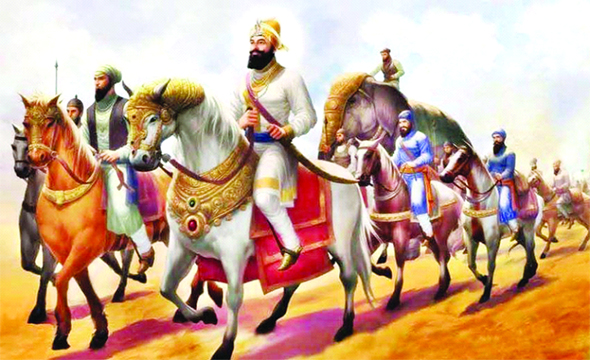

Guru Gobind Singh’s leadership was not confined to spiritual guidance; he led the Sikhs in multiple defensive battles to protect religious freedom and human dignity. His strategic brilliance was evident in Bhangani (1688), Nadaun (1691), Guler (1696), Chamkaur (1704), and Muktsar (1705).
These battles were not about conquest, but defense of righteousness, ensuring that the Sikh community could practice its faith freely. The Siege of Chamkaur is particularly legendary: Guru Gobind Singh, with just 40 warriors, faced thousands of Mughal soldiers. His two elder sons sacrificed their lives, yet the Guru held the fort, demonstrating extraordinary valor, resilience, and faith in God.
Through his leadership, Guru Gobind Singh taught that true courage arises from moral conviction, and that defending the weak and upholding justice is a sacred duty.
The Saint-Soldier – Merging
Spirituality and Valor
Guru Gobind Singh epitomized the Saint-Soldier ideal, integrating deep spirituality with martial prowess. His writings, including Jaap Sahib, Akal Ustat, and Zafarnama, combine poetry, theology, and philosophical insight, encouraging Sikhs to lead righteous lives while being prepared to fight injustice.
He emphasized Miri-Piri, the balance of temporal and spiritual power, teaching that worldly responsibilities and spiritual growth are intertwined. The Khalsa became the embodiment of this principle, inspiring generations to be both morally upright and courageous defenders of faith.
Teachings of Guru Gobind Singh: Courage, Devotion, and Righteous Living
Guru Gobind Singh Ji, the tenth Sikh Guru, was a unique combination of saint, poet, and warrior. His life was a symphony of devotion, courage, moral integrity, and leadership. The principles he articulated were not abstract ideals-they were practical guides for living a purposeful, righteous life. His teachings form the cornerstone of Sikh philosophy, but their universal appeal transcends religion, offering lessons in spirituality, ethics, courage, and service for humanity at large.
_Fearlessness and Courage – The Foundation of a Saint-Soldier
Guru Gobind Singh’s vision of the Khalsa was rooted in the principle of fearlessness. He believed that faith without courage is incomplete, and spiritual growth requires the ability to confront injustice and adversity with steadfast resolve.
The Baisakhi of 1699, when he created the Khalsa, was a powerful manifestation of this principle. The five men who stepped forward for initiation exemplified complete courage, surrendering personal safety for the cause of righteousness.
The Siege of Chamkaur (1704), where he defended Anandpur with just forty warriors against a massive Mughal army, illustrates his teachings in action: courage, strategic acumen, and unwavering faith.
His poetry in Jaap Sahib repeatedly exhorts the devotee to “be fearless, like the lion, in the face of tyranny.”
Fearlessness, according to Guru Gobind Singh, is not recklessness; it is disciplined courage guided by ethics and devotion. Every Sikh is taught to internalize this principle, applying it to life challenges, moral choices, and societal responsibility.
Equality and Social Justice – Upholding Human Dignity
A hallmark of Guru Gobind Singh’s teachings was the emphasis on equality and justice. In a society rife with caste discrimination, gender inequality, and religious persecution, he stood for the dignity and rights of all human beings.
By instituting the Panj Pyare, he rejected caste hierarchies, emphasizing that spiritual worth is not determined by birth but by character and devotion.
His life exemplified defending the oppressed. He not only led his followers in battles for religious freedom but also advocated for universal respect and fairness.
His writings encourage Sikhs to actively combat injustice, demonstrating that spirituality and social responsibility are inseparable.
This teaching resonates even today, emphasizing that true faith must manifest in ethical action and protection of human rights.
Devotion to God – The Core of Spiritual Life
At the heart of Guru Gobind Singh’s philosophy is unwavering devotion to God (Waheguru). He taught that spiritual life is not limited to ritual but requires living in constant remembrance of the Divine, cultivating purity of mind, body, and action. His compositions, including Jaap Sahib, Akal Ustat, and Bachittar Natak, are replete with praise for God’s infinite power, wisdom, and justice.
He emphasized direct, personal connection with the Divine, teaching that faith is not inherited but realized through disciplined practice, meditation, and righteous living. Devotion, in his view, is inseparable from moral courage: true worship requires action in the world.
Self-Discipline and Moral Integrity – The Backbone of Character
Guru Gobind Singh believed that self-discipline is essential for spiritual and worldly success. Physical fitness, mental sharpness, and ethical conduct are all intertwined in his teachings.
Daily discipline included prayer, meditation, physical training, and study.
He emphasized truthfulness, honesty, humility, and compassion as the foundations of character.
The Khalsa was trained to live a life of regulated conduct, balancing spiritual practice with the demands of leadership, service, and community defense.
Self-discipline, for Guru Gobind Singh, was not mere personal restraint; it was preparation for moral and physical responsibility, enabling one to act decisively when confronted with injustice.
Sacrifice and Service (Seva) – The Measure of Devotion
Service to humanity, or seva, was central to Guru Gobind Singh’s vision. Spiritual devotion, he taught, is incomplete unless it translates into selfless action for the benefit of others.
His own life was a model of sacrifice. From witnessing his father’s martyrdom to losing four sons in the struggle for justice, he demonstrated that principle comes before personal gain.
Seva extends beyond ritual; it includes protecting the oppressed, feeding the hungry, educating the community, and fighting tyranny.
The Guru emphasized that such service is both a spiritual practice and a civic duty, creating a compassionate, responsible society.
Education, Knowledge, and Wisdom
Guru Gobind Singh stressed the importance of knowledge as a companion to valor and faith. An educated mind, he taught, strengthens spiritual insight and enhances leadership.
He himself was multilingual, proficient in Persian, Sanskrit, Braj, and Punjabi, and composed literary works of immense depth.
Education was not limited to academic learning; it included understanding scripture, philosophy, history, and martial skills.
He believed that intellectual growth empowers moral action, ensuring that courage is guided by wisdom rather than impulse.
The Warrior Ethos – Protecting Justice
While he preached peace and devotion, Guru Gobind Singh recognized that defending righteousness sometimes requires armed action.
The Khalsa identity embodies this principle: a disciplined, spiritual community trained to protect truth, freedom, and the weak.
He distinguished between aggression and defense, teaching that warfare is a duty only in the service of justice.
His life demonstrates that spirituality and martial skill are complementary, enabling individuals to uphold ethical principles in a hostile world.
Universal Values – Lessons Beyond Religion
Guru Gobind Singh’s teachings are timeless and universal: courage, devotion, equality, self-discipline, service, and education are values that transcend faith. Leaders and thinkers across India and the world have recognized his wisdom. His message encourages all individuals to live ethically, act courageously, and serve humanity, offering a framework for personal excellence and societal betterment.
Quotes Reflecting Guru’s Teachings
“Fear God, do your duty, and keep your word.”
“In the midst of darkness, be the flame of courage.”
“Those who have no faith in their words have no faith in their soul.”
“True worship lies in righteous action and fearless living.”
Each quote reflects a fusion of spiritual devotion, ethical responsibility, and moral courage, guiding Sikhs and non-Sikhs alike toward principled living.


Be the first to comment