
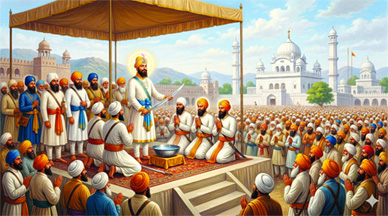

The sacred festival of Vaisakhi stands as one of the most transformative milestones in Sikh history. While it marks the harvest season in Punjab, for Sikhs it commemorates the historic moment in 1699 when Guru Gobind Singh founded the Khalsa-a disciplined, spiritual, and fearless brotherhood committed to justice, equality, and devotion to the Divine.
At the heart of this story lies a dramatic, deeply symbolic event that forever redefined Sikh identity.
The Historical Backdrop: A Community Under Trial
The creation of the Khalsa cannot be understood without recognizing the turbulent times in which it emerged. Under the rule of Aurangzeb, religious intolerance had intensified, and forced conversions and persecution had become widespread.
The martyrdom of Guru Tegh Bahadur in 1675-who gave his life defending the religious freedom of Kashmiri Pandits-left an indelible mark on the Sikh psyche. His sacrifice called for a transformation of the Sikh community into one that could defend righteousness not only through prayer but also through Shakti (strength).
His son, Guru Gobind Singh, rose to this challenge with extraordinary vision.
Vaisakhi 1699: The Moment of Revelation at Anandpur Sahib
On the day of Vaisakhi in 1699, at Anandpur Sahib, Guru Gobind Singh summoned thousands of Sikhs from across the land. The atmosphere was charged with devotion and anticipation.
Then, in a moment that would echo through history, the Guru addressed the congregation and made a startling demand:
“I need a head.”
The crowd fell silent. The call was not metaphorical-it was a test of ultimate faith and surrender.
After a tense pause, one man stepped forward-Bhai Daya Singh. He offered his head to the Guru. Guru Gobind Singh took him inside a tent. Moments later, the Guru emerged alone, his sword stained with what appeared to be blood, and repeated his call.
Four more men came forward, one by one:
– Bhai Dharam Singh
– Bhai Himmat Singh
– Bhai Mohkam Singh
– Bhai Sahib Singh
Each represented a different caste and region of India-symbolizing the complete rejection of social divisions.
Finally, the Guru reappeared with all five men alive, dressed in saffron and radiant with spiritual energy. They were declared the Panj Pyare-the Five Beloved Ones.
This powerful act demonstrated that true sacrifice was not about death, but about absolute devotion and courage.
The Creation of the Khalsa: The Amrit Ceremony
Following this dramatic test, Guru Gobind Singh initiated the Panj Pyare into a new spiritual order-the Khalsa, meaning “the pure”.
The Sacred Preparation of Amrit
Guru Gobind Singh prepared Amrit (holy nectar) in an iron bowl:
– Water was poured into the bowl
– Sugar crystals (patashas) were added by Mata Sahib Kaur, symbolizing compassion
– The mixture was stirred with a double-edged sword (Khanda)
As he prepared the Amrit, the Guru recited sacred verses from the Guru Granth Sahib, infusing the nectar with divine Shakti (power).
The First Initiation
The Panj Pyare were baptized by drinking the Amrit and having it sprinkled on their hair and eyes. They were instructed to live by the highest spiritual and moral discipline.
In a revolutionary act of humility and equality, Guru Gobind Singh then knelt before the Panj Pyare and asked them to initiate him in the same way. This established a timeless principle:
In the Khalsa, all are equal-Guru and disciple alike.
The Khalsa Identity: A New Way of Life
Guru Gobind Singh gave the Khalsa a distinct identity and code:
The Five Ks
– Kesh (uncut hair) – acceptance of divine will
– Kangha (comb) – cleanliness and discipline
– Kara (steel bracelet) – eternal bond with God
– Kirpan (sword) – duty to protect justice
– Kachera (garment) – moral restraint
New Names, New Identity
– Men were given the name Singh (lion)
– Women were given the name Kaur (princess)
This abolished caste distinctions and created a unified spiritual identity.
The Khalsa Ethos: Sant-Sipahi
(Saint-Soldier)
The Khalsa was envisioned as a community of Saint-Soldiers-individuals who balance meditation with action.
A Khalsa Sikh is expected to:
– Live in constant remembrance of God
– Serve humanity selflessly (Seva)
– Stand fearlessly against injustice
– Protect the weak and uphold righteousness
This ideal transformed the Sikhs into a force that could resist oppression while remaining spiritually grounded.
Vaisakhi Celebrations: Commemorating the Khalsa Spirit
Today, Vaisakhi is celebrated with deep devotion at sacred sites like the Golden Temple.
Key Observances
– Amrit Sanchar ceremonies for new initiates
– Nagar Kirtans led by the Panj Pyare
– Gatka performances showcasing martial heritage
– Langar serving free meals to all
– Devotional singing and recitation of Gurbani
The festival blends spirituality with cultural joy-featuring dances like Bhangra and community fairs.



Be the first to comment