
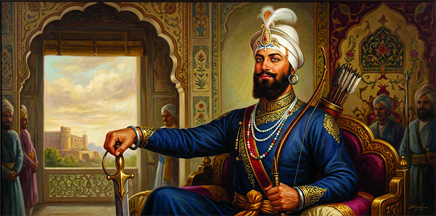

In the spiritual and historical consciousness of India, few personalities command as much reverence and awe as Guru Gobind Singh. Born Gobind Rai on December 22, 1666, and departing from the mortal world on October 7, 1708, he was the tenth and last human Guru of Sikhism-a towering figure who seamlessly united the roles of a spiritual master, warrior, poet, philosopher, and nation-builder.
His life was not simply an era in Sikh history; it was a revolution-one that transformed a persecuted community into a fearless, disciplined, and spiritually awakened order known as the Khalsa.
Birth and Early Formation: The Making of a Saint-Soldier
Guru Gobind Singh was born in Patna, at the sacred shrine of Takht Sri Patna Sahib, to Guru Tegh Bahadur and Mata Gujri. His early years were marked by both spiritual nurturing and exposure to the harsh realities of the time.
Even as a child, Gobind Rai displayed extraordinary brilliance. He mastered multiple languages-Persian, Arabic, Sanskrit, Braj, Punjabi, and Gurmukhi-reflecting not only intellectual depth but also a profound engagement with diverse cultures and traditions. Alongside scholarly pursuits, he trained rigorously in martial disciplines, including archery, swordsmanship, and horsemanship.
This dual training-of mind and body-was crucial. It prepared him for a future where spirituality alone would not suffice; it would need to be defended with courage and strength.
The Martyrdom of Guru Tegh
Bahadur: A Turning Point in History
The defining moment of his childhood came in 1675, when his father, Guru Tegh Bahadur, was executed in Delhi under the orders of Aurangzeb. The Guru had refused to convert to Islam and instead chose martyrdom to defend the religious freedom of Kashmiri Hindus.
This act of supreme sacrifice left an indelible imprint on young Gobind Rai. At just nine years old, he ascended as the tenth Guru of the Sikhs. But he did not inherit merely a spiritual seat-he inherited a mission: to defend Dharma, uphold justice, and ensure that tyranny would never silence truth.
Leadership and Expansion: Anandpur Sahib as the Spiritual Nucleus
After becoming Guru, Gobind Rai established his base at Anandpur Sahib, which soon evolved into a vibrant center of spirituality, culture, and military preparation.
He later traveled to Nahan at the invitation of Raja Medini Prakash and subsequently to Paonta Sahib, situated along the banks of the Yamuna River. At Paonta Sahib, he spent nearly three years composing literary works, training warriors, and strengthening the Sikh community.
It was here that he gathered a devoted following and laid the groundwork for a disciplined and organized force.
Warrior Leadership: Battles and Resistance
Guru Gobind Singh’s life was marked by constant struggle against injustice. His first major military engagement, the Battle of Bhangani (1688), saw him emerge victorious against a coalition of hill chiefs and rival forces.
Subsequent conflicts with Mughal authorities and hill rulers culminated in significant battles, including:
– The prolonged conflicts at Anandpur Sahib
– The heroic stand at Chamkaur
– The decisive Battle of Muktsar (1705)
Despite being outnumbered, his forces demonstrated unmatched courage and discipline-fueled by spiritual conviction rather than mere military ambition.
The Creation of the Khalsa: A Defining Spiritual Revolution
The most transformative moment of Guru Gobind Singh’s life-and indeed Sikh history-came on the sacred day of Vaisakhi in 1699.
At Anandpur Sahib, before a vast gathering, the Guru issued an unprecedented call:
“Who among you is willing to give your head for faith?”
The crowd was stunned. Then, one by one, five men stepped forward: Bhai Daya Singh, Bhai Dharam Singh, Bhai Himmat Singh, Bhai Mohkam Singh and Bhai Sahib Singh.
They belonged to different castes and regions-symbolizing unity in diversity and the complete rejection of social hierarchy.
The Amrit Ceremony
Guru Gobind Singh prepared Amrit in an iron bowl, mixing water with sugar crystals and stirring it with a double-edged sword while reciting sacred hymns from the Guru Granth Sahib.
The five men were initiated into the Khalsa and became the Panj Pyare (Five Beloved Ones). In an act of profound humility, the Guru then asked them to initiate him, establishing equality within the Khalsa order.
This moment marked the birth of a new spiritual identity-fearless, egalitarian, and devoted to justice.
The Khalsa Ethos: Equality, Identity, and Discipline
Guru Gobind Singh’s vision for the Khalsa was revolutionary:
– Abolition of caste distinctions
– Adoption of the surnames Singh and Kaur
– Adherence to the Five Ks
– Commitment to moral discipline and spiritual devotion
His famous declaration:
“Manas ki jaat sab ek hi pehchanbo”
(Recognize all of humanity as one)
became the cornerstone of Sikh philosophy.
Personal Sacrifice: The Price of Freedom
Guru Gobind Singh’s life was marked by unparalleled sacrifice. All four of his sons were martyred:
– The elder sons died in battle
– The younger sons were executed for refusing to convert
He also lost his mother and endured immense personal suffering. Yet, he never wavered in his mission.
His resilience embodied Chardi Kala-the spirit of eternal optimism and courage.
Literary Legacy and Zafarnama
Guru Gobind Singh’s literary contributions remain a cornerstone of Sikh thought. His works in the Dasam Granth reflect themes of divine justice, heroism, and devotion.
His Zafarnama, written to Aurangzeb, is a powerful assertion of moral victory over tyranny-a reminder that righteousness ultimately triumphs over power.
Final Days and the Eternal Guru
In his final days at Nanded, Guru Gobind Singh was attacked by assassins. Though he killed one attacker, he succumbed to his injuries in 1708.
Before his passing, he made a historic declaration:
There would be no more human Gurus. The Guru Granth Sahib would be the eternal Guru of the Sikhs.
Legacy: The Eternal Saint-Soldier
Guru Gobind Singh remains the ultimate symbol of the Saint-Soldier-a figure who demonstrated that spirituality must be active, courageous, and just.
His teachings emphasize:
– Courage in the face of adversity
– Equality of all humanity
– Devotion to truth and righteousness
– The coexistence of compassion and strength
Guru Gobind Singh’s life is a timeless beacon of hope, resilience, and moral clarity. He redefined spirituality as something dynamic-rooted in action, sacrifice, and service.
Through the creation of the Khalsa and his enduring teachings, he gave humanity a powerful message:
that faith must be fearless, justice must be defended, and all of humankind is one.
In him, the divine light of courage and compassion found its most radiant expression-a legacy that continues to inspire generations across the world.


Be the first to comment