
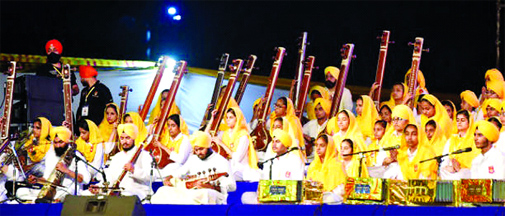

In an age defined by polarisation, identity clashes, and shrinking spaces for dialogue, the life and martyrdom of Guru Tegh Bahadur Ji continue to shine like a moral lighthouse for the world. Three hundred and fifty years after his supreme sacrifice, the Ninth Guru’s legacy is not confined to scriptures or memorials-his message echoes through human rights discourses, interfaith movements, global conversations on religious liberty, and the values we must pass on to younger generations. To understand the true power of his teachings today, one must revisit not merely the events of 1675 but the spirit behind them-a spirit rooted in courage, dignity, and an unwavering defence of humanity.
Guru Tegh Bahadur as a Global Symbol of Religious Freedom
In the international discourse on fundamental freedoms, Guru Tegh Bahadur Ji occupies a rare and profound position. Most symbols of human rights are political; his was spiritual. At a time when the Mughal empire exerted immense pressure on people to renounce their faith, Guru Tegh Bahadur rose as a protector not only of Sikhs but of Hindus, ascetics, scholars, and ordinary civilians whose right to their own belief system was being threatened.
His stand in 1675-public, fearless, and without the slightest personal gain-was essentially the world’s earliest, clearest assertion of the principle now enshrined in modern constitutions: “Let every human follow their conscience.” This universal moral stance transcends geography and religion, making the Ninth Guru a global symbol for freedom of thought and expression. He didn’t merely preach tolerance; he demonstrated it through sacrifice. In an era when governments, societies, and communities still struggle with coexistence, Guru Tegh Bahadur remains the embodiment of the statement: “Humanity is greater than any empire.”
Why the World Needs His Message of Tolerance & Sacrifice Today
Modern societies are facing a profound erosion of empathy. Intolerance spreads through social media walls, communal distrust grows in public spaces, and ideological rigidity fractures friendships, families, and nations. In such a climate, the Ninth Guru’s message offers a transformative antidote.
Guru Tegh Bahadur taught that moral courage is not loud-it is steady. True tolerance is not passive-it requires active commitment. And sacrifice is not loss-it is the price of universal justice.
His teachings urge us to rise above the noise of divisive politics and reclaim the shared humanity that binds us. He did not oppose a religion; he opposed tyranny. He did not die for a single community; he died for humanity’s collective right to believe freely. His legacy reminds the world that freedom survives only when individuals are willing to stand for the oppressed-without expecting rewards or fearing consequences.
Human Rights Movements and the Ideals of Guru Tegh Bahadur
Across continents, human rights activists, reformers, and defenders of civil liberties echo principles rooted in the Guru’s life. The global language of rights-liberty of conscience, dignity of belief, equality before law-reflects the ideals he championed through action.
International organisations that advocate for persecuted minorities often cite historical precedents of moral resistance; few parallels match the magnitude of Guru Tegh Bahadur’s stand. Unlike rebellions or armed uprisings, his was a peaceful, ethical, voluntary submission to suffering for the protection of others. It is rare in world history to find a figure who embraced martyrdom so that people of another belief could continue to practice it.
Human rights scholars often refer to his sacrifice as a “nonviolent assertion of conscience”, a concept that predates modern philosophical frameworks. In many ways, he was the world’s first defender of religious rights, centuries before these values entered legal charters or global treaties.
Interfaith Harmony in Modern India & the Guru’s Legacy
India’s greatest strength has always been its pluralism. Yet this pluralism is fragile-tested repeatedly by political tensions, cultural anxieties, and historical wounds. Guru Tegh Bahadur’s life stands as a reminder of the subcontinent’s deepest truth: that unity cannot be imposed; it must be lived.
When he offered his life for Kashmiri Pandits, he was not making a religious statement-he was making a civilisational one. His action declared that India belongs equally to all who inhabit it, regardless of faith. The Ninth Guru’s legacy thus becomes a foundational pillar for interfaith dialogue, multicultural coexistence, and national harmony.
Gurdwaras today welcome people of every community; the Guru’s langar feeds millions without discrimination; his teachings promote convergence, not conflict. In a culturally complex nation like India, the Ninth Guru’s ideals act as a blueprint for peace-a reminder that spiritual leadership is not about exclusion but protection.
Educating Today’s Youth Through the Teachings of the Ninth Guru
The youth of today navigate a world of information overload, moral ambiguity, and increasing pressure to conform. Guru Tegh Bahadur’s teachings can serve as a powerful compass for them-pointing toward inner resilience, clarity of purpose, and moral courage.
His bani (teachings) emphasises calmness in adversity, detachment from ego, purity of conduct, and fearlessness in righteousness. These values are profoundly relevant in an age of anxiety, consumerism, and identity crises. Educators and institutions can draw from his life to teach young people: how to stand up against bullying and injustice, how to value truth over convenience, how to honour diversity instead of fearing it, how to cultivate spiritual and mental strength, how to lead without seeking applause.
For students, the story of the Ninth Guru is not just history-it is a lesson in character-building, leadership, and ethical citizenship.
The Forgotten Disciples: Unsung Heroes Who Stood With the Guru
The story of Guru Tegh Bahadur’s martyrdom is incomplete without acknowledging the brave souls who walked beside him. While history often focuses on the Guru’s last days in Delhi, many disciples-ordinary villagers, traders, soldiers, scholars-supported him throughout his spiritual mission.
Figures like Bhai Mati Das, Bhai Sati Das, and Bhai Dayala are remembered, but countless others remain nameless: the families who sheltered him during his travels, the devotees who endured persecution, and the communities that upheld Sikh values despite imperial pressure. These unsung heroes kept the flame of justice alive at great personal cost. Their sacrifices remind us that revolutions are never the work of one person alone-they are built upon the courage of many who choose to stand on the right side of history.
A Legacy That Refuses to Fade
Guru Tegh Bahadur’s martyrdom did not end with his passing-it became the spark that illuminated the birth of the Khalsa under Guru Gobind Singh. His message continues to ripple across centuries, shaping philosophies, communities, and democracies.
Today, as nations struggle with intolerance and humanity grapples with division, the Ninth Guru’s sacrifice stands like a timeless declaration: Freedom cannot be gifted by rulers; it must be upheld by the fearless. His legacy urges us to rise above self-interest, embrace moral courage, and protect the rights of others-even when the world chooses silence.
His story is not just remembered-it is lived, sung, commemorated, and carried forward. Because some sacrifices do not belong to the past; they belong to eternity.



Be the first to comment