
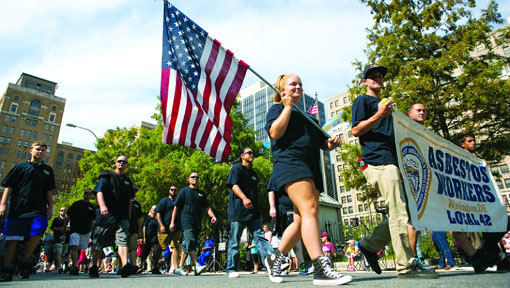

Observed the first Monday in September, Labor Day is an annual celebration of the social and economic achievements of American workers. The holiday is rooted in the late nineteenth century, when labor activists pushed for a federal holiday to recognize the many contributions workers have made to America’s strength, prosperity, and well-being. This year, Labor Day falls on September 1.
Early Adopters
Before it was a federal holiday, Labor Day was recognized by labor activists and individual states. After municipal ordinances were passed in 1885 and 1886, a movement developed to secure state legislation. New York was the first state to introduce a bill, but Oregon was the first to pass a law recognizing Labor Day, on February 21, 1887. During 1887, four more states – Colorado, Massachusetts, New Jersey and New York – passed laws creating a Labor Day holiday. By the end of the decade Connecticut, Nebraska and Pennsylvania had followed suit. By 1894, 23 more states had adopted the holiday, and on June 28, 1894, Congress passed an act making the first Monday in September of each year a legal holiday.
The First Labor Day
The first Labor Day holiday was celebrated on Tuesday, September 5, 1882, in New York City, in accordance with the plans of the Central Labor Union. The Central Labor Union held its second Labor Day holiday just a year later, on September 5, 1883.
By 1894, 23 more states had adopted the holiday, and on June 28, 1894, President Grover Cleveland signed a law making the first Monday in September of each year a national holiday.
The Birth of Labor Day: Industrial
America and the Labor Movement
In the late 19th century, the United States was undergoing explosive economic growth. The Industrial Revolution had transformed farms into factories, railroads stitched the continent together, and cities swelled with immigrant workers seeking opportunity. But this rapid progress came at a high human cost:
– Workdays stretched to 12-16 hours with few breaks.
– Factory conditions were dangerous, with frequent injuries and deaths.
– Child labor was rampant, with children as young as six working in textile mills and coal mines.
– Wages were low, barely enough to cover basic living expenses.
Out of these hardships emerged organized labor unions, demanding fair pay, shorter hours, and safer conditions. Groups such as the Knights of Labor and later the American Federation of Labor (AFL) led strikes, boycotts, and negotiations to protect workers’ rights.
From Local Celebration to Federal Holiday
Labor Day quickly spread to industrial cities across the country. By the late 1880s, several states-including Oregon, Colorado, Massachusetts, and New York-had declared it an official holiday.
The turning point came in 1894 after the Pullman Strike:
– The strike began when the Pullman Palace Car Company near Chicago cut wages during an economic depression but did not reduce rents in company-owned housing.
– Railroad workers, supported by the American Railway Union under Eugene V. Debs, walked out, crippling rail traffic nationwide.
– The federal government, citing disruption of mail delivery, sent troops to break the strike, leading to riots and over 25 deaths.
In an effort to ease tensions with organized labor, President Grover Cleveland signed legislation on June 28, 1894, designating the first Monday in September as Labor Day, a federal holiday.
Significance of Labor Day
Recognition of Workers’ Contributions
Labor Day affirms that the strength of the U.S. economy lies not only in innovation or capital investment, but in human effort-the millions of workers who built railroads, forged steel, tilled fields, staffed offices, and now code software and power digital industries.
Tribute to Labor Reforms
The holiday recalls the long battles for basic workplace protections, including:
– The eight-hour day and 40-hour week
– Overtime pay and minimum wage laws
– The right to organize and bargain collectively
– Workplace safety regulations (later strengthened by OSHA)
– The end of child labor, formally outlawed by the Fair Labor Standards Act of 1938
A Symbol of National Unity
By honoring workers of every trade and background, Labor Day underscores a shared ideal-that all honest work is dignified and essential to the nation’s prosperity.
How America Celebrates
Historic Traditions
– Parades and rallies led by labor unions remain common, particularly in cities with strong union presence such as New York, Chicago, and Detroit.
– Speeches by civic leaders often highlight economic achievements and the importance of maintaining fair labor standards.
Modern Customs
– Family gatherings, picnics, and barbecues make the most of the last long weekend of summer.
– Retail sales and back-to-school shopping have become a major part of the holiday economy.
– Sports and culture: Labor Day weekend marks the start of college football, the climax of the U.S. Open tennis tournament, and the stretch run of Major League Baseball.
Labor Day Today: Beyond the Barbecue
While Labor Day began as a day of protest and advocacy, in recent decades it has also become a day of rest and celebration. Yet its deeper meaning remains vital:
– Changing workforce: From manufacturing to service and technology, labor continues to evolve, raising new questions about gig work, automation, and job security.
– Wage and equity debates: Issues such as stagnant wages, gender pay gaps, and workers’ rights in the digital economy keep the labor conversation alive.


Be the first to comment