

On 5 September 1997, the world mourned the passing of Mother Teresa of Calcutta, a woman whose compassion crossed every border and spoke every language. Twenty-six years later, her life continues to inspire governments, humanitarian agencies, religious groups, and ordinary people seeking to make the world more humane.
Canonized as Saint Teresa of Calcutta in 2016, she remains an enduring symbol of unconditional love in action. Her legacy is not measured only in the institutions she built but in the countless lives she touched-one person at a time.
Early Life and Vocation
Born Agnes Gonxha Bojaxhiu on 26 August 1910 in Skopje (now North Macedonia), she was the youngest child in an Albanian Catholic family. Her father’s sudden death when she was eight plunged the family into hardship, yet her mother Dranafile’s unwavering faith and generosity left a profound mark. The Bojaxhiu home was known for feeding the poor regardless of their faith, a lesson Agnes carried all her life.
At 18, she joined the Sisters of Loreto, traveling to Dublin and later to Darjeeling, India, for novitiate training. She took her first vows in 1931 and final vows in 1937, teaching at St. Mary’s High School in Calcutta. Her students remembered her as disciplined but kind, and she served as both teacher and principal.
The “Call Within a Call”
In September 1946, while traveling by train to Darjeeling for a retreat, she felt what she later called “a call within a call.” She believed Jesus was asking her to leave the security of convent life to live among “the poorest of the poor.”
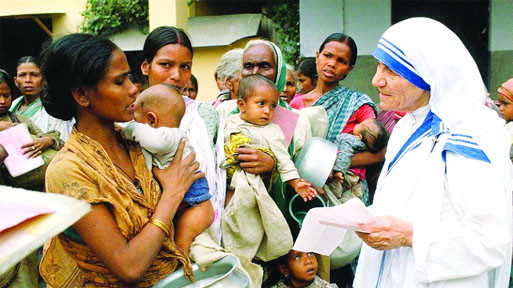
After two years of seeking Vatican approval, she left the Loreto convent in 1948, wearing a simple white sari with a blue border-an outfit that became the hallmark of her mission. She learned basic medicine and began working in Calcutta’s slums, teaching children under the open sky and tending to the sick in their homes.
Missionaries of Charity
In 1950, Mother Teresa received papal approval to establish the Missionaries of Charity (MC). Their mission was simple:
“To quench the thirst of Jesus by loving Him in the poorest of the poor.”
Key milestones in her work:
– 1952: Opened Nirmal Hriday (“Pure Heart”), Kalighat Home for the Dying, where the terminally ill could die with dignity, love, and care.
– 1955: Founded Shishu Bhavan (Children’s Home) for abandoned and orphaned babies.
– 1960s-1970s: Established leprosy clinics, mobile dispensaries, and self-sufficient leprosy villages across India to counter stigma and provide medical care.
– 1965: The Missionaries of Charity received official papal recognition, enabling expansion beyond India.
– 1970s-1980s: Homes were opened in Latin America, Africa, Europe, the Middle East, and the United States to serve AIDS patients, refugees, and the homeless.
By the time of her death, the MC had over 4,000 sisters and hundreds of brothers and volunteers serving in 120+ countries.
Encounters with the Powerful and the Powerless
Mother Teresa’s influence reached both slum dwellers and world leaders:
– She met Popes, U.S. Presidents, British monarchs, and UN leaders, often using these meetings to advocate for the poor rather than seek personal recognition.
– In 1982, she crossed the battle lines of Beirut to evacuate 37 children trapped in a hospital during civil war, demonstrating her fearless dedication.
– In 1985, she spoke at the UN General Assembly, receiving a standing ovation for her appeal to serve “the least of these.”
– Despite global fame, she personally tended to patients, often cleaning wounds and feeding the dying with her own hands.
Awards and Global Recognition
Mother Teresa received over 700 awards, including:
– Ramon Magsaysay Award (1962) for Peace and International Understanding.
– Jawaharlal Nehru Award (1969) for International Understanding.
– Bharat Ratna (1980)-India’s highest civilian award.
– Nobel Peace Prize (1979), where she redirected the prize banquet funds to feed the poor and famously said:
Faith, Writings, and Spiritual Struggle
While she radiated cheerfulness outwardly, letters published after her death (compiled in Come Be My Light, 2007) revealed deep spiritual darkness and a sense of distance from God that lasted for decades. Far from diminishing her sanctity, many saw this as proof of her faithfulness-serving relentlessly even without spiritual consolation.
Her spirituality was profoundly Christ-centered, but she often framed her mission in universal terms:
“We serve Jesus in the disguise of the poor, but anyone can do this by serving humanity with love.”
Final Years and Canonization
By the mid-1990s, Mother Teresa suffered from heart failure, but she continued traveling and overseeing her order. She stepped down as Superior General in March 1997 and died on 5 September 1997, just days after Princess Diana-her close friend-passed away.
Her funeral in Calcutta was attended by dignitaries from around the world, yet she was buried simply, in keeping with her vow of poverty.
Pope Francis canonized her as Saint Teresa of Calcutta on 4 September 2016, recognizing her life as a testimony of love in action.
Her Living Legacy
– Missionaries of Charity today: Over 5,000 sisters and brothers continue to operate homes, schools, hospitals, and hospices worldwide.
– Influence on volunteers: Thousands of lay volunteers have served alongside the MC, many claiming their lives were transformed by her witness.
– Global inspiration: Her message of “doing small things with great love” has been embraced in humanitarian projects, interfaith dialogue, and corporate social responsibility initiatives.
On her 26th death anniversary, remembering Mother Teresa is not about idealizing her life but about learning from her courage and simplicity. She chose to live among those whom society rejected and reminded the world that dignity, compassion, and love are not luxuries-they are duties.


Be the first to comment