
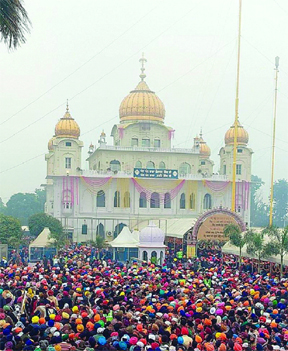

The martyrdom of the Sahibzadas-Baba Zorawar Singh and Baba Fateh Singh, the younger sons of Guru Gobind Singh Ji-stands as one of the most heart-rending yet inspiring episodes in world history. In December 1705, the two children, aged just nine and seven, were executed at Sirhind for refusing to abandon their faith. Their sacrifice, along with the earlier martyrdom of the elder Sahibzadas, Baba Ajit Singh and Baba Jujhar Singh, has come to symbolise unshakeable faith, moral courage and resistance against tyranny. In India and across the global Sikh diaspora, the remembrance of this supreme sacrifice is observed with deep solemnity, reflection and collective resolve.
In recent years, the observance has acquired renewed national and global visibility through Veer Bal Diwas, commemorated annually on December 26, marking a moment of shared remembrance beyond the Sikh community. In 2025, the martyrdom of the Sahibzadas was remembered with particular intensity in India and abroad, blending traditional Sikh religious practices with broader civic and educational engagement.
India: Sacred Remembrance Rooted in History
In India, the observance of the Sahibzadas’ martyrdom is deeply intertwined with sacred geography and collective memory. Key historical sites associated with the events of 1705-06 became centres of prayer and reflection. At Fatehgarh Sahib in Punjab, where Baba Zorawar Singh and Baba Fateh Singh were martyred, thousands of devotees gathered for *shaheedi samagams*, Akhand Paaths and kirtan darbars. The atmosphere was solemn rather than celebratory, with hymns and discourses focusing on sacrifice, steadfastness and faith in the face of cruelty.
Gurdwaras across Punjab, Haryana, Uttar Pradesh, Delhi and Bihar organised special religious congregations, during which the life stories of the Sahibzadas were narrated in detail. Katha and Gurbani recitations emphasised not just the tragedy of their deaths, but the moral clarity and spiritual courage displayed by the young martyrs. Langars were organised as acts of seva, reinforcing the Sikh belief that remembrance must be accompanied by service.
Veer Bal Diwas: National Recognition of Courage
The observance of Veer Bal Diwas on December 26 has added a national dimension to the remembrance of the Sahibzadas. In 2025, schools, cultural institutions and government bodies across India marked the day through commemorative programmes, exhibitions and educational events. Special assemblies were held in schools, where students learned about the Sahibzadas as symbols of fearlessness, moral strength and youthful heroism.
National and state-level events highlighted the relevance of the Sahibzadas’ sacrifice in contemporary society, particularly in the context of standing up for truth and conscience. Speeches and cultural presentations portrayed the Sahibzadas not merely as historical figures, but as role models whose lives challenge modern notions of courage and resilience. Veer Bal Diwas thus functioned as a bridge-bringing a deeply Sikh historical memory into the broader national narrative of sacrifice and ethical courage.
As part of the national observance, Prime Minister Narendra Modi paid heartfelt tribute to the Sahibzadas on Veer Bal Diwas, underscoring the profound moral and historical significance of their sacrifice. Speaking at the national programme in Bharat Mandapam, New Delhi, Modi described Veer Bal Diwas as “a day of reverence, dedicated to remembering the sacrifice of the brave Sahibzades,” and highlighted how their courage, conviction and steadfast adherence to righteousness continue to inspire generations across India. He recalled the unshakeable faith of Mata Gujri Ji and the immortal teachings of Sri Guru Gobind Singh Ji, and called on the youth to draw strength from the Sahibzadas’ indomitable spirit as they pursue their dreams and responsibilities for the nation’s future. Modi observed that the legacy of their bravery not only reflects the Sikh tradition of sacrifice but also embodies values of courage and moral clarity that are vital for all Indians today, affirming that such examples will continue to motivate people for generations to come.
Spiritual Observances and Community Participation
Across India, the martyrdom observances were marked by a distinctive spiritual tone. Unlike festive gurpurabs, these days were characterised by quiet devotion, contemplation and humility. Many gurdwaras observed early-morning prayers, followed by kirtans that dwelt on themes of *chardi kala*-the Sikh principle of remaining spiritually elevated even in suffering. Gatka displays, where organised, were restrained and symbolic, underscoring discipline and readiness rather than spectacle.
Community participation extended beyond religious spaces. Sikh organisations arranged blood donation camps, charity drives and free medical camps in memory of the Sahibzadas, translating remembrance into social responsibility. These acts reflected the Sikh understanding that martyrdom is honoured not by mourning alone, but by living according to the values for which the martyrs stood.
Canada: Diaspora Remembrance and Youth Engagement
In Canada, the martyrdom of the Sahibzadas was observed with deep emotional resonance, particularly among Sikh youth. Gurdwaras in Ontario and British Columbia held special shaheedi samagams, where kirtan and katha focused on the historical events at Sirhind and the spiritual maturity displayed by the young Sahibzadas. Educational sessions were organised in Punjabi schools and Sikh study circles, ensuring that younger generations born abroad remained connected to this foundational episode of Sikh history.
Veer Bal Diwas was also acknowledged through community-led initiatives, including seminars, storytelling sessions and youth-centric discussions on courage, identity and ethical decision-making. In some cities, Sikh organisations collaborated with local institutions to present the story of the Sahibzadas as a universal lesson in standing firm against injustice, irrespective of age or circumstance.
United States: Faith, Memory and Interfaith Awareness
Across the United States, Sikh communities marked the martyrdom with religious solemnity and outreach. Gurdwaras in New York, New Jersey, California and Texas organised Akhand Paaths and special kirtan programmes dedicated to the Sahibzadas. Religious leaders used the occasion to explain the historical context of Mughal persecution and the Guru’s uncompromising stand for religious freedom.
Veer Bal Diwas observances in the U.S. often included interfaith components, with Sikh organisations inviting educators, students and civic representatives to learn about the Sahibzadas’ sacrifice. Youth groups played a central role, using presentations, dramatizations and discussions to communicate the message of fearless integrity to wider audiences.
Australia and Other Global Communities
In Australia, where Sikh communities continue to grow, the martyrdom of the Sahibzadas was observed with reverence and educational focus. Gurdwaras in Melbourne, Sydney and Adelaide held prayer services and katha sessions, while community leaders emphasised the relevance of the Sahibzadas’ sacrifice in nurturing moral strength among children and youth in modern societies.
Similar observances took place in the United Kingdom, Europe and Southeast Asia, where Sikh diaspora communities used the occasion to reaffirm collective identity and pass on historical memory through oral narration, devotional music and community service.

What’s Happening i am new to this, I stumbled upon this I have found It positively helpful and it has helped me out loads. I hope to contribute & help other users like its aided me. Good job.
We’re a group of volunteers and opening a new scheme in our community. Your web site offered us with helpful information to work on. You have done a formidable job and our entire neighborhood will likely be grateful to you.
Just what I was searching for, appreciate it for putting up.
You have brought up a very fantastic points, thankyou for the post.
I loved as much as you’ll receive carried out right here. The sketch is attractive, your authored subject matter stylish. nonetheless, you command get bought an shakiness over that you wish be delivering the following. unwell unquestionably come more formerly again as exactly the same nearly very often inside case you shield this increase.
I do believe all the ideas you’ve presented on your post. They’re really convincing and will certainly work. Still, the posts are too brief for novices. Could you please extend them a little from next time? Thank you for the post.
I cherished as much as you’ll receive performed right here. The caricature is attractive, your authored subject matter stylish. nonetheless, you command get bought an edginess over that you would like be delivering the following. in poor health definitely come more until now again as exactly the similar nearly a lot continuously within case you protect this hike.
I like this site so much, saved to fav. “To hold a pen is to be at war.” by Francois Marie Arouet Voltaire.
I love your blog.. very nice colors & theme. Did you create this website yourself or did you hire someone to do it for you? Plz answer back as I’m looking to create my own blog and would like to find out where u got this from. cheers
After examine a number of of the blog posts on your web site now, and I actually like your method of blogging. I bookmarked it to my bookmark website checklist and will be checking again soon. Pls check out my website as properly and let me know what you think.
Definitely imagine that which you said. Your favorite reason appeared to be at the internet the easiest thing to have in mind of. I say to you, I certainly get annoyed while other people think about worries that they plainly don’t recognise about. You managed to hit the nail upon the highest as well as defined out the entire thing without having side effect , people can take a signal. Will probably be back to get more. Thank you
I have been reading out a few of your stories and i must say pretty good stuff. I will make sure to bookmark your website.
Hey just wanted to give you a quick heads up. The words in your post seem to be running off the screen in Firefox. I’m not sure if this is a format issue or something to do with browser compatibility but I thought I’d post to let you know. The style and design look great though! Hope you get the issue fixed soon. Kudos
This really answered my downside, thank you!
Spot on with this write-up, I truly assume this website wants way more consideration. I’ll probably be again to read rather more, thanks for that info.
It is in reality a nice and helpful piece of information. I’m glad that you just shared this useful info with us. Please keep us informed like this. Thanks for sharing.
Great post. I am facing a couple of these problems.
Those are yours alright! . We at least need to get these people stealing images to start blogging! They probably just did a image search and grabbed them. They look good though!
Just about all of what you mention happens to be supprisingly legitimate and it makes me wonder the reason why I had not looked at this with this light previously. This particular piece really did turn the light on for me as far as this subject matter goes. Nevertheless at this time there is one particular issue I am not too cozy with and whilst I attempt to reconcile that with the central idea of your position, permit me see what the rest of the subscribers have to say.Nicely done.
As a Newbie, I am always browsing online for articles that can benefit me. Thank you
An fascinating discussion is value comment. I feel that you should write more on this topic, it might not be a taboo topic but usually people are not sufficient to speak on such topics. To the next. Cheers
Some truly marvelous work on behalf of the owner of this web site, perfectly great subject material.
I wish to point out my appreciation for your kindness in support of individuals who have the need for help on this important question. Your real dedication to passing the message all over became astonishingly productive and have always enabled folks much like me to achieve their targets. The invaluable help can mean a lot to me and a whole lot more to my office workers. Thanks a ton; from everyone of us.
My brother recommended I may like this website. He was totally right. This publish actually made my day. You cann’t imagine just how a lot time I had spent for this info! Thanks!
Does your site have a contact page? I’m having a tough time locating it but, I’d like to shoot you an e-mail. I’ve got some suggestions for your blog you might be interested in hearing. Either way, great blog and I look forward to seeing it grow over time.
I believe this website has got very fantastic composed articles blog posts.
I just could not depart your website prior to suggesting that I extremely enjoyed the standard info a person provide for your visitors? Is going to be back often in order to check up on new posts
There is evidently a bunch to identify about this. I consider you made various nice points in features also.
Very interesting points you have remarked, thankyou for posting.
Some truly good info , Sword lily I detected this.
hello there and thank you for your information – I have definitely picked up something new from right here. I did on the other hand expertise several technical points the usage of this site, as I skilled to reload the site lots of instances previous to I may get it to load properly. I were considering in case your hosting is OK? Now not that I am complaining, but slow loading instances instances will very frequently have an effect on your placement in google and could harm your quality rating if advertising and ***********|advertising|advertising|advertising and *********** with Adwords. Well I am including this RSS to my e-mail and can look out for much more of your respective exciting content. Make sure you replace this again soon..
I have been reading out many of your posts and i can state pretty clever stuff. I will definitely bookmark your blog.
I’m not sure where you’re getting your information, but great topic. I needs to spend some time learning more or understanding more. Thanks for excellent info I was looking for this info for my mission.
Excellent site. Lots of useful info here. I am sending it to a few pals ans also sharing in delicious. And naturally, thank you to your sweat!
It’s actually a cool and helpful piece of info. I am happy that you shared this useful information with us. Please keep us up to date like this. Thanks for sharing.
Wow! Thank you! I continually needed to write on my site something like that. Can I take a fragment of your post to my website?
Great tremendous things here. I am very satisfied to see your post. Thank you so much and i am looking ahead to contact you. Will you kindly drop me a e-mail?
Thanks for your entire efforts on this site. Kate really loves going through investigation and it’s simple to grasp why. My spouse and i notice all relating to the powerful manner you produce both interesting and useful techniques through the web blog and therefore invigorate participation from people on that subject matter and our simple princess is always starting to learn a lot. Take pleasure in the remaining portion of the year. Your carrying out a fantastic job.
Thanks for another great article. Where else may anybody get that kind of info in such an ideal method of writing? I have a presentation subsequent week, and I’m on the look for such information.
Nice post. I learn something more challenging on different blogs everyday. It will always be stimulating to read content from other writers and practice a little something from their store. I’d prefer to use some with the content on my blog whether you don’t mind. Natually I’ll give you a link on your web blog. Thanks for sharing.
I conceive you have noted some very interesting details , thankyou for the post.
You have mentioned very interesting points! ps nice website .
I like this web blog so much, bookmarked. “Respect for the fragility and importance of an individual life is still the mark of an educated man.” by Norman Cousins.
I rattling happy to find this website on bing, just what I was looking for : D besides saved to bookmarks.
Way cool, some valid points! I appreciate you making this article available, the rest of the site is also high quality. Have a fun.
I admire your work, appreciate it for all the good blog posts.
I was very pleased to find this web-site.I wanted to thanks for your time for this wonderful read!! I definitely enjoying every little bit of it and I have you bookmarked to check out new stuff you blog post.
I precisely wished to say thanks again. I am not sure what I might have used without these thoughts revealed by you relating to such a area of interest. It has been a real scary problem in my position, however , considering your well-written technique you treated that forced me to leap for fulfillment. I am happier for this work and then wish you realize what a great job you’re putting in instructing the mediocre ones with the aid of your blog. Probably you’ve never encountered all of us.
I really appreciate this post. I have been looking all over for this! Thank goodness I found it on Bing. You have made my day! Thanks again
Thank you for sharing excellent informations. Your web-site is so cool. I am impressed by the details that you’ve on this site. It reveals how nicely you understand this subject. Bookmarked this website page, will come back for more articles. You, my friend, ROCK! I found simply the info I already searched all over the place and simply could not come across. What a perfect web site.
Some really good articles on this site, thankyou for contribution.
Hello my friend! I wish to say that this post is amazing, nice written and include approximately all vital infos. I’d like to see more posts like this.
Hi there, You’ve performed a great job. I will definitely digg it and individually suggest to my friends. I am sure they will be benefited from this website.
After study a few of the blog posts on your website now, and I truly like your way of blogging. I bookmarked it to my bookmark website list and will be checking back soon. Pls check out my web site as well and let me know what you think.
What i do not realize is if truth be told how you are not really much more neatly-favored than you might be right now. You’re so intelligent. You realize therefore considerably when it comes to this topic, produced me for my part believe it from numerous numerous angles. Its like women and men aren’t interested unless it is one thing to accomplish with Lady gaga! Your personal stuffs great. Always handle it up!
马赛客场硬刚布雷斯特!2026法甲20:45生死战,姆巴佩旧将能否带队翻盘?法国足球最新赛事比分火热预测中!