
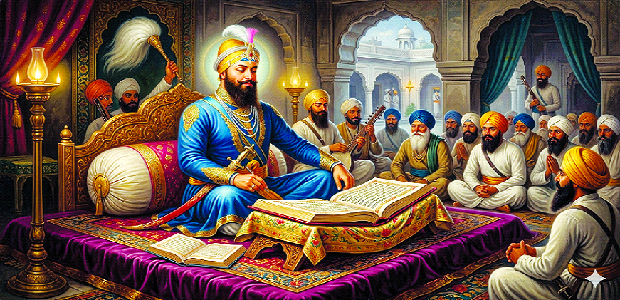

Within the vast and layered tradition of Sikh literature, the Dasam Granth stands as one of the most compelling and complex works. Closely associated with Guru Gobind Singh Ji, it is a text that defies simple classification-part devotional scripture, part heroic poetry, part philosophical reflection, and part courtly literature.
Distinct in tone and structure from the Guru Granth Sahib, the Dasam Granth has inspired devotion, debate, and deep scholarly engagement for centuries. Its legacy lies not only in what it contains, but also in how it continues to be interpreted, discussed, and lived.
The Court of Anandpur Sahib
The compositions of the Dasam Granth emerged during one of the most dynamic periods in Sikh history-the late 17th century, when Guru Gobind Singh Ji resided at Anandpur Sahib.
This was a time marked by:
– Political conflict with Mughal authority
– The consolidation of Sikh identity
– The formation of the Khalsa in 1699
– A flourishing of literary and artistic activity
Guru Gobind Singh Ji’s court became a vibrant intellectual center, often described as a “literary darbar,” where poets, scholars, and warriors from diverse backgrounds gathered. Many were well-versed in Sanskritic, Persian, and Indic traditions, contributing to a rich cultural synthesis.
The Dasam Granth reflects this environment-its compositions echo not only spiritual devotion but also the urgency of a community preparing for moral and physical resistance.
Compilation and Manuscript Tradition
Unlike the Guru Granth Sahib, which was compiled and canonized during the time of the Gurus, the Dasam Granth took shape after the passing of Guru Gobind Singh Ji in 1708.
Early Compilation Efforts
One of the earliest known compilations is associated with Bhai Mani Singh, a devoted Sikh scholar and martyr. He is believed to have collected and organized the Guru’s writings into a coherent volume, though historical evidence remains a subject of scholarly discussion.
Manuscript Variations
Several early manuscripts exist, including:
– The Anandpuri Bir
– The Patna Bir
– The Mani Singh recension
These manuscripts differ in arrangement, inclusion, and sequence of compositions, contributing to ongoing debates about the text’s final form.
Standardization
In the late 19th and early 20th centuries, efforts were made to standardize the Dasam Granth, particularly during the Singh Sabha reform movement. Printed editions helped establish a more widely accepted structure, though variations still exist.
The Dasam Granth is remarkable for its thematic and stylistic diversity. A closer look at its key compositions reveals its depth:
Jaap Sahib: The Infinite Divine
Jaap Sahib is one of the most revered compositions, forming part of daily Sikh prayers.
– It presents a vision of the Divine that is beyond form, gender, and limitation
– The language is rhythmic, expansive, and deeply poetic
– It emphasizes attributes such as timelessness, fearlessness, and universality
Rather than defining God, it dissolves all attempts at definition-inviting the reader into awe and contemplation.
Akal Ustat: Praise of the Timeless One
This composition celebrates the unity of humanity under one Divine source.
– It rejects distinctions based on religion, caste, or nationality
– It affirms that all people are equal in the eyes of the Divine
– It reflects Guru Gobind Singh Ji’s universal vision
Akal Ustat stands as a powerful statement of inclusivity and spiritual equality.
Bachittar Natak: Narrative and Mission
Often interpreted as semi-autobiographical, Bachittar Natak provides insight into the Guru’s life and purpose.
– It recounts his lineage and spiritual mission
– It describes divine guidance in shaping his role
– It frames his life within a broader cosmic narrative
Rather than a conventional autobiography, it is a theological narrative that situates human action within divine will.
Chandi Charitar and Chandi di Var
These compositions draw on mythological imagery, particularly the figure of Chandi (a form of divine power), to convey deeper spiritual truths.
– They depict the triumph of righteousness over evil
– They inspire courage and moral strength
These works are often understood symbolically rather than literally, emphasizing inner and outer battles against ignorance and oppression.
Zafarnama: The Epistle of Victory
Written in Persian and addressed to Emperor Aurangzeb, the Zafarnama is one of the most historically significant compositions.
– It asserts moral victory despite material loss
– It criticizes betrayal and injustice
– It reaffirms commitment to truth and righteousness
The Zafarnama is not merely a political document-it is a spiritual declaration of integrity.
Charitropakhyan: Complexity
of Human Nature
One of the most debated sections, Charitropakhyan consists of numerous narrative tales.
– It explores themes of morality, deception, and human behavior
– It presents cautionary stories about ethical pitfalls
– It reflects the complexity of worldly life
Interpretations vary widely-some view it as moral instruction, others as courtly literature, and still others as allegorical teaching.
Linguistic and Poetic Excellence
The Dasam Granth is a masterpiece of multilingual expression.
Languages and Influences
– Braj Bhasha (dominant literary medium)
– Punjabi
– Persian
– Sanskrit vocabulary and idioms
Literary Forms
– Devotional hymns
– Heroic ballads
– Narrative poetry
– Epistolary writing
The text employs intricate meters, alliteration, and rhetorical devices, reflecting a high level of literary sophistication.
Theological Position and Distinction
A key point of understanding is the distinction between the Dasam Granth and the Guru Granth Sahib.
– The Guru Granth Sahib is the eternal Guru and central scripture of Sikhism
– The Dasam Granth is a revered but non-canonical text in most Sikh traditions
While the Guru Granth Sahib focuses on spiritual liberation through devotion and remembrance of the Divine, the Dasam Granth often emphasizes:
– Moral courage
– The struggle against injustice
– The responsibilities of leadership
Together, they reflect complementary dimensions of Sikh thought-spiritual depth and active engagement.
Debates and Interpretive Traditions
The Dasam Granth has generated diverse perspectives within the Sikh community:
Authorship Debates
Scholars and traditions differ on whether all compositions were authored by Guru Gobind Singh Ji or whether some were contributed by court poets.
Theological Concerns
Certain mythological and narrative elements have raised questions about interpretation and alignment with Sikh doctrine.
Institutional Positions
Different Sikh institutions and traditions vary in how they approach the text-some emphasizing its devotional portions, others engaging critically with its entirety.
These debates are part of a living intellectual tradition, reflecting the depth and dynamism of Sikh scholarship.
Role in Sikh Practice and Identity
Despite debates, the Dasam Granth continues to influence Sikh life:
– Daily prayers: Compositions like Jaap Sahib are widely recited
– Khalsa initiation: Portions are included in ceremonial practices
– Martial inspiration: Its themes of courage and righteousness resonate strongly
It contributes to the Sikh ideal of the saint-soldier, reinforcing the balance between spirituality and action.
Cultural and Artistic Legacy
The Dasam Granth has left a lasting imprint on Sikh culture:
– Music and recitation traditions
– Martial poetry and ballads
– Visual art and symbolism
– Storytelling and oral traditions
Its narratives and imagery continue to inspire creative expression across generations.



Be the first to comment