
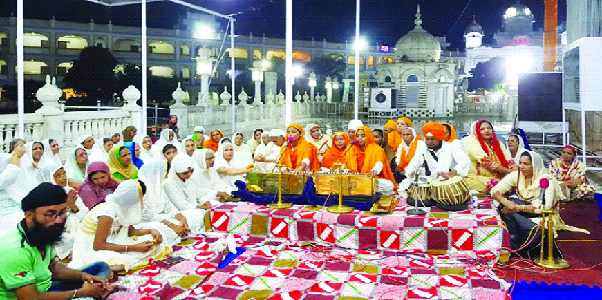

In the stillness of a Gurdwara, as the first notes of a hymn begin to rise, something profound unfolds. The air fills with melody, the mind quiets, and the heart turns inward. This is the power of Gurbani Kirtan-the sacred musical rendering of the divine word contained in the Guru Granth Sahib.
More than music, Gurbani Kirtan is a spiritual experience, a form of meditation, and a direct connection with the Divine. It is the heartbeat of Sikh devotion-where sound becomes prayer, and melody becomes a path to transcendence.
The Divine Word in Melody
At the core of Sikh spirituality lies Gurbani-the revealed word of the Sikh Gurus and saints, preserved in the Guru Granth Sahib. But these sacred verses are not meant to be merely read; they are meant to be sung.
The Guru Granth Sahib is uniquely structured according to ragas-classical musical frameworks that evoke specific moods and emotions. Each hymn is assigned a particular raga, guiding how it should be rendered. This deliberate fusion of poetry and music transforms scripture into a living, resonant experience.
For the Gurus, music was not ornamental-it was essential. Through melody, the message of the Divine could be felt, not just understood.
Origins of Kirtan: A Spiritual Tradition
The tradition of kirtan was established by Guru Nanak Dev Ji, who traveled far and wide sharing his message through song. Accompanied by his companion Bhai Mardana, who played the rabab, Guru Nanak used music as a universal language-one that transcended barriers of culture, religion, and literacy.
This musical tradition was further enriched by successive Gurus, especially Guru Arjan Dev Ji, who systematized the structure of ragas within the Guru Granth Sahib.
From its very inception, kirtan was not a performance-it was a form of devotion, an act of surrender, and a means of connecting with the Divine presence within.
The Instruments of Devotion
Traditional Gurbani Kirtan was performed using classical instruments such as the rabab, taus, saranda, and jori. These instruments were carefully chosen for their ability to complement the emotional depth of the hymns.
Over time, harmonium and tabla became more common in Gurdwaras, making kirtan more accessible to larger congregations. Yet, in recent years, there has been a revival of traditional string instruments, as musicians seek to reconnect with the original soundscape envisioned by the Gurus.
Regardless of the instrument, the essence remains unchanged: the focus is always on the sacred word, not the performer.
Kirtan as Meditation: The Power of Sound
Gurbani Kirtan is often described as a form of Naam Simran-the remembrance of the Divine through repetition and immersion in sacred sound.
As the hymns are sung and repeated, the mind gradually quiets. Thoughts slow down, distractions fade, and a sense of inner peace begins to emerge. The rhythm of the music synchronizes with the rhythm of the breath, creating a meditative state.
In this state, the listener is no longer merely hearing the music-they are experiencing it, becoming one with it. The boundaries between self and sound begin to dissolve.
This is why kirtan is often experienced as deeply healing. It soothes emotional turbulence, reduces stress, and nurtures a sense of spiritual grounding.
The Collective Experience: Sangat and Harmony
One of the most beautiful aspects of Gurbani Kirtan is its collective nature. It is rarely a solitary practice; it is shared within the sangat-the congregation.
As voices join together in unison, a powerful sense of unity emerges. Differences of background, status, and identity fade away, replaced by a shared spiritual experience.
In Gurdwaras around the world, daily kirtan sessions create a space where individuals can pause, reflect, and reconnect-not only with the Divine, but with each other.
This collective harmony mirrors the central Sikh teaching of oneness-of humanity, of creation, and of the Divine.
Beyond Ritual: A Universal Language
While deeply rooted in Sikh tradition, Gurbani Kirtan transcends religious boundaries. Its melodies and messages speak to the human soul, offering comfort, clarity, and inspiration to anyone who listens with an open heart.
Even those unfamiliar with the language often find themselves moved by the music. The emotional resonance of the ragas carries meaning beyond words, making kirtan a truly universal form of spiritual expression.
In an increasingly fragmented world, this universality is both rare and deeply needed.
Preserving a Sacred Heritage
In recent years, there has been a renewed effort to preserve and promote authentic Gurbani Kirtan traditions. Institutions, musicians, and scholars are working to revive classical ragas and traditional instruments, ensuring that this sacred art form remains true to its origins.
At the same time, digital platforms have made kirtan accessible to a global audience. Live streams from Gurdwaras, recordings by renowned ragis, and online learning resources have brought the experience of sacred sound into homes around the world.
This blending of tradition and technology ensures that the spiritual power of kirtan continues to reach new generations.
The Eternal Resonance
At its essence, Gurbani Kirtan is not about music-it is about transformation. It invites the listener to move beyond the noise of the external world and enter a space of inner stillness and awareness.
In the resonance of each note lies a deeper truth: that the Divine is not distant, but present-within the sound, within the silence, and within the self.
When Sound Becomes Sacred
Gurbani Kirtan is a reminder that spirituality is not confined to rituals or doctrines-it can be experienced through something as simple and profound as sound.
In every hymn sung, every note played, and every heart that listens, the wisdom of the Guru Granth Sahib comes alive. It speaks, it soothes, and it transforms. In the end, Gurbani Kirtan is not just heard-it is felt. And in that feeling, one finds peace, connection, and the quiet presence of the Divine.


Be the first to comment