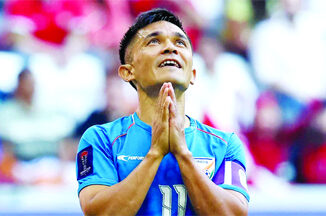
Sunil Chhetri, India’s most decorated footballer, has announced his retirement from international football. Chhetri, 39, made the announcement through a video on social media platform X, mentioning that India’s upcoming FIFA World Cup Qualifier game against Kuwait in Kolkata on June 6 will be his last.
“The recollection of the last 19 years is a combination of duty, pressure and immense joy. I never thought that these are the many games I would play for the country, good or bad but now I did but these last one and half two months I did. And this (the feeling) was very strange. I was probably going towards the decision that this game (against Kuwait) is going to be my last,” Chhetri said.
Sunil Chhetri, a name synonymous with Indian football, boasts a glittering career spanning over two decades. This gifted forward has not only dominated domestic leagues but also carved his name on the international stage. Call it coincidences or a twist of fate, Chhetri will play his final game in the city where he made his India debut 19 years ago. India’s game against Kuwait is a must-win to stay in contention for a World Cup Qualifiers Round 3 berth. Currently ranked second in Group A with four points from four games, India travel to face Qatar in their final group stage match. Only the top two teams progress.
“There is one day that I never forget and remember it quite often is the first time I played for my country man, it was unbelievable. But the day before, morning of the day, Sukhi sir, my first national team coach, in the morning he came to me and he’s like, you’re going to start? I can’t tell you how I was feeling man. I took my jersey, I sprayed some perfume on it, I have no idea why. So that day, everything that happened, once he told me, from breakfast to lunch and to the game and to my first goal in my debut, to conceding late 80th minute, that day is probably that I will never forget and is one of the best days of my national team journey,” Chhetri added.
“And the moment I told myself first, that yes, this is the game that is going to be my last, is when I started recollecting everything. It was so strange, I started thinking about this game, that game, this coach, that coach, that team, that member, that ground, that away match, this good game, that bad game, all my individual performances, everything came, all the flashes came. So I decided that this is it.”
Chhetri’s journey began in 2002 with Mohun Bagan. His talent soon propelled him abroad, with stints at the USA’s Kansas City Wizards (2010) and Portugal’s Sporting CP reserves (2012). Back in India, he donned the jerseys of prestigious clubs like East Bengal, Dempo, Mumbai City FC, and currently, Bengaluru FC. It’s with Bengaluru that Chhetri truly flourished, lifting trophies like the I-League (2014, 2016), ISL (2019), and Super Cup (2018). He even led them to the AFC Cup final in 2016.
While club success is impressive, Sunil Chhetri’s true magic lies in his international exploits. He has been instrumental in India’s victories in the Nehru Cup (2007, 2009, 2012) and the SAFF Championship (2011, 2015, 2021). Most significantly, his contribution to India’s 2008 AFC Challenge Cup win secured their first AFC Asian Cup appearance in 27 years.
But it’s his goalscoring prowess that sets Chhetri apart. Since his debut goal in 2002, he has amassed a staggering tally. With 94 goals in 150 international appearances, he sits comfortably as the third-highest active international goal-scorer, behind only Cristiano Ronaldo of Portugal and Argentina’s Lionel Messi. This achievement places him fourth on the all-time list.
Chhetri’s international debut came in 2005, followed by his first goal against Pakistan. A defining moment arrived in the 2011 SAFF Championship, where he surpassed Indian legend I.M. Vijayan’s record of six goals in a single edition by scoring a phenomenal seven, propelling India to victory and becoming the national team’s highest scorer.
Across club and country, Chhetri’s goal tally stands at a remarkable 252 in 515 appearances, averaging almost a goal every two games. This consistency and talent haven’t gone unnoticed. In 2022, FIFA honoured him with a documentary titled “Captain Fantastic,” celebrating his journey and achievements.
Tag: FIFA World Cup
-

Captain Leader Legend: Chhetri hangs up boots
-

Argentina’s FIFA World Cup winners arrive home to hero’s welcome
Buenos Aires (TIP)- Thousands of ecstatic fans gave Argentina’s football squad a hero’s welcome in Buenos Aires in the early hours before dawn on Tuesday, December 20, after the plane carrying Lionel Messi and his World Cup-winning team mates touched down at Ezeiza airport. The Argentine capital has been in party mode since their dramatic victory over France in Sunday’s final in Qatar, which gave the country its first World Cup win since Diego Maradona hoisted the trophy 36 years ago. The players, wearing their gold winners’ medals around their necks and taking turns to hold the World Cup trophy aloft, waved at fans from an open-top bus as the lights from thousands of mobile phones sparkled and flags fluttered in the crowd.
Joyous fans sang to the beat of a drum and fireworks lit up the sky as the bus slowly wound its way through the crowd.
The players are expected to spend a few hours at the Argentine Football Association (AFA) facilities near the airport before heading at noon to the huge Obeliso monument in the center of town. “Good morning!” Messi said on Tuesday in an Instagram post in which he could be seen sleeping in his room at the AFA complex next to the golden trophy.
Local media estimated that there were already more than 100,000 people waiting for the players at the Obeliso by mid-morning, with more crowds joining from streets on all sides.
Thousands had tracked the plane, the state airline Aerolineas Argentinas AR1915, all the way from Doha and a stop-off in Rome.
Argentina beat France 4-2 on penalties after a scintillating 3-3 draw, with Messi scoring twice and France’s Kylian Mbappe netting three times. Messi, 35, said the final would be his last match in the World Cup, though he intends to play a few more games for the national side. Source: Reuters
-

Germany suffer first World Cup qualifying loss in 20 years
London (TIP): Germany’s first World Cup qualifying loss in 20 years added another blemish to the final months of coach Joachim Loew’s 15-year reign in charge of the team. Germany’s 35-match unbeaten run in World Cup qualifying — a streak dating back to 2001 — ended with a stunning 2-1 home loss to North Macedonia on Wednesday that left the team sitting third in its group after three games. It was only the country’s third ever loss in qualifying for the World Cup since 1934, the other two coming against Portugal in 1985, when it was West Germany, and the famous 5-1 thrashing by England 20 years ago. Loew, who led Germany to the 2014 World Cup title, is stepping down as coach after the European Championship. After exiting the World Cup in the group stage in 2018, the Euros could cause the Germans more pain given they are in the same group as reigning champions Portugal and world champions France. In November, they lost 6-0 to Spain for their worst defeat since 1931. The road to Qatar could be bumpy, too, for Loew’s successor. In Group J, Germany have slumped to third place after three games — behind North Macedonia and 99th-ranked Armenia, who beat Romania 3-2 for a third straight win.
Goran Pandev, a 37-year-old striker playing in his 20th year of international football, was part of the North Macedonia team that shocked Germany, scoring the opener in first-half stoppage time.
Ilkay Gundogan equalised from the penalty spot but after Timo Werner missed a golden chance to put Germany ahead and potentially earn the team a 19th straight World Cup qualifying victory, Eljif Elmas scored the winner for North Macedonia in the 85th at the end of a counterattack.
Kosovo controversy
Europe’s other major powers ended the first batch of qualifying games on a successful note, with England, Italy, Spain and France all picking up wins before they switch their focus to the Euros. Spain’s 3-1 victory at home to Kosovo attracted attention because of the host country’s non-recognition of the visitors, with the Spanish national broadcaster disregarding normal protocol by not mentioning Kosovo as a country and using lowercase letters for “kos” in its graphics. Spain does not recognise Kosovo’s 2008 independence from Serbia.
England beat Poland 2-1 to stay perfect in Group I. Italy’s unbeaten run extended to 25 games with a 2-0 win in Lithuania. Italy moved three points ahead of Switzerland atop Group C.
France continued their recovery from an opening-round draw to Ukraine, beating Bosnia-Herzegovina 1-0.
France are four points clear in Group D, with Ukraine in second place on three points after a third straight draw, this time against Kazakhstan. Source: AP
-

FIFA was Russia’s coming out party

By Prabhjot Singh Moscow splurged over $11 bn to make the FIFA World Cup an event to make the ‘planet’ change its outlook about Russia. It worked, leading the FIFA chief to say, “ the whole world fell in love with Russia.’’
FIFA World Cup 2018 was an all-European show. If France won the Cup, Russia, the hosts, won the hearts. The Americas — north, south and central — were all cut to size not only on the playfields of Russia but also in politics. It turned out to be a wonderful carnival of fun, sport and politics that witnessed many upheavals, besides showcasing Russia as a modern, dynamic and “normal” nation, ready for inclusion in the global economic, political, and sporting landscapes.
Not only did all 32 nations that qualified laud the event as the “best ever”, a certificate of appreciation also came from FIFA president Gianni Infantino when he commented “the whole world fell in love with Russia” for hosting the best World Cup ever.
FIFA World Cup 2018 was no different from the 2008 Beijing Olympic Games and 2016 Rio Olympic Games for grabbing criticism on corruption, organizational lapses and failure to provide “clean, healthy and sporting environs for free and fair competitions”. Intriguingly, at the end of these events, this criticism was changed to praise.
The allotment of FIFA World Cup 2018 to Russia was not without a controversy. FIFA itself was dogged by allegations of corruption and impropriety. Sepp Blatter, the infamous suspended FIFA chief, was a special guest of Russian President Vladimir Putin.
Allotment was made in 2011 and Putin had promised that the event would change the way the planet saw his “nation”. He had put in place a mechanism to keep the showcase event of FIFA free from threats of hooliganism, terrorist attacks or disruptions by political activists.
Russia, an offshoot of the erstwhile Soviet Union, got the World Cup at a time when its relationship with both Europe and the US had touched the lowest ebb in decades. Its recent actions in Syria and Ukraine fractured further these ties.
But unlike the 1980 Moscow Olympic Games held a year after the invasion of Afghanistan, this FIFA World Cup witnessed no boycotts. It was all the more credible to have a full FIFA house in Russia, especially when the hosts remain on the “suspension list” of the International Olympic Committee. In the last Olympic Winter Games in PyeongChang, Russia was not allowed, though its athletes participated under the banner of Olympic Athletes Russia. The World Cup provided a pleasant change. Between June 14 and July 15, the 64 games played in 11 cities not only saw Iceland making an impressive debut, but also defending champions Germany making an exit after the group matches.
For Asia, it was Japan that carried the flag to the pre-quarterfinals, as other Asian contenders — Iran, Saudi Arabia and Korea —could not cross the group matches hurdle.
Though India has seldom qualified for the prestigious FIFA event, it had its nominal representation through Rishi Tej (10) and John K Nathania (11) who were chosen to carry the ball for the games on June 18 and 23 in the Russia World Cup. Besides there were 100-odd football fans from India, including Amitabh Bachchan. There were also some volunteers from India.
The FIFA World Cup is an event that is as prestigious, if not more, as the summer Olympic Games are. Russia spent more than $11.6 billion on infrastructure for the FIFA World Cup. Four years earlier, it had put in a huge amount for the Winter Olympic Games, an event that at the end soiled its credibility for conspiring to “drug” the games, with critics calling the 2014 Sochi Winter Olympics as “chemist” games.
Besides the Russian Government’s expenditure on making the World Cup an event to make the “planet” change its outlook about Russia, FIFA’s budget for the just-concluded World Cup was a whopping $1,943 million.
Compared to it, when Bhubaneswar holds the World Cup Hockey Tournament later this year, the total cost is estimated at about $19 million. The event will be spread over 19 days and feature 16 teams and 36 matches. FIFA World Cup, a 35-day event, witnessed 64 games played in 11 different cities.
There were nearly half a million football fans, including several thousand from Peru alone, drinking on the streets of Russia, through the World Cup days.
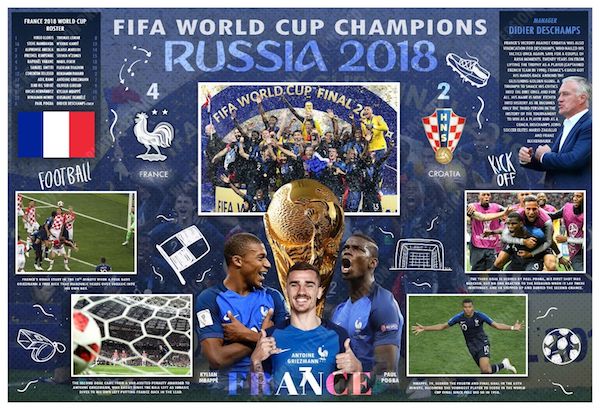
As the event progressed to its knockout rounds, some icons like Argentina, Spain, Portugal, Brazil and Uruguay made unceremonious exits, losing by results facilitated either by late goals, penalties, own goals or penalty shootouts. There were 29 penalties awarded in the tournament besides “own” goals, including the first goal of the final between France and Croatia. And then, the second goal came from a penalty.
By the time the tournament reached the semi-final stage, the challenge of Asia, Africa and the Americas had ended. The semi-finals and final were an all-European affair. Though Croatia made it to its first final of a World Cup, it could not stand up to the experience of the French, who won their second World Cup title in 20 years, and thus became only the sixth nation to win the elite soccer tournament two or more times.
Harry Kane (England), Luka Modric (Croatia), Kylian Mbappe (France) and Thibaut Courtois (Belgium) were adjudged among the best players of this World Cup that also saw the fading away of Lionel Messi (Argentina), even as Cristiano Ronaldo (Portugal) and Neymar (Brazil) may continue to hawk headlines for some more time.
And who can forget the Croatian President, Kolinda Grabbar-Kitarovic, who spent her own money to travel to Russia, sported the team jersey to watch the “silver team” play the final, from the stands, and greeted and consoled each member of the losing finalist team with a warm hug?
(The author is a senior journalist. He is executive editor with the PTC TV Channel)