Tag: Foreign Policy

  • Shaheed Nanak Singh Lecture Delivered

    Shaheed Nanak Singh Lecture Delivered

    “India’s unity and diversity are like the colours of a rainbow. If one were removed, its charm and beauty would be diminished”. – SHAHEED NANAK SINGH.
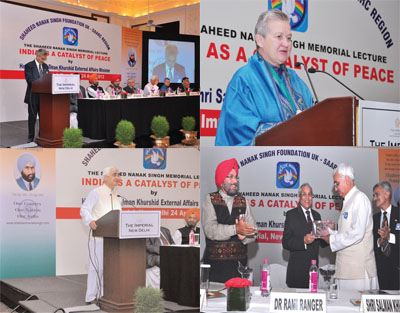
    NEW DELHI (TIP): The 6th Shaheed Nanak Singh Memorial Lecture was delivered by Salman Khurshid Minister for External Affairs Govt. of India, on 24th April at The Imperial Hotel, New Delhi, India. This year’s lecture was attended by over 200 elite guests including H.E. Ms. Nancy J Powell, US Ambassador to India, H.E. Gen JJ Singh, Governor of Arunachal Pradesh, H.E. Laimonas Talat-Kelpsa, Ambassador of Lithuania, H.E. Borislav Kostov, Ambassador of Bulgaria, H.E. Daniele Mancini, Ambassador of Italy, H.E. Prof. Piotr Klodkowski, Ambassador of Poland, H.E. Piotr Opalinski, Minister Counsellor, Deputy Head of Mission, Poland, H.E. Raimund Magis, Ambassador for Austria, H.E. Mark Reynhardt, Counsellor for South African High Commission, H.E. Tariq A Karim, High Commissioner of Bangladesh, the representatives from Belgium and Honorary Consuls of Samoa and Moldova.

    Also attending were Ambassador Rajesh Prasad, Ambassador Shri Nalin Suri, former Indian High Commissioner to the UK, Shri. Tarlochan Singh, Former Head of Minority Commission and member of parliament, General SK Sinha, Former Vice Chief of the Indian Army and Governor J&K, Shri Vivek Tankha, Former Additional Solicitor General to the Govt. of India, Vice Chief of Indian Navy, Admiral Robin Dhowan, Mr Jassi Khangura MLA, Punjab and Mr Surinder Singla former Finance Minister, Punjab. Mr Mukesh Anand, Chairman of the Foundation, paid tribute to Sardar Shaheed Nanak Singh Ji (www.shaheednanaksingh.com) who was born on 11th September 1903 in Kuntrila, Rawalpindi District, now in Pakistan.

    He was a great freedom fighter who dedicated his entire life for freedom, communal harmony and the unity of India. He strongly opposed the partition of India as he could foresee the consequences of breaking up India on the basis of religion. He delivered his last public speech on 4th March 1947 at Kup Mandi, Multan City, Pakistan along with Dr Saifudin Kichlew, President of the Punjab Congress.

    Sadly he fell the very next day, a martyr at the young age of 43, while trying to save 600 students of D.A.V School, Multan who were caught up in communal riots. He left behind a young widow of 35 and 8 young children, the oldest being 14 years old. Whilst delivering the Shaheed Nanak Singh Memorial lecture, Shri Salman Khurshid paid tribute to a great son of India who laid down his life for the principal of upholding India’s unity.

    He was particularly pleased to see that the Shaheed’s message was being carried forward by his Foundation. He praised the Shaheed’s youngest son Dr. Rami Ranger MBE for living up to the ideals of his illustrious father. In his impressive and memorable lecture, the Hon. Minister spoke about the necessity for peace in the world in order to progress. He said India has always been a catalyst for peace.

    India’s foreign policy was to foster a good relationship with its neighbours for the greater good of mankind. He said India was often accused of being weak in her resolve. However, he said it was easy to become violent but very difficult to be peaceful and India would never opt for the easy option. H.E. Gen JJ Singh the former Army Chief and now Governor of Arunachal also paid tribute to a man whose love for his motherland proved greater than self or his family.

    The Shaheed’s message of unity is as important today as the day he fell while saving innocent lives. He paid tribute to India’s rich civilization and felt proud to be an Indian. He said that whilst we promote peace, we must also be prepared to defend ourselves.With the absence of strength, our peace could be threatened. H.E. US Ambassador Ms Nancy J Powell thanked the organisers for inviting her to this important event.

    She praised India for being a land of ideas and that peace in the world is yet another good idea. Her own country, America, valued India’s friendship in this endeavour. The cooperation of India and the US would not only further peace in the region but also in the world. She was looking forward to working together for peace and prosperity in the world. Mr Tarlochan Singh, former Head of the Minority Commission and member of parliament also paid tribute to Shaheed Nanak Singh who tried desperately to stop the breakup of India.

    Just before his death, he called a peace conference and made a case to remain united. He further pleaded that a temporary gain for a few would become a permanent loss to the nation. He thanked Dr. Rami Ranger for coming each year to pay tribute to his father and to remind us in India of the need for unity between religions, races and castes. Mr Vivek Tankha the former Additional Solicitor General of India said it was not often that he got the opportunity to speak about a real patriot.

    He spoke about a family who for generations had dreamt and thought for Mother India, never flinched to offer the supreme sacrifice yet had never claimed credits or brownie points for what they did. He saluted such personalities and said that good people had to meet to ensure the bad did not takeover. He said we had no choice but to be together for the good of our country. He ended by stating that he was proud to be a part of this mission. Gen SK Sinha, former Vice Chief of Indian Army and Governor of J&K, said he had lived through the holocaust in 1947 as a young Major. He saw suffering on an unparalled scale.

    Over a million were killed and many millions uprooted and became refugees in a land where they were born. He fondly recalled the Shaheed Nanak Singh Lecture he delivered himself at the Punjabi University, Patiala a few years back. He said during this time he came to know more about the Shaheed and his son Dr Rami Ranger and became inspired by their lives. Dr. Rami Ranger, the youngest son of Shaheed Nanak Singh, summed up his father’s vision and foresight in an evocative vote of thanks.

    He thanked all the speakers, the trustees (Gp Capt DV Arora VSM & CA Alok Goel ) and Ms Shivani Mohan for conducting the proceedings most effectively and eloquently. He pointed out that India’s soul was its secular and democratic constitution where equality for all was enshrined regardless of race, religion or gender. Each year with the Shaheed Nanak Singh Memorial Lecture we reminded ourselves of the sacrifices people had paid for our freedom.

    He emphasized that it was imperative that we be proactive in pursuing peace and that if we did nothing, then we would achieve nothing and as a result we must promote and celebrate unity. He concluded by saying that if Shaheed Nanak’s Singh’s legacy could unite India, then his father would not have died in vain and together we could make India great. Dr Rami Ranger, on behalf of the Shaheed Nanak Singh Foundation, presented the Hon.

    Minister Shri Salman Khurshid ji with the “Soul of India” Award for his Services to Mother India and then to complete the occasion a sumptuous dinner was served to the guests.

  • India Hopes Pakistan Election Throws Up Clear Winner

    India Hopes Pakistan Election Throws Up Clear Winner

    NEW DELHI (TIP): As Pakistan takes baby steps into democracy, India is looking on with apprehension at the plethora of violence that may prevent the new government after Saturday’s election from being the kind that India would like to see. “Our best bet in Pakistan is a strong civilian government that can change the India narrative to something we can work with,” high level sources said.

    At this point, the dominant narrative is driven by the India-obsessed Pakistan army-ISI combine, which gives oxygen to jihadi groups like Lashkar-e-Taiba and its affiliates. Support to terrorism against India therefore has official sanction. The most important challenge for Pakistanis — candidates and voters alike — is that these elections have been dominated more by terror attacks than anything else. Indians hoping for a free election have been dismayed at the relentless violence that threatens to keep many indoors on polling day.

    India is hoping against hope that the election throws up a clear mandate for one of the mainstream parties. All signs point to the fact that Asif Zardari’s PPP might fall prey to antiincumbency and Nawaz Sharif appears the front-runner. Many believe that Sharif, who was last tossed out by General Pervez Musharraf’s coup, will not be particularly enamoured of the Pakistan army. But Sharif is accommodating of many of the Islamist groups.

    That bothers the west, but India appears more resigned to it. For India, its important that the new government takes the right economic and trade decisions for a start. That would put energy into the bilateral relationship even if other indices are more difficult to fulfil. Pakistan analyst Mosharraf Zaidi said in Foreign Policy, “This is not to say that Pakistanis embrace their neighbour. They are still smart about India’s role in separating Pakistan from Bangladesh, and still view with acrimony India’s administration over large parts of Kashmir.

    Yet, for all the bitterness and baggage, even the juiciest volleys from India are now returned with a disengaged ‘meh’. This will likely remain the status quo for a while. As long as it does, the doors remain open for India to tap into an unprecedented national appetite for normalcy.” A Pew survey tellingly found most Pakistanis deeply sceptical of Taliban and America alike.

    The study said, “About 80% think the Pakistani military, which for decades has been an important player in the country’s politics, is having a positive influence on the nation. Solid majorities say religious leaders (69%), the media (68%) and the courts (58%) are having a good impact on the country.” This doesn’t hold out much hope for the kind of government India wants in Pakistan.

    Sharif faces a challenge from Imran Khan and his Tehreek-e-Insaaf, which is seeing a bounce in the election campaigns largely due to his “outsider” tag; while the Sharifs are playing the governance card, they are also seen as the same old political class that has let Pakistan down.

  • Looking East, Looking West: U.S. Support for India’s Regional Leadership

    Looking East, Looking West: U.S. Support for India’s Regional Leadership

    Today, I’d like to talk about India’s growing influence, felt in the East through its “Look East” policy and in the west, particularly as we move toward the transition in Afghanistan. I’ll highlight how India’s engagement in these areas is crucial to U.S. foreign policy objectives and our pursuit of a stable, secure and prosperous region. India’s leadership has powerful implications that extend beyond its immediate neighborhood – as a beacon of democracy, stability, and growth. India has much to offer all of us, including communities right here in Cambridge. Harvard University’s increased engagement with India, through events like this, through its South Asia Institute, its research center in Mumbai, President Faust’s 2012 visit to India, through over 1,500 Harvard alumni in India, as well as a myriad of research projects, academic collaborations and student and faculty exchanges, testify to India’s growing prominence and our recognition of its increasing importance in the global arena. Massachusetts, likewise, has become a pioneer in forging closer relations with this key partner.

    The State Department strongly champions and supports state-to-state and cityto- city engagement,which is now a vital part of advancing our economic and people-to-people relationships. This year alone, at least eight American Governors are leading trade and other missions to India, not only to develop new markets but to attract job-boosting investments. Massachusetts was an early pioneer: back in 1995,when then-Governor Weld announced plans to forge an alliance with Karnataka, such engagement was a novel concept and a new approach. Governor Weld had the foresight to know that those who didn’t pursue ties with India would miss out on the many rewards this relationship has to offer. His delegation, consisting of 22 U.S. companies, paved the way for numerous U.S. firms to open in and around Bangalore. Today, Massachusetts is one of India’s top 25 trading partners in the world, and last year India received nearly $300 million of this state’s exports. But I hardly need to tell this audience how critical the U.S.-India relationship is.

    Those of you involved in collaborations with India, particularly in academia and research, are fully aware of the benefits. But our bilateral partnership benefits not only our two nations; it is of vital importance to a global vision for a future of shared prosperity. During his visit to India in 2010, President Barack Obama recognized the promise of our shared future and hailed the U.S.-India relationship as “one of the defining partnerships of the 21st century.” We and our Indian friends have taken significant steps to realize that vision. We established a Strategic Dialogue chaired by the Secretary of State and External Affairs Minister to give strategic direction to the wide range of bilateral dialogues between our two governments. We have expanded counterterrorism cooperation, intelligence sharing, and law enforcement exchanges that have helped make both of our countries safer, but clear-eyed about the threats that persist. Bilateral trade has grown by 50% from $66 billion to $93 billion in the last four years and is set to cross $100 billion this year.

    Indian foreign direct investment in the United States increased from $227 million a decade ago to almost $4.9 billion in 2011 – investments that have created and support thousands of U.S. jobs. Another growing component of our bilateral relationship with India is defense trade. Since 2000, sales to India have surpassed $8 billion, representing both an excellent commercial opportunity for U.S. companies but also advancing a vital component of our bilateral security relationship.We will continue to pursue defense trade cooperation with India, including a whole-of-government effort led by Deputy Secretary of Defense Ash Carter to reduce bureaucratic impediments, ease transactions between buyers and sellers, increase cooperative research, and focus on coproduction and co-development opportunities. We have grown our partnership with India on export controls and non-proliferation.We have worked closely with our companies to help them move deeper into India’s nuclear commercial markets, and we hope to announce more tangible commercial progress by the next Strategic Dialogue.

    We have increased our collaboration on clean energy through programs such as the U.S.-India Partnership to Advance Clean Energy (PACE). Since its creation, PACE has mobilized over $1.7 billion in renewable energy financing to India and has driven full-spectrum activity from basic research to development and commercialization in solar technology, advanced biofuels, and building efficiency. India is hosting the Fourth Clean Energy Ministerial (CEM) in New Delhi later this month. The CEM offers a tremendous opportunity for partnership on a range of clean energy technologies, particularly in buildings and appliance efficiency, that are among the world’s most ambitious. And we have witnessed an expansion of our already robust people-to-people ties, particularly in the educational arena,where there is great demand. India has about 600 million people under 25.

    The next generation can only fulfill their roles as economic drivers if equipped with the right training and skills. India aims to increase its higher education enrolment from under 20 percent to 30 percent by the end of the decade. That means it needs 50,000 more colleges and 1 million more faculty. Since the first iteration of the U.S. India Higher Education Dialogue last year,we have focused our efforts on such critical areas as skills training and workforce development by strengthening community college collaboration. We are preparing for another round of Obama Singh 21st Century Knowledge Initiatives awards,which will further partnerships and junior faculty development between U.S. and Indian higher education institutions in priority fields and we have sought to encourage more Americans to study in India and build American expertise about India and by ramping up our Passport to India initiative.

    With its strong democratic institutions, unprecedented demographic growth, economic promise and rising military capabilities, India is poised to play a critical leadership role both regionally and globally.With rising power comes greater global responsibility and in moving beyond its tradition of non-alignment, India has established its credentials as a responsible player in the global arena.We are committed to working together, along with others in the region, toward the evolution of an open, balanced, and inclusive architecture. India has long been an integral member of the Asia-Pacific region, sharing cultural and historical ties that have laid the foundation for its expanded engagement of today.With its “Look East” Policy, initiated in 1991, India began to work more closely with its Asian partners to engage the rest of the world, reflecting the belief that India’s future and economic interests are best served by greater integration with East and Southeast Asia.

    Today, India is forging closer and deeper economic ties with its eastern neighbors by expanding regional markets, and increasing both investments and industrial development from Burma to the Philippines. India is also seeking greater regional security and military cooperation with its neighbors through more intensive engagement with ASEAN and other near neighbors. This week, in fact, India and China held their annual counterterrorism dialogue and focused on pan-Islamic extremism in the backdrop of Afghanistan’s transition. Such interaction evinces Beijing and Delhi’s interest in coordinating to work together for stability in Kabul in 2014 and beyond. Trade, and by extension maritime security, are key components of our bilateral collaboration. The economic dynamism of South, Southeast and East Asia, along with improving relations between India and its neighbors to the East, has spurred the region’s interest in revitalizing and expanding road, air, and sea links between India, Bangladesh, Burma, and the rapidly expanding economies of ASEAN. From 2011 to 2012, trade between India and the countries of Southeast Asia increased by 37%.

    This emerging Indo-Pacific Economic Corridor, as we have come to call it, is a boon for the region and for the United States, providing our own economy with potential new markets. Linkages and infrastructure investments between the rapidly expanding economies of South Asia and those of Southeast Asia are a critical component to integrating regional markets to both accelerate economic development and strengthen regional stability,while helping unlock and expand markets for American goods and services. An India that is well-integrated into the Asia’s economic architecture, that pursues open market policies, and that has diverse and broad-based economic relationships across the East Asia region is not only good for India, but is good for the United States and the Asia- Pacific region as a whole.

    But trade can only prosper when maritime security is assured. Oceans are essential to India’s security and prosperity, as they are to ours. By volume, 90% of the goods India trades are carried by sea. India therefore has a strong interest in guaranteeing unhindered freedom of navigation in international waters, the free flow of commerce, and the peaceful resolution of maritime disputes. But beyond its own economic benefit, India realizes that the economic integration enabled by the improvements of connections across Asia, will lead to prosperity that benefits all nations. India’s growing naval capacity and modernization have enabled its strong presence across the Indian and Pacific Oceans and further bolstered its role as a net security provider in the maritime domain.

    Already in the Western Indian Ocean region, New Delhi is demonstrating its growing maritime capabilities with a robust counter-piracy approach that serves common regional interests and many of their own nationals held hostage in Somalia. As a founding member of the international Contact Group on Piracy off the Coast of Somalia, India has shown great leadership in the efforts to confront and combat piracy stemming from Somalia which threatens trade flows to and from Asia. Our shared vision for economic integration and the promotion of regional stability also extends westward. The United States and India are both strong supporters of a more economically integrated South and Central Asia, with Afghanistan at its heart — what we call the New Silk Road vision.

    At the core of this vision is an Afghanistan at peace and is firmly embedded in the economic life of the region. Such an integrated region will be better able to attract new investment, benefit from its resource potential, and provide increasing economic opportunity and hope for its citizens. Improving connections between South and Central Asia is made all the more urgent as Afghanistan moves through the transition process and puts its economy on a more sustainable private sector-led footing. The countries of the region have embraced a new vision for Afghanistan that places it at the center of a rejuvenated network of commerce, communications and energy transmission, a “land bridge” connecting the Middle East and central Asia to the dynamic markets of China, India and Southeast Asia. Its economic development and ultimate economic integration into the larger network of regional markets is yet another piece of the New Silk Road tapestry. As Afghanistan increasingly takes the lead in its own security, political, and economic situation,we also strongly support the constructive role that India is playing in Afghanistan’s ongoing development.We look to India to play an active part in ensuring that that stability and security endure and that the gains made in Afghanistan over the past 11 years are sustained. Indeed, great challenges lie ahead. But India is committed to our shared vision for a peaceful, stable and secure Afghanistan and has already proven its commitment to assume a greater role in enabling that vision to come to fruition. In 2011, India pledged through the signing of a wide-ranging strategic agreement to train and equip Afghan security forces.

    As the largest regional provider of humanitarian and reconstruction aid to Afghanistan, India has given some $2 billion in aid to the country. Indian public and private companies are building the infrastructure which will carry the nation forward. They have built highways from Kandahar to Kabul and a new parliament building in the capital, put transmission lines between Afghanistan and Uzbekistan and have plans to power Afghan cities through the Salma dam project and to help Afghanistan realize its mineral wealth through development of the Hajigak iron ore mines. On the soft power side, India’s Bureau of Parliamentary Studies and Training invited most senators in Afghanistan’s Upper House, the Meshrano Jirga, for a training session in legislative and budgetary processes in New Delhi, much as the JFK School of Government does for new lawmakers in Washington.

    There’s perhaps no better example of the potentially impact of the New Silk Road vision for Afghanistan and its region than the Turkmenistan-Afghanistan-Pakistan-India pipeline, or TAPI. By connecting abundant energy reserves in Turkmenistan with rapidly rising demand for that energy in South Asia and providing Afghanistan with much-needed transit revenue, TAPI can be transformative for the region. While there’s still much to be done to make this project a reality,we are closer today than anyone would have thought possible just a few years ago, thanks in no small part to Indian leadership. Beyond these infrastructure efforts, India has rallied the international community to encourage further development and to garner the support needed to enable Afghanistan’s successful transition.

    Last year New Delhi hosted a major summit on international investment in Afghanistan’s economy. As Afghanistan shifts the foundation of its economy from aid to trade in the coming years, India’s regional role as a driver of economic prosperity and anchor of democratic stability becomes even more important. Later this month in Almaty, the United States, India, and other countries of the region, will meet to discuss how we can best support a secure and prosperous Afghanistan, integrated into its region. This gathering is part of the Istanbul Process, in which neighbors and nearneighbors support Afghanistan through a range of initiatives that advance security and regional economic cooperation. India has already demonstrated a clear leadership role through its chairing of a working group focused on expanding cross-border commercial and business-to-business relations.

    In conclusion, in Afghanistan as in so many other areas, meeting the challenges of today and seizing the opportunities of tomorrow demand cooperative responses and lasting partnerships.We have found, in India, a strong partner in our shared quest for peace, stability, and prosperity in South Asia, the Asia-Pacific region, and beyond. As India continues to grow economically and extends its engagement outward,we see that our strategic investment in partnership with India is paying dividends that will last for generations.

    An India that is well-integrated into the Asia’s economic architecture, that pursues open market policies, and that has diverse and broad-based economic relationships across the East Asia region is not only good for India, but is good for the United States and the Asia-Pacific region as a whole”, says the author

  • China-Pakistan nuclear axis- India factor behind their game plan

    China-Pakistan nuclear axis- India factor behind their game plan

    Last month Beijing confirmed its plans to sell a new 1,000 megawatt nuclear reactor to Pakistan in a deal signed in February. This pact was secretly concluded between the China National Nuclear Corp (CNNC) and the Pakistan Atomic Energy Commission during the visit of Pakistani nuclear industry officials to Beijing from February 15 to 18. This sale would once again violate China’s commitment to the Nuclear Suppliers Group (NSG) and is in contravention to China’s promise in 2004 while joining the NSG not to sell additional reactors to Pakistan’s Chashma nuclear facility beyond the two reactors that began operation in 2000 and 2011.

    While this issue is likely to come up for discussion at the June meeting of the NSG in Prague, Beijing has already made it clear that nuclear cooperation between China and Pakistan “does not violate relevant principles of the Nuclear Suppliers Group.” This when the CNNC is not merely constructing civilian reactors in Chashma, it is also developing Pakistan’s nuclear fuel reprocessing capabilities and working to modernise Pakistan’s nuclear arsenal. At a time when concerns about Pakistan’s nuclear programme are causing jitters around the world, China has made its intentions clear to go all out in helping Pakistan’s nuclear development. At a time when many in India are contemplating a new bonhomie in Sino-Indian ties under the new Chinese leadership, China is busy trying its best to maintain nuclear parity between India and Pakistan. After all, this is what China has been doing for the last five decades. Based on their convergent interests vis-à-vis India, China and Pakistan reached a strategic understanding in mid-1950s, a bond that has only strengthened ever since.

    Sino- Pakistan ties gained particular momentum in the aftermath of the 1962 Sino-Indian war when the two states signed a boundary agreement recognising Chinese control over portions of the disputed Kashmir territory and since then the ties have been so strong that the Chinese President Hu Jintao has described the relationship as “higher than mountains and deeper than oceans.” Pakistan’s President, Asif Ali Zardari, has suggested that “No relationship between two sovereign states is as unique and durable as that between Pakistan and China.” Maintaining close ties with China has been a priority for Islamabad and Beijing has provided extensive economic, military and technical assistance to Pakistan over the years.

    It was Pakistan that in the early 1970s enabled China to cultivate its ties with the West and the US in particular, becoming the conduit for Henry Kissinger’s landmark secret visit to China in 1971 and has been instrumental in bringing China closer to the larger Muslim world. Over the years China emerged Pakistan’s largest defence supplier. Military cooperation between the two has deepened with joint projects producing armaments ranging from fighter jets to guided missile frigates.

    China is a steady source of military hardware to the resource-deficient Pakistani Army. It has not only given technology assistance to Pakistan but has also helped Pakistan set up mass weapons production factories. But what has been most significant is China’s major role in the development of Pakistan’s nuclear infrastructure, emerging as Pakistan’s benefactor at a time when increasingly stringent export controls in Western countries made it difficult for Pakistan to acquire materials and technology from elsewhere. The Pakistani nuclear weapons programme is essentially an extension of the Chinese one.

    Despite being a member of the NPT, China has supplied Pakistan with nuclear materials and expertise and has provided critical assistance in the construction of Pakistan’s nuclear facilities. Although China has long denied helping any nation attain a nuclear capability, the father of Pakistan’s nuclear weapons programme, Abdul Qadeer Khan, himself has acknowledged the crucial role China has played in his nation’s nuclear weaponisation by gifting 50 kilogrammes of weapon grade enriched uranium, drawing of the nuclear weapons and tonnes of uranium hexafluoride for Pakistan’s centrifuges. This is perhaps the only case where a nuclear weapon state has actually passed on weapons grade fissile material as well as a bomb design to a non-nuclear weapon state.

    India has been the main factor that has influenced China and Pakistan’s policies vis-à-vis each other. Whereas Pakistan wants to gain access to civilian and military resources from China to balance the Indian might in the subcontinent, China, viewing India as potential challenger in the strategic landscape of Asia, views Pakistan as its central instrument to counter Indian power in the region.

    The China-Pakistan partnership serves the interests of both by presenting India with a potential twofront theatre in the event of war with either country. In their own ways, each is using the other to balance India as India’s disputes with Pakistan keep India preoccupied failing to attain its potential as a major regional and global player. China meanwhile guarantees the security of Pakistan when it comes to its conflicts with India, thus preventing India from using its much superior conventional military strength against Pakistan. Not surprisingly, one of the central pillars of Pakistan’s strategic policies for the last more than four decades has been its steady and ever-growing military relationship with China. And preventing India’s dominance of South Asia by strengthening Pakistan has been a strategic priority for China.

    But with India’s ascent in global hierarchy and American attempts to carve out a strong partnership with India, China’s need for Pakistan is only likely to grow. A rising India makes Pakistan all the more important for Chinese strategy for the subcontinent. It’s highly unlikely that China will give up playing the Pakistan card vis-à-vis India anytime soon. Indian policy makers would be well advised to disabuse themselves of the notion of a Sino-Indian convergence in managing Pakistan. China doesn’t do sentimentality in foreign policy, and India should follow suit.
    “But with India’s ascent in global hierarchy and American attempts to carve out a strong partnership with India, China’s need for Pakistan is only likely to grow. A rising India makes Pakistan all the more important for Chinese strategy for the subcontinent. It’s highly unlikely that China will give up playing the Pakistan card vis-à-vis India anytime soon”, says the author.

  • The Iron Lady of UK- Margaret Thatcher

    The Iron Lady of UK- Margaret Thatcher

    Margaret Thatcher’s political career has been one of the most remarkable of modern times. Born in October 1925 at Grantham, a small market town in eastern England, she rose to become the first (and for two decades the only) woman to lead a major Western democracy. She won three successive General Elections and served as British Prime Minister for more than eleven years (1979-90), a record unmatched in the twentieth century.

    During her term of office she reshaped almost every aspect of British politics, reviving the economy, reforming outdated institutions, and reinvigorating the nation’s foreign policy. She challenged and did much to overturn the psychology of decline which had become rooted in Britain since the Second World War, pursuing national recovery with striking energy and determination.

    In the process, Margaret Thatcher became one of the founders, with Ronald Reagan, of a school of conservative conviction politics, which has had a powerful and enduring impact on politics in Britain and the United States and earned her a higher international profile than any British politician since Winston Churchill.

    By successfully shifting British economic and foreign policy to the right, her governments helped to encourage wider international trends which broadened and deepened during the 1980s and 1990s, as the end of the Cold War, the spread of democracy, and the growth of free markets strengthened political and economic freedom in every continent. Margaret Thatcher became one of the world’s most influential and respected political leaders, as well as one of the most controversial, dynamic, and plain-spoken, a reference point for friends and enemies alike.

    After 1990 Lady Thatcher (as she became) remained a potent political figure. She wrote two best-selling volumes of memoirs – The Downing Street Years (1993) and The Path to Power (1995) – while continuing for a full decade to tour the world as a lecturer. A book of reflections on international politics – Statecraft – was published in 2002. During the period she made some important interventions in domestic British politics, notably over Bosnia and the Maastricht Treaty. In March 2002, following several small strokes, she announced an end to her career in public speaking. Denis Thatcher, her husband of more than fifty years, died in June 2003, receiving warm tributes from all sides. Margaret Thatcher remains an intensely controversial figure in Britain.

    Critics claim that her economic policies were divisive socially, that she was harsh or ‘uncaring’ in her politics, and hostile to the institutions of the British welfare state. Defenders point to a transformation in Britain’s economic performance over the course of the Thatcher Governments and those of her successors as Prime Minister. Trade union reforms, privatization, deregulation, a strong anti-inflationary stance, and control of tax and spending have created better economic prospects for Britain than seemed possible when she became Prime Minister in 1979.

    Her legacy remains the core of modern British politics: the world economic crisis since 2008 has revived many of the arguments of the 1980s, keeping her name at the centre of political debate in Britain. In her death on April 8, the world has lost a statesman.

  • Meet The Acting Consul General Of India In New York

    Meet The Acting Consul General Of India In New York

    Dr. Devyani Khobragade is the current acting Consul General at the Indian Consulate in New York. Between the Finance Minister’s impending visit, the arrival of the next Consul General and many other obligations, she graciously took some time out to introduce herself to The Indian Panorama readers. She candidly answered questions on her personal life and on a number of issues, including the OCI cards issue that has been upsetting the Indian American community.

    Here are a few excerpts from the interview she gave to The Indian Panorama team comprising Chief Editor Prof. Indrajit S Saluja and Principal Reporter Pooja Premchandran in the ornate office of the Consul General of India, April 3.

    Q. Can you tell us a little bit about your childhood?
    I was born in Tarapore near Mumbai. I have had my education all over India because my father was in IAS. But I studied medicine in Mumbai. While medicine was very interesting I wanted to travel and wanted to experience different cultures. Medicine did not offer that. So I decided while doing MS in Ophthalmology to shift and take up the Civil Service. My father was a bureaucrat and my uncle, Dr. Gondane, is the High Commissioner of Papua New Guinea and he was also posted here in New York as Deputy Consul General. So I knew that I would be good at Civil Service. I am a people’s person; I like to be with people. So I thought it would be a good opportunity to be connected with my country and work for my country abroad at the same time. My first posting was in Germany. I also did a posting in Pakistan, which was the most challenging one in my career. After that, I came back to Delhi for a few years and now I am posted in New York.

    Q. Can you tell us a few significant highs and lows of your career?
    Well, lows are the same that is there everywhere. There is a hierarchical bureaucracy that exists where your ideas are disregarded and ignored. There have been instances where there have been a few issues with colleagues. Also there is a problem with moving to a new country and settling in a new country, especially for a woman with young children. The highs have been a quite a few too. The most significant one was where I could be a part of the foreign policy that commenced the Srinagar- Muzaffarabad bus service. It is wonderful to see your ideas and efforts finally coming to light. There have been many highs like this especially when such ideas are considered into foreign policy making. I also had a very good relation with the political class of Pakistan. Even today when he meets our Ambassador, Gilani asks about me. It feels nice to be remembered.

    Q. What are your ambitions and future goals?
    The highest point in our careers is the Ambassador’s post. But besides that my ambition is to make some changes within our Civil Services. For example, we lack a crèche, spousal support and many other facilities that women who are in foreign services of other countries are entitled to. My other ambition is to have direct impact on a foreign policy for the underprivileged women. I would like to work as an advisory capacity in an NGO or be a Trustee or a Board Member to communicate directly with the community.

    Q. Can you tell us a bit about your family?
    I have two young daughters. They are six and three years old. My husband is a professor of Philosophy. It is difficult for him to follow wherever my career takes me. But we work something out. I come from a family where our parents always encouraged that women must be economically independent. So they always stressed on education. I have another sister. My father would say ‘You are my sons and daughters’ and that is exactly what made me take up the Civil Service when everyone dissuaded me from leaving a financially beneficial medical field. They also told me that a woman couldn’t manage a family and children with a job like mine. But I always thought if a man can do it, so could I.

    Q. The tourism industry has suffered massively due to the recent attacks on women. A recent statistics published in a newspaper in the UK has provided evidence to this. What is the government’s plan to address this issue?
    Because of a few unwanted incidents, there has been an impression that the entire country is unsafe. Such incidents cannot reflect the situation of an entire country. I am not condoning the attacks on women. As you see, the government has taken extremely stringent actions to combat violence against women. I feel the whole consciousness of Indian society has awakened with one incident. It will not be relegated to the background. There will be a concerted action. Other than this, there are no reasons for tourism to drop in India. We remain a safe and secure country. And certainly we will do our bit to make sure it remains so. At the Consulate, we have been putting out information about the steps taken and ordinances issued by the Indian government since the incident. Our ambassador, Nirupama Rao wrote an article in the Wall Street Journal. So we have been making small efforts and will continue to make them in future too. We even intended to ask the Finance Minister to address the international media during his visit to the US and help clear the image we have now.

    Q. There has been a continual demand on the government to persuade the US government to extend more leniencies or provide quotas for Indians applying for work visa. Will we see more leniencies from the government’s side for H1B visa applicants?
    We are talking to the government about the upcoming immigration laws. We are trying to safeguard the interests of Indians who are highly specialized and skilled by increasing the number of H1B applications that can be accepted from Indian applicants. We also want to streamline a few procedures that are to be taken while applying for the H1B visa. The embassy is taking up these issues but as you know it’s a continual process.

    Q. The recent surrogacy issue has led to an uproar as well. Recently the home ministry introduced a rule stating that foreign nationals who come for surrogacy to India must come on a medical visa. Do you think it will have an adverse effect on tourism?
    I think this decision has been taken by the Home Ministry to protect the child that has been born through surrogacy in India from becoming stateless. It also ensures that the financial, property and such rights of the woman who opts to be a surrogate of foreign nationals are protected. Earlier, people were coming on tourist visa, and leaving so we had no record of any thing here. It has also been that when the child goes to any other country, he or she is not accepted in that country as a citizen. This letter from anybody going to India for surrogate child that we demand now, will ensure that the child has a proven record of citizenship intact with the ministry. The letter is a simple and easily obtainable letter. The tourism industry should not have any issue with this. That is just the usual obfuscation of the issue. But we give medical visas easily as long as the documents provided are strong.

    Q. There have been growing complaints from the OCI cards holders who travel to India and face problems before entering the country. What is the reason for that?
    This is due to the regulation of MHA that states that if a person has an OCI card and he or she is below 12 or above 50, at that point and in these particular instances, they have to get their US passport information endorsed on their OCI cards. The rationale behind this is that a child after 12 and a man after 50 begin to change appearances. But this rule is not very well known. That is why there is such confusion about the OCI cards. So if you are above 50 and your passport details do not match with the OCI cards you will face problems at the immigration. We do have the information displayed on the website where people go to apply for the OCI card. Travisa website too has the information. There is such a rule and we have to follow it. I will be happy to clarify the rule through media.

    Q. What is your take on the Indian community in New York?
    Perhaps the Indian community in New York is the most successful one anywhere in the world. We are happy to engage with them and work together towards common goals. I always say that our position in this country is bolstered by a very powerful and enigmatic voice and Diaspora of our community. Now that the Indian community has proven that we are professionally well equipped. I suppose the next logical step is for them to be directly involved in the political system of this country.

  • Dhaka needs focused approach

    Dhaka needs focused approach

    INDIA CAN’T IGNORE IT
    External Affairs Minister Salman Khurshid’s recent visit to Bangladesh laid the groundwork for the visit of the President, Pranab Mukherjee, to Dhaka. New Delhi has not been a great partner to Dhaka so far and by not signing the deals that matter most to Bangladesh is alienating pro-India forces in that country. Yet both visits have underscored the importance that India attaches to its relations with Bangladesh. Mukherjee had visited Dhaka in 2010 as the then Finance Minister to mark the signing of a $1 billion loan deal, the largest line of credit received by Bangladesh under a single agreement. India’s Exim Bank had signed this line of credit agreement with Bangladesh’s economic relations division and the loan was be used to develop railways and communications infrastructure there.

    This deal carried 1.75 per cent annual interest and would be repayable in 20 years, including a five-year grace period. It was offered during Sheikh Hasina’s visit to India in January 2010. This was followed by the two countries signing a 35-year electricity transmission deal under which India will be exporting up to 500 mw of power to Bangladesh. Dhaka has also signed a $1.7 billion pact with the National Thermal Power Corporation for the construction of two coal-fired plants in southern Bangladesh.

    Despite these initiatives India failed to build on the momentum provided by Hasina’s visit with its failure to implement two major bilateral agreements – finalization of land boundary demarcation and the sharing of the waters of the Teesta river. Bangladesh is rightly upset at the slow pace in the implementation of these.

    Hasina has taken great political risk to put momentum back into bilateral ties. But there has been no serious attempt on India’s part to settle outstanding issues. Bureaucratic inertia and lack of political will has prevented many of the deals from getting followed through. Dhaka is seeking response to its demand for the removal of tariff and non-tariff barriers on Bangladeshi products.

    India has failed to reciprocate Hasina’s overtures. The Bangladesh Nationalist Party (BNP) has used the India-Bangladesh bonhomie under Hasina to attack the government for toeing India’s line. India-Bangladesh ties had reached their lowest ebb during the 2001-2006 tenure of the BNP government. India has failed to capitalize on the propitious political circumstances in Bangladesh, damaging its credibility even further. New Delhi’s window of opportunity will not exist forever. Anti-Indian sentiments can be marginalized if India allows Bangladesh to harness its economic growth and present it with greater opportunities. Yet India remains obsessed with “AfPak” and has failed to give due attention to Bangladesh.

    Begum Khaleda Zia’s first visit to India came in March 2006, at the end of her term as Prime Minister. In contrast, Hasina visited India in January 2010, just a year into her term as the premier. New Delhi rolled out the red carpet to welcome Hasina as its first state guest of this decade. Overcoming formidable hurdles, Hasina’s Awami League had swept to a decisive electoral victory in December 2008.

    This tale of two visits is a reflection of how India’s relationship with Bangladesh seems to have become hostage to domestic political imperatives in Dhaka. It is ironic that this should happen given India’s central role in helping establish an independent Bangladesh and the cultural affinities and ethnic linkages they share. But friends are as temporary as enemies in international politics. Instead, it is a state’s national interests that determine its foreign policy.

    In the case of India and Bangladesh, these interests have been diverging for some years now, making this bilateral relationship susceptible to the domestic political narratives in New Delhi and Dhaka. India is the central issue around which Bangladeshi political parties define their foreign policy agenda. This shouldn’t be a surprise given India’s size and geographic linkages. Over the years political parties opposing the Awami League have tended to define themselves in opposition to India, in effect portraying Awami League as India’s “stooge”. Moreover, radical Islamic groups have tried to buttress their own “Islamic identities” by attacking India. Ever since she has come to power in December 2008, Sheikh Hasina has faced challenges from right-wing parties as well as the fundamentalist organizations such as the Jamaat-e- Islami and the Jamaat-ul-Mujahideen which enjoy Pakistan’s support.

    These groups are united in undermining efforts to improve ties with New Delhi. The greatest challenge that Hasina overcame in her first year was the mutiny by the paramilitary Bangladesh Rifles, which erupted in February, 2009. It soon became clear that the mutineers were being instigated by supporters of the Opposition led by the BNP and others connected to the Jamaat-e-Islami. India supported Hasina’s crackdown on the mutineers by sealing its borders with Bangladesh and forcing back mutineers attempting to cross over. Prime Minister Manmohan Singh visited Dhaka in September 2011 and was all set to sign the Teesta pact.

    But West Bengal Chief Minister Mamta Banerjee made sure that his plan got derailed at the last minute, damaging India’s credibility significantly. The Prime Minister ultimately managed to sign the land boundary agreement that demarcates territorial sovereignty along the 4,000-kilometre Indo-Bangladesh frontier. But even in this case, where Bangladesh has ratified this pact, India has failed to move forward because of the need for a constitutional amendment which requires support from the main opposition party, the BJP. India has finally signed a liberalized visa agreement and a landmark extradition treaty with Bangladesh that is likely to pave the way for the deportation of insurgents and criminals from Bangladesh.

    Salman Khurshid has been able to mollify some concerns in Dhaka about Indian intentions by making it clear that New Delhi will be taking the two pacts on the Teesta waters and land boundary to their logical conclusion soon. But the political dispensation in New Delhi should recognize the dangers of playing party politics with India’s foreign and security policy. India is witnessing rising turmoil all around its borders and, therefore, a stable, moderate Bangladesh is in its long-term interests. Constructive Indo- Bangladesh ties can be a major stabilizing factor for the South Asian region as a whole. It can’t afford to ignore Dhaka.

  • As I See It : When The Us Fails, Others Suffer

    As I See It : When The Us Fails, Others Suffer

    Nuclear’ Iran is getting to be a bigger botherfor the US and the rest of the world thanmany had assumed in the earlier stages. It isfallacious to argue that Tehran will become a stablepartner in global peace by having a nuclear arsenal.Iran will either get ‘the’ bomb or get bombed. Whatthis means regionally is anyone’s guess since thereare too many variables surrounding these twopossibilities.

    One thing that is invariable though, isAmerica’s dogged adherence to icons and dogmaswhich ensures that only the extremes are possible.As the situation stands, no one, not even theRussians and the Chinese, doubt in private that Iranis accelerating its efforts to build a bomb. In public,though, there are two narratives – the first is of thecrazy suicidal mullahcracy so rabidly obsessed withkilling Jews that another holocaust is on the horizon.The other, less printed, argument is that a nuclearIran would actually bring a greater level of stabilityto what is a highly volatile region. Both of course arehyperbolic, but they dominate print and broadcastopinions in one variant or the other.

    The former needs no serious refutation. The latteris true to a certain extent in that it alleviates Iran’sacute conventional inferiority vis-à-vis its neighbors,but this is only half the story. As the experience ofPakistan and North Korea has shown, nuclearweapons provide revisionist states with a shield for awhole new paradigm of provocations like Mumbai26/11 or the sinking of the South Korean warship,The Cheonan. Nuclear weapons, therefore, provide acertain strategic stability in that it prevents all-outwar, but then introduce great levels of subconventionalinstability either by covert actions or bynon/sub/quasi state actors.

    The problem here is, the proponents of the theorythat a nuclear Iran will bring stability have veryfrequently lost credibility either because theymisdirect their fire, obfuscate the nuance or engagein hyperbole – all aimed at exculpating the UnitedStates. Take for example Kenneth Waltz arguing thatIran is attempting to balance the 40-year-old Israeliarsenal. This ignores the fact that the prime ‘sabrerattler’and major nuclear power in the Middle Eastis, in fact, the United States that has already regimechangedtwo of Iran’s neighbors – Afghanistan andIraq, has Iran completely encircled and has skewedthe conventional balance by reckless arms sales toIran’s arch rivals.

    To blame Israel for the situation isas incredulous as Iranian President MahmoudAhmadinejad holding the Elders of Zion responsiblefor Iran’s travails.The prime mover of a nuclear Iran was in fact theUnited States spearheaded by arch neo-cons DonaldRumsfeld, Dick Cheney and Paul Wolfowitz in the 70s -ostensibly to buttress Iran’s position vis-à-vis theUSSR. Though suitably couched in terms of energy,the deal would have ensured that Tehran receivedboth enriched uranium and plutonium – all butproviding for the existence of a latent arsenal. Iran’s’policies’ in those days, of course, were directed in thepursuit of US policy.

    William Blum, for example, inhis book, Killing Hope: US Military and CIAInterventions since World War II, lists howAfghanistan was deliberately destabilized by Iran todrag the Soviets in. Today Iran’s ‘mischief’ is directed- largely by default – against the Unites States’interests.It is of course quite natural for any country toadopt double standards; no country on earth has adouble standard-free foreign policy. But what isworrying about the United States is how theinformation and the intelligence loops form a closedcircuit that filters out any divergent opinion – wherethe Government actually starts believing its ownspin, and sadly the academia tends to buttress this.Take for example Saddam Hussein’s use of nerveagents in Halabja in the 80s.

    Till the invasion ofKuwait, most US experts were keen to emphasize that”doubts existed” over who had resorted to usingmustard gas and in some form or another and it wasimplied that Iran had done it. Similarly, in spite ofoverwhelming evidence that Georgia had disruptedthe status quo in South Ossetia and Abkhazia, mostUS ‘experts’ on television went out of their way toeither claim that the evidence wasn’t clear.This pattern of self-delusion continues to buttressUnited States rigidity on Iran and revolve around fivemain points.

    First, the United States actually seems tothink the sanctions on Iran are smart and shouldhumanitarian concerns arise, they will be suitablymodified.

    Second, that sanctions are still an effectivetool that will achieve results.

    Third, no geopoliticalconcessions need to be made to Iran – or as Americansclaim “the world has moved on from spheres ofinfluence driven politics”.

    Fourth, the only ‘carrots’Iran needs to be offered are economic – likemembership of the World Trade Organization at somedistant point in the future.

    And fifth, Mr.Ahmadinejad’s statement on wiping Israel off the mapis proof of Iran’s diabolical designs.

    As far as one can remember, images of horriblydeformed Iraqi children did nothing to change the UShard line on the causative sanctions for 13 long yearsafter which the Washington, DC solution was toinvade. That sanctions can be effective has beendiscounted time after time. Anybody who bothersstudying Myanmar and Libya knows that the former’scompliance had more to do with a series of complexissues and the latter’s compliance with Gaddafi’ssuccession plans. The notion that somehow Iran willsit pretty and accept the fall of its allies like SyrianPresident Bashar al-Assad, the crushing of the Shiasand its conventional inferiority is laughable at best.As for the world moving on from spheres of influenceone would like to see how the United States reacts to aChinese announcement of setting up a nuclearmissile base in Venezuela or Cuba.

    The naïveté in believing that a country that hasendured severe sanctions and embargos for the betterpart of the last 30 years will be tempted by WTOaccession boggles the mind. Finally, it is curious thatthe United States does not accept at face value theabsence of homosexuality in Iran given that PresidentAhmadinejad claims just this, but his pronouncementson wiping out Israel are of course gospel truth.Between rigid dogma and iconoclastic hyperbole, theonly thing that gets reinforced is the United States’sense of infallibility and the consequences foreverybody else – paying the price for America’s failures.

  • Park’s National Security Chief To Face Tough Test With N. Korea

    Park’s National Security Chief To Face Tough Test With N. Korea

    SEOUL (TIP): Kim Jang-soo, the national securityoffice chief for incoming President Park Geun-hye, isexpected to face tough strategic challenges in copingwith North Korea as the belligerent neighbor threatensto stage a nuclear test despite repeated internationalwarnings.Kim, 65, the former defense minister under the RohMoo-hyun administration from 2004 to 2006, wasappointed to the major post in the top office afterleading the foreign policy and defense committee forPark’s transition team after the December election.

    He won conservative acclaim after he was shownstanding upright without bowing as he shook handswith then North Korean leader Kim Jong-il during the2007 inter-Korean summit. Since then the hardliner wasdubbed “Gen. Upright.”After stepping down from the defense chief post, Kimentered into politics on the proportional representationticket for the then ruling conservative Grand NationalParty, now known as the Saenuri Party, in the previousparliamentary session.Park, who replaces President Lee Myung-bak on Feb.25, campaigned on mending ties with Pyongyang inreturn for dismantling its nuclear program.

    Ahead of awidely expected third nuclear test, however, she hasrepeatedly urged the North to drop the plan and warnedthe test would further isolate the impoverished nation,which is already under heavy international sanctions.Under the Park administration, Kim is expected to takea greater role in overseeing foreign affairs, nationaldefense and inter-Korean affairs, as well as nationalcrisis management, which will be a newly added team tothe presidential office as part of Park’s governmentreorganization plan.

    The expanded national security team for the top officewas seen as underlining Park’s commitment to strongnational defense.Born in Gwangju in 1948, Kim graduated from theKorea Military Academy in 1971 and earned a master’sdegree in government administration from Seoul’sYonsei University in 1989. He served as deputycommander of the South Korea-U.S. combined forcescommand and Army chief.

  • As I See It: Worry About Kerry

    As I See It: Worry About Kerry

    As the US president, Barack Obama embarks on his second term, New Delhi is once again feeling the chill of a new administration in Washington. Sections of the Indian foreign policy making community are once again doing what they do best – crying hoarse over a possible change in the tone and tenor of US foreign policy. Obama has a new cabinet line-up with John Kerry nominated for the post of secretary of state, Chuck Hagel for the secretary of defense and John Bremmer as the head of the CIA. The US foreign policy is in a state of flux and some very significant changes are likely over the course of the next few years under the second Obama presidency. The most important issue in the short to medium term will be withdrawal of around 66,000 US troops from Afghanistan after more than a decade battling al Qaeda and the Taliban.

    Like most nations around the world, New Delhi will also be impacted by the impending changes in the foreign policy priorities of Washington. But instead of debating the larger ramifications of these changes, the discussion in India today is reminiscent of the discussion in the country when Obama came to office for the first time in 2008. There were widespread concerns about Obama’s attitudes towards India after eight years of privileged position under George W Bush administration. George W Bush, deeply suspicious of communist China, was personally keen on building strong ties with India.

    Hence, he was willing to sacrifice long-held US non-proliferation concerns to embrace nuclear India and acknowledge it as the primary actor in South Asia, dehyphenated from Pakistan. The Obama administration’s concerns in its initial months with protecting the nonproliferation regime, dealing with the immediate challenge of the growing Taliban threat in Afghanistan and Pakistan, and solving the unprecedented economic challenge led it to a very different set of priorities and an agenda in which India seemed to have a marginal role. The only context in which Obama mentioned India in his early months was related to the need to resolve Kashmir so as to find a way out of the west’s troubles in Afghanistan.

    To many Indians, the new administration seemed intent on sidelining India. In a similar vein, discussion these days is centered around the appointment of John Kerry and his supposed ’tilt’ toward Pakistan. Kerry has been closely associated with Obama administration’s Pakistan policy.

    It was he who helped broker the release of the CIA contractor, Raymond Davis, arrested on suspicion of murder and later persuaded Islamabad to return parts of US stealth helicopter that crashed during the Abbottabad raid that killed Osama bin Laden. Kerry has already been termed by sections of the Indian media as a friend of Pakistan, implication being that he would be unfriendly towards India. Kerry’s strong support for strengthening the NPT and the Kerry-Lugar-Berman bill authorizing a five-year $7.5 billion financial aid package to Pakistan have been viewed as examples of Kerry’s pro-Pakistan worldview.

    Sympathetic ear
    Pakistan’s effusive praise for Kerry’s nomination may indeed underscore a sense in Islamabad and Rawalpindi that they have gained a sympathetic ear in the new US cabinet. It won’t be surprising if the recent adventurous behavior of Pakistan military at the Line of Control may have been inspired by this bravado.

    But just as Pakistan will be fooling itself, if it believes that Kerry is going to be Pakistan’s friend, India is being unnecessarily defeatist if it thinks that Kerry’s nomination will be a disaster for India. Kerry is neither going to be pro-India nor pro-Pakistan, he will be pro-US. And if Obama had to change his foreign policy worldview vis-à-vis India soon after coming into office, Kerry will have no choice but to build on Obama’s first term and strengthen ties with India.

    After all, it was Kerry who has described India-US ties as “without doubt one of the most significant partnerships in US foreign policy.” The US-India relationship has matured and reached a stage where changes in personnel will only have a limited impact on its trajectory. There is a growing perception that India is not yet ready for prime-time and that the political leadership in New Delhi remains perpetually preoccupied with domestic turmoil and lacks political will to claim India’s rightful place in the comity of nations.

    It is for India to pursue strategic partnerships with like-minded nations and advance its interests. The world will only take India seriously when India starts taking itself seriously and starts behaving like a serious power. There is a larger problem that underlies this perpetual hyperventilation in India about the ostensible tilt in Washington.

    It has become a regular feature of Indian diplomacy to press America toward securing its own regional security interests. The speed with which India has outsourced its regional foreign policy to Washington is astonishing.New Delhi is now reduced to pleading with Washington to tackle Pakistan and to rein in Pakistan army’s nefarious designs against India in Afghanistan, in Kashmir and elsewhere.

    For all the breast beating in recent years about India emerging as a major global power, Indian strategic and political elites display an insecurity that defies explanation. A powerful, self-confident nation should be able to articulate a coherent vision about its priorities and national interests.

    The brazen display of a lack of self-confidence by Indian elites in their nation’s abilities to leverage the international system to its advantage only weakens India.

    A diffident India will continue to crave for the attention of Washington but will find it difficult to get. A confident India that charts its own course in world politics based on its national imperatives will force the world to sit up and take notice.

  • Immigration Reform lit by Obama Electoral Landslide

    Immigration Reform lit by Obama Electoral Landslide

    Two paths to citizenship, based upon differing culpability, can open the door to 11 million new Americans while reforming our immigration regime to welcome talented highly skilled workers and agricultural workers to stimulate our economy. Arizona’s success in the Supreme Court in “show me your papers,” with its attendant dangers of disparate impact, an issue not yet decided by the Supreme Court, seems to have galvanized both of its senators, Republicans John McCain and Jeff Flake, to be part of the Bipartisan Eight who decided enough was enough.

    America must control its borders, and the law must be recalibrated. Joining with Lindsey Graham, Marco Rubio and Democratic heavyweights Chuck Schumer, Dick Durbin, Bob Menendez and Mike Bennet, America can now cure its weak enforcement regime, legalize the illegals who help America get stronger daily with their Puritan work ethic, attract highly skilled workers as well as folks willing to work on America’s farms to expand our economy, enforce sovereignty on the border including with high-tech drones, and hold employers liable for disobeying the law. The segregated pathway to citizenship, based upon an amount of culpability, speaks with compassion and proportionality and bodes well for all of us. Its was said a long time ago: the law must never be an ass.

    Our broken immigration system, from bad enforcement to silly exclusion of highly skilled workers who could stimulate our economy, cried out for reform. The electoral cry heard in the November 2012 presidential election was the trigger to both save the nation and our vital two party system. No one more than the Republicans need to enact immigration reforms if they are to re-attract the Hispanic vote block.

    America’s best is always ahead, as we have the ability to recalibrate and each one of us is a patriot – after all, isn’t that the ultimate joy of being an American – the ability to join patriots Thomas Jefferson and Nathan Hale. Incidentally, America’s fan club is not limited only to those already American, as our exceptionalism is felt the world over. We just need our foreign policy to be less temporal and more friendship-bedrock based. Also worth noting is that our domestic freedom and lawful process permits Marco Rubio to become a star and join those already in that league.

    This Plan will now have traction in both houses, as it is filibuster-proof in the senate. The President awaits a bill that moves 11 million illegals onto a path of 11 million future voters who will remember that America acted with compassion and proportionality. As a New Yorker, I take special pride in our senior senator, the very Honorable Chuck Schumer – from presiding over a great inauguration to a great immigration reform regime. You do us all proud, Senator Schumer!

  • Pakistan Taliban Renews Ceasefire Offer

    Pakistan Taliban Renews Ceasefire Offer

    ISLAMABAD (TIP): The Tehrik-e- Taliban Pakistan has stated that it is willing to declare ceasefire if the Pakistan government withdraws from the US-led war on terror and forms a new foreign policy in accordance to the holy Quran and Sunnah. The Taliban offer came in the form of a letter written to senior Pakistani journalist Salim Safi by Punjabi Taliban’s head Asmatullah Muawiya that was later endorsed by TTP central spokesperson Ihsanullah Ihsan. The Punjabi Taliban, which is affiliated to the TTP, comprises militants with Punjabi background. In a letter Asmatullah says: ‘The Pakistani Taliban follow the Islamic Shariah. The Pakistan Army started the war against us. Still considering them as our own forces, we made a peace deal with it. But the army did not keep its words and (despite the peace agreement) killed Mullah Naik Muhammad (killed in 2004 at Wana).’ ‘The government did not stop there. They took the war to Sararogha from Wana, the headquarters of South Waziristan.

    On US orders, the tribal areas were turned into a battlefield. The tribesmen were massacred. Pakistani agencies handed Dr Aafia Siddiqui (who was later sentenced to 86-year jail term in September 2010 for shooting FBI agents and US army personnel during her arrest in Afghanistan) over to the US. Islamabad [also wrote the bloody episode of Jamia Hafsa and Lal Masjid.” Asmatullah further wrote, ‘It was the Army that forced us to abandon jihad inside Kashmir and Afghanistan to start fighting inside Pakistan.

    For all such fighting, the army and government are responsible and to guard ourselves is our religious right.’ On the ongoing military operation against Taliban, the Taliban leader said: “If forces from 42 countries could not eliminate the Taliban, how can Pakistan hope to win this war?’ Asmatullah put forward three main conditions in front of army and government of Pakistan for restoration peace in the country.

    “The government should make independent foreign policy, withdrawal from the Afghan war and form and implement a new Islamic constitution in the country.” Reacting to the Taliban’s demands, Awami National Party central leader and Railways Minister Ghulam Ahmed Bilour stated that the offer for negotiation is an attempt to create division among political parties. “The statement seemed to be written by some intelligent politician.

    It is an attempt to create divisions among political parties, especially between the ANP and the Muttahida Quami Movement.” Commenting on the peace offer, journalist Rasool Dawar — an expert over Taliban issues, said “There is nothing new in the demands. The Taliban have been making these demands since the day the movement was started.” On whether any ceasefire was possible, Dawar said, “Not at all. Nobody is ready to pay heed to these demands.
    STILL WE WOULD OFFER OUR SERVICES FOR THE COUNTRY UNDER THESE CONDITIONS:

    1)If the Army stops working as mercenaries forces for the US;
    2)The Army becomes a purely Muslim army;
    3)Instead of killing our own people start preparations to avenge the 1971 defeat;
    4)The Army fights for the liberation of Kashmir.’

  • US offers India help in combating violence against women

    US offers India help in combating violence against women

    WASHINGTON (TIP): In the wake of the gang-rape of an Indian woman, the United States has offered to help India strengthen public and private organizations working to combat violence against women. “Our goal is, whether it’s in India or anywhere else, to help strengthen all of the public and private organizations that are working to combat violence against women,” State Department spokesperson Victoria Nuland told reporters on January 3 The US has worked very hard around the world to combat violence against women and will continue to make it a strong tenet of itsforeign policy wherever there is a problem, she said when asked about the gang-rape in Delhi and subsequent death of the victim Delhi that sparked huge protests in India.

    US Ambassador to India Nancy Powell had put out a statement on Dec 29 “after the victim died from this assault, offering our heartfelt condolences and our absolute abhorrence of these events”, Nuland noted. “Obviously, we have as a government worked very hard around the world with regard to combating violence against women,” she added. “We have a number of programes, including programes in India in public education, in support for NGOs, that help women who are victims of violence, including domestic violence,” she said.

    “And we will continue to make this a strong tenet of our foreign policy wherever there is a problem, and unfortunately, there are problems in countries around the world, including our own.” “Obviously, if the result of the investigation into this case indicates that the Indian Government wants to make changes or go in a different set of directions with regard to those programmes, we’d be interested in talking to them about it,” Nuland said. “Our goal is, whether it’s in India or anywhere else, to help strengthen all of the public and private organizations that are working to combat violence against women,” Nuland added. Asked if Secretary of State Hillary Clinton, recovering from a clot in her head, was aware of the issue in India, the spokesperson said: “I’m sure she’s aware of it. It’s, as you know, had enormous press and it’s a subject that is very close to her heart.”

  • Three countries, one center of gravity

    Three countries, one center of gravity

    United States Secretary of State Hillary Clinton, Australia’s Defense Minister Stephen Smith, India’s National Security Advisor Shivshankar Menon and Foreign Secretary Ranjan Mathai have all spoken of the “Indo-Pacific” – a region spanning the Indian and the Pacific Oceans – as the world’s new “strategic centre of gravity.” What is behind this new-found discovery of the Indo- Pacific and does it imply a strategic convergence between these three democracies?

    A closer analysis suggests that the Indo- Pacific regional construction is driven more by a desire to resolve distinctive domestic and foreign policy preoccupations rather than promote a common regional vision. For the U.S., central policy issues include reversing the slide in its economic fortunes and dealing with the shift of power to Asia in ways that preserve existing international rules and the U.S.’s position as the world’s foremost rule-maker. Australia has long been preoccupied by the disjuncture between its geographical positioning in Asia and its historical links with the West.

    The implications of continuing a close alliance with the U.S., while growing increasingly economically enmeshed with Asia, have dominated recent foreign policy debates. The Indo-Pacific regional construction is a key part of the U.S.’s “pivot to Asia,” which Australia has supported. For both the Australian and U.S. policymakers, adopting and shaping the “Indo-Pacific” as a geostrategic category helps them resolve their key domestic and foreign policy dilemmas while maintaining their positions in the global order as a great power and middle power respectively.

    Fitting in India
    But how does India fit into this emerging concept? While India supports a basic adherence to international law, freedom of navigation and peaceful dispute settlement, it is increasingly clear that its preferred regional architecture in the “Indo-Pacific” will be shaped by the demands of its domestic economic restructuring and its continuing adherence to the principle of strategic autonomy.

    For this reason, any assumption that India will sign up to an Indo-Pacific security architecture devised in Washington and Canberra fundamentally misreads the domestic political projects that animate India’s own vision of the Indo- Pacific. To see how different domestic imperatives lead to distinctive Indo-Pacific regional constructions, we can examine some of the major regional initiatives that have recently been promoted by the U.S., Australia and India.

    Leaving out China
    The U.S. has recently launched the Trans- Pacific Partnership (TPP), a free trade initiative that does not involve China and includes trade, investment, intellectual property, health care, environmental and labor standards. It has also called for a “regional architecture of institutions and arrangements to enforce international norms on security, trade, rule of law, human rights, and accountable governance” in the Indo-Pacific region.

    These regional initiatives are built on the promotion of regulatory frameworks in the Indo-Pacific – in areas such as intellectual property rights – that serve domestic political and economic agendas, namely increasing the competitiveness of the American economy and maintaining U.S. prominence as a global rule-setter. It is thus central to emerging geo-economic competition over the regulation and rules of the regional and global political economy.

    The Australian bridge
    Australia, meanwhile, is attempting to act as a classic middle power bridge between the East and West by balancing its commitment to a U.S.-driven framework of rules and regulations with the knowledge that its economic future is increasingly intertwined with Asia and China, in particular.

    To manage these growing tensions, it has encouraged the U.S. pivot to the Indo- Pacific while advocating greater political, economic and strategic enmeshment between the U.S. and China and refocusing its attention on the Indian Ocean Rim- Association for Regional Cooperation (IORARC). Australia has also welcomed both the U.S.-centred TPP as well as the Association of South-East Asian Nations (ASEAN)- centred Regional Comprehensive Economic Partnership (RCEP).

    The RCEP includes China and focuses on a narrower set of issues than the TPP, excluding issues such as labor standards, which would deter China from ascension. Despite the differences between the two schemes, Australia regards the TPP and RCEP as complementary pathways to a regional free trade area and has vowed to promote the inclusion of elements such as environmental and labor standards during RCEP negotiations.

    Despite embracing the Indo-Pacific concept, India is not a member of the TPP but has joined the RCEP. The TPP’s rigid objectives of regulatory coherence do not fit with India’s stated desire for a “plural, inclusive and open security architecture in the Indo-Pacific” and India has long resisted the inclusion of non-trade related provisions in multilateral trade negotiations.

    RCEP’s provisions for “the different levels of development of the participating countries” and ASEAN’s emphasis on consensual decision-making are far more conducive to the type of regional architecture that India desires, since they are more congruent with its domestic imperatives of development and autonomy. This suggests the contested nature of the Indo-Pacific.

    Domestic imperatives also drive India’s increased attention to regional groupings like the IOR-ARC and smaller, more specialized forums that deal with issues like piracy, energy and food security. These initiatives focus on non-traditional security issues, which India sees as posing the most significant external threat to its economic development.

    This bottom-up, issue-driven approach to Indo- Pacific regionalism may prove, over the long run, to be more sustainable than the elitedriven regional projects that were the hallmark of Asia-Pacific regionalism. Hence, a new “Indo-Pacific” era may well be dawning. But the adoption of the concept in the foreign policy debates and vocabularies of India, Australia and the United States reflect a heightened focus in all three countries on domestic political and economic challenges rather than a strategic convergence or a common regional vision.

  • An Indian grammar for International Studies

    An Indian grammar for International Studies

    A little over three years ago I wrote in The Hindu that at a time when interest in India and India’s interest in the world are arguably at their highest, Indian scholarship on global issues is showing few signs of responding to this challenge and that this could well stunt India’s ability to influence the international system.

    As we meet here now, at the first real convention of scholars (and practitioners) of International Studies from throughout India, we can take some comfort. A quick, albeit anecdotal, audit of the study of International Studies would suggest that the last three years have been unusually productive.

    So much so, that we are now, I believe, at a veritable “tipping point” in our emergence as an intellectual power in the discipline. Hoffman, Professor of International Relations (IR) at Harvard, once famously remarked that IR was an American social science.

    The blinding nexus between knowledge and power (particularly stark in the case of IR in the United States) perhaps made him forget that while the first modern IR departments were created in Aberystwyth and in Geneva, thinking on international relations went back, in the case of the Indian, Chinese and other great civilizations, to well before the West even began to think of the world outside their living space. Having absorbed the grammar of Western international relations, and transited to a phase of greater self-confidence, it is now opportune for us to also use the vocabulary of our past as a guide to the future.

    2011 survey
    Recovery of these Indian ideas should not be seen as part of a revivalist project or as an exercise that seeks to reify so-called Indian exceptionalism. Rather, interrogating our rich past with its deeply argumentative tradition is, as Amartya Sen put it, “partly a celebration, partly an invitation to criticality, partly a reason for further exploration, and partly also an incitement to get more people into the argument.”

    In the context of international relations it offers the intellectual promise of going beyond the Manichean opposition between power and principle; and between the world of ideas and norms on the one hand, and that of statecraft and even machtpolitik, on the other. In doing so we are not being particularly subversive.

    A 2011 survey of American IR scholars by Foreign Policy found that 22 per cent adopted a Constructivist approach (with its privileging of ideas and identity in shaping state preferences and international outcomes), 21 per cent adopted a Liberal approach, only 16 per cent a Realist approach, and a tiny two per cent a Marxist approach. When academics were asked to “list their peers who have had the greatest influence on them and the discipline,” the most influential was Alexander Wendt, the Constructivist, and neither the Liberal, Robert Koehane, nor the Realists, Kenneth Waltz or James Mearisheimer.

    Mohandas Gandhi once said that “if all the Upanishads and all the other scriptures happened all of a sudden to be reduced to ashes, and if only the first verse in the Ishopanishad were left in the memory of the Hindus, Hinduism would live forever.” Let me make what may seem like another astounding claim, and which I hope, in the best argumentative tradition, will be heavily contested.

    If all the books on war and peace were to suddenly disappear from the world, and only the Mahabharata remained, it would be good enough to capture almost all the possible debates on order, justice, force and the moral dilemmas associated with choices that are made on these issues within the realm of international politics.

    Uncertainty in the region

    Beyond theory, we are faced with a period of extraordinary uncertainty in the international system and in our region. Multilateralism is in serious crisis. While the U.N. Security Council remains deadlocked on key issues, there is little progress on most other issues of global concern, be it trade, sustainable development or climate change. As academics, we cannot remain unconcerned about these critical failures.

    Our continent is being defined and redefined over time. Regions are, after all, as much shaped by the powerful whose interests they seek to advance as by any objective reality. Whatever nomenclature we adopt, and whatever definition we accept, we are faced with, what Evan Feigenbaum and Robert Manning described as two Asias: the ‘Economic Asia’ whose $19 trillion regional economy drives global growth; the “Security Asia,” a “dysfunctional region of mistrustful powers, prone to nationalism and irredentism, escalating their territorial disputes over tiny rocks and shoals, and arming for conflict.” The Asian Development Bank says that by nearly doubling its share of global GDP to 52 per cent by 2050, Asia could regain the dominant economic position it held 300 years ago.

    Yet, as several academics have pointed out “it is beset by interstate rivalries that resemble 19th century Europe,” as well the new challenges of the 21st century: environmental catastrophes, natural disasters, climate change, terrorism, cyber security and maritime issues. An increasingly assertive China that has abandoned Deng Xiaoping’s 24-character strategy of hiding its light and keeping its head low, adds to the uncertainty of the prevailing strategic environment. India’s military and economic prowess are greater than ever before, yet its ability to influence South Asian countries is less than what it was, say, 30 years ago.

    An unstable Nepal with widespread anti-India sentiment, a triumphalist Sri Lanka where Sinhalese chauvinism shows no signs of accommodating legitimate Tamil aspirations, a chaotic Pakistan unwilling to even reassure New Delhi on future terrorist strikes, are symptomatic of a region being pulled in different directions. Can our thinking from the past help us navigate through this troubled present? Pankaj Mishra, in his brilliant book, From the Ruins of Empire: the Revolt Against the West and the Remaking of Asia, describes how three 19th century thinkers, the Persian Jamal-al Din al-Afghani, Liang Qichao from China and India’s Rabindranath Tagore, navigated through Eastern tradition and the Western onslaught to think of creative ways to strike a balance and find harmony.

    In many ways, these ideas remain relevant today as well. For if Asia merely mimics the West in its quest for economic growth and conspicuous consumption, and thAlittle over three years ago I wrote in The Hindu that at a time when interest in India and India’s interest in the world are arguably at their highest, Indian scholarship on global issues is showing few signs of responding to this challenge and that this could well stunt India’s ability to influence the international system. As we meet here now, at the first real convention of scholars (and practitioners) of International Studies from throughout India, we can take some comfort. A quick, albeit anecdotal, audit of the study of International Studies would suggest that the last three years have been unusually productive. So much so, that we are now, I believe, at a veritable “tipping point” in our emergence as an intellectual power in the discipline. Hoffman, Professor of International Relations (IR) at Harvard, once famously remarked that IR was an American social science. The blinding nexus between knowledge and power (particularly stark in the case of IR in the United States) perhaps made him forget that while the first modern IR departments were created in Aberystwyth and in Geneva, thinking on international relations went back, in the case of the Indian, Chinese and other great civilizations, to well before the West even began to think of the world outside their living space. Having absorbed the grammar of Western international relations, and transited to a phase of greater self-confidence, it is now opportune for us to also use the vocabulary of our past as a guide to the future. 2011 survey Recovery of these Indian ideas should not be seen as part of a revivalist project or as an exercise that seeks to reify so-called Indian exceptionalism.

    Rather, interrogating our rich past with its deeply argumentative tradition is, as Amartya Sen put it, “partly a celebration, partly an invitation to criticality, partly a reason for further exploration, and partly also an incitement to get more people into the argument.” In the context of international relations it offers the intellectual promise of going beyond the Manichean opposition between power and principle; and between the world of ideas and norms on the one hand, and that of statecraft and even machtpolitik, on the other. In doing so we are not being particularly subversive.

    A 2011 survey of American IR scholars by Foreign Policy found that 22 per cent adopted a Constructivist approach (with its privileging of ideas and identity in shaping state preferences and international outcomes), 21 per cent adopted a Liberal approach, only 16 per cent a Realist approach, and a tiny two per cent a Marxist approach. When academics were asked to “list their peers who have had the greatest influence on them and the discipline,” the most influential was Alexander Wendt, the Constructivist, and neither the Liberal, Robert Koehane, nor the Realists, Kenneth Waltz or James Mearisheimer.

    Mohandas Gandhi once said that “if all the Upanishads and all the other scriptures happened all of a sudden to be reduced to ashes, and if only the first verse in the Ishopanishad were left in the memory of the Hindus, Hinduism would live forever.” Let me make what may seem like another astounding claim, and which I hope, in the best argumentative tradition, will be heavily contested. If all the books on war and peace were to suddenly disappear from the world, and only the Mahabharata remained, it would be good enough to capture almost all the possible debates on order, justice, force and the moral dilemmas associated with choices that are made on these issues within the realm of international politics. Uncertainty in the region Beyond theory, we are faced with a period of extraordinary uncertainty in the international system and in our region. Multilateralism is in serious crisis. While the U.N. Security Council remains deadlocked on key issues, there is little progress on most other issues of global concern, be it trade, sustainable development or climate change. As academics, we cannot remain unconcerned about these critical failures. Our continent is being defined and redefined over time. Regions are, after all, as much shaped by the powerful whose interests they seek to advance as by any objective reality.

    Whatever nomenclature we adopt, and whatever definition we accept, we are faced with, what Evan Feigenbaum and Robert Manning described as two Asias: the ‘Economic Asia’ whose $19 trillion regional economy drives global growth; the “Security Asia,” a “dysfunctional region of mistrustful powers, prone to nationalism and irredentism, escalating their territorial disputes over tiny rocks and shoals, and arming for conflict.” The Asian Development Bank says that by nearly doubling its share of global GDP to 52 per cent by 2050, Asia could regain the dominant economic position it held 300 years ago.

    Yet, as several academics have pointed out “it is beset by interstate rivalries that resemble 19th century Europe,” as well the new challenges of the 21st century: environmental catastrophes, natural disasters, climate change, terrorism, cyber security and maritime issues. An increasingly assertive China that has abandoned Deng Xiaoping’s 24-character strategy of hiding its light and keeping its head low, adds to the uncertainty of the prevailing strategic environment.

    India’s military and economic prowess are greater than ever before, yet its ability to influence South Asian countries is less than what it was, say, 30 years ago. An unstable Nepal with widespread anti-India sentiment, a triumphalist Sri Lanka where Sinhalese chauvinism shows no signs of accommodating legitimate Tamil aspirations, a chaotic Pakistan unwilling to even reassure New Delhi on future terrorist strikes, are symptomatic of a region being pulled in different directions.

    Can our thinking from the past help us navigate through this troubled present? Pankaj Mishra, in his brilliant book, From the Ruins of Empire: the Revolt Against the West and the Remaking of Asia, describes how three 19th century thinkers, the Persian Jamal-al Din al-Afghani, Liang Qichao from China and India’s Rabindranath Tagore, navigated through Eastern tradition and the Western onslaught to think of creative ways to strike a balance and find harmony.

    In many ways, these ideas remain relevant today as well. For if Asia merely mimics the West in its quest for economic growth and conspicuous consumption, and the attendant conflict over economic resources and military prowess, the “revenge of the East” in the Asian century and “all its victories” will remain “truly Pyrrhic.”e attendant conflict over economic resources and military prowess, the “revenge of the East” in the Asian century and “all its victories” will remain “truly Pyrrhic.”

  • India: the warped history and geography of Non Alignment 2.0

    India: the warped history and geography of Non Alignment 2.0

    In the aftermath of the disintegration of the Soviet Union, the Narasimha Rao government reworked India’s dysfunctional economic and foreign policies to improve India’s abysmal terms of trade with the rest of the world. The latest global financial crisis seems to have shaken the United States’ global dominance and is forcing India to revisit its post-Soviet foreign policy.

    Choices Asian countries like India make in the near future will affect the chances of the emergence of an ‘Asian Concert’ that, in turn, will influence the United States’ ability to sustain its dominance by ‘rebalancing’ toward Asia. A second term for President Obama means that Asian countries may be compelled to respond to ‘rebalancing’ sooner rather than later. Obama’s first foreign tour since his re-election is a case in point. But as usual India is struggling to discover the right balance between strategic independence and alignment, and soft and hard powers. NonAlignment 2.0: A Foreign and Strategic Policy for India in the Twenty First Century, a document released in February 2012, is of interest in this context, as it is one of the most comprehensive contributions to the ongoing debate within India.

    It discusses India’s strategic opportunities and attempts to outline India’s foreign and strategic policy over the next decade. While the authors, including well-known academics, retired government officials, journalists and industry representatives, ‘were administratively supported by the National Defence College and Centre for Policy Research’, the usual disclaimers apply. Written over a year, the document’s release coincided with the Chinese foreign minister’s visit to India and was attended by the current and past National Security Advisors, who mostly disagreed with the document. The document indeed does not throw much light on India’s foreign policy conundrum – ‘to enhance India’s strategic space and capacity for independent agency’. It largely restricts itself to presenting a bulleted list of what ought to be done. The authors were ‘driven by a sense of urgency… that we have a limited window of opportunity in which to seize our chances’ and the belief that ‘internal development will depend decisively on how effectively we manage our global opportunities’.

    But they seem to be torn between nostalgia for India’s earlier non-alignment policy and the belief in India as a quintessentially nonaggressive country, and the reality of an emerging multipolar world, where hard choices are unavoidable and hard power counts. NonAlignment 2.0 then appears to be a convenient, if not ad hoc, solution to India’s foreign policy conundrum in the midst of the growing chances of confrontation between the US and China, as well as between Israel and Iran. Three aspects of this document – which limit its usefulness – are striking. First, the document is devoid of idealism, which, irrespective of its impracticality, could have helped build overarching structures to reconcile the otherwise irreconcilable claims upon foreign policy. Second, the discussion is not built upon any theoretical and strategic framework, given the ad hoc nature of the solutions presented in the document. Third, the document does not empirically substantiate the assumptions that inform the solutions.

    The discussion essentially happens in a vacuum without engaging in parallel or preceding debates. The document does not even refer to the Non-Alignment Movement. Unsurprisingly, the authors neither explain why and in what ways the earlier non-alignment policy needs to be changed, nor do they explain in what respects NonAlignment 2.0 is different. Moreover, the authors think in largely non-institutional terms, which is surprising given their commitment to nonalignment that ideally entails multilateralism. This is evident from the absence of references to key organizations and blocs such as ASEAN, the EU and SAARC. With the exception of the IMF, UN and the G20, other international organizations are rarely, if ever, mentioned. And there is hardly any discussion on potential alternatives to the existing international organizations. A narrow geographical focus compounds the historical and institutional vacuum at the heart of NonAlignment 2.0. Global pretensions notwithstanding, the document largely focuses on China and Pakistan – the only countries that have sub-chapters devoted to them. Most references to the US are related to Pakistan, Afghanistan and China. Even Pakistan is thought of ‘as a subset of the larger strategic challenges posed by China’. SAARC members, excluding Pakistan and Afghanistan, are referred to merely seven times, of which five references are to Bangladesh.

    And Indonesia, another important neighbor, and Japan, an important partner, attract less attention than Iran. In fact, Iran completely overshadows the Middle East in the document. Viewed alongside the lack of engagement with international institutions and India’s history, the skewed geographical focus of NonAlignment 2.0 suggests two things that should disturb those who, for some reasons, hope that India will step up and play a larger role in the emerging international order in Asia. Firstly, a significant section of the Indian strategic community continues to be obsessed with Pakistan and, increasingly, China and, hence, is oriented toward India’s northern land borders. Such an orientation is obsolete given India’s ever increasing marine footprint and growing economic and strategic engagement with countries across the world. Secondly, they also continue to be unable to imagine international institutional solutions to perennial regional military and diplomatic concerns.

    For instance, NonAlignment 2.0 informs us that in future, Chinese attempts to escalate the China-India border conflict ought to be countered through ‘effective insurgency in the areas occupied by Chinese forces’. This is a solution from another age. But as veteran journalist BG Verghese pointed out, this document is important insofar as it challenges others to think aloud.

  • As I See It:Welcome Change

    As I See It:Welcome Change

    One must congratulate the Government of India for taking the bold step of joining the 138 nations voting ‘Yes’ for the resolution to upgrade Palestine to a non-member observer state in the United Nations.

    What is commendable is that despite India’s recent strategic overtures to the United States and its cooperation with Israel on defense matters, India demonstrated independence and courage in voting for the Palestinians. In the past, while India made some feeble noises in spurts regarding the Palestinians’ cause and about international morality, India’s policy had seen several flip-flops and had lacked boldness. It was the usual customary dubious statements after every incident involving or affecting the Palestinians; the nature and careful wording of the official statements after the fact reflected its spineless foreign policy.

    Gladly, this time it was different. Along with the newly found courage, one hopes that the policy is backed by a firm sense of purpose. This sense of purpose should be revealed in its reaction to America’s actions in Syria, another Arab country. Barack Obama, weighed down by the difficult task of showing results in the domestic economy and particularly in the unemployment rate during his second and last term of presidency, may take cover under results in his foreign policy.

    After his tacit approval of the happenings so far in Syria, he may now plan for a stronger action to dislodge President Bashar Assad. As it is, the effects of the uprising against Assad and the suppression of the unrest by the present Syrian government have been devastating for the people of that country. There is a humanitarian crisis, as US’s ally UK’s prime minister David Cameron has said recently.

    But, it is going to be complicated further by escalating the armed conflict in that country. The first step the US and its allies may take is to deploy surface to air missiles in Turkey, thus dragging the latter into almost a war. Will India show its true mettle by advising its new strategic partner – the US – against any misadventure in Syria? If India believes in the larger issue of peace and justice, it should put it in practice by being able to prevent escalation of the Syrian conflict to Turkey and then its further spread elsewhere. After the George W Bush era, the Americans have agreed, if not very vocally, that the ‘weapons of mass destruction’ theory was a lie. The threat of biological war by Iraq was also an unfounded fear.

    Indian foreign policy had been to keep its lips zipped through the entire episode. It was neither for the Arabs nor against them. Not a good policy for a country that depended so much on the Arab world by importing oil and exporting labor force in large numbers.

    No significant help
    What India got in return was some leniency in the international nuclear power production regime and nuclear reactors that the US and its European allies anyway wanted to sell us during their recessionary times. That a highly risk-prone nuclear power production would not help our energy crunch in any significant way is another matter. Since the fall of Saddam Hussein, the Arab world has seen increasing turmoil and the western world has become bolder in its initiatives in the Arab countries.

    There is a huge room for doubt regarding the genesis of the so-called ‘Arab Spring’. Hosni Mubarak of Egypt was toppled by what seemed like a popular uprising against his rule which lasted over three decades. His replacement, Mohamed Morsi who has enacted draconian laws giving him sweeping powers, does not appear to be any messenger of democracy for the people of that country.

    The effect for the Arab region and the countries nearby has been one of some degree of destabilization. Whatever may have been the demerits of the Hosni Mubarak government, it had an influence in holding the regional countries together. Egypt had a moderating influence in a region that was moving towards increasing fundamentalism. During the entire Tahrir Square movement, India remained a mute spectator, as though a strategy of non-commitment was a prudent policy. It remains unsure even now.

    The fall of and killing of Colonel Muammar Gaddafi of Libya was another sordid saga in which, again, India practiced silence. Gaddafi may have been a dictator, but the situation that has replaced his regime is no better; Libya has not gone any farther after Gaddafi; if any, it has sunk into endless internal squabbles. India did not take any active diplomatic interest to defuse the crisis and better the prospects of the country. Arabs and now Iran are at the receiving end from the western powers that obviously have an eye on the oil resources in this part of the world. Peace, stability and prosperity of that region are in the best interests of India.

    If India does not support their cause out of a sense of helplessness, then the same sense of vulnerability will manifest when it has to deal with the border problems with China and Pakistan and several other issues with Bangladesh, Myanmar, Sri Lanka and Maldives. If an era of toughness and principled stand has indeed commenced for India as indicated in the case of the recent UN vote on Palestine, it is a significant event. India needs to be firm and focused as regards its relations with the outside world. It needs to be candid with its strategic allies like the United States.

  • I.K. Gujral – a Profile

    I.K. Gujral – a Profile

    A suave gentleman, Gujral who was easy in every role, was passionately committed to friendship between India and Pakistan

    Inder Kumar Gujral was a rare breed of political persona who switched roles seamlessly from a practitioner of diplomacy to the rough and tumble of politics that took him to the pinnacle of political power as the Prime Minister of India.

    For someone born in a family of Congress workers at Jhelum, now in Pakistan on December 4, 1919, Gujral’s early political thoughts were influenced by the communist, worked closely with Prime Minister Indira Gandhi in the middle and drifted towards socialists in the end.

    Gujral’s family was among the thousands that crossed over to India from Pakistan post-Partition, and in his autobiography “Matters of Discretion”’, the former Prime Minister dwelt at length speaking nostalgically of his childhood days in Jhelum in West Punjab and the pangs of separation.

    It is perhaps the umbilical ties with undivided Punjab that drove the process to take India-Pakistan relations on a
    different plane. In fact, a few months before he was chosen by the Janata Dal to lead the United Front Government at the Centre, the then Pakistan Premier Nawaz Sharief had commented that India never had a Prime Minister from Punjab.

    Gujral began his career in politics as a student leader. He was arrested in 1942 and jailed for his involvement in the Quit India movement. Gujral got elected first to the Electoral College of Delhi and served as the Vice President of New Delhi Municipal Council. At the end of the tenure in 1964, he was elected to the Rajya Sabha where he served two consecutive terms till 1976.

    It was during this period that a storm was brewing in the Congress. The post-Nehru and Shastri-era saw the emergence of Indira Gandhi and her struggle against the ‘old guard’. The phase saw the young Gujral being drawn into the vortex marking his presence in the corridors of power.

    Such was his rise and proximity to the changing structure of power that Gujral was bracketed as someone in the early version of Indira Gandhi’s ‘kitchen cabinet’.

    Interestingly, in his book Gujral describes Indira Gandhi as a “split and very complex personality,” who could be mean, petty, and vicious yet large-hearted, gracious and charming.

    Gujral, however, held grudging respect for Indira Gandhi in whose Council of Ministers he served as a Minister of State for Parliamentary Affairs and Communications, Information and Broadcasting, Works, Housing and Urban Development and later Planning.

    While students of politics were fortunate that Gujral left behind his memoirs for posterity, unfortunately he preferred not to elaborate as to why he fell out of favour with Indira Gandhi. Reports later suggested that he was not particularly keen to implement censorship that came in the wake of internal emergency. It is perhaps the gentleman-politician him that made Gujral avoid reference to the period or that of the rise of Sanjay Gandhi.
    For Gujral, a self-confessed Communist, his posting as India’s Ambassador to the then USSR between 1976-1990 served as springboard for his role later as the External Affairs Minister during the 1989-90 VP Singh’s Government.
    His days in Moscow allowed Gujral to follow the India’s foreign policy from close quarters especially since Indira Gandhi had excellent personal equations with the top Soviet leaders and the back and forth communication between New Delhi and Moscow through him.

    After his return from Moscow in 1980, amid growing distance from the Congress under Indira Gandhi, his intellectual and political thought was stimulated in the company of the leaders with socialist leanings.
    The period saw national upheavals and Gujral attending Opposition conclaves in various parts of the country, studying trouble in Jammu and Kashmir, the ‘Mandal’ upsurge and the ‘Mandir-Masjid’ issues that dominated political discourse in the country.

    During his tenure as the External Affairs Minister in the VP Singh Government, he expounded the Gujral doctrine which he expanded later first in his second stint in the Ministry of External Affairs under H D Deve Gowda and later as Prime Minister between April 1997 and March 1998. Among the books he published is one on ‘A Foreign Policy for India’.
    At a time when the United Front was under pressure to change Prime Minister Deve Gowda, Gujral emerged the front-runner. In fact, Gowda cautioned Gujral against assuming the mantle under such circumstances. The Congress withdrew support to the Janata Dal Government during March 1998 over the continuation of the DMK in the coalition Government in the wake of Jain Commission of Inquiry into Rajiv Gandhi assassination.

    During his tenure, a controversial decision to impose President’s Rule in Uttar Pradesh was returned by President KR Narayanan.

    IK GUJRAL-TIMELINE

    Born on December 4, 1919 in Jhelum town now in Pakistan
    Actively participated in the Freedom Struggle and was jailed in 1942 during the Quit India Movement
    Educated at DAV College, Haily College of Commerce and Forman Christian College, Lahore
    Gujral became vice-president of the New Delhi Municipal Committee in 1958
    He formally joined Congress and six years later, Indira Gandhi gave him a ticket with which he entered Rajya Sabha in April 1964
    He was part of the ‘coterie’ that helped Indira Gandhi become Prime Minister in 1966
    In Indira Gandhi’s government, he held several portfolios as Union Minister for Communications, Parliamentary Affairs and Housing
    He was Information and Broadcasting Minister when Emergency was imposed (on June 25, 1975), which brought in arbitrary press censorship
    As he refused to kowtow to the powers-that-be, he was taken out of the ministry and sent by Indira Gandhi as Ambassador to Moscow
    He continued even during the tenures of her two successors – Morarji Desai and Charan Singh
    He left the Congress to join the Janata Dal in the late-1980s
    Gujral became External Affairs Minister in the VP Singh-led National Front government in 1989
    He had a second stint as External Affairs Minister in the United Front government under HD Deve Gowda, whom he later replaced as PM after the Congress withdrew support in the Summer of 1997
    Gujral served as the 12th Prime Minister of India from April 1997 to March 1998
    He breathed his last in a private hospital in Gurgaon at 3.27 pm on November 30, 2012 after a multi-organ failure. He was admitted to the hospital on November 19 with a lung infection

  • Hedging Bets: Washington’s Pivot to India

    Hedging Bets: Washington’s Pivot to India

    In November 2010, President Obama visited India for three days. In addition to meeting with top Indian business leaders and announcing deals between the two countries worth more than $10 billion, the president declared on several occasions that the US and India’s would be the “defining partnership of the twenty-first century.” Afterward, Obama flew straight to Jakarta without any plans to visit Pakistan, officially the US’s major non-NATO ally in the region.

    No president, except Jimmy Carter, had done such a thing before. The US has traditionally seen its India and Pakistan policies as being deeply linked, and except for Richard Nixon’s brief “tilt” in 1971, the US has been cautious of elevating one neighbor over the other. Despite India’s non-aligned status and pro-Soviet posture during the Cold War, Washington has tried to ensure that its relationship with Pakistan would not disadvantage India.

    Obama’s visit, however, illustrated that this era of evenhandedness was now over. With India’s economic rise, fears of Chinese hegemony, and the unraveling relationship with Pakistan, the US is now pursuing what previously would have been regarded as an asymmetrical foreign policy agenda in South Asia. As part of its new Asia-Pacific strategy, the US is committed to strengthening India in all major sectors of national development, with the hope of making it a global power and a bulwark against Chinese influence in Asia. Meanwhile, Washington is looking for a minimalist relationship with Pakistan, focused almost exclusively on security concerns.

    The US and India are natural allies, but Obama has let China and Pakistan get in the way of New Delhi’s importance. Early signals of this gradual tilt toward India can be found in the final years of the Clinton administration. During his 1999 visit to South Asia, President Clinton spent five days in India, praising the nation’s accomplishments, and mingling with everyday Indians. During his speech to the Indian Parliament, Clinton referred to the US and India as “natural allies” and offered a program for a close partnership in the twenty-first century. In sharp contrast, his stop in Pakistan lasted only five hours and was blemished with security concerns, a refusal to be photographed shaking hands with the country’s military dictator, General Pervez Musharraf (who would become the country’s president in two years), and a blunt warning that Pakistan was increasingly becoming an international pariah.

    The Bush administration took office wanting to take this policy even further by actually de-linking the US’s India and Pakistan policies, and enhancing its relationship with India. As former Deputy Secretary of State Richard Armitage explained to me, “The Bush administration came in with our stated desire to obviously improve relations with India, but also to remove the hyphen from ‘India-Pakistan.’” And the administration did just that. While relations with Pakistan improved dramatically in the aftermath of the 9/11 attacks, they were based almost exclusively on combating terrorism. On the other hand, relations with India, which deepened more slowly but also more surely, were focused on broad economic, security, and energy sectors. The most significant achievement in this regard was the US-India civilnuclear deal that was announced during President Bush’s 2006 visit to New Delhi. The fact that this agreement was extremely controversial because India, like Pakistan, has not signed on to the Nuclear Non- Proliferation Treaty, was evidence of the US’s commitment to transforming relations with India and facilitating its rise as a global power.

    This redefinition of regional priorities has continued during the current administration. While the strategic partnership with India continued to be strengthened, Pakistan was declared the source of America’s Afghanistan troubles in the first few months of the Obama presidency. Since then, as mutual mistrust has grown because of policies such as US drone strikes in Pakistan’s tribal areas and Pakistan’s eight-month blockade of NATO supply lines, the US-Pakistan engagement has reached one of its all-time lows. The difference between Washington’s relationship with India and its relationship with Pakistan is best illustrated by the actual words used by members of the administration. While Secretary of State Hillary Clinton describes US-India ties as “an affair of the heart,” Secretary of Defense Leon Panetta characterized relations with Pakistan as “complicated, but necessary.”

    This affair of the heart is hardheaded and unemotional. The defining feature of evolving US-India relations is that, unlike the US and Pakistan, the two countries actually share a number of common interests, and have also managed to create a broad-based partnership centered along deepening trade ties and energy and security cooperation. Bilateral trade and investment are the most significant components of the two countries’ engagement. The US-India trade relationship has become increasingly strong over the past decade-especially after the lifting of US sanctions in 2001-with the result that today the US is India’s thirdlargest trading partner (see Figure 1). India’s industrial and service sectors have now become increasingly linked to the American market. In the first half of 2012 alone, the US imported almost $20 billion worth of goods and $16 billion worth of services from India, while in 2011 US-India bilateral trade in goods and services peaked at almost $86.3 billion. Standing at $18.9 billion in 2001, bilateral trade in goods and services has doubled twice within a decade. This steady rise has made the US one of the largest investors in the Indian economy. According to the Office of the US Trade Representative, US foreign direct investment in India was $27.1 billion in 2010 (latest available data), a thirty-percent increase from 2009. Even Indian FDI in the US increased by forty percent between 2009 and 2010, reaching $3.3 billion.

    It was, of course, cooperation over energy that symbolized the coming-of-age of Indo-American relations. The landmark civil-nuclear deal signed in 2008 was intended to help India meet its growing energy demand through the use of nuclear technology. The US agreed to supply nuclear fuel to India and convince members of the Nuclear Suppliers Group to follow suit. In addition to this, the US has also been helping India access oil from suppliers other than Iran, with the aim of reducing Indo-Iranian cooperation.

    Along with deepening economic and energy ties, the two countries’ defense cooperation has also strengthened over the past decade. In addition to closely cooperating with India over counterterrorism and conducting joint military exercises with it since 2007, the US has included India in the “Quad” forum, along with Japan, Australia, and Singapore, thereby making it an integral part of its emerging Asian security architecture. Moreover, during his visit President Obama also announced more than $5 billion worth of military sales to India, adding to the $8 billion of military hardware India had already purchased from US companies between 2007 and 2011. As reported by the Times of India, India will spend almost $100 billion over the next decade to acquire weapons systems and platforms. This push for sales comes partly from the US Defense Department’s strong desire to equip India with modern weaponry, to collaborate with it on high-end defense technology such as unmanned aerial vehicles (“drones”), and to become India’s largest weapons supplier.

    Beyond defense technology, the US and India have also cooperated successfully in space. The joint venture between NASA and the Indian Space Research Organization during India’s Chandrayaan-1 lunar mission, which detected water on the lunar surface for the first time, is a significant example. Moreover, members of the US and Indian public and private sectors have also promoted the idea of cooperation to harness space-based solar power. Finally, the US has offered New Delhi increasingly strong political support as exemplified in Obama’s unequivocal backing of India’s bid to become a permanent member of the UN Security Council. Furthermore, despite Pakistan’s request for American assistance in negotiating the Kashmir dispute, the US has yielded to Indian demands that it not get involved. When Richard Holbrooke was appointed the US special envoy to Afghanistan and Pakistan in 2009, India and Kashmir, as revealed by US officials to the Washington Post, were covered within Holbrooke’s mandate under “related matters.” The Indian government, however, lobbied the Obama administration swiftly and strongly with the result that Kashmir was eliminated from Holbrooke’s portfolio altogether.

    Although the evolving Indo-American partnership is rooted in multiple areas of common interest, from Washington’s perspective one priority looms larger than others in its partnership with India, and that is China. Simply put, India has become a central component in America’s grand strategy to balance Chinese power in Asia. China’s strengthening military capabilities and several moves in Asia, such as its claim of territorial sovereignty in the South China Sea, assertiveness in the Pacific Ocean, and growing naval and commercial presence in the Indian Ocean, have increasingly worried the US. For example, China’s aggressive posture and territorial claims inundated Secretary Clinton’s agenda when she visited the region in September. Further, according to one report, in 2007 a senior Chinese naval officer even suggested to the former US Pacific Fleet commander, Admiral Timothy Keating, a plan to limit US naval influence at Hawaii. Moreover, through its “string of pearls” policy China has acquired rights to base or resupply its navy at several ports from Africa though the Middle East and South Asia to the South China Sea.

    Over the last decade Washington has considered several strategies to check Chinese power, with India essential to all of them. The National Security Strategy 2002 made it clear that India could aid the US in creating a “strategically stable Asia.” George Bush’s secretary of state, Condoleezza Rice, had also voiced this view in a Foreign Affairs article written during the 2000 presidential campaign. Moreover, a 2011 report by the Council on Foreign Relations and Aspen Institute India argued that “a militarily strong India is a uniquely stabilizing factor in a dynamic twenty-firstcentury Asia.” India’s role in balancing China was most vividly described later on in the Obama administration. The 2012 Defense Strategic Review recognized that China’s rise would affect the US economy and security, and declared that the US “will of necessity rebalance [its military] toward the Asia- Pacific region.” Secretary of State Clinton had previously outlined this policy in greater detail in an article titled “America’s Pacific Century,” explaining that to sustain its global leadership the US would invest militarily, diplomatically, and economically in the Asia-Pacific region. The US security agenda, she highlighted,

    would include countering North Korea’s proliferation efforts, defending “freedom of navigation through the South China Sea,” and ensuring “transparency in the military activities of the region’s key players.” Two of the three objectives, in other words, were targeted directly at China. While in the past the US had projected power into the Asia-Pacific through colonization and occupation-notable examples being Guam and the Philippines in 1898 and Japan after 1945-its new presence is based on creating strong bilateral economic and military alliances with regional countries, and efforts to organize the region into multilateral economic and security institutions to balance China’s economic and military influence. Thus, in addition to strongly supporting the Association of Southeast Asian Nations (ASEAN) and the Asia- Pacific Economic Cooperation (APEC), America also backs other organizations like the Trans- Pacific Partnership and Pacific Islands Forum, and formal security dialogue groups such as the “Quad” and the US-India-Japan trilateral forum.

    Not only is the US looking to enhance India’s Pacific presence by integrating it into these organizations, but, as described in the Defense Strategic Review, through its long-term goal of helping it become an “economic anchor and provider of security in the broader Indian Ocean region.” The grand strategies are in play, but will the US and India be able to manage a strong alliance whose chief objective is enabling the US to effectively accomplish its goals vis-à-vis China? To put the question more simply, will India play the balancing game? And will India also support the US on other foreign policy objectives in Asia?

    The strategic goals of at least a section of the Indian foreign policy elite can be gauged from the report Nonalignment 2.0, published in 2012 by the Center for Policy Research (CPR), an influential Indian think tank. The report’s study group included prominent retired officials such as Ambassador Shyam Saran, who helped negotiate the US-India civil nuclear deal, and Lieutenant General Prakash Menon. The deliberations were also attended by the sitting national security adviser, Shivshanker Menon, and his deputies, thus signaling some level of official endorsement. The report argued that “strategic autonomy” in the international sphere has and should continue to define Indian foreign policy so that India can benefit from a variety of partnerships and economic opportunities to spur internal development, which in turn will propel its rise to great-power status.

    Even if India were to abandon strategic autonomy, as some of the report’s critics advocate, it is essential to note that the Sino-Indian relationship is a little too complex for the sort of balancing game the US played with the USSR during the Cold War. As highlighted by Mohan Malik, the relationship faces several tensions, including territorial disputes, China’s aggressive patrolling of borders, maritime competition, and the race for alliances with littoral states in the Indian and Pacific Oceans. But China also happens to be India’s second-largest trading partner. Sino- Indian bilateral trade in 2011 peaked at almost $74 billion. In short, the relationship is adversarial in certain areas, but symbiotic in others.

    India is also engaged with China in international forums that are often perceived as emerging balancers against US power, such as the India-Russia-China forum and the Brazil-Russia-India-China- South Africa (BRICS) group, which has not only criticized US policies, but also called for replacing the US dollar as the international currency. Furthermore, the Indo-US relationship has troubles of its own, especially in dealing with Iran and Afghanistan, which signal the limits of Indian support for US policies in Asia. Because Iran is a key resource for energy supplies, India has not participated in efforts to pressure Iran economically to curtail its nuclear program. When US sanctions against Iran were heightened in early 2012, Iran and India proposed a plan to barter oil for wheat and other exports. India is also perturbed by the US’s planned departure from Afghanistan in 2014, which it fears may lead to chaos there. Moreover, it is wary of US-Taliban negotiations, afraid that the Taliban’s return to power will put Indian investments in Afghanistan at risk and also offer strategic space to anti-Indian militant groups.

    For these and other reasons, while the US and India share a range of common interests now and have been cooperating in a variety of areas, they still have a long way to go before establishing a truly close partnership. While the growing strength of this relationship is obvious, so are its limitations, and the ultimate nature of this relationship is as yet an open question. India’s global rise and the position it can acquire within US grand strategy is also dependent on things beyond America’s control-its continued economic growth and ability to tackle domestic challenges such as poverty and underdevelopment, infrastructural weaknesses, and multiple insurgent conflicts. It also fundamentally depends on the US’s continued ability to financially and politically afford a strong military and diplomatic presence in Asia. The current strategic commitments of American and Indian policymakers have also placed limits on the relationship. In Washington’s game plan, India is only one country in a larger web of alliancesstretching from India to Japan and Mongolia to Australia-that the US is developing. For its part, New Delhi is not looking to commit to an exclusive alliance with the US, but rather enter into a series of partnerships with a number of countries to gain what it can in terms of resources, trade, and security cooperation.

    Nevertheless, while this affair of the heart may remain unconsummated, both parties are growing more serious about each other and implementing policies to strengthen the strategic partnership. As for the US and Pakistan, they should limit their relationship to cooperation over issues that are truly of common interest. Moreover, though Islamabad will remain uneasy with increasing US-India coziness, this partnership does not necessarily forebode trouble for it. Such an outcome is especially avoidable with continued normalization of diplomatic relations and increased trade relations between India and Pakistan. That the Pakistani military and civilian leaderships are becoming committed to reducing tensions is a welcome sign.

  • XI Jinping takes China’s Helm with many Tough challenges

    XI Jinping takes China’s Helm with many Tough challenges

    BEIJING (TIP): Long-anointed successor Xi Jinping assumes the leadership of China at a time when the ruling Communist Party is confronting slower economic growth, a public clamor to end corruption and demands for change that threaten its hold on power. The country’s political elite named Xi to the top party post on Thursday, and unexpectedly put him in charge of the military too, after a weeklong party congress and months of divisive bargaining. The appointments give him broad authority, but not the luxury of time.

    After decades of juggernaut growth, China sits on the cusp of global pre-eminence as the second largest economy and newest power, but it also has urgent domestic troubles that could frustrate its rise. Problems that have long festered – from the sputtering economy to friction with the U.S. and territorial spats with Japan and other neighbors – have worsened in recent months as the leadership focused on the power transfer. Impatience has grown among entrepreneurs, others in the new middle class and migrant workers – all wired by social media and conditioned by two decades of rising living standards to expect better government, if not democracy. All along, police have continued to harass and jail a lengthening list of political foes, dissidents, civil rights lawyers and labor activists.

    Two young Tibetans died Thursday after setting themselves ablaze in far west China, Radio Free Asia said, in the latest of dozens of suicide protests over Beijing’s handling of its Tibetan regions.

    In his first address to the nation, Xi, a 59- year-old son of a revolutionary hero, acknowledged the lengthy agenda for what should be the first of two five-year terms in office. He promised to deliver better social services while making sure China stands tall in the world and the party continues to rule. “Our responsibility now is to rally and lead the entire party and the people of all ethnic groups in China in taking over the historic baton and in making continued efforts to achieve the great renewal of the Chinese nation,” a confident Xi said in nationally televised remarks in the Great Hall of the People.

    He later said “we are not complacent, and we will never rest on our laurels” in confronting challenges – corruption chief among them. By his side stood the six other newly appointed members of the Politburo Standing Committee: Li Keqiang, the presumptive premier and chief economic official; Vice Premier Zhang Dejiang; Shanghai party secretary Yu Zhengsheng; propaganda chief Liu Yunshan; Tianjin party secretary Zhang Gaoli; and Vice Premier Wang Qishan, once the leadership’s top troubleshooter who will head the party’s internal watchdog panel. Xi gave no hint of new thinking to address the problems.

    The lack of specifics and the new leadership heavy with conservative technocrats deflated expectations for change in some quarters. “We should be expecting more of the same, not some fundamental break from the past,” said Dali Yang of the University of Chicago. Fundamental for the leadership is to maintain the party’s rule, he said. “They are not interested in introducing China’s Gorbachev” – the Soviet leader whose reforms hastened the end of the Soviet Union – Yang said. Many of the challenges Xi confronts are legacies of his predecessor, Hu Jintao. In addition to relinquishing his role as party chief, having reached the two-term maximum, Hu also stepped down from the party commission that oversees the military.

    The move is a break from the past in which exiting party leaders kept hold of the military portfolio for several years. During Hu’s 10 years in office, policies to open up China to trade and foreign investment begun by his predecessors gathered momentum, turning China into a manufacturing powerhouse and drawing tens of millions of rural migrants into cities.

    Easy credit fueled a building boom, the Beijing Olympics and the world’s longest high-speed rail network. At the same time, Hu relied on an ever-larger security apparatus to suppress protests, even as demonstrations continued to rise. “More and more citizens are beginning to awaken to their rights and they are constantly asking for political reform,” said rights activist Hu Jia, who has previously been jailed for campaigning for AIDS patients and orphans. “The Communist Party does not have legitimacy.

    It is a party of dictatorship that uses violence to obtain political power. What we need now is for this country’s people to have the right to choose who they are governed by.” Chief among the problems Xi and his team will have to tackle is the economy. Though Hu pledged more balanced development, inequality has risen and housing costs have soared. Over the past year, the economy has flagged, dragged down by anemic demand in Europe and the U.S. for Chinese products and an overhang from excessive lending for factories and infrastructure.

    With state banks preferring to lend to state-run companies or not at all, private entrepreneurs have had to turn to unofficial money-lenders. “The bank just asked me to wait,” said Deng Mingxin, who runs a zipper factory with 10 employees in Jiangsu province. “Maybe it’s because I didn’t offer enough ‘red envelopes’” – a reference to bribes.

    The World Bank warns that without quick action, growth that fell to a threeyear low of 7.4 percent in the latest quarter may fall to 5 percent by 2015 – a low rate for generating the employment and funding the social programs Beijing holds as key to keeping a lid on unrest. Analysts and Beijing’s own advisers have said it needs to overhaul its strategy and nurture consumer spending and services to meet its pledge of doubling incomes by 2020. “China will need a very different economy in the next decade,” said Citigroup economist Minggao Shen. In foreign policy, the U.S. and other partners are looking for reassurance that China’s policy remains one of peaceful integration into the world community.

    Tensions have flared in recent months between China, Japan and the Philippines over contested islets in the East and South China Seas. Mistrust has also grown with the U.S. as it diverts more military and diplomatic resources to Asia in what Chinese leaders see as containment. Fresh in office, Xi can ill-afford to bow to foreigners, crossing a nationalistic public and a military that may still be uncertain about his leadership.

    “The leaders can’t look like they are being soft on the U.S. or foreign policy because they will lose power in terms of people,” said Robert Lawrence Kuhn, a business consultant and author of the book “How China’s Leaders Think.” Kuhn expects More tough rhetoric than action in the months ahead, but expects Xi’s leadership to develop a more nuanced foreign policy as it consolidates its authority at home. Of all the knotty long-term challenges, few threaten to derail China’s march to a more prosperous society more than its rapidly aging society.

    Baby boomers whose labor manned the factories and construction sites are starting to retire. Meanwhile fewer Chinese are entering the workforce after a generation of family planning limits and higher incomes led to smaller families. If left unchecked, the trend will further stress already pressed social security funds.

    Scrapping the rule that limits many families to one child would help in the long run, and is being urged by experts. But the leadership for years has delayed change, in part because it sees smaller families and fewer births as having helped raise incomes overall. “China has wasted some time and opportunities partly because its growth over the last 10 years was so spectacular,” said Wang Feng, director of the Brookings-Tsinghua Center for Public Policy and an expert on China’s demographics. “Now it no longer has that luxury.”

  • Obama’s Choice for Secretary of State: Fried Rice vs Stale Kerry

    Obama’s Choice for Secretary of State: Fried Rice vs Stale Kerry

    WASHINGTON (TIP): A furious political scrap has erupted in full public view in the US capital over a potential successor to Hillary Clinton in the State Department. Republican lawmakers have threatened to block the confirmation of Susan Rice, the US envoy to UN, if President Obama nominates her for Secretary of State. The President has dared them to take him on.

    At the heart of the wrangle are charges from lawmakers that Rice misled them on the events in Benghazi, Libya, when she suggested that the killing of the U.S ambassador there was the result of a spontaneous uprising rather than a terrorist attack. They have demanded an inquiry into the incident and have said they have no confidence in Rice, who is an Obama acolyte and one of three candidates in running to succeed Clinton, John Kerry and National Security Advisor Tom Donilon being the other two.

    But at a White House press conference on Wednesday — his first since March — Obama bristled at suggestions that he would be forced to back down if he nominated Rice, and strongly defended the UN ambassador. Rice, the President grated, made her presentation at the request of the White House and gave her best understanding of the intelligence that had been provided to her. If McCain and Graham and others want to go after somebody, ”they should go after me. And I’m happy to have that discussion with them.” “But for them to go after the UN ambassador, who had nothing to do with Benghazi and was simply making a presentation based on intelligence that she had received and to besmirch her reputation is outrageous,” Obama fumed, adding if they are going after Rice because she’s an easy target, ”then they’ve got a problem with me.” It was the most combative President Obama got during the hour long session with the media in the East Room, although the press conference also touched on two other explosive topics — the Petraeus affair and the fiscal cliff issue. Other than that minor eruption, the President, who appeared to have banished his gray hair overnight, exuded good cheer and confidence after his famous election win. Obama maintained he had not made a decision on naming Rice but “if I think that she would be the best person to serve America in the capacity, then I will nominate her. That’s not a determination that I’ve made yet.”

    The current Foggy Bottom incumbent, who has expressed her desire to step down, was meanwhile in Perth, Australia, on her final farewell tours. Opinion is divided on whether Obama will expend political capital in pushing Rice should McCain and Graham dig in their heels and fry her nomination. Democrats have 53 seats in the Senate and the support of two Independents; they need 60 votes to pull Rice through, not an impossible task. But the President also has the option of drafting Rice as his National Security Advisor — a staff position that does not require Senate confirmation — and sending his current NSA Tom Donilon to State. Another possibility is that he may nominate John Kerry — the Senate will happily confirm one of its own — although it will reduce the Democrats’ strength in the chamber.

    Capitals across the world are watching the developments. Whichever way it goes, New Delhi mandarins say they can live with it in the spirit of accepting what is inevitable, although they lean towards Rice despite occasional run-ins with her at the United Nations. Rice recently went on a private trip to India — including a mandatory visit to Agra — but found time to exchange notes with NSA Shiv Shankar Menon and Foreign Secretary Ranjan Mathai, an exercise that reportedly went off well. Kerry on the other hand — despite his longer engagement with foreign policy and India — invites a roll of the eyebrows because of his ardent championing of US aid to Pakistan to buy its support. That stale policy, repeated every few years, is now deemed a failure.

  • As i see it : Obama Win: Some Indicators

    As i see it : Obama Win: Some Indicators

    President Obama win in 2008 was a truly historic occasion as the election of a non-white to the presidency represented the far reaching social change that had occurred relatively undetected in the American society over the years. His second win consolidates that social transformation. This does not mean, however, that racism has vanished from America’s social landscape.

    Many Republican whites could never fully reconcile themselves with Obama in the White House. The right wing swing of the Republican party after 2008 resulted in political gridlock in the US Congress, especially after the Republicans won a majority in the House of Representatives. This was despite Obama’s genuine efforts to reach a bi-partisan consensus on vital social and financial legislation.

    With this second defeat, bitterness in the Republican camp is set to become more acute. This election has more sharply polarized the country, with white, middle-aged, rural America broadly pitted against the Blacks, Hispanics and young, urban whites. With the Republicans retaining their majority in the House, the political gridlock will continue, making governance in America more difficult. The “fiscal cliff” looming in January 2013 will severely test Obama’s second presidency.

    Obama’s victory is not as “overwhelming” as some claim. His share of the electoral vote, and more particularly, the popular vote has come down, the first time this has happened in 100 years for a second term president. Obama had disappointed his democratic base early into his first presidency by seeking compromises on legislative measures he had promised and his failure to withdraw quickly from Afghanistan etc. In foreign policy, despite an unwarranted Nobel Peace Prize, he broadly continued Bush’s end-of-the-second-term policies. Antipathy towards Romney rather than a full endorsement of Obama seems to have affected the choice of voters.

    For India, Obama’s re-election provides continuity. We are familiar with his attitude and policies towards India. He has a good personal rapport with our Prime Minister. His initial views on Pakistan, Kashmir, terrorism, Afghanistan and China were problematic for us. But he has learned on the job, and today US policies on all these issues are more congenial for us. The US now considers India as the lynchpin of its “re-balancing” towards Asia. This shows the direction of US thinking on its strategic partnership with India.

    The India-US bilateral agenda pursued in Obama’s first tenure is richly textured. The opportunities and the obstacles are known to both sides, with realization that the pace of implementation will be determined by political compulsions. The relationship lacks excitement but is steady. Differences over Iran, Libya and Syria have been delicately balanced, which a Romney victory could have unsettled.

    On outsourcing Obama has remained negative, undeterred by larger political considerations. Visa fees hikes and visa denials to Indian service providers is an irritant. Our IT industry, chary of Obama’s win, fears the president will put tax penalties on US firms that outsource jobs. Obama has alienated the most pro-American segment of the modern, knowledge-based entrepreneurial class in India. Bangalore, a hi-tech job creating symbol of India-US ties in many ways, is presented parochially as a threat to US jobs by Obama.

    Whatever, our grievance on this score, the IT sector cannot be the defining test of the India-US relationship. We will have to keep voicing our concerns to the US, in the expectation that it would also want to contain the fall-out of these differences on the overall bilateral relationship. By squeezing us here, the US will also lose diplomatic ground in canvassing for more economic reforms in India.

  • Fresh polls indicate a neck-and-neck presidential race

    Fresh polls indicate a neck-and-neck presidential race

    WASHINGTON (TIP): Two national polls released between October 23 and 24 show that the presidential race remains a dead heat, with GOP nominee Mitt Romney gaining ground in one survey but losing steam in another, says a CBS report.

    But despite the deadlocked national numbers, President Obama seems to be retaining a small but statistically significant lead in pivotal Ohio. October 23 afternoon’s Washington Post/ABC News poll found the candidates nearly tied among likely voters, with 49 percent of respondents backing Romney and 48 percent backing the president. The results were flipped from a week prior, when the same poll showed Mr. Obama ahead of his challenger by a single point. Both results were within the poll’s margin of error.

    Notably, the Washington Post/ABC News poll showed Romney leading the president by 12 points among independents, a high watermark for the Republican with that group.

    The survey, conducted between October 19 and 22, polled 1,382 likely voters.

    But if the president’s campaign was unnerved by the new numbers from Washington Post/ABC News, they may take heart from today’s national tracking poll from Gallup, which shows that Romney’s lead has dwindled to 3 points in the wake of Monday’s foreign policy debate.

    Romney outpaces the president among likely voters in the Gallup survey, 50 percent to 47 percent, but the gap has closed significantly since last Sunday, when Gallup put the Republican nominee ahead by 7 points, 52 to 45 percent

    Even on October 23, Gallup’s survey put Romney ahead by five points but did not appraise voters’ reaction to the final presidential debate; October 24 survey included one of post-debate reaction.

    Gallup’s national tracking poll surveys roughly 3,000 likely voters over 7 days. October 24 three-point spread is just outside Gallup’s two-point margin of error.

    Finally, despite the inscrutable national numbers, a Time Magazine poll released October 24 shows Mr. Obama holding onto a five-point lead in the crucial battleground state of Ohio, besting Mitt Romney 49 to 44 percent.

    The results corroborate the latest Ohio numbers from Quinnipiac/CBS News, which showed the president leading Romney, 50 to 45 percent, in the Buckeye State.

    The Time poll surveyed 783 likely Ohio voters. The survey’s margin of error was plus or minus 3 percentage points.

  • Take Advantage of Foreign Direct Investment Policy Initiatives-Minister Ahmed

    Take Advantage of Foreign Direct Investment Policy Initiatives-Minister Ahmed

    NEW YORK (TIP): The Consulate General of India in New York organized October 10 a Reception-cumdinner at the Consulate Ballroom in honor of E. Ahmed, Minister of State for External Affairs, to meet members of the Indian-American community as well as the media. Dharmendra Yadav, the youngest Member of Parliament, who had addressed the United Nations in Hindi earlier in the day, was also present at the function, which was well attended. Manjeev Singh Puri, the Deputy Permanent Representative of India to the United Nations also attended

    Welcoming the Minister, Consul General Ambassador Prabhu Dayal said that he is privileged to have known the Minister from the early 90s and has since then been in regular touch with him during his earlier assignments in Kuwait, Dubai, Morocco, etc. The Consulate General of India in New York was fortunate to have him here whenever he visits USA, he added, and thanked the Minister for sparing his precious time and gracing the occasion. He also welcomed the youngest Member of Parliament from Uttar Pradesh, Dharmendra Yadav. The Minister thanked Ambassador Dayal for hosting a grand reception and providing him an opportunity to meet and interact with the vibrant Indian-American community. Echoing Ambassador Dayal’s words, Minister Ahmed said that he had known Ambassador Dayal even while he was a Member of Parliament and has always remained in close contact with him wherever he was.

    On India’s foreign policy, the Minister asserted that it is dictated by our national interest, and, therefore, there are bound to be differences even with friendly countries like USA. He also gave an example of Myanmar on which India differed with USA. Complementing the Indian Foreign Service officers for their acumen and foresightedness in chalking out India’s foreign policy, he said that having been associated with the Ministry of External Affairs and working closely with these officers for several years, he has complete faith in their competence. Expressing his happiness at the comfortable life led by the Indian- American community, Minister hoped to see a similar standard of life in India in the near future. He also urged the Indian-American community to make optimal use of the recently announced Foreign Direct Investment policy initiatives by the Government of India.

    Thanking Ambassador Dayal for inviting him to the Consulate, Dharmendra Yadav thanked Ambassador Dayal for inviting him to the Consulate. He said he felt very happy that he could address the UN in Hindi, which was well received, and thanked the Permanent Mission of India for making it happen

  • A Hot Vice Presidential Debate: Biden Outperforms Ryan

    A Hot Vice Presidential Debate: Biden Outperforms Ryan

    NEW YORK (TIP): The vice presidential debate between Vice-President Joe Biden and Republican Vice Presidential nominee Re. Paul Ryan appeared to be a sequel of an earlier debate between Obama and Romney.

    The 90 minute debate held at Centre College in Danville, Kentucky, from 9:00 p.m. – 10:30 p.m. on Thursday, October 11 was moderated by ABC’s Mar tha Raddatz. The debate was split on foreign and domestic policies. Libya, Afghanistan were the major foreign policy issues. Speaking about the failure of Obama to understand the situation in Libya, Paul said, “It took the president two weeks to acknowledge that this was a ter rorist attack.” Ryan blamed the Obama administration for “projecting weakness abroad.”

    “What we are watching on our TV screens is the unraveling of the Obama foreign policy,” he added. Biden, who ke pt smiling during Ryan’s comments, responded, “With all due respect, that’s a bunch of malarkey.” He criticized Ryan for voting to cut funding for embassy security and added of Mitt Romney and Ryan, “These guys bet ag ainst America all the time.” For Biden, the debate marked an oppor tunity to change the nar rative of the campaign in the wake of President Obama’s widely-panned perfor mance in the first presidential debate last week. Mitt Romney has g ained in both national and battle g round state polls in the wake of that perfor mance, and the two men are now ef fectively tied in national polls. While vice presidential debates have not changed the course of a campaign in the past, a strong perfor mance by the vice president could allow the Obama campaign to re g ain its footing. For Ryan, the Wisconsin Re publican cong ressman and House Budget Committee chair who is seen by many as the intellectual leader of the GOP, the debate was a chance to introduce himself to the American people and make a forceful case for the Romney/Ryan ticket.

    Ryan, who asked to be refer red to as “Mr. Ryan” instead of “Cong ressman Ryan” by the moderator, was pressed on his plan to transfor m Medicare into a voucher-like system as well as the Romney-Ryan ticket’s unwillingness to specify which deductions and loopholes should be eliminated from the tax code in order to make its tax cuts revenue-neutral. On Iran, the two ag reed Iran should not be allowed to obtain a nuclear weapon, but Ryan said sanctions should be tougher claiming Iran is moving faster toward a nuclear weapon. Biden defended the administration’s sanctions saying “These are the most crippling sanctions in the history of sanctions. Period.” Biden followed by asking, rhetorically, how the administration could make the sanctions any tougher.

    “What more can the President do? We will not let them acquire a nuclear weapon,” he said. Raddatz then moved on to domestic policy where Biden and Ryan got to Mitt Romney’s comment at a F lorida fundraiser that “47 percent” of people don’t pay income taxes. Ryan came to his running mate’s defense, “sometimes the words don’t come out of your mouth in the right way,” Ryan said. Biden immediately dismissed the suggestion that Romney’s “47 percent” was a flub saying, “If you think he just made a mistake, then I’ve got a bridge to sell you.”Moving to Medicare, Biden laid down his commitment, “We will be no par t of a voucher pro g ram or the privatization of Social Security,” he said. But Ryan accused the vice president of not putting “a credible solution on the table.” Ryan shot back, “they got caught with their hands in the cookie jar tur ning Medicare into Obamacare,” refer ring to the Obama administration’s $716 billion in Medicare savings. Raddatz then moved on to the proposed tax plans of both the Obama- Biden and Romney-Ryan ticket. Ryan fiercely defended Romney’s plan saying “six studies have guaranteed that this math adds up,” and guaranteeing that his plan won’t raise the deficit or raise taxes on the middle class. Biden questioned that guarantee asking how lower taxes rates and g reater economic g rowth was possible.

    “Jack Kennedy lowered tax rates and increased g rowth,” Ryan of fered. “Oh, now you’re Jack Kennedy,” Biden quipped back. On the topic of abor tion, Raddatz asked Ryan if someone who wishes abor tion to remain le g al has something to wor ry about with Romney in of fice. “We don’t think that unelected judges should make this decision,” said Ryan But Biden argued those who wish abor tion to remain le g al do in fact have something to wor ry about, “The next president will get one or two supreme cour t nominees, that’s how close Roe vs. Wade is,” he said. On a personal note, Raddatz asked what each candidate’s individual character would bring to the White House.

    “There are plenty of fine people who could lead this country,” Ryan be g an, “but what you need are people who, when they see problems, fix those problems.” Biden pointed to his drive to fight for the middle class. “My record stands for itself,” he said, “I never say anything I don’t mean…my whole life has been devoted to leveling the playing field for middle class people.” In closing, Biden reiterated his commitment to the middle class once more, “The president and I are not going to rest until the playing field is leveled,” he said, “That’s what this is all about.” Ryan, with the final word, made the hard sell, “Mitt Romney and I will not duck the tough issues, and we will not blame others for the next four years. We will take responsibility…the choice is clear, and the choice rests with you, and we ask you for your vote.”