Tag: Fr. Stan Swamy

  • The Bhima Koregaon case and what it tells us about democracy

    The Bhima Koregaon case and what it tells us about democracy

    Dissent has a huge price in India, say writers, who piece together the story of the imprisonment of human rights defenders including professors, lawyers, journalists and poets, without credible evidence and without trial, after being labelled as Maoist terrorists or ‘urban Naxals’

    By Ziya Us Salam

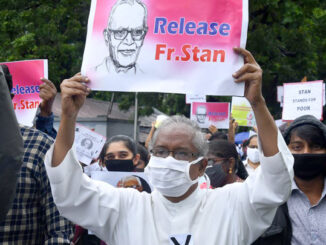
    At a raid on Bagaicha, the training center and home of Jesuit priest and activist Father Stan Swamy in Ranchi, in August, 2018, the Pune police told him that he was a suspect in the Bhima Koregaon case. This shocked him, recalls Prakash Louis who has put together details of Swamy’s subsequent arrest and death in custody in a book, Fr Stan Swamy: A Maoist or A Martyr?. Swamy had never been to Bhima Koregaon nor did he have anything to do with the violence that happened on January 1, 2018, when Dalits had gathered to commemorate the 200th anniversary of the Battle of Bhima Koregaon.

    “They seized my laptop, mobile and sim card, some CDs and some documents lying on my table,” he recalled. The raid was to change the octogenarian’s life. Arrested in October 2020, he was to die in judicial custody on July 5, 2021. He faced multiple accusations of involvement in the Bhima Koregaon incident besides alleged Maoist links. There were reports that Swamy was being denied basic human rights in jail, including the use of a sipper — he was suffering from Parkinson’s disease.

    Fr Stan Swamy: A Maoist or A Martyr

    Louis’s book, which is being translated into many Indian languages, asks questions not just about the Bhima Koregaon arrests but the larger issue of how and why a man, whose death in judicial custody is considered by many to be an institutional murder, came to be called a Maoist in some government circles. In 2021, after his passing, The Indian Social Institute, Bengaluru, where Swamy had worked for years, published I am not a Silent Spectator, an autobiographical fragment by Stan Swamy, where he reflects on his life and work, and also his time in prison.

    Arrests, and after
    In her new book, Alpa Shah, professor of anthropology at the London School of Economics, provides details of arrests of activists, from Rony Wilson, Sudhir Dhawale and Surendra Gadling to Shoma Sen — who has just got bail after six years in jail without trial — and Mahesh Raut. Then came the arrests of Sudha Bharadwaj, Arun Ferreira and Vernon Gonsalves followed by those of Gautam Navlakha, Anand Teltumbde, Hany Babu and Swamy etc. In The Incarcerations: Bhima Koregaon and the Search for Democracy in India, Shah outlines how 16 human rights defenders, whom she calls the BK 16, including academics, activists, lawyers and poets, were imprisoned for years without credible evidence, and dubbed Maoist terrorists/’urban Naxals’. She goes on to write about the role of the police in hacking into the computers of at least three of the accused — Swamy, Wilson and Gadling.

    Patiently, Shah unravels how these alleged terrorists were charged with inciting violence at a commemoration in January 2018, accused of waging a war against the Indian state and plotting to kill the Prime Minister. “The BK case is a bellwether for the collapse of democracy because, for the first time in Indian history, there is a multi-pronged coordinated nationwide persecution of these custodians of democracy. This goes well beyond the routine forms of anti-journalistic, anti-activist action taken by the state in the past. The BK case shows that the ritual of elections hides the rise of authoritarianism. It exposes the brutal state-sponsored abuse of democratic rights taking place across India with complete impunity.”

    Indeed, when the arrests of noted human rights defenders took place, civil society was alarmed, and some took recourse to the judiciary. The Booker Prize-winning novelist Arundhati Roy drew attention to the Emergency-like condition, stating, “In the India of today, to belong to a minority is a crime. To be murdered is a crime. To be lynched is a crime. To be poor is a crime. To defend the poor is to plot to overthrow the government.” Historian Romila Thapar went to court, stating, “Our intention was to draw the attention of the judiciary to what we see is a case of a gross misuse of the state’s power under the draconian law of the UAPA (Unlawful Activities Prevention Act).”

    Two of the three Supreme Court judges rejected Prof Thapar’s petition, with a dissenting note by Justice D.Y. Chandrachud. He wrote in his judgment, “Circumstances have been drawn to our notice to cast a cloud on whether the Maharashtra Police has in the present case acted as a fair and impartial investigating agency….Liberty cannot be sacrificed at the altar of conjectures…Voices of opposition cannot be muzzled because it’s a dissent. Dissent is the safety valve of democracy. If dissent is not allowed, then the pressure cooker may burst.”

    Prison diaries
    The BK 16 case is bleak, but there are some moments of light in the darkness. The arrests of accomplished academics and lawyers give us an insight into the conditions of prisons besides the heart-warming ground reality of common people building bonds beyond social barriers. Recalling her days in prison, Sudha Bharadwaj penned From Phansi Yard, which brings many human stories together. The book has sketches and notes about 76 prisoners or groups of prisoners with whom Bharadwaj interacted during her time at Yerwada and Byculla jails. Through the stories of prisoners unconnected with the BK case, Bharadwaj threw light on how women helped women in prisons, that even in times of acute distress, they looked out for those in more dire circumstances.

    The BK 16 case is a warning to the dangers facing Indian democracy. As Christophe Jaffrelot writes in his endorsement for Shah’s book, “A poignant biography of the Bhima Koregaon accused, Shah’s book uses this entry point to make us understand what post-democracy India is fast becoming, and how those who resist suffer — be they in jail or out.”

    (Ziya Us Salam is an Indian Author, critic, journalist, social commentator)

  • Draupadi Murmu: will she be the guardian of Adivasi interests?

    Draupadi Murmu: will she be the guardian of Adivasi interests?

    “Apart from all the political maneuvering, one needs to look at the story of the Adivasis and make one’s own conclusions whether this nomination by BJP is part of a genuine effort to recognize the aspirations of a backward community or simply a charade slyly weaponizing its diversity, equity, and inclusion program. The upper caste politics have long realized that they can no longer control the people under ‘Chaturvarnya,’ the caste system. Today’s Hindutva agenda includes carefully crafted strategies to attract Scheduled Castes and Scheduled Tribes into their fold.”

    By George Abraham
    By  George Abraham

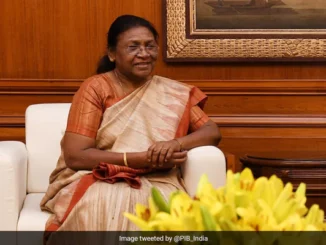
    It is almost a foregone conclusion that Draupadi Murmu will be the next President of India. She belongs to the Scheduled Tribes and hails from the Santhal community in the district of Mayurbhanj in Odisha. When elected, she will be the first tribal woman to be the President of India. It is indeed a triumph for the community, and she deserves all the accolades that come her way. However, one cannot help but be dismayed by the blatant politics the BJP has employed to elect their favored candidate. BJP clearly lacked the necessary votes to elect someone outright. It is believed that they might be short of 2% votes to get their candidate over the hump. In the meantime, the divided opposition parties tried to line up behind a single candidate. A united opposition might have thwarted the BJP’s desire not to have a consensus candidate. However, with the selection of Murmu, the BJP appeared to have outplayed the opposition.

    The selection of a Tribal candidate has just disarmed the opposition and has placed them in a precarious position, where any criticism could be construed as anti-tribal, anti-woman, or even anti-poor. Biju Janata Dal (BJD)  has declared their early support stating that Murmu belongs to Odisha while expressing their pride and joy on the nomination. The selection has forced the Jharkhand Mukti Morcha (JMM) Hemant Soren to announce support for Draupadi Murmu, calling it a proud moment for tribals. Even Mamata Banerjee’s commitment to the opposition unity in this regard may be in doubt. As the opposition is in disarray and the support for Yashwant Sinha is fast vanishing,  the die is cast that she will emerge victorious on the voting day. Apart from all the political maneuvering, one needs to look at the story of the Adivasis and make one’s own conclusions whether this nomination by BJP is part of a genuine effort to recognize the aspirations of a backward community or simply a charade slyly weaponizing its diversity, equity, and inclusion program. The upper caste politics have long realized that they can no longer control the people under ‘Chaturvarnya,’ the caste system. Today’s Hindutva agenda includes carefully crafted strategies to attract Scheduled Castes and Scheduled Tribes into their fold.

    Sri Aurobindo’s lights on the system of Indian culture compiled the following, “There are, first and highest, the man of learning and thought and knowledge; next, the man of power and action, ruler, warrior, leader, administrator; third in the scale, the economic man, producer and wealth-getter, the merchant, artisan, cultivator: these were the twice-born, who received the initiation, Brahmin, Kshatriya, Vaishya. Last came the more undeveloped human type, not yet fit for these steps of the scale, unintellectual, without force, incapable of creation or intelligent production, the man fit only for unskilled labor and menial service, the Shudra.” The BJP certainly realizes that they need the votes of the last category to attain and keep them in power. That begs the question of whether the RSS-BJP’s effort is simply vote-bank politics or points to a genuine transformation from their original feudalistic-caste designs. Their record speaks an entirely different story. BJP’s idea of “sabka Saath, sabka vikas” runs entirely contrary to the tribal interests and their wellbeing as they are repeatedly told they must sacrifice their lands and resources for other people’s vikas. Media reports state that under the BJP rule in Chhattisgarh, 2003-18, villages were burnt, and thousands were killed in Salwa Judum and subsequent operations. The forest act of 2006 has been further diluted by the Modi regime, making the Scheduled tribe consent the last requirement for forest diversion to industry rather than the first.

    For  long the Modi Government has wanted to diminish these rights in favor of corporates or other vested interests. In May 2016, the BJP Government passed two legislations that enabled the transfer of tribal land to commercial interests. That legislation set in motion a struggle (Pathalgadi movement) between the tribal people and the government, resulting in a brutal crackdown by the authorities. Moreover, the movement was branded as anti-national, and hundreds of people were arrested and charged under the sedition laws. The government went a step further and linked the movement to ‘Maoists,’ which is labeled as anti-national and dedicated to the overthrow of the elected governments.

    At this point, it is worth remembering the late Fr. Stan Swamy, who has been a vocal critic of the government policies and defender of the tribal rights over these lands. Sadly, he died in prison awaiting trial, being charged with plotting the government’s violent overthrow. To bolster their case, NIA, in their charge sheet, accused Fr. Stan as responsible for the violence in Bhima Koregaon in Maharashtra in 2017. He was not present at the rally celebrating British and Dalit forces’ victory over Brahmin Peshwas. Bhima Koregaon was an incident where Dalits were taught another lesson for daring such a celebration.

    Historically, the BJP/RSS strategy resisted real enlightenment for the oppressed people. The feudalistic and casteist mindset under which they operate detests any individual or group that educates and inspires people from those impoverished conditions of their rights and privileges. Their anti-conversion campaign is often seen as camouflage to prevent the Tribal population from ever learning of their true worth as human beings but condemning them forever in a subservient role to the upper echelons of society. What Fr. Stan has done was to help this vulnerable population demand equal justice and freedom from servitude.

    The RSS also refuses to recognize the Adivasi religion as distinct and deserving of the nation’s respect. Those who have been converted to Christianity often suffer attacks on their worship places. What happened to Fr. Stan Swamy is a harsh reality in today’s India and a lesson to anyone who dares to defend the rights of the Adivasis. Some would argue that RSS fronts like Vanavasi Kalyan and Vidya Bharati run schools filling a critical need. But in the process, the Adivasi children are converted into Hindutva followers and foot soldiers against Muslims and Christians, as in Gujarat in 2002 and Kandhamal, Odisha, in 2008, respectively. It has also been said that Adivasis in prisons are much higher than their percentage of the population.

    To her credit, as Governor of Jharkhand, Murmu returned bills proposed by the BJP government that aimed at changing the land tenure legislation – CNTA (Chhota Nagpur  Tenancy Act) and SPTA (Santhal Pargana Tenancy Act), which were intended to make it easier to take over the Adivasi land. However, under apparent pressure, she passed the anti-Adivasi changes in the Land Acquisition Act and the Freedom of Religion bill 2017, which criminalizes conversion. She appeared to be only a pawn in the BJP’s political game than a conscientious defender of the rights of her own people. Fr. Stan Swamy may not belong to the Adivasis; however, his legacy in defense of those impoverished and defenseless people will outshine forever any tokenism employed by the current regime.

    (The author is a former Chief Technology Officer, the  United Nations, and is Vice Chairman of the Indian Overseas Congress USA. He can be reached at gta777@gmail.com)

  • “In death, Fr. Stan Swamy’s voice is even stronger’ – Father Noby Ayyaneth

    “In death, Fr. Stan Swamy’s voice is even stronger’ – Father Noby Ayyaneth

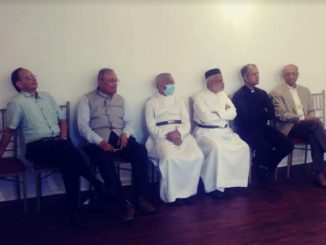
    Mohinder Singh Gilzian, Father Noby Ayyaneth, Dr. Surinder Malhotra, George Abraham
    Prof. Indrajit Saluja, Varghese Abraham, Leela Maret

    NEW YORK (TIP): “Living Stan was a nobleman, but the departed Stan is unstoppable and his voice on behalf of the poor and the downtrodden is even stronger and will resonate it throughout history,” said Father Noby Ayyaneth of the Malankara Catholic Diocese of North America condoling the death of Father Stan Swamy at a remembrance meeting organized under the banner of Indo-US Democracy Foundation in Floral Park, New York. Jesus Christ was a master humanitarian, and Fr. Stan was following in his master’s footsteps. For him, suffering was not a tragedy in the face of injustice and as he could not be a silent spectator”.

    Mr. George Abraham, Executive Director of the India-US Democracy Foundation, welcomed the gathering and stated ‘it is a dark day for democracy in India and Father Stan Swamy’s detention, treatment in prison and death is a blot on the nation’s consciousness and a travesty of justice. He expressed his disappointment that in today’s India, the presumption of innocence is becoming a thing of the past. India is about to celebrate its 75th Independence Day, and our founding fathers built democratic institutions that stood the test of time and protected democracy, freedom, individual liberty, and equal justice under law. However, these institutions are increasingly under attack and are being diminished. Today, anyone who dares to criticize the authorities is in danger of being termed anti-national.

    Professor Indrajit Saluja, Publisher of Indian Panorama Newspaper, said Father Stan Swamy was a frail and weak man physically but strong morally and spiritually to carry on with his work on behalf of the weaker sections of society. As Indian Americans, we must demand our politicos to speak out when authorities target the poor and downtrodden in India. UAPA is a draconian law that the Supreme Court should have reviewed, and it is a shame that an innocent man had to pay with his life this way.

    Pastor Wilson Jose, Pastor of the Grace International Church in Mineola, said while we have gathered here to celebrate Father Stan’s life, we would like to express our indignation as Pravasis, the way the political leaders and the judiciary treated him in India. Father Stan represented Christ’s teachings to its core and did his best to uplift the neglected ones by a caste system that is in place over centuries. Jesus said, love your enemies and pray for those who persecute you, and Fr. Stan’s life exemplified those principles. During the freedom struggle, Mahatma Gandhi was jailed many times by the British authorities. However, they respected his ideals and made sure no harm happened to him. Sadly today, the Government of India lacks even that basic level of humanity in the treatment of its own citizens!

    Father John Thomas of Orthodox Church pondered what it would be like if any one of us would be in Fr. Stan’s shoes. Will we get intimidated or pull back? Father Stan’s life is a testament to all of us and should inspire us to stand up and fight for what is right.

    Father P.M. Thomas, Vicar-in-charge of Marthoma Church in Queens Village, said Father Stan’s passing had created a big void, and each of us has a role to play in continuing his work. He asked not to be discouraged but to continue the fight until the truth is revealed.

    Mr. Amir Rashid, Director at NYPD who hails from Bihar, described the hardships the marginalized people suffer at the powerful hands in States like Jharkhand. Father Stan Swamy was the voice for the voiceless, and as long as this same power structure exists, these injustices will continue to be tolerated.

    Pastor Babu Thomas of IPC Hebron in Queens Village reiterated the old saying that injustice anywhere is a threat to justice everywhere. Father Stan Swamy was not a terrorist. The government knew that. His only crime was he loved the poor and served them. Unless we stand up and fight for our freedom and rights, our world will be a diminished place to live.

    Dr. Surinder Malhotra, former President of the Indian Overseas Congress described the pathetic situation in India as far as caste and religion is concerned. Unlike the United States, even for a job application, they want to know your religion. Even in our Diaspora here, they tend to ask whether he is a Hindu or a Christian, north Indian or south Indian, and such intolerance is so evident and has become part of our mindset. He condoled the death of a man who dedicated his entire life to doing good but ended up dying in custody.

    Mr. Mohinder Singh Gilzian, President of the Indian Overseas Congress, USA, said it is outrageous that a man who is working on behalf of the poor dies in Government custody. The people who are responsible for foisting false charges to imprison him should be held accountable. The UAPA act is being misused and used against people for political reasons.

    Dr. Anna George, President of the Indian Nurses’ Association in New York, called Father Stan Swamy’s imprisonment and death cruel and unusual punishment. She asked for raising our collective voices to stop this from happening again.

    Mr. Koshy Thomas, who ran for the NYC Council from District 23, expressed his sorrow, and asked authorities to protect  activists such as Father Stan while respecting the human rights of every citizen in India regardless of their religion or caste.

    Mr. John Joseph, the Vice-President of the Indian overseas Congress, urged not to be silent on these ongoing atrocities by the authorities. Is India a real democracy? He asked the participants to be more vigilant in guarding against these Human Rights abuses.

    Mr. Shaji Karackal, National news coordinator, Harvest TV said ‘forgive us father, I am guilty and many of us are for not seeing the truth on time to come to your defense”. Father Stan Swamy will be remembered as a nobleman who stood up for the poor and marginalized.

    Mr. George Chacko also spoke. Mr. Varhgese Abraham thanked everyone for their attendance and paid tribute to the memory of this great soul, Father Stan Swamy. Mr. Shaji Ennasseril (solidactionstudio.com) provided the logistics.

    (Based on a press release)

  • Is India’s social justice paradigm under threat?

    Is India’s social justice paradigm under threat?

    Sudha Bharadwaj
    By George Abraham

    Stories of Fr. Stan Swamy and Sudha Bharadwaj


    “These two cases illustrate that India’s social justice paradigm is in danger. The regressive forces are busy staging a counter-revolution to destroy the social justice pillars: Freedom, Equality, Justice, and fraternity. Fr. Stan Swamy and Sudha Bharadwaj represent that social justice paradigm created and nurtured by modern India’s founding fathers.  To those NRIs who demonstrated in the Streets in the U.S fighting for the release of Arnab Goswami, an arrogant exclusionist, may I say that your silence on the detention of Stan Swamy and Sudha Bharadwaj is quite deafening!”

    In a letter written by Fr. Stan Swamy SJ, from the prison, said, “Dear friends: Peace! Though I do not have many details, from what I have heard, I am grateful to all of you for expressing your solidarity support. I am in a cell approximately 13 feet x 8 feet, along with two more inmates. It has a small bathroom and a toilet with an Indian commode. Fortunately, I am given a western commode chair. Varavara Rao, Vernon Gonsalves, and Arun Ferreira are in another cell. During the day, when cells and barracks are opened, we meet with each other. From 5.30 pm to 06.00 am and 12 noon to 03.00 pm, I am locked up in my cell with two inmates. Arun assists me to have my breakfast and lunch. Vernon helps me with bath. My two inmates help during supper in washing my clothes and give massage to my knee joints. They are from very poor families. Please remember my inmates and my colleagues in your prayers. Despite all odds, humanity is bubbling in Taloja prison.” One may genuinely wonder why this 83-year-old Jesuit Priest afflicted with Parkinson’s disease, who has dedicated his entire life for the upliftment of the poor, is languishing in jail! What horrific deed has he committed to warrant such a treatment from the authorities?  It says a lot more about today’s political climate in India than the fate of one single old frail man who had to approach the Bombay special court for permission to use a straw and sipper cup because of his disability. The National Investigation Agency (NIA), which arrested Mr. Fr. Stan, has sought 20 days’ time from the court to respond! There is truly little doubt that his arrest is a political witch hunt. He is known for his staunch defense on behalf of the indigenous tribal people across the tribal belt and advocated fiercely for their land rights. His work in terms of educating people about their rights and helping to pass laws to protect the land rights of the tribal population is quite phenomenal. Article 13 (3) (a) of the Indian constitution empowers the tribal people to assert their traditional self-rule in those areas inhabited by them. These constitutional provisions are remarkably like the treaties governing Indian reservations in the United States.

    For long, the Modi Government has wanted to diminish these rights in favor of corporates or other vested interests. In May 2016, the BJP Government passed two legislations that enabled the transfer of tribal land to commercial interests.  That legislation set in motion a struggle (Pathalgadi movement) between the tribal people and the government, resulting in a brutal crackdown by the authorities. Moreover, the movement was branded as anti-national, and hundreds of people were arrested and charged under the sedition laws.

    The government went another step further and linked the movement to ‘Maoists,’ which is labeled as anti-national and dedicated to the overthrow of the elected governments. Fr. Stan, who has been a vocal critic of the government policies and defender of the tribal rights over these lands, was also charged with plotting the government’s violent overthrow.  To bolster their case, NIA, in their charge sheet, accused Fr. Stan as responsible for the violence in Bhima Koregaon in Maharashtra in 2017. He was not present in the rally celebrating British and Dalit forces’ victory over Brahmin Peshwas.

    Historically, the BJP/RSS strategy resisted real enlightenment for the oppressed people. The feudalistic and casteist mindset under which they operate detests any individual or group that educates and inspires people from those impoverished conditions of their rights and privileges. Their anti-conversion campaign is often seen as camouflage to prevent the Tribal population like this one in Chhattisgarh ever learning of their true worth as human beings but condemning them forever in a subservient role to the upper echelons of society. What Fr. Stan has done was to help this vulnerable population demand equal justice and freedom from servitude.

    Unfortunately, it is a Jesuit priest, and any person in India, whether journalists, writers, artists, religious leaders, students, or even politicians, can be branded as anti-nationals or terrorists if they dare to speak out against Prime Minister Modi or the BJP government’s crony capitalist policies.  A common tactic is to brand all peace activists as a front inspired by ‘Maoists’ or Christian missionaries. By arresting Fr. Stan, they are also conveying a message that even a Church can be branded as anti-national to the great delight of the Sangh Parivar organizations.


    This branding is quite expansive now as we learn that 13th February 2021 marks the civil rights lawyer and activist Sudha Bharadwaj’s 900 days in detention. She took cases that many other attorneys refused to touch and represented workers wrongfully dismissed by companies, illegally evicted villagers from their land, and women who alleged sexual assault by security forces.

    According to a Washington Post report, Police raided her house and took computers and phones, and demanded passwords for email accounts. Then they arrested Bharadwaj under an anti-terrorism statute accusing her of a plot to commit violent actions. Since 2018, Sudha and 15 other activists, writers, and lawyers have been arrested under the draconian Unlawful Activities Prevention Act (UAPA) and accused them of having links with the ‘Maoist’ group.  In a charge filed remarkably similar to Fr. Stan’s, it has been alleged that she and other human rights defenders conspired to incite Dalits in Bhima Koregaon village in Pune, Maharashtra. It fits a pattern now where many people across the country are getting arrested who are either critics of the government policies or outspoken advocates for India’s most disadvantaged, whether they are indigenous tribal peoples or Dalits.


    Born in Boston to a distinguished economist, she went to IIT Kanpur to study Mathematics. Later, she moved to an iron mining ore town in Chhattisgarh and supported worker’s rights and safety while challenging land acquisition by major corporations and seeking justice for extrajudicial killings by police officers.  Bharadwaj has denied the charges and said it was “totally concocted’. Obviously, these arrests appear to be an affront to the rule of law and infringing of the citizen’s constitutional rights.  It has been said that a right without a remedy is no right at all.


    According to press reports, Sudha’s health situation continues to deteriorate in prison. The 59-year-old suffers from diabetes, hypertension, and heart disease, making her susceptible to Covid-19 in the cramped prison. Her bail plea is being rejected, and she has been denied books and Newspapers in jail. Her father passed away during her time in jail. In January, the UN Human Rights office expressed serious concern about the human rights defenders’ detention and urged the Indian authorities to immediately release the detainees. According to Michele Bachelet, the UNHCHR commissioner expressed concern over using ‘vaguely defined laws’ to silence activists and government critics.

    These two cases illustrate that India’s social justice paradigm is in danger. The regressive forces are busy staging a counter-revolution to destroy the social justice pillars: Freedom, Equality, Justice, and fraternity. Fr. Stan Swamy and Sudha Bharadwaj represent that social justice paradigm created and nurtured by modern India’s founding fathers.  To those NRIs who demonstrated in the Streets in the U.S fighting for the release of Arnab Goswami, an arrogant exclusionist, may I say that your silence on the detention of Stan Swamy and Sudha Bharadwaj is quite deafening!

    (Author is a former Chief Technology officer of the United Nations)