Tag: French President Emmanuel Macron

  • French President Emmanuel Macron, the chief guest at India’s 75th c celebrations

    French President Emmanuel Macron, the chief guest at India’s 75th c celebrations

    French President Emmanuel Macron is the chief guest at the 75th Republic Day celebrations that is taking place in all its glory today, January 26, 2024. A day earlier the French President arrived in India but his first stop was the Pink City of Jaipur in Rajasthan. Later at night, he arrived in the capital Delhi, where the grand Republic Day parade takes place. Macron’s visit marks a unique reciprocal exchange following Prime Minister Narendra Modi’s visit to France on its National Day in July 2023.
    According to sources, in Delhi, the French President is staying at the luxury hotel ITC Maurya. He is reportedly staying on the Grand Presidential Floor of the hotel, where US Presidents Barack Obama and Donald Trump have also stayed in the past. According to hotel sources, French President Macron is extremely warm and has a friendly demeanour. Even though he arrived at the hotel late at night, he warmly greeted the hotel staff and was all smiles.
    Earlier in the day, Macron called Prime Minister Narendra Modi a dear friend, Macron took to X to post, “My dear friend @NarendraModi, Indian people, My warmest wishes on your Republic Day. Happy and proud to be with you. Let’s celebrate!”
    This is the sixth time (the highest for any country) that a French leader is participating in India’s biggest ceremonial event. This tradition began with President Jacques Chirac in 1976, followed by Valery Giscard d’Estaing in 1980, Nicolas Sarkozy in 2008, and Francois Hollande in 2016. PM Modi and President Macron have engaged in a series of high-profile meetings throughout 2023, underscoring the strength and depth of the bilateral relationship. Their interactions have spanned various global platforms, including the COP 28 Summit in Dubai, the G20 Leaders’ Summit, and the G7 Summit in Hiroshima. Notably, President Macron was also the Guest of Honour at the Bastille Day Celebrations in France in July 2023.
    Emmanuel Macron was re-elected for the second term as the French President in 2022. He defeated his arch-rival Marine Le Pen by a significant margin. With his re-election to the office, he becomes the first French President to secure a second term for two decades.
    Emmanuel Macron was born on 21 December 1977 in Amiens to Françoise Macron and Jean-Michel Macron. His father is a professor of neurology at the University of Picardy while his mother is a physician.
    Macron did his schooling at Lycée la Providence in Amiens and Lycée Henri-IV in Paris. He holds a diploma in piano studies from Amiens Conservatory and a DEA degree in philosophy from the University of Paris-Ouest Nanterre La Défense. Macron obtained a master’s degree in Public Affairs from the Paris Institue of Political Studies and graduated from the École Nationale d’administration.
    Emmanuel Macron was appointed as a deputy secretary-general by President François Hollande after he was elected in May 2012. In 2014, Macron was appointed to the French Cabinet as the Minister of the Economy, Industry and Digital Affairs by then Prime Minister Manuel Valls. During his two-year stint in the Cabinet, he launched several business-friendly reforms.
    Emmanuel Macron resigned from the Cabinet in 2016 to run for the 2017 French Presidential election on En Marche! ticket. He won the presidential election with a 66.1% vote, thereby defeating arch-rival Marine Le Pen. He is the youngest President in the history of France.
    He was re-elected for a second term by defeating Marine Le Pen in the 2022 France Presidential Election. With this, he became the first person in the history of France to be re-elected as the President.
    During his stint as French President, Emmanuel Macron has brought about several reforms in labour laws, taxation, pensions and a transition to renewable energy.
    He has led the response to the COVID-19 pandemic, and the vaccination drive. He has inked several bilateral treaties with countries such as Italy and Germany and called for reforms to the European Union. He oversaw the dispute between Australia and US over the trilateral AUKUS security pact.
    Under his leadership, France continued its involvement in the Syrian civil war and is in solidarity with Ukraine to help Russian de-escalation.
    Emmanuel Macron Wife and Children
    Emmanuel is married to his former teacher Brigitte Trogneux. The two met at the theatre workshop where Trogneux was the trainer. At that time, Macron was 15-year-old while his teacher was 39-year-old. Macron’s parents initially attempted to separate the two by sending their ward to Paris for his final year of schooling. However, after his graduation, the couple reunited and hitched in 2017.
    Brigitte Trogneux has three children from her previous marriage and Macron doesn’t have a child of his own. During the 2017 presidential campaign, Trogneux helped Macron in improving his public speaking skills.

  • The French Connections

    The French Connections

    The Macron visit underlined the growing strategic convergence that draws India and France together

    By Rakesh Sood
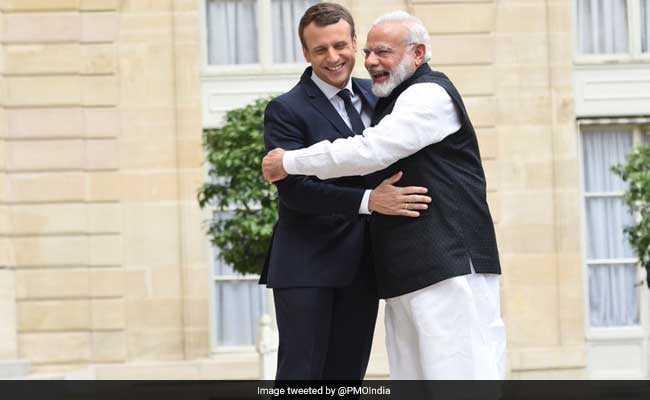
    The slew of bilateral agreements and memoranda of understanding signed, the detailed ‘joint statement’ and accompanying ‘vision statements’ on cooperation in space and the Indian Ocean Region, the boat ride in Varanasi, and Prime Minister Narendra Modi’s warmly reciprocated diplohugs indicate that the relationship has received a momentum that gives it critical mass and greater coherence, says the author.

    With French President Emmanuel Macron’s recent visit to India, the India-France Strategic Partnership launched in 1998 seems finally to have come of age. In these two decades, both sides have gradually enhanced cooperation in diverse fields covering civil nuclear, defense, space, counter-terrorism, education, research and development in science and technology, culture, urban development, climate change, trade and economics and people-to-people contacts. The slew of bilateral agreements and memoranda of understanding signed, the detailed ‘joint statement’ and accompanying ‘vision statements’ on cooperation in space and the Indian Ocean Region, the boat ride in Varanasi, and Prime Minister Narendra Modi’s warmly reciprocated diplohugs indicate that the relationship has received a momentum that gives it critical mass and greater coherence.

     A shared worldview

    As a country that has prided itself on its ‘exceptionalism’, France has always been sympathetic to similar Indian claims based on its ancient civilization. This is why both countries were quick to voice support for global multi-polarity once the Cold War ended. French discomfort with the U.S.’s unipolar moment in the 1990s was evident when it described it as a ‘hyperpower’.

    Defense cooperation with France began in the 1950s when India acquired the Ouragan aircraft and continued with the Mystères, Jaguar (Anglo-French), Mirage 2000, Alizè planes and the Alouette helicopter. Joint naval exercises, later christened Varuna, date back to 1983.

    Cooperation in the space sector has continued since the 1960s when France helped India set up the Sriharikota launch site, followed by liquid engine development and hosting of payloads. Today, it is a relationship of near equals and the ‘vision statement’ refers to world class joint missions for space situational awareness, high resolution earth observation missions with applications in meteorology, oceanography and cartography. Inter-planetary exploration and space transportation systems are cutting edge science and technology areas that have also been identified.

    Yet the Cold War imposed limitations on the partnership. After the Cold War, France decided that its preferred partner in the Indian Ocean Region would be India. In January 1998, President Jacques Chirac declared that India’s exclusion from the global nuclear order was an anomaly that needed to be rectified. After the nuclear tests in May 1998 when India declared itself a nuclear weapon state, France was the first major power to open dialogue and displayed a far greater understanding of India’s security compulsions compared to other countries. It was the first P-5 country to support India’s claim for a permanent seat in an expanded and reformed UN Security Council.

     Building a partnership

    With the establishment of a Strategic Dialogue, cooperation in defense, civil nuclear, space, intelligence sharing, and counter-terrorism has grown. An agreement for building six Scorpène submarines in India with French help was signed in 2005. Similarly, technology sharing, and acquisitions of short range missiles and radar equipment were concluded. Joint exercises between the air forces and the armies were instituted in 2003 and 2011, respectively. The government-to-government agreement for 36 Rafale aircraft, salvaged out of the prolonged negotiations for the original 126 which were at an impasse, was as much driven by technical requirements as by political considerations. The ambitious offset target of 50% (nearly ₹25,000 crore), properly implemented, can help in building up India’s budding aerospace industry.

    In the nuclear field, an agreement was signed about a decade ago for building six EPR nuclear power reactors with a total capacity of 9.6 GW for which negotiations have been ongoing between the Nuclear Power Corporation of India (NPCIL) and Areva, and now EdF. Terror strikes in France in recent years by home-grown terrorists have enlarged the scope of counter-terrorism cooperation to include cyber security and discussions on radicalization.

    Even though these areas provided a robust basis for engagement, it remained primarily at a government-to-government level. In recent years, it was clear that for a wider partnership, strengthening business-to-business and people-to-people relationships was essential. Climate change and renewable energy resources, particularly solar, soon emerged as a new plank, reflected in the multilateral initiative of the International Solar Alliance. Another area identified was urban planning and management of services like housing, transport, water, sanitation, etc. using the public private partnership model which the French have employed successfully. Mr. Macron’s visit has enabled progress to be registered across a variety of sectors including the strategic partnership areas.

    There has been a growing convergence of interests in maritime cooperation. Like India, France has expressed concern about China’s growing presence in the Indian Ocean Region. French overseas territories in the Indian and the Pacific Oceans provide it with the second largest exclusive economic zone globally. It has long maintained bases in Reunion Islands and Djibouti and established one in Abu Dhabi in 2009. This regional dimension is reflected in the Vision Statement on cooperation in the Indian Ocean Region.

    The signing of MoUs regarding the provision of reciprocal logistics support to each other’s armed forces, exchange and reciprocal protection of classified information and developing shared space studies and assets for maritime awareness provide the basis on which to strengthen joint naval exercises. With the U.S., naval cooperation has been easier with the Pacific Command which covers China and the region up to the Bay of Bengal but more difficult with the Central Command which covers western Indian Ocean and the Arabian Sea because of Central Command’s privileged relationship with Pakistan. Therefore, strengthening cooperation with France, particularly in the western Indian Ocean Region makes eminent strategic sense even as India develops its presence in Oman (Duqm) and Seychelles (Assumption Island).

    The agreement on the industrial way forward between NPCIL and EdF affirms that work at Jaitapur will commence before the end of 2018. Equally significant are the two agreements signed between EdF and other French entities and L&T and Reliance, respectively, reflecting the engagement of Indian industry.

    Trade has grown in recent years but at $10 billion is half of the trade with Germany. The signing of nearly $16 billion worth of agreements at the business summit indicates that private sectors in both countries are beginning to take notice. There are nearly 1,000 French companies present in India including 39 of the CAC 40 while over a hundred Indian businesses have established a presence in France. In the past, Indian companies saw the U.K. as the entry point for Europe; now with Brexit approaching, Mr. Macron has cleverly pitched that India should look at France as its entry point for Europe and Francophonie! The flagship program of Smart Cities in which France is focusing on Chandigarh, Nagpur and Puducherry is taking shape as more than half the business agreements signed related to electric mobility, water supply, waste management and smart grids.

     Educational links

    Potentially, the most significant was the focus on youth and student exchanges. Currently about 2,500 Indians go to France annually to pursue higher education, compared to more than 250,000 from China. A target has been set to raise it to 10,000 by 2020. The agreement on mutual recognition of academic degrees and the follow-on Knowledge Summit, where 14 MoUs between educational and scientific institutions were signed, is a welcome move.

    Tourism is another area that has received attention. A target of a million Indian tourists and 335,000 French tourists has been set for 2020. Given that France receives over 80 million tourists a year and India around nine million, these targets may seem modest but reflect that while there are only about 20 flights a week between India and France, there are four times as many to Germany and 10 times as many to the U.K.

    The Strategic Partnership has already created a solid foundation; other aspects have now received the much needed focus and with proper implementation, it can add to the growing strategic convergence that draws India and France together.

    (The author is a former Ambassador to France and currently Distinguished Fellow at the Observer Research Foundation. E-mail: rakeshsood2001@yahoo.com)