Tag: Fumio Kishida

  • Biden to host QUAD summit at his Delaware home on September 21

    Biden to host QUAD summit at his Delaware home on September 21

    The Summit will focus on bolstering the strategic convergence among member nations

    WASHINGTON, D.C. (TIP): US President Joe Biden will host the fourth in-person Quad Leaders summit at his Delaware home next week, in a rare gesture for his counterparts from Australia, India and Japan, a presidential spokesperson announced Thursday. India, which was scheduled to host QUAD this year, would host the summit next year. QUAD leadership summit is an initiative of Biden and is one of the key foreign policy legacies for the outgoing American president.

    “President Joseph R. Biden, Jr. will host the fourth in-person Quad Leaders Summit in Wilmington, Delaware, on Saturday, September 21. The President looks forward to welcoming Prime Minister Anthony Albanese of Australia, Prime Minister Narendra Modi of India, and Prime Minister Kishida Fumio of Japan,” White House Press Secretary Karine Jean-Pierre said.

    “This will be President Biden’s first time hosting foreign leaders in Wilmington as president — a reflection of his deep personal relationships with each of the Quad Leaders, and the importance of the Quad to all of our countries,” she said. QUAD is a diplomatic partnership between four countries–Australia, India, Japan, and the United States.

    The Biden-Harris administration has elevated and institutionalized the Quad as a top priority, from the first-ever Quad Leaders Summit at the White House in 2021 to annual Summits since then.

    In recent years, Quad Foreign Ministers have met eight times, and Quad governments continue to meet and coordinate at all levels, she said.

    “The Quad Leaders Summit will focus on bolstering the strategic convergence among our countries, advancing our shared vision of a free and open Indo-Pacific region, and delivering concrete benefits for partners in the Indo-Pacific in key areas. These include health security, natural disaster response, maritime security, high-quality infrastructure, critical and emerging technology, climate and clean energy, and cybersecurity,” Jean-Pierre said.
    (Source: PTI)

  • Leaders of South Korea, China and Japan will meet next week for the first time since 2019

    Leaders of South Korea, China and Japan will meet next week for the first time since 2019

    SEOUL (TIP): Leaders of South Korea, China and Japan will meet next week in Seoul for their first trilateral talks in more than four years, South Korea’s presidential office announced May 23.
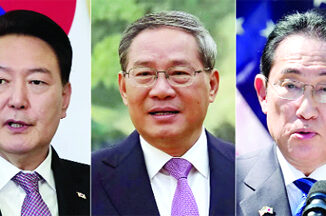
    The trilateral summit among South Korean President Yoon Suk Yeol, Chinese Premier Li Qiang and Japanese Prime Minister Fumio Kishida will take place in Seoul on Monday, Yoon’s presidential office said.
    The three leaders were scheduled to hold bilateral talks among themselves on Sunday, according to the South Korean presidential office.
    Since their inaugural stand-alone trilateral summit in 2008, the three Asian countries were supposed to hold such a meeting among their leaders each year. But the summit has been suspended since they were last held in December 2019 in China.
    Efforts to boost cooperation among the Asian neighbors often hit snags because of a mix of issues, including historical disputes stemming from Japan’s wartime aggression and the strategic competition between China and the United States.
    Ties between South Korea and Japan deteriorated severely due to issues originating from Japan’s 1910-45 colonization of the Korean Peninsula. But their relations warmed significantly since 2023 as the two countries took a series of major steps to move beyond that history and boost cooperation in the face of North Korea’s advancing nuclear program and other shared challenges.
    North Korea’s growing arsenal of nuclear-capable missiles poses a major security threat to South Korea and Japan. But China, North Korea’s last major ally and biggest source of aid, is suspected of avoiding fully enforcing United Nations sanctions on North Korea and shipping covert assistance to help. (AP)

  • US, South Korea, Japan set to deepen military ties

    US, South Korea, Japan set to deepen military ties

    Agree on security pledge ahead of Camp David summit

    WASHINGTON, D.C. (TIP): The United States, Japan and South Korea are set to sign on to a new security pledge, committing the three countries to consult with each other in the event of a security crisis or threat in the Pacific, according to Biden administration officials.

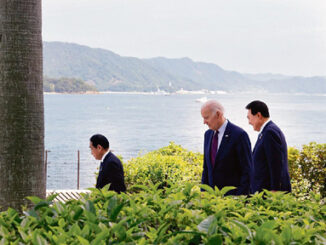
    Details about the new “duty to consult” commitment emerged as President Joe Biden prepared Friday to welcome South Korean President Yoon Suk Yeol and Japanese Prime Minister Fumio Kishida for a summit at the Camp David presidential retreat in Maryland.

    The move is one of several joint efforts that the leaders are expected to announce at the daylong summit, as the three countries look to tighten security and economic ties amid increasing concerns about North Korea’s persistent nuclear threats and Chinese provocations in the Pacific.

    Kishida, before departing Tokyo, told reporters the summit would be a “historic occasion”.
    (Source: PTI)

  • India is ready, Japan to take a call on expanding defence cooperation

    India is ready, Japan to take a call on expanding defence cooperation

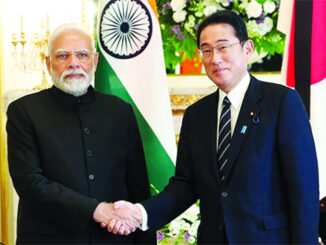
    New Delhi (TIP)- Japan Prime Minister Fumio Kishida will have a full plate in the Capital next Monday with Indo-Pacific, QUAD summit and G7-G20 on the agenda when he meets Prime Minister Narendra Modi.
    The Japanese view on the Indo-Pacific and on expanding ties with India will be revealed when PM Kishida delivers a lecture on bilateral relations at the Sushma Swaraj Institute on March 20. Japan will host the G-7 summit in Kishida’s constituency Hiroshima on May 19-21, which will be attended by PM Modi with the QUAD summit in Sydney taking place the same month.
    New Delhi will be hosting the SCO Summit on July 4 with G-20 Summit scheduled for September this year.
    While the Chinese belligerents in the Indo-Pacific with Beijing having military friction with Tokyo over Senkaku Islands and in East Ladakh with India on top of the agenda, PM Modi and PM Kishida will have a discussion on the G-7, QUAD and G-20 summits later this year. Key to these discussions will be how the two leaders are able to harmonize their positions over the Ukraine war as the impact of G-7 and QUAD summit communique will be felt on the G-20 summit being hosted by India in September this year. Japan is with the Anglo-Saxon powers over Ukraine and wants to punish Russia, India on its part wants the war to end without taking an anti-Russia stand.
    Although India and Japan have a successful economic relationship, New Delhi is looking towards Tokyo to see whether PM Kishida wants to expand the bilateral ties to security and defence sectors. Even though Japan has doubled its capital defence spending in wake of China-Russia aggression in East China Sea and Sea of Japan, the country has still to shed off its pacificist doctrine and is diffident in deepening security ties with India. The situation gets even more complicated as PM Kishida represents Hiroshima, which was nuked and destroyed by the US in World War II, in the House of Representatives.
    Even though Japan is a leader in specific defence technologies and cyber-security, PM Kishida is still mulling over whether to expand the bilateral relationship in these sectors and its impact on adversary China. From the statement emanating from Beijing on Taiwan, it is quite evident that Japan will have to be prepared for a military emergency in Taipei as some Japanese Islands in the Okinawa Prefecture are in close proximity to Taiwan.
    With Chinese President Xi Jinping expected to hold a summit with Russian President Vladimir Putin next week in Moscow, the Japanese situation will get more critical as the two “no limits allies” are already holding military exercises near Japan. While India has made up its mind over its strategic choices in a rapidly changing political world, the bilateral relations with Japan will only grow if Tokyo is clear on where it stands vis-à-vis China and Russia.
    Source: HT

  • UK, Japan sign defence deal amid China concern

    London (TIP) : The leaders of Britain and Japan are signing a defence agreement on January 11 that could see troops deployed to each others’ countries. The two countries are strengthening military ties amid growing concern about China’s increasing military assertiveness and designs toward Taiwan, which it considers a renegade province. The British government said the defence agreement “cements our commitment to the Indo-Pacific” region. It is due to be signed by Japanese Prime Minister Fumio Kishida and UK leader Rishi Sunak during a meeting in the symbolic setting of the Tower of London fortress.

    The deal has been in the works for years, and was discussed when Kishida visited Sunak’s predecessor, Boris Johnson, in London in May.

    The deal, Reciprocal Access Agreement — Japan’s first with any European nation — allows the two countries to hold joint military exercises. — AP

  • PM Modi’s mother Heeraben passes away; cremated in Gandhinagar

    PM Modi’s mother Heeraben passes away; cremated in Gandhinagar

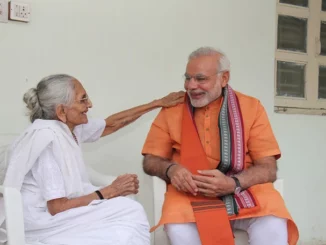
    NEW DELHI (TIP): The mortal remains of Prime Minister Narendra Modi’s mother Heeraben, who passed away here early on Friday, December 30, were consigned to flames in Gandhinagar.

    Heeraba passed away at UN Mehta Institute of Cardiology and Research Centre in Ahmedabad in the wee hours on Friday, December 30. She was 99 and was admitted to the hospital on Wednesday, December 28.

    The hospital said in a statement that she breathed her last at 3.30 am during treatment at the institute. The PM’s last meeting with his mother before she was hospitalized was on the eve of the Gujarat polls on December 4 when he went to seek her blessings in Gandhinagar. Paying tributes to his mother, the PM tweeted, “A splendid century long life has come to an end. In my mother, I saw the trinity—of a hermit, an ascetic and a life devoted to ideals.”

    Heeraba is survived by five sons—PM Modi and brothers Soma Bhai, Amrutbhai, Prahladbhai and Pankajbhai, and daughter Vasantiben. The PM and his brothers lit the pyre at their mother’s last rites in Gandhinagar. Earlier, the PM reached Ahmedabad from Delhi and went straight to the house of brother Pankaj Modi at Raysan village on Gandhinagar outskirts where the mortal remains of Heeraba were kept. After carrying the mortal remains for some distance, the PM boarded the mortuary van to accompany his mother on her last journey to the cremation ground.

    President Droupadi Murmu led the tributes to Heeraba, hailing her simple and compassionate life.

    Pakistan PM Shehbaz Sharif, Japanese PM Fumio Kishida and Israeli PM Benjamin Netanyahu also paid tributes.

    “Prime Minister Narendra Modi’s mother Heeraba’s 100 years of struggle are a symbol of Indian ideals. Shri Modi imbibed the spirit of ‘#Matradevobhav’ (Mother is God) and the values of Heeraba in his life. I pray for the peace of the holy soul (sic),” the President said. A prayer meeting in the memory of Heeraba would be held later at Vadnagar, the family’s native place. Born in Mehsana, she led an active life and often made headlines. She was seen standing in a queue to withdraw cash from an ATM after PM Modi declared demonetization in 2016. She also made news when she accepted the Covid vaccine and was a regular voter. —

    Condolences poured in from leaders across the world.

    My deepest condolences. May her soul rest in peace. — Fumio Kishida, Japanese PM

    May she rest in peace and may you find solace in her memory and the rich heritage she bequeathed to you and many others. — Benjamin Netanyahu, Israel PM

    There is no greater loss than losing one’s mother. My condolences to Prime Minister Narendra Modi. — Shehbaz Sharif, Pak PM. We have seen how instrumental her role was in every aspect of your life as a mother, motivator and mentor. — Sheikh Hasina, B’desh PM.

  • Quad makes pragmatic push to cement ties

    Quad makes pragmatic push to cement ties

    By Gurjit Singh

    “Though Biden wants Quad to look at Russia’s Ukraine invasion and North Korea’s nuclear threats, he views the Quad partnership of four major democracies in the Indo-Pacific as vital to challenge China’s growing influence in the region. The balance among these threats varies between the Quad partners.

    The Quad Summit held in Tokyo on Tuesday; May 24 was the fourth such occasion in the past two years. The four leaders met at a virtual summit in March 2021 followed by the first-ever physical summit in September 2021 in Washington DC. Thereafter, in March 2022, another virtual meeting took place, and the Tokyo physical summit of 2022 shows the quick turnaround time for Quad summits since the Biden administration took over.

    Prime Minister Narendra Modi and US President Joe Biden are seniormost among the Quad leaders, while Japanese Prime Minister Fumio Kishida is a more recent entrant. Australian Prime Minister Anthony Albanese participated in the summit soon after his election victory.

    A salient difference between the Quad summits of 2021 and 2022 is the context. Undoubtedly, the Quad assimilated to pose a challenge to China’s hegemonic intent in the Indo-Pacific. The US pivot to Asia was inadequate and required the support of like-minded and willing countries like India, Japan and Australia. While Japan and Australia are US allies, India is an important strategic partner.

    The summits of 2021 reduced the rhetoric on security and strategy and focused more on functional cooperation, particularly targeting ASEAN, whose centrality was trumpeted. It became evident that to challenge China, the main arena was the South China Sea, where China made serious inroads into fulfilling their strategic ambitions and winning over ASEAN countries with large economic cooperation. Japan was a major economic partner of ASEAN, but by itself could not match the strategic economic outreach of China and thus the Quad adjusted its positions. Since ASEAN prefers not to take sides between China and the USA, the readjustment of Quad’s public position was to bring alignment with ASEAN concerns.

    The 2021 summits focused on Covid, better health security and the Quad vaccine initiative; they also looked at the Quad Infrastructure Coordination Group, climate issues, hydrogen, education and people-to-people exchanges. Critical and emerging technology remains an important area where there is serious competition with China which leads to cybersecurity.

    The March 2022 summit convened after the Ukraine crisis, whose broader implications were discussed. The US remains keen to aggregate the Quad to provide strategic and humanitarian support to Ukraine, the same way that are planned for the Indo-Pacific. India remains lukewarm to this. The Ukraine crisis, portraying Russia as enemy number one, has the potential of derailing the concerted challenge to China in the Indo-Pacific. For India, it is not Russia but China, which is the main threat. The Indo-Pacific policies which the Quad pursues ought to remain focused on China and should cover Russia only if Russia becomes more active in this region. The convening of the fourth Quad summit in Tokyo, came on the back of the US showing more interest in the region, despite the Ukraine crisis. Biden hosted a summit with the ASEAN leaders on May 12-13 and then proceeded on a tour of South Korea, where he met the new President Yoon Suk-yeol,  and the Prime Minister of Japan. The intent was to deepen security cooperation with both and encourage them to impose further sanctions on Russia amid the Ukraine war.

    Though Biden wants Quad to look at Russia’s Ukraine invasion and North Korea’s nuclear threats, he views the Quad partnership of four major democracies in the Indo-Pacific as vital to challenge China’s growing influence in the region. The balance among these threats varies between the Quad partners.

    There are four, among many things that the Quad is coordinating on, in which India has a direct interest. To deal with Covid, the Quad vaccine initiative has already agreed to manufacturing facilities in India. There is another group dealing with decarbonized green shipping lines in the Indo-Pacific, which will use hydrogen as fuel. India with its new hydrogen policy is keen to get this technology and perhaps be a manufacturing base for hydrogen.

    Thirdly, the Quad infrastructure coordination group is looking at quality infrastructure in the region. This is again an area of Indian interest, as through this India can enhance its profile in its neighborhood. The fourth important group deals with critical technologies and cybersecurity. India has an interest in both, particularly in setting up semiconductor production in the country, to become part of an independent supply chain and not remain dependent on China-based supplies. Cybersecurity is an area of extreme importance for India. The Quad cybersecurity and semiconductor initiatives are good outcomes from the summit.

    The six major takeaways from this summit are: (i) The Indo-Pacific Partnership for Maritime Domain Awareness, which brings commitment for a faster, wider and accurate maritime awareness of almost real-time maritime movement in regional waters; (ii) Quad will seek more than $50 billion of infrastructure assistance and investment in the Indo-Pacific, over the next five years. This will keep debt stress in firm view to differentiate from the BRI; (iii) The Quad Climate Change Adaptation and Mitigation Package (Q-CHAMP) with mitigation and adaptation as its two themes was launched. Q-CHAMP includes ongoing activities under the Quad Climate Working Group on green shipping and ports aiming for a shared green corridor framework and others. Its coverage includes new cooperation in clean fuel ammonia, carbon recycling, cooperation and capacity-building support to advance high-integrity carbon markets; (iv) The Quad will increase interoperability and security through the signature of a new Memorandum of Cooperation on 5G Supplier Diversification and Open RAN (radio access networks); (v) The Common Statement of Principles on Critical Technology Supply Chains, launched at the summit, advances Quad cooperation on semiconductors and other critical technologies, providing a cooperative foundation for resilience against various risks; (vi) The Indo-Pacific Economic Framework (IPEF) has brought 13 countries together to discuss an economic future together. This is the first time India is an economic arrangement in the Indo-Pacific. It included all RCEP countries except China, Cambodia, Laos and Myanmar and adds India and the USA. Its success is that it gets seven ASEAN countries to join the consultations process.

    The Quad is on the right track and is getting better at implementing its ideas and securing adherents as well as acceptability. That is the way to challenge China’s hegemony in the region.

    (The author is a former ambassador)

  • Fumio Kishida wins vote to become Japan PM

    Fumio Kishida wins vote to become Japan PM

    “I felt our democracy is in a crisis. I am determined to make an effort towards making a more open LDP and creating a bright future for Japan” – Fumio Kishida

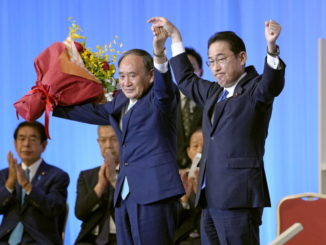
    TOKYO (TIP): Former Japanese Foreign Minister Fumio Kishida won the governing party’s leadership election on Wednesday and is set to become the next Prime Minister, facing the tasks of reviving a pandemic-hit economy and ensuring a strong alliance with Washington to counter growing regional security risks. Kishida replaces outgoing party leader PM Yoshihide Suga, who is stepping down after serving only one year. As new leader of the Liberal Democratic Party, Kishida is certain to be elected the next PM on Monday, October 4, in Parliament, where his party and its coalition partner control both Houses. In his victory speech, Kishida vowed to tackle “national crises”, including Covid-19, the pandemic-battered economy and the declining population and birthrate. He said he would pursue “important issues related to Japan’s future”.

    (Agencies)