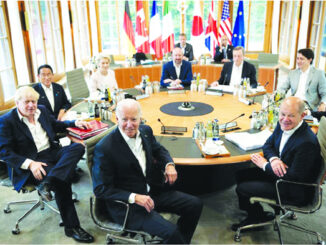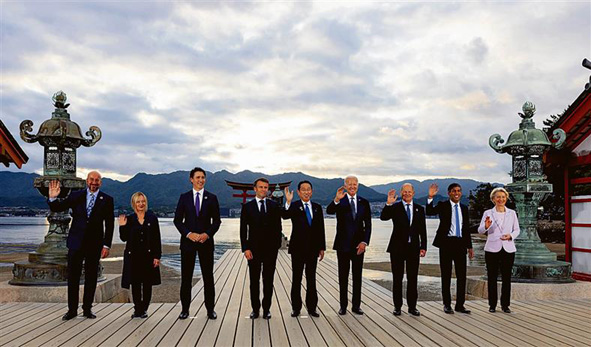
HIROSHIMA (TIP): Leaders of the Group of Seven rich nations called on Friday, May 19, for a “world without nuclear weapons”, urging Russia, Iran, China and North Korea to cease nuclear escalation and embrace non-proliferation, a statement released by the White House showed.
Russia’s nuclear rhetoric and stated intent to deploy nuclear weapons in Belarus “are dangerous and unacceptable,” and Russia should return to full implementation of New START treaty, the leaders said in the statement. The leaders also agreed on Friday to stiffen sanctions against Russia, while a draft communique to be issued after their talks in the Japanese city of Hiroshima stressed the need to reduce reliance on trade with China.
G7 leaders said they had ensured that Ukraine had the budget support it needs for this year and early 2024. “Today we are taking new steps to ensure that Russia’s illegal aggression against the sovereign state of Ukraine fails,” they said in a statement. A French government plane took Zelenskyy to the Arab League Summit in Saudi Arabia and will later take him to the G7 summit in Hiroshima, a source familiar with the matter said.
Ukraine wants its allies to be bolder in imposing sanctions on Russia, including by targeting banks that provide financial services to serving soldiers, a senior adviser said.
German Chancellor Olaf Scholz said his government wanted pragmatic measures to prevent the circumvention of sanctions imposed on Russia. G7 members are prepared to build “constructive and stable relations” with China while acting in their national interests, according to a draft version of their communique.
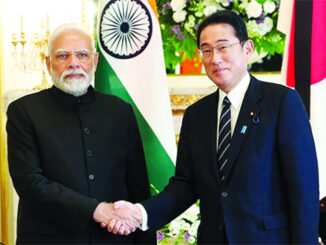
New Delhi (TIP)- Japan Prime Minister Fumio Kishida will have a full plate in the Capital next Monday with Indo-Pacific, QUAD summit and G7-G20 on the agenda when he meets Prime Minister Narendra Modi.
The Japanese view on the Indo-Pacific and on expanding ties with India will be revealed when PM Kishida delivers a lecture on bilateral relations at the Sushma Swaraj Institute on March 20. Japan will host the G-7 summit in Kishida’s constituency Hiroshima on May 19-21, which will be attended by PM Modi with the QUAD summit in Sydney taking place the same month.
New Delhi will be hosting the SCO Summit on July 4 with G-20 Summit scheduled for September this year.
While the Chinese belligerents in the Indo-Pacific with Beijing having military friction with Tokyo over Senkaku Islands and in East Ladakh with India on top of the agenda, PM Modi and PM Kishida will have a discussion on the G-7, QUAD and G-20 summits later this year. Key to these discussions will be how the two leaders are able to harmonize their positions over the Ukraine war as the impact of G-7 and QUAD summit communique will be felt on the G-20 summit being hosted by India in September this year. Japan is with the Anglo-Saxon powers over Ukraine and wants to punish Russia, India on its part wants the war to end without taking an anti-Russia stand.
Although India and Japan have a successful economic relationship, New Delhi is looking towards Tokyo to see whether PM Kishida wants to expand the bilateral ties to security and defence sectors. Even though Japan has doubled its capital defence spending in wake of China-Russia aggression in East China Sea and Sea of Japan, the country has still to shed off its pacificist doctrine and is diffident in deepening security ties with India. The situation gets even more complicated as PM Kishida represents Hiroshima, which was nuked and destroyed by the US in World War II, in the House of Representatives.
Even though Japan is a leader in specific defence technologies and cyber-security, PM Kishida is still mulling over whether to expand the bilateral relationship in these sectors and its impact on adversary China. From the statement emanating from Beijing on Taiwan, it is quite evident that Japan will have to be prepared for a military emergency in Taipei as some Japanese Islands in the Okinawa Prefecture are in close proximity to Taiwan.
With Chinese President Xi Jinping expected to hold a summit with Russian President Vladimir Putin next week in Moscow, the Japanese situation will get more critical as the two “no limits allies” are already holding military exercises near Japan. While India has made up its mind over its strategic choices in a rapidly changing political world, the bilateral relations with Japan will only grow if Tokyo is clear on where it stands vis-à-vis China and Russia.
Source: HT
PM Narendra Modi with US President Joe Biden and Canadian PM Justin Trudeau on Monday. Photo credit: Reuters
Elmau (TIP)- Leaders of the world’s wealthiest democracies struck a united stance to support Ukraine for “as long as it takes” as Russia’s invasion grinds on, and said they would explore far-reaching steps to cap Kremlin income from oil sales that are financing the war. The final statement Tuesday, June 28, from the Group of Seven summit in Germany underlined their intent to impose “severe and immediate economic costs” on Russia. It left out key details on how the fossil fuel price caps would work in practice, setting up more discussion in the weeks ahead to “explore” measures to bar imports of Russian oil above a certain level. That would hit a key Russian source of income and, in theory, help relieve the energy price spikes and inflation afflicting the global economy as a result of the war. “We remain steadfast in our commitment to our unprecedented coordination on sanctions for as long as necessary, acting in unison at every stage,” the leaders said.
Leaders also agreed on a ban on imports of Russian gold and to step up aid to countries hit with food shortages by the blockage on Ukraine grain shipments through the Black Sea. The price cap would in theory work by barring service provides such as shippers or insurers from dealing with oil priced above a fixed level. That could work because the service providers are mostly located in the European Union or the UK and thus within reach of sanctions.
To be effective, however, it would have to involve as many consuming countries as possible, in particular India, where refiners have been snapping up cheap Russian oil shunned by Western traders. Details on how the proposal would be implemented were left for continuing talks in coming weeks. Before the summit’s close, leaders joined in condemning what they called the “abominable” Russian attack on a shopping mall in the town of Kremechuk, calling it a war crime and vowing that President Vladimir Putin and others involved “will be held to account”.
The leaders of the US, Germany, France, Italy, the UK, Canada and Japan on Monday pledged to support Ukraine “for as long as it takes” after conferring by video link with Ukrainian President Volodymyr Zelenskyy. The summit host, German Chancellor Olaf Scholz, said he “once again very emphatically set out the situation as Ukraine currently sees it.” Zelenskyy’s address came hours before Ukrainian officials reported a deadly Russian missile strike on a crowded shopping mall in the central city of Kremenchuk. From the secluded Schloss Elmau hotel in the Bavarian Alps, the G-7 leaders will move to Madrid for a summit of NATO leaders, where fallout from Russia’s invasion of Ukraine will again dominate the agenda. All G-7 members other than Japan are NATO members, and Japanese Prime Minister Fumio Kishida has been invited to Madrid.
Zelenskyy has openly worried that the West has become fatigued by the cost of a war that is contributing to soaring energy costs and price hikes on essential goods around the globe. The G-7 has sought to assuage those concerns.
While the group’s annual gathering has been dominated by Ukraine and by the war’s knock-on effects, such as the challenge to food supplies in parts of the world caused by the interruption of Ukrainian grain exports, Scholz has been keen to show that the G-7 also can move ahead on pre-war priorities. Members of the Group of Seven major economies pledged Tuesday to create a new climate club for nations that want to take more ambitious action to tackle global warming.
The move, championed by Scholz, will see countries that join the club agree on tougher measures to reduce greenhouse gas emissions with the aim of keeping global temperatures from rising more than 1.5 Celsius (2.7 Fahrenheit) this century compared with pre-industrial times. Countries that are part of the club will try to harmonise their measures in such a way that they are comparable and avoid members imposing climate-related tariffs on each others’ imports. Speaking at the end of the three-day summit in Elmau, Germany, Scholz said the aim was to “ensure that protecting the climate is a competitive advantage, not a disadvantage”. He said details of the planned climate club would be finalised this year. Source: AP
Modi lavishes gifts for G7 leaders
Gulabi Meenakari brooch, cufflink, Black Pottery, Platinum painted hand painted Tea Set, and Zari Zardozi box were among the few specialised items gifted by Prime Minister Narendra Modi to Group of Seven leaders during his two-day visit to Germany. PM Modi was the senior most global leader holding country’s top office at the G7 summit and carried special gifts for all the leaders made under UP one district one product scheme. He has already attended three G7 summits on invitation, highlighting India importance in global scheme of things.
PM Modi gifted US President Joe Biden Gulabi Meenakari brooch, a piece of pure silver which is moulded into a base form, and the chosen design is embossed in the metal. It is a GI tagged art-form of Varanasi in Uttar Pradesh. The cufflinks were prepared for Biden with a matching brooch for the First Lady, Jill Biden. French President Emmanuel Macron received a carrier box crafted in Lucknow. The Zari Zardozi box was hand embroidered on khadi silk and satin tissue in the three colours of the French National Flag, which has its origin in the French Revolution. The box included Attar Mitti – a unique attar produced in UP’s Kannauj – Jasmine Oil, Attar Shamama, Attar Gulab, Exotic Musk, and Garam Masala.
Prime Minister Modi gifted platinum painted hand painted tea set from Bulandhshahr district to British Prime Minister Boris Johnson. According to Prime Minister’s Office, the crockery has been outlined with platinum metal paint in honour of Queen Elizabeth’s platinum jubilee being celebrated this year.
“The US and Europe have fundamental contradictions with regard to China and Russia. While the US faces an immediate threat from China, many European countries have extensive economic ties with China and no security concerns. For Europe, the more immediate threat is from Russia, a perception not fully shared by the US. Several European countries weren’t happy that the US (and NATO) resources would be drawn away from Moscow to a more distant China.”
President Biden’s initiatives would strengthen transatlantic unity and build on resetting relations with Russia, isolating China. It may even embolden some of Xi’s critics at home to question whether his wolf warrior diplomacy had yielded any positive results for the country.
President Biden’s first foreign visit to Europe from June 9-16 will be remembered for how he tamed dissenting and doubting allies and rejuvenated the transatlantic alliance to convey a message of strong unity and resolve to an aggressive China (and a combative Russia), which is trying to challenge the international order for unilateral gains. China was the dominant theme during his discussions with G-7 leaders at Cornwall, UK (June 11-13) and EU and NATO leaders (June 14-16) at Brussels and Geneva and the underlying theme in his discussions with President Putin on July 16. The final G-7 communiqué is dominated by the US with several paras aimed directly and indirectly against China (and some against Russia), such as eradicating the use of forced labor in global supply chains (reference to Xinjiang and Tibet), collective approaches to challenge unfair trade policies, use of technologies to promote democratic values and fundamental freedoms. The G-7 supported President Biden’s initiative of “a timely, transparent, expert-led and science-based WHO-convened phase-2 Covid-19 origins study in China”. It is going to rile China as its senior diplomat Yang Jiechi had urged the US Secretary of State Anthony Blinken in his phone conversation on June 11 to “not politicize the source of the virus and focus on global cooperation in the fight against the disease”. The group’s formulation on China’s human rights abuse in Xinjiang, respect for fundamental freedoms and a high degree of autonomy for Hong Kong is a compromise as the mention of genocide which the US wanted was dropped to accommodate the concerns of Germany, France and Italy. The US and Europe have fundamental contradictions with regard to China and Russia. While the US faces an immediate threat from China, many European countries have extensive economic ties with Beijing and no security concerns. For Europe, the more immediate threat is from Russia, a perception not fully shared by the US. Several European countries were not happy that the resources of US (and NATO) would be drawn away from Moscow, their primary threat, to a more distant China. They were also worried that taking a hard line on China would make her less receptive to cooperate on more pressing multilateral issues such as climate change, control of pandemics and trade. For the first time, the G-7 took a united stand against China on an issue of core interest to her, i.e., Taiwan, and in support of the US by agreeing on the “importance of peace and stability across the Taiwan Strait and peaceful resolution of cross-strait disputes”. The G-7 unveiled a new initiative known as “Build Back Better World” (B3W) to give an alternative choice to the developing countries in building infrastructure to spare themselves from China’s debt trap projects. The group has agreed to provide one billion doses of coronavirus vaccines in 2021-22 and more later. At Cornwall G-7 meetings, India was more deeply engaged at the ministerial and PM’s level. PM Modi spoke of the need for democratic societies to strengthen each other’s hands to respond to new challenges, India’s efforts to share its development partnership with other developing countries, its readiness to work with B3W partners and its engagement with WHO, G-20 and G-7 countries for dealing with the current pandemic and preparing for future pandemics.
NATO leaders’ 79-point statement devoted three paragraphs with 10 mentions castigating China’s behavior. It said: “China’s stated ambitions and assertive behavior present systematic challenges to the rules-based international order”. China is investing heavily in new disruptive technologies such as autonomous systems, facial recognition and artificial intelligence and putting these into new weapon systems, which are changing the nature of warfare never seen before. China should act responsibly in the international system, including in space, cyber and maritime domains, in keeping with its role as a major power. President Biden’s meeting with President Putin at Geneva (June 16) was another high point of this visit. It reflected his desire to focus on the escalating rivalry between the US and China by reducing tensions with Moscow. He improved the atmospherics by calling Russia as one of the two Great Powers (other being the US and not China) and President Putin a worthy adversary, which would have been music to Putin’s ears. Though the results of the meeting were modest (establishment of bilateral strategic stability dialogue for control of new and dangerous weapons, limitation on the use of cyber weapons and return of Ambassadors) it is expected to promote a dialogue between the two countries on other issues of mutual concern, reducing current hostility and tensions.
China would be disappointed as it had always thought that the huge dependence of the US’s European and Asian allies on her would never allow emergence of a unified transatlantic bloc aimed against Beijing. Though some differences remain on the economic issues, President Biden has been able to rally his disparate allies together. The EU has frozen the Comprehensive Agreement on Investment hurriedly concluded by Beijing in December 2020 before President Biden’s takeover.
President Xi Jinping had tried to forge a united front with Russia by deputing his senior diplomat Yang Jiechi to Moscow but that ploy has not worked. Chinese official media has grudgingly admitted that the “Geneva meeting shows that both sides have the will to stop the worsening US-Russia relationship. President Biden wants to ease the tensions with Russia to focus on dealing with China now”.
President Biden’s initiatives would strengthen transatlantic unity and build on resetting relations with Russia, isolating China. It may even embolden some of Xi’s critics at home to question whether his wolf warrior diplomacy had yielded any positive results for the country. It would add increasing pressure on Xi to defend himself as he rallies the Chinese Communist Party to celebrate 100 years of its foundation in July 2021 and is likely to temper China’s aggressive behavior toward its neighbors.
(The author is a former Ambassador)
Signup to our Newsletter!
Don’t miss out on all the happenings around the world