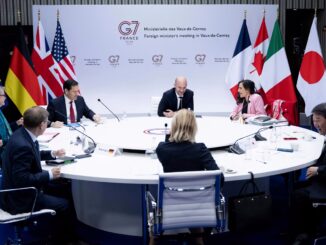
Tag: G7

  • Canadian Energy Minister says he is pleased to work with India

    Canadian Energy Minister says he is pleased to work with India

    By Prabhjot Singh

    TORONTO (TIP): “As Prime Minister Carney says, we are in the midst of a rupture, not a transition. That means we must move quickly to deepen and enhance partnerships in every corner of the globe and use the natural advantages and resources we have to build Canada Strong.

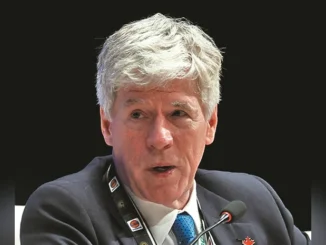
    “As one of the largest and fastest-growing economies in the world, India is looking to us as a potential supplier of energy and minerals. I am pleased to work with India to build partnerships that advance bilateral trade and investment, global energy security, and the clean energy transition and generate revenue in Canada that we can use to pay for the public services we rely on. This is what being an energy superpower looks like,” says Tim Hodgson, Canadian Minister of Energy and Natural Resources, at the conclusion of his trip to India, where he attended India Energy Week and met with leaders of major Indian energy companies and his Indian counterparts to discuss opportunities to deepen bilateral trade and investment.

    He is the third Canadian minister, after Anita Indira Anand and Maninder Singh Sidhu, to visit India during the past few months. Canadian Prime Minister Mark Carney is also expected to visit India in the coming months.

    As Canada diversifies trade and attracts new investment to build the strongest economy in the G7, he says, “We are prioritizing broad engagement to maximize opportunities for our industries. That includes building new and enhanced relationships with Asian markets seeking long-term, reliable collaboration in energy and critical minerals.

    “As one of the world’s largest economies, India is expected to have the largest growth in global energy demand from now through to 2030—offering a significant opportunity for Canada to supply Indian partners and customers with world-class, low-cost, low-carbon Canadian resources,” he said.

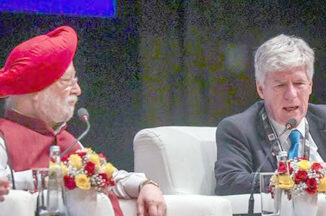
    During India Energy Week, Minister Hodgson relaunched the Canada-India Ministerial Energy Dialogue (CIMED) alongside Hardeep Singh Puri, India’s Minister of Petroleum and Natural Gas, and endorsed the CIMED Action Plan. These initiatives mark a crucial first step for Canada toward a long-term, collaborative bilateral relationship with India that will serve as an important channel for sustained discussions on advancing Canada–India energy projects, potential long-term supply agreements, joint ventures, business-to-business deals, and targeted investments.

    Minister Hodgson also met Piyush Goyal, India’s Minister of Mines, in New Delhi following his participation in India Energy Week. The two ministers agreed to formalize Canada and India’s cooperation on critical minerals in the coming weeks, including a high-level Indian government and industry delegation coming to the Prospectors & Developers Association of Canada Convention in Toronto in March 2026.

    There is strong alignment between India’s ambitions and Canada’s push to begin building major energy and natural resource projects again, including LNG and recent investments under the G7 Critical Minerals Production Alliance. Rebuilding Canada’s relationship with India is key to achieving the Prime Minister’s goal of doubling exports to non-U.S. markets by 2035.

    Canada has what the world wants, from conventional and clean energy to critical minerals, and we are leveraging these strengths to build partnerships with major global players—creating economic opportunities at home to foster our position as an energy superpower worldwide. Recognizing the opportunities for enhanced economic cooperation, Canada’s participation in India Energy Week continues positive momentum and bilateral engagement with India toward more reliable supply chains and strategic stability, for the benefit of both countries.

    (Prabhjot Singh is a Toronto-based Senior Journalist. He can be reached at prabhjot416@gmail.com)

  • India, Canada revive Ministerial Energy Dialogue

    India, Canada revive Ministerial Energy Dialogue

    By Prabhjot Singh

    NEW DELHI/TORONTO (TIP): Energy ministers of India and Canada have reaffirmed the immense importance that energy security and diversity of supply have in the safety, well-being, and economic vitality of both countries. They held a bilateral meeting last week and launched the renewed Canada-India Ministerial Energy Dialogue.

    Indian Minister of Petroleum and Natural Gas of India, Hardeep Singh Puri, and Canadian Minister of Energy and Natural Resources, Timothy Hodgson, participated in India Energy Week 2026 (IEW’26) in Goa, marking the first high-level participation of a Canadian Cabinet Minister at IEW.

    The Goa meeting was a follow-up to the direction provided by the prime ministers of the two countries during their interaction on the sidelines of the G7 Summit, held in June 2025 in Kananaskis, where they underscored the importance of restarting senior ministerial as well as working-level engagements.

    Natural Resources Canada and India’s Ministry of Petroleum and Natural Gas recognized the complementary nature of their energy sectors and the mutual value to be gained from sustained engagement on energy matters.

    Canada has stated its goal of becoming an energy superpower in clean and conventional energy, with export diversification as a priority, while India, as the epicenter of the global energy landscape, offers a natural and symbiotic partnership grounded in scale, stability, and long-term opportunity.

    Canada has current and emerging liquefied natural gas (LNG) projects, is increasing production and exports of crude oil to markets in Asia via the Trans Mountain Expansion (TMX) Pipeline, and is advancing liquefied petroleum gas (LPG) exports to Asia via the west coast of Canada. At the same time, India, being the world’s third largest oil consumer, fourth largest LNG importer, third largest LPG consumer, and having the fourth largest refining capacity, is projected to remain at the center of the global energy landscape, accounting for over one-third of the growth in global energy demand over the next two decades, the largest contribution by any country.

    Even efforts are underway in India to substantially scale up domestic oil production, significantly expand refining capacity, and increase the use of natural gas in the energy mix. Thus, India and Canada have significant potential to emerge as strong collaborators in the area of energy fuels. In this context, the ministers affirm to deepen bilateral energy trade, including the supply of Canadian LNG, LPG, and crude oil to India and the supply of refined petroleum products from India to Canada.

    The ministers recognize the importance of joint commercial and investment partnerships in each other’s energy sector. Canada is acting quickly to build energy projects and supply products to international markets, with Asia as a priority region. In 2025, the Government of Canada launched the Major Projects Office and announced the acceleration of several energy and resource projects and strategies, representing more than $116 billion in investments.

    India is also investing heavily in its own energy supply and prosperity. India highlighted the various policy reforms undertaken, including the huge investment opportunity of US$ 500 billion in the overall value chain of the energy sector. Recognizing this, the ministers agreed to deepen long-term partnerships aimed at facilitating increased reciprocal investment in the Canadian and Indian energy sectors.

    The ministers also recognized the importance of climate-related objectives. This includes efforts to reduce emissions in conventional energy value chains, including through carbon capture utilization and storage, and support for the development and deployment of cleaner technologies as energy demand grows. Recognizing that there exists a huge potential for cooperation in clean energy value chains, the ministers noted the opportunities for collaboration in renewable energy, including hydrogen, biofuels, and sustainable aviation fuel; battery storage; critical minerals; clean technologies; electricity systems; energy supply chain resilience; and the application of artificial intelligence in the energy sector.

    The ministers noted the ongoing collaborative efforts to advance the global energy transition via the global development and deployment of biofuels through the Global Biofuels Alliance (GBA), where Canada is an observer.

    Building on the deliberations, both sides affirm:
    The importance of energy security and diverse energy supply chains. Canada, as a safe, secure, and reliable supplier, and India, as a major consumer, can act in partnership to deepen trade and ensure stable and secure energy supplies. Canada and India will collaborate to promote and strengthen cooperation across trade in the energy sector, including services.
    Their commitment to continued government-to-government dialogue and cooperation, such as through the Canada-India Ministerial Energy Dialogue, and regular and ongoing expert collaboration.
    The intention is to work in partnership to support meaningful business-to-business, or business-to-government, collaboration across the value chain.
    Their mutual intent is to continue supporting work through bilateral and multilateral mechanisms, as well as with industry partners, to support climate objectives for the benefit of the global community.

    (Prabhjot Singh is a Toronto-based Senior Journalist. He can be reached at prabhjot416@gmail.com)

  • Can India trust the West? UK must answer

    Can India trust the West? UK must answer

    India will not abandon Russia simply to please western partners. It will not accept moral lectures that ignore western hypocrisy

    “The Modi government’s foreign policy reflects a clear doctrine of multi-alignment rather than allegiance. India cooperates with the US in the Quad, buys S-400 systems from Russia, maintains close ties with France, deepens economic engagement with the Gulf and expands participation in BRICS. This is not fence-sitting. It is the behavior of a nation that has learned not to rely on any single power.”

    By Shyam Bhatia

    When The Telegraph splashed its recent headline, “Can the West trust India?”, it captured a sentiment now rippling through much of the British press. Vladimir Putin’s visit to New Delhi has triggered the familiar chorus of western anxiety: India is “hedging”, India is “in Moscow’s orbit”, India is “unreliable”. Commentators warn about discounted Russian oil, defense purchases and diplomatic signaling — as though a sovereign nation pursuing its strategic interests were committing an ideological betrayal.

    What these headlines reveal, however, is not a failure of Indian policy but a failure of western imagination. The question is mis framed. A more honest one in 2025 would be whether India can trust the West to treat it as an equal partner.

    Much of the commentary in London reflects an outdated assumption: that India should align reflexively with western preferences. Only recently, the British High Commissioner in New Delhi co-authored an op-ed urging India to stand firmly with the West on Ukraine and isolate Russia “as a matter of principle.” The tone was unmistakably patronizing, implying that India must assume a subordinate posture.

    But India today is not the India of 1991, let alone 1947. It is a rising economic powerhouse, a central player in the Indo-Pacific and an increasingly indispensable global swing state. It trades widely, hedges openly and maintains multiple strategic options. This is not duplicity; it is statecraft. Western discomfort stems from something simpler: India no longer responds to moral pressure or diplomatic coaxing in the way it once did.

    British commentary often singles out India for continuing to buy crude oil from Russia. What is omitted is equally important. European nations still import significant quantities of Russian LNG. The US remains one of the world’s largest buyers of Russian uranium. Several G7 countries maintain complex, sanctioned-but-exempt trade channels with Russia. Yet only India is asked to justify its purchases, even though they ensure affordable energy for 1.4 billion people and prevent fuel inflation from throttling its economy. The selective outrage is not lost on New Delhi.

    Another routine complaint is that India refuses to distance itself from Russian defense hardware. But Britain, like the US and France, is simultaneously urging deeper strategic and defense cooperation with New Delhi. London wants India on its side but appears unwilling to accept the policy choices that come with strategic autonomy. India’s position is straightforward: it will diversify defense suppliers, but not at the cost of national readiness; it will maintain ties with Moscow as long as those ties serve India’s interests; it will not enter alliances that compromise independent decision-making. This is not duplicity; it is exactly how the West behaves when its own interests are at stake.

    The deeper issue is psychological. British political culture still struggles with the idea of India as a global peer. This discomfort is visible in moralizing editorials that frame Indian choices as ethical lapses rather than strategic calculations, selective double standards that judge India more harshly than western states acting similarly, and a lingering reluctance to confront Britain’s own role in shaping historical mistrust.

    Indian policymakers rarely invoke colonial history in diplomatic meetings. But every serious Indian strategist is aware that trust deficits did not begin in 2022. Parliament debates, commission reports and the historical record all testify to periods of profound injustice during British rule. That past cannot be erased simply because today’s commentators find it inconvenient. India’s skepticism towards western advice is not an emotional legacy of the empire; it is a rational reading of recent behavior.

    Beyond history, there are contemporary reasons why India is cautious. One is inconsistency on Pakistan, where western pressure and indulgence often shift unpredictably. Second, technology and sanctions risks have repeatedly forced India to choose between great-power agendas, not of its own making, and vacillation on immigration and visas. Britain courts Indian talent but simultaneously tightens entry rules, sending mixed signals about partnership.

    The West’s own Asia strategy has also become increasingly variable, asking India simultaneously to be indispensable and to “choose sides”, a contradiction New Delhi refuses to accept. Trust is not built on lectures; it is built on consistency.

    The Modi government’s foreign policy reflects a clear doctrine of multi-alignment rather than allegiance. India cooperates with the US in the Quad, buys S-400 systems from Russia, maintains close ties with France, deepens economic engagement with the Gulf and expands participation in BRICS. This is not fence-sitting. It is the behavior of a nation that has learned not to rely on any single power.

    Western anxiety arises because India refuses to be absorbed into the old western security architecture. It insists on building its own. The debate in London is revealing not of India’s unreliability, but of Britain’s need to adjust to a new geopolitical reality.

    India will not abandon Russia simply to please western partners. It will not accept moral lectures that ignore western hypocrisy. It will not behave as a subordinate power in the international system. And it will not apologize for acting in its own national interest, any more than Britain would.

    So when British commentators ask “Can the West trust India?”, they reveal an outdated assumption that trust means compliance. But partnership in 2025 looks very different from partnership in 1965 or even 2005. The more meaningful question now is whether western governments — and the British press in particular — are prepared to treat India as an equal interlocutor rather than a pupil in need of direction.

    India has demonstrated consistency, transparency and a clear logic in its foreign policy. What it seeks in return is not approval, but respect. If trust is the issue, India has every reason to be the one asking whether the West has earned it.

    (Shyam Bhatia is an Indian-born British journalist, writer and war reporter based in London)

  • G7 conclave and Canada’s presidency end as the foreign ministers’ conclave comes to a close

    G7 conclave and Canada’s presidency end as the foreign ministers’ conclave comes to a close

    • By Prabhjot Singh

    NIAGARA, CANADA (TIP): Maritime security and prosperity, critical minerals, economic resilience, and energy security were the major issues discussed during the 2-day G7 Foreign Ministers conclave that concluded at White Oaks resort in Niagara on Wednesday, November 12.

    India’s foreign minister, S. Jaishankar, was among the participants representing the outreach countries. It was for the second consecutive time that India was represented at a G7 event held under Canada’s presidency.

    With the end of its presidency, Canada will pass on the baton to the next country in the queue, South Africa.

    At the end of the conclave, the following joint communique was issued:

    “We, the G7 Foreign Ministers of Canada, France, Germany, Italy, Japan, the United Kingdom, and the United States of America, and the High Representative of the European Union, met under Canada’s G7 Presidency in Niagara on November 11-12, 2025. We welcomed the participation of the Foreign Ministers of Brazil, India, the Kingdom of Saudi Arabia, Mexico, the Republic of Korea, South Africa, and Ukraine, who joined us for discussions on maritime security and prosperity, critical minerals, economic resilience, and energy security.

    Ukraine’s long-term prosperity, security and defense

    We reaffirmed our unwavering support for Ukraine in defending its territorial integrity and right to exist, and its freedom, sovereignty, and independence. We reiterated that an immediate ceasefire is urgently needed. We agreed that the current line of contact should be the starting point of negotiations. We remain committed to the principle that international borders must not be changed by force.

    We are increasing the economic costs to Russia and exploring measures against countries and entities that are helping finance Russia’s war efforts.

    We condemned the provision of military assistance by DPRK and Iran and the provision of weapons and dual-use components by China, a decisive enabler of Russia’s war.

    We acknowledged the ongoing discussions on a wide range of financing options, including further leveraging immobilized Russian Sovereign Assets in our jurisdictions in a coordinated way to support Ukraine.

    We strongly condemned Russia’s recent direct attacks on energy infrastructure and reaffirmed our support for Ukraine’s energy security.

    Peace and stability in the Middle East

    We reiterated our strong support for President Trump’s Comprehensive Plan to End the Gaza Conflict. We welcomed the ceasefire and the release of hostages. We stressed the urgency of returning the remains of deceased hostages. We also welcomed the increased flows of aid, but expressed concern about restrictions that remain in place. We called on all parties to allow for humanitarian assistance without interference at scale, through the United Nations and its agencies, and the Red Crescent, in addition to other international institutions and INGOs, as stipulated in President Trump’s plan.

    All parties must continue to engage constructively on the next steps outlined in the Comprehensive Plan, in pursuit of a political horizon for peaceful and prosperous co-existence for the Israeli and Palestinian peoples that advances comprehensive Middle East peace and stability. We will also continue to maintain attention on the situation in the West Bank.

    We urged Iran to fully implement its obligations both under UN Security Council resolutions and the Treaty on the Non-Proliferation of Nuclear Weapons. Iran must resume full cooperation with the International Atomic Energy Agency, including enabling inspections of all nuclear facilities and materials. We called on Iran to engage in direct talks with the United States, supported by the E3. We continue to call on all UN member states to adhere to their obligations following the legal implementation of the snapback mechanism. 

    Regional security and prosperity across the Indo-Pacific

    We reaffirmed the importance of a free and open Indo-Pacific based on the rule of law. We reiterated our strong opposition to any unilateral attempts to change the status quo, in particular by force or coercion, including in the East China Sea and the South China Sea.

    We expressed serious concern over the use of dangerous maneuvers and water cannons in the South China Sea, as well as efforts to restrict freedom of navigation and overflight through militarization and coercion in the South China Sea.  We reiterated that the award rendered by the Arbitral Tribunal on 12 July 2016 is a significant milestone, binding upon the parties.

    We emphasized the importance of maintaining peace and stability across the Taiwan Strait, and opposed any unilateral attempts to change the status quo, particularly by force or coercion. We encouraged the peaceful resolution of cross-Strait issues through constructive dialogue. We also expressed support for Taiwan’s meaningful participation in appropriate international organizations.

    We remain concerned about China’s military build-up and rapid increase in nuclear weapons arsenal and call on Beijing to demonstrate its commitment to stability through improved transparency.

    We strongly condemned the DPRK’s nuclear and ballistic missile programs and reaffirmed our commitment to the complete denuclearization of the DPRK, in accordance with relevant UN Security Council Resolutions.  We expressed grave concern over the DPRK’s cryptocurrency thefts.  We urged the DPRK to resolve the abductions issue expeditiously. 

    Haiti

    We stressed the need for voluntary personnel and financial contributions to implement UNSC Resolution 2793. We urged the Haitian authorities to present a concrete plan and timeline toward free and fair elections. We welcomed the launch of a Regional Maritime Security Initiative to address transnational organized crime and foster greater stability and resilience in Haiti and the Caribbean through improved maritime security. 

    Sudan

    We strongly condemned the recent escalation of violence and attacks that are often ethnically motivated by the Rapid Support Forces (RSF) against unarmed civilians and aid workers, particularly in El Fasher and North Kordofan. We deplore the devastating impact of this war on civilians, including the famine that has led to the world’s largest humanitarian crisis. We unequivocally condemn sexual violence. We urged the Rapid Support Forces (RSF) and Sudanese Armed Forces (SAF) to respect human rights, de-escalate, commit to an immediate and permanent ceasefire, and ensure the rapid and unimpeded passage of humanitarian assistance.  We expressed our support for diplomatic efforts underway to restore peace and security and called upon external actors to contribute to that end.

    Eastern DRC

    We remain deeply concerned by ongoing violence and reports of human rights violations in eastern DRC, including conflict-related sexual violence. We called on all parties to protect civilians and facilitate humanitarian access. We urged all parties to engage in good faith in the peace process, to deliver lasting peace and security, in line with UNSC Resolution 2773. We called on parties to uphold commitments to fully implement the June 27 Peace Agreement and July 19 Declaration of Principles. We welcomed the Paris Conference on peace and stability in the Great Lakes region, held on October 30, 2025.

    Migration

    We noted the serious impact of conflict and instability on affected countries and regions, as well as on broader regional and international security, undermining growth and development, lessening opportunity and driving displacement and irregular migration. We committed to take up these issues at a future G7 Foreign Ministers’ Meeting. 

    Maritime security and prosperity

    Maritime security and prosperity are fundamental to global stability, economic resilience, and the well-being of all nations. We reaffirm the principles reflected in the United Nations Convention on the Law of the Sea.

    We recalled the G7 Foreign Ministers’ Declaration on Maritime Security and Prosperity, adopted in Charlevoix, Quebec, on March 14, 2025. We welcomed the work carried out by the members of the G7 NB8++ Shadow Fleet Task Force.

    We reiterated our commitment to strengthen G7 coordination with partners to prevent the use of unregistered or fraudulently registered, uninsured and substandard vessels engaged in sanctions evasion, risky navigation practices, arms transfers, illegal, unreported and unregulated fishing, illicit trade, and maritime crime.

    We reaffirmed our shared commitment to address hybrid threats, including activity against critical undersea infrastructure, and to strengthen our partnership in securing maritime ports and routes against the trafficking of illegal drugs. 

    Economic resilience, energy security and critical minerals

    Building on the G7 Critical Minerals Action Plan, the G7 Roadmap to promote standards-based markets for critical minerals and the Production Alliance, we are pursuing partnerships that drive economic development, innovation, resilient and sustainable supply chains, and shared prosperity and security beyond the G7.

    We expressed particular concern with the use of non-market policies and practices to disrupt critical minerals supply chains, as well as other forms of market distortions, including overcapacity. In this regard, we welcome the results of the recent U.S. – China discussions and discourage any future policy impediments to predictable trade, including in critical minerals.

    G7 members agreed to pursue concrete initiatives, jointly with partners, to address vulnerabilities by reducing our dependencies and strengthening our collective economic resilience and security.

  • Canada’s final G7 event skips trade and tariff issues

    Canada’s final G7 event skips trade and tariff issues

    Prabhjot Singh at G7 at NIAGARA

    NIAGARA, CANADA (TIP): The last showcase of the Canadian presidency of the G20—the foreign ministers’ conclave—may have gone well beyond the expectations of the hosts with a glitch-free event, yet it left certain questions, especially those related to tariffs and trade, unanswered.

    Anita Anand, Minister of Foreign Affairs, played a warm, welcoming host to more than a dozen members of her clan drawn not only from member G7 nations but also from eight other outreach countries, including India.

    She also held one-to-one meetings with all attending foreign ministers. However, her meeting with Marco Rubio, the United States Secretary of State, on the second and last day of the G7 Foreign Ministers’ conclave in the Niagara Region, landed her in a little hot soup over skipping the subject of tariffs and trade with her US counterpart.

    Though Minister Anand and Secretary of State Rubio discussed the strong Canada–United States partnership and cooperation on key global challenges, including stability in the Indo-Pacific region, Russia’s ongoing war of aggression against Ukraine, peace and security in the Middle East, and the ongoing crisis in Haiti, they did not talk about the “big rupture” in the bilateral trade relations that occurred last month when the US President, Donald Trump, abruptly cancelled talks with Ottawa.

    The two neighbors had been trying to reach a settlement to scale back Donald Trump’s protectionist tariffs on Canadian goods.

    When confronted with a question at the end of the event press conference about leaving trade off the agenda during her 40-minute meeting with Marco Rubio, Anita Anand defended the lack of trade, saying negotiations on the subject were well left to her colleague, Dominic LeBlanc.

    She was rubbed further when asked if Indian Foreign Minister Subrahmanyam Jaishankar could discuss trade with Marco Rubio during their meeting on the sidelines of the summit. Why not her?

    “I am respectful of my colleagues’ portfolios, one of whom is Dominic LeBlanc—whose role is to cover Canada-US trade,” she said in her answer to the question. She held that her job was to build relationships with the United States on other engaging issues from Ukraine to the Middle East to the Arctic.

    The minister and the secretary of state also spoke about national and joint efforts to ensure the security of the North American Arctic. The two ministers agreed to continue close cooperation in advancing shared security and foreign policy priorities.

    “From the Gulf of America to the Pacific, safe and open waterways are the backbone of the American economy, carrying U.S. products to markets around the world. We engaged in important discussions with G7 partners today on more coordination in support of U.S. efforts to increase maritime security.

    Marco Rubio took to his X handle to say “Met with Canadian Foreign Minister to further U.S.-Canada coordination on improving the security situation in Haiti, sustaining the ceasefire in the Middle East, and maintaining a free Indo-Pacific.

    Meanwhile, the Indian Foreign Minister talked about his meeting with Marco Rubio, saying, “Good to meet @SecRubio. Appreciate his condolences on the loss of lives in the blast in Delhi. Discussed our bilateral ties, focusing on trade and supply chains. Exchanged views on the Ukraine conflict, the Middle East/West Asia situation and the Indo-Pacific.

    Jaishankar also talked about his participation in an Outreach Session on Energy Security and Critical Minerals and put forth his perspective. Spoke about the need on both issues to mitigate dependence, strengthen predictability, and build resilience. Greater international cooperation is the only way forward. Noted the unpredictability and market constraints in global supply. More policy consultations and coordination are helpful. The key issue, however, is to translate that on the ground. India is open to working constructively with international partners in this regard.

    Jaishankar also met foreign ministers of Germany, the UK, Brazil, France, South Africa, Mexico, Saudi Arabia, and Ukraine, and representatives of the European Union.

    Anita Anand met with Andrii Sybiha, Ukraine’s Minister of Foreign Affairs, on the last day of the G7 Foreign Ministers’ meeting. They discussed Ukraine’s economic and governance reforms, as well as the joint efforts being made to advance the work of the International Coalition for the Return of Ukrainian Children.

    Anita Anand reaffirmed Canada’s strong support for Ukraine’s sovereignty and territorial integrity. She highlighted Canada’s plans to increase pressure on Russia through sanctions and other economic measures and to use its G7 presidency to strengthen these efforts.

    The ministers also discussed increasing bilateral cooperation on energy security, recognizing its strategic importance for Ukraine’s resilience, war efforts, and long-term recovery.

    During her round of meetings, Anita Anand met Antonio Tajani, Italy’s Minister of Foreign Affairs and International Cooperation.

    Minister Anand highlighted Canada’s participation in Security Action for Europe (SAFE) as a commitment to defense cooperation and discussed ways of enhancing bilateral relations and addressing ongoing geopolitical challenges.

    Both ministers agreed that trade diversification strengthens economic resilience and creates new opportunities for businesses in both countries. They also committed to continuing to further strengthen bilateral and trade relations between Canada and Italy.

    Minister Anand expressed that she looks forward to visiting Italy in the new year to continue building on the strong partnership between the two countries.

    Anita Anand also met Jean-Noël Barrot, France’s Minister for Europe and Foreign Affairs.

    The ministers discussed the importance of the defense and trade relationship between Canada and France to meet the challenges of today’s world, including through the promotion of industrial collaboration. In particular, they underscored joint efforts to strengthen transatlantic security, deepen defense cooperation, and expand trade ties in partnership with the European Union.

    Minister Anand and Minister Barrot reaffirmed their unwavering support for Ukraine and their commitment to advancing peace in the Middle East.

    Both ministers agreed that Canada and France share a strong potential for further collaboration in areas such as critical minerals. They discussed ongoing priorities for the G7 as France prepares to assume the G7 presidency next year.

  • Minister Sidhu advances Canada’s trade priorities with G7 trade ministers

    Minister Sidhu advances Canada’s trade priorities with G7 trade ministers

    OTTAWA (TIP): This week, Maninder Sidhu, Canada’s Minister of International Trade, hosted a meeting with G7 trade ministers in Paris, France. Minister Sidhu led an important discussion on the G7’s role in contributing to a trade environment that supports our shared goals of driving economic growth, creating good-paying jobs, and building long-term prosperity. The G7 trade ministers engaged on pressing issues that are impacting the global economy.

    Minister Sidhu reaffirmed Canada’s commitment to the rules-based global trading system and the principles that underpin it. He highlighted the need for open, stable markets that ensure predictability amidst economic uncertainty, which is particularly important for small and medium-sized enterprises disproportionately affected by trade disruptions.

    The minister also emphasized the importance of addressing the impacts of non-market policies and practices on our workers, businesses and economies.

    “While the rules-based global trading system continues to face complex and evolving challenges, it is the foundation of economic security and prosperity. The G7 is a vital forum to address the challenges that affect not only its members’ economies, but also the global economy. I will continue to work closely with my G7 counterparts to support Canadian businesses of all sizes in finding trade opportunities in diverse markets and to build Canada as the strongest economy in the G7.” – Maninder Sidhu, Minister of International Trade

    The Group of Seven (G7) is an informal grouping of seven of the world’s most advanced economies, including Canada, France, Germany, Italy, Japan, the United Kingdom, and the United States, as well as the European Union.

    As the G7 President this year, Canada will host the G7 Leaders’ Summit in Kananaskis, Alberta from June 15 to 17, 2025.

  • Donald Trump will visit Canada for the G7, the White House confirms

    Donald Trump will visit Canada for the G7, the White House confirms

    Trump will be in Canada from June 15 to 17

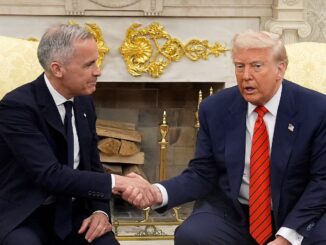
    WASHINGTON, D.C. (TIP): U.S. President Donald Trump will attend the G7 leaders’ summit in Canada next month, White House Press Secretary Karoline Leavitt confirmed in a briefing.

    Trump will be in Canada from June 15 to 17. More details of his visit will be announced shortly, Leavitt said.

    On May 6, during Mark Carney’s meeting with Trump at the White House, the prime minister noted that the two leaders “look forward to meeting next month at the G7 Summit in Kananaskis.” The 51st G7 summit will be held from June 15 to 17 in Kananaskis, Alta., attended by the core members of the group. Also in attendance will be Ukrainian President Volodymyr Zelenskyy and Australian Prime Minister Anthony Albanese.

    G7 shows unity at financial summit
    This week, finance ministers from the G7 countries, as well as heads of the World Bank Group (WBG), International Monetary Fund (IMF), Organisation for Economic Cooperation and Development (OECD), and Financial Stability Board (FSB), participated in a three-day summit in Banff, Alta.

    They discussed global trade, artificial intelligence and the war in Ukraine.

    “After 50 years of working together, transcending national differences and promoting global prosperity, the value of the G7 is clear,” the communique reads. “We held a productive and frank exchange of views on the current global economic and financial situation, the risks and opportunities common to our countries, and ways to address them.”

    U.S. Treasury Secretary Scott Bessent, along with chair of the U.S. Federal Reserve Jerome Powell, represented the American delegation for this portion of the summit.

    Canada’s Finance Minister François-Philippe Champagne concluded the three-day meeting saying there was a sense of unity among the G7 members. “The best proof of unity is that we have a joint communique,” Champagne said.

    The communique does not mention Trump’s tariffs, but addresses the multiple, complex global challenges,” and “are committed to pursuing our shared policy objectives.”

  • US, India stronger when working together: Blinken

    US, India stronger when working together: Blinken

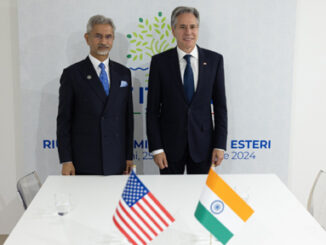
    WASHINGTON, D.C. (TIP): The United States and India are stronger when they work together, US Secretary of State Tony Blinken has said. Blinken made the remarks in a post on X after meeting India’s External Affairs Minister S Jaishankar on the sidelines of the G7 meeting in Fiuggi, Italy on Tuesday. “The US and India are stronger when we are working together. Indian External Affairs Minister Dr S Jaishankar and I met today in Italy to discuss the importance of our continued close cooperation to promote global security and prosperity,” Blinken said.

    He also shared a picture from the meeting.

    Jaishankar also posted about the meeting on X and said he discussed the state of the world and the India-US partnership, which continues to move forward, with Blinken.

    After the meeting, State Department Spokesperson Matthew Miller said, “The United States desires to continue coordinating closely with India to address global security challenges.”

    During the meeting, Blinken and Jaishankar affirmed the US and India’s enduring commitment to deepening bilateral ties, Miller said in a readout of the meeting.
    (Source: PTI)

  • G7 leaders commit to transition away from fossil fuels in energy systems

    G7 leaders commit to transition away from fossil fuels in energy systems

    • The document commits to collective effort to reduce methane emissions by 75% by 2030
    • India’s Prime Minister Modi meets with G7 leaders and Pope Francis

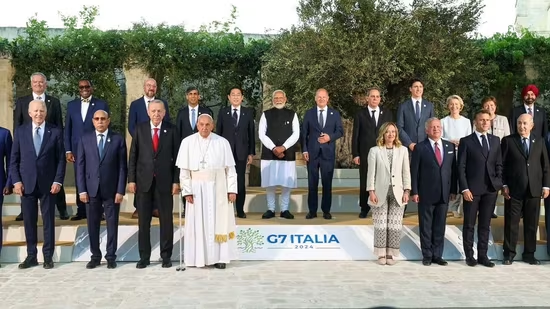
    BORGO EGNAZIA (TIP): Leaders of the Group of Seven (G7) developed democracies will commit to accelerating their transition away from fossil fuels during this decade, according to a draft of a statement to be issued at the end of their ongoing summit in Italy, says a Reuters report.

    “We will transition away from fossil fuels in energy systems in a just, orderly, and equitable manner, accelerating actions in this critical decade, to achieve net-zero by 2050 in keeping with the best available science,” said the draft seen by Reuters.

    Other commitments on climate policy in the draft include a pledge “to phase out existing unabated coal power generation in our energy systems during the first half of 2030s.” With the COP29 United Nations climate conference due to start in November, the leaders of the United States, Canada, Japan, Germany, France, Britain and Italy said they would submit “more ambitious” national climate plans, according to the draft.

    The document commits to a collective effort to reduce methane emissions by 75% by 2030 but, in a section likely to upset environment activists, the leaders give a green light to public investments in natural gas, a polluting fossil fuel.

    “In the exceptional circumstance of accelerating the phase-out of our dependency on Russian energy, publicly supported investments in the gas sector can be appropriate as a temporary response, subject to clearly defined national circumstances,” the draft said.

    Meanwhile, India’s Prime Minister Narendra Modi on Friday, June 14, held talks with Ukrainian President Volodymyr Zelenskyy, French President Emmanuel Macron and his British counterpart Rishi Sunak on the sidelines of G7 Summit in Italy’s Apulia region. He also met with Pope Francis who he invited to visit India.

    It is learnt that Ukraine’s Zelenskyy briefed Modi on various aspects of the Russia-Ukraine conflict. Modi had met Zelenskyy on the sidelines of the previous G7 summit in Hiroshima in May last year as well.

    India has been maintaining that the conflict in Ukraine must be resolved through dialogue and diplomacy.

    Modi and French President Macron discussed ways to further strengthen the strategic partnership, including in areas of defense, nuclear and space, and exchanged views on key global and regional issues.

    The two leaders met in the southern resort town of Italy.

    “Taking Strategic Partnership to new levels! PM @narendramodi met President @EmmanuelMacron of France on the sidelines of the 50th G7 Summit in Apulia, Italy,” Ministry of External Affairs spokesperson Randhir Jaiswal posted on X.

    “The two leaders discussed ways to further strengthen the partnership including in areas of defense, nuclear, space, education, climate action, digital public infrastructure, critical technologies, connectivity and culture. They also exchanged views on key global and regional issues,” he wrote.

    It is Prime Minister Modi’s first foreign trip after assuming office for a third time this month. The two leaders last met in January when the French President visited India to attend the 75th Republic Day of India.

    PM Modi’s meeting with his British counterpart Sunak followed his talks with French President Macron. The two leaders greeted each other with a warm hug as they met on the sidelines of the 50th G7 Summit at the luxury resort of Borgo Egnazia in Apulia.

    Modi reaffirmed his commitment to further strengthen the India-UK strategic partnership in the third term of the NDA government and reviewed the progress made in the ongoing FTA negotiations.

    “It was a delight to meet PM @RishiSunak in Italy. I reiterated my commitment to further strengthen the India-UK Comprehensive Strategic Partnership in the third term of the NDA Government,” Modi posted on X soon after their meeting.

    “There is great scope to deepen ties in sectors like semiconductors, technology and trade. We also talked about further cementing ties in the defense sector,” Modi wrote.

    The spokesperson of the Ministry of External Affairs Randhir Jaiswal described the meeting between the two leaders as “fruitful.”

    “The two leaders took stock of bilateral relations in areas of defense and security, trade and economic collaboration, critical and high technology sectors and people to people connect. They discussed implementation of Roadmap 2030 and progress made in ongoing FTA negotiations,” Jaiswal posted on X.

    Sunak and Modi last met in person at the G20 Summit in New Delhi last September, when they had agreed to accelerate the FTA talks with the hope of signing off before India’s general election.

    However, the trade talks are now expected to resume only after a new UK government is elected on July 4.

    The India-UK FTA negotiations, which opened in January 2022, are aimed at significantly enhancing bilateral trade – currently worth around 38.1 billion pounds a year as per official statistics from earlier this year.

    Modi is attending the summit on the invitation of Italian President Georgia Meloni and will address an Outreach session on Artificial Intelligence, Energy, Africa and the Mediterranean alongside leaders of other invited countries and Pope Francis.
    (With inputs from PTI)

  • President Biden to host PM Modi for Official State Visit to US on June 22: White House

    President Biden to host PM Modi for Official State Visit to US on June 22: White House

    WASHINGTON, D.C. (TIP): President Joe Biden will host Prime Minister Narendra Modi for an Official State Visit to the United States, which will include a state dinner on June 22, the White House announced on Wednesday, May 10. This would be the first State Visit of an Indian leader after then President Barack Obama invited then prime minister Manmohan Singh for a State Visit in November 2009.

    President Biden and the First Lady Dr Jill Biden will host Prime Minister Modi for an Official State Visit to the United States June 22, White House Press Secretary Karine Jean-Pierre said in a statement while announcing the visit.

    “The upcoming visit will affirm the deep and close partnership between the US and India and the warm bonds of family and friendship that link Americans and Indians together,” she said.

    Prime Minister Modi’s visit will strengthen two countries’ shared commitment to a free, open, prosperous, and secure Indo-Pacific, she said, amid China’s aggressive behavior in the strategic region.

    The visit will also elevate the bilateral strategic technology partnership, including in defense, clean energy, and space, she said.

    “The leaders will discuss ways to further expand our educational exchanges and people-to-people ties, as well as our work together to confront common challenges from climate change to workforce development and health security,” she added.

    Prime Minister Modi’s visit to the US comes ahead of the G20 summit being hosted by India in September.

    After becoming the Prime Minister in 2014, Modi has made more than half a dozen trips to the United States for bilateral and multilateral meetings with all the three American presidents, Obama, Donald Trump and now Biden, but this is for the first time he has been invited for an official State Visit, a privilege accorded to America’s close friends and allies.

    He last visited Washington in September 2021 at the invitation of President Biden for a bilateral meeting and also attended the first in-person Quad Leaders Summit.

    Modi will join Biden and his counterparts from Australia and Japan at a summit of the Quad leaders in Sydney on May 24 that is expected to focus on implications of the Ukraine conflict and the overall situation in the Indo-Pacific.

    Before travelling to Australia, Modi is likely to visit the Japanese city of Hiroshima to attend the annual summit of the Group of Seven (G7) advanced economies which is scheduled to take place from May 19 to 21.

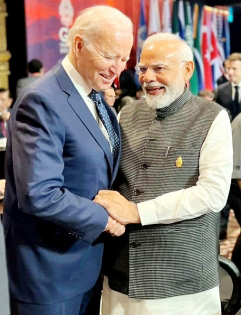
    President Biden will attend the G7 leaders’ summit in Hiroshima as well as the Quad summit in Sydney. Modi’s State Visit is reflective of the importance that the President Biden attaches to his personal relationship with him and the India-US ties. “It is entirely good and proper that the world’s two greatest democracies further cement their strategic, economic, and technology convergence in these turbulent geostrategic times. The State Visit will remind the world that India and America still have so much more potential to capture in our bilateral relations, reflecting the energy and talent of our demographics and our systems, which serve to empower our free peoples,” US-India Business Council president Atul Keshap said. Earlier, Prime Minister Modi met President Biden on the sidelines of the G20 Summit in Bali, Indonesia in November last year. The two leaders also met on the sidelines of the G7 Summit in Germany in June 2022 and before that in May on the sidelines of the Quad Leaders Summit in Tokyo. Meanwhile, India’s ambassador the US Taranjit Singh Sandhu, on May 10 said: “Prime Minister Narendra Modi’s visit to the US will show that the partnership between the two nations is people-centric, people-driven, and is good for the world at large”, even as he called the visit “historic.”

    “The PM’s forthcoming official state visit to the US, at the invitation of President Biden, is historic. Prime Minister and President Biden have together imparted significantly new vigor and momentum to our bilateral ties,” India’s Ambassador to the US, Taranjit Singh Sandhu told PTI. “The visit will be an opportunity for the two leaders to spend time together, take stock of the progress achieved and provide guidance on the future limitless possibilities. The visit will also underscore that India-US partnership is people-centric and people-driven, and that it is not just for the two countries, but for the world at large,” Sandhu said.
    (Source: PTI)

  • G7 rallies support for Kyiv, flags China’s rise amid global crisis

    G7 rallies support for Kyiv, flags China’s rise amid global crisis

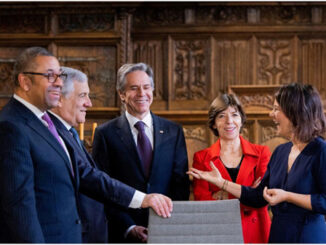
    Muenster (TIP): Top diplomats from the world’s major industrialised democracies on November 5 rallied support for Ukraine in its resistance to Russia’s invasion and coalesced around suspicion of China’s increasing assertiveness amid a panoply of global crises. Foreign ministers from the Group of Seven nations, wrapping up two days of talks in the historic western German city of Muenster, were set to release a statement asserting common positions on Ukraine, Russia, China and recent developments in Iran and North Korea, officials said. A year after warning Russia about the consequences of invading Ukraine, the G7 ministers were expected to endorse further punishments for the Kremlin and additional backing for Kyiv and countries affected by food and energy shortages that the war has exacerbated, the officials said. “It is incredibly important that we retain our strategic endurance, the willingness to stick with this until this is done, both to support the people of Ukraine as they defend themselves against aggression but also to lift the pressure off those countries around the world and those people around the world who are already experiencing food insecurity and are even pushed closer to a famine,” British Foreign Secretary James Cleverly said.

    The ministers will also call out Iran for allegedly supplying weapons to Russia and a brutal crackdown on anti-government protesters. Their statement will further condemn the recent escalation of tensions in Asia caused by North Korean military activity.

    “As a collective G7, our work is to ensure that we maintain peace, bring back peace also to the region, and we are there to protect these international norms,” Canadian Foreign Minister Melanie Joly said. Blinken referred to a 374-year-old document at a Thursday event with German Foreign Minister AnnalenaBaerbock. He said Russia’s actions were an attack on the concepts of national sovereignty and territorial integrity that the centuries-old treaty established. — AP

  • Revival of G7 and its impact

    Revival of G7 and its impact

    From US perspective, the summit’s aim is to announce that ‘America is back’

    By Shyam Saran

    “From the US perspective, the objective of the summits is to announce that ‘America is back’ and ready to lead the world after the debilitating disruption of western alliances and partnerships and a retreat from global engagement during the Trump years. What Biden is signaling is that the revival of American leadership and diplomatic activism will be anchored in the web of its transatlantic relationships, even as the Indo-Pacific strategy will be its key preoccupation, given the acknowledged challenge posed by China. The emphasis on the transatlantic alliance and partnership is also important in countering the Russian threat.”

    The three-day G7 summit concluded on June 13 and released an unusually long and detailed joint statement of 70 paragraphs and a separate Open Societies Statement. The latter statement was on behalf of the G7 and the four invitees to the summit, namely Australia, India, South Korea and South Africa. The summit is only the first of three key meetings involving western countries. This week includes a meeting of the EU and the US and a meeting of the NATO military alliance, both in Brussels. Fortified by the display of solidarity at these three summits, President Biden will have his first summit with Russian President Putin in Geneva on June 16.

    From the US perspective, the objective of the summits is to announce that ‘America is back’ and ready to lead the world after the debilitating disruption of western alliances and partnerships and a retreat from global engagement during the Trump years. What Biden is signaling is that the revival of American leadership and diplomatic activism will be anchored in the web of its transatlantic relationships, even as the Indo-Pacific strategy will be its key preoccupation, given the acknowledged challenge posed by China. The emphasis on the transatlantic alliance and partnership is also important in countering the Russian threat. While Biden has described China as a competitor, Russia is the ‘enemy’, even though the US is prepared to work together with both on areas where there are convergent interests on global issues, such as climate change, cyber security and nuclear non-proliferation. Has Biden succeeded in convincing his western allies and partners and his adversaries that the US is back? The answer to that, as judged from the joint statement, should be a yes. But then, the Trump years were a low base to compare to.

    Has Biden achieved a degree of western consensus in presenting a united front against Russia and China? Perhaps more against Russia and less against China. For example, the launch of the Build Back a Better World (B3W) partnership was launched as a ‘values driven, high standard and transparent infrastructure partnership led by major democracies’ but stopped short of explicitly posing it as an alternative to China’s Belt and Road Initiative. There are few details of how this partnership is going to be financed beyond saying that this will be private financed but with ‘catalytic investment’ from public and multilateral sources. We may conclude that there are simply not enough resources available to be deployed by the G7 which could match what China has been offering, despite concerns over lack of transparency and exacerbation of the debt overload on several developing countries.

    There are several other references to Chinese misdemeanors which taken together do represent a broad western consensus on the need to confront China. These include the importance of maintaining peace and stability in the Taiwan Strait, ‘a free and open Indo-Pacific’, of avoiding ‘unilateral attempts to change the status quo and increase tensions in the East and South China Seas.’ In addition, there are references to human rights issues in Xinjiang and Hong Kong, both of which are regarded as ‘core issues’ by China. Overall, therefore, one could say that Biden has been able to fashion a consensus on acknowledging the Chinese security challenge and ideological challenge.

    Will this impress China? Up to a point. The economic and commercial relationship between Europe and China is deep and broad ranging as is that between China and Japan. The EU and China have been working together, for example, for several years on developing benchmarks for climate finance, including green bonds, disclosure norms and the running of carbon markets. The area of climate finance will assume critical importance as climate change action gets into high gear after the Glasgow summit later this year. There is a limit to disengaging from the world’s second largest economy and the central node in global supply chains.

    China has reacted by dismissing the G7, pointing out that a small group of countries cannot rule the world. There is another important shift the summit represents. After the global financial and economic crisis of 2007-8, it is the G20 which was established as the premier forum for international economic coordination. It worked very well in dealing with the immediate crisis, but its role has steadily diminished since then. With renewed tensions between the US and China and with Russia, the utility of the G20 is not so obvious currently. This adds to the significance of the revival of G7, even though its economic heft is much less than in its heyday. It constitutes only 30% of world GDP as against 60% at the end of the Cold War. However, the global trading system and its financial infrastructure continue to be dominated by the G7 so one should not underestimate its influence. It has the potential to emerge as a core of a broader coalition to achieve a degree of balance in the power equations that the emergence of China has upturned in the new millennium.

    The adoption of the Statement on Open Societies reflects Biden’s renewed emphasis on the importance of preserving and promoting ‘open societies, democratic values and multilateralism as foundations for dignity, opportunity and prosperity for all.’ For all the cynicism that attends the expression of such lofty statements, they have value in contesting China’s confident belief in the efficacy of its authoritarian ideology and system of governance. Biden is taking head on the prevailing pessimism about democracy within democracies themselves. One should welcome PM Modi being honored as the lead speaker at the session on Open Societies. His remarks were unexceptionable and worthy of a leader of the world’s largest democracy. One hopes that this is followed by a renewed commitment to democratic values which are enshrined in the Indian Constitution, but also constitute, as PM Modi said, the civilizational values of India.

    (The author is a former Foreign Secretary of India and senior fellow, Centre for Policy Research)

  • G7 to provide 1 billion vaccine doses ‘to world’: United Kingdom

    G7 to provide 1 billion vaccine doses ‘to world’: United Kingdom

    Front page main story

    The announcement came after the United States said it would donate 500 million jabs to 92 poor and lower-middle-income nations.

    LONDON (TIP): G7 leaders will agree to expand global COVID vaccine manufacturing to provide at least one billion doses to the world through sharing and financing schemes, Britain said Thursday, June 10.

    The announcement came after the United States said it would donate 500 million jabs to 92 poor and lower-middle-income nations.

    The UK, which is hosting the big powers’ gathering in southwest England, added it would donate at least 100 million surplus doses within the next year, including five million beginning in the coming weeks.

    The commitments follow growing calls for richer countries to step up their efforts to share COVID-19 shots with less developed nations, with charities warning the current situation is leading to “vaccine apartheid”.

    Britain, which has orders for more than 400 million doses, has faced criticism for failing to begin making donations to poorer countries.

    But on the eve of welcoming world leaders from the group of seven wealthy nations to their first summit in almost two years, British Prime Minister Boris Johnson vowed that would soon change.

    “As a result of the success of the UK’s vaccine programme we are now in a position to share some of our surplus doses with those who need them,” he said.

    “At the G7 Summit I hope my fellow leaders will make similar pledges”.

    A Downing Street statement said: “At the Summit world leaders are expected to announce they will provide at least one billion coronavirus vaccine doses to the world.. and set out a plan to expand vaccine manufacturing in order to achieve that goal.”

    ‘Humanitarian obligation’

    Meanwhile EU members have agreed to donate at least 100 million doses by the end of 2021 — with France and Germany each committing to providing 30 million.

    French President Emmanuel Macron issued his own call for pharma groups producing vaccines to donate 10 percent of their production to poor nations.

    US President Joe Biden on Thursday saluted a “historic” moment in the fight against the pandemic after Washington announced its donation.

    “This is about our responsibility, our humanitarian obligation to save as many lives as we can,” Biden told reporters at the start of his first overseas trip as president.

    Biden said the move was also in the US interest because of the risk of variants while the White House said the decision would “supercharge the global fight against the pandemic”.

    The enduring challenge to defeat the virus was earlier laid bare by the World Health Organization which warned Europeans not to drop their guard because vaccination levels remain too low to stop another wave of infections.

    Although pockets of the rich world have scored successes against the disease, the gains are fragile and billions of mostly poor people remain unprotected.

    Over 100 million people in the 27-nation European Union, or 22.6 percent of its population, have been fully vaccinated against Covid-19, according to an AFP count.

    The contrast with developing nations was further evidenced Thursday when South Africa’s National Institute For Communicable Diseases announced his country had technically entered a third wave with more than 9,000 cases over the past 24 hours.

    On Thursday, India reported a global record of more than 6,000 Covid-19 deaths in a day after one state dramatically revised its data upwards, fueling concerns that the official tally of almost 360,000 deaths, the world’s third-highest toll, is woefully understated.

    WHO warns against complacency

    The United States has also faced criticism for sitting on huge stocks of unused vaccines.

    But with more than 60 percent of Americans having received at least one shot, Washington has moved to reclaim global leadership with its huge donation which will be channeled through the Covax program which aims to ensure equitable global vaccine distribution.

    The White House said the doses will start shipping in August.

    Dismissing suggestions that it is in a so-called vaccine diplomacy contest with Russia and China, Washington has described its initiatives as a return to multilateral action after the nationalist isolationism under Biden’s predecessor Donald Trump.

    In Europe, some lockdown restrictions have been eased of late notably ahead of the Euro football competition starting Friday.

    But Hans Kluge, the WHO’s regional director, said he feared complacency.

    “Vaccination coverage is far from sufficient to protect the region from a resurgence,” Kluge told reporters, warning against repeating the “mistake” of last summer by easing protective measures prematurely.

    Iran’s government meanwhile warned that recent success in containing the Middle East’s deadliest coronavirus outbreak risks being reversed should the public cease being diligent in their precautions amid a shortage of vaccines.

    The country saw total infections pass the three million mark on Thursday, adding to the global total of almost 174,350,990. The pandemic has claimed more than 3.7 million lives worldwide.

    (Agencies)

  • BRITISH PRIME MINISTER TO HOST VIRTUAL MEETING OF G7 LEADERS

    BRITISH PRIME MINISTER TO HOST VIRTUAL MEETING OF G7 LEADERS

    Nirpal Singh Shergill in London

    LONDON, (TIP): The British Prime Minister Boris Johnson will use the first leaders’ meeting of theUK’s G7 Presidency to call for further international cooperation on vaccine distributionand to build back better from coronavirus. Prime Minister will call for a new, global approach to pandemics that learns lessons fromthe division that characterized the initial international response to the coronavirus pandemic.

    This month the PM and Foreign Secretary will chair meetings of the UN Security Councilfocused on coronavirus, conflict and climate change.

    On Friday (19th February) the Prime Minister will host fellow G7 leaders for a virtual meeting todiscuss how the world’s leading democracies can work together to ensure equitable distributionof coronavirus vaccines around the world, prevent future pandemics and build back better from coronavirus.

    Friday’s meeting will be the first hosted by the PM as part of the UK’s G7 Presidency this year and thefirst gathering of G7 leaders since April 2020.

    The Prime Minister will use the meeting, which will also be US President Biden’s first major multilateralengagement, to call for leaders to work together on a joined-up global approach to pandemics thatbrings an end to the nationalist and divisive politics that marred the initial response to coronavirus.

    He will argue that putting our citizens first should not come at the expense of working on a unifiedresponse, and that the last twelve months of the pandemic have showed that no country can be safeuntil every country is safe from the pandemic. The rollout of vaccines offers a fresh opportunity todemonstrate the value of international cooperation.


    International pandemic preparedness will be a major priority for the UK’s G7 Presidency and thePrime Minister will work with fellow G7 leaders to implement his five-point plan to prevent futurepandemics announced at the UN General Assembly last year.


    The five-point plan includes a worldwide network of zoonotic research hubs, developing globalmanufacturing capacity for treatments and vaccines, the design of a global pandemic early warningsystem, the agreement of global protocols for a future health emergency and the reduction of trade barriers.


    There have already been positive steps to ensure equitable access to a coronavirus vaccine. Last monththe US announced it would join the COVAX initiative, becoming the final G7 country to do so. COVAX willprovide developing countries with 1.3 billion doses of the vaccine this year and theUK is providing £548m to the scheme.


    In recent weeks, the UK has worked closely with G7 partners on a huge range of global issues andshared challenges. On Friday, the Chancellor and Governor of the Bank of England held the first meetingof G7 Finance Ministers. G7 Foreign Ministers have spoken out together in the last month in condemnationof the military coup of Myanmar, the detention of Alexey Navalny in Russia and threats tohuman rights in Hong Kong.


    The Prime Minister said:

    “The solutions to the challenges we face – from the colossal mission to get vaccines to every single country,to the fight to reverse the damage done to our ecosystems and lead a sustainable recoveryfrom coronavirus – lie in the discussions we have with our friends and partners around the world.

    “Quantum leaps in science have given us the vaccines we need to end this pandemic for good. Now worldgovernments have a responsibility to work together to put those vaccines to the best possible use.

    I hope 2021 will be remembered as the year humanity worked together like never before to defeat a common foe.”


    During February, the UK also holds the Presidency of the United Nations Security Council, which rotates betweenmembers every month. The UK is using this Presidency to galvanize international actionon coronavirus, climate change and conflict.


    On the 23rd of February, the Prime Minister will chair a virtual meeting of the UN Security Council on the link betweenclimate change and conflict. This is the first time a UK Prime Minister has chaired a Security Council sessionsince 1992. The discussions at the meeting will inform crucial action ahead of the UK-hosted COP26 Summit inNovember.

  • UK TO HOST G7 SUMMIT IN CORNWALL FROM 11-13 JUNE 2021

    UK TO HOST G7 SUMMIT IN CORNWALL FROM 11-13 JUNE 2021

    • PM will use the UK’s G7 Presidency to unite leading democracies to help the world build back better from coronavirus and create a greener, more prosperous future.
    • Australia, India and South Korea invited as guest countries

    Nirpal Singh Shergill in London

    LONDON (TIP): The G7 Summit will be held in Carbis Bay, Cornwall from 11-13th June 2021.

    Prime Ministers and Presidents from the world’s leading democracies will come together inCornwall in June to address shared challenges, from beating coronavirus and tackling climatechange, to ensuring that people everywhere can benefit from open trade, technologicalchange and scientific discovery.

    Prime Minster Boris Johnson will use the first in-person G7 summit in almost two years to ask leaders toseize the opportunity to build back better from coronavirus, uniting to make the future fairer,greener and more prosperous.

    The G7 – which is made up of the UK, Canada, France, Germany, Italy, Japan, the USA andthe EU – is the only forum where the world’s most influential and open societies andadvanced economies are brought together for close-knit discussions. The Prime Minister’s ambition is to use the G7 to intensify cooperation between the world’sdemocratic and technologically advanced nations. To that end, he has invited leaders fromAustralia, India and South Korea to attend as guest countries to deepen the expertise andexperience around the table. Between them the 10 leaders represent over 60% of thepeople living in democracies around the world.

    The choice of Cornwall as the location for the Summit will mean the eyes of the world are onthe beautiful, historic and innovative region. The leaders’ meeting itself will be held in thecoastal town of Carbis Bay, supported by neighboring St Ives and other towns acrossthe region. The whole of Cornwall will reap the benefits of hosting the G7.The region is already a powerhouse for green innovation, providing an ideal setting fora Summit focused on building back better from the coronavirus pandemic.

    Visit Cornwall estimates the total economic impact for the county will be £50 million,including through an increase in future tourism. The Government will also work closely withCornish leaders and institutions to ensure the Summit leaves a long-term legacy for theregion, reaping the benefits of hosting the G7 for years to come.

    The UK will also host a number of meetings throughout the year between GovernmentMinisters from the G7, both virtually and in different locations across the UK – ensuringmany areas of the country experience the benefits of the UK’s G7 Presidency. Theseministerial summits will cover economic, environmental, health, trade, technology,development and foreign policy issues.

    Prime Minister Boris Johnson said:

    “As the most prominent grouping of democratic countries, the G7 has long been thecatalyst for decisive international action to tackle the greatest challenges we face. Fromcancelling developing world debt to our universal condemnation of Russia’s annexationof Crimea, the world has looked to the G7 to apply our shared values and diplomaticmight to create a more open and prosperous planet.

    “Coronavirus is doubtless the most destructive force we have seen for generations andthe greatest test of the modern world order we have experienced. It is only right that weapproach the challenge of building back better by uniting with a spirit of openness tocreate a better future.

    “Cornwall is the perfect location for such a crucial summit. Two hundred years ago Cornwall’stin and copper mines were at the heart of the UK’s industrial revolution and this summerCornwall will again be the nucleus of great global change and advancement. I’m very muchlooking forward to welcoming world leaders to this great region and country.” 2021 marks a crucial year of international leadership for the UK. In addition to the G7 Summit,during February the UK will assume the Presidency of the UN Security Council, and later thisyear the UK will host COP26 in Glasgow and a global education conference aimed at gettingchildren in the developing world into school.