Tag: G7 summit

  • A ‘crucial’ colloquy at the G7 Summit

    A ‘crucial’ colloquy at the G7 Summit

    Besides addressing issues like global vaccination, vaccine passport, counterterrorism and economy, the G7 Summit could take a stern stance towards China

    By Prabhu Dayal

    “The likely “Policy Priorities” that could be discussed at the Summit include leading the global recovery from coronavirus while strengthening resilience against future pandemics, promoting future prosperity by championing free and fair trade, tackling climate change and preserving the planet’s biodiversity, and championing globally shared values. Some issues will flow from the G7 ministerial meeting which are important from India’s point of view.”

    The G7 Summit between June 11-13 in Cornwall is set to discuss major world issues. As the world’s most influential leaderships prepare to meet at the first in-person meet in two years, a question remains whether the Summit will send a tough message to China.

    The Group of Seven (G7) is an informal club of wealthy democracies consisting of the United States, the United Kingdom, France, Germany, Japan, Italy and Canada. It represents 62 per cent of the global net wealth, more than 46 per cent of the global nominal GDP and more than 32 per cent of the global GDP based on purchasing power parity.

    The UK, which currently holds the G7 Presidency, has invited representatives from India, Australia, South Korea and South Africa as guest members, indicating that it is serious about pivoting the Indo-Pacific. Prime Minister Narendra Modi will attend the Summit virtually given the Covid situation in India.

    The likely “Policy Priorities” that could be discussed at the Summit include leading the global recovery from coronavirus while strengthening resilience against future pandemics, promoting future prosperity by championing free and fair trade, tackling climate change and preserving the planet’s biodiversity, and championing globally shared values. Some issues will flow from the G7 ministerial meeting which are important from India’s point of view.

    UK Prime Minister Boris Johnson could call on fellow G7 leaders to make concrete commitments to vaccinate the entire world against coronavirus by the end of 2022. He is expected to call for stepping up the manufacture of vaccines, lowering barriers to the international distribution of vaccines and sharing surplus doses with developing countries. Another issue is that of “vaccine passports”. Earlier this week, UK Prime Minister Boris Johnson had indicated that he would like to push the G7 to look at the possibility of agreeing on the issue of “vaccine passports”. The proposal is intended to ease international travel and would involve recording immunity, vaccination or test in the “vaccine passport”. However, there have been concerns that this could create hurdles for citizens from countries that are unable to increase the pace of vaccination due to manufacturing limitations. India’s Health Minister, Harsh Vardhan, had also expressed his opposition to this idea. He pointed out that there are lower levels of vaccination in developing countries in contrast to the developed countries, and vaccine passport will be hugely discriminatory and disadvantageous for the developing countries. He suggested that implementation of the same be made only after duly addressing the concerns.

    The taxation of multinational companies will be yet another important issue. Speaking at the recent meeting of the G7 Finance Ministers, Rishi Sunak, UK Chancellor of the Exchequer said that the world cannot “continue to rely on a tax system that was largely designed in the 1920s”. The G7 Finance Ministers reached an important deal to close cross-border tax loopholes used by some of the world`s biggest companies. This landmark deal aims to squeeze more money out of multinational companies and reduce their incentive to shift profits to low-tax offshore havens. The deal would be discussed at the G7 Summit and later put up before the G20 Finance Ministers meeting on July 9-10, 2021. It could form the basis of a global pact aimed at ending a prevailing trend in which ‘tax haven’ countries have competed to attract corporate giants by offering ultra-low tax rates and exemptions. Rich nations like the G7 have struggled for years to agree on a way to raise more revenue from large multinationals that often book profits in jurisdictions where they pay little or no tax. In terms of this deal, the G7 said it would back a minimum global corporation tax rate of at least 15 per cent, and put in place the measures to ensure that taxes were paid in the countries where businesses operate.

    On the issue of counterterrorism, the communique issued after the recent G7 Finance Ministers meeting stated: “Global implementation of the FATF standards for combating money laundering, terror-financing and proliferation financing remains uneven. We recognize the role of the nine FATF-Style Regional Bodies (FSRBs) in assessing and supporting the implementation of the FATF standards around the world.” The G7 Finance Ministers have committed to providing additional expertise and funding to support the FSRB’s assessment programs by at least USD 17 million during 2021-24. From India’s viewpoint, it is a welcome sign that the G7 is devoting attention to terror financing because the abetment and financing of terrorist outfits by Pakistan has shown no signs of abating. An influential grouping like G7 can do much more to rein in the scourge of terrorism.

    China is likely to figure prominently in the discussions at the Summit in Cornwall. The communique issued after the Foreign Ministers meeting called on China to participate constructively in the rules-based international system, guided by the principles such as respect for human rights and fundamental freedoms, in context of Xinjiang, Tibet and especially the Uyghurs. Moreover, the PRC was reminded that it is obliged to respect the high degree of autonomy, rights and freedoms of Hong Kong, ‘including those set out in the Sino-British Joint Declaration and the Basic Law’. In terms of economic matters, G7 Foreign Ministers had noted that, as nations that support free and open trade, they expect the fair economic system, trade, investment and capital growth not to be undermined. The PRC was urged to assume and fulfil obligations and responsibilities commensurate with its global economic role. Beijing was also asked to refrain from conducting or supporting intellectual property theft by exploiting cyberspace. Besides, they expressed support for Taiwan’s participation in the WHO and World Health Assembly WHA. They also expressed concern about the situation in the East and South China Seas. India will watch with interest what transpires at the Summit concerning all these important issues.

    (Prabhu Dayal is a retired Indian diplomat. He is an author and a commentator, particularly on foreign affairs. A regular panelist at TV channels, he also contributes articles regularly to many publications, including New York based The Indian Panorama. He can be reached at prabhu_dayal70@hotmail.com)

  • Trump disrupts global governance

    Trump disrupts global governance

    By G Parthasarathy

    India has been at the receiving end of Trump’s economic policies of “America first.” His duties on imports of aluminum and steel have resulted in India taking up the issue with the WTO and imposing reciprocal trade curbs on US exports.

    New Delhi has been at the receiving end of Trump’s economic policies of “America first.” Trump’s duties on imports of aluminum and steel have resulted in India taking up the issue with the WTO and imposing reciprocal trade restrictions on US exports. India’s trade surplus with the US in 2017-18 was around $21 billion, barely 5 per cent of the trade surplus of China. But, the Trump administration would evidently like to end GSP trade preferences, accorded to India since 1974, together with demands that India ends restrictions on imports of American dairy products.

    While Trump is proposing tariffs on some $50 billion of Chinese exports, he also supports special treatment for China, while heaping praise on President Xi Jinping. He intervened to reverse a US Congressional ban on ZTE, China’s manufacturer of Android phones, which accepted that it had violated sanctions, by exports to Iran and North Korea.  The US Commerce Department banned US companies from exporting components essential for ZTE’s survival and brought the company to its knees. Trump, however, stepped in, tweeting that he would work with Xi, to reverse the ban.

    With high-level meetings under way, India should respond to Trump’s policies by being judicious in extending support, while seeking a quid pro quo for its actions, which support US policies. Any significant purchase of defense equipment, or civilian transport aircraft should be linked to specific political, economic and security gestures from Washington, while ensuring that US actions do not undermine the India-Russia defense relationship.

    We need to work with Russia and China so that Washington does not take us for granted. Defense Secretary Mattis and Secretary of State Pompeo appear to have a realistic understanding of India’s policies, potential and imperatives.

    We need to keep a close watch on US policies on Afghanistan, where an effort appears under way to mainstream the Taliban. This should not lead to politically equating the Taliban with the legitimate Afghan Government.

    The annual summit meetings of the G7 grouping are marked by camaraderie. They make a significant contribution to issues of global governance, ranging from environment, trade and investment, to peace, stability and security. Trump shook this record by his behavior during and after the G7 summit in Vancouver earlier this month. The summit was marked by simmering tensions on trade relations, with the US unilaterally imposing additional tariffs on imports of steel and aluminum, from its G7 partners. Differences on this issue led to Trump disowning the Summit Declaration he had signed and calling Canadian Prime Minister Trudeau: “Dishonest and Weak.” Outraged European leaders joined ranks, taking exception to Trump’s comments, while Japanese Prime Minister Shinzo Abe, already shaken by Trump’s U-turns on China and North Korea, maintained a silence.

    He revoked US participation in the “Trans-Pacific Partnership”, which sought to integrate the economies of the Asia-Pacific, ranging from Canada and the US to Japan, South Korea and ASEAN markets. China, now pushing for a “Comprehensive Economic Cooperation” agreement with ASEAN and its dialogue partners like India, Japan and Australia, will only increase its economic domination of the Indo-Pacific, by these American actions.

    Other destabilizing Trump policies include his determination to scuttle the North American Free Trade Agreement, his ban on travel to the US by people from six Muslim countries, his imposition of nuclear sanctions on Iran and his insulting labelling of Haiti and countries in Africa as “shithole countries,” which provoked formal protests by six African countries.

    Trump has created new tensions by recognizing the whole Jerusalem as part of Israel, ignoring the global consensus that East Jerusalem would be under Palestinian control in any peace settlement in West Asia.

    Trump’s impetuously ignored the security concerns of key allies South Korea and Japan and went ahead with a summit meeting in Singapore, with North Korean leader Kim Jong Un, whom he had earlier spoken of in derogatory terms. Trump expressed his admiration for the North Korean leader and cancelled longstanding military exercises with South Korea, thereby implicitly accepting the assurances of the North Korean leader that he would end his country’s nuclear weapons program. These actions were ill advised, naïve and undermined the trust that South Korea and Japan had reposed in the US. There is little prospect of North Korea discarding its nuclear arsenal anytime soon. Moreover, one wonders if Shinzo Abe can afford to remain a mere spectator, with China and North Korea possessing missile and nuclear arsenals, with US acquiescence.

    Interacting with well-informed journalists and analysts in the US during a stay at the US west coast, where people voted massively against Trump, one feels that a larger section of people now appear more indulgent towards religious bigotry and racism. There is appreciation of the fact that not only did Trump receive nearly 63 million votes in the presidential elections, but his economic policies, particularly on tax relief, have been accompanied by reduced unemployment, with a booming stock market.  Acceptance and support, particularly amongst small-town white Americans, of Trump’s immigration policies, is evident. A large number of Americans, especially in the mid-west and south, feel that far too much of their national resources has been spent on involvement beyond the country’s borders and that there is, therefore, merit in Trump’s slogan of “America First”. Aspirants for quick “green cards” and those with unrealistic expectations of continuing American “liberalism,” would be well advised to bear this in mind.

    (The author is a career diplomat)

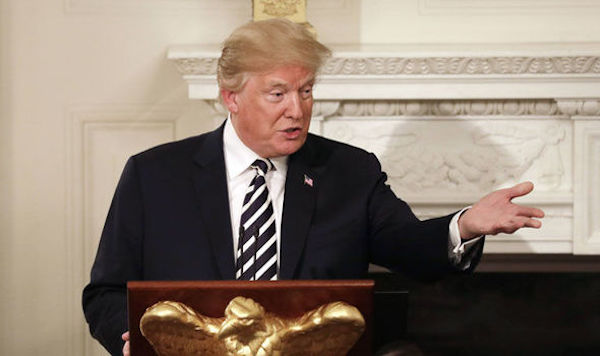
  • President Trump to attend G7 Summit, in part

    President Trump to attend G7 Summit, in part

    The two-day meeting will be dominated by the possibility of a trade war – prompted by the US levies of 25 per cent on steel and 10 per cent on aluminum

    WASHINGTON(TIP): After initial dithering, President Trump is heading for G7 Summit at Charlevoix, Canada on Friday, June 8. Following the session on Women’s Empowerment, Trump will travel directly to Singapore from Canada in anticipation of his upcoming meeting with North Korea’s leader Kim Jong Un, Tuesday, June 12.

    Deputy Assistant to the President for International Economic Affairs Everett Eissenstat will represent the United States for the remaining G7 sessions, White House Press Secretary Sarah Sanders said.

    The annual G7 (Group of Seven) summit kicks off in Charlevoix, Quebec on Friday, June 8 and the stage is set for a major showdown between the US and its allies.

    The leaders of the G7, an informal bloc of some of the world’s most powerful industrialized countries, including Germany, the UK, and Japan, get together every year to discuss collaboration on issues like global security, the international economy, and climate change.

    At the end of the summit, they aim to sign a joint statement detailing the policy positions and initiatives they agree on.

    But there’s a decent chance that might not happen this year.

    That’s because President Donald Trump has so badly rattled the other members with his recent heavy steel and aluminum tariffs and other divisive new policies that it might be impossible for the group to reach a consensus on any substantive issue.

    The two-day meeting will be dominated by the possibility of a trade war – prompted by the US levies of 25 per cent on steel and 10 per cent on aluminum.

    Angela Merkel, the German chancellor, has predicted a big fight at the summit, triggering suggestions it has become a “G6+1” – with the US president isolated and alone.

    The EU is poised to impose tariffs on US imports ranging from Harley-Davidson motorbikes and jeans to bourbon, peanut butter, cranberries and orange juice, from next month.

    Brussels is still finalizing the list it will submit to the World Trade Organisation (WTO), which will be on top of tit-for-tat tariffs on about £2.5bn of US steel.

    A French official told Bloomberg that French President Emmanuel Macron wants to make progress with President Trump on smoothing tensions over trade, the US’s withdrawal from the Iran nuclear deal, and climate policy — and if that doesn’t happen, France may refuse to sign.

    Then there’s the fact that Trump himself is reportedly contemplating not signing the joint statement to show that the US is perfectly happy to go its own way if the other members give it too much trouble during talks. The divide has become so stark that staffers and observers of the G7 have started to call it the “G6 plus one.”

    “What this G7 is going to show is that the United States are alone against everyone, and especially alone against their allies,” French Finance Minister Bruno Le Maire told reporters last week.

    The G7 summit is usually a boring meeting of broad consensus. Not anymore.

    The G7 summit, which includes Canada, France, Germany, Italy, Japan, and the United Kingdom, plus the European Union (which is not technically part of the G7 but participates), is typically a pretty straightforward affair.

    The official themes for this year’s summit include “investing in growth that works for everyone,” “preparing for the jobs of the future,” and “advancing gender equality.” Against the backdrop of these deliberately anodyne themes, world leaders can hobnob and try to move the ball forward on issues like a new free trade agreement or cooperative climate policy.

    But Trump has departed sharply from the G7 consensus on issues like these in the past by, for instance, pulling out of the Paris climate agreement and withdrawing from the Trans-Pacific Partnership.

    And White House officials say he is planning to strike a confrontational posture at the summit. “There are disagreements. He’s sticking to his guns, and he’s going to talk, talk to them,” National Economic Council Director Larry Kudlow told reporters on Wednesday. Trump is also reportedly considering implementing a fresh round of tariffs against Canada — the host of the summit.

    European countries could also shun the final statement. Their biggest priority is likely going to be getting Trump to consider some kind of compromise on his recent protectionist trade policies, the most controversial one being his imposition of sweeping tariffs on foreign steel and aluminum. Currently, those tariffs hit exports from every other member of the G7.

    Trump is also apparently not looking forward to what could be a tense and awkward meeting. According to the Washington Post, Trump has reportedly complained to advisers about having an “uneasy rapport” with German Chancellor Angela Merkel and sees British Prime Minister Theresa May as “too politically correct.”

    And Trump has apparently told advisers that he doesn’t want to be “lectured” by other world leaders, especially as he tries to prepare for an upcoming high-stakes summit with North Korea next week.

    If the final joint statement for the G7 is missing signatories this weekend when the summit wraps up, it won’t be the end of the world. It’s a symbolic show of unity, not a binding document with concrete policy effects. But it will be yet another sign of how far the US is drifting from many of its most trusted friends in the world.

    (With input from agencies)