Tag: Ganesh Chaturthi

  • Ganesh Chaturthi

    Ganesh Chaturthi

    Ganesh Chaturthi also known as Vinayaka Chaturthi is one of the important Hindu festivals celebrated throughout India with a great devotion. This day is celebrated as the birthday of Lord Ganesh, the elephant-headed son of Lord Shiva and Goddess Parvati. Lord Ganesh is the symbol of wisdom, prosperity and good fortune.
    Ganesh Chaturthi is celebrated on Shukla Chaturthi of the Hindu month of Bhadra (generally falls between August and September).
    This year, the festival will be celebrated on August 27.
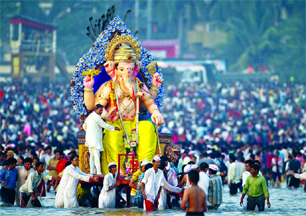
    This festival is celebrated by Hindus with a great enthusiasm. People bring idols of Lord Ganesh to their homes and do worship. The duration of this festival varies from 1 day to 11 days, depending on the place and tradition. On the last day of the festival the idols are taken out in a colorful and musical procession and immersed traditionally in water.
    As per Hindu mythology Lord Ganesh is considered as “Vigana Harta” (one who removes obstacles) and “Buddhi Pradaayaka” (one who grants intelligence). This festival is very important for students, they worship Lord Ganesh to illumine their minds.
    The festival was celebrated as a public event since the days of Maratha King Shivaji (1630–1680). However, the public festival as celebrated in Maharashtra today, was introduced by Bhausaheb Laxman Javale in 1892 by installing first Sarvajanik (Public) Ganesh idol- Shrimant Bhausaheb Rangari Ganpati, Bhudwar Peth, in Pune. The first meeting regarding starting the Sarvajanik Ganesh utsav took place under the leadership of Bhausaheb Laxman Javale at his residence (Bhudwar Peth) now known as Bhau Rangari Bhavan. In 1893 Lokmanya Tilak praised the concept of Sarvajanik Ganesh Utsav in Kesari Newspaper. In 1894, he installed Ganesh idol in Kesari wada, Pune too and started preaching Ganesh Utsav.
    While celebrated all over India, it is grandest and most elaborate of them especially in Maharashtra, Karnataka, Telangana, Tamilnadu, Kerala, Andhra Pradesh, Goa and in other parts of Western India and Southern India. Outside India, it is celebrated widely in Terai region of Nepal and by the Hindu diaspora in the United States, Canada, Mauritius, and other places.
    Legend of Ganesha
    Traditional Hindu about Ganesha tell that Parvati, the consort of Shiva, created Ganesha out of sandalwood paste that she used for her bath and breathed life into the figure. She then set him the task of guarding her door while she bathed. Shiva, who had gone out, returned and as Ganesha didn’t know him, didn’t allow him to enter. After the combat between Ganesha and Shiva Ganas, finally angry Shiva severed the head of the child. Parvati seeing this became enraged and Shiva then promised that her son will be alive again. The devas searched for the head of dead person facing North, but they found only the head of an elephant. They brought the head of the elephant and Shiva fixed it on the child’s body and brought him back to life. Lord Shiva also declared that from this day the boy would be called Ganesha (Gana Isha : Lord of Ganas).
    According to the Linga Purana, Ganesha was created by Lord Shiva and Goddess Parvati at the request of the Devas for being a Vighnakartaa (obstacle-creator) in the path of Rakshasas, and a Vighnahartaa (obstacle-averter) to help the Devas achieve fruits of their hard work.
    Celebration, rituals and tradition
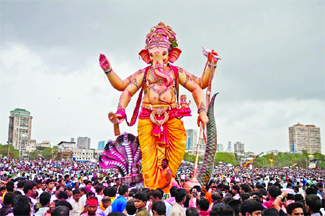
    Weeks or even months before Ganesha Chaturthi, artistic clay models of Lord Ganesha are made for sale by skilled artisans. They are beautifully decorated and depict Lord Ganesha in vivid poses. The size of these statues may vary from 3/4 of an inch to over 70 feet.
    Ganesha Chaturthi starts with the installation of these Ganesha statues in colorfully decorated homes and specially erected temporary structures mandapas (pandals) in every locality. The pandals are erected by collecting monetary contributions and are decorated specially for the festival, by using decorative items like flower garlands, lights, etc. and at times have theme based decorations.
    The priest then with the chanting of mantras invokes the presence of Ganesha using the statue as a channel, or body for his energy. This ritual is the Pranapratishhtha. After this the ritual called as Shhodashopachara (16 ways of paying tribute) follows. Coconut, jaggery, modaks, durva (trefoil) blades of grass and red flowers are offered. The statue is anointed with red unguent, typically made of kumkum and sandalwood paste. Throughout the ceremony, Vedic hymns from the Rig Veda, the Ganapati Atharvashirsa, Upanishad, and the Ganesha stotra from the Narada Purana are chanted.
    History
    It is not known when and how Ganesh Chaturthi was first celebrated. Ganesh festival was being celebrated as a public event in Pune since the times of Shivaji (1630–1680), the founder of the Maratha Empire. The Peshwas, the de facto hereditary administrators of the Empire from 1749 till its end in 1818, encouraged the celebrations in their administrative seat Pune as Ganesha was their family deity (Kuladevata). With the fall of the Peshwas, Ganesh festival lost state patronage and became a private family celebration again in Maharashtra till its revival by Indian freedom fighter and social reformer Lokmanya Tilak.
    The public festival as celebrated in Maharashtra today, was introduced by Bhausaheb Laxman Javale in 1892 by installing first Sarvajanik (Public) Ganesh idol. This followed a meeting at his residence, which was attended by, amongst others, Balasaheb Natu, and Krishnajipant Khasgiwale. Khasgiwale on his visit to the Maratha ruled princely state of Gwalior had seen the tradition of public celebration still maintained and brought it to the attention of his friends in Pune.
    In 1893 Lokmanya Tilak praised the concept of Sarvajanik Ganesh Utsav in his newspaper, Kesari, and the next year he installed a Ganesh idol in Kesari Wada too. Tilak’s efforts transformed the annual domestic festival into a large, well-organized public event. Tilak recognized the wide appeal of the deity Ganesha as “the god for everybody”, and popularized Ganesh Chaturthi as a national festival in order “to bridge the gap between Brahmins and ‘non-Brahmins’ and find a context in which to build a new grassroots unity between them”, and generate nationalistic fervour among people in Maharashtra against the British colonial rule. Tilak was the first to install large public images of Ganesh in pavilions, and also established the practice of submerging the idols in rivers, sea, or other pools of water on the tenth day after Ganesh Chaturthi.
    Under Tilak’s encouragement, the festival facilitated community participation and involvement in the form of intellectual discourses, poetry recitals, performances of plays, musical concerts, and folk dances. It served as a meeting ground for people of all castes and communities in times when, in order to exercise control over the population, the British discouraged social and political gatherings.

  • Ganesh Chaturthi

    Ganesh Chaturthi

    The festival of Ganesh Chaturthi is celebrated to honor the Hindu god Ganesh. The festival, also known as Vinayaka Chaturthi is observed in the Hindu calendar month of Bhaadrapada, starting on the shukla chaturthi (fourth day of the waxing moon period) and lasts for 10 days, ending on Anant Chaturdashi (fourteenth day of the waxing moon period). People start celebrations by preparing months in advance by making eco-friendly idols, artistic clay models of Lord Ganesha and decorating the idols.
    The size of these idols vary from inches to feet. Ganesh Chaturthi starts with the installation of these Ganesh statues in colorfully decorated homes and specially erected temporary structures mandapas (pandals) in many localites. The pandals are decorated using decorative items like flower garlands, lights, etc.. Some pandals are made theme based which depict religious themes, events related to Lord Ganesha or sometimes current events.
    There are many legends surrounding the celebration of Ganesha Chaturthi. The most well-known of these are related to Lord Shiva and Parvati. According to legend, Parvati used sandalwood to create Ganesha while her husband, Shiva was away. She designated Ganesha to watch over her house’s entrance while taking a bath. When he returned, Ganesha blocked Shiva from entering the building, eager to meet Parvati. This caused the two of them to fight. He initially makes vain attempts to persuade the boy. Shiva, the god of destruction, finally cuts off Ganesha’s head.
    When Parvati caught sight of this scene, she transformed into the goddess Kali and declared that she would end the world. Everyone was concerned about this and prayed to Lord Shiva to find a solution and subdue Goddess Kali’s rage. Shiva then commanded all his followers to run off and find a child whose mother was neglectful, turning her back on her child and bringing his head. The followers saw the first child as an elephant, so they cut off his head and brought it to Lord Shiva as instructed.
    The head was immediately placed on Ganesha’s body by Lord Shiva, who then revived it. Goddess Parvati was once more overpowered as Maa Kali’s rage subsided. Ganesha or Ganapati, the chief of the ganas or the attendants of Shiva, was given a warm welcome into the first family of the Hindu heavens and given the elephant-headed god’s name. The most important god in the Hindu pantheon is Ganesha. This valiant doorkeeper for Parvati’s bath is revered as the most auspicious deity of fresh starts. He is worshiped before people travel or start a new project and during all festivals. You will also see him carefully guarding entrances to temples and homes, peeping out of calendars and happily gracing marriages and other such occasions.
    Puranas say that on the fourth day of the month in the Hindu calendar, Saka Samwat, devotees observe a fast and worship Lord Ganesha on Chaturthi. Ganesha is said to have been born on Bhadra Chaturthi, which falls between August and September.
    Even though Ganesh Chaturthi is celebrated as Lord Ganesha’s birthday, freedom fighter Lokmanya Tilak revived the celebration of Ganesh Utsav in Maharashtra, making it more popular among the general public.
    Through his efforts, the festival became a ten-day celebration. On the tenth day of the celebration, devotees carry Ganesha idols alongside singing and moving to drench it in water. The name of the procession is Visarjana.
    Rituals of Ganesh Chaturthi
    Selecting a Ganesha Idol
    It is considered very lucky to choose an idol of Lord Ganesha. Because it is a representation of happiness and prosperity, a sitting Ganesha idol is suggested. In addition, it would be ideal for the idol to depict one of Ganesha’s hands in a blessing position and the other holding a modak, a deity-favored sweet.
    Installation Direction
    It is essential to position the Ganesha idol so that it faces the north side and is erected in the northeast direction of your home. First, pick a clean platform, cover it with a cloth, and set the idol on it. It is believed that this position brings blessings and positive energy into the home.
    Worship Rituals
    As part of the purification ceremony, rice and pure Gangajal (holy water) should be sprinkled on the deity after it has been installed. Along with the idol, you must also place Riddhi and Siddhi, which are representations of spiritual power and prosperity.
    On the idol’s right side, a water container should be placed. Make an offering of flowers, fruits, and sweets, particularly modaks, to Lord Ganesha following these preparations. Finish the ritual of worship by reciting mantras and waving lighted lamps in front of the deity in the form of an aarti.
    Significance of the Ganesh Chaturthi
    The celebration is also known as Ganesh Utsav or Vinayaka Chaturthi. Lord Ganesha is also known as ‘Vignaharta’, and that implies the one who removes hurdles. The celebration is an ideal chance for devotees to look for help from above for life’s regular difficulties.

  • Ganesh Chaturthi

    Ganesh Chaturthi

    The festival of Ganesh Chaturthi is celebrated to honor the Hindu god Ganesh. The festival, also known as Vinayaka Chaturthi is observed in the Hindu calendar month of Bhaadrapada, starting on the shukla chaturthi (fourth day of the waxing moon period) and lasts for 10 days, ending on Anant Chaturdashi (fourteenth day of the waxing moon period). People start celebrations by preparing months in advance by making eco-friendly idols, artistic clay models of Lord Ganesha and decorating the idols. The size of these idols vary from inches to feet. Ganesh Chaturthi starts with the installation of these Ganesh statues in colorfully decorated homes and specially erected temporary structures mandapas (pandals) in many localites. The pandals are decorated using decorative items like flower garlands, lights, etc.. Some pandals are made theme based which depict religious themes, events related to Lord Ganesha or sometimes current events. The collective celebrations of Ganesha Chaturthi dates back to early 1890. At that time the society was divided on the basis of caste and relegious beliefs. LokManya Bal GangaDhar Tilak decided to bring the divided society into one thread and asked the people to come together and celebrate the festival in collective manners.
    During the celebrations, the chanting of mantras invokes the presence of Ganesha. This ritual is the Pranapratishhtha. After this, the ritual called as Shhodashopachara (16 ways of paying tribute) follows during which Coconut, jaggery, modaks, durva blades of grass and red flowers are offered. The statue of Lord Ganesha is anointed with red unguent, made of kumkum and sandalwood paste. The festival ends with Ganesha visarjana during which these installed statues of Lord ganesha are immersed into the water bodies sea and river.
    The Legend of Lord Ganesha
    To understand the essence of Ganesh Chaturthi, it’s important to know the legend behind Lord Ganesha’s birth. According to Hindu mythology, Lord Ganesha is the son of Lord Shiva, the destroyer, and Goddess Parvati. The story goes that Parvati created Ganesha from the clay of her body and breathed life into him, thus making him her son and a guardian of her privacy.
    One day, when Parvati was taking a bath, she asked Ganesha to stand guard outside her chamber. When Lord Shiva returned home and attempted to enter, Ganesha, unaware of his divine lineage, stopped him as per his mother’s instructions. This led to a fierce battle between the two, resulting in Lord Shiva beheading Ganesha.
    Upon realizing the mistake, Lord Shiva and Parvati were grief-stricken. To make amends, Lord Shiva promised to bring Ganesha back to life by replacing his head with that of the first living being he encountered. This happened to be an elephant, thus giving Ganesha his iconic elephant-headed form. Lord Shiva also declared Ganesha as the “Lord of Beginnings” and “Remover of Obstacles,” making him a revered deity in Hinduism.
    The Significance of Ganesh Chaturthi
    Ganesh Chaturthi, which falls on the fourth day of the bright half of the Hindu lunar month of Bhadrapada (usually in August or September), is celebrated to commemorate the birth of Lord Ganesha. This festival holds immense significance for several reasons:
    Remover of Obstacles
    Lord Ganesha is worshipped as the deity who removes obstacles and grants success and prosperity. People seek his blessings before starting new ventures, weddings, or any significant life event.
    Symbol of Wisdom
    Ganesha is also revered as the God of wisdom and intellect. Devotees pray to him for guidance and knowledge, especially students seeking success in their studies.
    Unity and Harmony
    Ganesh Chaturthi transcends caste, creed, and social boundaries. It brings people from diverse backgrounds together in celebration, fostering unity and communal harmony.
    Cultural Celebration
    Beyond its religious significance, Ganesh Chaturthi is a cultural extravaganza, featuring music, dance, processions, and elaborate decorations.
    Ganesh Chaturthi Celebrations
    Ganesh Chaturthi celebrations typically span ten days, with the most elaborate festivities occurring on the first and last days. The festival begins with the installation of clay idols of Lord Ganesha in homes and public places. These idols are beautifully decorated with flowers, jewelry, and colorful clothing.
    Devotees offer prayers, perform aarti (rituals involving the waving of lamps), and sing bhajans (devotional songs) to seek Lord Ganesha’s blessings. Modak, a sweet dumpling, is a favorite offering to the deity, symbolizing the sweet rewards of life. On the final day of the festival, the idols are immersed in water bodies, symbolizing the departure of Lord Ganesha back to his abode while cleansing the surroundings of negativity.
    Ganesh Chaturthi is not merely a religious festival; it’s a celebration of faith, culture, and unity. It reminds us of the importance of seeking wisdom and guidance, overcoming obstacles, and fostering communal harmony. As the vibrant celebrations unfold each year, Ganesh Chaturthi continues to be a source of joy, hope, and renewal for millions of people, making it one of India’s most cherished festivals.
    Important events
    – Prana Pratishtha: This ceremony installs the Ganesha idol in the home or temple. It is performed on the Chaturthi Tithi.
    – Aarti: This prayer ritual is performed on Lord Ganesha daily during the festival.
    – Hawan: This is a fire ritual that is performed to invoke the blessings of Lord Ganesha. It is usually performed on the first and last day of the festival.
    – Visarjan is the ceremony of immersing the Ganesha idol in a river or ocean. It is performed on the Dashami Tithi.

  • Ganesh Chaturthi

    Ganesh Chaturthi

    The festival of Ganesh Chaturthi is celebrated to honor the Hindu god Ganesh. The festival, also known as Vinayaka Chaturthi is observed in the Hindu calendar month of Bhaadrapada, starting on the shukla chaturthi (fourth day of the waxing moon period) and lasts for 10 days, ending on Anant Chaturdashi (fourteenth day of the waxing moon period). People start celebrations by preparing months in advance by making eco-friendly idols, artistic clay models of Lord Ganesha and decorating the idols. The size of these idols vary from inches to feet. Ganesh Chaturthi starts with the installation of these Ganesh statues in colorfully decorated homes and specially erected temporary structures mandapas (pandals) in many localites. The pandals are decorated using decorative items like flower garlands, lights, etc.. Some pandals are made theme based which depict religious themes, events related to Lord Ganesha or sometimes current events. The collective celebrations of Ganesha Chaturthi dates back to early 1890. At that time the society was divided on the basis of caste and relegious beliefs. LokManya Bal GangaDhar Tilak decided to bring the divided society into one thread and asked the people to come together and celebrate the festival in collective manners. During the celebrations, the chanting of mantras invokes the presence of Ganesha. This ritual is the Pranapratishhtha. After this, the ritual called as Shhodashopachara (16 ways of paying tribute) follows during which Coconut, jaggery, modaks, durva blades of grass and red flowers are offered. The statue of Lord Ganesha is anointed with red unguent, made of kumkum and sandalwood paste. The festival ends with Ganesha visarjana during which these installed statues of Lord ganesha are immersed into the water bodies sea and river.

    Lord Ganesh is considered to be the God who has the ability to bestow wisdom and wealth upon humans. All the new undertakings, whether at place of work or at home, start by reciting the mantra of Lord Ganesha. He is known as the God of good luck and prosperity. Therefore, before any auspicious occasion, Hindus performs the puja of Lord Ganesha, to achieve success in it. Ganesh Chaturthi, the day marking the birth of the Lord, is celebrated in a grand manner in Maharashtra as well as other parts of India. It falls in the Hindu lunar month of Bhadra and lasts over a period of ten days. One of the most loving festivals of India, Ganesh Chaturthi has many legends associated with it. Given below are the legends from Shiv and Skanda Purana.

    Legend From Shiv Purana

    The most popular legend associated with Lord Ganesha can be found in the Shiv Purana. It says that Lord Ganapati was created out of the dough that Goddess Parvati used for her bath. The Goddess wanted a door-keeper, to prevent the coming of any visitors when she took a bath. So, she created a doll from the dough and breathed life into him. The day she did this came to be known as the birthday of Lord Ganesha, which we today celebrate as Ganesh Chaturthi. On day, while Goddess Parvati was taking her bath, Lord Shiva happened to visit her. Ganesha did not know him, so he did not allow the Lord to enter the house. This made Lord Shiva angry and he beheaded Ganesha. Later, when he came to know the truth, he fixed the head of an elephant in place of Ganesha’s head. With this, the appearance of Lord Ganesha changed and he came to have the head of an elephant.

    Legend From Skanda Purana

    There is yet another popular legend associated with Ganesh Chaturthi, arising from Skanda Purana. It goes that once Ganesha was invited for a feast in Chandralok. He ate many Ladoos and later, as he got up to walk after the meal, he could not balance himself, because of his huge stomach, and slipped. His stomach burst and all the laddoos came rolling out. Seeing this, the moon could not control himself and began laughing. Ganesha got angry and cursed the moon that it will vanish from the universe.

    Because of moon’s absence, the whole world began to wane. The gods asked Lord Shiva to get Ganesha to change his mind. The moon also apologized for his misbehavior. Finally, Ganesha modified his curse saying that the moon would be invisible on only one day of a month and would be partially seen on Ganesha Chaturthi. He also added that anyone who watches moon on Ganesha Chaturthi would face a false accusation. This is the reason why, even today, it is considered inauspicious to look at the moon on Ganesh Chaturthi.

    Law of worship

    On this day, after bathing in the morning, an idol of Ganesha should be worshiped with gold, copper, silver, clay or cow dung. At the time of worship, we offer twenty-one Modakas and should offer twenty-one seedlings of Green Durva to the following ten names –

    1. Gatapi, 2. Ghori Suman, 3. Aghanashak, 4. Ekadanta, 5. Ishputra, 6. Sarvasiddhiprada, 7. Vinayaka, 8. Kumar Guru, 9. Inbhakkatraya, 10. Mooshak Vahan Sant.

    After that, out of twenty-one laddus, ten laddus should be donated to Brahmins and eleven laddus should be eaten by themselves.

    Katha

    Godess Parvati created Ganesha out of sandalwood paste that she used for her bath and breathed life into the idol. She then set him to stand guard at her door while she bathed. When Lord Shiva returned from outside and as Ganesha didn’t know him, he didn’t allow Lord Shiva to enter. Lord Shiva became enraged and asked his follower Ganas to teach the child some manners. Ganesha being very powerful, defeated everyone and did not allow anyone to enter inside while his mother was taking bath. Finally angry Lord Shiva severed the head of the child Ganesha. After seeing this Godess Parvati became enraged and then Lord Shiva promised Her that the child will be alive again.

    The ganas searched for the head of person in North direction, but they could not find and human and instead brought the head of an elephant. Lord Shiva fixed it on the child’s body and brought him back to life.

  • Ganesh Chaturthi : The birth of Lord Ganesha

    Ganesh Chaturthi : The birth of Lord Ganesha

    This year, the month of September marks one of the most auspicious festivals for Hindus – Ganesh Chaturthi. The celebrations for the 10-day festival will begin from September 10 this year. It will be marked with much pomp and fervour in Maharashtra, Karnataka, Gujarat, Odisha, Goa, West Bengal, Chhattisgarh, and Uttar Pradesh. The festival will come to an end on September 21.

    To celebrate Ganesh Chaturthi, also known as Vinayaka Chaturthi, devotees bring home idols of Lord Ganesh to worship the deity, eat good food, enjoy with friends and family, and in the end, immerse the idols. Additionally, temples offer prayers and distribute sweets such as modaks because it is Lord Ganesh’s favourite. The festival marks the birth of Lord Ganesh, the god of wisdom and prosperity. It falls in the Bhadrapada month of the Hindu calendar, which falls in August-September.

    Lord Ganesh is considered a symbol of wisdom, writing, travel, commerce and good fortune. He is also called Gajanana, Gajadanta, and Vighnaharta. These are few names among his 108 other titles.

    The Indian mythology tells the legend of Goddess Parvati creating baby Lord Ganesh using sandalwood paste and asking him to guard the entrance while she took a bath. When Lord Shiva arrived at the entrance and told Ganesh that he wanted to visit Goddess Parvati, Ganesh refused to allow him to pass through. This made Lord Shiva angry and enraged he severed the child’s head. When Goddess Parvati realised what had happened, she was heartbroken.

    Seeing Goddess Parvati overwhelmed with grief, Lord Shiva promised to bring baby Ganesh back to life. He instructed his followers to search for the head of the first living creature they could find. However, they could only find a baby elephant’s head. That is how Lord Ganesha came back to life with the head of an elephant.

    Puja Timings

    This year the tithi for the Chaturthi will last from 12:17 am to 10 pm on September 10. The timing for Puja vidhi will begin from 11:03 am and will last till 1:33 pm. Devotees pray to Lord Ganesh on this day, as it is believed that worshipping him removes obstacles from one’s life and brings peace.

    Anant Chaturdashi

    Anant Chaturdashi is the day devotees bid farewell to Lord Ganesh by immersing the diety’s idols in the local water bodies and asking him to return next year. These are the idols that people keep inside their homes for the 10-day Mahotsav. The celebrations marking the festival’s conclusion include playing devotional songs and dancing to their beats during processions.

    PUJA VIDHI

    It is believed that worshiping lord Ganesh duly helps in resolving all the problems. Lord Ganesh’s Idol, Water pot, ‘Panchamrit’, red cloth, ‘roli’, ‘Akshat’, ‘Kalava janeoo’, cardamom, coconut, ‘Chandi ka vark’, ‘supari’, ‘laung’, panchmeva’, ‘ghee kapur’, ‘chaukee’ and ‘gangajal’ need to collected for completing the worshipping.

    As much as people love welcoming Lord Ganesh to their house every year, it also makes them sad when he leaves. But both his welcome and his farewell are done with the same amount of devotion in the heart. Lord Ganesh is very commonly referred as ‘Vighnaharta’ which means the one who removes all obstacles.

    During this 10-day duration of Ganesh Chaturthi, there are 16 rituals performed. Among them we can broadly classify them as 4 key rituals:

    AVAHANA AND PRAN PRATISHTHA

    This is the maiden step after devotees do ‘Deep-Prajwalan’ and ‘Sankalpa’. With mantra recitation, Lord Ganesha is reverentially invited and life is invoked in the idol placed in the pandal or temple or at home. It’s a ritual to consecrate the ‘murti’ or statue.

    SHODASHOPACHARA

    Next step involves the tradition of 16-step puja wherein ‘shodasha’ means 16 and upachara means ‘devoutly offering the lord’, in Sanskrit.

    Having washed Ganesha’s feet, the idol is bathed in milk, ghee, honey, curd, sugar (panchamrit snan) followed by scented oil and then ganga jal. Then new vastra/clothes are offered (vastra, uttariya samarpan); along with flowers, unbroken rice (Akshata), garland, sindoor, and chandan. The idol is decked and worshipped religiously by offering modak, betel leaves, coconut (naivedya) lighting incense sticks, diyas, chanting hymns, mantras.

    UTTARPUJA

    This ritual is performed before visarjan. With great joy and devotion, people of all age groups participate in the festival. Be it in pandals, temples or homes, Ganesha Chaturthi is observed with immense happiness. People sing, dance, and light up fireworks. With the beautiful chant of mantras, aarti, flowers, Ganesha is worshipped to bid farewell. The sequence of steps involved are Niranjan aarti, Pushpanjali arpan, Pradakshina.

    GANPATI VISARJAN

    This is the final closing ritual of the grand festival. Ganesha idol is reverentially immersed in the water bodies wishing for the Lord of wisdom to return next year. People cry out loud “Ganapati Bappa Morya, Purchya Varshi Laukariya” while they head for immersion.