NORTH PORTLAND (TIP): A section of the Punjabi diaspora in the US’s North Portland has announced to film a documentary on the Ghadar movement and its founder Sohan Singh Bhakna, whose image will also appear in the community-painted mural.
After Amritsar Tribune highlighted the condition of memorial, library set up by Sohan Singh at his native village Bhakna, a release, mailed from the US by the Peninsula Odd Fellows Lodge, stated that it is undertaking the initiative to depict the epoch-making event in the 35’x83’ community-painted mural to honor the diverse and influential figures who have shaped North Portland’s history. Founded in 1895, the Peninsula Odd Fellows Lodge, which also houses a museum depicting local history, has been a cornerstone of the North Portland community, providing support through charitable initiatives and preserving local history.
The release stated that the artwork will feature prominent individuals whose contributions have left an indelible mark on the community. Among other notable leaders, honorees include Dr Merriman, Oregon’s first Black physician, William Killingsworth, a key figure in the building of numerous North Portland landmarks, Hattie Redmond, a Black suffragist whose leadership was instrumental in securing voting rights for women in Oregon, Thomas Monahan, a trolley car conductor turned civil servant, and Sohan Singh Bhakna who helped found the Ghadar movement after an anti-immigrant mob tried to forcibly expel Punjabi workers from St. Johns.
Community volunteers will begin painting the mural on July 26 to honor the diverse and influential figures who have shaped North Poland’s history.
Community volunteers will begin painting the mural on July 26 at the First Annual Unity in the community celebration. Oregon Public Broadcasting will be present at the celebrations, filming for an upcoming documentary on the Ghadar movement and its leader Sohan Singh Bhakna.
It stated that Navdeep is a writer and professor, and the son of Pashaura Singh Dhillon, who was raised by Sohan Singh Bhakna, will be present to launch the painting of Bhakna’s image.
It stated that their goal with this mural is to foster community pride and spark interest in North Portland’s rich and diverse history to preserve and celebrate for generations to come.
The project to make the mural becomes even more special due to its inclusive approach. The project will involve community volunteers, including students, local artists, and residents eager to participate.
Tag: Ghadar Movement
-

Punjabi diaspora in the US to make documentary on Ghadar movement and its founder Sohan Singh Bhakna
-

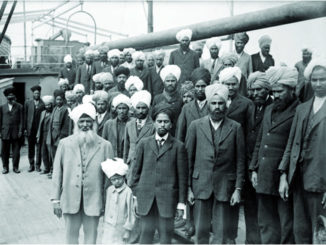
The saga of Komagata Maru
The Komagata Maru incident involved the Japanese steamship Komagata Maru, on which a group of people from British India attempted to immigrate to Canada in April 1914, but most were denied entry and forced to return to Calcutta, where at least 19 people were killed in a clash with British soldiers. IN 2017, the Akal Takht, the highest temporal seat of the Sikhs, accorded the status of martyrs upon those killed in Komagata Maru tragedy.
On May 20, 2016, Canadian Prime Minister Justin Trudeau rendered an apology in Parliament, saying ‘More than a century ago, a great injustice took place.’ This was one of the rare occasions when a sitting public ofcial apologised publicly for a controversial historic event. What he wasapologising for was the SS Komagata Maru incident of 1914, when aship laden with Indian immigrants was refused entry at the Canadian ports.
It was a time when Canada’s immigration policies were an actively racialised endeavour. The objective of the Canadian government was to attract more British and American immigrants, as well as immigrants from the ‘preferred countries’ of central and northern Europe. This strict hierarchy continued till the Second World War, with a more inclusive policy only being adopted in the 1960s.
Suffice it to say, Indians and other ‘Asians’ were on the bottom deck, actively kept out due to Western paranoia about them coming and taking up local jobs and introducing their ‘ways of life.’
As per the Canadian government’s 1908 Continuous Passage Act, all potential immigrants had to make a continuous journey to Canada, with no stops. A later amendment stated that no immigrant of ‘Asiatic’ origin would be permitted unless they were in possession of $200, a signicant sum even today.
Canada at the time was actually seeing a period of increased migration from Europe, with its more direct routes. A journey from law. This was, therefore, just another case of ‘smart discrimination,’ part of a concerted Asian-exclusion policy by the Canadian Government, to keep the ‘unwanted’ out.
Matters came to a head with the Komagata Maru incident.
The story begins in 1913. Gurdit Singh was a well-to-do Sikh contractor from Amritsar, who had also lived variously in south-east Asia. During a visit to Hong Kong in 1913, he came across a large contingent of Sikhs who were looking to immigrate to the United States or Canada.
The ship set sail from Hong Kong on April 4, 1914, with 165 passengers, and more joining in Shanghai and Yokohama. It left Yokohama on May 3 with 376 passengers and sailed into Burrard Inlet, near Vancouver, on May 23. The Canadian authorities, however, citing the policy, refused permission to dock and the passengers were detained on board. A two-month stalemate followed, with negotiations, political manoeuvring and talks taking place. Conditions aboard were abysmal for the passengers, with a shortage of food and water.
‘Shore’ committees were formed to help the passengers with provisions, both food and legal, by Indians in Vancouver. Protest meetings were also held in the city. But on July 23, the ship was forced to turn back, with only 20 people satisfying the authorities to
stay back and the rest having their dreams shattered.
The ship’s departure, however, was just the beginning of the saga though—the passengers faced the iron st of the British authorities, to much more violent ends, on the return voyage.
It was the time when the revolutionary Ghadar movement was sweeping across the Indian diaspora in the USA and Canada. Theleaders planned to return to India and foment a revolution. Clarion calls were sounded across Indian student societies across the Pacic Coast, including California and Oregon, urging Indians to ‘go home’.
The British were not in the dark about what was brewing. They were ell-prepared for it, and the passengers of the Komagata Maru had to bear the brunt of the response. They even passed an ordinance restricting the liberties of any Indian returning to the country after September 5, 1914, and the ship’s passengers were one of the first to be charged. The SS Komagata Maru arrived at the Budge Budge dock in Calcutta on September 27, only to be welcomed by British gunboats at the entry into the port. The passengers were charged as political agitators who had acted illegally. A riot ensued, as the police stepped in to capture Gurdit Singh and other leaders. In the ruckus, 19 passengers were shot and killed, the rest were incarcerated or kept under house arrest until WWI ended. Gurdit Singh escaped, but eventually gave himself up and served a ve-year term.
Komagata Maru was an incident that not only shaped Indian immigration but galvanised Indian nationalism, particularly with the Ghadar movement. The confrontation became a rallying point in a diasporic movement for social justice and a springboard for an international, anti-colonial sentiment.
In 1952, the Indian government erected a monument to the martyrs of Komagata Maru at Budge Budge. September 29 is marked as memorial day when Sikhs visit Budge Budge to pay homage.
While remembered as a dark phase in Canadian history, the story still remains largely forgotten in India.
Source: Live History India
-

Ghadar Movement: The rebels who wrote history
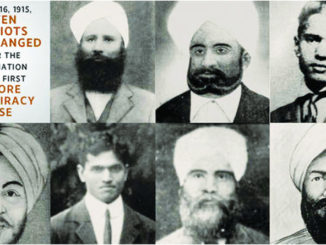
On November 16, 1915, seven patriots were hanged after the culmination of the first Lahore Conspiracy Case. These hangings, however, did not deter the Ghadarites from waging a war against the British. These included Bakshish Singh, Jagat Singh, Vishnu Ganesh Pingle, Surain Singh s/o Boor Singh, Surain Singh s/o Ishar Singh, Harnam Singh and Kartar Singh Sarabha. These trials were to have an enduring impact on the psyche of Punjab and reverberations on India’s history. These hangings by the colonial government were one of the many in order to curb the war declared by the Ghadarites on the colonial government in India in February of 1915.
Events that led to Ghadar
A week after Britain declared war on Germany on August 4, 1914, a clarion call had appeared in Ghadar, a weekly revolutionary newspaper published from San Francisco, summoning its overseas Indian readers to return to their homeland and fight. It said the opportunity to free their country from slavery had arrived.
This was so because Britain was quite vulnerable due to depletion of troops and resources. Also, its arch-enemy Germany was offering support to various revolutionary movements which had the potential of undermining the strength of the Empire. These included the Indian and Irish national revolutionists and the pro-Ottoman pan-Islamists. This was how the Ghadar Movement was launched among the Punjabi migrant workers in North America in 1913. It was characterised by a predominant Punjabi male participation and was a ringing explosion in the ears of the imperial government of the time.
The Ghadar Party was established by the Punjabi Sikhs of the USA and Canada in June 1913 also known as the Hindi Association of the Pacific Coast. The word ‘Ghadar’ means “mutiny” or “rebellion” or “revolt”. On November 1, 1913, the Ghadar Party issued their first newspaper from University of California in Berkeley. This party was originally built around the weekly paper Ghadar. For the first time, a true picture of the British rule was shown in the journal, simultaneously enunciating a vision for the future of India. In fact, the founders envisioned that the Ghadar would do the work of preparing the Indians for revolt until the actual war.
Today, it is important to remember the martyrs and the specific conditions that led the erstwhile loyal ‘Sikhs’ to turn against their imperial benefactors. At the heart of the movement was the Punjabi farmer-soldier-turned-labourer abroad, driven out by the accretion of economic problems at home.
In the decade before the seeds of this large-scale unrest were sown by the imperial government in Punjab, the agrarian legislation, the colonisation Bill, issues of water rates and enhancement of land revenue had largely contributed to Punjabi men being forced to migrate in search of economic opportunities. At the same time the Indian National Association, the Indian National Congress, the Swadeshi Movement and the activities of Zamindara League (Unionist Party) had contributed to the political awakening of the Punjabis.
The Sikh connection
It is a curious question of history as to how the Sikh community in Punjab which was given the distinction of being a ‘martial race’ by the British, turned around to demand complete independence and plan a violent stratagem against their benefactors. The spectacular display of material prosperity, the spring of freedom in the steps of white people and the opportunities of economic mobility in the USA and Canada led the pioneer migrants to understand their own depravity induced by slavery to an imperial power. The white Canadians and Americans believed that they belonged to a superior and civilised race whereas Indians and other Asians were considered uncivilised.
During the first decade of the 20th century, 5,000 Indians reached Canada. Out of these more than 90 per cent were Sikhs. The harsh racial differentiation, violent attacks by white labourers and hoodlums led to a feeling of humiliation and shame among these Indian migrants. They believed they were subjected to this treatment because they were citizens of a slave nation. The British at that time did not want Indians associating or interacting with white people. This led to measures being taken by the Canadian government, then a colony of Britain, discouraging immigration from India. The freedom offered by these countries to the migrants propelled the transition to a demand for a more just social order.
These socio-political conditions led to the birth of the Ghadar Party, a party that gave expression to the evolved understanding of the repercussions of colonial rule in India. Although strict interpretation of its character is difficult without being unfair to its secular participants, numerically the Ghadar was largely a Sikh movement. The Komagata Maru incident was the final spark that ignited an already inflamed Sikh pride. The aftermath of this incident was a burst of revolutionary activity in the migrant Sikhs to redeem themselves from both the shame of allegiance to the British government in 1857 and their own cursed status as a slave nation.
Literary legacy
The Ghadar was no ordinary movement neither in its scope of influence nor its tactics. Maia Ramnath has observed in her book, Haj to Utopia that the Ghadar’s printed material served as connective tissue or switching circuit, capable of linking various elements among the Indian radicals abroad. It also linked Indian radicals to other networks, and also connected pre to post-war revolutionary movements inside the country. This movement in its overall assessment has been termed as a “heroic failure” by Ghadar historian Harish K Puri. Although it largely failed to impact the colonial government in ways its members had originally anticipated, its cultural reach extends to this day.
The literature of Ghadarites was strikingly separate from any talk of fatalism. Instead it spoke to the higher ideal in men while looking at the ultimate fate in its eye. It remains a shiny reminder of the refusal of a population which formed the spine of the military prowess of the colonisers to yield to exploitation, a doomed attempt of unthinkable courage and splendid patriotism. It is a story of our forefathers which merits remembrance and retelling.
The Ghadar Movement was the first Indian movement with truly global linkages that effectively kick-started the movement of immigrants for equal rights and consolidated the integration of migrants into their new nations. It needs to be remembered that the participants being largely Sikh, the ideas of egalitarianism, sacrifice, service and martyrdom formed the bedrock of the political thinking of this and the later resistance movements in the region.
A struggle like Ghadar which failed in its overall objective and did not gain the large-scale support of the citizenry has a tendency to be relegated into historical insignificance. However, this is the exact reason why it must be remembered that not every battle is about victory.
Parallels can be drawn with the widespread desire of today’s Punjabi youth for migration abroad. The fact that it speaks volumes about the socio-economic conditions here is not lost to anyone. The demand for fair migratory opportunities is a prominent legacy of the Ghadar.
The rejection of sectarianism, calling out for social justice and demand for a just society, are vestiges of its cultural impact. In line with Kartar Singh Sarabha’s daring conviction ‘the blood of martyrs never goes waste’, the failure of the Ghadar Movement proved to be a landmark in the struggle for freedom. It inspired the likes of Bhagat Singh who considered Kartar Singh Sarabha his role model towards a revolutionary change. It will be right to conclude that the dreams of these primal modern revolutionaries must be remembered on the day of their martyrdom to serve as a light post for the future we aspire to as a society and a country and to forever be grateful.
Source: The Tribune