Tag: Goa

  • India’s freedom struggle: From first invasion to midnight of Independence

    India’s freedom struggle: From first invasion to midnight of Independence

    India’s journey to freedom was neither swift nor simple-it was a centuries-long saga of resilience, rebellion, and renaissance. While the climax arrived on 15 August 1947, the struggle had its roots in the earliest invasions that disrupted the subcontinent’s autonomy. This story spans from medieval conquests to colonial exploitation, from fragmented resistance to unified nationalism, and from armed uprisings to non-violent mass movements.
    Before the Raj: Early Invasions
    The Turkish and Mughal Periods

    The first significant foreign incursions into India’s political structure began with Mahmud of Ghazni’s raids in the 11th century, followed by Muhammad Ghori’s conquests in the late 12th century. These invasions led to the establishment of the Delhi Sultanate (1206-1526), which reshaped governance and trade but also saw resistance from local rulers like the Rajputs.
    The arrival of the Mughals in 1526, under Babur, ushered in a new imperial order. While the Mughal period (especially under Akbar) was known for cultural synthesis, by the 18th century, weakening central control allowed European trading companies to gain influence.
    The European Footprint: Traders to Rulers
    Portuguese and Dutch Presence
    The Portuguese, led by Vasco da Gama’s arrival in 1498, were the first Europeans to establish a foothold, controlling ports like Goa. The Dutch East India Company followed, though their influence remained largely in trade.
    The British East India Company
    An official of the East India Company in processionSurrounded by Indians, a colonial official of the British East India Company moving on horseback in a procession. Watercolor on paper, c. 1825–30. The British first arrived not as conquerors, but as merchants, drawn by India’s extraordinary wealth, which had been famous in the West since Greek times. They arrived to find India dominated by the vast Mughal empire, which had been established in the 16th century by the conqueror Babur and now ruled most of the subcontinent. In 1613, the Mughal emperor Jahangir granted the British permission to establish a trading post in Surat, Gujarat, which would become the first British foothold in India.
    Over the following century, the British East India Company established additional trading posts and also gradually increased its economic and political influence throughout the subcontinent. After the death of Emperor Aurangzeb in 1707, the Mughal empire entered a rapid phase of decline, providing an opening for various regional powers, including the Marathas, the Sikhs, and the northern Rajput chiefs to assert their sovereignty. By the middle of the 18th century, there was no longer a single dominant power in the subcontinent, leaving the region vulnerable to colonial ambitions.
    The Battle of Plassey
    The Battle of Plassey in 1757, part of the larger Seven Years’ War between Britain and France, was a turning point in the British conquest of India. The East India Company had increasingly solidified its position and was now regarded by native rulers as a serious threat. The nawab (ruler) of Bengal, Siraj al-Dawlah, favoring an alliance with the French, had previously attacked company trading posts. With the help of some of the nawab’s own generals, the British were able to defeat and depose the nawab at the Battle of Plassey and appointed their own administration in Bengal. This crucial victory marked the transformation of the British East India Company from a mere mercantile presence into a military and political power in India. The company would go on to consolidate its power over the Indian subcontinent through a series of military campaigns. It established its dominance in Bengal and Bihar with the Battle of Buxar (1764), in southern India with Tipu Sultan’s defeat in the fourth Mysore War (1799), and in the Punjab following the second Sikh war (1848-49).
    The Rebellion of 1857 and the British raj
    By the 1850s, the company had consolidated its rule over much of India, fostering widespread discontent and a pattern of unrest that produced localized uprisings such as the Sannyasi Rebellion in the late 18th century and the Santhal Rebellion of 1855–56. On May 10, 1857, however, a rebellion erupted in Meerut that would profoundly alter the dynamic between India and Britain. Sepoys (Indian soldiers) in the company’s service shot their British officers and marched to Delhi, rallying local troops to their cause. By the evening of May 11, they had declared the aged Bahadur Shah II the emperor of India, symbolically restoring the Mughals to power and rejecting British rule.
    The Rebellion of 1857, often called as the Sepoy Mutiny in traditional British historiography, spread rapidly across northern and central India. It produced fierce battles at Delhi, Kanpur, and Lucknow, and it eventually involved leaders such as Nana Sahib, Tantia Tope, and Lakshmi Bai, the rani (“queen”) of Jhansi. Lakshmi Bai in particular became a legendary symbol of resistance against British rule; after the British attempted to annex Jhansi using the pretext of the doctrine of lapse, Lakshmi Bai took command of the rebels in the Bundelkhand region and fought valiantly before being killed in battle on June 17, 1858.
    By the end of 1858, the revolt was largely suppressed. The British captured Bahadur Shah II and exiled him to Rangoon (now Yangon, Myanmar [Burma]), where he died in 1862, marking the end of the Mughal dynasty. In response to the revolt, the British government recognized the administrative failures of the East India Company, and the British crown assumed direct rule of India, initiating the period known as the British raj.
    The failure of the revolt had a profound psychological impact on the people of India. The sepoys, the native princes, the queen of Jhansi, and the heir of Mughal grandeur had made their stand against the British—and they had failed. From this time all serious hope of a revival of the past or an exclusion of the West diminished. The traditional structure of Indian society began to break down and was eventually superseded by a Westernized class system, from which emerged a strong middle class with a heightened sense of Indian nationalism.
    Formation of the Indian National Congress
    Yet the struggle continued. On December 28, 1885, the Indian National Congress (Congress Party) was formed, marking the inception of the first major nationalist movement to emerge in the British Empire outside Britain. Led largely by Allan Octavian Hume, a retired British civil servant sympathetic to the cause of Indian freedom, the Congress Party was initially established as a platform for educated Indians to discuss political issues and advocate for a greater role in governance. The first meeting was held in Bombay (now Mumbai), drawing 72 delegates from across the Indian subcontinent. These initial delegates were largely Western-educated and from elite backgrounds and focused on moderate reforms rather than outright independence.
    By the early 20th century, a strong “extremist” faction emerged within the Indian National Congress in response to British policies, especially after the 1905 partition of Bengal, which was widely viewed as an attempt to weaken nationalist sentiment in the region. The partition of Bengal sparked the Swadeshi Movement (swadeshi: “of one’s own country”), the first organized mass action against British rule; though it declined by 1908, its central aim was achieved when the partition was annulled in 1911. By 1907, a clear delineation existed within the Congress between the “extremists,” led by Bal Gangadhar Tilak, Bipin Chandra Pal, and Lala Lajpat Rai, and the “moderates,” led by Gopal Krishna Gokhale.
    Formation of the All-India Muslim League
    The All-India Muslim League, the first political party for Muslims in India, was founded in Dhaka (now the capital of Bangladesh) on December 30, 1906. This development was driven by the increasing dissatisfaction among Indian Muslims with the Indian National Congress, which many perceived as primarily representing Hindu interests. The party was heavily influenced by the visionary Indian Muslim leader Sir Sayyid Ahmad Khan, who had died in 1898, and was founded by leaders including Mian Muhammad Shafi, Nawab Waqar-ul-Mulk, Nawab Mohsin-ul-Mulk, Syed Ameer Ali, Mualana Mohammad Ali Jouhar, and Sir Sultan Mohammed Shah (the league’s first president, also known as Aga Khan III). Sir Muhammad Iqbal would emerge as a key voice within a few years of the party’s founding.
    The league aimed to safeguard the rights of Indian Muslims and initially espoused loyalty to the British raj as a means to achieve greater civil rights and counterbalance the dominance of the Congress Party. The Muslim League would eventually lay the groundwork for modern Pakistan. Mohammed Ali Jinnah, who joined the league in 1913, would later transform the political party into a mass movement for Muslim autonomy.
    Gandhi’s return from South Africa
    Mohandas Karamchand Gandhi, later known as Mahatma (“Great Soul”) Gandhi, was born in 1869 in Porbandar, India, and initially trained as a lawyer in England before relocating to South Africa. There, he advocated for civil rights and developed his foundational philosophy of nonviolent resistance. After spending over two decades in South Africa, Gandhi returned to India in 1915 amid the backdrop of World War I and joined the Indian National Congress. Initially, he remained at the periphery of the movement, supporting the British war effort and refraining from political agitation. However, his perspective shifted dramatically following the enactment of the Rowlatt Act in 1919.
    The Rowlatt Act is passed
    In February 1919 the British government passed the Rowlatt Act, which empowered authorities to imprison suspected independence activists without trial and allowed for certain political cases to be tried without juries. The object of this act was to replace the repressive provisions of the wartime Defence of India Act with a permanent law. Indians felt profoundly betrayed after their support of Britain throughout World War I, and resentment spread throughout the country. Gandhi, provoked by the act, announced his initial satyagraha (“clinging to truth”) struggle, advocating nonviolent civil disobedience, which would lead to a political earthquake throughout the spring of 1919.
    The Jallianwala Bagh Massacre
    On April 13, 1919, British troops under the command of Gen. Reginald Dyer fired on a crowd of unarmed civilians in Amritsar. Following Gandhi’s calls for resistance and a one-day general strike earlier that month, protests had broken out across the country, particularly in Punjab. In Amritsar, following the arrests of prominent Indian leaders, protests had turned violent on April 10. A force of several dozen troops commanded by General Dyer was tasked with restoring order, and among the measures taken was a ban on public gatherings.
    On the afternoon of April 13, a crowd of at least 10,000 men, women, and children gathered in the Jallianwala Bagh, a public garden near the Golden Temple that was nearly completely enclosed by walls and had only one exit. It is not clear how many people there were protesters who were defying the ban on public meetings and how many had come to the city from the surrounding region to celebrate Baisakhi, a spring festival. Dyer and his soldiers arrived and sealed off the exit. Without warning, the troops opened fire on the crowd, reportedly shooting hundreds of rounds until they ran out of ammunition. It is not certain how many died in the bloodbath, but, according to one official British report, an estimated 379 people were killed, and about 1,200 more were wounded. After they ceased firing, the troops immediately withdrew, leaving behind the dead and wounded.
    The shooting was followed by the proclamation of martial law in Punjab that included public floggings and other humiliations. Indian outrage grew as news of the shooting and subsequent British actions spread throughout the subcontinent. The Bengali poet and Nobel laureate Rabindranath Tagore renounced the knighthood that he had received in 1915. Gandhi was initially hesitant to act, but he soon began organizing the noncooperation movement (1920–22), his first large-scale and sustained nonviolent protest campaign.
    The noncooperation movement
    Launched in 1920 Gandhi’s noncooperation movement, backed by the Congress Party, was a mass protest against British authority advocating nonparticipation in colonial institutions. Indians were encouraged to resign from their titles; boycott government educational institutions, courts, government services, foreign goods, and elections; and, eventually, refuse to pay taxes. The noncooperation movement rapidly gained momentum amid growing national anger toward the British raj, particularly in the wake of the Rowlatt Act and the Jallianwala Bagh massacre. The heavy-handedness of the British government and its failure to adequately address the actions of General Dyer only intensified the Indian resolve for self-governance.
    By 1921 the British government, confronted with a united Indian front for the first time, was visibly shaken. The noncooperation movement had definitively shown the potential of united, nonviolent civil disobedience against the colonial regime; additionally, it marked the transition of Indian nationalism from a middle-class movement to a nationwide struggle. Gandhi, at this point, emerged as the de facto leader of both the Indian National Congress and the independence movement itself. The noncooperation movement also drew support from the Khilafat movement, which was mobilizing Muslim protest against the dissolution of the Ottoman empire after World War I. Gandhi’s solidarity with the Khilafat movement helped strengthen Hindu-Muslim unity during this phase of the independence struggle.
    However, Gandhi called an end to the noncooperation movement in 1922 after an angry mob in Chauri Chaura killed 22 police officers. Gandhi feared that the movement was becoming violent, contrary to its principles. Gandhi was arrested for sedition that year and sentenced to six years in prison. Jawaharlal Nehru, a young leader within the Congress Party who would later become India’s first prime minister, had been arrested the previous year for anti-government activity and released a few months later.
    Gandhi was released in 1924 after serving only two years of his sentence. By the time of his release, the political landscape had changed significantly. The Indian National Congress had split into two factions: one led by Chittaranjan Das and Motilal Nehru (the father of Jawaharlal Nehru), favoring participation in the British-dominated legislative councils as a means to gain political influence, and the other led by Chakravarti Rajagopalachari and Vallabhbhai Patel, opposing this approach and advocating for a more assertive stance against British authority. Additionally, the unity between Hindus and Muslims had deteriorated. In 1924 Gandhi was named president of the Congress Party, a position he held for a year.
    Declaration of Purna Swaraj
    On January 26, 1930, the Indian National Congress publicly declared its Purna Swaraj (“Complete Self-Rule”) resolution, decisively rejecting the idea of dominion status within the British Empire and establishing full sovereignty as the goal of the independence movement. Initially, some leaders within the movement had aimed for dominion status, which would have given India a position similar to that of Canada and Australia within the British Empire. However, as the movement progressed, this idea was increasingly viewed as inadequate by Congress Party leaders.
    The resolution was initially passed by the Congress Party on December 19, 1929, during the presidency of Jawaharlal Nehru, who at the time was the youngest person to hold that position in the party. The resolution was publicly declared the following month, with the Congress Party urging Indians to celebrate January 26 as Independence Day. Although August 15 was later chosen as India’s official Independence Day after achieving independence in 1947, the date January 26 remained significant. The constitution of India was drafted to take effect on January 26, 1950, to honor the 1930 declaration, marking India’s transition to a republic. Today, January 26 is celebrated annually as Republic Day in India.
    The Salt March
    In March 1930 Gandhi launched the Salt March (popularly known as the Dandi March), a satyagraha campaign against the British monopoly on salt. Salt production and distribution in India had long been a lucrative monopoly of the British. Through a series of laws, the Indian populace was prohibited from producing or selling salt independently, and instead Indians were required to buy expensive, heavily taxed salt that often was imported. This affected the great majority of Indians, who were poor and could not afford to buy it. Indian protests against the salt tax began in the 19th century and remained a major contentious issue throughout the period of British rule.
    Gandhi decided to mount a highly visible demonstration against the increasingly repressive salt tax by marching through what is now the western Indian state of Gujarat from his ashram (religious retreat) at Sabarmati (near Ahmadabad) to the town of Dandi (near Surat) on the Arabian Sea coast. He set out on foot on March 12, accompanied by several dozen followers. After each day’s march the group stopped in a village along the route, where increasingly larger crowds would gather to hear Gandhi speak about the unfairness of the tax on poor people. Hundreds more would join the core group of followers as they made their way to the sea, until on April 5 the entourage reached Dandi after a journey of some 240 miles (385 km). On the morning of April 6, Gandhi and his followers picked up handfuls of salt along the shore, thus technically “producing” salt and breaking the law.
    In May Gandhi was arrested after informing Lord Irwin, the viceroy of India, of his intention to march on the Dharasana saltworks. Gandhi’s arrest further fueled the movement, prompting tens of thousands more people to join the satyagraha. On May 21 Sarojini Naidu, a well-known political activist and poet, led a march to the saltworks, where many of the 2,500 peaceful marchers were brutally attacked and beaten by police. By the end of 1930 approximately 60,000 people were imprisoned as part of the civil disobedience campaign. In January 1931 Gandhi was released from custody and began negotiations with Irwin, leading to the Gandhi-Irwin Pact, signed on March 5, 1931. This truce ended the satyagraha campaign and allowed Gandhi, accompanied by Naidu, to represent the Indian National Congress at the second section of the Round Table Conference in London later that year. This session, however failed to reach agreement, either on a constitutional framework or on communal representation.
    The Poona Pact, Ambedkar, and the movement against “untouchability”
    The Poona Pact, signed on September 24, 1932, was a significant agreement between Hindu leaders and Dalit representatives, granting new rights to Dalits, Hindu caste groups then labeled “untouchables.” This agreement arose from the British government’s Communal Award, which proposed separate electorates for Dalits to ensure their political representation. Bhimrao Ramji Ambedkar, the most prominent Dalit leader, supported the proposal, believing that it would allow Dalits to advance their interests. However, Mahatma Gandhi opposed separate electorates, fearing that it would divide the Hindu community and weaken India’s fight for independence. While imprisoned, Gandhi began a fast unto death on September 18, 1932, to protest the separate electorates. Faced with Gandhi’s deteriorating health, Ambedkar and Hindu leaders negotiated the Poona Pact, which increased Dalit representation within the Hindu electorate instead of creating separate electorates.
    Ambedkar’s advocacy of Dalit rights was rooted in his personal experiences of discrimination and his extensive education. Born on April 14, 1891, into a Dalit Mahar family, Ambedkar faced severe social exclusion from an early age. Nonetheless, he excelled academically, to the extent that he came to the attention of Sayajirao Gaekwad III, the maharaja of Baroda (now Vadodara). The maharaja provided financial support for Ambedkar’s education at Bombay’s Elphinstone College and later at Columbia University in the United States and the London School of Economics in Britain. Ambedkar would use this education to champion the cause of Dalit rights upon his return to India. Ambedkar would also later become the chairman of the Drafting Committee of the Constitution for the future Republic of India.
    Although the Poona Pact was a significant development in the movement against “untouchability,” Ambedkar felt coerced into the agreement by Gandhi’s threat of suicide by starvation. Nonetheless, Ambedkar’s work would continue. He would found several journals for Dalits and, through his later role in drafting the Indian constitution, secure special representation for them in legislative councils. His efforts laid the foundation for future advancements in social justice and the eventual outlawing of untouchability, although cultural caste prejudice continues to persist in India.
    Provincial elections of 1937
    Following the Government of India Act of 1935, which granted significant autonomy to the provinces of India in response to increasing momentum in the struggle against British rule, elections were held during the winter of 1936–37, and results were declared in February 1937. The Indian National Congress emerged victorious in seven provinces, demonstrating its popularity with the Indian populace. This allowed the Congress Party to form provincial governments, giving Indians significant control over local governance for the first time in over a century. The Muslim League, however, was unable to establish a government in any province, even the Muslim-majority provinces of Punjab and Bengal. The Congress Party ministries resigned only a few years later, in 1939, in protest against India being declared a belligerent nation in World War II without consultation.
    World War II begins
    With the outbreak of World War II in 1939, the Indian Independence Movement entered its last, crucial phase. The viceroy of India, Victor Alexander John Hope (commonly known as Lord Linlithgow), declared that India was at war with Germany, to the dismay of the Congress Party, which had not been consulted. Throughout the war, Indian soldiers would fight for Britain in Asia, Africa, and Europe.
    The Indian National Congress, under the leadership of figures like Mahatma Gandhi and Jawaharlal Nehru, grappled with how to respond to the war. Gandhi, a staunch anti-fascist, was fundamentally opposed to all forms of violence, including war. However, he was equally critical of British colonialism. Initially, the Congress Party was willing to support the British war effort, provided that Britain assured India of eventual self-governance. However, the British did not agree to this condition, leading the Congress Party to distance itself from Britain as the war progressed. In contrast, the Muslim League fully supported the war effort.
    The Lahore Resolution and the idea of Pakistan
    In March 1940 the Muslim League fully resolved to chart its own path. In Punjab’s ancient capital of Lahore, the league called for the creation of a separate state for Muslims, under the leadership of Mohammad Ali Jinnah. The famous Lahore Resolution, later known as the Pakistan Resolution, was passed by the largest gathering of league delegates just one day after Jinnah informed his followers that “the problem of India is not of an inter-communal but manifestly of an international character.” The league resolved, therefore, that any future constitutional plan proposed by the British for India would not be “acceptable to the Muslims” unless it was so designed that the Muslim-majority “areas” of India’s “North-Western and Eastern Zones” were “grouped to constitute ‘independent States’ in which the constituent units shall be autonomous and sovereign.” Although the term “Pakistan” was not mentioned in the resolution itself, it was popularized by the Hindu press in their coverage shortly after the resolution was passed, and the term was then widely adopted by Muslims. Jinnah later clarified that the resolution envisioned the establishment of not two separately administered Muslim countries but rather a single Muslim nation-state—namely, Pakistan.
    The Quit India Movement
    On July 14, 1942, the Congress Party passed its “Quit India” resolution calling for an immediate end to British rule in India. The involvement of India in the war outraged many Indian political leaders, who, despite a range of opinions on the just nature of the war, thought it was morally wrong for the British to force their subjects into the fighting without consulting Indian leadership and to use Indian resources for the effort. By the war’s end 2.5 million Indians had served in the British armed forces, though the majority were volunteers.
    As the war continued and Japanese armies swept through Britain’s Southeast Asian colonies—Singapore, Malaya (now Malaysia), and Burma (now Myanmar)—a faction of the Congress Party began to call for India to gain immediate independence from Britain in order to avoid a Japanese invasion. Japanese forces moved into the Bay of Bengal, attacked British ships, and bombed the east coast ports of Visakhapatnam and Kakinada, thus making the threat of full-scale war on Indian soil seem imminent. Gandhi became more adamant about the departure of the British colonists and less concerned about internal squabbles among Indian leadership. He notably demanded of the British in his magazine Harijan on May 24, 1942: “Leave India to God. If that is too much leave her to anarchy.”
    The Congress Party’s resolution authorized Gandhi to lead a mass nonviolent protest movement if independence was not granted. The slogan “Quit India” was coined by the mayor of Bombay (now Mumbai), Yusuf Meherally. When the British government failed to meet its demands, the Congress Party met in Bombay and voted on August 8 to initiate the Quit India Movement. During that meeting, Gandhi delivered his “Do or Die” speech, in which he famously declared: “The mantra is ‘Do or Die.’ We shall either free India or die in the attempt; we shall not live to see the perpetuation of our slavery.”
    The morning after the Quit India resolution was agreed upon in Bombay, British authorities invoked the Defense of India Act, which permitted detention without a trial, to arrest Gandhi and dozens of other leaders of the Congress Party, including Jawaharlal Nehru, Abul Kalam Azad, and Vallabhbhai Patel. Concern for Gandhi’s age and fear of worldwide condemnation persuaded the British not to jail Gandhi, and instead they confined him in the Aga Khan summer palace in Pune along with his wife, Kasturba, his secretary, and some followers. The British authorities erroneously hoped they could stifle the movement by imprisoning its leaders.
    The British authorities were, however, misguided. Younger leaders stepped forward; among the most prominent of these was Aruna Asaf Ali, who presided over the August 9 Congress session in Bombay, hoisted the Congress flag, and galvanized protesters across the country. The absence of senior Congress leaders also enabled more militant forces to turn the movement in a more incendiary direction. The British government, particularly secretary of state Leopold Amery in a radio address, further fanned the flames by justifying the arrests of the Congress Party leaders as a means of preventing mass violence. Amery’s description of the movement’s disruptive tactics might have inadvertently given voice and legitimacy to those very actions among more militant protesters. Also partly due to the lack of Congress Party leaders emphasizing nonviolence, many demonstrations turned into attacks on the British themselves and parts of the British raj’s infrastructure. Telegraph lines and railroads were destroyed, and hundreds of railway stations, post offices, and police stations were burned down or damaged.
    The British response to these protests was often brutal. The military, already present in India in larger than usual numbers for the war effort, was deployed to disperse rioters, and in a few cases airplanes were instructed to fire their machine guns on the crowds from the air. Parts of the United Provinces, Bihar, the North-West Frontier, and Bengal (now West Bengal state and Bangladesh) were bombed and strafed by pilots as the British raj resolved to crush all Indian resistance as swiftly as possible. Thousands of people were killed or wounded, and roughly 60,000 arrests were made in the first few months. Most of those arrested, along with the leaders of the Congress Party, were imprisoned for the duration of World War II to prevent further protests, although Gandhi was released on May 6, 1944, because of his failing health.
    Although the movement failed to achieve its stated aim of gaining India’s immediate independence from British rule, its impact was profound. The Quit India Movement demonstrated the willingness of ordinary Indians to take action to advance their independence and proved to the British government the necessity of decolonization after World War II.
    Subhas Chandra Bose and his Indian National Army
    Running parallel to the activities of Gandhi, Nehru, and the other nationalist leaders was the career of Subhas Chandra Bose, an individual with a biography worthy of Shakespearean tragedy. Commonly known as Netaji (“Respected Leader”), he was at times an ally and at other times an adversary of Gandhi. Dedicated to the independence movement from a young age, he advocated for broad industrialization, in contrast with Gandhi’s preference for cottage industries, and favored a militant approach to the independence struggle, as opposed to Gandhi’s insistence on nonviolence.
    During World War II, Bose sought alliances with Germany and Japan. Desperate for military support, he believed that they could aid India in driving the British out. In 1943, with Japanese aid and assistance, he proclaimed the establishment of a provisional independent Indian government and formed a trained army of about 40,000 troops in Japanese-occupied Southeast Asia, which he called the “Indian National Army” (Azad Hind Fauj). Alongside Japanese troops, his forces advanced to Rangoon (now Yangon) and thence overland into India, reaching Indian soil on March 18, 1944, and moving into Kohima and the plains of Imphal.
    In a stubborn battle, the mixed Indian and Japanese forces, lacking Japanese air support, were defeated and forced to retreat; the Indian National Army nevertheless for some time succeeded in maintaining its identity as a liberation army, based in Burma (now Myanmar) and later broader Southeast Asia. With the defeat of Japan, however, Bose’s fortunes ended. A few days after Japan’s announced surrender in August 1945, Bose, fleeing Southeast Asia, reportedly died in a Japanese hospital in Taiwan as a result of burn injuries from a plane crash.
    World War II ends
    By the end of World War II, Britain was greatly diminished, under immense international pressure to decolonize and, following the Quit India Movement, increasingly recognizing the necessity of withdrawal from India. In the 1945 United Kingdom general elections, Churchill’s Conservative Party government was voted out of power, and the new Labour Party prime minister, Clement Attlee, appointed one of Gandhi’s old admirers, Lord Frederick William Pethick-Lawrence, as Secretary of State for India and Burma. With the dawn of the atomic age in August and Japan’s surrender, London’s primary concern in India was how to find the political solution to the Hindu-Muslim conflict that would most expeditiously permit the British raj to withdraw its forces and to extricate as many of its assets as possible from what seemed to the Labour Party to have become more of an imperial burden and liability than any real advantage for Great Britain.

    The 1946 Cabinet Mission
    In 1946 Pethick-Lawrence personally led a three-man cabinet deputation to New Delhi with the hope of resolving the Congress Party–Muslim League deadlock and, thus, of transferring British power to a single Indian administration. Richard Stafford Cripps was responsible primarily for drafting the ingenious Cabinet Mission Plan, which proposed a three-tier federation for India, integrated by a minimal central-union government in Delhi, which would be limited to handling foreign affairs, communications, defense, and only those finances required to care for such unionwide matters. The subcontinent was to be divided into three major groups of provinces: Group A, to include the Hindu-majority provinces of the Bombay Presidency, Madras (now Chennai), the United Provinces (now Uttar Pradesh), Bihar, Orissa, and the Central Provinces (virtually all of what became independent India a year later); Group B, to contain the Muslim-majority provinces of Punjab, Sindh, the North-West Frontier, and Balochistan (the areas out of which the western part of Pakistan was created); and Group C, to include the Muslim-majority Bengal (a portion of which became the eastern part of Pakistan and in 1971 the country of Bangladesh) and the Hindu-majority Assam. The group governments were to be virtually autonomous in everything but matters reserved to the union center, and within each group the princely states were to be integrated into their neighboring provinces. Local provincial governments were to have the choice of opting out of the group in which they found themselves should a majority of their populace vote to do so.
    Punjab’s large and powerful Sikh population would have been placed in a particularly difficult and anomalous position, for Punjab as a whole would have belonged to Group B, and much of the Sikh community had become anti-Muslim since the start of the Mughal emperors’ persecution of their Gurus in the 17th century. Sikhs played so important a role in the British Indian Army that many of their leaders hoped that the British would reward them at the war’s end with special assistance in carving out their own country from the rich heart of Punjab’s fertile canal-colony lands, where, in the kingdom once ruled by Ranjit Singh (1780–1839), most Sikhs lived. Since World War I, Sikhs had been equally fierce in opposing the British raj, and, though never more than 2 percent of India’s population, they had as highly disproportionate a number of nationalist “martyrs” as of army officers. A Sikh Akali Dal (“Party of Immortals”), which was started in 1920, led militant marches to liberate gurdwaras (“doorways to the Guru”; the Sikh places of worship) from corrupt Hindu managers. Tara Singh (1885–1967), the most important leader of the vigorous Sikh political movement, first raised the demand for a separate Azad (“Free”) Punjab in 1942. By March 1946 many Sikhs demanded a Sikh nation-state, alternately called Sikhistan or Khalistan (“Land of the Sikhs” or “Land of the Pure”). The Cabinet Mission, however, had no time or energy to focus on Sikh separatist demands and found the Muslim League’s demand for Pakistan equally impossible to accept.
    Direct Action Day
    As a pragmatist, Jinnah—terminally afflicted with tuberculosis and lung cancer—accepted the Cabinet Mission’s proposal, as did Congress Party leaders. The early summer of 1946, therefore, saw a dawn of hope for India’s future prospects, but that soon proved false when Nehru announced at his first news conference as the reelected president of the Congress Party that no constituent assembly could be “bound” by any prearranged constitutional formula. Jinnah read Nehru’s remarks as a “complete repudiation” of the plan, which had to be accepted in its entirety in order to work. Jinnah then convened the league’s Working Committee, which withdrew its previous agreement to the federation scheme and declared August 16, 1946, to be “Direct Action Day,” a day of nationwide protest by the “Muslim Nation.” Thus began India’s bloodiest year of civil war since the mutiny nearly a century earlier. The Hindu-Muslim rioting and killing that started in Calcutta sent deadly sparks of fury, frenzy, and fear to every corner of the subcontinent, as all civilized restraint seemed to disappear.
    Lord Mountbatten’s arrival
    Lord Louis Mountbatten (served March–August 1947) was sent to replace Archibald Percival Wavell as viceroy as Britain prepared to transfer its power over India to some “responsible” hands by no later than June 1948. Shortly after reaching Delhi, where he conferred with the leaders of all parties and with his own officials, Mountbatten decided that the situation was too dangerous to wait even that brief period. Fearing a forced evacuation of British troops still stationed in India, Mountbatten resolved to opt for partition, one that would divide Punjab and Bengal, rather than risk further political negotiations while civil war raged and a new mutiny of Indian troops seemed imminent. Among the major Indian leaders, Gandhi alone refused to reconcile himself to partition and urged Mountbatten to offer Jinnah the premiership of a united India rather than a separate Muslim nation. Nehru, however, would not agree to that, nor would his most powerful Congress Party deputy, Vallabhbhai Patel, as both had become tired of arguing with Jinnah and were eager to get on with the job of running an independent government of India.
    The Indian Independence Act
    Britain’s Parliament passed in July 1947 the Indian Independence Act. It ordered that the dominions of India and Pakistan be demarcated by midnight of August 14–15, 1947, now celebrated annually as Independence Day in both Pakistan (August 14) and India (August 15). It was both a glorious and a tragic moment. The peoples of the subcontinent, though deeply divided, were now free and the masters of their own destinies. Just before midnight, Nehru made his famous “Tryst with Destiny” speech to the Indian Constituent Assembly in the Parliament House.
    The Partition of India and Pakistan
    The Indian Independence Act ordered that the assets of the world’s largest empire—which had been integrated in countless ways for more than a century—be divided within a single month. Racing the deadline, the Boundary Commission, appointed by Mountbatten, worked desperately to partition Punjab and Bengal in such a way as to leave the maximum practical number of Muslims to the west of the former’s new boundary and to the east of the latter’s. The commission consisted of four members from the Congress Party and four from the Muslim League and was chaired by Cyril Radcliffe, a lawyer who had never before been to India. With little agreement between the parties and the deadline looming, Radcliffe made the final determination of the borders, which satisfied no one and infuriated everyone.
    Dividing Punjab and Bengal, the provinces with a slim Muslim majority, caused tremendous problems, as the demographic distributions of those regions were heterogeneous and diverse. The new borders ran through the middle of villages, towns, fields, and more. When Pakistan was created, East and West Pakistan were separated by about 1,000 miles (1,600 km).
    The commission also effectively cut in half the large Sikh population in Punjab. The western half of the community reacted with great concern over potential Muslim rule: the Mughal emperors had persecuted the Sikh Gurus in the 17th century, and the legacy of that persecution remained deeply felt. Although the commission had placed Amritsar, the Sikhs’ most sacred city, under Indian dominion, many other important Sikh shrines and landed estates were set to become part of Pakistan. Some Sikhs of western Punjab tried initially to retain control over their estates by pushing out local Muslims, but their attempts were met with violent reprisals. Nearly the entirety of the Sikh community ultimately fled to areas that would become part of India.
    The transfer of power was completed on August 14 in Pakistan and August 15 in India, held a day apart so that Mountbatten could attend both ceremonies. With the birth of the two independent countries, the British raj formally came to an end on August 15, 1947.
    The borders of the new countries were not published until August 17, two days after the end of British rule. This set the stage for an immediate escalation of communal violence in areas around the new borders. Many people did not understand what partition meant until they were in the middle of it, sometimes literally. If a border village was roughly evenly divided between Hindus and Muslims, one community could argue that the village rightly belonged to India or Pakistan by driving out or killing members of the other community.
    As soon as the new borders were announced, roughly 15 million Hindus, Muslims, and Sikhs fled from their homes on one side of the newly demarcated borders to what they thought would be “shelter” on the other. Some people were able to take trains or buses from one country to another, but most were forced to flee on foot, joining refugee columns that stretched for miles. These columns were the target of frequent ambushes, as were the trains that carried refugees across the new borders. In the course of that tragic exodus of innocents, as many as 2 million people were slaughtered in communal massacres (although scarce documentation left a wide range of estimates). Sikhs, settled astride Punjab’s new division, suffered the highest proportion of casualties relative to their numbers.
    While the worst of the violence took place during the first six weeks of partition, the consequences of those weeks played out for decades. Even provinces that had initially escaped violence later saw outbreaks of conflict; for example, Sindh struggled to absorb large numbers of refugees (muhajirs) from India who, although Muslim, belonged to different ethnolinguistic groups from the local population. Disparities that arose from the hasty creation of Pakistan led ultimately to a devastating war in 1971 between its eastern and western provinces, which resulted in the independence of East Pakistan as Bangladesh. Territorial disputes between India and Pakistan, particularly the question of the Kashmir region, have also led to multiple wars. Moreover, tensions over the rights of Sikhs and the preservation of their communal integrity have also led to violent confrontations in India, most notably with the storming of the Harmandir Sahib in 1984 and the subsequent assassination of Indira Gandhi.
    The assassination of Mahatma
    Gandhi and aftermath
    Amid growing communal violence, Gandhi traveled to New Delhi, India’s capital, to take part in a fast for peace and to participate in prayer meetings. His presence on the day of his death, January 30, 1948, attracted a crowd of followers estimated at between several hundred and 1,000 people. About 5:15 PM, Gandhi and his two granddaughters left Birla House, where he had been living, with the intent of leading his followers to a nearby summer pagoda where he often made his evening devotions. Nathuram Godse approached the frail politician, greeted him, then fired three shots at close range from a small-caliber revolver that he had hidden in his clasped hands, striking Gandhi in the upper thigh, abdomen, and chest. As Gandhi fell to the ground, he put his hand to his forehead in the Hindu gesture of forgiveness. He was quickly carried back into Birla House and placed on a couch, his head resting in the lap of his granddaughter Mani, who minutes later told the crowd: “Bapu is finished.” His final words were, allegedly, “He Ram, He Ram” (“Oh God, Oh God”).
    News of Gandhi’s death spread quickly throughout India, generating a sometimes violent response. In Bombay (now Mumbai), riots set fundamentalist Hindus against terrified Muslims. In New Delhi, throngs of people left their homes and businesses to mourn at Birla House. Troops were sent to maintain order. A few hours after Gandhi’s death, a balcony window at Birla House was opened and Gandhi’s body was carried outside and placed in a chair facing the crowd. Prime Minister Jawaharlal Nehru gave a radio address later in the evening in which he proclaimed a day of national mourning and appealed for calm:
    The light has gone out of our lives, and there is darkness everywhere. I do not know what to tell you and how to say it. Our beloved leader, Bapu as we called him, the Father of the Nation, is no more.…We will not run to him for advice and seek solace from him, and that is a terrible blow….The light has gone out, I said, and yet I was wrong….The light that has illumined this country for these many years will illumine this country for many more years, and a thousand years later, that light will be seen in this country and the world will see it and it will give solace to innumerable hearts.
    At the end of his speech, Nehru informed listeners that Gandhi’s body would be brought out at 11:30 AM the following day and taken to the banks of the Yamuna River, a tributary of the Ganges, and cremated there at 4 PM.
    Nathuram Godse was an acolyte of a right-wing fundamentalist political ideology known as Hindutva, championed at the time by the Rashtriya Swayamsevak Sangh (RSS), a Hindu nationalist organization. Godse was tried by a special court inside the historic Red Fort in May 1948. When it came time for him to speak, Godse read a 30,000-word confession in which he referred to Gandhi’s murder as “wholly and exclusively political” and held Gandhi responsible for partition and communal violence. Godse said he acted alone, although seven others were later convicted in relation to the murder. Godse and an accomplice, Narayan Apte, were executed by hanging on November 15, 1949; the other six were sentenced to life in prison.
    Yet Nehru carried on at India’s helm, and, owing in part to his secular enlightened leadership, not only did India’s flood of religious hatred and violence recede, but also some progress was made toward communal reconciliation and economic development. Nehru spoke out fearlessly against India’s “caste-ridden” and “priest-ridden” society, which, as a Hindu Brahman pandit, he could do without fear of too much upper-caste criticism. His charismatic brilliance, moreover, continued to make him a major vote-winner in each election campaign that he led (1951–52, 1957, and 1962) throughout his 17 arduous years in office as the Indian National Congress—opposed only by minor parties and independent candidates—dominated political life. Nehru’s modernist mentality and cosmopolitan popularity helped to hide the traditional continuity of India’s internal problems, few of which disappeared under his leadership.
    The promulgation of the Indian constitution
    The dominion of India was reborn on January 26, 1950, as a sovereign democratic republic and a union of states. That day is celebrated annually as Republic Day, a national holiday commemorating the adoption of India’s constitution on January 26, 1950. The constitution was crafted under the chairmanship of Bhimrao Ramji Ambedkar and resolved to secure for its citizens liberty, equality, and fraternity.
    With universal adult franchise, India’s electorate was the world’s largest, but the traditional feudal roots of most of its illiterate populace were deep, just as their religious caste beliefs were to remain far more powerful than more recent exotic ideas, such as secular statehood. Elections were to be held, however, at least every five years, and the major model of government followed by India’s constitution was that of British parliamentary rule, with a lower House of the People (Lok Sabha), in which an elected prime minister and a cabinet sat, and an upper Council of States (Rajya Sabha). Nehru led his ruling Congress Party from New Delhi’s Lok Sabha until his death in 1964. The nominal head of India’s republic, however, was a president, who was indirectly elected. India’s first two presidents were Hindu Brahmans, Rajendra Prasad and Sarvepalli Radhakrishnan, the latter a distinguished Sanskrit scholar who had lectured at the University of Oxford. Presidential powers were mostly ceremonial, except for brief periods of “emergency” rule, when the nation’s security was believed to be in great danger and normal constitutional procedures and civil rights were feared to be too cumbersome or threatening.

  • Parliament paralyzed for 4th day as Opposition protests over Bihar SIR

    Parliament paralyzed for 4th day as Opposition protests over Bihar SIR

    NEW DELHI (TIP): Proceedings in both Houses of Parliament were disrupted for the fourth consecutive day of the Monsoon session on Thursday, July 24, as the Congress-led opposition staged noisy protests over the ongoing Special Intensive Revision (SIR) of electoral rolls in Bihar, demanding the exercise be rolled back.

    The opposition continued to press the Union government for a debate not only on the SIR but also on Operation Sindoor, former US President Donald Trump’s repeated claims of brokering a ceasefire between India and Pakistan and the abrupt resignation of Vice President Jagdeep Dhankhar after the session’s opening day.

    Although the government has agreed to a 16-hour discussion next week on the Pahalgam terror attack and Operation Sindoor, opposition MPs have stalled proceedings in both Houses since July 22 over the SIR in Bihar.

    Sources indicate that the Rajya Sabha may also take up a 16-hour debate on these issues next week.

    On Thursday, July 24, the Houses opened to fresh protests by opposition MPs focused on the SIR issue. Earlier in the day, members of the opposition INDIA bloc demonstrated outside Parliament, criticizing the Election Commission of India’s handling of the SIR and demanding a full debate in both Houses. As the Lok Sabha convened, opposition MPs attempted to raise the matter of electoral roll revision in Bihar, shouted slogans and entered the Well of the House holding placards. Speaker Om Birla urged protesting members to return to their seats and assured them opportunities to raise their concerns as per rules. However, as the din continued, he adjourned the House until 2 pm.

    When the Lok Sabha reconvened, protests resumed with equal intensity. Officiating Speaker Krishna Prasad Tenneti appealed to the MPs to allow the House to take up a bill reserving seats for Scheduled Tribes in the Goa Legislative Assembly. As opposition members refused to relent, the TDP MP adjourned proceedings for the day.

    Similar scenes played out in the Rajya Sabha, which faced repeated adjournments before being adjourned for the day until July 25.

  • AIR INDIA AND LUFTHANSA GROUP ANNOUNCE SIGNIFICANT EXPANSION OF CODESHARE PARTNERSHIP

    AIR INDIA AND LUFTHANSA GROUP ANNOUNCE SIGNIFICANT EXPANSION OF CODESHARE PARTNERSHIP

    60 ADDITIONAL ROUTES ACROSS 12 INDIAN AND 26 EUROPEAN CITIES

    • Air India and Lufthansa Group to codeshare on 100 routes across the Indian Subcontinent, Europe, Australia & the Americas
    • New codeshare agreement between Air India and Austrian Airlines
    • Expanded agreements between Air India, Lufthansa and SWISS

    NEW DELHI (TIP): Air India and Lufthansa Group have agreed to build on their longstanding codeshare partnership, which sees Air India enter into a new codeshare agreement with Austrian Airlines, as well as expand the existing codeshare agreements between Air India, Lufthansa, and Swiss International Air Lines (SWISS).

    The expanded partnership significantly boosts flight options and connectivity for travelers between the Indian Subcontinent and Europe with the addition of close to 60 codeshare routes operated by the four airlines across 12 Indian and 26 European cities.

    The expanded agreements increase the total number of codeshare routes between Air India, Lufthansa and SWISS from 55 to nearly 100. Additionally, the new agreement between Air India and Austrian Airlines adds 26 codeshare routes. This provides greater choice, convenience, and seamless experiences to travelers from both regions.

    Air India will now offer its customers a total of 26 destinations across Europe and 3 destinations in the Americas beyond its gateways in Europe (Frankfurt, Vienna, and Zurich), with the ‘AI’ designator code placed on the following services operated by airlines in the Lufthansa Group, including Austrian Airlines for the first time:

    Lufthansa

    Between Frankfurt and: Amsterdam, Barcelona, Berlin, Bremen, Brussels, Copenhagen, Dresden, Düsseldorf, Dublin, Geneva, Hamburg, Hannover, Luxembourg, Lyon, Manchester, Marseille, Munich, Nice, Nuremberg, Oslo, Prague, Riga, Rio de Janeiro, São Paulo, Stockholm, Stuttgart, Toulouse, Valencia, – Washington D.C.

    SWISS

    Between Zurich and: Amsterdam, Barcelona, Berlin, Bremen, Brussels, Copenhagen, Dresden, Düsseldorf, Dublin, Geneva, Hamburg, Hannover, Luxembourg, Manchester, Marseille, Munich, Nice, Oslo, Prague, Stockholm, Stuttgart, Valencia. 

    Austrian Airlines

    Between Vienna and: Amsterdam, Barcelona, Berlin, Bremen, Brussels, Copenhagen, Düsseldorf, Geneva, Hamburg, Hannover, Lyon, Manchester, Marseille, Munich, Nice, Oslo, Prague, Stockholm, Stuttgart, Valencia.

    Reciprocally, customers of Lufthansa Group will now be able to connect to Air India’s domestic services to or from 15 points within India, namely Ahmedabad, Amritsar, Bengaluru, Bhubaneswar, Chennai, Delhi, Goa Mopa, Goa Dabolim, Hyderabad, Indore, Kochi, Kolkata, Mumbai, Pune, and Thiruvananthapuram. Additionally, Lufthansa Group carriers will add their respective designator codes to Air India’s international services to 3 destinations from Delhi and Mumbai: Kathmandu, Melbourne, and Sydney.

    Additionally, flights currently operated by Air India and Lufthansa Group carriers between India and Germany or Switzerland will be covered under the expanded codeshare partnership. For example, customers who wish to fly between Delhi and Frankfurt will now have three daily flight options each way with ‘LH’ flight numbers, including two flights operated by Air India and one flight operated by Lufthansa.

    Both airlines plan to progressively include other destinations in their network to the codeshare arrangements.

    Air India and the three Lufthansa Group carriers are members of Star Alliance. Frequent flyers will continue to earn and redeem points/miles on all four airlines, while elite status holders of Air India’s Maharaja Club and Lufthansa Group’s Miles & More programs will benefit from Star Alliance Gold benefits including priority services, extra baggage allowance, and airport lounge access across the world.

    “Our goal is to enable our customers to travel from any corner of the world to another via Air India and its partner airlines. The expansion of our partnership with Lufthansa Group is a step in that direction, and we are pleased to take this long-standing relationship to the next level,” said Nipun Aggarwal, Chief Commercial Officer, Air India.

    “With this renewed partnership, our customers will have access to more destinations and greater flexibility to travel across Europe on Lufthansa Group carriers. It also gives us the opportunity to serve Lufthansa Group customers, with warmth and quintessential Indian hospitality, aboard Air India flights. We look forward to continue working closely with our Star Alliance partners in making the world feel like a smaller place,” Aggarwal added.

    “We are thrilled to strengthen our partnership with Air India and elevate the travel experience for our joint customers. By further enhancing our cooperation, we will increase the travel options between Europe and India and offer our passengers improved access to additional destinations. Lufthansa Group remains committed to India, and we are excited about the possibilities and potential the country and Air India as a partner have to offer”, according to Dieter Vranckx, Chief Commercial Officer, Lufthansa Group.

    Subject to regulatory approvals, the codeshare flights will be progressively made available for sale through the airlines’ respective booking channels.

    For more stories on Air India, visit http://www.airindia.com/newsroom 

    ABOUT LUFTHANSA GROUP:

    The Lufthansa Group is an aviation group with operations worldwide. With 100,000+ employees, Lufthansa Group generated revenue of €35.4bn in the financial year 2023. Our largest business segment is Passenger Airlines while other key business segments include Logistics and Maintenance, Repair and Overhaul (MRO). Other companies and Group functions such as IT companies and Lufthansa Aviation Training form complimentary components of the Group. All airlines and business segments play leading roles in their respective markets.

  • Why phase 3 polls in Gujarat, Karnataka, Goa are crucial for BJP

    Why phase 3 polls in Gujarat, Karnataka, Goa are crucial for BJP

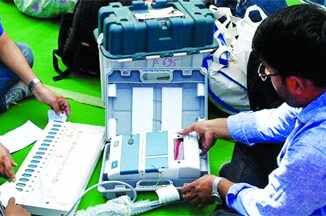
    Ten states and two Union territories, with 94 constituencies, are voting in the phase three of the Lok Sabha elections 2024 on May 7. The states in the fray are Goa, Gujarat, Assam, Bihar, Madhya Pradesh, Karnataka, Chhattisgarh, Maharashtra, and Uttar Pradesh.
    Gujarat, Karnataka and Goa will be under the spotlight as all Lok Sabha seats here go to polls on May 7.
    Two Goa seats
    Goa’s two Lok Sabha seats—North Goa and South Goa—will see a two-way contest between the Congress and the Bharatiya Janata Party (BJP). Congress candidate Ramakant Khalap will fight against BJP’s Shripad Yesso Naik from North Goa, while INC’s Viriato Fernandes has been fielded against NDA-led BJP’s Pallavi Dempo in South Goa. Dempo, is the richest candidate in the fray in the third phase of polling on May 7. In 2019, the BJP had won the North Goa seat while the Congress bagged the South Goa seat.
    Gujarat, PM Modi’s home turf
    Voting will also take place on 25 out of 26 seats in Gujarat. The only exception is Surat, where BJP candidate Mukesh Dalal secured an uncontested victory after the nomination of Congress’ Nilesh Kumbhani was rejected, and several other contenders stepped back from the race last week.
    The Election Commission of India (ECI) earlier informed that Gujarat and Maharashtra had the most nominations out of the 12 states and Union Territories voting in this phase. “In phase 3, Gujarat had a maximum of 658 nominations from 26 Parliamentary constituencies, followed by Maharashtra with 519 nominations from 11,” the EC said.
    In this phase, 2,963 nominations were filed for 95 Parliamentary constituencies across 12 states and UTs going to the polls for the Lok Sabha Elections 2024.
    For the BJP, Gujarat remains crucial for being the home state of Prime Minister Narendra Modi and Union Home Minister Amit Shah. The saffron party has been in power in the Gujarat Legislative Assembly with an absolute majority for about three decades since 1995.
    Gujarat is also key because the BJP is facing protests from the crucial Kshatriya community against Union Minister and BJP’s Rajkot Lok Sabha candidate Parshottam Rupala, over remarks made by him against the community. The Prime Minister is campaigning in Gujarat since May 1.
    The voting in the third phase will begin at 7 am on May 7 and conclude at 6 pm, providing ample opportunity for citizens to exercise their franchise. Voting for the seven-phase polls to elect the 18th Lok Sabha started on April 19 and will conclude on June 1. The counting of votes will take place on June 4.
    Prajwal Revanna jolt in Karnataka
    Fourteen parliamentary seats of Karnataka will also vote in the third phase on May 7. Karnataka sends 28 members to the Lok Sabha. Fourteen seats of the state voted in the second phase on April 26.
    Karnataka matters for the BJP for it is the only state in the South where it has gained a dominant presence after winning 25 of the 28 seats in 2019 Lok Sabha elections. It is also key for the BJP’s ‘Mission South’, as the party has failed to make inroads in southern states other than Karnataka and Telangana.
    Days ahead of phase 3 polling, the BJP and the JD(S), the alliance partners, have found themselves in a spot after the sexual abuse episode involving Prajwal Revanna, who is also the grandson of former Prime Minister HD Deve Gowda.
    Source: Livemint

  • PM Modi in US- A major leap forward for India-US ties?

    PM Modi in US- A major leap forward for India-US ties?

    By Suhasini Haidar

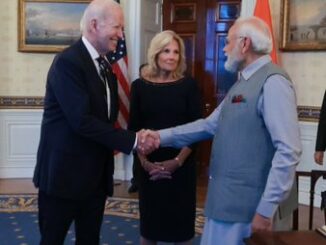
    This week we are looking at Prime Minister Narendra Modi’s visit to Washington, which saw US President Joseph Biden roll out the red carpet for him. PM Modi’s visit included a private dinner at the White House, a ceremonial welcome, a state banquet, an address to the US Congress joint session and lunch at the State Department.

    PM Modi is the third international leader, after French President Macron and South Korean President Yoon Suk Yeol to be invited as a State guest to the Biden White House. He is also the third Indian leader to be invited as a State visitor to Washington. In 2009,  Prime Minister Manmohan Singh was invited by President Barack Obama,  and  in 1963,  President Sarvepalli Radhakrishnan was invited by President John F Kennedy.

    “Decades from now — decades from now, people will look back and say the Quad bent the arc of history toward “global good,” as the Prime Minister describes it. Together, India and the United States are working closely on everything from ending poverty and expanding access to healthcare to addressing climate change to tackling food and energy insecurity stoked by Russia’s unprovoked war on Ukraine,” U.S President Joe Biden said.

    “We were strangers in defense cooperation at the turn of the century. Now, the United States has become one of our most important defense partners. Today India and the US are working together, in space and in the seas, in science and in semi-conductors, in start-ups and sustainability, in tech and in trade, in farming and finance, in art and artificial intelligence, in energy and education, in healthcare and humanitarian efforts, PM Narendra Modi said.

     High-Tech partnership

    1. The big deal announced during this visit was the MoU for a co-production deal between GE and HAL to manufacture GE-F414 jet engines in India for Tejas Light Combat Aircraft
    1. Semiconductor supply chains: Micron Technology will invest $800 million toward a new $2.75 billion semiconductor assembly and test facility in Gujarat- the Indian Semiconductor mission will fund the rest of the project
    1. Under the newly launched Initiative on Critical and Emerging Technology (iCET), a number of innovation partnerships, also on India and the United States have established a Joint Indo-U.S. Quantum Coordination Mechanism to facilitate joint research looking at Quantum, Advanced Computing, and Artificial Intelligence
    1. India to join the 11-nation minerals security partnership (msp) meant to reduce dependence on China for critical minerals

    Defense cooperation

    1. India will buy 16 Drones- armed MQ-9B SeaGuardian UAVs.
    1. The US Navy has concluded a Master Ship Repair Agreement (MSRA) with Larsen and Toubro Shipyard in Kattupalli (Chennai) and is finalizing agreements with Mazagon Dock Limited (Mumbai) and Goa Shipyard (Goa).
    2. Placing Indian liaison officers at 3 US commands
    3. Launch of India-U.S. Defense Acceleration Ecosystem (INDUS-X)— between private defense industries in US and India

    Space cooperation:

    1. India signed the Artemis Accords, joining 26 other countries working on exploration of the Moon, Mars, and beyond.
    1. NASA will provide advanced training to Indian Space Research Organization (ISRO) astronauts with the goal of launching a joint effort to the International Space Station in 2024.
    1. NASA and the ISRO are developing a strategic framework for human spaceflight cooperation by the end of 2023

    Trade and Consular issues

    1. Resolution of six of seven outstanding WTO disputes between the two countries through mutually agreed solutions, market access
    2. India to set up consulate in Seattle, 2 other US cities. US to set up new consulates in Ahmedabad and Bengaluru
    3. Relaxation in H1B visa norms for in country renewal and more availability of visas

    The broad geopolitical takeaways of the Modi visit

    1. Reaffirmation of India-US strategic ties, also within Quad and the Indo-Pacific, although no specific messaging on China.
    1. High technology partnerships will drive the next phase of the relationship, just as the nuclear deal, or the defense agreements, or the search for an FTA once did. In particular, the Jet engine deal if it goes through could pave the way for more technology transfer that has thus far eluded the relationship
    1. Leadership level summits and meetings continue to ensure India-US ties grow year on year as they have over the past two decades. Biden will visit India for the G20 summit in September, and there’s speculation PM Modi will be invited to California for the APEC summit in November, where leaders of 21 countries including US and China will meet.

    Reading the fine print- the left-outs

    1. The big-ticket item on this visit- for the GE F414 jet engines to be co-produced in India still has a long regulatory road ahead- a manufacturing license agreement has now been submitted for Congressional Notification. US Congress will need to clear the deal on two counts of Export Administration Regulations (EAR) and International Traffic in Arms Regulations (ITAR). Questions are still open on just how much technology will actually be transferred- and whether India will accept conditions attached to that….some of the reasons previous attempts on jet engine tech transfer, as the two countries attempted from 2010-2019 under DTTI, failed.
    1. Indian regulations have similarly held up the Indo US nuclear deal between Nuclear Power Corporation of India Limited (NPCIL) and Westinghouse Electric Company (WEC) for the construction of six nuclear reactors in Kovvada, Andhra Pradesh. 8 years after Modi-Obama announced the nuclear deal is done, and worked a way around the CLNDA, there’s still no techno-commercial offer. ‘
    1. The Biden administration has made it clear it has no interest in continuing the Trump-era FTA talks, and the Modi government has made it clear it still expects the Biden administration to restore India’s GSP status for exports. But no movement during this visit
    1. The big ticket deal from 2019 on an Indian investment in a US LNG plant- specifically the $2.5 bn planned by Petronet in Tellurian’s Driftwood LNG project- has not been revived, nor was any announcement made on GAIL India’s plans to invest in US LNG plants.
    1. India and US agreed to disagree, but differences over the Russian war in Ukraine remained- while Biden referred to what he called Russia’s brutal war on two occasions, PM Modi didn’t, nor did the Joint statement reflect it.
    1. Human Rights-this remains as prickly an issue as it was in 2014, when PM Modi visited India for the first time after his visa was revoked in 2005. Ahead of this visit as many as 75 members of the US Congress wrote to President Biden demanding that he raise concerns over human rights and democracy in India publicly, which he did not.

    And former President Obama said this in an interview that released the same day as the State visit:

    “I think it is true that if the President meets with Prime Minister Modi, then the protection of the Muslim minority in a majority Hindu India, that’s something worth mentioning. Because, and by the way, if I had a conversation with Prime Minister Modi, who I know Well, part of my argument would be that if you do not protect the rights of ethnic minorities in India, then there is a strong possibility, and at some point, starts pulling apart. And we’ve seen what happens when you start getting those kinds of large internal conflicts”

    When asked at a rare press event with – where he answered a few questions from the media, here’s what PM Modi said

    “We have proven that democracy can deliver, and there is no discrimination in India on the issues of cast, creed, religion”

    World View Take

    Quite aside from the moment at hand, the underlying logic for India-US relations, especially between its people has always been strong- and is the reason relations remained close despite cold war tensions. PM Modi’s state visit to Washington is one more step in ties that have grown year on year over 2 decades and are poised to take the next leap on technology transfer. When it comes to questions over Indian democracy, that are internal to India, PM Modi made a rare exception in taking questions in the US, but it is the answers he gives to Indians in India on democratic freedoms that will actually count.

  • KARNATAKA ELECTIONS

    KARNATAKA ELECTIONS

    After Lord Rama & Bajrangbali, Arjuna part of election rhetoric

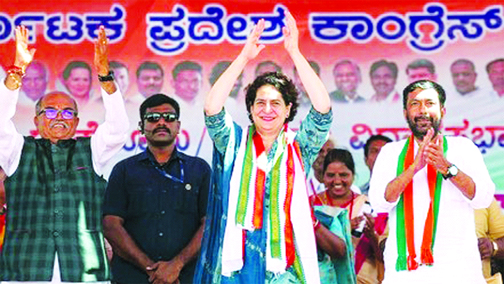
    New Delhi (TIP)- Lord Rama, Bajrangbali, ace warrior Arjuna — heroes of the Ramayana and the Mahabharata — continue to dominate the Karnataka election rhetoric even as the Vishwa Hindu Parishad (VHP) held protests across the state against Congress’ poll promise to ban the Bajrang Dal. The Bajrang Dal is the youth wing of the RSS affiliate, the VHP. On campaign trail on Thursday, May 4,Congress general secretary Priyanka Gandhi Vadra while addressing a rally at Kanakgiri in Koppal urged voters to become “Arjuna”.
    “You should all become Arjunas of the Mahabharata. Like him, set your eyes on the goal of voting for your developed and prosperous future. No matter how big a leader comes and says something, do not stray from your goal. Stay focused on issues that concern you and your lives,” Vadra said. She also accused the ruling BJP dispensation in the state of being a “40 per cent commission” government.
    This even as BJP’s star campaigners led by Prime Minister Narendra Modi continued to start and end their rallies with “Jai Shri Ram” and “Jai Bajrangbali” chants.
    In a new twist to the Bajrang Dal controversy, Congress general secretary (communications) Jairam Ramesh today reminded the BJP whether it was an insult to Lord Rama when saffron governments banned the Sri Ram Sene.
    “The PM’s hypocrisy, especially when in despair and desperation, has no limits. On August 20, 2014, (then) Goa CM Manohar Parrikar banned the Sri Ram Sene. In 2020, the BJP government in Goa again banned the Sri Ram Sene for 60 days. Did the PM consider this an insult to Lord Rama?” asked Ramesh as the BJP spun the Congress promise of banning the Bajrang Dal into an “anti-Lord Hanuman” narrative. Source: TNS

  • Law ministry approves increase of poll expenditure by candidates

    New Delhi (TIP)-The Union ministry of law and justice on Thursday, Jan 6,  approved raising the election expenditure ceiling by a candidate to a maximum of Rs 95 lakh in Parliamentary elections and Rs 40 lakhs in assembly elections, increasing them from the earlier limits of Rs 77 lakh and Rs 30.8 lakh.

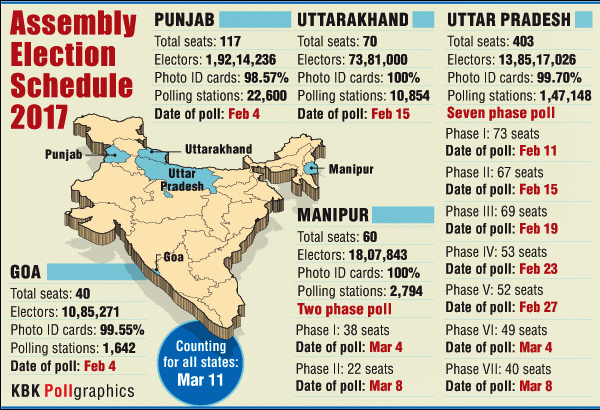
    The increase comes at a time when five states are headed for assembly polls — Uttar Pradesh, Punjab, Uttarakhand, Manipur and Goa — even as a sharply rising third wave of Covid-19 cases has raised the clamour for political rallies to be conducted virtually to avoid the spread of the infection.

    The increased budget is meant to facilitate this shift, officials familiar with the matter said on condition of anonymity.

    “In exercise of the powers conferred by subsection (3) of Section 77 read with Section 169 of the Representation of the People Act, 1951 (43 of 1951), the central government, after consulting the Election Commission of India, hereby makes the following rules further to amend the Conduct of Elections Rules, 1961, namely, the government said in a gazette notification. These rules may be called the Conduct of Elections (Amendment) Rules, 2022. (2) They shall come into force on the date of their publication in the Official Gazette,” the gazette notification said.

    In 2020, the government approved a 10% raise in the poll expenditure cap ahead of the Bihar elections to allow candidates to spend on virtual campaigning amid the pandemic. The ceiling for parliamentary constituencies was at the time raised to Rs 77 lakh, from the 2014 limit of Rs 70 lakh, and assembly polls to Rs 30.8 lakhs from Rs 28 lakh in larger states. With the revision, candidates in Uttar Pradesh, Uttarakhand and Punjab — classified among large states — will therefore be able to spend Rs 40 lakh in the upcoming polls, while those in Goa and Manipur — classified as small states — will have to adhere to a limit of Rs 28 lakh.

    The increase was cleared on the recommendation by the Election Commission, the official cited above said.

    According to EC officials, there were three considerations which officials had while recommending raising limit. “Number of electors has gone up significantly, inflation index has also gone up,” a second official said.

    The Commission anticipates virtual campaigning to also increase costs. ‘They will need to out up big screens in various places so a budget for that had to be factored in,’’ the official added, saying that this was part of the reforms that the poll panel has been pushing for. The Commission had come under the scanner in April this year as polls continued amid the peak of the second wave of the pandemic. The Madras High Court went as far as to say that EC officials were culpable for murder for conducting polls.

    Candidate expenditure includes the money spent by them on polling events, rallies, posters and other paraphernalia. The same, however, can also be borne by the political party the candidate is affiliated to.      Source HT

  • Disasters that rocked India

    Disasters that rocked India

    While India was already battling with the COVID-19 pandemic this year, climate change-induced natural disasters like floods, cyclones have also been making lives miserable for people in India and sometimes even life-threatening. A flashback at the natural disasters that hit different parts of India this year.

    Tamil Nadu floods

    The Indian Meteorological Department (IMD) had predicted heavy rainfall in parts of Tamil Nadu, and it came true from November 1. The flooding was caused by extremely heavy downpours, killing at least 41 people.

    Several red alerts were issued for many areas in Tamil Nadu, including Cuddalore, Sivaganga, Ramanathapuram, Karaikal, Tiruvallur, Chennai, Kanchipuram, Chengalpattu, Viluppuram, and Tiruvannamalai for November 10-11. Over 11,000 were displaced due to the incessant rainfall.

    Maharashtra floods

    Starting on 22 July, Maharashtra saw heavy rainfall in many of its western districts and recorded the highest rainfall in the month of July in 40 years.

    Around 251 people died and over 100 were missing due to floods and landslides in Maharashtra.

    Its neighbouring state Goa also witnessed the worst floods in decades.

    Kerala floods

    Between October 12 and 20, after heavy rains caused rivers to overflow, cutting off towns and villages, 42 people died and 217 houses were destroyed. Out of the 42 people who lost their lives in the floods, five were children.

    Kottayam and Idukki were two of the worst affected districts in the state, where days of heavy rainfall had caused deadly landslides.

    Cyclone Tauktae

    It was a powerful, deadly and damaging tropical cyclone in the Arabian Sea that became the strongest tropical cyclone to make landfall in the Indian state of Gujarat since the 1998 Gujarat cyclone and one of the strongest tropical cyclones to ever affect the west coast of India.

    Started on May 14, the storm displaced over 200,000 people in Gujarat and killed 174 people with 80 people still missing.

    Tauktae brought heavy rainfall and flash floods to areas along the coast of Kerala and Lakshadweep. There were reports of heavy rain in the states of Goa, Karnataka and Maharashtra as well.

    Cyclone Yaas

    It was a relatively strong and very damaging tropical cyclone that made landfall in Odisha and brought significant impact to West Bengal in May. Yaas formed from a tropical disturbance that the Indian Meteorological Department first monitored on May 23.

    Around 20 people across India and Bangladesh died due to the cyclone and West Bengal was one of the most impacted states in India due to Yaas, with a loss of approximately $2.76 billion, according to several media reports.

    Cyclone Gulab

    The third storm in India that impacted eastern India, was formed on September 24 in Bay of Bengal. On September 26, Gulab made landfall in India’s Andhra Pradesh, but weakened over land. The storm overall brought heavy rains and strong winds throughout India and the Middle East, killing at least 39 people.

    Over 30,000 individuals were evacuated into safety as a result of the cyclone. This number further increased to 46,075 people as the storm further moved inland.

    Assam earthquake

    On April 28, a 6.4 magnitude earthquake jolted Assam. The quake resulted in two fatalities and at least 12 people were injured. The quake struck at a depth of 34 kilometres and 140 kilometres north of Guwahati.

    The earthquake occurred as a result of oblique-slip faulting at a shallow depth just at the foothills of the Himalayas. Analysis by India’s National Centre for Seismology revealed that the earthquake involved a slip along the Kopili Fault, near the Main Frontal Thrust.

    Uttarakhand floods

    At least 54 people died in various incidents triggered by heavy rains and subsequent flash floods in Uttarakhand in October this year.

    Melting glaciers

    In February, a ferocious flash flood hurtled down a remote Himalayan valley, sweeping away homes, a hydro plant and around 200 people. Only 60 bodies have been found.

    The flash floods in Uttarakhand was due to the collapse of a hanging glacier, initial observations by scientists at the Wadia Institute of Himalayan Geology suggests. A hanging glacier is a body of ice that breaks off abruptly at the edge of a precipice or steep slope.

    Experts believe the cause was a massive chunk of a glacier — 15 football fields long and five across — breaking off high in the mountains.

    In the Himalayas, about 10,000 glaciers are receding at a rate of 30 to 60 metres (100 to 200 feet) per decade as global temperatures rise. In 2013, a flash flood in the same area killed 6,000 people.

  • India in history this Week-December 10 to December 16, 2021

    India in history this Week-December 10 to December 16, 2021

    10 DECEMBER

    1878       The freedom fighter leader G. Rajagopalachari was born.

    1878       Birth of Muhammad Ali Johar, one of the founders of Jamia Millia Islamia in Rampur.

    2001       Dada Muni, one of the stalwarts of Indian cinema, said goodbye to the world.

    1992       The first hovercraft service of the country was started in Gujarat.

    1998       Amartya Sen was awarded the Nobel Prize for Economics in Stockholm.

    11 DECEMBER

    1911       Dilip Kumar, one of the greatest actors of Indian cinema, was born.

    1935       Former President of the country Pranab Mukherjee was born in Birbhum in West Bengal.

    1969       Vishwanath Anand, the emperor of chess, was born.

    2011       Pandit Ravi Shankar died.

    1845       First Anglo-Sikh War: The Sikh army crossed the Sutlej River in Punjab.

    1858       Bankim Chandra Chattopadhyay and Yadunath Bose became the first Bachelor of Arts subjects from the University of Calcutta.

    1946       Rajendra Prasad was appointed the President of the Constituent Assembly.

    1967       In western India, a magnitude 6.5 earthquake killed 170 people.

    1687       The East India Company formed a municipal corporation in Madras (India).

    12 DECEMBER

    1911       The capital of India was shifted from Calcutta to Delhi.

    1971       All the facilities provided to the former kings by the Indian Parliament were canceled.

    1992       Giant Buddha statue was installed in Hyderabad’s Hussain Sagar lake.

    1996       Signing of 30-year treaty on the sharing of Ganga water between India and Bangladesh.

    2001       India gave two cheetah helicopters and weapons to Nepal.

    1964       Famous Hindi poet and litterateur Maithilesharan Gupta died.

    13 DECEMBER

    1232       Iltutmish, the ruler of the Ghulam dynasty, captured Gwalior.

    2001       The Indian Parliament was attacked by terrorists.

    1921       The Banaras Hindu University was inaugurated by the ‘Prince of Wales’.

    1955       India and the Soviet Union accepted the Panchsheel agreement.

    1961       Mansoor Ali Khan Pataudi started his Test match career against England in Delhi.

    1998       Mahatma Ramchandra Veer was awarded the “Bhai Hanuman Prasad Poddar Rashtra Seva” award from the Bada Bazaar Library in Kolkata.

    2008       For the fifth phase of Jammu and Kashmir, 57% polling was held in 11 assembly constituencies.

    2012       In the final match of the blind Twenty20 World Cup, the Indian cricket team defeated Pakistan by 30 runs to take the title of world winner.

    1955       Former Chief Minister of Goa Manohar Parrikar was born.

    2000       Former captain of the Indian cricket team, Vijay Samuel Hazare became the first person to receive the ‘Castrol Lifetime Achievement Award’.

    14 DECEMBER

    1924       Director, producer, showman Raj Kapoor was born.

    1901       Mahatma Gandhi reached Rajkot via Porbandar.

    1960       The Organization for Economic Cooperation and Development (OECD) was established.

    2005       11 Hindus are condemned with life imprisonment for their involvement in the killing of Muslims in the 2002 Gujarat violence.

    2011       Poisonous liquor banned in India kills 166 people in West Bengal.

    15 DECEMBER

    1950       The iron man Sardar Vallabhbhai Patel died.

    1749       Chhatrapati Shivaji’s grandson Shahu died.

    1953       India’s S. Vijayalakshmi Pandit was elected the first woman president of the eighth session of the United Nations General Assembly.

    1991       Filmmaker Satyajit Ray was awarded a Special Oscar for his achievements in the cinema world.

    16 DECEMBER

    1985       The country’s first fast breeder nuclear react started functioning in Kalpakkam.

    1971       Bangladesh separated from Pakistan and became an independent nation after agreeing to a cease-fire between India and Pakistan.

    1993       ‘Education for all’ conference starts in New Delhi.

    2004       Doordarshan’s free to air DTH service ‘DD Direct +; Was launched by the Prime Minister.

    1903       The Taj Mahal Palace Hotel in Mumbai was opened for guests.

    2012       In New Delhi, a woman was gang-raped in a bus, leading to public protests against the Government of India and the Government of Delhi.

    1937       Hawa Singh, one of the best boxers in India, was born.

  • India in history this Week- December 3 to December 9, 2021

    India in history this Week- December 3 to December 9, 2021

    03 DECEMBER

    1844       The first President of the country Dr. Rajendra Prasad was born.

    1751       Battle of Arnie in India (Second Carnatic War): A British East India Company-led army under Robert Clive defeats a very large Franco-Indian army under the command of Rana Sahib at Archana.

    1796       Baji Rao II was made the Peshwa of the Maratha Empire. He was the last Peshwa of the Maratha Empire.

    1889       The youngest hanged revolutionary, Khudiram Bose, was born in the independence movement.

    1915       A magnitude 6.5 earthquake in Bhutan and Arunachal Pradesh killed 170 people and destroyed many homes.

    1971       The Emergency came into force in the country after the war between India and Pakistan started.

    1979       Hockey magician Major Dhyanchand  died.

    2004       India and Pakistan agreed to restore rail connectivity between Munabav and Khokhrapar after 40 years.

    2011       Film actor Dev Anand died.

    1984       Leaking toxic gas from the Union Carbide factory in Bhopal killed at least 3000 people and caused several thousands of physical deformities.

    1959       India and Nepal signed the agreement of Gandak Irrigation and Power Project.

    1967       India’s first rocket (Rohini RH 75) was launched from Thumba.

    2008       Chief Minister of Maharashtra Vilasrao Deshmukh resigned from his post on the day after the terrorist incident of 23 November in Mumbai.

    04 DECEMBER

    2008       Renowned historian Romila Thapar was chosen for the Cluj honor.

    1888       Birth of historian Ramesh Chandra Majumdar.

    1860       Agustino Lawrenceo of Margao, Goa, received a doctorate in chemistry from the University of Paris. He became the first Indian to pursue a doctorate from a foreign university.

    1899       For the first time, the vaccine of typhoid was used to protect humans from this disease.

    1919       The twelfth Prime Minister of India, Indra Kumar Gujral was born.

    1910       Ramaswamy Venkataraman, the eighth president of India, was born.

    1971       The Indian Navy attacked the Pakistani Navy and Karachi.

    05 DECEMBER

    1955       The STD service that provides long distance telephone calls to every home came into existence on this day in 1955.

    1971       India recognized Bangladesh as a country.

    1895       The birth of Josh Malihabadi, the famous Urdu poet of India and Pakistan.

    1941       Famous Indian female painter Amrita Shergill died in Lahore. Many of his artworks were appreciated worldwide.

    1969       The birth of Anjali Bhagwat, the famous shooter who has illuminated the name of India in the world in shooting.

    1998       Russia agrees to give ‘Krivak class’ multi-purpose warship to Indian Navy.

    1999       Yukta Mukhi took the title of Miss World to her name.

    1657       Shah Jahan’s younger son Murad proclaimed himself king.

    1943       Japanese airplane bombed Kolkata.

    1950       Freedom fighter, poet, yogi and philosopher Arvind Ghosh died in Puducherry.

    1950       Sikkim became a protected state of India.

    06 DECEMBER

    1732       Warren Hastings, the first Governor General of the East India Company, was born.

    1907       The first incident of dacoity related to India’s freedom struggle took place at Chingaripota railway station.

    1992       Babri Masjid in Ayodhya was demolished by fierce Hindu kar sevaks. After this, riots broke out in many states of India.

    1907       The first incident of dacoity related to India’s freedom struggle took place at Chingaripota railway station.

    1956       Bahujan political leader and constitution builder Babasaheb Bhimrao Ambedkar died.

    1987       MiG-29 joined the Indian Air Force, renamed ‘Baz’.

    07 DECEMBER

    1949       Indian Armed Forces Flag Day is celebrated.

    1782       Hyder Ali, the ruler of Mysore died.

    1825       The first steam-powered ship ‘Enterprise reached Kolkata.

    1856       The ‘Hindu widow’ was officially married for the first time in the country.

    1995       India launched communication satellite INSAT-2C.

    2003       Raman Singh holds the post of Chief Minister of Chhattisgarh.

    2008       Indian golfer Jeev Milkha Singh won the Japan Tour title.

    2016       Famous Indian actor, comedian, political satirist, playwright, film director and advocate Cho Ramaswamy passed away.

    08 DECEMBER

    1875       The great liberal leader Tej Bahadur Sapru was born in Aligarh.

    1879       The great revolutionary Yatindra Nath Mukherjee aka Barrier Jatin was born.

    1900       Pandit Uday Shankar, born dancer and dance director of modern dance of India, was born.

    2002       Gomutra was patented by the United States after India’s traditional bio-wealth, neem, turmeric and berries.

    2005       The Red Cross and Red Crescent Society accepted a red crystal of diamond shape in the white background as a new additional symbol.

    1967       The first submarine INS Kalwari was inducted into the Indian Navy.

    1990       Uday Shankar, the famous Indian classical dance dancer, dance director and ballet producer was born.

    1947       Parmanand, the great revolutionary brother of the Indian freedom struggle, died.

    09 DECEMBER

    1946       The first meeting of the Constituent Assembly that made the country’s highest law was on this day.

    1946       UPA Chairperson Sonia Gandhi was born.

    1971       During the Liberation War, the Indian Army had pierced the air campaign Meghna Heli Bridge.

    1484       The great poet and saint Surdas was born.

    1758       The thirteen-month-long war of Madras began in India. This was the most dangerous war between Britain and France in India.

    1898       Belur Math was established in Kolkata.

    2001       United National Party leader Ranil Vikram Singhe was sworn in as the Prime Minister of Sri Lanka.

    1825       Rao Tula Ram, a prominent hero of the Sepoy Mutiny was born.

  • Madgaon: The commercial and cultural capital of Goa

    Madgaon: The commercial and cultural capital of Goa

    Being the commercial and cultural capital of Goa, Margao, also known as Madgaon, is the largest city of Goa by population. Margao is the centre of administration for the Salcete as well as the district of South Goa. Since the construction of the Madgao Railway Station, Margao has become a focal point for travellers as everyone who wishes to arrive in Goa by train has to enter through Margao.

    The origin of Madgaon’s name has various stories. Some say that it is derived from Sanskrit word Mathagram which would mean village towards the east and some say that Mathagram was the name due to the Vaishnavite Matha (cloister) located in the area. But a clear picture to the former name of Matha Gram was due to the Nine Mathas in the town. Raiders, however, destroyed these Mathas along with the Damodar Temple where the Holy Spirit Church now stands. The whole of Margao is a repository for the stories and history of Goa.

    With structures like the Braganza House, Fernandes House and Sat Burzam House that are nearly as old as the town itself, there is history in every old nook and corner of Margao. The Goa Chitra Museum will introduce you to the authentic traditions and culture of Goa. The Rachol Fort will transport you back in time to the battles between Vijayanagara and Bijapur Sultans. The Municipal Gardens are the pitstop for every traveller’s Imagination before continuing the journey into the festivities of the Sao Joao feast of St. John the Baptist Church.

    With all such heritage to keep its travellers indulged, Margao has earned its place as the Cultural capital of Goa. The shopping scene in Margao offers everything from local street markets to signature shopping malls. There are many restaurants and cafe’s that satisfy your hunger pangs, such as the Cinnamon, Pepper’s, Martin’s, Mircho-Go that serve multiple cuisines. The nightlife in Margao, however, is dull compared to North Goa as there are no pubs or bars that stay open until late in the night.

    Places To Visit

    Colva Beach

    The captivating Colva Beach, located in South Goa, is one of the most visited beach of Goa. The 2.5 km long beach is known for its powdery white sands flanked by swaying coconut trees that add to its beauty. It looks more stunning with shacks, nightclubs and souvenir stalls all around.

    Colva Beach is also popular for water sports like paragliding, jet-skiing, snorkelling, speed boat ride and banana boat rides. It is visited by tourists for its stunning sunset and calming blue waves. While the Colva Beach is serene for peace-lovers, it perks up at night for party-lovers. With the nonchalant ambience, mesmerizing view of the endless beach and spirited people, Colva Beach is one of the most loved beaches of Goa.

    Goa Chitra

    Goa Chitra Museum, located in Benaulim, is an ethnography museum displaying the traditional Goan way of life and culture. The museum was established by Victor Huge Gomez as a tribute to his Portuguese ancestors. He has collected over 4000 items such as woodwork, metalwork, weapons, furniture, religious Goa artefacts and other memorabilia. It also showcases an organic farm.

    Goa Chitra actively conducts workshops and activities to share their knowledge about the traditions with the public. It has been titled by the Archaeological Survey of India as the topmost contemporary museum in India.

    Our Lady Of Mercy Church

    Our Lady Of Mercy Church, located in Colva, is a colonial church founded in 1630. It was earlier known as Nossa Senhora de Merces. The church houses a statue of infant Jesus Christ which is believed to be found on the Mozambique coast by Fr Bento Ferreira who brought it to Goa and installed it in the church in 1648.

    Church Of the Holy Spirit Goa

    Church Of the Holy Spirit is a 17th century Portuguese church in Goa and one of the oldest churches in Margao. The site initially had a shrine dedicated to a Hindu deity, Lord Damodar, which was destroyed by the Portuguese before the church was erected. It was further destroyed a number of times by the Muslim Army till finally the structure that currently exists was built in 1675. The monument is famous for its splendid architecture and religious significance.

    Majorda Beach

    One of the more crowded beaches of South Goa, Majorda beach is a golden sand beach located between Utorda and Betalbatim Beach. Lined with swaying palms and calm azure water, this is one of the most gorgeous beaches in South Goa. Majorda Beach is usually crowded with Russian tourists and offers a wide range of water sports activities. Dotted with sunbeds the beach is ideal for sunbathing and relaxing.

    Streetside stalls can be found on Majorda Beach selling funky souvenirs that Goa is famous for. A large number of churches dot the map of Majorda, a great display of the Portugues architecture ever-present across Goa. Paintball and Go Karting facilities can be found closer to the highway. For those looking to do something truly offbeat, the Ashvek Vintage Car Museum is definitely worth a visit, displaying cars and related paraphernalia dating back to 1886. All in all, the charming Majorda has a little something for everyone who crosses its path.

  • Road trips to explore the best of Western Ghats

    Road trips to explore the best of Western Ghats

    A 1,200 km long mountain range with endemic flora and fauna interspersed with green plantations and splendid hill stations- the Western Ghats of India hide many gems of destinations.

    Recognized as one of the world’s eight “hottest hotspots” of biological diversity and as a UNESCO listed World Heritage Site, the place attracts various kinds of travelers every year and offers them an experience like no other.

    To slowly familiarize yourself with these mountain ranges, here is a list of some destinations you can visit to explore the best of the Western Ghats.

    Madikeri, Coorg (Karnataka)

    If you’re someone who dreams of reconnecting with nature and in turn yourself during the upcoming getaway, then Coorg is just the right destination for you. Lush green landscapes.

    Aromatic tea and coffee plantations. Magnificent waterfalls. Mouth-watering cuisine. Misty hills. Exotic flora and fauna. Be it the food lover in you or the curious geographer, the wandering traveller or the nature enthusiast- Coorg is a gem that attracts thousands every year, leaving them with no other option other than to pay a visit to the place.

    Alternatively known as the ‘Scotland of India’, Madikeri is a picturesque hill-town in Southern India. Framed by the Western Ghats range, it is an extremely beautiful plantation town with rich culture and warm locals. With its haven of dense forests, misty peaks, magnificent waterfalls and soothing streams- it offers a heavenly retreat from a cluttered life.

    You can spend the day walking around Chikli Hole or stay at cozy homestays and meet great hosts. You can try the amazing cuisine or go waterfall-hopping, spending a day mesmerized by all the beauties. A trip to Coorg is the relaxing long drive that will put you in a good mood.

    Mahabaleshwar (Maharasthra)

    Mahabaleshwar is a hill station in India’s forested Western Ghats range, south of Mumbai. The beautiful hill-station has something to offer to everyone.

    For the adventurous spirits, you have the option of going jungle trekking in unique hamlets like Tapola. To calm your spirit and encounter a soothing ambiance, you can ride a shikhara in the Venna Lake, as you watch the sun paint a million hues on the blue canvas. If you are a history buff or want to take a trip down the nostalgia lane, you can always visit popular heritage sites like Pratapgad Fort and the Mahabaleshwar Temple. To get some picture-perfect frames for your Instagram posts, elevated viewing points, such as Arthur’s Seat or nature’s beauties like Lingmala Waterfall provide the perfect muse.

    The famous strawberries of Mahabaleshwar, the centuries-old forts, the soothing rivers, and culturally rich temples- be it a nature-lover, a budding photographer; an artist searching for inspiration or a frequent trekker, Mahabaleshwar, its scenic beauty and its mountains offer a home to everyone. Once you get a taste of this place, you would not want to come back.

    Mollem (Goa)

    Goa is the go-to destination for most people when you want to enjoy all the benefits of the modern world and have the time of your life. Very few people associate Goa with a place that can help one seek spirituality, oneness, and proximity to nature.

    However, Mollem is a small village in Goa that serves the purpose of breaking all these predetermined notions. Situated in South India on National Highway 4 near the border with Karnataka in the foothills of the Sahyadri Mountain range at the beginning of Anmod Ghat- Mollem is a place that introduces you to stunning waterfalls and rich, wild forests.

    It is the primary entry point for Bhagwan Mahaveer Sanctuary and Mollem National Park. If you plan to visit Goa anytime soon, you cannot miss out on the opportunity to visit this place.  The sanctuary spread over an area of 240 sq. km, it is home to an impressive diversity of flora and fauna and ancient temples. It takes you to the breath-taking Dudhsagar Falls. A drive through this forest will certainly rejuvenate your senses and make you look forward to the next day, even more.

    Kalpetta,Wayanad (Kerala)

    Kalpetta is the main town in Wayanad and one that attracts travelers every year but hasn’t been affected by excessive commercialization yet. It is all about its beautiful countryside, magnificent waterfalls, green landscapes, tea-gardens, and rich flora and fauna. Wayanad literally means ‘Land of Paddy Fields’ and brings out the true beauty of Kerala. It is the ideal place to be in for a serene drive amidst beauty of a kind.

    Coonoor (Tamil Nadu)

    Coonoor is one of those unexplored gems that will leave you spellbound. Completely surrounded by Nilgiri Hills, the region is mainly known for its tea plantations and mystical beauty. To get a taste of Coonoor, drive through the beautiful roads hugging the hills with a mesmerizing view of tea plantations around you. Drive to Kotagiri or Ooty or head up into the hills and take the toy train or the century-old mountain railway up the hills.

  • Monsoon destinations in India

    Monsoon destinations in India

    Monsoon is one of the best times of the year to experience the beauty of every exotic part of India that offers ecstasy, beauty, and heavenly pleasure when you are vacationing. Although people may not find it very safe to travel during monsoon, rains have the magical spell to change your fear to become a little more adventurous. The lush greenery in the mountains, the lakes getting overflowed with sparkling water, driving around the waterfall, create a heavenly scenery that is too hard to resist. You will find a list of top gorgeous places to visit in monsoon in India that looks even more spectacular during this time.

    Shillong, Meghalaya

    When it comes to best places to visit in monsoon, Shillong, also known as the ‘Scotland of the East’, is considered one of the top travel destinations in India during this season. The captivating beauty becomes even more mesmerizing when the entire hill town gets drenched in rains. Misty clouds, with lush green everywhere and rumbling waterfalls with a beautiful view, can surely be the best reason for visiting Shillong, Meghalaya. Road-tripping around the hills and staying at nearby cozy hotels with gorgeous views, visiting the Elephant Falls, and the Spread Eagle Falls, trying out the local delicacies, are what you need for a vacation. Both the nearest airport and railway station are in Guwahati (Assam), at a distance of 149 km.

    Goa

    Goa is surely a major attraction point for any time in the year, but the Monsoon in Goa will make you spellbound. The land of beaches becomes gorgeous during Monsoon with the never-ending view of the sea and other picturesque sceneries. Ideal place for all nature lovers during the rainy season, you can go for trekking, heritage tour, shopping, birdwatching, etc. Road-tripping from Mumbai to Goa is the ultimate adventure you need. Apart from that, you can go there through Goa international airport in Dabolim.

    Coorg, Karnataka

    The dense forest is covered with a wide variety of flora and fauna which makes it an even more romantic destination during Monsoon. The enchanting waterfalls, lakes, vast coffee plantations, and delicious cuisines to treat your taste buds are the reasons to consider it as one of the best places to visit in monsoon. Trekking, bird watching, horse ride, coffee plantation tour are a few options you can indulge in when you are in Coorg. The 5 hours road trip from Bangalore (~270.4 km) is surely a great idea especially if you want to enjoy the mesmerizing view in rains, however, the nearest airports are Mysore at 120 km, Mangalore which is 135 km far and Bangalore at 260 km.

    Munnar, Kerala

    South India looks heavenly with lush greenery and witnessing it getting drenched in rain surely makes it one of the best places to visit in rainy season. And Munnar will surely offer you a great view with all of that, with silvery mist, vast tea gardens, hills, etc.

     This hill station has become one of the favourite tourist places in India during monsoons because of its beauty. The crowd-free Munnar is famous for trekking trails, sight-seeing, tea gardens, getting hypnotized by the natural bliss, and indulging in delicious Kerala cuisine. It takes nearly 3 hours via NH49 route from Cochin, and the nearest railway station is Aluva and Ernakulam, and the nearest airport is Cochin at 110 km and Madurai international airport which is 140 km away.

    Mahabaleshwar

    With the greenery, calm surroundings, the beauty of the Sahyadri range, which is a part of the Western Ghats, Mahabaleshwar becomes one of the most romantic places in India, especially in the rainy season. Pratapgad is a beautiful place to explore if you’re in Mababaleshwar, along with Lingamala waterfalls and The Elephant’s Head Point is another major attraction among tourists that make a captivating sight during Monsoon. Mahabaleshwar is definitely one of the best places to visit in rainy season which is very close to Mumbai and Pune. A road trip (120 km from Pune and 250 km from Mumbai) is the best idea in the rains.

    Udaipur, Rajasthan

    During monsoons, this place flourishes with more greenery around the lakes and palaces making it a breathtaking view drenched with rain and majesty altogether. The beauty of the Fateh Sagar Lake becomes extra captivating during this time. Boat riding in rains with your partner sounds romantic around those royal architectural properties. For heritage lovers, monsoon is pleasant weather to visit all the spots like City Palace, Monsoon Palace, Lake Palace. Udaipur railway station and Maharana Pratap airport in Dabok make it easier to reach the main city.

    Spiti Valley, Himachal Pradesh

    Spiti Valley is one of the most unusual places in India to visit during Monsoon, and have become quite popular among people who like the calm and mystical vibe of the “Little Tibet”. Definitely a great place for camping, and wildlife viewing, and rains make it even more magical. The Lhalung monastery will give you a calming effect if you are looking for it. The nearest railway station is in Shimla and the nearest airport is the Kullu airport at Kullu.

  • Journalist Tarun Tejpal acquitted in rape case

    Journalist Tarun Tejpal acquitted in rape case

    NEW DELHI (TIP): A sessions court in Goa on Friday, May 21, acquitted journalist Tarun Tejpal of sexually assaulting a former female colleague.

    Tejpal, former Tehelka editor-in-chief, was accused of sexually assaulting the colleague inside the elevator of a luxury hotel in Goa in 2013. He was arrested in November 2013 following an FIR by Goa Police

    Here is a timeline of the Tarun Tejpal case.

    The Goa Police had registered an FIR against Tejpal in November 2013 following which he was arrested.

    He faced trial under IPC sections 341 (wrongful restraint), 342 (wrongful confinement), 354 (assault or criminal force with intent to outrage modesty), 354-A (sexual harassment), 354-B (assault or use of criminal force to woman with intent to disrobe), 376(2)(f) (person in a position of authority over women, committing rape) and 376(2)k) (rape by a person in a position of control).

    He has been out on bail since May 2014.

    The court had earlier adjourned pronouncement of the verdict in the case on three occasions, citing various reasons.

    The court was to deliver the verdict on April 27, but the judge had adjourned it to May 12. On May 12, it was further adjourned to May 19 and on May 19, it was adjourned to May 21.

    “My family had to deal with catastrophic fallout of false allegations’, said Tejpal after acquittal.

    (Source: PTI)

  • Gorbachev’s 90th birthday celebrated

    Gorbachev’s 90th birthday celebrated

    Ashok Parulekar  

    PANAJI, GOA, INDIA (TIP):  On Tuesday, March 2, President Gorbachev ‘s 90th Birthday was observed.  He is a close friend of Sri Chinmoy. They both worked for World Peace. One as a President of USSR.  the other as a Spiritual Master and through his Meditation, Music, Books, Art, Sports, The United Nation centre, and his disciples around the world in more than 60 countries. President Gorbachev’s achievements are many. He was instrumental in ending the Cold War between USA and USSR. He was the great man behind the removal of the Berlin Wall and the unification of Germany. During his presidency 80% of nuclear weapons were destroyed. Sri Chinmoy composed 21000 songs and wrote 1600 books. Some of them are specially for his dear friend Gorbachev. A few of his Peace Concerts were dedicated to his wife Raisa. In 2007 a month before his passing Sri Chinmoy went to Russia to see him. They met 22 times helping world peace process enormously.  President Gorbachev’s birthday was celebrated at many places around the world. In Panaji Goa, India it was at Mother Teresa House near Sri Chinmoy Centre.

  • Political takeaways from the Bihar campaign

    Political takeaways from the Bihar campaign


    By Seema Chishti

    Tejashwi Yadav’s campaign in Bihar is frustrating the ruling party as it is using that very powerful appeal against a 15-year-old regime by citing the absence of bread and butter issues and taking the campaign out to the State’s youth. His primary emphasis during the election campaign has been on 

    the high rate of unemployment, forming the backbone of his promise of providing 10 lakh new government jobs to the youth of Bihar. The BJP has been forced to play catch-up. After the results come in, there will be much to theorize on how caste politics has changed in north India. Enough has already been said about how this is the last of the Mandal elections (with Nitish Kumar on the backfoot, Lalu Prasad not campaigning and Ram Vilas Paswan no more); but on closer scrutiny, this is more about evolution of the social justice plank than its burial.

    Bihar’s Champaran farmlands served as the brewing fields for Gandhi’s ruminations and eventual journey to a Mahatma more than a century ago. Later, the State was quick to catch the sparks off Gujarat’s student revolt and lend the anti-Emergency movement the fury that was to become a prairie fire which consumed the invincible Indira Gandhi. Bihar is renowned for its intangible political energy, equations and trends that have gone on to shape India’s political firmament.

    Throwbacks to the past

    The final election results notwithstanding, not that the voters’ mandate is sacrosanct — consider Goa, Manipur, Karnataka, Maharashtra and Madhya Pradesh — the election campaign has provided important political takeaways. Like all elections in the last six years, including the municipal polls in the capital in 2017, Narendra Modi has campaigned with admirable energy and dedication in Bihar. The Prime Minister’s campaigning is an opportunity to peep into his vision and priorities for the people of the State and the country.

    A quick glance at his speeches shows that Mr. Modi’s refrain is Ayodhya’s Ram temple and Article 370 in Kashmir (Darbhanga on October 28 and Champaran on November 1), “Jungle Raj” spoken of often, a reference to the “double Yuvrajs” ostensibly of Tejashwi Yadav and Rahul Gandhi (Chhapra on November 1) struggling to “keep the simhasan/throne”, “BIMARU” Bihar, referring to an outdated acronym for Bihar, Madhya Pradesh, Rajasthan and Uttar Pradesh no longer used even in seminars. Almost all of the Prime Minister’s repeated references are jaded throwbacks to the past: Ayodhya’s Babri Masjid was brought down in 1992, ‘jungle raj’, referring to pejoratives for Lalu Yadav and Rabri Devi’s time as Chief Minister is 15 years ago and the last time that either Tejashwi Yadav or Rahul Gandhi’s fathers held public office was several years ago — there is certainly no ‘simhasan’ for them to defend. It is a negative agenda of a campaign anchored selectively in the past.

    No vision, invoking fear

    Nitish Kumar has been in power in the State for the past 15 years, mostly with the Bharatiya Janata Party (BJP), and there is little in the achievement columns of his report card for Mr. Modi to seek votes on. Soliciting support for another five years of a jaded government is tough, and thus the argument seems to be that “we are bad but they are worse” — not the most inspiring political pitch. More surprising is the lack of vision for either Bihar or India from the Prime Minister. The selective recall of the 1990s is odd when at 57.2%, Bihar has the highest proportion of those below 25 years of age in the country. This is like the captain’s proverbial yearning for the safety of the shore when the boat is in choppy waters mid-ocean, when, instead, it needs a vision to navigate ahead.

    The exponential rise of the BJP, now dominating the political scene with more than half of India’s States under its rule and having 302 Lok Sabha seats (as on October 1, 2020), began by leveraging the upheaval of the 1990s as the polity was challenged by newly opened fissures of caste, religion and economic disparity. Social and cultural issues are an integral part of Indian electoral politics, but to invoke the divisive issues of the past at this time points to a poverty of vision for the future, of the missing destination the ship of governance is aiming for when at sea. Instead of taking matters to a higher level of ‘aspiration’, the country’s top leadership has chosen to invoke not hope but fear.

    A lost opportunity and why

    When India has gone from one of the fastest growing three economies in the world to among the slowest, with an unprecedented decline of 23.9% in the first quarter of 2020, the country would have benefited from learning of the Prime Minister’s plan to get the economy back in shape. The novel coronavirus pandemic also offered an opportunity to speak of public health as a sharp arrow in its quiver, and take his party’s campaign to another high level. Quite the contrary happened when a free vaccine was offered as an election sop, hitting another new low for the BJP in 2020. Public health, at a time of a rapidly growing infectious disease, has always been handled centrally and has been universal and free. The smallpox vaccine, BCG or even the tuberculosis programme has been centrally driven and unconnected with electoral cycles.

    The appeal that proved invincible and lent a deathly blow to the Congress-led United Progressive Alliance in 2014 was a dream that Mr. Modi associated himself with. The ‘Gujarat model’, notwithstanding its merits, was about hope, about vikas, development (if not progress), and overall about improving lives of Indians, a formula that proved unbeatable. The promise, plastered on all available billboards was about ‘two crore jobs’ every year, ₹15 lakh in every bank account and the burnishing of an entrepreneurial spirit that would bring welfare and prosperity. Mr. Modi would make India great again and improve the conditions of its millions, who came out and voted for that dream. This appeal was developed on the campaign that Mr. Modi had carefully crafted around ‘Vibrant Gujarat,’ which had shut down his critics. It was Mr. Modi as the doer and the Vikas Purush that won accolades and eventually the seat of power in Delhi. The core Hindutva spirit that he stood for was just the backstory: Mr. Modi in 2014 worked, as he offered himself and much more.

    The youth connect

    Turning the tables on this, Tejashwi Yadav’s campaign in Bihar is frustrating the ruling party as it is using that very powerful appeal against a 15-year-old regime by citing the absence of bread and butter issues and taking the campaign out to the State’s youth. His primary emphasis during the election campaign has been on the high rate of unemployment, forming the backbone of his promise of providing 10 lakh new government jobs to the youth of Bihar. The BJP has been forced to play catch-up. After the results come in, there will be much to theorize on how caste politics has changed in north India. Enough has already been said about how this is the last of the Mandal elections (with Nitish Kumar on the backfoot, Lalu Prasad not campaigning and Ram Vilas Paswan no more); but on closer scrutiny, this is more about evolution of the social justice plank than its burial. Tejashwi Yadav in 2020 is doing a Narendra Modi in 2014, by not making it overtly about social justice alone. The Mandal campaign of the 1990s in north India was particularly anxious to underscore that it was not economics but social oppression that rankled and needed urgent redress. By threading economic upliftment seamlessly into the idea of social justice, Tejashwi Yadav has confounded his opponents. He need not even loudly talk about backward caste or utter the phrase social justice, any more than Mr. Modi had to proclaim that he is a proud bearer of Hindutva.

    In 2015 when Nitish Kumar and Lalu Prasad struck an alliance, they stumped the BJP by turning it into a ‘forward versus backward’ election. That was a case of political innovation in the face of the BJP juggernaut, at a time when the electoral machine of the BJP, with its freshness, was at its peak. But this time, what has annoyed Nitish Kumar and visibly frustrated the BJP is Tejashwi Yadav coming up from behind and smoothly introducing Social Justice 2.0 into the campaign in his own unique manner. The results of the elections will be known soon but if there is already a winner for political reimagination, it is Tejashwi Yadav against a weary Nitish Kumar and a rear-view mirror-gazing Narendra Modi.

    (The author  is a journalist based in New Delhi)

    (Source: The Hindu)

  • US supercarrier Nimitz to join Vikramaditya for QUAD Malabar exercise

    US supercarrier Nimitz to join Vikramaditya for QUAD Malabar exercise

    New Delhi (TIP): Indian Navy’s flagship Vikramaditya and US supercarrier Nimitz along with two destroyers of the Australian and Japanese navies will conduct full-spectrum exercises off the coast of Goa as part of Malabar war games from November 17 to 20.

    The two carrier groups, with MiG-29K fighters on board Vikramaditya and F-18 fighters on board Nimitz, will participate in war games, while the involvement of the two other countries, which are, like India and the US, members of the Quad grouping, will strengthen multi-operability in full domain exercises. It is also expected to help all four countries understand the ethos and level of training of each other’s navies, commanders and personnel. The exercise will take place in quite a congested environment with at least 70 foreign warships patrolling the area between the Persian Gulf and Arabian Sea. The People’s Liberation Army (PLA) Navy’s warships are not in the vicinity but are not too far off either – ostensibly conducting anti-pirate operations off the Gulf of Aden.

  • Statue of Peace Leader Sri Chinmoy Dedicated at Toronto’s Vishnu Mandir

    Statue of Peace Leader Sri Chinmoy Dedicated at Toronto’s Vishnu Mandir

    By  Ashok Parulekar

    TORONTO (TIP): Leaders of Toronto’s Vishnu Mandir dedicated a bronze statue of Dreamer of World-Peace Sri Chinmoy holding aloft the Peace Torch on Sunday, May 26  afternoon in their Peace Park dedicated to interfaith harmony.

    The life-sized likeness of the peace leader recognises a lifetime of his devoted service to fostering peace through music, art, writings, sports and silent all-faith meditation. Sri Chinmoy’s message is that each and every human being can be a peace-builder—and starting first within himself or herself. The spiritual leader led the interfaith silent Peace Meditation at the United Nations at the invitation of UN Secretary-General U Thant for 37 years. As well, he founded the global Sri Chinmoy Oneness-Home Peace Run which includes millions running for the cause of world peace.

    After showing a video on Sri Chinmoy’s life and contributions, the ceremony moved outdoors to the Peace Park where the statue is located, beginning with the ceremonial blowing of conches. Arriving Peace Runners passed the lighted Peace Torch to Dr. Budhendranauth Doobay, Chairman of the Board and Religious Advisor of the Vishnu Mandir.  “Sri Chinmoy was a great soul…Sri Chinmoy was a man of peace who has been recognized by so many people from around the world,” stated Dr. Doobay. “It is a great honour for us to welcome Sri Chinmoy in the form of this statue which will be here for all times to come.”

    Ms. Ranjana Ghose, President of the Sri Chinmoy Centres, spoke with deep insight about

    Sri Chinmoy’s peace activities and offered heartfelt gratitude to the Vishnu Mandir for this 38th peace statue dedication saying, “Sri Chinmoy’s life was an amazing success story of bringing the peace of the soul to the fore, within himself and in those with whom he interacted.  He was greatly respected by many dignitaries around the world, who cherished Sri Chinmoy for his compassionate manner of thinking and peaceful way of addressing a dynamic life.”

    Dr. Doobay then received the Torch Bearer medallion for his tireless devotion in fostering living spirituality and oneness amongst the faiths. Mr. Salil Wilson, Executive Director of the global Sri Chinmoy Oneness-Home Peace Run, presented the award. In 1987, Sri Chinmoy founded the Peace Run and, for the first time ever, the run will be covering every country in the world in the coming two years.

    Col. Gerry Nudds of the Mandir then invited illustrious representatives of many faiths to each lead participants in a prayer from their own faith. Hindu, Muslim, Christian, Buddhist, Jain and Jewish prayers added greatly to the spirit of interfaith harmony. As Sri Chinmoy wrote, “Spirituality is not merely tolerance. It is not even acceptance. It is the feeling of universal oneness…Spirituality is not mere hospitality to others’ faith in God. It is the absolute recognition and acceptance of their faith in God as one’s own.”

    A few other homes of Sri Chinmoy’s statues include the Kala Academy in Goa, India; ARMA museum in Ubud and Ngurah Rai International Airport, both in Bali, Indonesia; and Seattle’s Burke Gilman Trail.

  • Goa beckons to  iconic  Carnival  from February 10 to 13, 2018

    Goa beckons to iconic Carnival from February 10 to 13, 2018

    During Goa carnival, every year a person from the is chosen to play King Momo – a mythological character who symbolically rules the state during the carnival time and leads the float parades held across Goa.

    PANAJI:  The popular annual Goa Carnival will be held across the coastal state from February 10 to 13. The main float parade of the festival will be held in the state capital Panaji on February 10 and  ‘King Momo’ will lead the float parades in all the major cities of the state. Every year, a person from the state is chosen to play King Momo – a mythological character who symbolically rules the state during the carnival time and leads the float parades held across Goa.

    This year, Bruno Azaredo (57), from Utorda village in South Goa district, has been selected to play the role of King Momo and lead the float parades, a spokesman of the state tourism department said.

    State tourism minister Manohar Ajgaonkar earlier took stock of the preparations, including security and traffic arrangements, for the four-day festival. The float parades will be held in Margao and Ponda on February 11, Vasco and Curchorem on February 12 and in Mapusa and Morjim on February 13, he said.

    The carnival committees, set up by the tourism department, have been asked to encourage participants to promote the state’s culture and traditions in the festival and minimise the commercialisation of floats, he said.

    “The vehicles which cause pollution will not be allowed in the parades. The consumption of liquor and carrying of weapons will also not be permitted during the event,” the spokesman said.

    The carnival is being celebrated in Goa since the 18th century and is meant for enjoyment and merry-making, just before the 40 days of Lent, which is the time of abstinence and spiritual preparation for Easter, one of the organisers said.

    The festival was introduced by the Portuguese, who ruled Goa for over 500 years, he added.

    History of Goa Carnival :

    Goa carnival was brought to India by Portuguese during the time they ruled here and approximately 500 years ago the first every carnival was organised in the state. But it was not the Portuguese originally who had these kind of exuberant riotous celebrations, the culture actually came from ancient Rome and Greece and spread to Spain and Portugal eventually. This quite explains that when Portuguese colonised Goa they wanted their culture to be dominant here and hence this carnival was organised. It had a Portuguese flavour to it earlier but with time the celebrations have taken up the essence of Goan culture and thus people identify with the festivities and take part in the carnival in crazily large numbers.

    Entry to Goa Carnival :

    There are no entry tickets for the carnival and you just have to come and take part in the celebrations. Everyone is invited with open arms to join in and revel in the four days of exhilaration and unmatched exuberance.

    Goa Carnival Celebrations :

    There would be no doubt in your mind by now that Goa Carnival is the most awaited event in the state. You can get this from the fact that preparations start in December to make the carnival a roaring success! Music, dance and entertainment are the shining features of the carnival and along with these there are plays of a short length which portray the Goan traditions and culture very beautifully.

    It is organised before the month of Lent is going to begin when people would have to completely abstain themselves from the consumption of meat. Starting with a grand procession on the Fat Saturday evening, the parade is lead by King Momo who sets out with his entourage of dancers, bands, clowns, acrobats and other entertainers to spread the message of merry making across the state.

    The parade moves down through the main street of Panaji, the capital city of Goa? to come to rest after some hours of what seems like “endless gaiety”. The festivities end with red and black dance where women and men dresses in red coloured upper garments and black coloured lower garments dance to the beats of the bands in a festooned procession. Ash Wednesday as it is called is the last day of the carnival when the month of Lent begins. One thing to note is that the feasting is a major part of the festivities and hence this is time for the foodies to venture out and taste some of the best cuisines, drinks and wines here. Pure indulgence, we must say!

    Important Tips to Goa Carnival :

    Booking hotels and travel tickets well in advance will be of huge benefit because you might get your hands on attractive discounts with early booking. Also, advance planning and booking will be good because you would not like to get stuck in the rush hour as Goa is flooded with tourists during the time of carnival.

    Take your best clothes with yourself and get ready to rock the carnival and also don’t wear any shoes that are uncomfortable or may give you a shoe bite as there are a lot of street activities which you may be taking part in.

  • Nitish says decision to quit was in Bihar interest, mandate not to serve one family

    POLITICAL DRAMA IN BIHAR

    PATNA(TIP) : The decision to part ways with the RJD and join hands with the BJP was taken in the interest of Bihar and will ensure development and justice for the state, Nitish Kumar on July 27 said after being sworn in as the chief minister.

    Kumar resigned the post Wednesday night after a fall out with the alliance partner RJD over corruption charges against Lalu Yadav and some of his family members, including son Tejashwi, who was the then deputy chief minister.

    “Whatever decision we have taken will be in the interest of Bihar and of its people. It will ensure development and justice. It will also ensure progress. This is a collective decision. I ensure that our commitment is towards the people of Bihar,” Nitish Kumar told reporters. Kumar was sworn in as the chief minister of the state along side senior BJP leader Sushil Kumar Modi, who will be his deputy in the new government, at the Raj Bhawan in Patna.

    NITISH-MODI REUNION NOT A HURRIED AFFAIR

    The reunion of Narendra Modi and Nitish Kumar appeared hurried on Wednesday, but it was in the works for nearly seven months. Warmth returned to the chilly relationship between the Prime Minister and Bihar chief minister as early as this January. The two astute politicians met after a long gap at a function in Patna to commemorate the 350th birth anniversary of Guru Gobind Singh. It was January 5 and TV screens flashed images of the two politicians sitting together, smiling at each other and even holding hands at different moments. The bitterness of parting ways and poll campaign was over.

    “The unease in the relationship between the two leaders was over,” a BJP leader said. “Over the next months, they remained in touch, directly and through emissaries.”

    The onstage bonhomie between the two was quite palpable. Modi praised Nitish for arrangements he made for prakash utsav and going ahead with prohibition despite opposition. Kumar reciprocated by praising Modi for successfully implementing a liquor ban in Gujarat as its chief minister.

    The event at the historic Gandhi Maidan in Patna happened within months of Kumar supporting Modi’s decision to recall high-value banknotes. He also supported Modi on the military “surgical strikes” against terrorist hideouts in Pakistan-occupied Kashmir. Less than a week after this bonhomie blossomed, Kumar had an ice-breaking meeting with a top BJP leader in Patna.

    They met again in Delhi in February to explore if a reunion can happen and on what terms.

    The subsequent months saw Kumar talking of a grand alliance against the BJP, and simultaneously sharing with the BJP leadership his unease about the functioning of RJD chief Lalu Prasad, his alliance partner.

    He was jittery over Prasad calling the shots in departments headed by his son, deputy chief minister Tejashwi. This was not acceptable to a leader conscious of his image. A senior Union minister remained in constant touch with Kumar and every move was communicated to Prime Minister Modi and BJP chief Amit Shah.

    A dispute between Tejashwi and another minister close to Kumar over a government project in Raxaul was another flashpoint. He was upset over friction between allies on sharing boards and corporation and the Congress’s dilly-dally on strategic matters.

    LALU PRASAD TO TAKE FIGHT FOR BIHAR TO SUPREME COURT

    Former Bihar Chief Minister and RJD supremo Lalu Prasad
    addresses a press conference in Ranchi on Thursday.
    Pic courtesy: PTI

    PATNA (TIP): The battle for Bihar is expected to reach the Supreme Court but legal experts see little hope for Lalu Prasad, who has said that he will approach the top court against the governor’s decision to not call his Rashtriya Janata Dal for government formation.

    Prasad’s ally Nitish Kumar dumped their so-called Grand Alliance on Wednesday and decided to partner with the Bharatiya Janata Party within hours, a development that Prasad has claimed should not have been allowed by governor Keshri Nath Tripathi since his was the largest party by elected legislators.

    Legal experts say there is nothing illegal about the governor’s action and that he had the prerogative to invite whoever he thought had a better shot at forming government. “The idea of a single-largest party comes after election; after a crisis comes the concept of who has the larger and a stable combination – So the governor has the discretion to call on a combination or a party that will enjoy majority on the floor of the house,” said senior advocate Rajeev Dhawan.

    Dhawan cited the example of Goa and Manipur,where too the governor’s action was challenged in the Supreme Court but nothing came of it.

    The 2017 Goa elections saw a close contest in the 40-member assembly. BJP won 13 seats,while the Congress-NCP with 18 was the single largest collective. Yet the governor invited and appointed a BJP coalition with the MGP (three seats), Goa Forward Party (three seats) and three independents to form the government. Congress took the matter to the Supreme court but its petition was dismissed. Chief Justice of India J S Kehar had then said, “Where are your numbers? You could have finished the case in 30 seconds by showing that BJP don’t have the numbers. It seems you were not confident about the support you have. You should have asked the governor what nonsense she is doing and confidently said look we have the numbers. You should have sat on a dharna. You did nothing. You could have filed affidavits of your supporters before us. You are putting us in the position of the governor. These things you should have stated before the governor.”


  • Debate Why Hinduwadis are obsessed with Cow?

    Debate Why Hinduwadis are obsessed with Cow?

    Cow is not sacred and beef is not forbidden to Hindus, according to Vedas 

    By Dave Makkar

    The author finds no mention in Hindu scriptures about cow being referred to as “mother” or as “holy”. He finds no evidence that cow slaughter was ever prohibited, that beef eating was forbidden. He wonders why Hinduwadis are so obsessed with cow. The Indian Panorama, with this article, is initiating a debate on an issue which has fiercely divided the Indian nation. The views expressed here are the author’s own.

    The current atmosphere in India on the issue of cow defies all sane logic, Hindu religious Texts, thousands of years old sacred history, historians and scholars.  On one hand the current Modi government talks of making India the biggest economic power in the world surpassing America and China. On the other hand, his own party and his Hindu affiliate’s members talk of what people can eat or cannot eat, how many children the Hindu couples should produce, what the women should wear, adult girls cannot be seen in the company of opposite sex friends, Hindu girl cannot marry a non-Hindu and any criticism of government policies make you anti-national that includes refusing to say Bharat Mata ki Jai or Cow is our mother.

     Modi himself and his team members are biggest hypocrites on the issue of cow or meat. As CM of Gujarat under Modi meat production 10,600 tons in 2001-2 went up to 35,286 tons in 2011-12. Still Modi accused UPA government for cow slaughter for their support to meat exporters “Pink Revolution” during the run up to the 2014 elections that brought him to power. Ironically under Modi’s watch bovine/cow meat export has gone up by 70% according to the Commerce Ministry website. Now India is number 1 exporter of bovine/cow meat in the world.

     Modi’s confidante Amit Shah during the 2014 campaign made several speeches that cow slaughter will not be banned in north eastern states of India. As BJP’s party president on May 28, 2015 in Goa; Amit Shah ruled out a nation-wide beef-ban or cow slaughter.  Union Government and Goa Government both under BJP are jointly running a slaughterhouse in Goa.

     Sangeet Som, the Hindutva poster boy & one of the main accused in 2013 Muzzafarnagar communal riots, UP Assembly Member and now Minister in Adityanath Yogi’s government had been personally associated with two meat processing and export companies, Al-Dua and Al-Anam. Al-Dua is one of the India’s leading halal meat export companies which exports meat to Arab countries.

     BJP candidate Sreeprakash on April 2, 2017 in the run up to the Mallapuram Lok Sabha by election in Kerala said, “I will ensure quality beef and standard abattoirs in my constituency.”

     Modi’s Minister of State for Home Affairs Kiren Rijiju in Aizwal on May 27, 2017 said that, “I eat beef, I’m from Arunachal Pradesh and can anybody stop me? So let us not be touchy about somebody’s practices. This is a Democratic country. Sometime some statements are made which are not palatable.” Kiren Rijiju also described as “unpalatable” his colleague Mukhtar Abbas Naqvi’s remarks that those who eat beef should go to Pakistan, and questioned whether anyone could stop him from eating beef. The BJP leaders in Arunachal, Meghalaya, Sikkim, Mizoram, Nagaland have been making statements to their constituents, sale of beef at subsidized rates is their commitment to them. After the new Cattle Trade Rules announced by the Modi government they went to the extent of saying “No Beef No Support to BJP”

     BJP’s Karnataka spokesperson Vaman Acharya on May 28, 2017 while participating in a panel discussion on Suvarna News opposed the beef ban. He said that people from all communities including the Brahmin community, consumed beef. Before India became an agrarian nation, beef had been a staple diet. Even today, several people, including indigenous tribes in the North Eastern States consumed beef as a staple. Acharya had also said that as chairman of the Karnataka Pollution Control Board, he gave permission for the setting up of 16 abattoirs in the State.  Lastly, he had said that he didn’t subscribe to the religious sentimentality attached to the cattle. He retracted his statements on June 6, 2017 under party pressure.

     Modi’s Home Minister Rajnath Singh in Aizwal on June 12, 2017, said that people are free to choose what they want to eat.  When asked about protests against the government’s ban on sale of cattle for slaughter, Singh clarified that the Centre will not impose any restrictions on one’s choice of food. However, even as Singh spoke, scores of people in the Mizoram capital participated in a “beef ban bashing banquet” organized by a local organization. (PTI)

    Kerala BJP and RSS have joined hands to start a co-operative society to sell meat which includes bovine meat as well as fish, a Malayalam daily Deshabhimani reported on July 5, 2017.

    July 17, 2017 Goa’s BJP CM Manohar Parikar who also holds the animal husbandry portfolio in the assembly session replied to BJP assembly members concern over the poor quality of Beef imported from Congress ruled neighboring state Karnataka; “Approximately 2,000 kg beef is produced per day at the state abattoir of the Goa Meat Complex Limited, while rest of beef is brought in from Karnataka. Parrikar said he would issue directions to the department concerned to carry proper inspection of beef imported from Karnataka. Parrikar further added that “The Goa Meat Complex Ltd has no problem in slaughtering more animals if they are brought there by traders,”

    Modi’s New Cattle Trade Rules that have been stayed by the SC on July 12, 2017 violates Right of a Person to Freedom of Choice regarding Food as enshrined in Indian Constitution and it is also violating the rights of the farmers to trade. Under this law farmers cannot sell the cattle in the market for slaughter but slaughter houses can come to the farmer and buy cattle for slaughter. Then majority of the farmers are not educated how they can comply with filling out numerous forms about the origin & ownership of the animal in question? First, the farmers/dairy operators will be exploited by the bureaucracy and then by Slaughterhouses that can make a cartel to give them less price for their cattle.

     Modi aka BJP is paving the way for its handlers like Adani, Ambani, Tata and other foreign MNC’s to control the meat and animal hide trade that is worth Billions of Dollars. UP slaughterhouses alone employ 25 lac people with a turnover of Rs. 15,000.00 crore, the highest producer of meat in India. The meat industry is likely to grow at a compound growth rate of 8.4% over the next five years. The processed meat industry is growing even much faster, at about 20%. The meat export from India is about $4.5 billion and raw hide to leather goods is another $5.5 billion. About 22 million people are in the workforce and the meat export industry is expected to grow 50% in 5 years. Beside that 70% of Indians are non-vegetarians. Domestic per capita meat consumption in India is very low — around 5 kg as compared to the world average of 47 kg. With rising incomes between 2003 and 2012, their meat consumption rose by 6.3% a year. It is expected to rise by another 3.5% a year between 2013 and 2022.

     Apart from 73.7 lakh tons of meat in 2016-17, India also produced 108 lakh tons of fisheries in 2015-16 ranking 2nd after China. India is the number One the and largest exporter of shrimp fish in the world. This industry is growing at a robust pace of 8% per annum. The business is valued at Rs. 1 Lakh Crore and employs about 150 lakh people. Andhra Pradesh occupies the first place, West Bengal 2nd and Modi’s Gujarat at 3rd place in fish production in India.

     The demonetization was also done for these very influential people so that they can control food business worth billions that is traditionally run on cash basis by the informal sector. On top of that to pave the way for billions of dollars that can be made in transaction fees in the guise of digital money from the less fortunate and financially most vulnerable people of Indian society. Rich have credit cards; they don’t pay any fees to use it; rather they are rewarded with points and cash back for its use; it is the merchant that pays the fees for accepting it. The poor has to get a “Pre-Paid Debit Card” for a fee with a monthly maintenance fee and fee for loading money; one of the biggest Ponzi schemes ever invented by the American Financial Industry to loot the poor.

     Coming to Team Modi & Hinduwadi’s understanding of Hinduism, its history, its writing on eating meat and views of various learned scholars, all of them are a very big disappointment. Team Modi should do some soul searching why Atal Behari Bajpai avoided the trap of cow laid by the bogus Hindutva supporters that has no love for their own 50 crore (500 million) extremely poor Hindus living a miserable life.

     According to Sanskrit Scholar Rajani K Dixit, “there is no such thing as Holy Cow in the Vedas”. The Vedas consider bovines important for milk, beef, agriculture and transport but not divine or holy. The word ‘Aghnyaa’ applies only to a milch cow because it is not economical to kill it. A Vaisha cow is meant for beef, and especially reserved to an extent for Brahmins only. Atharva 12.4(13) tells us that in case a Brahmin begs for a cow from a non-Brahmin, “even if that person has a beef-dinner at his house, he has to select another cow to slaughter for his own dinner, than the one that is asked for”. The word ‘Aghnyaa’ (not to be killed) coined by Rigveda for young milch cows was the main cause of the Hindu misunderstanding that cows or bovines are not to be slaughtered.

     The Rigveda has never used the word ‘mother’ for a cow. There is no punishment recommended for a cow slaughterer even if someone kills a young milch cow. Beef-eating is also not taboo. Beef parties are not only allowed but highly appreciated, and a person who cooks beef for his guests is praised by the term ‘Atithi-gva’ ‘one who offers beef to guests’.           

     Ritual sacrifice of a bull is a must in worship to God Indra. Beef parties also seem a regular affair in weddings (RV 10.85). Cows are not sacred and beef is not forbidden to Hindus. Here is a line from a verse ascribed to god Savita, the presiding deity of the Gayatri Mantra, describing a dinner party he is hosting: “At night we are going to kill cows” (RV.10.85(19). RV 10.89 (14) mentions “cows for food, laying scattered on the grounds of a slaughter house”. Mark that the author does not use the word ‘animals’ but ‘cows’, showing that beef was the most popular item, and the cow the most slaughtered animal. RV 10.95(6) says that “old cows which do not give milk” are “only fit to be cooked”. It further states that “useless cows ….are taken to be cooked, but never milch cows”. It is clear that slaughter houses are not banned, beef is allowed and useless bovines are allowed to be slaughtered in Hinduism.

     Aadi Shankaracharya born in 788 CE in Kerala: in his commentary on Brahadaranyako Upanishad 6/4/18 says: ’Odaan’ rice mixed with meat is called ‘maansodan’ on being asked whose meat it should be, he answers ‘Uksha’ is used for an ox, which is capable to produce semen. Currently 72 communities including some upper caste Hindus in Kerala prefer beef to the mutton and some prefer it because it is cheaper than mutton.

     Hinduisms great propagator Swami Vivekaanand said: “You will be surprised to know that according to ancient Hindu rite and rituals, a man cannot be a good Hindu who does not eat beef “. (The complete works of Swami Vivekanand vol :3/5/36)

     Vinayak Damodar Savarkar, the Hindutva Icon and Icon of Hindu religious & political parties including BJP, espoused his views in Vidnyan Nishta Nibandh, that the cow, like the peepal tree, should be cared for, as something useful to humans, which meant eating it as well if need be. He insisted that a superstitious mindset towards cows would ruin India’s intellect and that cows should be protected for their economic use to man, and not because of their ‘divinity’. Attributing religious qualities to it gives it a godly status. Such a superstitious mindset destroys the nation’s intellect. “When humanitarian interests are not served and in fact harmed by the cow and when humanism is shamed, self-defeating extreme cow protection should be rejected.”              

    Every now and then, an admirer of Savarkar raises the topic. “Can anyone imagine that the ‘Father of Hindutva’ advocated beef-eating (in special circumstances), rejected the divinity of the Vedas, denounced the sanctity of the caste system and launched a virulent attack on the hypocrisy of the priests?” wrote Ved Pratap Vaidik, a journalist close to several Hindutva figures. “Incidentally, Savarkar was a beef-eater,” wrote Varsha Bhonsle on Savarkar’s birth anniversary, February 26, in 1998. “For he was, above all else, a rationalist – a true Hindu – and eons ahead of contemporary Hindutvawadis.” (“Why is the Cow a Political Animal?” S. Joshi)

    Mahatma Gandhi was approached for total ban on Cow Slaughter in India. His reply was, “I have been long pledged to serve the cow but how can my religion also be the religion of the rest of the Indians? It will mean coercion against those Indians who are not Hindus. The assumption of the Hindus that India now has become the land of the Hindus is erroneous. India belongs to all who live here. Earlier on 25th July 1947 he also said that “The Hindu religion prohibited cow slaughter for the Hindus, not for the world. The religious prohibition came from within. Any imposition from without meant compulsion. Such compulsion was repugnant to religion.”

     A Brahmin’s Cow Tales by D. N. Jha, a high cast Brahmin himself. The cow as a sacred animal, Jha believes, did not really gain currency until Dayanand Saraswati’s cow protection movement in the 19th century”. The cow became a tool of mass political mobilization with the organized cow-protection movement,” the historian points out. “The killing of cows stopped gradually with the agrarian society and caste rigidity. The Brahmins found it convenient to say that those who ate beef were untouchable. But they themselves continued to consume it, recommending it for occasions such as shraadh. The beef-eating habits of Indians which existed in Rig Vedic times and continued till the 19th century and after, despite repeated Brahminical injunctions against cow-killing. That ancient Hindus, including Brahmins, were beef-eaters, willing to incur the minor penalty that an agrarian society began imposing on cow-killers, and that this fondness for cattle meat had nothing to do with Islam or Christianity.       

     For those who blame Muslims for the practice of Cow slaughter in India.  Babar’s first act after conquering Delhi was to forbid the killing of cows. They must read Babar’s Directives (Wasiyyat namd-i-majchfi) a secret testament to his son Humayun and his future generations. For the stability of the Empire, O my son!, “The realm of Hindustan is full of diverse creeds. Praise be to God, the Righteous, the Glorious, the Highest, that He hath granted unto thee the Empire of it. It is but proper that thou, with heart cleansed of all religious bigotry, should dispense justice according to the tenets of each community.’ “And in particular refrain from the sacrifice of cow, for that way lies the conquest of the hearts of the people of Hindustan; and the subjects of the realm will, through royal favour, be devoted to thee. And the temples and abodes of worship of every community under Imperial sway, you should not damage. Dispense justice so that the sovereign may be happy with the subjects and likewise the subjects with their sovereign. The progress of Islam is better by the sword of kindness, not by the sword of oppression.” (Abstracted from the 1936 book The Mughal Empire From Babar To Aurangzeb, by SM Jaffar of Peshawar. It mentions that “the original document is in Persian and is treasured in the Hamida Library at Bhopal as one of its heirlooms.”)

    The British Origin of Cow-Slaughter in India (published 2002) by Gandhian historian Dharampal. His book draws from official documents to show that the riots of 1880-1894 were not the obvious Hindu-Muslim conflagration they were made out to be. The book cites accounts of how “many prominent Muslims as well as the Parsis and Sikhs actively participated in the (cow protection) movement.” Dharampal wrote that large-scale cow slaughter was not the handiwork of Muslims who came to India from central and western Asia. “The question of the sacrifice of a cow did not arise as the land where Islam arose did not have many cows.”

    Mughals were habituated to the meat of goats and mutton, sacrificing camels on the occasion of festivals like Eid or for large feasts, the book says. Dharampal rues the lack of research on cow killing between 1200 and 1700, when a series of Muslim kings ruled over a large part of India. But he goes on to show that systematic slaughter of cattle began in India with the East India Company establishing itself. The British, unlike the central and west Asians, were habituated to beef.  The first slaughterhouse in India was built in Calcutta (now Kolkata) in 1760 by Robert Clive, then Governor of Bengal. It could kill 30,000 animals per day. Several more slaughterhouses were set up in various parts of the country by the Commissariat Wing of the three British armies of Bengal, Madras and Bombay Presidencies. A total of 350 slaughterhouses were constructed by 1910.

     Nitya Sambamurti Ghotge, a veterinary surgeon who heads Anthra, a group in Pune that has worked with rural livestock rearers since 1992. Laws against cow slaughter and Trade Rules will only criminalize the livestock trade, not protect the animals, said Ghotge. Only the smugglers and the law enforcement officials will benefit from the ban on cow slaughter, not the poor farmers or the livestock. Like the agriculture scientist Ramanjaneyulu, Ghotge holds that the cow protection laws are unjust; it is about powerful urban people outsourcing the burden of cow protection on the rural poor, she said.

    As for the BJP’s claim that “cow is the only divine animal that exhales oxygen”, no living being other than plants exhale oxygen is also a myth. Animals, however, exhale unused oxygen, as lungs cannot process all the oxygen that is inhaled. According to the 2006 FAO report, the livestock sector accounts for 9 per cent of carbon dioxide derived from human-related activities, but produces a much larger share of even more harmful greenhouse gases.

     Team Modi is least concerned about the millions of Indians- Hindus as well as non-Hindus employed directly and indirectly in the cattle trade. The millions especially children and elderly that depend on bovine meat as the cheapest source of protein. In the name of misguided Hindutva they are imposing their personal believes on the cattle breeders, traders, farmers and bovine meat eaters without considering the economic realities. There was a time when the owner could get Rs 12,000.00 to Rs. 15,000.00 for the unproductive animal from a slaughterhouse, now that has been reduced to Zero by the Gau Rakshaks/cow vigilantes. Rs 2,500.00-3,000.0 per month is the cost just to keep the animal alive for 8-10 years after the end of its economic utility. If the 10 million or so cattle that possibly end up at the abattoir every year are not culled, farmers will simply stop caring for them and let them loose in towns and cities. It will cost upward of Rs 22,000 crore to take care of them. And since the 10 million-plus will keep adding each year, till they die in their natural course, these costs would only keep on mounting up every year.  Just in the 4th year the cost could be more than Rs. 88,000.00 crore. In BJP ruled state Rajasthan the state government is providing Rs 70.00/day for cow and Rs 35/day for calf and at the same time it is providing Rs. 25.63/person on welfare schemes in the state. Under Modi, India has become an international joke where cow is more valuable than human beings.

    (The author is a New Jersey based community activist and a regular commentator on burning issues. He can be reached at davemakkar@yahoo.com)


                                (The Indian Panorama invites comments on the article)


  • AAP NATIONAL EXECUTIVE TO MEET ON SUNDAY, REDRAW GUJARAT POLL PLAN

    AAP NATIONAL EXECUTIVE TO MEET ON SUNDAY, REDRAW GUJARAT POLL PLAN

    NEW DELHI (TIP): The Aam Aadmi Party (AAP) is likely to redraw its strategy for contesting the Gujarat assembly elections, which is scheduled to be held later this year, and take a few steps back in favour of consolidating its position in Delhi and Punjab.

    Just five months ago, the party launched an elaborate exercise in Prime Minister Narendra Modi’s home state to spread its reach and contest the polls there as a direct challenge to the ruling Bharatiya Janata Party (BJP).

    Its plan was to go all out in the western state, with senior leaders including Delhi’s deputy chief minister Manish Sisodia put in charge of different zones to oversee election preparations. The change in course will be discussed at the meeting of the party’s national executive – the highest. executive body of AAP comprising around two dozen top leaders – on Sunday, an AAP leader said.

    This is the first such meeting after the Delhi municipal polls and the last round of assembly elections in which the AAP fell way short of its expectations of forming a government in Punjab and making electoral gains in Goa.

    A series of crises, including infighting in the Delhi and Punjab units, have hit the party since. The last meeting of the NE was held in April 2016.

    “A final decision on Gujarat will be taken in a meeting of those involved with the party’s expansion in the state with Arvind Kejriwal next week. It is now a question of how many seats to fight in the assembly elections there,” a party leader privy to the deliberations so far said.

    Kejriwal, the party’s national convenor, has called the meeting on June 6. Before that, the party’s top leaders will deliberate on the change in course.

    A senior leader said that the consensus within the party brass is to go slow on Gujarat, and therefore the national expansion plan, and look at “consolidating our position in Delhi and Punjab.” “Gujarat is no longer our priority.

    Regaining lost ground in Delhi is of utmost importance. Punjab has given us a good opportunity by making us the principal opposition party. We need to build on that,” he added. Source: HT

  • Manohar Parrikar wins floor test in Goa assembly, 22 votes to 16

    Manohar Parrikar wins floor test in Goa assembly, 22 votes to 16

    Manohar Parrikar won the trust vote on the floor of the House on Thursday, March 16.

    PANAJI (TIP): The Manohar Parrikar-led coalition government in Goa won the floor test in the legislative assembly on Thursday, March 16, by getting 22 votes to 16 in the 40-member Goa assembly, one more than the simple majority figure of 21.

    One MLA was made the speaker for the trust vote and did not vote while one Congress legislator walked out during the floor test against his own party. Congress MLA Vishwajeet Rane walked out during the floor test and later submitted his resignation to the pro tem speaker. Rane, son of Congress veteran Pratapsinh Rane who himself won his 11th term as an MLA in the Goa assembly elections, also resigned as a Congress member. He said he would re-contest from Valpoi constituency.

    Apart from the Bharatiya Janata Party’s 13 MLAs, Parrikar also got support from three legislators of Maharashtrawadi Gomantak Party (MGP), three legislators of Goa Forward party (GFP), two independents, and Nationalist Congress Party’s lone member Churchill Alemao.

    Before the floor test began, Rane told reporters that the delay caused by the Congress leadership in staking claim to form the government had demoralized the people of Goa. “They have lost the trust of voters in Goa,” he said.

    Hours after the Goa governor appointed Parrikar as the chief minister, Rane had said that as many as 13 of the 17 Congress legislators were angry that the party leadership could not elect a legislative party leader. Later, Rane and other Congress legislator Jennifer Monserrate blamed All India Congress Committee general secretary and Goa observer Digvijay Singh for this delay. Singh hit back on Wednesday with a tweet asking Rane “what he was doing with Parrikar in a Goa hotel”.

    A triumphant Parrikar told reporters at a press conference later that the BJP was always confident of winning the trust vote. “The Congress did not have the numbers ever. Today’s floor test was a voluntary vote for us. No MLA was hidden in a hotel or anything,” Parrikar said. The Goa chief minister, who earlier this week resigned as the defence minister and made some deft moves in Goa to stitch together a BJP-led coalition, said “all eyes in India were on this floor test”.

    The floor test was ordered by the Supreme Court after the Congress party in Goa filed a petition on 13 March challenging Goa governor Mridula Sinha’s decision to appoint a BJP-led government.

    Parrikar was sworn in on 14 March along with eight other ministers.

    The chief minister said after winning the trust vote that portfolios would be announced on 18 March. Ministers from MGP and GFP are likely to get important portfolios. In the 40-member Goa assembly, the BJP won 13 seats in the recent elections and later received support from 9 others.

    The Congress won 17 seats and emerged the single largest party but never staked claim to form the government. On Thursday morning itself, it became clear that the BJP would sail through the trust vote as the MGP and GFP leaders reiterated their support to the BJP.

  • Goa for BJP: Alchemy of making minority into a majority

    Goa for BJP: Alchemy of making minority into a majority

    As expected the Manohar Parrikar government in Goa was able to prove its majority on Thursday, March 16, following a Supreme Court directive. Once the Governor had decided to invite the former Defence Minister, Parrikar to form the government, even though the Congress had emerged as the largest party, the dice got loaded in favor of the BJP.

    In the end, the BJP with just 13 MLAs in a house of 40 managed to conjure up a slate of 22 legislators for voting in favor of chief minister Parrikar. The vote and the outcome are in perfect harmony with the Goan political culture of smaller parties and independents making themselves available for the highest bidder.

    As the BJP is politically ascendant nationally and is flush with resources and imbued with resourcefulness, there was little doubt about its ability to win this round in Goa. Even before the final vote on Thursday, the Congress was making allegations of money changing hands.

    It is the irony of our times that the winner not only gets to write the history but also re-writes the norms; it would be seen as cussedness to point out the ethical dimension of the denouement:  the BJP was in power and it lost the majority in the election, ending up with only 13 MLAs yet storming its way back into power.  Most curious and inexplicable is the case of all the three MLAs, belonging to the Goa Forward Party, siding with the BJP; in disgust, the GFP president, Professor Prabhakar Timble resigned from the party, accusing the BJP of inflicting a ‘political mafia raj’.  So be it. The BJP’s cocky leadership would have the satisfaction of having one more state government under its belt.  

    Within days all the righteous anger about a ‘stolen government’ would subside.  No one should be surprised if some of the Congress MLAs end up crossing over to the winning side.  Goa would return to its happy and carefree habits and preferences. Above all, Manohar Parrikar’s exile in Delhi ends. Goa gets a chief minister it deserves and the country will, hopefully, get a defence minister it badly deserves.


  • Assembly Elections 2017 Anti-Incumbency a dominant factor

    Assembly Elections 2017 Anti-Incumbency a dominant factor

    Exit polls find BJP ahead in UP, Goa; Cong & AAP neck-and-neck in Punjab

    NEW DELHI (TIP): Anti-incumbency appears to be a factor in deciding the fate of political parties in the fray in five States of India which have gone to polls. Results are expected on Saturday, March 11. However, exit polls, as in the past, have come up with their assessment of number of seats likely to be won by each of the parties in each of the States. The Bharatiya Janata Party could emerge as the single-largest party in three of five states, including Uttar Pradesh, which voted to elect new assemblies over the past month, exit polls showed on Thursday, March 9.

    The Congress and the Aam Aadmi Party were locked in a tight race in Punjab and the country’s principal opposition party was battling with the BJP to retain power in Manipur and Uttarakhand.

    The results, officially out on Saturday, March 11, will be seen as a referendum on Prime Minister Narendra Modi’s policies, including the shock recall of 500-and 1000-rupee banknotes – a decision that opposition parties slammed as anti-poor and turned into a poll plank.

    The five state polls are also billed as a virtual semi-final to the general elections in two years from now, and the results are likely to shape both upcoming presidential elections and policy formation. If the forecasts come true on March 11, the BJP-led central government could give a fresh impetus to politically unpalatable economic reforms, especially those in the labor sector.

    Exit polls have frequently gone wrong in the past, including in Bihar and Delhi in 2015. Analysts say states with diverse populations and complex caste, community and religious affiliations tend to throw pollsters off.

    Some of the polls predicted ranges of seats while others gave absolute numbers without mentioning any error margin.

    In UP, where the BJP is seeking to regain power after 14 years, all exit polls forecast a hung assembly. Two gave the BJP a clear advantage over its nearest rival, the Samajwadi Party-Congress alliance, while two others predicted a close fight between them.

    The Bahujan Samaj Party (BSP) was seen as a distant third in all four exit polls available for the 403-member house. In the event of the polls throwing a hung assembly in UP, post-poll re-alignments of political forces could not be ruled out.

    In a Facebook Live conversation with BBC Hindi on Thursday, UP chief minister Akhilesh Yadav was ambiguous about the possibility of the SP joining hands with the BSP to keep the BJP out of power.

    “No one will want President’s Rule in UP and that the BJP governs the state through a remote control,” he said in a cryptic reply to a query about the possibility of a post-poll arrangement with the BSP.

    The BJP was seen as surging ahead of the rivals in Goa and Uttarakhand as well.

    In Punjab, all exit polls unanimously predicted a drubbing for the ruling Shiromani Akali Dal-BJP combine. But the polls were divided on whether the Congress or the Aam Aadmi Party, which is fighting its debut assembly election in the state, will form the next government.

    Two exit polls predicted a photo-finish while two others were split between the Congress and the AAP in the 117-member assembly. The halfway mark is 59.

    In Uttarakhand, the BJP looked set to dislodge the Congress as four out of five exit polls gave a clear majority to the saffron party. One poll forecast a close fight in the 70-member legislature.

    Three exit polls suggested that the BJP could retain power in Goa. The AAP, which ran a high-voltage campaign in its debut outing in the state, was seen as failing to have had an impact in the 40-member assembly.

    But polls were split over Manipur, with one giving a majority to the BJP and the other to the ruling Congress.

    (With inputs from agencies)