Tag: Good Friday

  • Good Friday: The crucifixion of Jesus Christ

    Good Friday: The crucifixion of Jesus Christ

    Good Friday is a Christian holiday commemorating the crucifixion of Jesus and his death at Calvary. The day in 2023 falls on April 7. Good Friday is a religious holiday observed by Christians around the world to commemorate the crucifixion of Jesus Christ, his death, and his burial. It is observed on the Friday before Easter Sunday and marks the end of Holy Week. In 2023, Good Friday known by various names such as Holy Friday, and Easter Friday will be celebrated on April 7th this year as Easter falls on Sunday, April 9 2023. However, the date of Good Friday changes every year as it is calculated based on the lunar cycle. Good Friday is a day of solemnity and mourning for Christians, and it is observed by fasting, prayer, and attending church services. Many churches hold special services, such as the Stations of the Cross, which reflect on Jesus’ journey to the crucifixion. It is a time for reflection on Jesus’ sacrifice for humanity and the significance of his death and resurrection.

    In many countries, Good Friday is a public holiday, and businesses and schools are closed. Some traditions associated with Good Friday include the consumption of hot cross buns, which have a cross on top to symbolize the crucifixion, and the abstaining from meat in some Christian communities.

    History

    According to the holy book Bible, Jesus was arrested, and sentenced to death by crucifixion by the Roman authorities under the rule of Pontius Pilate, the highest form of criminal punishment at the time. Jesus’ crucifixion was a brutal and painful form of execution, which involved nailing the person to a wooden cross and leaving them to die slowly. The events leading up to Jesus’ crucifixion are recorded in the four Gospels of the New Testament. The Gospels tell of Jesus’ last supper with his disciples, his arrest in the Garden of Gethsemane, and his trial before Pilate. They also record his death on the cross and his burial in a nearby tomb.

    Christians around the world commemorate Good Friday with special services, prayers, and devotions. Many churches hold processions, reenactments of the crucifixion, and veneration of the cross. In some countries, such as the Philippines, devotees even participate in self-flagellation and crucifixion to show their devotion to Christ.

    Good Friday is a solemn and reflective day for Christians, reminding them of Jesus’ sacrifice and the price he paid for their salvation. It is a time for prayer, fasting, and repentance, as well as a time to express gratitude for God’s love and mercy.

    Significance

    Good Friday, also known as Holy Friday or Black Friday, is a Christian holiday that commemorates the crucifixion and death of Jesus Christ. It is observed on the Friday before Easter Sunday and is a significant event in the Christian calendar. This year Good Friday will be celebrated on 7 April 2023.

    The significance of Good Friday lies in the belief that Jesus Christ willingly sacrificed himself on the cross for the forgiveness of sins. Christians believe that through his death and resurrection, Jesus Christ opened the way for humanity to be reconciled with God and receive eternal life.

    On Good Friday, many Christians participate in various forms of worship and reflection, such as attending church services, fasting, and engaging in acts of repentance and self-denial. Some traditions also include reenactments of the crucifixion, such as the Stations of the Cross. Good Friday is also a day of mourning and reflection on the suffering and sacrifice of Jesus Christ. It serves as a reminder of the love and mercy of God, and the importance of humility, sacrifice, and forgiveness in the Christian faith.

    In addition to its religious significance, Good Friday has also played a significant role in the history and culture of many countries. It is a public holiday in many nations, and is often marked by special events, processions, and traditions. Good Friday holds a significant place in the Christian faith as a solemn day of reflection on the sacrifice and love of Jesus Christ, and as a reminder of the importance of faith, forgiveness, and redemption.

    What is Good Friday?

    The name “Good Friday” may seem paradoxical, given that it commemorates the death of Jesus, but it is thought to have originated from the phrase “God’s Friday,” which over time evolved into “Good Friday.” The goodness of the day lies in the belief that Jesus’ death on the cross was a sacrifice that atoned for the sins of humanity, making it possible for people to be reconciled with God and receive eternal life.

    How is Good Friday observed?

    Many Christians attend church services on Good Friday, which typically include prayers, hymns, and readings from the Bible. Some churches hold a special service called the Stations of the Cross also called Way of the Cross, which involves walking through the events leading up to Jesus’ crucifixion, as depicted in 14 images or stations.

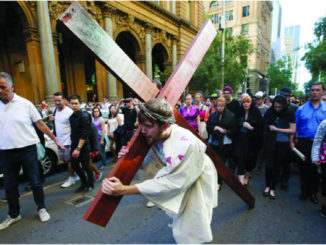
    In some countries, Good Friday is a public holiday, and businesses and schools may be closed. Many people choose to observe the day by fasting or abstaining from meat, as a sign of respect and solidarity with Jesus’ suffering. Other common traditions include the veneration of the cross, where a large cross is displayed and worshippers are invited to approach it and kneel or touch it. This practice is often accompanied by singing or chanting. In some cultures, there are also processions or reenactments of the crucifixion, where people dress up as biblical characters and walk through the streets, carrying crosses or statues of Jesus.

    Good Friday is a solemn and reflective day for Christians around the world, who seek to remember and honor the sacrifice of Jesus Christ, as they prepare for the celebration of his resurrection on Easter Sunday.

    Who was Jesus Christ?

    Jesus Christ is a central figure and founder of Christianity and is also considered to be the son of God. He is believed to have been born in Bethlehem in the first century AD to the Virgin Mary and Joseph, a carpenter. Christians believe that Jesus is the Messiah, the savior of the world, and that his teachings provide a path to salvation and eternal life.

    According to the Bible, Jesus spent his early life in Nazareth and began his public ministry at the age of 30. He traveled throughout Galilee and Judea, preaching about the kingdom of God and performing miracles such as healing the sick and feeding the hungry.

    Jesus’ teachings emphasized the importance of love, compassion, and forgiveness, and he often spoke in parables to convey his message. His teachings were controversial, and he was eventually arrested and sentenced to death by crucifixion. Christians believe that Jesus’ death on the cross was a sacrifice for the sins of humanity, and that he rose from the dead on the third day, thereby conquering death and offering the promise of eternal life to all who believe in him. This event is celebrated as Easter by Christians worldwide.

    Jesus’ life and teachings have had a profound impact on the world, shaping the beliefs and practices of millions of people across the globe. He is considered by many to be the most important figure in human history, and his message of love and redemption continues to inspire people of all faiths and backgrounds.

    Source: Indiatimes


  • Good Friday

    Good Friday

    Good Friday is one of the most significant festivals for Christians as it commemorates the crucifixion of Jesus. It is one of the seven days of the holy week where Christians recall the events that lead to the death of Jesus and his resurrection, which is observed as Easter. This year, the week will be observed from April 10 to April 16. Each day of the holy week has its own significance and represents a different event. The week starts with the Palm Sunday followed by Holy Monday and culminates on the seventh day with Holy Saturday, which falls a day before Easter Sunday.

    Palm Sunday

    The week begins with the Palm Sunday when Christians commemorate Jesus’ entry into Jerusalem. As per tradition, it is believed that Jesus was welcomed by people who waved palm branches and laid the leaves in his path.

    Holy Monday

    Holy Monday marks the day when Jesus first cleaned the temple. The cleaning is believed to be done for teaching and admonishing. Also, on this day Jesus had spotted a fig tree that had leaves but no fruits on it. Jesus cursed the tree for not bearing fruits following which it weathered the next day.

    Holy Tuesday

    On this day, Jesus condemned the religious authorities and claimed his deity. The Pharisees and the Herodians joined hands to conspire against Jesus and tried to get him convicted.

    Holy Wednesday

    This day is also called Spy Wednesday when Judas met Jewish leaders and got paid 30 pieces of silver to betray Jesus. Also, it was on Holy Wednesday when Jesus sat down at the supper table at the house of Simon the Leper in Bethany with his disciples.

    Holy Thursday

    Holy Thursday commemorates the day when Jesus had his last supper. In Roman Catholicism, the pope washes the feet of 12 poor or humble persons as an imitation of Jesus’ selfless love for people of all traditions.

    Good Friday

    Holy Friday is the darkest day of all in the Holy Week. It marks Jesus’ death and suffering on the cross. People mourn Jesus on this day by fasting and attending church services and also holding processions to re-enact the crucifixion.

    Holy Saturday/Easter Vigil

    This day commemorates the day Jesus was buried in a tomb. A day after this, he was resurrected.

    Historical Significance of Good Friday

    The celebration of Good Friday dates back to the 4th century by Egeria. This ancient practice denotes time of self-punishment and fasting on the death anniversary of the Christ. Nomenclature of “Good Friday” is derived from “God’s Friday,” although the correct reason for this kind of name is still not known.

    Arrest of Jesus

    As per the documents in the Gospels, the Temple Guards were protected by the Jesus’ disciple Judas Iscariot; in the Garden of Gethsemane he then arrests Jesus. In exchange, Judas was rewarded with money, 30 pieces of silver was his reward to betray Jesus. After the arrest, Jesus was forcibly brought to the house of Annas, (the father-in-law of the high priest, Caiaphas), who then interrogated Christ but could not get satisfactory answers. He was then taken into captivity by Caiaphas, who was the high priest where the Sanhedrin had gathered.

    Jesus – The Son of God

    There were many conflicting testimonies against Jesus along with many witnesses, and Jesus remained numb to all this. Then, the high priests made Jesus undertake the solemn oath, saying “I adjure you, by the Living God, to tell us, are you the Anointed One, the Son of God?” Jesus accepted the witness obscurely, “You have said it, and in time you will see the Son of Man seated at the right hand of the Almighty, coming on the clouds of Heaven.” That day the Sanhedrin brought upon the sentence of death as the high priest condemned Jesus for sacrilege. Peter also did not stand as a well-wisher and also denied Jesus three times to onlookers. The interrogations went on just like Jesus had predicted.

    Pilate’s Judgement

    Next day morning, Jesus was brought to the Roman governor Pontius Pilate by the assembly under charges of destabilizing the nation, refusing taxes to Caesar, and claiming himself as a king. Pilate directed the Jewish leaders to review according to their own law. However, the final word was the death sentence. Jewish leaders were not ready to let out the death sentence as the Romans restricted this right on Jews. Pilate then questioned Jesus and informed the assembly that the death sentence was not justified. He further learned that Jesus was from Galilee, and that led him to take over the case to the ruler of Galilee, King Herod.

    “Crucify Him”

    Herod also questioned Jesus but did not get any answer; and then send him back to Pilate. Pilate confirmed the assembly that neither he nor Herod had found Jesus guilty. He proposed of just whipping Jesus and released him. The chief priests and the crowd called for the Barabbas, who was in the prison for murdering during an insurrection. Pilate was surprised and asked what relation they had with Jesus? And the crowd demanded, “Crucify him”. Pilate’s wife dreamt of Jesus previous night and she already warned him not to harm this righteous man. Somehow, Pilate elbowed Jesus out from the crowd to release him. The chief priests got enraged and demanded Pilate to get Jesus be sentenced to death only “because he claimed to be God’s son.” Pilate got puzzled and also afraid; he brought in Jesus into his palace and asked him from where he belonged.

    The Death Sentence

    On knowing the answer, Pilate again faced the crowd and confirmed that Jesus was innocent and washed his own hands in water to prove that he was not involved in this criticism. However, Pilate handed over Jesus to the crowd to get crucified as he feared that a riot would start up anytime. Jesus has his cross with him to the site of execution and was accompanied by Simon of Cyrene. The sentence mentioned “Jesus of Nazareth, King of the Jews” and the execution site was said to be the “place of the Skull”, or “Golgotha”. He was crucified there along with two criminals.

    The Lord Let Go His Soul

    Jesus suffered on the cross for long six hours and during his last three hours on the Cross, he had seen darkness fell over the entire land. His last words were “My God, my God, why have you forsaken me?” Jesus gave up his spirit with a loud cry, followed by natural disasters like earthquake, curtains in the temple tore off, and the tombs broke open. The centurion who was on guard at the site of crucifixion said in himself, “Truly this was God’s Son!” Joseph of Arimathea, who was a member of the Sanhedrin and revered Jesus, requested Pilate for his body. Nicodemus, another follower of Jesus helped wrap the body of Jesus. Pilate wanted to confirm if Jesus was dead and a soldier pierced the side of Jesus showing that blood was oozing out and thus Jesus was dead. This is the sad history of Good Friday; after the Jewish burial customs Shabbat began at the sunset. On the third day from this day Easter Sunday (or Pascha) is celebrated and the followers believe that on this day, Jesus rose from the dead.

    Significance

    Good Friday, also called Holy Friday and Black Friday, is a day of mourning. The day is observed worldwide by Christians. It is believed that Jesus suffered and died for the sins of humans. This day is, therefore, observed to ask for forgiveness for one’s sins.

    People pray that they may be liberated from pain, suffering and agony in their lives. According to Christian beliefs, Jesus’ death also signifies the end of all sins. It shows that after all the sins are eliminated, there’s a possibility of a new beginning, which is signified by Jesus Christ’s resurrection on Easter Sunday.

    How it is observed

    Many people fast and attend religious services on Good Friday. Churches hold special rituals to commemorate Jesus Christ’s suffering and muffle their bells as a sign of mourning.

    Good Friday is preceded by Maudy Thursday and followed by Holy Saturday. On this day, the service for the Three Hours Agony is held.

    Christians also drape a black cloth over all crosses, photographs, and statues to symbolize Jesus Christ’s death.

  • Good Friday

    Good Friday

    Every year on the Friday before Easter, Good Friday is observed and this year it falls on April 2, 2021. Easter is observed on the first Sunday after the Paschal Full Moon which falls on April 4, 2021, according to the Church’s Lunar calendar. Christians commemorate the crucifixion of Jesus Christ on this day. For Christians all over the world, it is a day of mourning, penance, and fasting. For the same reason, the day is also known as Black Friday. Good Friday, also known as Holy Friday, marks the end of Lent, a 40-day period of fasting for Christians.

    Why is it called Good Friday?

    According to the Bible, the son of God was flogged, ordered to carry the cross on which he would be crucified and then put to death. It’s difficult to see what is “good” about it.

    Some sources suggest that the day is “good” in that it is holy, or that the phrase is a corruption of “God’s Friday”.

    However, the adjective good traditionally “designates a day on (or sometimes a season in) which religious observance is held”. The “good” in this context refers to “a day or season observed as holy by the church”, hence the greeting “good tide” at Christmas or on Shrove Tuesday. In addition to Good Friday, there is also a less well-known Good Wednesday, namely the Wednesday before Easter.

    The earliest known use of “guode friday” is found in The South English Legendary, a text from around 1290, according to the dictionary. According to the Baltimore Catechism – the standard US Catholic school text from 1885 to the 1960s, Good Friday is good because Christ “showed His great love for man, and purchased for him every blessing”.

    The Catholic Encyclopedia, first published in 1907, states that the term’s origins are not clear. It says some sources see its origins in the term “God’s Friday” or Gottes Freitag, while others maintain that it is from the German Gute Freitag. It notes that the day was called Long Friday by the Anglo-Saxons and is referred to as such in modern Danish.

    It also says that the day is known as “the Holy and Great Friday” in the Greek liturgy, “Holy Friday” in Roman Languages, and Karfreitag (Sorrowful Friday) in German.

    History

    The crucifixion and death of Jesus Christ are commemorated on Good Friday. According to many accounts, Christ was arrested and executed on this day. Good Friday is considered holy because it was on this day that Jesus Christ, out of love for all people, gave his life as a sacrifice while suffering for their sins. Humanity was given a new start as a result of this gesture, and all of their sins were forgiven. The above-mentioned crucifixion is also said to have occurred around AD 30 or AD 33.

    Now the question arises: why is the day known as Good Friday if it has such a sad history? The term is thought to have originated from the words “God’s Friday.” However, some people believe that the letter ‘Good’ stands for Holy, which is why the day is also known as Holy Friday.

    Significance

    Despite the fact that Jesus Christ was crucified on Good Friday, the Bible claims that the son of God was resurrected on Easter. It symbolizes that good always triumphs, and that Christ went through so much pain for humanity’s sins demonstrates how much he loved everyone.

    Importance of Easter

    Easter is, without a doubt, the most significant Christian holiday of the year. It is the day on which Christians commemorate Jesus Christ’s resurrection. According to the Bible, Jesus Christ was resurrected on Easter Sunday and came back to life. Easter has grown in importance in modern times, and markets, malls, and confectionary shops are flooded with Easter goodies. Easter, which commemorates Christ’s Resurrection, is derived from the old English ‘eastre’, which refers to a spring festival.

    The tradition of Good Friday

    On this day, believers traditionally gather to attend Church services. The service time on this day varies slightly, with services beginning around noon and lasting until 3 p.m. This is done because it is thought that Jesus suffered on the cross during these hours. On this day, many Christians all over the world fast. Processions commemorating Jesus’ death are held in some parts of the world, including the Philippines, Italy, and Spain.

    However, this year, because of the Covid-19 pandemic, safety precautions need to be followed, which might hinder some people from attending Church and its large gatherings.